

Last updated: October 3, 2026
Quick Answer
The best travel reward credit cards in 2026, ranked by first-year value after subtracting annual fees, are led by mid-tier cards rather than premium ones. A card with a 75,000-point welcome offer and a $95 fee usually beats a card with a 150,000-point offer and a $695 fee once you discount statement credits you won’t fully use. Chase Sapphire Preferred and Capital One Venture Rewards currently deliver the strongest net first-year value for most households, while premium cards like Amex Platinum and Marriott Bonvoy Brilliant only clear their fees if you genuinely use lounge access, hotel credits, and airline credits every year.
Key Takeaways
Net value, not headline offers, should drive the decision. Subtract the annual fee, then discount statement credits to what you’ll realistically use.
Mid-tier cards ($95 fee range) win year one for most people because the welcome offer is large relative to the fee and the minimum spend is achievable.
Premium cards can still clear their fee in year one, but the math depends on lounge visits, airline credits, and hotel credits you would have paid for anyway.
Transferable points beat fixed-value rewards when you redeem for international premium cabin awards, but only if you can find award availability.
Credits are worth roughly 50-70% of face value for most households. Valuing a $200 hotel credit at $200 is the most common ranking error.
Year two is where premium cards fail. Without the welcome offer, the card has to justify itself on perks alone.
You may be interested
No-annual-fee travel cards win on a multi-year basis because they cost nothing to keep and preserve your points when you downgrade a premium card.
Airline and hotel co-branded cards are worth it only if you’re loyal to that program, mainly for free checked bags, elite credits, and award seat access.



Our First-Year Net Value Methodology, Stated Up Front
First-year net value here equals the welcome offer value, plus realistically used statement credits, plus the extra earnings from bonus categories on a typical household budget, minus the annual fee. No card gets credit for perks the average holder won’t use.
The three rules that shape every ranking below:
Points are valued conservatively. Transferable points (Amex points, Chase points, Capital One miles, Citi points, Bilt points) are valued at 1.6 to 1.8 cents each. That reflects solid transfer partner redemptions, not outlier First Class redemptions at 8 cents per point. Fixed-value redemptions through a card portal are valued at their actual rate, usually 1.0 to 1.25 cents.
Credits are discounted. A $300 travel credit that requires booking through a card portal is not worth $300. It’s worth what you’d have spent anyway at prices you’d have accepted anyway.
Minimum spend must be reachable without manufactured spending. If a card requires $8,000 in three months, it’s flagged. Median U.S. household card spending doesn’t support that without stretching.
The fastest way to overrate a travel card is to add up every credit at face value. The fastest way to underrate one is to ignore the welcome offer entirely. Net value math sits between those two errors.
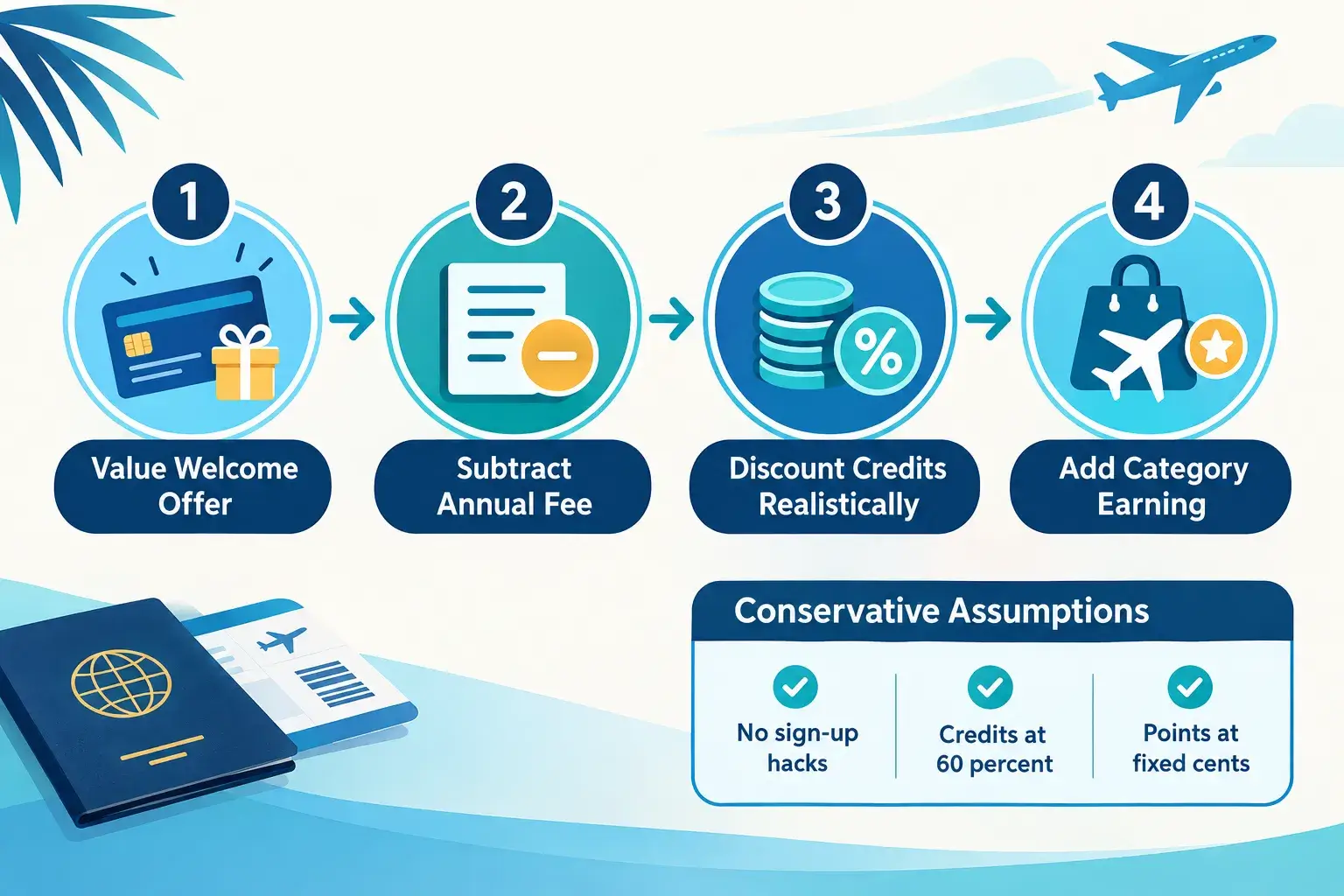
How We Value Welcome Offers, Credits, and Earning
We value welcome offers at conservative transfer-partner rates, apply a haircut to credits based on realistic usage, and model earnings on a $2,500-per-month household spend split across groceries, dining, gas, travel, and general purchases.
Here’s the discount schedule applied to common credit types:
Credit typeRealistic usage assumptionWhyFlexible travel credit (any travel purchase)90-100%Easy to use; behaves like cash for travelersPortal-only travel credit60-75%Portal prices are often higher; limits choiceHotel credit requiring a qualifying stay50-70%Needs a specific brand and rate codeAirline incidental credit40-60%Narrow list of qualifying chargesMonthly-capped dining or rideshare credit40-70%Use-it-or-lose-it each monthGlobal Entry / TSA PreCheck creditOnce per 4-5 yearsReal value, but spread thin annually
Decision rule: if a credit requires you to change where, when, or how you’d normally book, cut its value by at least a third. If it requires enrollment and expires monthly, assume you’ll miss two or three months.
Common mistake: counting a Global Entry credit as $120 of annual value. It’s roughly $24 to $30 per year when amortized, and worth zero if you already have it.
For a deeper look at how points values feed into these numbers, the travel points calculator for valuing miles and points in 2026 walks through the cents-per-point math step by step.
What Makes a Travel Rewards Credit Card Actually Worth It
A travel rewards credit card is worth it when the first-year net value clears the annual fee by a comfortable margin and the card still earns its keep in year two on perks and earning rates alone.
Four tests, in order:
The fee test. Can you name specific annual benefits that replace spending you’d do anyway? If not, the fee is a real cost.
The redemption test. Do the card’s points transfer to programs you can actually book? Points transfer partners matter more than earning rates.
The behavior test. Will you hit the minimum spend without buying things you don’t need?
The year-two test. Strip out the welcome offer. Is the card still positive?
Not for: people who carry a balance. Travel card APRs run high enough that interest wipes out any redemption value. Pay off debt first, then chase welcome offers.
How Do Travel Credit Card Sign Up Bonuses Work
Travel credit card sign-up bonuses award a lump sum of points or miles after you spend a required amount within a set window, usually three to six months from account opening. The bonus posts one to two statement cycles after you cross the threshold.
Mechanics worth knowing:
The spend window starts at approval, not at card activation. Plan large purchases in advance.
The annual fee usually does not count toward minimum spend on most issuers.
Cash advances, balance transfers, and most fees don’t count. Returns subtract from your total.
Eligibility rules differ by issuer. Chase applies a 5/24 limit on new accounts, Amex uses once-per-lifetime language on many products, and Capital One restricts multiple cards in the same family.
Sign-up bonuses are often large enough to cover a $95 annual fee for several years of card ownership. That’s the core reason mid-tier cards rank so well in year one. For help sequencing applications and spend, see the guide on why the end of the year is the best time to open a new travel rewards card.
Common pitfall: opening two cards in the same month and splitting your spend so you miss both thresholds. Do one at a time unless your spending genuinely supports both.
The Top No-Annual-Fee Travel Cards by Net Value
No-annual-fee travel cards have positive net value by definition, since there’s no fee to subtract. In 2026 the best of them pair a modest welcome offer (usually 15,000 to 25,000 points) with earning rates strong enough to keep long-term.
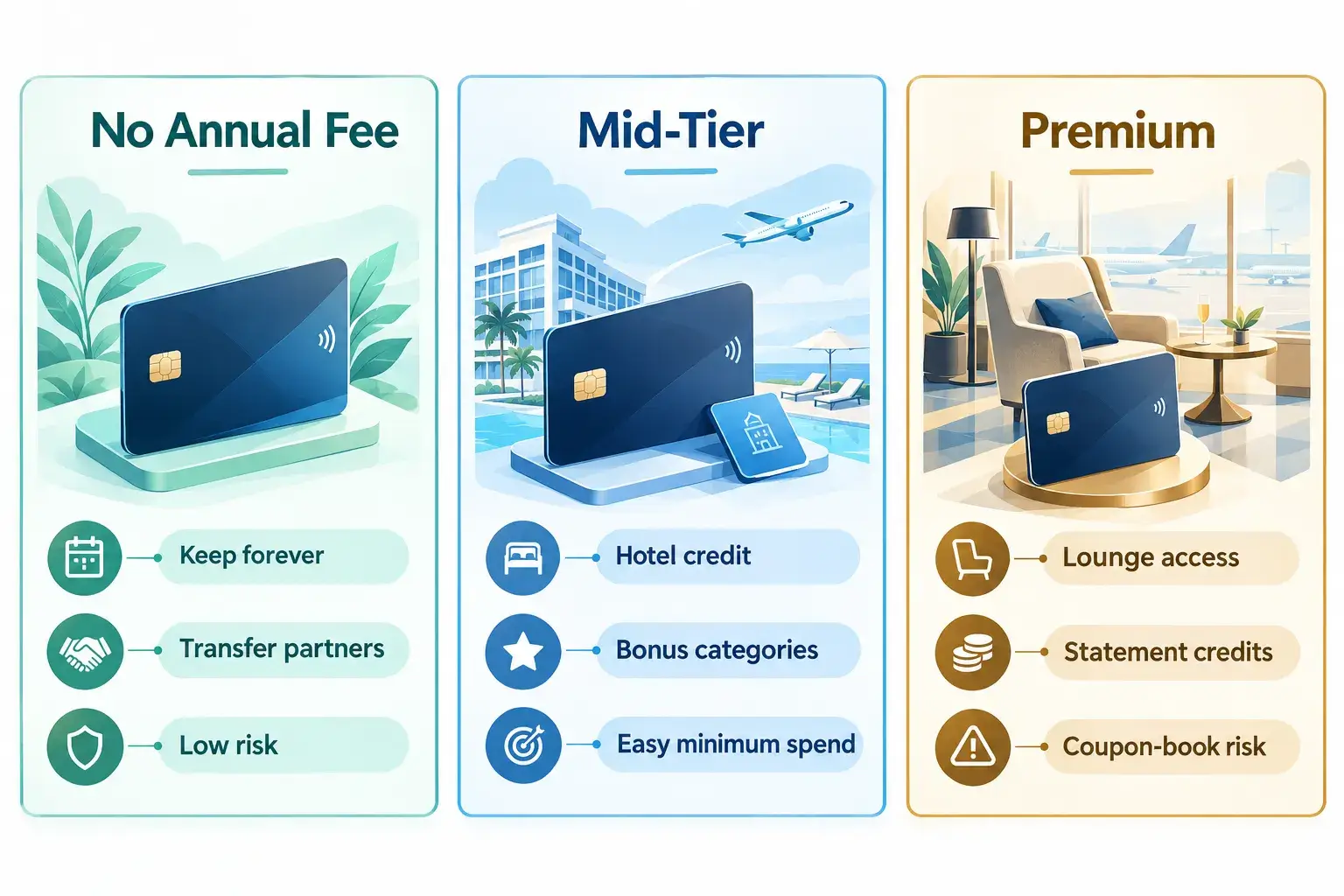
Why they belong in a serious setup:
They hold your points. Downgrading a premium card to a no-fee card in the same family keeps your transferable points alive instead of forcing a cash-out.
They cost nothing to keep, which helps average account age and credit utilization.
Several now include no foreign transaction fees, which used to be a premium-only feature.
Card typeTypical first-year net valueBest forNot forNo-fee flexible points card$200,$400Building a transferable points balanceLounge seekersNo-fee airline card$150,$300 plus checked bag savingsOne-airline flyersMulti-airline travelersNo-fee hotel card$150,$350 plus annual perksRepeat stays at one brandIndependent hotel bookers
Decision rule: if you travel two or fewer times a year, start here and skip the fee entirely. Full comparisons are in the roundup of best no annual fee travel credit cards for 2026 and the best airline credit cards with no annual fee in 2026.
The Best Mid-Tier Cards Once the Fee Is Subtracted
Mid-tier cards with roughly $95 annual fees post the highest first-year net value in 2026 among the best travel reward credit cards, because the welcome offers are large and the fee is small.
Chase Sapphire Preferred currently carries a sustained 75,000-point offer plus a $100 hotel credit on a Chase Travel booking. At 1.7 cents per Chase point, that offer alone runs well past $1,200 in transfer-partner value. Subtract the $95 fee, apply a conservative haircut to the hotel credit, and first-year net value comfortably exceeds $1,100 for someone who can hit the minimum spend. The card also earns a 10% points bonus on anniversary spend, which quietly improves year-two math. It has repeatedly been named a top travel rewards card of the year by major outlets, and the net value math supports that.
Capital One Venture Rewards is running a limited-time structure combining 75,000 miles with a $300 travel credit. That credit is usable through Capital One Travel, so apply a 60-75% haircut. Even then, the combined first-year package lands in the same tier as Sapphire Preferred, and the flat 2x earning on everything makes it simpler for households without clean spending categories.
Mid-tier cardAnnual feeWelcome offer structureRealistic first-year net valueChase Sapphire Preferred$9575,000 points + $100 hotel creditRoughly $1,150,$1,300Capital One Venture Rewards$9575,000 miles + $300 travel credit (limited time)Roughly $1,100,$1,300Citi Strata Premier tier$95Points offer, no major creditsRoughly $900,$1,200Bilt-style rent-earning card$0,$95Smaller offer, rent earning$300,$700, higher for renters
Best for: anyone who wants transferable points, a manageable fee, and no dependence on statement credits.
Not for: frequent flyers who need lounge access more than they need points.
More side-by-side detail lives in the compare travel credit cards guide for building the right setup in 2026.
Premium Cards That Still Clear Their Own Fee in Year One
Premium travel cards with $450 to $795 annual fees can clear their fee in year one, but only through a large welcome offer plus heavy use of credits. Strip the welcome offer and most of them go negative for casual travelers.

Where premium cards genuinely win:
Lounge access with a family. Two or more travelers at $50-plus per visit adds up fast. The airport lounge access credit cards cost-per-visit math shows the break-even point.
Hotel elite status by card. Automatic mid-tier status can produce upgrades and breakfast credits worth real money across 15-plus nights a year.
Free night certificates. A hotel card certificate you’d have paid cash for is close to face value. One you have to plan a trip around is not.
Marriott Bonvoy Brilliant Amex is currently running a large welcome offer with a stated end date of September 30, 2026. With a fee in the $650 range, the first-year math works if you use the dining credit monthly, take the annual free night certificate at a property worth more than the fee, and value Platinum elite status. Year two is far tighter. Details on that family are in the Marriott Bonvoy credit cards compared for 2026.
The premium decision rule: add up only the credits you used in the last 12 months of actual travel, not the ones you plan to use. If that total plus realistic earning doesn’t beat the fee, downgrade. The analysis in premium travel cards worth it in 2026 applies this test card by card.
Cards That Look Strong but Lose on Net Value
Several popular cards post negative or near-zero net value once credits are discounted honestly. These aren’t bad products, they’re mismatched to most holders.
Patterns to watch for:
Coupon-book premium cards. Fees above $650 supported by six or more monthly credits at specific merchants. Miss three months and the math collapses.
Airline cards with fees but no bag benefit for your route. If you fly basic economy on a different carrier, the fee buys nothing.
Second and third cards in the same family. Welcome offer restrictions often mean no bonus, which removes the main source of first-year value.
Portal-locked travel credits on cards you’d otherwise use for transfers. You end up booking at worse prices to “use” the credit.
High-fee cards held purely for status you don’t requalify for. Status without stays produces little.
Edge case: a card with weak net value on paper can still be right if it unlocks award space you can’t get elsewhere, such as co-branded access to discounted award seats or expanded saver availability. Price that benefit specifically rather than assuming it.
Travel Rewards Card vs Cashback Card for Travel
A travel rewards card wins when you redeem through airline and hotel transfer partners for premium cabin awards. A cashback card wins when you book cheap economy fares, prefer independent hotels, or don’t want to manage award searches.
Choose cashback if your travel is mostly domestic economy on whatever airline is cheapest, or if you book Airbnbs and small hotels. Transferable points add little there.
Choose travel rewards if you’ll put in the search time for premium cabin awards, where 100,000 points can offset a $4,000 cash fare. That’s the only place points reliably beat 2% cash back.
Best Travel Rewards Card if You Don’t Fly Much
If you fly once or twice a year, a no-fee or $95 card with flexible redemption is the right answer. Premium cards are almost never worth it below roughly four trips a year.
Ranked approach for infrequent travelers:
Start with a no-annual-fee flexible points card. Zero risk, no annual break-even to hit.
Add one $95 card for its welcome offer if you have a trip 12-18 months out and can hit the minimum spend naturally.
Consider a hotel card with an annual free night certificate if you take one or two hotel-heavy trips. A certificate can exceed a $95 fee in a single use.
Skip lounge cards entirely. At two trips a year, cost per lounge visit on a $695 card runs well over $100.
Travel Rewards Cards for International Spending
For international spending, the non-negotiable feature is no foreign transaction fees, which typically save 3% on every overseas purchase. Beyond that, prioritize chip-and-PIN acceptance, no-fee ATM partners where relevant, and strong travel protections.
What actually matters abroad:
No foreign transaction fee on your primary and backup card. Carry two cards on different networks.
Trip delay and baggage delay coverage, which mid-tier and premium cards often include and no-fee cards often don’t.
Rental car coverage, ideally primary rather than secondary.
Points that transfer to non-U.S. programs, which is where award sweet spots and lower surcharges usually live.
Watch for fuel surcharges. Some partner awards carry several hundred dollars in surcharges and fees on transatlantic routes, which can erase the advantage of a cheaper award chart. Compare total cash out of pocket, not just points required.
Card-by-card options are covered in best no foreign transaction fee credit cards 2026.
Best Travel Credit Card for Hotel Stays vs Flights
For hotel stays, a co-branded hotel card with an annual free night certificate and elite status usually beats a general travel card. For flights, transferable points win, because award availability varies too much to commit to one airline.
GoalBetter toolWhyTwo-plus stays per year at one hotel brandCo-branded hotel cardFree night certificate, status, bonus pointsFlexible hotel booking across brandsTransferable points cardTransfer to Hyatt or book cash-equivalentInternational business classTransferable points cardMultiple alliance partners, more award spaceDomestic flights on one carrierCo-branded airline cardChecked bags, priority boarding, award discounts
Should you get a travel card or an airline-specific card? Get the general travel card first. It earns points you can move to several airlines when award space opens. Add an airline card only when you can name a concrete benefit: free checked bags on routes you fly, companion certificates you’ll use, or access to award inventory the airline restricts to cardholders. Options are laid out in best travel credit cards 2026 top picks by traveler.
How to Maximize Travel Rewards Points Value
Maximize points by transferring to partner programs for premium cabin awards, timing transfers to coincide with transfer bonuses, and confirming award availability before you move a single point.
The working sequence:
Find award space first. Search the airline program’s own site or a dedicated award search tool. Never transfer speculatively.
Compute cents per point. Divide the cash fare (minus taxes you’d still pay) by the points required. Under 1.5 CPP on economy, consider paying cash.
Check for a transfer bonus. A 20-30% bonus effectively cuts the points cost, but confirm the award is still bookable before transferring.
Account for surcharges and fees. Some programs add meaningful carrier-imposed surcharges. Others don’t.
Transfer only what you need, in the exact amount. Transfers are one-way and usually instant to some partners, delayed 24-72 hours for others.
Book immediately after the transfer lands. Award space can vanish within hours.
Sweet spots to know: short-haul partner awards with distance-based charts, off-peak awards where they still exist, and hotel programs with published award charts rather than pure dynamic pricing. Review the best credit card transfer partners for 2026 value before committing to an ecosystem.
Devaluation risk is real. Programs adjust award pricing with little notice. Treat a large points balance as a depreciating asset and earn-and-burn rather than stockpiling for years.
Can You Use Travel Points on Any Airline or Hotel
No. Transferable points move only to that issuer’s specific partner list, and each partner has its own award chart, availability, and restrictions. Card portal bookings are broader but usually redeem at a fixed, lower rate.
Two paths and their tradeoffs:
Transfer to a partner: best value, restricted to partner airlines and alliance partners, subject to award space and married segment logic.
Book through the card portal: nearly any airline or hotel, but redemption value is fixed near 1.0-1.25 cents per point, so you give up the upside.
Edge case: some issuers let you erase a travel purchase at a fixed rate. Convenient, poor value. Use it when award availability fails, not as your default.
Travel Credit Cards for People with Fair Credit
With fair credit (roughly 580-669 FICO), most premium and mid-tier travel cards will decline. The practical path is a no-annual-fee card with modest rewards or a secured card, then a travel card after 12-18 months of on-time payments.
What to do in order:
Pull your reports and fix errors before applying anywhere.
Use a secured or entry-level card with no foreign transaction fee if you travel.
Keep utilization under 30%, ideally under 10%.
Wait for your score to clear the mid-600s, then apply for a $95 travel card with a strong welcome offer.
Avoid this mistake: applying to a premium card “to see what happens.” Each hard inquiry costs a few points and a denial doesn’t refund anything. Students and early-career applicants can start with the picks in best travel credit cards for students and young pros.
How Long Do Travel Rewards Points Expire
Transferable points from Amex, Chase, Capital One, and Citi generally don’t expire while your account is open and in good standing. Airline miles and hotel points usually expire after 18 to 24 months of no qualifying activity, depending on the program.
Rules that matter:
Close the card and you may lose the points. Chase, Amex, and Citi points are tied to an open account. Downgrade instead of canceling.
Airline miles often need activity, not spend. A small earn event can reset the clock.
Some programs have hard expiration regardless of activity. Check before transferring a large balance.
Bilt points and several others have their own activity requirements. Read the program terms, not summaries.
Before you cancel anything, read the guide on how to downgrade a travel credit card and keep your points in 2026.
Common Mistakes People Make with Travel Reward Cards
The most expensive mistakes are carrying a balance, valuing credits at face value, and transferring points before confirming award availability. Each one can cost more than a year of card fees.
The full list:
Carrying a balance. Interest at travel-card APRs exceeds any rewards rate.
Transferring speculatively. Transfers are irreversible. No award space means stranded points.
Redeeming transferable points at 1.0 cent through a portal when a partner award would have returned 2-plus cents.
Paying a premium fee for unused perks. Two lounge visits a year does not justify a $695 fee.
Missing the minimum spend window by a few hundred dollars.
Chasing offers while a mortgage or auto loan application is pending.
Ignoring surcharges and fees on partner awards, then paying $700 in taxes on a “free” flight.
Holding a card past its useful life instead of calling for a retention offer or downgrading. Strategy is covered in best credit card annual fee review for 2026: keep, downgrade, or cancel.
What Changes in Year Two and How to Plan for It
Year two removes the welcome offer, which is usually 70-90% of a card’s first-year value. What’s left is earning rates plus credits minus the fee, and that flips several premium cards negative.

Card tierYear-one net value driverYear-two realityRecommended actionNo annual feeSmall offer plus earningStill positive, costs nothingKeep indefinitely$95 mid-tierLarge offer relative to feeUsually positive via anniversary bonus and creditsKeep if you travel yearly$250,$450 premiumOffer plus creditsMarginal; depends on credit usageRecalculate annually$650+ ultra-premiumOffer plus many creditsOften negative for under 4 trips a yearDowngrade or request retention offer
The year-two checklist, run about 60 days before your anniversary date:
Pull 12 months of statements. Total the credits you actually used.
Add anniversary benefits you’ll genuinely use (free night certificate, points bonus).
Subtract the fee. Negative result means act.
Call retention. Ask specifically whether any statement credit or points offers are available on the account. Some issuers offer nothing, some offer meaningful value. Approaches are outlined in travel credit card annual fee waivers and retention offers.
Downgrade rather than cancel if the answer is no, so your points survive.
Note the eligibility clock for reapplying later, since some issuers allow a new welcome offer after a set period.
One backdrop worth tracking: interchange settlements and regulatory attention to card rewards programs could pressure reward structures over time. Nothing requires action now, but treat generous current offers as a reason to act sooner rather than to wait.
FAQ
Are travel credit card annual fees worth it in 2026?
Yes for mid-tier cards around $95, where welcome offers typically exceed the fee many times over. Usually no for fees above $650 unless you take four or more trips a year and use lounge access, airline credits, and hotel credits consistently.
What is the best travel reward credit card for first-year value?
Chase Sapphire Preferred and Capital One Venture Rewards lead on net first-year value in 2026, both with $95 fees, 75,000-point or 75,000-mile welcome offers, and additional travel or hotel credits. Both have minimum spend requirements reachable on an average household budget.
Can I get a travel card welcome bonus more than once?
Sometimes. Chase generally allows a new bonus on the same product after 48 months from the last bonus, Amex applies once-per-lifetime language to many cards with population-based targeting, and Capital One restricts by card family. Check the offer terms before applying.
Do travel rewards points lose value over time?
Yes, through devaluation. Airline and hotel programs raise award prices periodically, often with little warning, and dynamic pricing means costs can change without a published chart change. Earn and redeem within a reasonable window rather than stockpiling for years.
Is a $95 travel card enough, or do I need a premium card?
A $95 card is enough for most travelers. Premium cards make sense when lounge access, hotel elite status, and airline credits replace spending you’d do anyway, typically at four or more trips per year or when traveling with family.
What’s the minimum spend on most travel cards, and is it realistic?
Most mid-tier travel cards require $3,000 to $4,000 in three months, which is achievable for a household spending $1,200 or more monthly on cards. Premium cards often require $6,000 to $8,000, which usually needs planned large purchases like insurance premiums or tax payments.
Should I get a general travel card or an airline card first?
General travel card first. Transferable points can move to multiple airlines when award space opens, while airline miles lock you into one program’s availability. Add an airline card once you can name a specific recurring benefit, such as free checked bags on routes you fly regularly.
Conclusion and Next Steps
Ranking the best travel reward credit cards by first-year net value produces a clear pattern: $95 mid-tier cards with large transferable-points offers beat both no-fee cards and ultra-premium cards for most households in year one. No-fee cards win over five years because they cost nothing. Ultra-premium cards win only for frequent travelers who use their credits without changing their behavior.
Do these four things next:
Check your last three months of card spending. That number tells you which minimum spend requirements are realistic.
Pick one ecosystem to start. Chase points, Amex points, or Capital One miles. Look at the transfer partner list and identify at least two programs you’d genuinely book.
Apply for one card at a time and hit the spend threshold before opening another.
Calendar your anniversary date and run the year-two checklist above before the fee posts.
If you want a broader comparison of current options before applying, start with the best travel credit cards 2026 top picks compared, then price your specific fee decision with the credit card annual fee ROI calculator.


Content on Award Travel Hub is independently created by Award Travel Hub Editorial Desk and, where noted, reviewed by Award Travel Hub Review Desk. Some pages may contain affiliate links, but compensation does not determine our coverage, opinions, or methodology.