
Airline Transfer Partners: Compare Programs, Ratios, and Award Booking Options

Last updated: July 31, 2026
Quick Answer: Airline transfer partners are frequent-flyer programs that accept points or miles from an eligible transferable-rewards program such as American Express Membership Rewards, Chase Ultimate Rewards, Capital One miles, Citi ThankYou Rewards, Wells Fargo Rewards, Bilt Rewards, or Rove Miles. Eligibility, transfer ratios, minimums, increments, timing, and active bonuses vary by program, by card, and sometimes by account. Points always move to a loyalty program, never to an alliance or to a specific flight, and the receiving program’s rules then set the mileage price and cash charges.
Key Takeaways
- Airline transfer partners are loyalty programs. Travelers transfer to a program, then that program issues the award.
- Amex, Chase, Capital One, Citi, Wells Fargo, Bilt, and Rove each publish their own partner lists. Amex and Chase are card issuers; Bilt and Rove are rewards platforms rather than traditional bank issuers.
- Not every transfer is 1:1. Some partners convert at 2:1 or other ratios, so more transferable points do not always mean more airline miles.
- Partner lists change. Etihad Guest exited the Amex lineup globally at the end of June 2026, Qantas Frequent Flyer briefly vanished from the Amex U.S. list in June 2026, and Amex added The Leading Hotels of the World Leaders Club in July 2026.
- Wells Fargo added Cathay Pacific as an airline transfer partner on April 28, 2026, while Citi’s Aeromexico Rewards partnership was terminated on January 25, 2026.
- Receiving more miles does not guarantee better value. Award prices, availability, fees, and cancellation rules differ by program.
- Treat completed transfers as final. Confirm the award is bookable before moving anything.
What airline transfer partners are and how airline transfer partner programs work
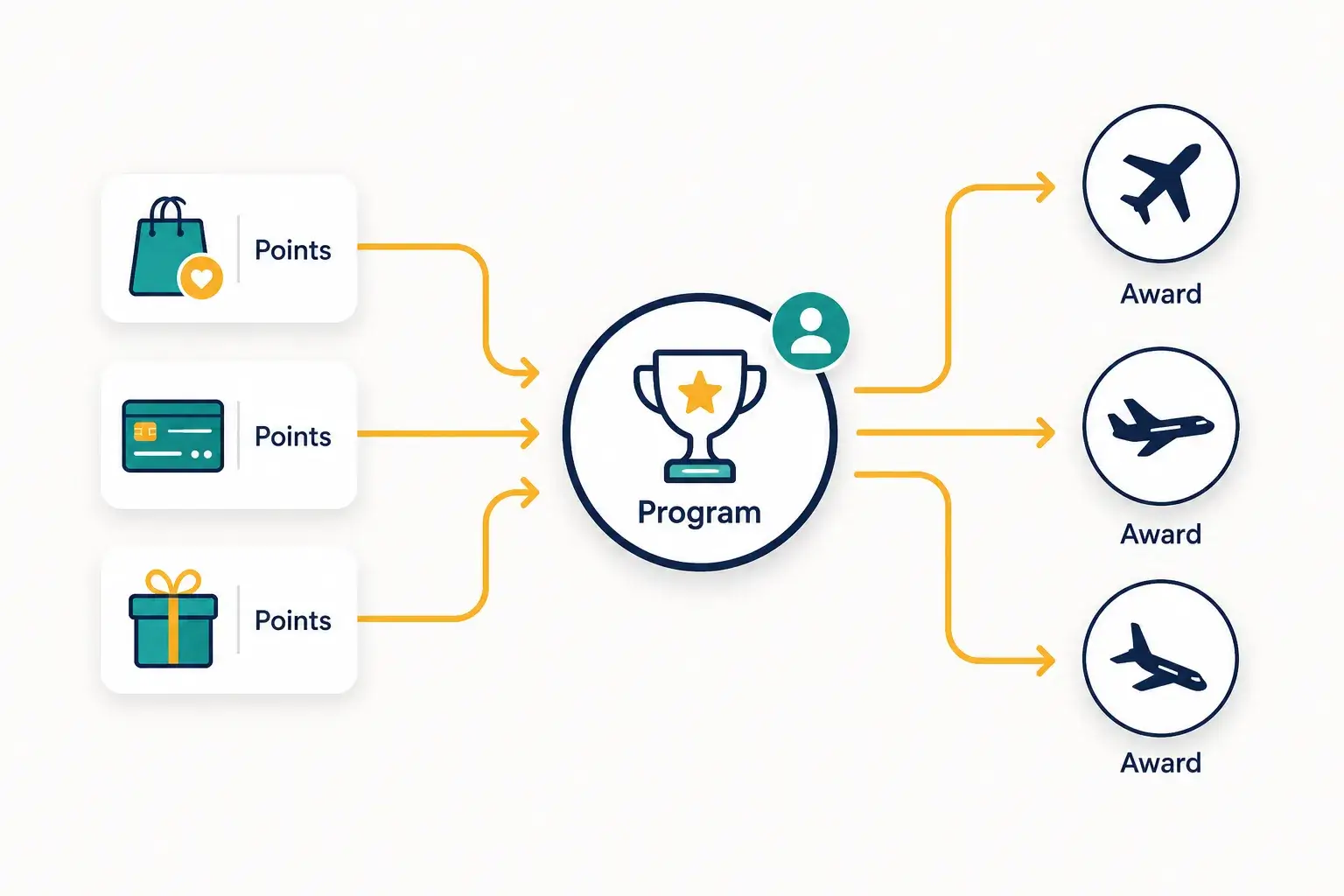
An airline transfer partner is a frequent-flyer program that has agreed to accept a conversion of points from a transferable-rewards currency. The transfer is one-way: transferable points leave the rewards account, arrive as airline miles in the loyalty account, and are then subject to that airline program’s award rules.
Five different actions get confused constantly. Keep them separate:
| Action | What actually happens |
|---|---|
| Transferring flexible rewards | Amex, Chase, Capital One, Citi, Wells Fargo, Bilt, or Rove points convert into miles in an airline program you already joined |
| Booking through an issuer travel portal | The issuer buys a cash ticket for you (for example, through amextravel.com or the Capital One travel site) and charges points at a fixed rate |
| Redeeming airline miles earned directly | Miles credited from flying or an airline co-brand card, used inside that same program |
| Using one program to book a partner airline | American AAdvantage miles booking a partner carrier, subject to partner award rules |
| Buying, gifting, or combining airline miles | A separate, usually expensive transaction inside the airline program, not a card transfer |
You cannot transfer points to Star Alliance, oneworld, or SkyTeam, and you cannot transfer points to a flight. Alliance partners may not be transfer partners, and transfer partners are not always alliance members.
The interactive airline transfer partners 2026 table
The table below is the current source of truth for airline transfer partners, ratios, estimated timing, active bonuses, and links to each airline program. Jump in, filter by rewards program or airline, and use the search box to check a specific pairing before you plan a redemption.
Transfer Partners
Transfer ratios and transfer times can change. Please verify details with the issuer before transferring points.
How to read it:
- Ratio column: always expressed as transferable rewards to airline miles.
- Timing estimate: an estimate only. Some pairings post nearly instantly, others take days.
- Bonus badge: flags a live transfer bonus, which is temporary and often runs for part of a month.
- Program filter: shows only partners your currency can reach.
Please verify the final ratio, minimum, increment, and terms inside your own rewards account before confirming, since displayed terms can differ by card and account.
Transfer partners versus airline alliances and partner awards
Alliances, bilateral partnerships, and transfer partnerships are three unrelated things. An alliance is a marketing and ticketing network; a bilateral partnership is a one-to-one airline deal outside an alliance; a transfer partnership is a contract between a rewards currency and an airline program.
- Star Alliance lists more than 20 member airlines, and oneworld and SkyTeam each list well over a dozen. Membership tells you which airlines a program can usually ticket, not which points can reach it.
- Some airline programs book non-alliance partners. That is why Emirates Skywards, Virgin Atlantic Flying Club, and others matter even without alliance ties.
- One airline’s miles can often book another airline. Turkish Airlines Miles&Smiles, KLM Flying Blue, Avios programs, and Japan Airlines Mileage Bank all ticket partner flights under their own rules.
Decision rule: identify the operating airline first, then list every loyalty program that can ticket it, then check which of those programs your currency reaches. For alliance mechanics, see the SkyTeam award booking guide.
Bank points versus airline miles: can you transfer points between airline partners?
Transferable points and airline miles are different assets, and airline miles generally cannot be moved from one airline program into another. Once Chase points become airline miles, they stay in that airline program.
- Airline-to-airline transfers are rare. Most programs only allow buying, gifting, or family pooling inside their own ecosystem, usually at poor value.
- Transferable currencies flow outward only. Miles do not flow back into Amex, Chase, Capital One, Citi, Wells Fargo, or Bilt.
- Some issuers let you combine points between your own accounts. Chase and Capital One household rules differ from Citi and Wells Fargo rules, so read the terms.
- Bilt and Rove are rewards platforms, not banks, but their points behave the same way once transferred.
Common mistake: transferring “extra” miles as a cushion. Stranded miles in a program you rarely use often expire or get devalued.
How airline transfer ratios work
Ratios describe how many transferable points it takes to create one airline mile, always written as transferable rewards to airline miles. Higher output is not automatically better value.
| Ratio or bonus | Example |
|---|---|
| 1:1 | 1,000 transferable points become 1,000 airline miles |
| 2:1 | 2,000 transferable points become 1,000 airline miles |
| 1:1 with a 20% bonus | 10,000 transferable points become 12,000 airline miles |
Which airlines have the least favorable ratios? Any partner where the table shows a sub-1:1 conversion, plus programs with high minimums or large transfer increments. A 30% bonus into a program with weak award availability and heavy carrier charges can still be worse than a 1:1 transfer elsewhere. Run the math with an award travel calculator rather than reacting to the ratio alone.
How to compare airline loyalty programs and which currency has the most partners
Amex is generally the deepest transferable currency in the U.S. market by partner count, but it is also the most volatile, as the June 2026 Etihad and Qantas changes showed. Depth matters less than whether a currency reaches the one program that can ticket your flight.
Compare on six factors: award pricing method, award availability access, carrier-imposed charges, partner roster, cancellation rules, and mileage expiration.
American Express Membership Rewards
Cardholders earn Membership Rewards points on personal and Business cards, and the roster spans all three alliances plus hotel options. Card terms (Amex publishes annual fee details behind a “see rates and fees” link) never override an airline program’s award rules.
Chase Ultimate Rewards
Chase has a smaller airline roster than Amex or Capital One but a strong core, leaning heavily on the United MileagePlus and World of Hyatt ecosystems. The Chase Sapphire Preferred Card and other premium Chase cards unlock transfers of Chase Ultimate Rewards points.
Capital One miles
Capital One is wide but slightly niche: many partners, broadly 1:1, and strong for international premium cabins. Capital One Venture Rewards Credit Card and Capital One Venture X Rewards Credit Card holders can compare transfers against the portal in this Capital One travel portal versus transfer partners breakdown and the best uses of Capital One miles.
Citi ThankYou Rewards
Citi has had a genuine resurgence, driven by American Airlines access and a strong Star Alliance trio in Turkish, Avianca LifeMiles, and Singapore Airlines KrisFlyer. The July 2026 Citi transfer grid refresh followed the January 2026 Aeromexico exit.
Wells Fargo Rewards and Bilt
Wells Fargo Rewards remains the smallest of the major rosters, though the April 2026 Cathay Pacific addition helped; see the Wells Fargo transfer partners guide. Bilt started rent-focused and now runs a full premium ecosystem, detailed in the Bilt transfer partners guide, while Rove Miles is newer and narrower.
How to earn transferable points and miles
Earn Membership Rewards points, Chase points, Capital One miles, Citi points, Bilt points, Wells Fargo Rewards, or Rove Miles through card welcome offers, category bonus spending, rent payments, and partner promotions. Hotel programs like Accor and Leaders Club are covered in the hotel transfer partners directory.
Award availability, pricing, taxes, and carrier charges
Yes, awards can carry real cash charges, and they vary by issuing program rather than by airline. Government taxes are unavoidable; carrier-imposed surcharges, close-in booking fees, phone ticketing fees, and change or cancellation fees are program-specific.
The same seat can cost different amounts through different programs because each program sets its own award pricing, and the operating airline may release different inventory to partners than it keeps for itself.
Use this formula:
Transferable-point value = (comparable cash cost avoided − unavoidable award charges) ÷ transferable points required
Hypothetical example only: a round-trip you would otherwise buy for $1,000 cash prices at 60,000 miles plus $85 in taxes and fees. That works out to ($1,000 − $85) ÷ 60,000 = about 1.5 cents per point. Change any assumption and the cents-per-point result changes. Do not use a universal cents-per-point target, and do not compare against a premium fare you would never actually purchase.
Transfer eligibility and account requirements

Eligibility depends on the card and account, not just the currency. Join the airline program and confirm your account is in good standing before you sign in to your rewards account to initiate anything.
- The airline account name usually must match the rewards account holder.
- Some programs allow transfers to household or authorized-user accounts; many do not.
- Business and personal cards can have different partner access and pooling rules.
- Get the exact spelling, member number, and eligible loyalty program name right. Misdirected transfers are rarely fixable.
Airline transfer partners that are easiest to use for beginners
Beginners generally do best with programs that publish clear pricing, allow online partner booking, and cancel cheaply. Programs with phone-only partner ticketing, unpublished pricing, or heavy fuel surcharges belong in the intermediate tier.
How long airline transfers take, and can you transfer to multiple airlines at once
Timing varies by pairing, and the interactive table’s estimate is a guide rather than a guarantee. Some transfers post in minutes; others take business days, and processing can slow during promotions or weekends.
| Currency | Instant-posting expectation |
|---|---|
| Amex | Instant with some partners, longer with others |
| Capital One | Instant with several partners; verify per pairing |
| Bilt | Instant with some partners; others queue |
| Citi | Instant with some partners; not universal |
| Wells Fargo | Rarely described as instant; allow time |
Reported patterns differ by pairing: Chase to certain partners posts almost instantly, while Amex to others can take days. Chase, Amex, Capital One, Bilt, Citi, and Wells Fargo can all be slower than expected, so never rely on instant delivery for a same-day booking.
You can transfer to multiple airline programs, but each transfer is separate and final. Splitting points across programs “just in case” is a common way to strand miles.
How transfer bonuses work
A transfer bonus temporarily increases the miles you receive, usually as a percentage on top of the standard ratio. The bonus environment remained active through July 2026, with new offers appearing most months across Amex, Chase, Capital One, Citi, Wells Fargo, and Bilt.
- Bonuses are time-limited and often expire at month end.
- A bonus is only useful if the award you want is bookable and reasonably priced in that program.
- Bonuses do not protect against devaluation. Programs can reprice awards after your transfer lands.
Track live and past offers through the current and historical transfer bonus coverage and the broader credit card transfer partners hub.
Safe transfer process and checklist
Here is the sequence that prevents most wasted transfers. Search in the program that will actually issue the award before moving any points.
- Identify the desired flight, date, cabin, and operating airline.
- Find loyalty programs capable of booking it.
- Confirm which of those programs accept your transferable currency.
- Search through the exact program that will issue the award.
- Confirm the award is bookable and record the full mileage and cash cost.
- Compare alternative programs, cash fares, and portal options.
- Verify the current ratio, bonus, minimum, increment, and estimated timing.
- Review cancellation, change, expiration, and account-ownership rules.
- Confirm the receiving loyalty account and the displayed amount.
- Transfer only what is needed, then book promptly after the miles arrive.
Award space can disappear while a transfer processes. Tools such as point.me, Seats.aero, or Daily Drop Pro can speed up step 4, but nothing guarantees the seat holds.
Skip the idea of a universal test transfer. Minimums and increments vary, a test can delay the booking, and it often leaves orphaned miles behind.
Alternatives to transferring, and whether transfers beat cash back
Transferring is worth it when a partner award clearly beats the cash price after fees. When it does not, several alternatives are better.
Pros of transferring: access to partner-only award space, outsized value on long-haul premium cabin awards, and pricing that ignores cash fare spikes.
Cons: irreversible transfers, devaluation risk, dynamic pricing, fuel surcharges, and opportunity cost if the points would have covered a cheap cash fare.
Alternatives worth pricing first:
- Paying cash and keeping the points liquid.
- Booking through an issuer portal or redeeming rewards against a travel purchase at a fixed rate.
- Using an airline co-brand card’s own miles or benefits.
- Booking the same flight through a different airline loyalty program with lower surcharges.
If your redemption is a domestic economy ticket at a low cash price, straight cash back often wins. Browse airline program guides to compare before committing.
Common airline-transfer mistakes
The costliest mistakes happen before the transfer, not after. Most involve transferring on speculation.
- Transferring before confirming live award space.
- Assuming all partners convert at 1:1.
- Chasing a bonus into a program you will never use again.
- Ignoring carrier-imposed surcharges that erase the savings.
- Transferring more than the award requires.
- Forgetting mileage expiration and account-activity rules.
- Assuming partner programs see identical award inventory.
Frequently asked questions
What are airline transfer partners?
They are frequent-flyer programs that accept points from a transferable-rewards currency such as Amex Membership Rewards, Chase Ultimate Rewards, Capital One miles, Citi ThankYou points, Wells Fargo Rewards, Bilt points, or Rove Miles.
Which credit-card points transfer to airlines?
Points from Amex, Chase, Capital One, Citi, Wells Fargo, Bilt, and Rove can transfer to airlines, subject to card eligibility. The interactive table shows which airline programs each currency reaches.
Does every transfer use a 1:1 ratio?
No. Many airline transfers are 1:1, but some convert at 2:1 or other ratios, and minimums and increments differ. Always confirm the ratio in the table and in your rewards account.
Can points transfer directly to an airline alliance?
No. Points transfer only to individual loyalty programs. Star Alliance, oneworld, and SkyTeam do not hold member balances.
Can airline miles transfer between programs?
Generally no. Airline miles usually stay in the program that issued them, aside from limited buying, gifting, or family-pooling options inside that program.
Can one airline’s miles book another airline?
Often yes. Many programs ticket alliance and bilateral partners, though partner award pricing, availability, and fees differ from the operating airline’s own awards.
Why does the same flight cost different amounts through different programs?
Each loyalty program sets its own award pricing and surcharges, and the operating airline may release different inventory to partners than it keeps for its own members.
How long do airline transfers take?
It depends on the pairing. Some are effectively instant; others take business days. Use the timing estimate in the table as a guide, not a promise.
Can a transfer be reversed?
Treat every transfer as final. Reversals are rare, discretionary, and sometimes carry fees, so confirm the award before transferring.
Can points transfer to another person’s airline account?
Sometimes, but rules vary by program and many require a name match. Check the specific terms before attempting it.
Should travelers make a test transfer?
Usually not. Minimums and increments vary, and a test can delay your booking or leave unusable miles behind.
Are transfer bonuses worth using?
Only when the award you want is bookable at a reasonable price in that program. A bonus into an unusable program is not value.
Where can readers find current partners, ratios, timing, and bonuses?
In the interactive table above, then verified inside your own rewards account before you confirm the transfer.
Next steps and related guides
Start with the flight, not the currency. Confirm live award space in the program that will issue the ticket, price the cash alternative, then check the interactive table for ratio, minimum, and timing before moving anything.
Next: review the best credit card transfer partners for 2026 value, compare Turkish Airlines Miles&Smiles and Emirates Skywards for your route, and read how to choose an airline loyalty program. For transparency about how this site is funded, see our affiliate disclosure. Program terms are published by each operating entity,





Content on Award Travel Hub is independently created by Award Travel Hub Editorial Desk and, where noted, reviewed by Award Travel Hub Review Desk. Some pages may contain affiliate links, but compensation does not determine our coverage, opinions, or methodology.