

Last updated: June 5, 2026
Quick Answer
The best airline credit cards with no annual fee options in 2026 are useful for beginners who want to earn miles with one airline and avoid paying to test the hobby. The strongest picks are usually the card tied to the airline you already fly, but a no-fee flexible-points card can be better if you want transferable points, more booking options, and less loyalty lock-in.
Key Takeaways
- No-annual-fee airline cards work best as starter cards, not long-term powerhouses.
- In 2026, airline programs have become more favorable to cardholders than non-cardholders, especially on cheaper fares.
- The best no-fee airline card depends more on which airline you actually fly than on the sign-up bonus alone.
- Most no-fee airline cards have limited perks: usually no lounge access, weak travel protections, and often no free checked bag.
- A no-fee flexible travel card can beat an airline card if you want transferable points and access to multiple points transfer partners.
- Beginners should compare earn rates, foreign transaction fees, and whether spending earns elite credit or Loyalty Points.
- The biggest mistake is collecting miles in a program with poor award availability or heavy dynamic pricing, only to find no practical redemptions.
- If you outgrow a starter card, an upgrade or product change can make more sense than canceling.
- If annual fees make you hesitant, also compare our guides to best no-annual-fee travel cards and best travel credit cards for beginners.
A no-fee airline card sounds small, but in 2026 it matters more than it used to. Several major airline programs now reward cardholders more heavily, while occasional flyers without a co-branded card can earn less on cheaper fares. That shift makes airline credit cards no annual fee a practical entry point for beginners who want to start earning miles without committing to a $95 to $150 annual fee on day one.
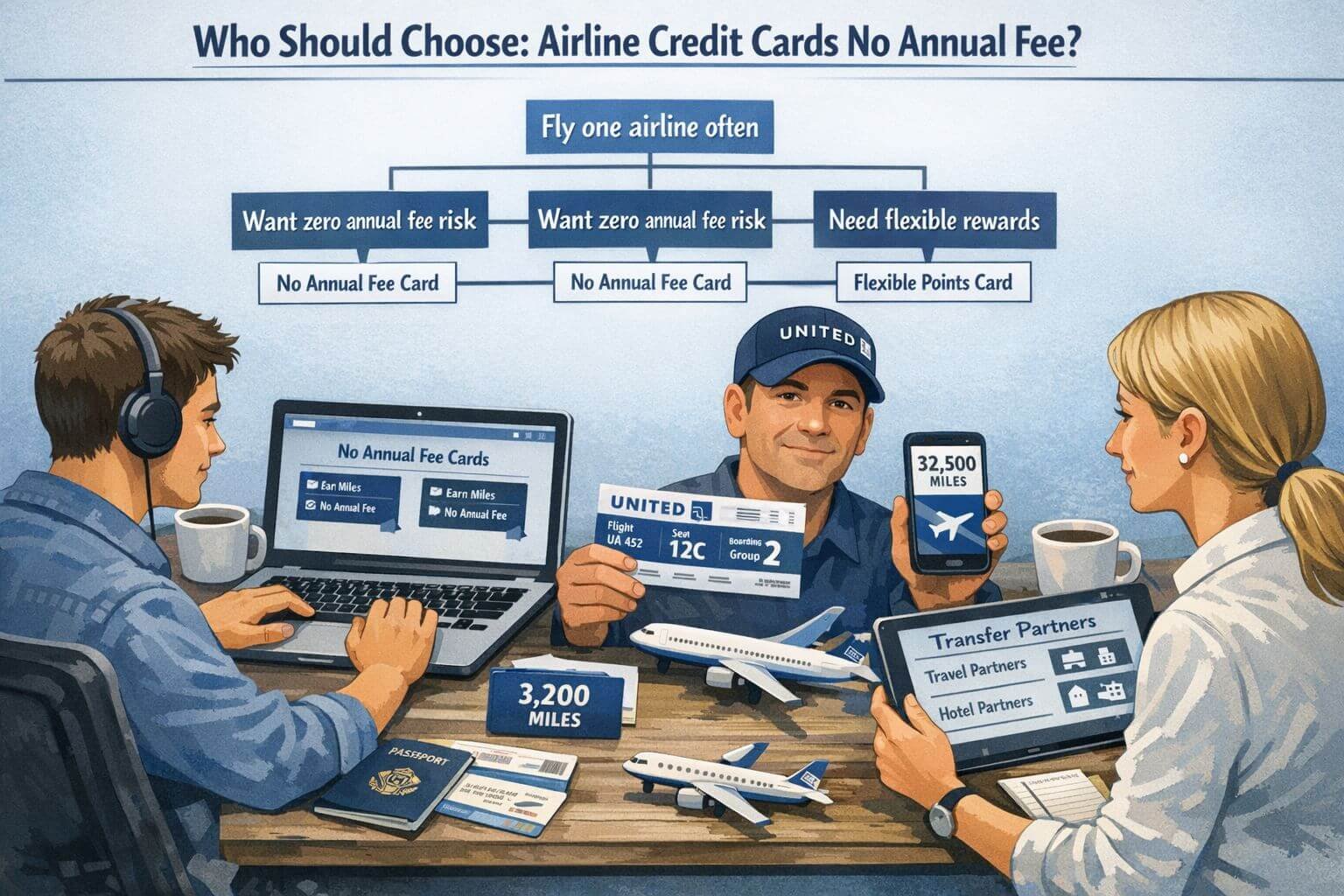
Who should consider airline credit cards no annual fee?
A no-fee airline card is best for someone who flies one airline at least a few times a year, wants a simple mileage strategy, and does not yet need premium perks. It is not the best fit for travelers who want maximum value from transferable points, premium cabin awards, or broad travel protections.
Best for
- Beginners coming from cash back who want to test miles first
- Travelers loyal to one airline hub, such as United in Denver or American in Dallas
- People worried about annual fees and downgrade decisions
- Cardholders who want to keep an airline account active and slowly build miles
- Flyers who want a stepping stone before moving to a mid-tier card
Not for
- People chasing the best use of points across many partner airlines
- Travelers focused on business class deals or first class redemptions
- Anyone who checks bags often and would save more with a mid-tier card
- International travelers who need no foreign transaction fees
- Readers who prefer simple value and may be better off with cash back or a flexible travel card
A no-annual-fee airline card is usually a low-risk starting point, not the highest-value end state.
Quick decision rule
Choose a no-fee airline card if:
- You already fly that airline
- You want to earn miles without fee pressure
- You can use the welcome bonus for a real trip in the next 12 to 18 months
Choose a no-fee flexible-points card instead if:
- You want transferable points
- You are still comparing airlines
- You care about points transfer partners, transfer bonuses, and booking strategy flexibility
You may be interested



For a broader comparison, see Points vs cash back: which strategy wins in 2026? and our guide to the best transferable points programs in 2026.
What should you look for in airline credit cards no annual fee?
The right no-fee airline card should match your actual spending and your redemption options. For most beginners, the key factors are practical: earning rate, foreign transaction fees, airline-specific benefits, and ease of using miles.
Use this checklist
1. Start with airline fit
- Do you fly the airline from your home airport?
- Does the airline have useful alliance partners?
- Is award availability decent for the routes you want?
If you need a refresher on major alliances and partner airlines, see our airline alliances guide.
2. Check the earning structure
- Airline purchases: often 2x
- Grocery, dining, or gas bonuses: useful for beginners
- Everything else: often just 1x
3. Look at foreign transaction fees
- A card with foreign transaction fees is a poor fit for overseas spending, even if you fly the airline internationally.
4. Check airline perks
- Priority boarding
- Discounts on in-flight purchases
- Better mileage earning as a cardholder
- Elite credit or Loyalty Points
5. Think about redemption quality Miles are not all equal. Dynamic pricing means award prices move with demand rather than staying fixed on an award chart. That can reduce value fast.
Common mistake
Many beginners choose the biggest welcome bonus, then realize the miles are hard to redeem at a good cents per point (CPP) value. A smaller bonus in a program you can actually use is often better.
Which are the best airline credit cards no annual fee in 2026?
The best no-fee airline cards in 2026 are the ones that help a beginner earn usable miles with low complexity. The cards below are the most relevant U.S. market options to compare first.
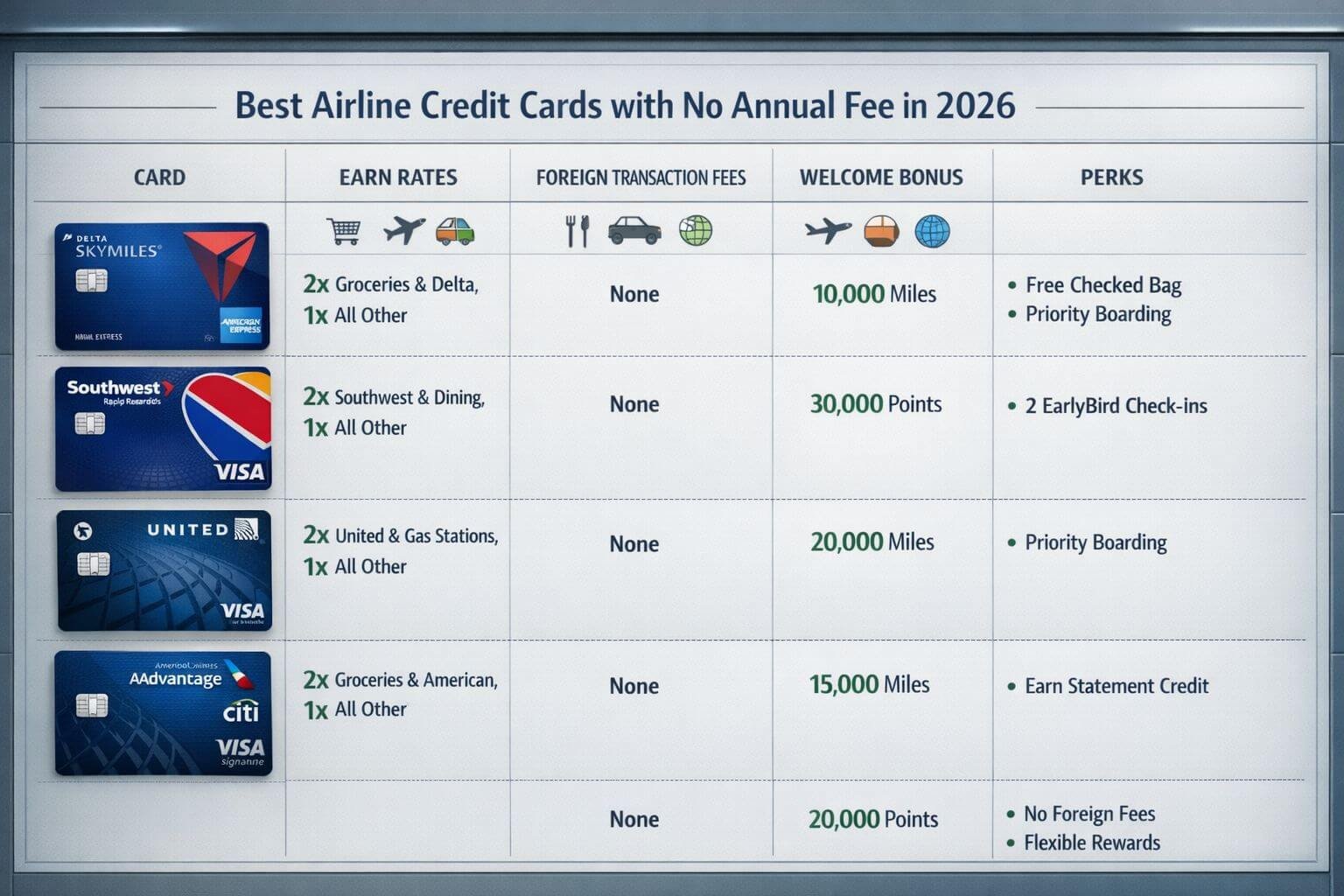
Side-by-side comparison
| Card | Best for | Annual fee | Typical ongoing earn | Foreign transaction fees | Airline-specific perks to note |
|---|---|---|---|---|---|
| United Gateway℠ Card | United flyers, especially after 2026 earning changes | $0 | 2x on United, gas stations, local transit/commuting; 1x elsewhere | None | Better fit now that cardholders are favored in MileagePlus earning |
| Delta SkyMiles® Blue American Express Card | Casual Delta flyers | $0 | 2x at restaurants worldwide, on Delta purchases; 1x elsewhere | None | Pay with Miles eligibility if you also value simple Delta redemptions |
| American Airlines AAdvantage® MileUp® | AA flyers who spend on groceries | $0 | 2x at grocery stores and eligible AA purchases; 1x elsewhere | Yes | Earns AAdvantage miles and supports Loyalty Points path |
| JetBlue Card | Domestic leisure travelers and JetBlue loyalists | $0 | 3x JetBlue, 2x restaurants/grocery stores; 1x elsewhere | Yes | Useful for Northeast and Florida-heavy flyers |
| Southwest Rapid Rewards® Plus-style no-fee alternative? | No true long-term no-fee personal Southwest co-brand widely positioned like Big 3 entry cards | — | — | — | For Southwest, compare low-fee cards rather than forcing a no-fee choice |
| Frontier Airlines World Mastercard® | Ultra-low-cost carrier flyers only | $0 or limited-offer no-fee versions may vary by issuer cycle | Airline-heavy rewards structure | Often Yes | Very niche, redemption and fee structure matter more than earn rate |
| Free Spirit® Travel More / Travel Mastercard tiering varies | Spirit loyalists only | Product lineup changes by issuer cycle | Varies | Varies | Usually only makes sense for frequent Spirit users |
| Capital One VentureOne Rewards | Best flexible alternative to airline lock-in | $0 | 1.25x on everyday purchases, higher on issuer travel portal | None | Transfer to multiple airline programs, better for flexible booking strategy |
Editor’s practical picks
Best airline-specific starter card: United Gateway℠ Card
Why: In 2026, United’s earning changes made co-branded cards more relevant. If United is your main carrier, the Gateway is a stronger starter card than it would have been a year ago.
Best grocery spender card: AAdvantage MileUp
Why: The grocery category can produce more miles than a plain 1x airline card for many households.
Best flexible no-fee alternative: Capital One VentureOne
Why: Transferable points are often a better long-term asset than one airline currency. If you want access to partner airlines, transfer bonuses, and a stronger booking walkthrough later, flexibility wins.
For travelers deciding between a no-fee United card and a paid version, see Best United credit cards 2026: Explorer vs Quest vs Club.
Best for / Not for callouts
United Gateway
- Best for: United flyers, no foreign transaction fee users
- Not for: People who want a strong everyday card
Delta Blue
- Best for: Casual Delta users who dine out and want no annual fee
- Not for: Travelers who need checked bag benefits
AA MileUp
- Best for: Grocery-heavy households, AA flyers
- Not for: International spend because of foreign transaction fees
JetBlue Card
- Best for: JetBlue loyalists in focus cities
- Not for: Travelers seeking broad global alliance redemptions
VentureOne
- Best for: Anyone who wants Amex points, Chase points, Capital One miles, Citi points, or Bilt points-style flexibility, but in a no-fee card lane
- Not for: Travelers who want airline-specific status boosts
How much can a beginner realistically earn with no-fee airline cards?
A beginner usually earns enough for a domestic award top-off or a short-haul redemption, not a premium long-haul trip, from spending alone. The welcome bonus matters most in year one, while ongoing spending on a no-fee airline card is often modest.
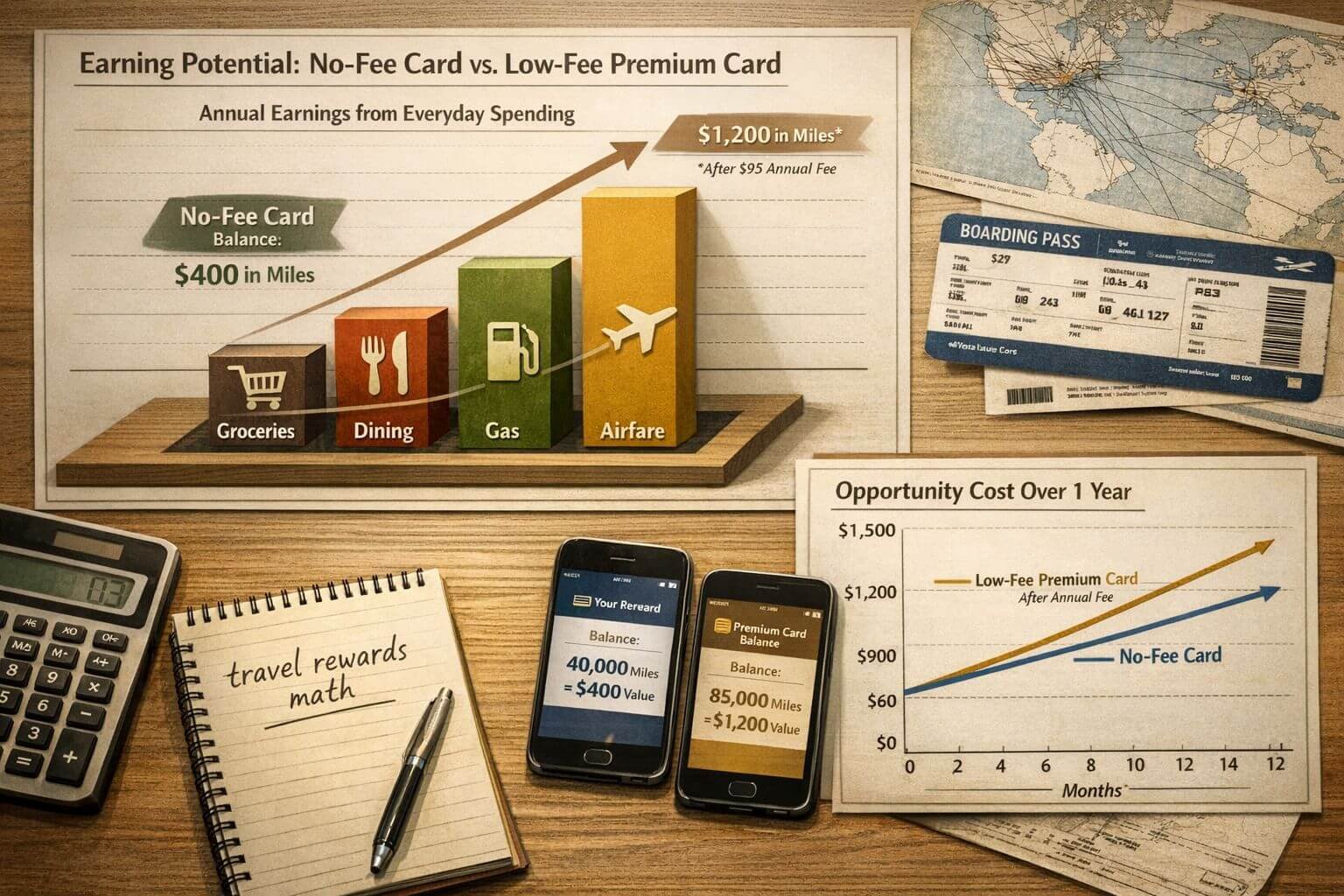
Assumed beginner spending profile
To keep the math realistic, assume annual spend of:
- $3,000 on groceries
- $2,400 on dining
- $1,800 on gas/transit
- $1,200 on airline tickets
- $6,000 everything else
Total annual spend: $14,400
Estimated miles from spending only
| Card | Estimated annual miles/points from this profile |
|---|---|
| United Gateway | about 16,800 miles |
| Delta Blue | about 16,800 miles |
| AA MileUp | about 18,600 miles |
| JetBlue Card | about 19,800 points |
| Capital One VentureOne | about 18,000 miles |
These are estimates based on common public earning structures in 2026 and the spending profile above. Actual terms can change, and category definitions vary by issuer.
What does that mean in practice?
For most beginners:
- 16,000 to 20,000 miles can help with a one-way domestic economy ticket, an off-peak short-haul award, or topping off an existing balance.
- It usually is not enough for premium cabin awards without a welcome bonus or transferable points strategy.
- Dynamic pricing can make these balances worth less during holidays or peak periods.
Opportunity cost versus a low-fee card
Compare that to a typical $95 annual fee airline or travel card:
- You may get a much larger welcome bonus
- You may get a free checked bag, priority boarding, or better earn rates
- You may come out ahead even after the fee
Simple rule: if one round trip with checked bags would save more than the annual fee, a mid-tier card can beat a no-fee card immediately.
That is why some beginners should skip the no-fee option and go straight to a paid card, especially if they already know their airline. For that comparison, read Are premium travel cards worth it in 2026?.
When does a no-fee airline card make sense, and when should you skip it?
A no-fee airline card makes sense when uncertainty is the main issue. If you are still learning award availability, program rules, and redemption patterns, avoiding an annual fee can be the right first move.
Start with no fee if
- You are new to airline miles
- You are testing whether you will actually redeem awards
- You want to build credit history and keep an account long term
- You only take a few flights a year
- You dislike paying a fee before proving value
Skip straight to a paid card if
- You check bags often
- You want airport lounge access or priority boarding
- You want travel protections
- You already know your home airport is dominated by one airline
- You can easily meet a larger welcome bonus responsibly
Edge case
If you mainly want premium cabin awards, a no-fee airline card is rarely the fastest route. A better path is often a flexible points setup with cards earning transferable points, then moving points to the right partner when award space appears. That approach is stronger for sweet spots, stopovers, married segments, and partner airline bookings.
For that strategy, see How to book business class with points and Best ways to find partner award space fast.
How should beginners use airline credit cards no annual fee without wasting miles?
The best approach is to treat a no-fee airline card as a narrow tool, not your only rewards strategy. Use it where it has an edge, then pair it with a better everyday card or a transferable-points card.
Step-by-step guide
1. Pick one airline you can use from your home airport
Do not choose based only on branding or bonus size.
2. Confirm an actual redemption path first
Search a few routes you might book in the next year. Check if awards are available at reasonable rates.
3. Use the card for bonus categories only
If your airline card gives 2x on groceries or airline tickets, use it there. Avoid putting all spending on a weak 1x base card.
4. Track your miles expiration and program rules
Some programs are more forgiving than others. See Do airline miles expire? 2026 rules and extension guide.
5. Pair with a flexible strategy later
After six to twelve months, consider adding a card with transferable points. That helps with award charts, points transfer partners, and devaluation risk.
Common pitfalls
- Hoarding miles without a trip in mind
- Paying foreign transaction fees overseas
- Ignoring surcharges and fees on award tickets
- Assuming airline miles always beat cash back
- Missing stronger alternatives in flexible currencies
When should you upgrade from a no-fee airline card?
Upgrade when the card’s missing perks cost more than the annual fee would. The most common triggers are checked bag fees, higher annual flight volume, and the need for better travel protections.
Signs you have outgrown the card
- You fly the airline 4 or more times a year
- You regularly check bags
- You value earlier boarding or seat selection
- You need stronger trip delay, rental car, or baggage coverage
- You can use a larger welcome offer on a better card
What to do before canceling
- Ask whether a product change is available
- Compare downgrade options versus closure
- Check whether closing the card affects your credit profile
A downgrade path often protects account age while removing the annual fee. See Credit card downgrade versus cancel decision guide.
What are the main tradeoffs of no-fee airline cards in 2026?
The main tradeoff is simple: no annual fee means less upside. Most no-fee airline cards are easy to keep, but they usually lag low-fee cards on welcome bonus size, perks, and long-term value.
Pros
- No annual fee risk
- Easy entry point for beginners
- Good for testing one airline program
- Helps in programs that increasingly reward cardholders
- Can be kept long term for credit history
Cons
- Weaker earning rates
- Fewer airline perks
- Lower value for frequent flyers
- More exposure to one-program devaluation risk
- Harder path to high-value redemptions
Practical framework
If your goal is simple domestic redemptions, a no-fee airline card can be enough.
If your goal is to maximize points for premium cabin awards, a transferable-points setup usually wins because it gives more optionality across alliance partners, positioning flights, and premium cabin inventory.
FAQ
Are airline credit cards no annual fee worth it in 2026?
Yes, for beginners who want to earn miles with one airline and avoid fee pressure. They are usually worth it only if the airline fits your real travel pattern.
What is the best no annual fee airline card for beginners?
The best beginner card is usually the airline card for the carrier you fly most. For flexible rewards instead of airline lock-in, a no-fee travel card can be a better first move.
Do no-fee airline cards include a free checked bag?
Usually not. Free checked bags are more common on mid-tier airline cards with annual fees.
Are no-fee airline cards better than cash back cards?
Only sometimes. If you rarely fly one airline or do not redeem miles well, a cash back card can be a better choice.
Can you earn elite status or Loyalty Points with a no-fee airline card?
Some airline cards help with elite qualification or Loyalty Points, but the details vary by program. Check the issuer’s current terms before applying.
Are airline miles from no-fee cards enough for business class deals?
Usually not from spending alone. Premium cabin awards often require a welcome bonus, transferable points, partner airlines, and careful searches for award availability.
Should beginners choose an airline card or transferable points first?
Choose an airline card first if you already fly one airline regularly. Choose transferable points first if you want flexibility and better long-term redemption options.
Do no-fee airline cards have foreign transaction fees?
Some do and some do not. That detail matters a lot if you travel abroad.
Conclusion
The best airline credit cards no annual fee in 2026 are useful when the goal is simple: start earning miles, avoid fee anxiety, and learn how one airline program works. For beginners, that is a valid strategy.
But the tradeoff is real. No-fee airline cards usually offer weaker welcome bonuses, fewer perks, and less flexibility than low-fee or premium cards. If you already know your home airline, check bags often, or want premium cabin awards, a no-fee starter card may only be a short stop on the way to a stronger setup.
Next steps:
- Check which airline has the best route network from your home airport.
- Compare that airline’s no-fee card against a flexible no-fee travel card.
- Search for a few real awards before applying, so the miles have a clear use case.
- If your long-term goal is premium travel, start learning partner searches and transfer strategy now. Read Best award search tools for beginners in 2026 and Maximize travel rewards bonuses with top transfer partners.
- If you are still deciding between airline-specific and general travel cards, review Best travel rewards credit cards for beginners in 2026.
Related reading
- Best no-annual-fee travel cards in 2026
- Best United credit cards in 2026
- Best transferable points programs in 2026
- How to book business class with points


Content on Award Travel Hub is independently created by Award Travel Hub Editorial Desk and, where noted, reviewed by Award Travel Hub Review Desk. Some pages may contain affiliate links, but compensation does not determine our coverage, opinions, or methodology.