
Last updated: October 4, 2026
Quick Answer
Barclays no longer accepts new applications for its AAdvantage or Hawaiian Airlines cards, so the current lineup worth considering centers on JetBlue and Wyndham, with niche options like Lufthansa Miles & More and Emirates Skywards for specific travelers. For most points collectors who have already built out Chase, Amex, and Citi wallets, the JetBlue Plus Card is the strongest general pick, while the no-fee JetBlue Card and Wyndham Rewards Earner Card make sense for lighter spenders. None of these cards earn transferable points, so they only belong in a wallet alongside, not instead of, a flexible points strategy.
Key Takeaways
- Barclays stopped accepting new AAdvantage Aviator applications in October 2025, and Citi became the exclusive AAdvantage credit card issuer on April 24, 2026.
- Grandfathered benefits on legacy Barclays Aviator accounts, including certain companion certificates, are set to end October 25, 2026, under Citi’s terms.
- Barclays also removed its Hawaiian Airlines cards from new-applicant availability after HawaiianMiles merged into Alaska’s Atmos Rewards program on October 1, 2025.
- The current actionable Barclays travel portfolio centers on JetBlue (three tiers) and Wyndham (two tiers), plus Lufthansa Miles & More and Emirates Skywards for travelers with specific loyalty needs.
- Barclays cards earn co-brand airline or hotel points, not transferable points, so you can’t move them to Amex, Chase, Capital One, or Citi transfer partners.
- Barclays approval decisions appear sensitive to recent account openings and inquiries, similar in spirit to Chase’s 5/24 rule, though Barclays has no single published threshold.
- The JetBlue Plus Card ($99 annual fee) is the best general-purpose Barclays travel card for most applicants, thanks to a free checked bag benefit worth more than the fee for most flyers.
- Barclays travel cards work best as a supplement to a core Chase, Amex, or Citi strategy, not as a replacement for a transferable points foundation.
Why Barclays Matters for Award Travelers in 2026
Barclays matters less for its own points currency and more for the specific perks its remaining co-brand cards unlock. Unlike Amex, Chase, Citi, and Capital One, Barclays does not run a transferable points program in the U.S. market, so every Barclays travel card earns points or miles tied to a single airline or hotel program.
That narrower role became more pronounced in 2026. Barclays exited two of its longest-running airline partnerships within a single year. American Airlines moved its full AAdvantage credit card program to Citi, with the transition completing on April 24, 2026. Existing Barclays Aviator cardholders were mapped automatically into equivalent Citi products, the Aviator Red became the Citi / AAdvantage Platinum Select World Elite Mastercard, without needing to reapply. But new applicants can no longer get an AAdvantage card through Barclays at all; Barclays stopped taking Aviator applications in October 2025, ahead of the formal handoff.
Barclays also dropped its Hawaiian Airlines co-brand cards after HawaiianMiles merged into Alaska Airlines’ Atmos Rewards program on October 1, 2025. Barclays no longer offers those cards directly to new applicants.
The practical result for 2026 applicants: Barclays’ relevant U.S. travel lineup is now concentrated in JetBlue, Wyndham Rewards, and a small number of niche international co-brands. Anyone researching “Barclays Bank credit cards” for travel should treat AAdvantage and Hawaiian options as closed doors and focus on what Barclays is actually issuing today.
The Barclays Travel Card Lineup: Airline Co-Brands and Beyond
Barclays’ active U.S. travel lineup in 2026 is a co-brand-only portfolio: JetBlue, Wyndham, Frontier, Lufthansa Miles & More, and Emirates Skywards. Barclays doesn’t offer a general-purpose, Barclays-branded travel rewards card that earns a flexible currency like Chase Ultimate Rewards or Amex Membership Rewards.
What are the best Barclays credit cards for travel rewards
The strongest Barclays travel cards for most U.S. points collectors are the JetBlue Plus Card and the Wyndham Rewards Earner Plus Card, because both pair a moderate annual fee with benefits that consistently outweigh the cost for regular travelers on those brands.
You may be interested



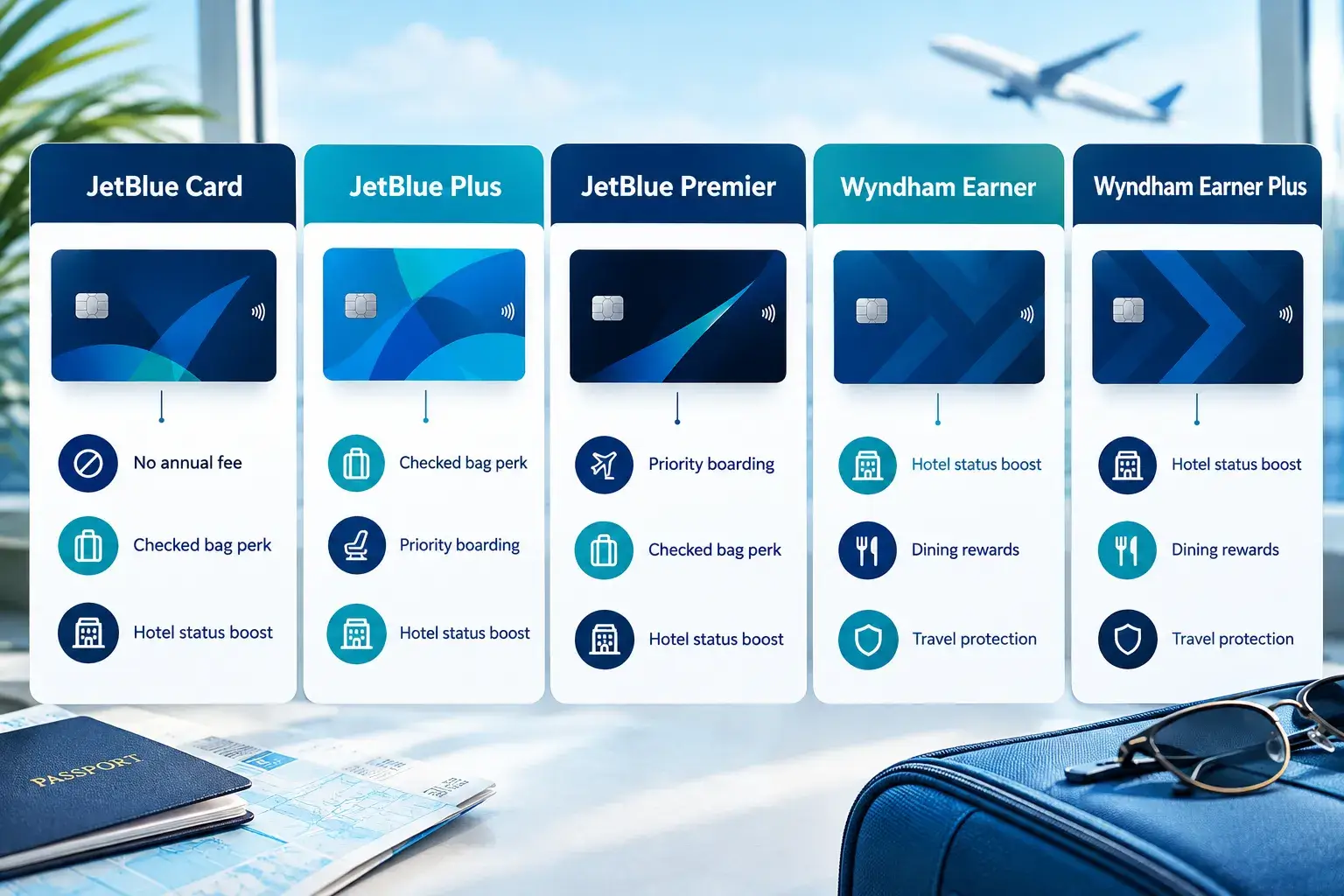
Here is how the current lineup compares:
| Card | Annual Fee | Welcome Offer | Key Earn Rates | Best For |
|---|---|---|---|---|
| JetBlue Card | $0 | 10,000 points after $1,000 spend in 90 days | 3X JetBlue/Paisly, 2X restaurants and eligible groceries | Occasional JetBlue flyers who want a fee-free foothold |
| JetBlue Plus Card | $99 | 60,000 points after $1,000 spend and paying the annual fee within 90 days | 6X JetBlue/Paisly, 2X restaurants and eligible groceries, 1X other | Regular JetBlue flyers who check bags |
| JetBlue Premier Card | $499 | 70,000 points plus 5 tiles after $5,000 spend and paying the annual fee within 90 days | Elevated JetBlue/Paisly earn plus tile-based status perks | Frequent JetBlue flyers chasing Mosaic-adjacent perks |
| Wyndham Rewards Earner Card | $0 | Up to 75,000 bonus points (tiered spend thresholds) | Standard Wyndham and everyday category earn | Occasional Wyndham stayers who want free status |
| Wyndham Rewards Earner Plus Card | $95 | Up to 100,000 bonus points (tiered spend thresholds) | 6X Wyndham, 4X eligible travel, dining, and grocery | Regular Wyndham stayers wanting Diamond status |
Decision rule: choose the no-fee JetBlue Card or Wyndham Earner Card if you fly or stay with these brands only a few times a year. Move up to the Plus tiers once travel frequency on that specific brand justifies the fee through checked-bag savings or hotel status value.
Barclays travel credit card annual fee vs benefits
The annual fee on a Barclays travel card is worth paying only when the card’s specific perks exceed the fee in real, predictable savings. This is a brand-specific calculation, not a general travel card calculation.
- JetBlue Plus ($99 fee): The free first checked bag for the cardholder and up to three companions on the same reservation can offset the fee in a single round trip for a family of two, since airline bag fees typically run $35 to $40 each way per passenger. Add the $100 annual JetBlue Vacations credit (after a $100 qualifying purchase) and the 5,000-point anniversary bonus, and the math clears easily for anyone flying JetBlue two or more times a year.
- JetBlue Premier ($499 fee): This is a niche product for households that fly JetBlue frequently enough to value tile-based status progress and a checked-bag benefit for up to three companions. For most travelers who have already maxed out Chase and Amex cards, this fee is hard to justify unless JetBlue is a primary carrier.
- Wyndham Earner Plus ($95 fee): Automatic Diamond status in year one, followed by Platinum, plus a 10% award-booking discount, make this fee worthwhile for anyone who stays at Wyndham-family hotels (La Quinta, Ramada, Days Inn, Wyndham Garden) several times a year.
Common mistake: applying for a premium Barclays co-brand card based on the welcome bonus alone, then never using the ongoing perks. The bonus is one-time; the annual fee repeats every year. Evaluate the card on what it does in year two, not just at signup.
How do Barclays travel card points work
Barclays travel cards earn brand-specific currency, JetBlue points or Wyndham Rewards points, that can only be redeemed within that single loyalty program. They are not a flexible or transferable points currency.
This is the single biggest distinction between Barclays cards and a bank like Chase, Amex, Citi, or Capital One. JetBlue points redeem through the JetBlue TrueBlue program at a fairly stable, revenue-based rate (roughly 1.3 to 1.5 cents per point on many fares, though this fluctuates with fare price). Wyndham points redeem for hotel stays using Wyndham’s award chart, with better value typically found at lower-category properties.
Because these are single-purpose currencies, they cannot flow into a broader points strategy the way transferable points from Amex, Chase, or Citi can. If maximizing flexibility across multiple airline and hotel partners is the priority, a Barclays co-brand card should sit alongside a transferable points card, not replace one.
What’s the sign-up bonus on Barclays travel cards right now
Current welcome offers on Barclays travel cards range from 10,000 points on the no-fee JetBlue Card up to 100,000 points on the Wyndham Earner Plus Card, with the JetBlue Plus Card sitting at 60,000 points after meeting spend and fee requirements. Terms and required spend levels change without much notice, so the live Barclays application page is the only reliable source before applying.
As of the card’s current product page, the JetBlue Plus offer requires $1,000 in purchases and payment of the annual fee within 90 days of account opening to earn the full 60,000-point bonus. The no-fee JetBlue Card requires $1,000 in spend within 90 days for its smaller 10,000-point bonus. Because these thresholds are modest compared to premium transferable points cards, most travelers will clear them through ordinary monthly spending without needing to manufacture spend.
Barclays credit card foreign transaction fees
Most current Barclays travel co-brand cards, including the JetBlue Card, JetBlue Plus, and JetBlue Premier, do not charge foreign transaction fees, so you can use them abroad without an added surcharge on purchases. This is a standard feature across nearly all modern travel-focused co-brand cards, so it should not be treated as a differentiator when choosing between Barclays cards and competitors. For a broader look at cards built specifically around this feature, see this guide to cards with no foreign transaction fees.
Barclays travel rewards card for international flights
Barclays’ most relevant options for international flying outside the JetBlue network are the Lufthansa Miles & More Credit Card and the Emirates Skywards Rewards Card, both aimed at travelers who fly those carriers or their alliance partners regularly. These cards make sense only for travelers with a genuine reason to hold Miles & More or Skywards currency, for example, someone who regularly positions through Frankfurt on Lufthansa or books Emirates premium cabin awards. For travelers without a specific tie to those programs, a transferable points card that can reach Star Alliance or Skywards partners through Amex or Citi transfer partners is usually more flexible than holding a dedicated co-brand card.
AAdvantage Aviator Red vs. JetBlue Plus: Which Barclays Card Fits You
The AAdvantage Aviator Red is no longer available to apply for through Barclays, so this comparison is really about legacy Aviator holders deciding whether to keep the card versus applicants choosing JetBlue Plus as their entry point into Barclays’ current lineup.
Existing Barclays Aviator Red cardholders were automatically converted to the Citi / AAdvantage Platinum Select World Elite Mastercard as part of the April 24, 2026 transition. No new application was required, and the underlying account number and history typically carried over. However, Citi announced in late August 2026 that most grandfathered Barclays-era benefits on these converted accounts, including certain companion-certificate terms and Loyalty Point provisions, will end on October 25, 2026. Anyone still holding a converted Aviator account should confirm current benefit terms directly with Citi before relying on old perks like a companion certificate for an upcoming trip.
For anyone deciding where to put a new application today, JetBlue Plus is the more relevant comparison point because it is the actual card Barclays is issuing.
Can you transfer Barclays points to airline partners
Barclays co-brand points cannot be transferred to other airline or hotel partners; they are locked into the single program tied to the card. JetBlue points stay in JetBlue TrueBlue, and Wyndham points stay in Wyndham Rewards. Barclays has no transfer portal comparable to Amex Membership Rewards or Chase Ultimate Rewards.
This matters when comparing Barclays to the AAdvantage program more broadly. AAdvantage miles themselves can be earned through multiple paths, flying, co-brand cards, and some transferable points transfers from certain programs, but a Barclays JetBlue or Wyndham card only ever produces points redeemable inside that one program. Travelers who want AAdvantage miles specifically now need a Citi AAdvantage card or a transfer-eligible program, not a Barclays product.
How to redeem Barclays travel points for flights
Redeeming Barclays-earned points for flights means booking directly within the loyalty program tied to the card, JetBlue points through TrueBlue for JetBlue-operated flights, for example, rather than through a bank travel portal or transfer partner.
A practical example: a cardholder earning 60,000 JetBlue points from the Plus Card’s welcome bonus can typically book a round-trip domestic JetBlue flight priced around $400 to $450 in cash, since JetBlue points commonly redeem at 1.3 to 1.5 cents per point on standard fares. That works out to roughly $780 to $900 in ticket value from the bonus alone, before factoring in the free checked bag and other perks. Availability and pricing shift with demand, since JetBlue uses a revenue-based award chart rather than fixed award pricing, so the exact value varies by route and date.
Barclays Approval Rules: The 6/24 Sensitivity and Card Churning Limits
Barclays does not publish a formal rule like Chase’s 5/24 policy, but applicant-reported approval patterns suggest Barclays reviews recent account openings and hard inquiries closely, particularly across all issuers in the past 6 to 12 months. Some in the points and miles community refer to this informally as Barclays’ own version of a “6/24” sensitivity, though it is not an official published threshold.
Applicants who have opened several new cards across Chase, Amex, and Citi in the months before applying to Barclays report a higher chance of denial or a request for additional documentation. Spacing out applications and keeping recent inquiries to a minimum improves approval odds, though outcomes still vary by individual credit profile.

Barclays travel card minimum credit score requirements
Barclays travel co-brand cards generally require good to excellent credit, typically in the 690 and above range, though the exact cutoff is not published and can vary based on income, existing Barclays relationships, and overall credit profile. A strong score alone does not guarantee approval if recent account activity looks aggressive to Barclays’ underwriting.
Edge case: applicants with an excellent score but five or more new accounts opened in the past year have reported denials despite otherwise strong credit files, reinforcing that Barclays weighs recent inquiry activity heavily, not just the score itself.
What happens if you don’t meet Barclays minimum spend requirement
Missing the minimum spend requirement on a Barclays travel card means forfeiting the welcome bonus entirely; Barclays does not prorate bonuses for partial spend. The account remains open and usable, but the points from the offer never post.
To avoid this common pitfall:
- Confirm the exact spend threshold and deadline on the current offer terms before applying.
- Route planned near-term purchases (rent via a payment service, insurance premiums, tuition) onto the new card during the qualifying window.
- Track spend against the deadline using the Barclays online dashboard, since the countdown typically starts from account opening, not the first purchase.
- Avoid returns or disputes on qualifying purchases during the window, since refunded purchases can reduce spend below the threshold.
For a broader look at scheduling new applications without wasting bonuses, see this guide on avoiding common mistakes with travel credit cards.
How Barclays Cards Fit Around Chase, Amex, and Citi
Barclays travel cards work best as a supplement to a transferable points foundation, not as a replacement for one. Because Barclays co-brand points only redeem within a single airline or hotel program, they should be added once a traveler already has flexible Chase, Amex, or Citi points covering most travel needs.
Barclays travel card vs Chase Sapphire which is better
The Chase Sapphire cards and a Barclays co-brand card serve different jobs, so “better” depends entirely on the goal. Chase Sapphire Preferred and Reserve earn transferable Chase Ultimate Rewards points that can move to more than a dozen airline and hotel transfer partners, giving far more redemption flexibility. A Barclays JetBlue or Wyndham card earns a single-program currency but often delivers stronger brand-specific perks, like a free checked bag or automatic hotel status, that Sapphire cards do not offer.
Choose Chase Sapphire if: the priority is flexibility across multiple airlines and hotels, premium travel protections, and a broad transfer partner network. Choose a Barclays co-brand card if: JetBlue or Wyndham is already a primary travel brand and the card’s specific perks (free bags, automatic status) offset its annual fee. For a side-by-side look at how transferable points cards stack up against co-brand options, see this comparison of travel credit card setups.
Barclays credit card travel insurance coverage what’s included
Barclays travel co-brand cards typically include baggage delay insurance and lost luggage reimbursement, but coverage is generally lighter than what premium transferable points cards like the Sapphire Reserve or Amex Platinum provide. Exact benefits vary by card tier, and Barclays updates terms periodically, so cardholders should check the current guide to benefits attached to their specific card rather than assume parity with premium travel cards. For a full breakdown of what different issuers include, see this guide to travel insurance benefits on credit cards.
Do Barclays cards have travel protections like trip cancellation
Some Barclays co-brand cards include trip cancellation or interruption coverage, but it is not universal across the lineup and tends to be more limited than coverage on premium Chase or Amex cards. Cardholders should read the guide to benefits document for their specific card, since coverage limits, eligible reasons for cancellation, and reimbursement caps differ by product and can change with little notice.
Not for: travelers relying primarily on a Barclays co-brand card for major trip protection on high-cost international trips. A premium transferable points card with stronger built-in trip protections is a better primary safety net for expensive itineraries.
Barclays credit card travel perks lounge access
Barclays’ current JetBlue and Wyndham travel cards do not include airport lounge access as a standard benefit. Lounge access remains concentrated in premium transferable points cards like Amex Platinum, Chase Sapphire Reserve, and Capital One Venture X. Anyone prioritizing lounge access should look outside the Barclays co-brand lineup; this roundup of airport lounge access credit cards covers the stronger options for that specific perk.
Is Barclays travel card worth it for occasional travelers
For occasional travelers who fly JetBlue or stay at Wyndham properties only once or twice a year, the no-fee JetBlue Card or Wyndham Rewards Earner Card is usually the better fit than a fee-bearing tier, since the fee-free versions still earn bonus points on relevant spend without an ongoing cost. Stepping up to a fee-based tier only makes sense once travel frequency on that specific brand justifies the added perks.
Is a Barclays Card Worth Opening? Final Picks by Traveler
The right Barclays card depends entirely on how often a traveler uses JetBlue or Wyndham specifically, not on a general travel rewards comparison. Here is a decision framework by traveler type:
- Frequent JetBlue flyer with checked bags: Open the JetBlue Plus Card. The free checked bag benefit for up to three companions typically clears the $99 fee within one or two round trips.
- Occasional JetBlue flyer, rarely checks a bag: Stick with the no-fee JetBlue Card. The 3X earn rate on JetBlue and Paisly purchases still builds points without an annual cost.
- JetBlue-based traveler chasing elevated status perks: Consider the JetBlue Premier Card only if JetBlue is a primary carrier flown several times per year; the $499 fee is hard to justify otherwise.
- Regular Wyndham-family hotel guest: Open the Wyndham Rewards Earner Plus Card for automatic Diamond status and stronger per-dollar earn rates.
- Occasional Wyndham guest: The no-fee Wyndham Rewards Earner Card delivers automatic Gold status and a welcome bonus without an annual fee, though the $15,000 spend threshold for the anniversary bonus is a real hurdle worth noting.
- Traveler focused on flexibility across airlines and hotels: Skip Barclays co-brand cards for now and prioritize a transferable points card instead; Barclays currency cannot be redirected elsewhere.
- Former Aviator Red holder: No action needed on the card conversion itself, but confirm current Citi benefit terms before October 25, 2026, since several grandfathered perks are being phased out.
For a broader look at how co-brand cards should sit inside a full points strategy, this guide to maximizing rewards with co-branded credit cards and this roundup of best hotel credit cards for 2026 are useful next reads.
FAQ
Can I still apply for a Barclays AAdvantage card in 2026? No. Barclays stopped accepting new AAdvantage Aviator applications in October 2025, and Citi became the exclusive AAdvantage card issuer on April 24, 2026. Existing Aviator accounts were converted to Citi products automatically.
What happened to Barclays Hawaiian Airlines cards? Barclays removed its Hawaiian Airlines co-brand cards from new-applicant availability after HawaiianMiles merged into Alaska Airlines’ Atmos Rewards program on October 1, 2025.
Do Barclays travel cards earn transferable points? No. Every current Barclays travel card earns points tied to a single airline or hotel program, such as JetBlue TrueBlue or Wyndham Rewards, with no transfer option to other partners.
Is the JetBlue Plus Card annual fee worth paying? For most travelers who fly JetBlue at least twice a year and check a bag, yes. The free checked bag benefit for the cardholder and up to three companions typically exceeds the $99 fee within one or two round trips.
Does Barclays have its own version of Chase’s 5/24 rule? Not officially, but reported approval patterns suggest Barclays reviews recent account openings and inquiries closely, similar in effect to a “6/24”-style sensitivity, even though no fixed published threshold exists.
What happens to grandfathered benefits on converted Barclays Aviator accounts? Citi announced that most grandfathered Barclays-era benefits on converted Aviator accounts, including certain companion-certificate terms, are scheduled to end October 25, 2026. Cardholders should confirm current terms directly with Citi.
Conclusion
The Barclays travel card story in 2026 is a story of subtraction. AAdvantage moved to Citi, Hawaiian left Barclays entirely, and what remains is a smaller, co-brand-only lineup built around JetBlue and Wyndham, with a few niche international options. That narrower focus does not make Barclays irrelevant, it makes the decision more specific. The JetBlue Plus Card earns its keep for regular JetBlue flyers through a checked-bag benefit that often pays for the fee outright, and the Wyndham Earner Plus Card does the same for frequent Wyndham guests through automatic Diamond status.
For points collectors who have already built a Chase, Amex, or Citi foundation, the next step is straightforward: check actual travel frequency on JetBlue or Wyndham before applying, confirm the live welcome offer and spend deadline directly on Barclays’ application page, and treat any Barclays card as a brand-specific addition rather than a core points strategy. Anyone still holding a converted Aviator account should review Citi’s updated terms before October 25, 2026, since several legacy perks are being phased out on that date.


Content on Award Travel Hub is independently created by Award Travel Hub Editorial Desk and, where noted, reviewed by Award Travel Hub Review Desk. Some pages may contain affiliate links, but compensation does not determine our coverage, opinions, or methodology.