
Chase 5/24 Rule: How It Works and What Counts
Last updated: July 30, 2026
Quick answer
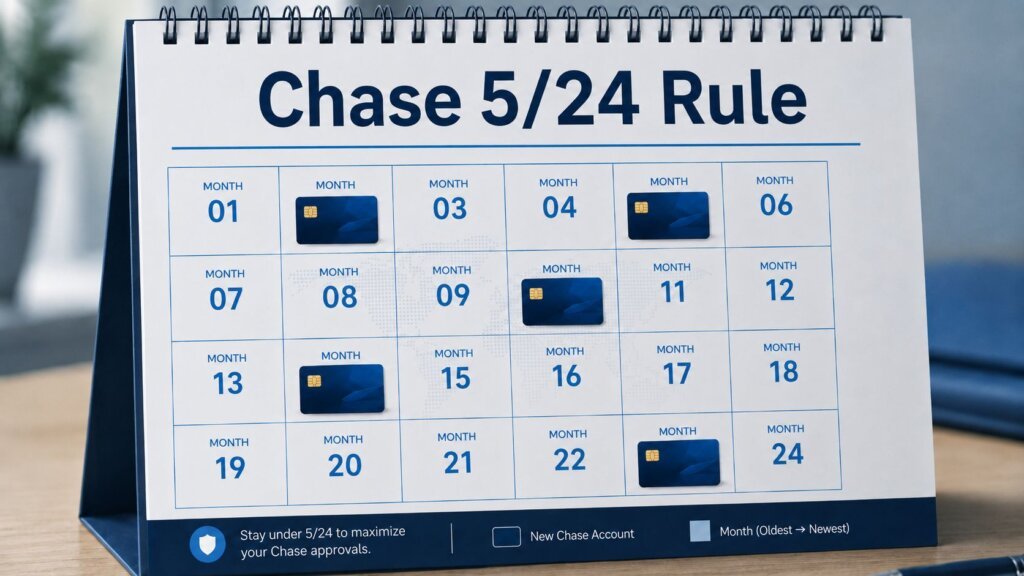
The Chase 5/24 rule is an unpublished but widely observed Chase application policy. Chase will generally not approve most new Chase credit cards when the applicant has opened five or more credit-card accounts that appear on their personal credit reports during the preceding 24 months. Chase does not formally publish, confirm, or guarantee this policy, and reported application data from established rewards publications remain the primary evidence for how it works. Being under 5/24 improves the odds of approval but does not guarantee it, because Chase still evaluates credit history, income, existing credit lines, and other underwriting factors.
Key takeaways
- “At 5/24” means five qualifying credit-card accounts were opened during the relevant 24-month period. Applicants at exactly five, not only those above five, are generally considered ineligible for cards subject to the rule.
- “Under 5/24” normally means zero through four qualifying accounts.
- The count is based on credit-card accounts that appear on personal credit reports from any issuer, not only Chase accounts.
- A business card generally does not add to the count when it does not appear as an account on personal credit reports. That depends on the issuer’s reporting practice for that specific product, not on a universal rule.
- Authorized-user accounts may appear on a personal credit report and may be included in Chase’s automated review. That is a complication, not a workaround.
- Closing a recently opened card does not remove it from the calculation. The opening date is what matters.
- Standard product changes (upgrades or downgrades) generally do not add to the count when the issuer keeps the existing tradeline, but they also normally do not earn a new welcome offer.
- Denied applications and standalone hard inquiries do not create new accounts, so they generally do not add to the count. Inquiries can still affect the credit decision.
- Under 5/24 is not the same as welcome-offer eligibility. Card-specific bonus terms are separate and controlled by the current application page.
What is the Chase 5/24 rule and how does it work?
The Chase 5/24 rule is an application screen: when Chase reviews a credit-card application, it counts how many credit-card accounts the applicant has opened in the last 24 months, according to personal credit reports. If that count reaches five, most Chase card applications are generally declined regardless of credit score or income.
The mechanics, as consistently described by established rewards publications that track application outcomes:
- Chase pulls at least one personal credit report during the application review. Chase’s own materials confirm that applications involve a credit review, but Chase does not state that it applies a five-account cutoff.
- Accounts from every issuer count, not just Chase. A card opened with a competing bank, a store card, or a cobranded card can all contribute.
- The screen appears to be applied early and mechanically, which is why applicants at 5/24 often report an immediate or near-immediate denial rather than a pending decision.
- Because the policy is unpublished, enforcement details, exceptions, and edge cases can change without notice.
A useful mental model: 5/24 is a gate, and normal underwriting happens after the gate. Passing the gate gets the application reviewed. It does not decide the outcome.
Why is the 5/24 rule considered unofficial?
There are three separate evidence levels worth keeping straight:
- Official Chase information. Chase publishes general guidance on how long to wait between credit-card applications and on reasons an application may be denied despite good credit. Those pages discuss credit reviews, recent account activity, income, and debt. They do not acknowledge a 5/24 threshold, and they should never be cited as proof that Chase confirms one.
- Consistent application evidence. Publications such as The Points Guy, NerdWallet, and Frequent Miler have documented approval and denial patterns across years of reader reports. That evidence is why 5/24 is treated as reliable in practice.
- Isolated anecdotes. Occasional reports of approvals above five accounts circulate in forums. Those are outliers and should not be planned around.
Because the rule is unpublished, phrasing like “Chase appears to,” “generally,” and “reported application data indicate” is more accurate than treating 5/24 as a fixed formula.
Does the Chase 5/24 rule still apply in 2026?
As of mid-2026, the 5/24 screen is still widely reported to be in effect for most Chase-issued rewards cards, and current guides from major rewards publications continue to describe it as active. Chase has not announced any change, because Chase has never announced the rule at all.
What has shifted over the years is scope, not existence. Early on, some cobranded products appeared to sit outside the screen. Over time, coverage broadened to include most Chase consumer rewards cards and, functionally, most Chase business card applications as well. Since the policy is unpublished, the practical approach is:
- Treat the rule as active unless multiple current, established sources report otherwise.
- Verify with a current guide (dated within the last few months) before planning an application timeline.
- Check the actual application page and offer terms for the specific card, because product-level requirements can differ.
How many Chase cards can someone apply for under 5/24?
There is no published Chase application limit tied to 5/24, and the rule does not authorize a specific number of Chase applications. The rule only describes the count of recently opened accounts that appears to disqualify an applicant.
Two points that get conflated frequently:
- 5/24 counts accounts, not Chase cards. Someone with zero Chase cards but five recent cards from other banks is generally at 5/24 and blocked. Someone with three Chase cards and no other recent accounts is generally at 3/24.
- Every new Chase card raises the count. Opening Chase personal cards uses up the same 24-month slots as any other issuer’s cards.
Beyond 5/24, Chase applies separate velocity considerations. Chase’s own guidance notes that applying for multiple cards in a short window can work against an applicant, since each application involves a credit check and recent account activity is part of the review. Opening several cards in quick succession is not a dependable strategy, and applying for two Chase cards on the same day should not be treated as a reliable technique.
For readers deciding which programs to prioritize before opening anything, comparing currencies first tends to be more useful than counting slots. Reviewing the major transferable points programs and how Chase Ultimate Rewards compares to Amex Membership Rewards or Capital One miles helps clarify whether Chase cards belong early in a plan at all.
What counts toward the 5/24 rule?
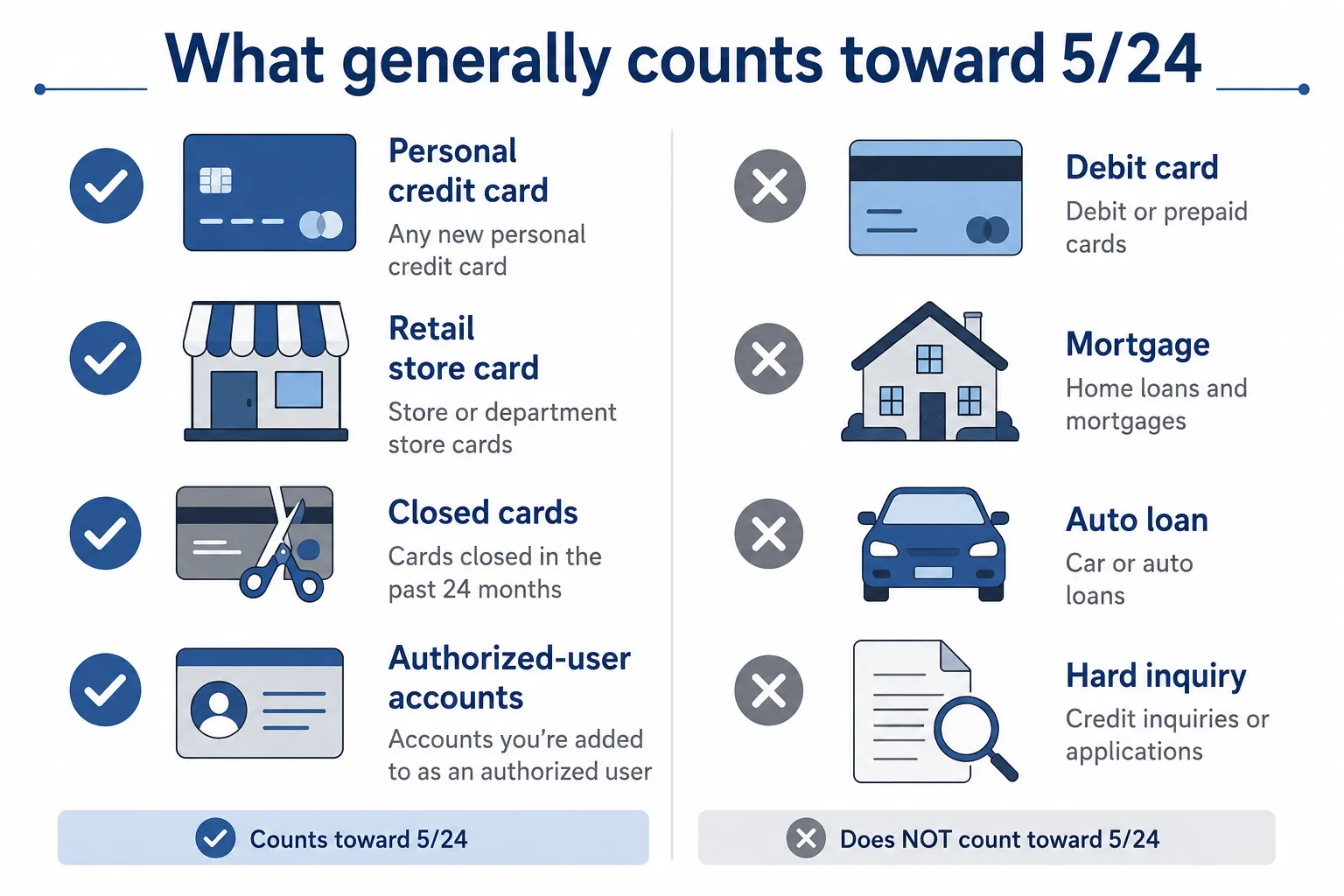
The count generally includes credit-card accounts that appear as newly opened tradelines on the applicant’s personal credit reports during the 24-month window, from any issuer.
Generally counts:
- Personal credit cards opened with Chase or any other issuer during the period
- Recently opened cards that were subsequently closed
- Retail and store cards when they report as consumer credit-card accounts
- Authorized-user accounts when they appear on the applicant’s personal credit report, though manual treatment during reconsideration may differ
- Business cards when the issuer reports the account as a tradeline on the applicant’s personal credit report
- Charge cards, when they report as card accounts on the personal credit report
Generally does not count:
- An application that was denied and produced no new account
- A hard inquiry on its own
- Mortgages, auto loans, student loans, and personal loans
- Debit cards and prepaid cards
- Business cards that do not appear as accounts on personal credit reports
- A standard product change that preserves the existing tradeline without creating a newly reported account
One caveat on inquiries: a hard inquiry does not add to the 5/24 count, but it still appears on the credit report and can influence the overall decision. Several recent inquiries plus a thin file can produce a denial even at 2/24.
Common mistake: assuming a denied application “burned a slot.” It did not create an account, so it generally does not count, though the inquiry remains visible.
How are personal and business cards treated differently?
Personal cards almost always count. Business cards count only when they show up as accounts on the applicant’s personal credit reports, which depends on the issuer and the specific product rather than on a blanket rule.
Practical framework:
- If a business card does not report as a personal-credit-report account, it generally does not add to the 5/24 count.
- Some business-card issuers and some individual products do report business accounts to personal bureaus.
- Reporting practices change over time, and treatment can also differ once an account becomes delinquent.
- The only reliable check is the applicant’s own credit report after the account has been open long enough to report, combined with the issuer’s current disclosures.
Two specific clarifications about Chase business cards:
- Approval eligibility: applicants generally need to be under 5/24 to be approved for most Chase business cards. The rule gates business applications too.
- Effect on the count: a newly approved Chase business card generally does not add to the applicant’s 5/24 count when it is not reported as a personal credit-card account. That is the reported pattern, not a guarantee for every Chase business product, every reporting circumstance, or a delinquent account.
Business cards are not a guaranteed way to stay under 5/24, and no one should apply for a business card without a legitimate business or qualifying business activity and the ability to provide accurate information on the application. Readers evaluating that path can start with an overview of business cards used for award travel and then confirm current terms on the issuer’s own page.
Does the 5/24 rule apply to authorized users?
An authorized-user card can appear on the authorized user’s personal credit reports, and when it does, Chase’s automated review may count it toward 5/24. Authorized-user status is not a way around the rule.
How this typically plays out:
- The primary cardholder adds a family member as an authorized user. The account may then report on the authorized user’s credit file with the original opening date or the date added, depending on the issuer’s reporting.
- If that account falls inside the 24-month window, an automated count may include it.
- The authorized user is not normally the person contractually responsible for paying the account.
- When an application is denied, a Chase representative may sometimes reconsider after identifying which accounts are authorized-user accounts. Manual exclusion has been reported but is not guaranteed and should not be assumed.
Two corrections worth stating plainly, because older guides get this backward:
- Adding someone as an authorized user does not help that person get around 5/24. It can instead add an account to their credit report and make the count higher and harder to interpret.
- Accurate, legitimate authorized-user tradelines should not be disputed with a credit bureau in order to influence an application. Disputes are for information a consumer believes is inaccurate or incomplete, as described in the CFPB’s dispute guidance.
Decision rule: if authorized-user accounts push a conservative count to five, treat the application as blocked and plan around it rather than counting on manual removal.
Do closed cards, denied applications, or product changes change the count?
Closing a card does not reduce a 5/24 count, a denied application generally does not add to it, and a standard product change generally does not add to it either. The consistent factor is whether a new credit-card tradeline was created and when it was opened.
Closed accounts. The relevant data point is the opening date reported on the credit file, not whether the account remains open. Closed accounts can remain on credit reports for years, and a card opened 8 months ago and closed last week still generally counts. Closing a card solely to reduce a 5/24 count does not work and can hurt in other ways: it reduces available credit, can raise utilization, ends card benefits, forfeits or complicates rewards, and may shorten average account age over time.
Denied applications. No account, no new tradeline, so generally no addition to the count. The hard inquiry stays on the report and can still matter to underwriting.
Product changes. A standard upgrade or downgrade within an issuer normally keeps the existing tradeline, so it generally does not add to 5/24. Important caveats:
- A product change normally does not earn the new card’s welcome offer.
- Reporting treatment can vary by issuer and product.
- Receiving a different card number does not by itself prove a new credit account was created.
- Confirm with the issuer whether the change involves a new account or a hard inquiry, and then verify on the credit report whether a new tradeline appeared.
Anyone weighing an upgrade path (for example, moving between the Sapphire Preferred and Sapphire Reserve) should treat the bonus question and the 5/24 question as two separate decisions.
How to check whether you’re under or over 5/24
The reliable method is to read the personal credit reports themselves and count credit-card accounts by opening date. No app, dashboard, or single-bureau score product produces Chase’s actual underwriting result.
Step-by-step:
- Pull current personal credit reports from Equifax, Experian, and TransUnion through AnnualCreditReport.com, the federally authorized source for free reports. Avoid imitation credit-report sites.
- Review both open and closed credit-card accounts. Closed accounts are frequently in a separate section.
- Record the opening date shown for each credit-card account.
- Identify every credit-card account with an opening date inside the applicable 24-month window.
- For an initial conservative count, include authorized-user accounts and any business accounts that appear as recently opened personal-report tradelines.
- Mark authorized-user accounts separately, since Chase may treat them differently during a manual review.
- Do not count inquiries that produced no account.
- Compare results across all three reports. They are often not identical, and an account may appear on two bureaus but not the third.
- Recheck shortly before applying, because new accounts and corrections can take weeks to appear.
Monitoring tools and issuer dashboards are convenient for tracking, but they can mislead a 5/24 count because they may show only one or two bureaus, tuck closed accounts out of view, use a stale report date, display approval dates rather than reported opening dates, or produce a count that does not match what Chase sees. No single service, including any one bureau’s portal or a free credit app, provides a definitive 5/24 status.
If an account, opening date, or ownership designation looks wrong, dispute it with the credit bureau and the furnisher, then allow time for a legitimate correction to post before applying.
How long does 5/24 last, and when can someone reapply?
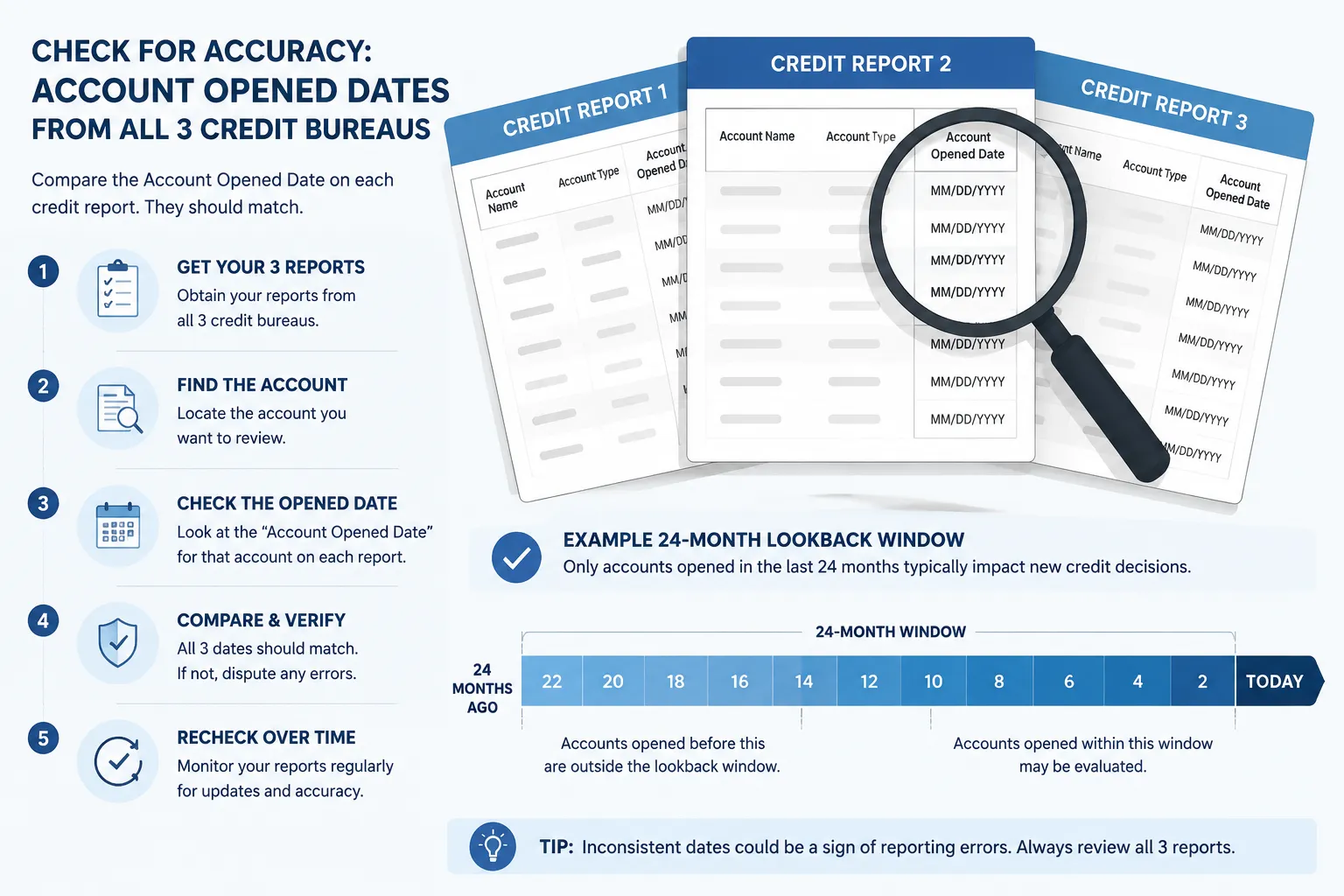
An account generally stops affecting the count once its opening month is outside the applicable 24-month window. The commonly used community convention treats an account as safely outside the calculation beginning on the first day of the 25th month after its opening month.
Worked example, using the conservative convention:
- The fifth-newest qualifying account was opened in October 2024.
- The conservative application date would be November 1, 2026 or later.
Points to keep in mind:
- This is an observed timing convention reported by rewards publications, not an official Chase guarantee.
- Reporting delays can shift the practical result in either direction, so verify the dates on current reports before applying.
- Applying on the exact anniversary date, or hoping a reporting lag creates an opening, is not a dependable plan.
- After the relevant accounts age out, there is no separate waiting period tied to a previous 5/24 denial. Someone denied at 5/24 can generally reapply once they are back under the threshold and their broader credit profile supports the application.
Edge case: if two qualifying accounts were opened in the same month, both age out at the same time, which can move a count from 6/24 to 4/24 in a single month. Building a simple list of opening months makes those cliffs easy to spot.
Which Chase applications are generally affected?
Most Chase-issued personal rewards cards are generally considered subject to 5/24, and most Chase business-card applications also generally require the applicant to be under 5/24. Because the rule is unpublished, scope and enforcement can change.
What that covers in practice:
- Chase’s Ultimate Rewards earning consumer cards
- Chase’s airline and hotel cobranded consumer cards
- Chase business cards, in terms of approval eligibility
Rather than relying on a static list that ages badly, check the current application page and offer terms for the exact card, then cross-check a current 5/24 guide from an established publication. Readers who want to understand what Chase points are actually worth before applying can review the Chase Ultimate Rewards transfer partners and which airline programs fit their routes, including United and Southwest.
Can you get approved over 5/24, and are there exceptions?
Approvals above 5/24 are occasionally reported, most often in connection with targeted or preapproved offers, but no exception is dependable. Applicants at or above five qualifying accounts should expect a denial for cards subject to the rule.
On targeted and preapproved offers:
- Chase may display preapproved, prequalified, or “just for you” offers to existing customers and through its preapproved offers page.
- Updated application reports indicate that some targeted offers have occasionally been approved above 5/24. Results are inconsistent.
- A mailer, referral link, elevated welcome offer, CardMatch result, or generic marketing email does not automatically override 5/24.
- A fixed APR or an invitation code is not evidence that the rule will be waived.
- Chase states that preapproval and prequalification do not guarantee final approval, and its guidance on next steps after preapproval makes clear that a full application follows.
- Checking for offers may use a soft inquiry, but submitting an application normally results in a hard inquiry either way.
What happens if someone applies while at or above 5/24? Usually the application is declined. The practical consequences are a hard inquiry on the credit report and, in some cases, a denial notice explaining factors considered. There is no penalty box, blacklist, or published sanction, but repeated denied applications add inquiries and recent-activity signals that can weigh against future approvals across issuers.
What can reconsideration actually do?
Reconsideration is useful for verification issues and credit-report problems. It is not a reliable way to overturn a correctly calculated 5/24 denial.
Situations where a call can help:
- Chase needs to verify identity or income before finishing the review.
- The credit report contains an inaccurate account, opening date, or ownership designation.
- Authorized-user accounts appear to have affected the automated count, and the applicant can identify which accounts are not their own obligations.
- Chase wants to discuss existing credit lines across the applicant’s Chase accounts.
How to approach it:
- Use the phone number provided in the application notice, denial letter, or Chase’s current official contact information. Do not rely on numbers copied from forum posts.
- Provide truthful, concise answers, and be ready to identify specific accounts by issuer and opening date.
- Do not call repeatedly hoping to reach an agent willing to disregard policy.
- If the count is accurate and the applicant is at or above five, the appropriate response is to wait for accounts to age out.
Politeness, persistence, offering to move an existing credit line, or explaining why past cards were opened will not reverse a valid 5/24 decision.
Why being under 5/24 does not guarantee approval
Under 5/24 only means the application is likely to be reviewed rather than screened out. Chase still declines applications for standard underwriting reasons, several of which the bank documents in its own education materials.
Factors Chase may consider include:
- Credit score and length of credit history
- Reported income relative to requested credit
- Total debt and monthly obligations
- Credit utilization across accounts
- Payment history, including late payments, collections, or derogatory marks
- Number and recency of hard inquiries
- Total credit already extended by Chase across existing accounts
- Application frequency and recently opened accounts
- Identity verification and information consistency
Example scenario: an applicant at 2/24 with a high score can still be declined if Chase has already extended a large share of their available credit across existing Chase cards. In that case, the useful step is often to ask about reallocating an existing Chase credit line rather than to reapply.
How does 5/24 compare with other banks’ application rules?
Other major issuers apply their own application limits, and those rules are structured differently from 5/24. Comparing them helps explain why sequencing matters for anyone who wants cards from multiple banks.
| Issuer | Commonly reported application constraint | Basis |
|---|---|---|
| Chase | Generally declines when five or more card accounts were opened in 24 months | Unpublished, widely observed |
| American Express | Limits on number of cards held and on welcome-offer eligibility per product, plus application velocity limits | Partly disclosed in offer terms, partly observed |
| Capital One | Limits on approvals within a rolling period and on total cards held | Largely observed |
| Citi | Waiting periods between applications and between bonuses within card families | Partly disclosed, partly observed |
| Bank of America | Approval limits tied to applications within rolling windows, with different treatment for existing relationship customers | Largely observed |
Treat the middle column as a summary of reported patterns rather than published policy, and confirm the current details for any specific card on the issuer’s own application page. The practical takeaway: Chase’s screen looks backward at accounts from every bank, while some other issuers focus mainly on their own accounts and application timing. That is why Chase applications are often considered earlier in a sequence.
Is the 5/24 rule worth following, or is it a myth?
It is not a myth. It is an unpublished policy supported by years of consistent application evidence, and treating it as real saves applicants unnecessary hard inquiries and denials. The reasonable position is to plan around it while acknowledging that Chase never promised it and can change it.
Responsible planning considerations that matter more than slot counting:
- Annual fees and whether the card’s benefits are actually used
- Minimum spending requirements that can be met with normal, planned spending
- The effect of new accounts and inquiries on credit
- Upcoming mortgage, auto, or other major loan applications, which usually argue for delaying card applications
- Actual travel plans and which programs serve the routes and hotels being considered
- The ability to pay balances in full every month
Travelers who genuinely want Chase cards may reasonably choose to consider them before opening cards from other issuers, since Chase counts everyone’s accounts. That is a sequencing observation, not a universal recommendation. Nobody should open cards purely to fill available slots, and Chase points do not always deliver the best value for a given itinerary. Comparing Chase Ultimate Rewards against other transferable currencies against the specific award being targeted is the better test.
Is 5/24 eligibility the same as welcome-offer eligibility?
No. Passing the 5/24 screen and qualifying for a card’s welcome bonus are separate questions decided by different rules.
- Card-specific provisions may address prior bonuses on the same card, current or previous ownership of related products, card-family restrictions, and time-based waiting periods.
- These provisions change, and they differ by product.
- The exact application page and offer terms in effect at the time of application control eligibility.
- Reconsideration and 5/24 status have no bearing on whether a bonus posts.
Someone at 1/24 can be approved for a card and still receive no welcome bonus because of a product-specific restriction. Read the offer terms before applying, not after.
FAQ
What is the Chase 5/24 rule?
It is an unpublished but widely observed Chase policy under which Chase generally will not approve most new Chase credit cards for applicants who have opened five or more credit-card accounts appearing on their personal credit reports in the preceding 24 months.
Is the Chase 5/24 rule official?
No. Chase does not publish, confirm, or guarantee the rule. It is documented through consistent application reports collected by established rewards publications.
What does being at 5/24 mean?
It means five qualifying credit-card accounts were opened during the relevant 24-month period. Applicants at exactly five are generally considered ineligible for cards subject to the rule.
Is 4/24 considered under 5/24?
Yes. Under 5/24 normally means zero through four qualifying accounts.
Do cards from other banks count?
Yes. Credit-card accounts from any issuer generally count when they appear as recently opened tradelines on a personal credit report.
Do Chase business cards count?
Applicants generally need to be under 5/24 to be approved for most Chase business cards, but a newly approved Chase business card generally does not add to the count when it is not reported as a personal credit-card account. That is a reported pattern, not a guarantee for every product or circumstance.
Do other issuers’ business cards count?
Only when the issuer reports the account as a tradeline on the applicant’s personal credit report. Reporting practices vary by issuer and product and can change, so verify before applying.
Do authorized-user cards count?
They may. When an authorized-user account appears on the applicant’s personal credit report inside the window, Chase’s automated review may include it. Manual exclusion during reconsideration has been reported but is not guaranteed.
Do store cards count?
Generally yes, when the retail card reports as a consumer credit-card account on a personal credit report.
Do charge cards count?
Generally yes, when the charge card appears as a card account on the personal credit report.
Does closing a card reduce the count?
No. The opening date determines whether an account falls inside the 24-month window, and closed accounts can remain on credit reports for years.
Does a denied application count?
Generally no, because no new account was created. The hard inquiry still appears on the report and can affect future decisions.
Does a hard inquiry count?
No. An inquiry by itself is not a new account for 5/24 purposes, though inquiries can still influence an approval decision.
Does a product change count?
A standard upgrade or downgrade generally does not add to the count when the issuer keeps the existing tradeline. Verify with the issuer, and confirm on the credit report whether a new tradeline appeared. A product change normally does not earn the new card’s welcome offer.
When does a card fall outside the 24-month window?
The commonly used conservative convention treats an account as outside the calculation beginning the first day of the 25th month after its opening month. This is an observed timing convention, not a Chase guarantee.
Are all Chase cards subject to 5/24?
Most Chase-issued personal rewards cards are generally considered subject to it, and most Chase business-card applications generally require the applicant to be under 5/24. Enforcement can change, so check the current application page and a current guide.
Can a targeted or preapproved offer bypass 5/24?
Sometimes, but not dependably. Some targeted offers have reportedly been approved above 5/24, while many are declined. Chase states that preapproval does not guarantee final approval.
Can reconsideration override a 5/24 denial?
Not reliably. Reconsideration can help with verification issues, credit-report errors, or authorized-user accounts that affected an automated count, but it is not a way to overcome an accurate 5/24 denial.
Does being under 5/24 guarantee approval?
No. Chase may still consider credit score, income, debt, utilization, payment history, recent inquiries, existing Chase credit lines, application frequency, and identity verification.
Is welcome-offer eligibility the same as 5/24 eligibility?
No. Card-specific bonus terms are separate and can change. The current application page and offer terms control.
Where can someone check their credit reports?
At AnnualCreditReport.com, the federally authorized site for free reports from Equifax, Experian, and TransUnion. Checking all three is recommended because the reports may differ.
Related reading
- Chase Ultimate Rewards program overview and transfer partners
- Transferable points programs compared
- Airline award program guides
- Award travel calculators





Content on Award Travel Hub is independently created by Award Travel Hub Editorial Desk and, where noted, reviewed by Award Travel Hub Review Desk. Some pages may contain affiliate links, but compensation does not determine our coverage, opinions, or methodology.