

Last updated: August 19, 2026
Quick Answer
A travel points calculator should answer one question before every redemption: are the points saving more value than the realistic cash alternative? Use this formula: (cash price minus award taxes and fees) divided by points used, multiplied by 100. In 2026, the best redemptions usually come from transferable points moved to partner airlines, but portal bookings and cash can be better when award availability is poor, fuel surcharges are high, or dynamic pricing pushes award rates up.
Key Takeaways
- Cents per point, or CPP, is the core travel rewards math for comparing cash, portal, hotel, and airline award options.
- The standard CPP formula is: (cash cost – award taxes/fees) ÷ points used × 100.
- Baseline values help set a floor, but they are not guarantees. Award availability, transfer ratios, and program rules change the real value.
- Transferable points such as Amex points, Chase points, Capital One miles, Citi points, and Bilt points are usually worth more when used with strong points transfer partners.
- Premium cabin awards can produce high CPP, but only when award space exists and surcharges and fees are reasonable.
- Hotel points need separate math because resort fees, taxes, elite benefits, and dynamic pricing can change the outcome.
- Transfer bonuses can improve redemption value, but speculative transfers increase devaluation risk.
- The best use of points is not always the highest CPP. Time, routing, cancellation rules, and opportunity cost matter.
Why you need a points value framework
A points value framework keeps you from using 100,000 points for a booking that should have been paid in cash. The goal is not to chase the highest possible CPP; the goal is to make a clear, repeatable decision before transferring or redeeming points.
Points and miles values change because loyalty programs control award prices. In 2026, dynamic pricing, hotel category changes, fuel surcharges, and limited award space can all lower real-world redemption value.
A good framework helps you compare:
- Cash booking with a credit card
- Travel portal booking using bank points
- Transfer partner award through airline miles or hotel points
- Hybrid options, such as paying cash for a positioning flight and using miles for the long-haul segment
Use a framework when:
- Transferring flexible rewards to partner airlines
- Booking premium cabin awards
- Comparing hotel points against cash rates
- Evaluating a transfer bonus
- Deciding whether to save points for a better trip
Practical rule: if the redemption is below your baseline value and the cash price is reasonable, paying cash is often the cleaner choice.
For a broader set of tools, the Award Travel Hub calculators can help compare points, cash, and transfer options before booking.
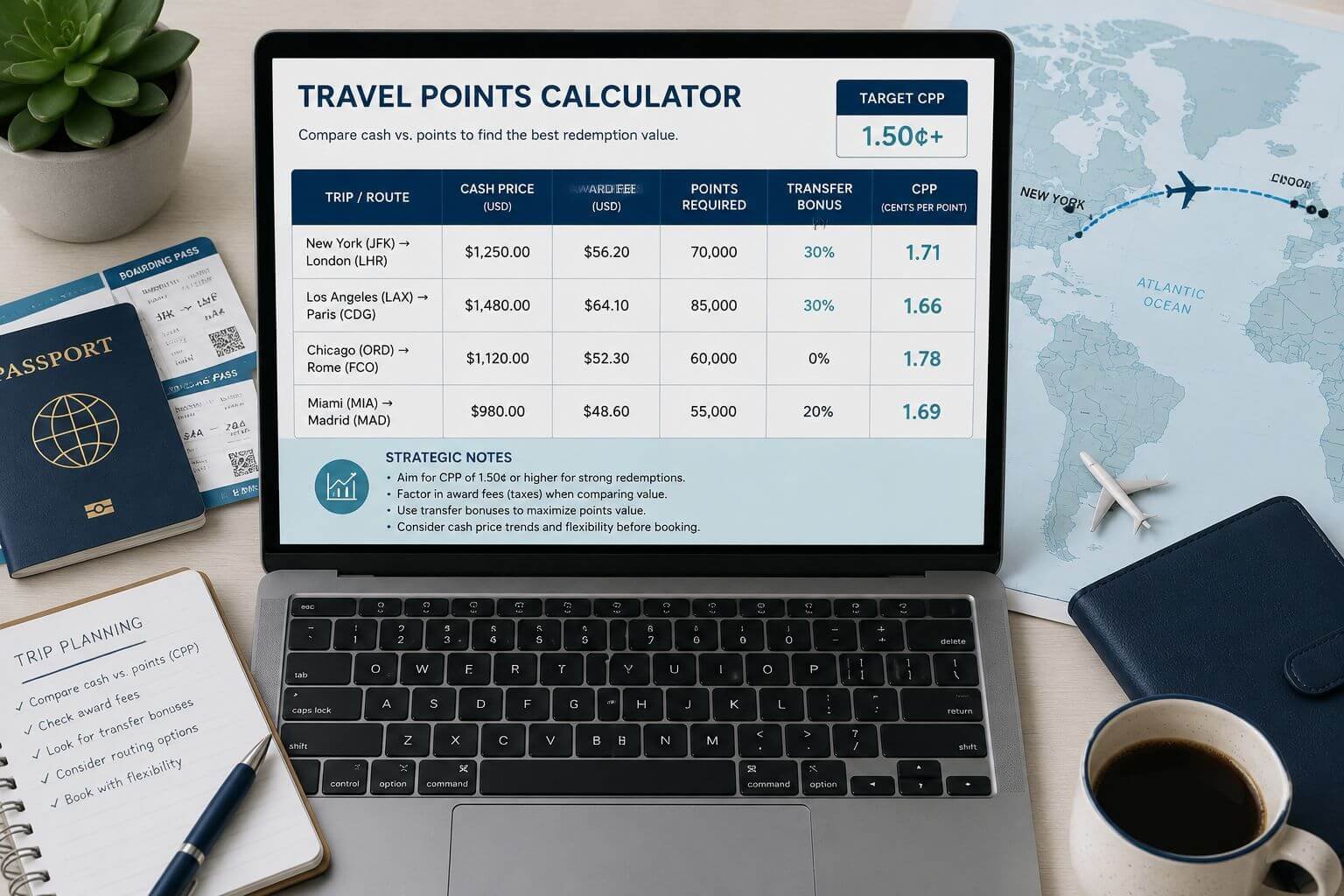
Cents-per-point: the core calculation explained
Cents per point measures how much cash value each point creates in a specific redemption. A travel points calculator uses CPP to turn different currencies, such as airline miles and hotel points, into a common comparison.
The standard CPP formula
Use this formula:
You may be interested



CPP = (cash price – award taxes and fees) ÷ points required × 100
Example:
- Cash flight price: $1,250
- Award price: 60,000 miles + $90
- Net value: $1,250 – $90 = $1,160
- CPP: $1,160 ÷ 60,000 × 100 = 1.93 cents per point
That means each mile saved about 1.93 cents in cash value.
What counts as the cash price?
Use the price you would realistically pay, not an inflated fare you would never book.
For example, a $7,500 one-way business class fare may produce a huge CPP number. But if the traveler would have paid $1,200 for premium economy or $800 for economy, the personal value is lower.
Use the most realistic comparison:
- Same dates or nearby dates
- Same cabin if you would pay for that cabin
- Reasonable routing
- Similar cancellation rules
- Taxes, fees, and seat charges included when relevant
Common mistake: ignoring fees
Award taxes, surcharges and fees reduce value. Fuel surcharges can be minor on some partner airlines and several hundred dollars on others.
If an award costs 80,000 miles plus $850 in carrier surcharges, the redemption may still be useful, but the CPP calculation must subtract that $850 from the cash value.
For deeper valuation context, see Award Travel Hub’s points and miles valuation update.
Baseline values for major programs and how to use them
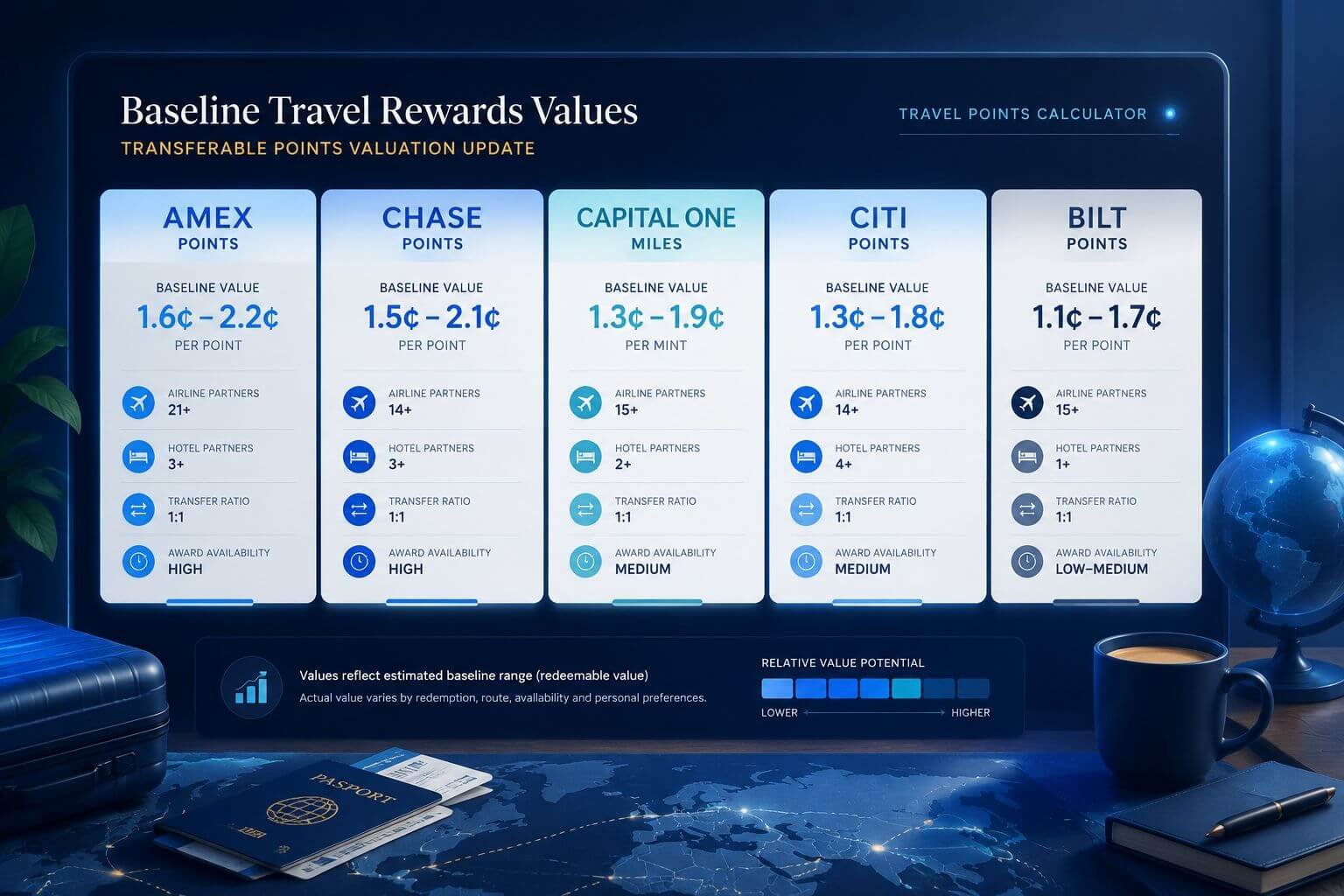
Baseline values are planning estimates, not fixed prices. In 2026, many major transferable currencies are commonly valued around the mid-to-high 1-cent range, with higher upside when transferred to strong partner airlines for premium cabin awards.
Use baseline values as a decision floor. If a redemption beats the floor and meets your travel needs, it may be worth booking. If a redemption falls below the floor, compare cash or portal options before spending points.
| Rewards currency | Practical 2026 baseline range | Best for | Watch out for |
|---|---|---|---|
| Amex points | 1.7 to 2.0 CPP | Airline transfer partners, premium cabin awards | Some partners have high fuel surcharges |
| Chase points | 1.7 to 2.0 CPP | Hyatt, partner airlines, selected portal value | Portal rates vary by card and offer |
| Capital One miles | 1.5 to 1.8 CPP | Airline transfers, simple travel redemptions | Portal redemptions are often lower than strong transfers |
| Citi points | 1.5 to 1.8 CPP | International airline partners and transfer bonuses | Fewer domestic-friendly options for some users |
| Bilt points | 1.7 to 2.0 CPP | Rent-earned transferable points, airline and hotel partners | Transfer timing and partner fit matter |
| Major hotel points | 0.4 to 1.8 CPP | Program-specific sweet spots | Dynamic pricing and devaluations |
These ranges are most useful for transferable points because transfer partners create optionality. A bank point that can become airline miles, hotel points, or portal credit is usually more flexible than a single airline currency.
For a current partner-program overview, use the Bank Transfer Partners Guide 2026 before moving points.
How to use baseline values
Use this simple rule:
- Below 1.0 CPP: usually weak for transferable points unless cash flow matters.
- 1.0 to 1.4 CPP: acceptable only for convenience or portal simplicity.
- 1.5 to 2.0 CPP: solid range for many transferable points.
- 2.0+ CPP: strong value, often from partner airline sweet spots.
- 4.0+ CPP: possible on business class deals and first class redemptions, but verify the cash comparison is realistic.
Program-specific tradeoffs
The best use of points depends on transfer ratios and program rules.
Examples:
- Chase points can be strong with Hyatt, but hotel devaluations can reduce value.
- Amex points have many airline partners, but some redemptions carry high fuel surcharges.
- Capital One miles can be easy to use, but transfers may beat portal value. See the detailed comparison of Capital One Travel portal vs transfer partners.
- Citi points can be valuable with international partner airlines, especially during transfer bonuses.
- Bilt points are useful because they transfer to valuable partners, but award space still controls the result.
How to calculate the value of a specific redemption
To calculate a specific redemption, compare the award against the realistic cash cost, subtract fees paid on the award, then divide by the number of points used. This works for flights, hotels, and portal bookings as long as the inputs are honest.
Step-by-step travel points calculator process
Find the cash price
- Use the same dates, route, cabin, and cancellation terms when possible.
Find the award price
- Note points required, taxes, surcharges, and fees.
Subtract award fees from the cash price
- Fees paid in cash reduce the value of the points.
Divide by points used
- Use the actual number of points leaving your account.
Multiply by 100
- This converts dollars per point into cents per point.
Compare against your baseline
- Use the result to decide whether to book, transfer, or pay cash.
Worked example: business class flight
Assume a one-way business class flight from New York to Madrid:
- Cash fare: $3,200
- Award price: 70,000 airline miles + $102
- Transfer ratio: 1:1 from bank points
- Award availability: confirmed on the date needed
Calculation:
($3,200 – $102) ÷ 70,000 × 100 = 4.43 CPP
That is a strong redemption if the traveler values business class and the routing works.
If there is a 20% transfer bonus, the math improves:
- Miles needed: 70,000
- Bank points needed: 58,334
- Net cash value: $3,098
- CPP on bank points: $3,098 ÷ 58,334 × 100 = 5.31 CPP
This is why transfer bonuses can be powerful. But the bonus only helps if award space exists and the transfer is completed before the seat disappears.
For route-specific premium cabin planning, see the guide to the best points to book business class to Japan in 2026.
Worked example: hotel stay
Assume a three-night hotel stay:
- Cash rate with taxes: $1,455
- Award price: 75,000 hotel points
- Resort fee on award: $0
- Cancellation rules: similar
Calculation:
$1,455 ÷ 75,000 × 100 = 1.94 CPP
That is excellent for many hotel points. But the answer changes if the cash rate drops, the award price rises, or the hotel adds fees that are not waived.
Hotel points need extra care in 2026 because dynamic pricing can move award costs closer to cash rates. For hotel-specific tactics, read the Dynamic Hotel Award Pricing Playbook 2026.
Comparing transfer vs portal vs cash with simple math
The best booking method is the one that gives the strongest net value after fees, flexibility, and opportunity cost. A transfer to partner airlines often wins for premium cabin awards, while portals or cash can win for cheap economy flights, independent hotels, and bookings where award space is weak.

Comparison table: which option should you choose?
| Booking option | Best for | Not for | Main risk |
|---|---|---|---|
| Transfer to airline partner | Premium cabin awards, sweet spots, alliance partners | Cheap cash fares, uncertain plans | Transfers are often irreversible |
| Transfer to hotel partner | High-value hotel awards, waived fees, peak cash rates | Low-category cash deals | Dynamic pricing and devaluations |
| Travel portal | Simple bookings, paid-flight earnings, no award space | High-value premium awards | Portal value may be capped |
| Pay cash | Low fares, mileage earning, flexible comparison shopping | Expensive peak travel | Uses cash instead of points |
Booking walkthrough: three options
Assume a round-trip economy flight:
- Cash fare: $360
- Portal price: 24,000 points at 1.5 CPP
- Airline award: 30,000 miles + $11
Transfer award CPP:
($360 – $11) ÷ 30,000 × 100 = 1.16 CPP
Portal value:
$360 ÷ 24,000 × 100 = 1.5 CPP
In this case, the portal booking is better than transferring points. The traveler may also earn airline miles and elite credit if the portal ticket books as a paid fare.
Now assume an international business class award:
- Cash fare: $3,800
- Portal price: 253,334 points at 1.5 CPP
- Partner award: 75,000 miles + $180
Transfer award CPP:
($3,800 – $180) ÷ 75,000 × 100 = 4.83 CPP
In this case, transferring points is likely better, assuming the seat is available and the routing is acceptable.
Decision rule
Choose transfer partners if:
- CPP is well above your baseline
- Award availability is confirmed
- Surcharges are reasonable
- You understand cancellation rules
- The transfer is instant or low-risk
Choose portal or cash if:
- Cash fares are low
- Award prices are dynamic and inflated
- You need a paid ticket for elite credit
- The award has poor routing, long layovers, or high fees
- You may need easy changes or cancellations
Chase users should check the displayed portal value before assuming a fixed outcome, especially as Chase Points Boost and card-specific portal rates can change the comparison.
Common valuation mistakes that inflate point worth
Most inflated point values come from using unrealistic cash prices, ignoring fees, or treating all points as equal. A travel points calculator is only useful when the inputs match the trip the traveler would actually book.
Mistake 1: using a cash fare you would never pay
Premium cabin awards can show high CPP because paid business and first class fares are expensive. That does not mean every premium cabin redemption is personally worth the cash fare.
Better approach:
- Use the cabin you would realistically buy as a secondary comparison.
- Treat the full premium fare as “market value,” not always personal value.
- Do not justify bad routing only because the CPP looks high.
Mistake 2: ignoring devaluation risk
Devaluation risk is the chance that a program raises award prices, removes award charts, adds dynamic pricing, or increases fees. This risk is higher when points are transferred speculatively and left unused.
Avoid mistakes by:
- Transferring only after finding award space
- Knowing whether transfers are instant
- Checking program rules before moving points
- Using transfer bonuses for near-term bookings, not vague future plans
Hotel programs have been especially active with pricing changes. For example, Award Travel Hub’s Marriott Bonvoy devaluation analysis explains why hotel point values need ongoing review.
Mistake 3: forgetting opportunity cost
Using points has a cost because those points could be used elsewhere. Spending 100,000 Chase points on a low-value hotel booking may block a better Hyatt stay or airline transfer later.
Ask:
- What else could these points book?
- Is this trip urgent or flexible?
- Is the award space rare?
- Would cash preserve points for a better redemption?
Mistake 4: overvaluing hard-to-book awards
Some sweet spots look excellent on paper but are difficult to book. Limited award availability, married segments, stopover rules, and positioning flights can reduce real value.
A 6 CPP redemption is less compelling if it requires:
- Two positioning flights
- Overnight airport hotels
- Separate tickets with misconnect risk
- High fuel surcharges
- Unreliable award space
- Long transfer delays
Mistake 5: comparing different products
A nonstop cash flight is not the same as a two-stop award itinerary. A refundable hotel rate is not the same as a prepaid award alternative if cancellation policies differ.
Match the comparison as closely as possible before calculating CPP.
Putting it together: a repeatable redemption decision
A repeatable redemption decision uses math first, then program rules, then practical travel constraints. The right answer is often clear after comparing CPP, award space, fees, and flexibility side by side.
Use this decision framework before every major redemption.
The seven-step decision framework
Define the trip
- Dates, route, cabin, hotel area, and flexibility.
Check cash prices
- Look at realistic paid options, not just the highest fare.
Search award space
- Use airline sites, alliance partners, hotel calendars, and award search tools.
Run the CPP calculation
- Subtract fees and calculate the value of the points used.
Compare against baselines
- Decide whether the redemption beats your personal floor.
Review rules
- Check transfer ratios, transfer times, cancellation fees, stopovers, and surcharges.
Book or wait
- Transfer only when the award is available and the value justifies the risk.
Best for / Not for
This approach is best for:
- Intermediate points users with transferable points
- Premium cabin awards
- International partner airline bookings
- Hotel stays during high cash-rate dates
- Transfer bonus decisions
This approach is not for:
- Travelers who want the fastest booking regardless of value
- Redemptions with no cash alternative
- Situations where cash savings matter more than CPP
- Highly speculative transfers without firm plans
Quick checklist before transferring points
Before clicking transfer, confirm:
- Award space is visible and bookable
- The transfer ratio is correct
- The number of points includes any transfer bonus
- Taxes, fuel surcharges, and fees are acceptable
- Names match across accounts
- Transfers are expected to arrive in time
- Cancellation and redeposit rules are acceptable
- No better partner airline has the same award for fewer miles
If booking through Star Alliance programs, partner rules and award space can vary by program. The Star Alliance award booking guide can help compare alliance partners before transferring points.
FAQ
What is a travel points calculator?
A travel points calculator is a simple tool or formula that converts a points redemption into cents per point. It helps compare award bookings against cash prices, portal rates, and transfer partner options.
What is a good cents-per-point value in 2026?
A good value for transferable points in 2026 is often around 1.5 CPP or higher, while strong partner airline redemptions can exceed 2.0 CPP. The right target depends on the program, fees, award availability, and your realistic cash alternative.
Should taxes and fuel surcharges be included in CPP?
Yes. Taxes, fuel surcharges, and award booking fees should be subtracted from the cash price before calculating CPP. Fees paid in cash reduce the value created by the points.
Are airline miles worth more than hotel points?
Airline miles often have higher upside for premium cabin awards, while hotel points vary widely by program. Some hotel points can be excellent during peak cash-rate dates, but dynamic pricing and devaluations can reduce value.
Is it better to transfer points or book through a travel portal?
Transferring points is usually better for high-value airline or hotel awards, especially premium cabin awards. A travel portal can be better for cheap cash fares, simple bookings, or when award availability is poor.
Do transfer bonuses always make redemptions better?
No. Transfer bonuses improve the math only when there is useful award space and the program has reasonable pricing and fees. Speculative transfers can backfire if award prices rise or plans change.
Conclusion
A travel points calculator is the simplest way to avoid wasting miles and transferable points in 2026. Start with the CPP formula, compare the result against realistic baseline values, then factor in award availability, surcharges and fees, transfer risk, and cancellation rules.
The strongest booking strategy is usually:
- Search cash prices first.
- Check partner airlines and hotel programs.
- Calculate CPP after fees.
- Compare portal, transfer, and cash options.
- Transfer points only when the award is available and the value is clear.
High CPP is useful, but it is not the only goal. The best redemption is the one that saves meaningful cash, fits the trip, and uses points that would not be better deployed elsewhere.
Related reading
- Award travel calculators to maximize rewards and value
- Bank transfer partners guide 2026
- Capital One Travel portal vs transfer partners in 2026
- Dynamic hotel award pricing playbook 2026





Content on Award Travel Hub is independently created by Award Travel Hub Editorial Desk and, where noted, reviewed by Award Travel Hub Review Desk. Some pages may contain affiliate links, but compensation does not determine our coverage, opinions, or methodology.