

Last updated: May 4, 2026
Quick Answer: You can downgrade most travel credit cards to no-annual-fee versions and keep your points, but the rules differ by issuer. Chase and Amex points stay in your account as long as you hold at least one card that earns that currency. Citi and Capital One miles generally survive a downgrade. Bilt points remain tied to your Bilt account regardless of card tier. The key is knowing each bank’s specific rules before you call, so you don’t accidentally forfeit a balance worth hundreds or thousands of dollars.
Key Takeaways
- Downgrading preserves your credit history and account age, which canceling does not. This matters for your credit score.
- Chase Ultimate Rewards points survive a downgrade to Freedom or Freedom Unlimited, but you lose the ability to transfer to partner airlines and hotels unless you hold another premium UR card (like Ink Business Preferred).
- Amex Membership Rewards points stay as long as you keep at least one MR-earning card open. If you close your last MR card, you forfeit points.
- Always call for a retention offer first. Banks frequently offer 10,000–30,000 bonus points or $100–$300 in statement credits to keep you from downgrading.
- Most issuers require 12 months before allowing a product change, so plan ahead.
- Citi’s downgrade policies are inconsistent—results vary by agent and by week.
- Canceling may be better than downgrading if the card is under two years old and you want to reapply for a new welcome bonus later.
- Bilt’s multi-card lineup (Blue, Palladium, Obsidian) means your points live in the Bilt ecosystem, not on a specific card.
- Run the math annually. The average cardholder leaves $624 in card benefits unused each year.
Why Downgrade Strategies Matter More as Annual Fees Stack Up
Annual fees on premium travel cards have climbed steadily, and many intermediate cardholders now carry two, three, or more cards with fees ranging from $95 to $695. The math that justified each card in year one—when a welcome bonus offset the fee—often doesn’t hold in year two and beyond.
The core question when you want to downgrade a travel credit card and keep points is straightforward: Does the card still earn or save you more than its annual fee?
If not, you have three options:
- Negotiate a retention offer to make the fee worthwhile for another year.
- Downgrade (product change) to a no-fee or lower-fee card in the same family.
- Cancel the card outright.
Downgrading is usually the safest default because it preserves your credit line, account age, and—most importantly—your transferable points balance. But each bank handles this differently, and a wrong move can cost you tens of thousands of points.
Industry analysts are increasingly recommending simplification in 2026, with some closing cards that require managing complicated “coupon book” credits that don’t match actual spending. One analyst downgraded a Chase Sapphire Reserve to a Sapphire Preferred in early 2026, cutting the net annual cost from roughly $195 (after the $300 travel credit) to just $45.
For a broader look at whether your current cards still make sense, see our credit card annual fee review framework.
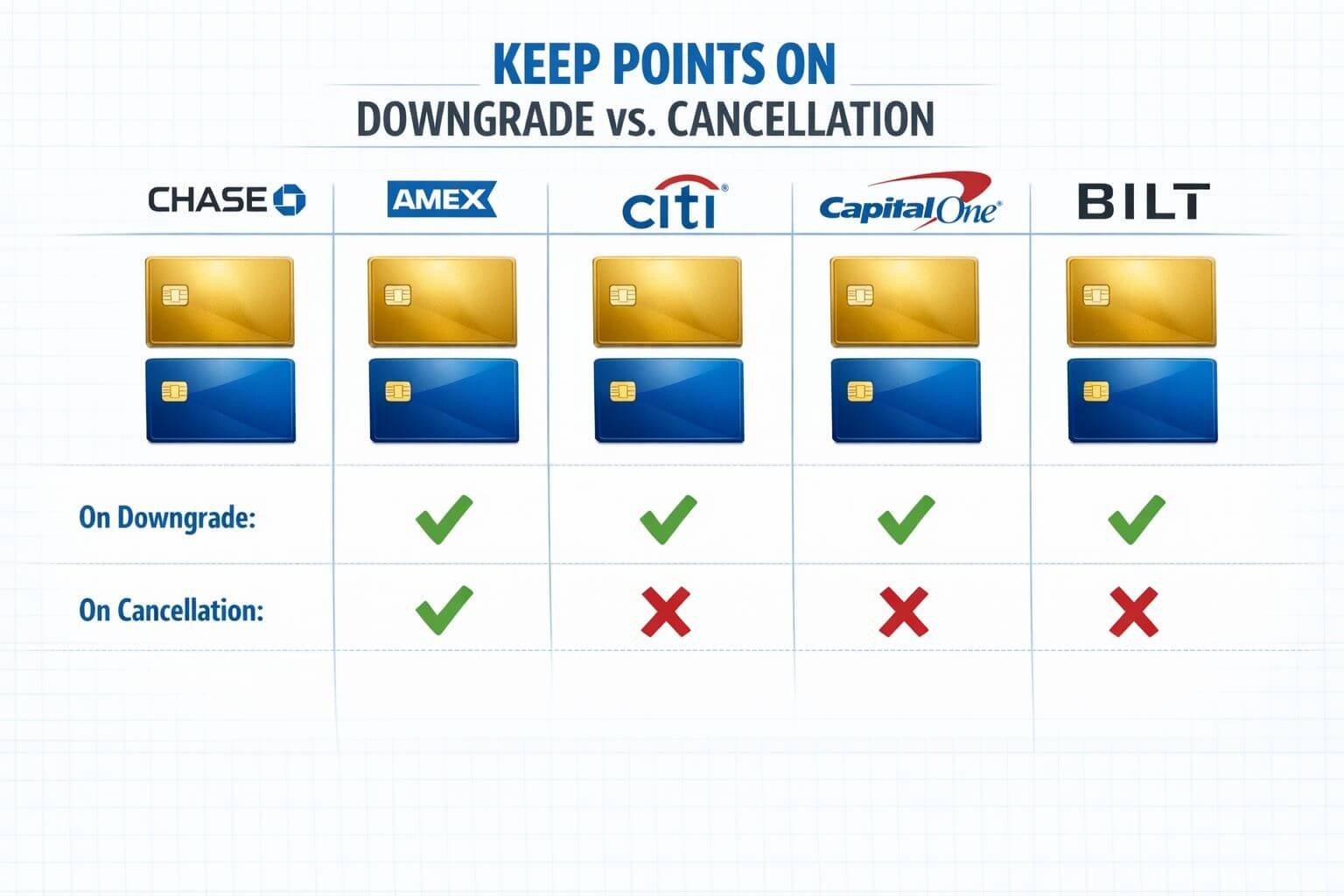
How Chase, Amex, Citi, Capital One, and Bilt Treat Points on Downgrades
This is where the details matter most. Here’s a bank-by-bank breakdown of what happens to your points when you downgrade or cancel in 2026.
Chase Ultimate Rewards
Safe downgrade targets: Chase Freedom Unlimited, Chase Freedom Flex, Chase Freedom Rise
You may be interested



Chase points stay in your account when you downgrade a Sapphire Reserve or Sapphire Preferred to a Freedom card. However, Freedom cards cannot transfer points to airline and hotel partners—they can only be redeemed for cash back or statement credits at 1 cent per point (CPP).
Critical rule: To maintain transfer access to partners like Hyatt, United, and Southwest, you need at least one premium UR card (Sapphire Preferred, Sapphire Reserve, or Ink Business Preferred). If you downgrade your only Sapphire card and don’t have an Ink Business Preferred, your points are safe but locked into lower-value redemptions.
| Scenario | Points Safe? | Transfer to Partners? |
|---|---|---|
| Downgrade CSR to Freedom Flex (no other premium card) | Yes | No |
| Downgrade CSR to Freedom Flex + keep Ink Business Preferred | Yes | Yes |
| Cancel CSR (no other UR card) | Points forfeited | N/A |
Decision rule: If you hold an Ink Business Preferred ($95/year), downgrading your Sapphire card is clean—you keep full transfer flexibility at a lower total cost. If you don’t have a business card, downgrade to Sapphire Preferred ($95/year) instead of Freedom to preserve transfer access.
For more on maximizing Chase transfers, see our guide to Chase transfer partners and bonuses.
Amex Membership Rewards
Safe downgrade targets: Amex Green (still has a fee), EveryDay, EveryDay Preferred
Amex points remain in your Membership Rewards account as long as you hold at least one MR-earning card. If you close or downgrade your last MR card, your points are forfeited—no grace period, no exceptions.
Important restriction (2024 policy change): Amex eliminated the downgrade path from the Delta Business Platinum to the Delta Business Gold in July 2024, citing the expanded “buying power” feature. This kind of restriction can appear without warning on other cards too.
Common mistake: Assuming co-branded Amex cards (Delta, Hilton, Marriott) earn Membership Rewards. They don’t. Closing a Hilton Aspire doesn’t affect your MR balance because Hilton points live with Hilton, not Amex.
For a full list of where Amex MR points can go, check our Amex Membership Rewards transfer partners guide.
Citi ThankYou Points
Safe downgrade targets: Citi Double Cash, Citi Custom Cash
Citi points survive a downgrade, and both the Double Cash and Custom Cash earn ThankYou points. However, Citi’s product change policies are notoriously inconsistent—some cardholders report being blocked from switching AA-branded cards to non-AA products, while others succeed in the same week.
Practical tip: If your first call doesn’t go well, try again a few days later with a different agent. Document the date, time, and agent name for each attempt.
Capital One Miles
Safe downgrade targets: Capital One Quicksilver, Quicksilver One
Capital One miles are generally retained after a downgrade. However, only the Venture X, Venture, and Spark Miles cards can transfer miles to airline partners. Downgrading to Quicksilver means your miles become fixed-value at 1 CPP, either through the Capital One travel portal or as statement credits toward travel purchases.
Bilt Points
No traditional downgrade needed in most cases. Bilt points live in your Bilt Rewards account, not on the card itself. If you hold the Bilt Mastercard (no annual fee), your points are safe regardless of what happens to a co-branded Bilt product.
Bilt’s evolving lineup—Blue, Palladium, Obsidian—means the ecosystem is still shifting. Beginning in late 2024, Bilt capped Rent Day double-earn at 1,000 bonus points per month, which reduced the upside of aggressive spending for some users. This makes it worth reassessing whether a higher-tier Bilt card is justified by its cost if you’re not hitting the spending thresholds that matter.
For Rent Day strategies, see our guide to maximizing Bilt dining and Rent Day rewards.
Safe Downgrade Paths That Keep Your Bank Points Alive
Here’s a step-by-step framework for executing a downgrade without losing points:
Step-by-Step Downgrade Checklist
- Check your card’s anniversary date. Call 30–60 days before the annual fee posts. If the fee has already been posted, most banks give you 30–41 days to downgrade and receive a full refund.
- Verify you’ve held the card for 12+ months. Most issuers won’t allow product changes before the one-year mark.
- Call and ask for a retention offer first. Say: “I’m considering my options for this card because the annual fee is coming up. Are there any offers available on my account?” Don’t mention downgrading yet. Retention offers of 10,000–30,000 points or $100–$300 credits are common.
- Evaluate the retention offer. If the offer effectively reduces the net fee below the value you get from the card, it may be worth staying another year.
- If declining, request a product change. Ask: “I’d like to product change to [specific card name]. Can you process that?” Name the exact target card.
- Confirm points are retained. Before hanging up, ask: “Can you confirm my [points currency] balance will remain in my account after this change?”
- Verify in writing. Check your online account within 7–10 days to confirm that the product change has been processed and your points balance is intact.
Common Mistakes to Avoid
- Canceling instead of downgrading when you have a large points balance and no other card in that ecosystem.
- Downgrading your only transfer-capable card without realizing you’ve locked your points into low-value redemptions.
- Not asking for retention offers. You’re leaving money on the table.
- Forgetting about the welcome bonus clawback rules. Some issuers may claw back a bonus if you downgrade within 12 months of receiving it. See our guide to welcome bonus clawbacks for details.
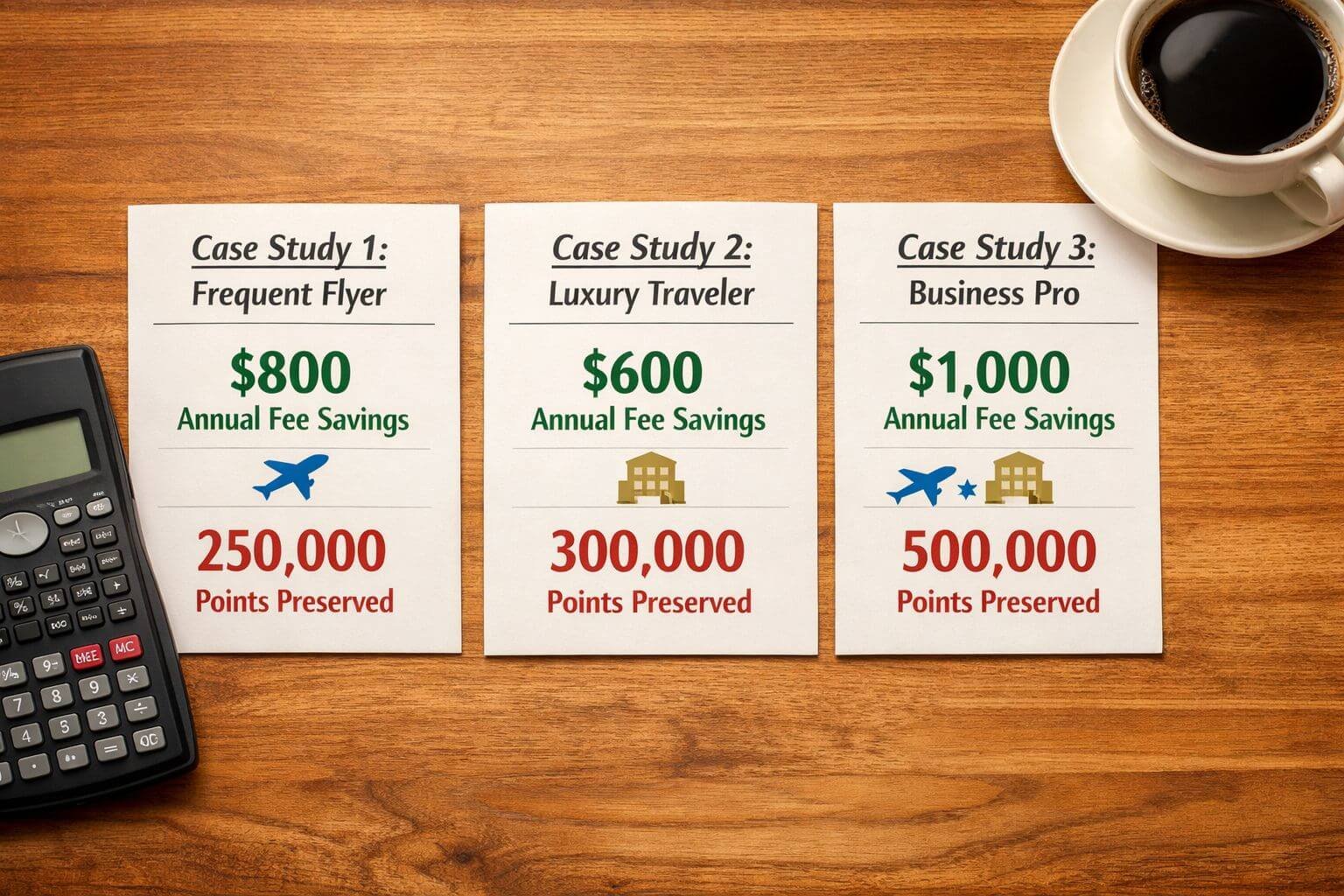
Case Studies: When Downgrading Beats Canceling (and Vice Versa)
Case Study 1: Chase Sapphire Reserve → Sapphire Preferred
Profile: Cardholder earns 80,000 UR points/year through dining and travel. Rarely uses lounge access. Has no business cards.
| Factor | Keep CSR | Downgrade to CSP |
|---|---|---|
| Annual fee (net) | $195 ($495 – $300 credit) | $95 ($95 – $0 travel credit… actually $50 hotel credit) |
| Transfer to partners? | Yes | Yes |
| Earn rate on dining | 3x | 3x |
| Earn rate on travel | 5x (portal) / 3x (other) | 5x (portal) / 2x (other) |
| Annual fee savings | — | $100/year |
| Points retained | 80,000+ | 80,000+ |
Verdict: Downgrade. The $100 annual savings is real, points stay fully transferable, and the earn rate difference is marginal for most spending patterns. This is the exact move one analyst made in early 2026.
Case Study 2: Amex Platinum → Amex Green (with Amex Gold kept)
Profile: Cardholder holds both Amex Platinum ($695) and Amex Gold ($325). Doesn’t use Centurion Lounge access enough to justify the Platinum fee. Has 150,000 MR points.
- Downgrade Platinum to Green ($150/year): Saves $545/year. MR points stay because the Gold card remains open. Loses Centurion access, Fine Hotels & Resorts, and $200 airline/Uber credits.
- Cancel Platinum outright: Same fee savings, but loses account history. Points are still safe because Gold is open.
Verdict: Downgrade to Green if you value the credit line and account age. Cancel if the Platinum is under two years old, and you might want to reapply for a new welcome bonus later.
Case Study 3: Citi Premier → Double Cash
Profile: Cardholder has 45,000 ThankYou points. Doesn’t travel enough to justify the $95 Premier fee. Wants to keep points for a future transfer to a partner airline.
- Downgrade to Double Cash: $0 annual fee. Points retained. Double Cash earns 2% on everything (as ThankYou points). Transfer access preserved.
- Cancel: Points forfeited if no other ThankYou-earning card is open.
Verdict: Downgrade. This is one of the cleanest downgrade paths available—you keep transfer access, earn a competitive flat rate, and pay nothing.
Timing, Credit Score, and Bonus Clawback Considerations
When to downgrade: The ideal window is 30–60 days before your annual fee posts. If the fee has already been posted, call within 30 days—most banks will refund the fee in full upon product change.
Credit score impact: A product change (downgrade) does not trigger a hard inquiry and does not close your account. Your credit age, credit limit, and utilization ratio remain unchanged. Canceling, by contrast, reduces your total available credit and can shorten your average account age.
Bonus clawback risk: If you received a welcome bonus within the past 12 months, downgrading may trigger a clawback. Chase’s terms generally require keeping the card for 12 months. Amex’s terms are broader—some bonuses require keeping the card for a full year after the bonus posts. Always check the specific terms of your welcome offer.
The reapplication angle: Sometimes, canceling is strategically better than downgrading. If you cancel a Chase Sapphire Preferred and wait 48 months from your last Sapphire bonus, you can reapply and earn a new welcome bonus. Downgrading keeps the product family “occupied,” which may block future eligibility for bonuses.
| Strategy | Best For | Not For |
|---|---|---|
| Downgrade | Large points balance, long account history, want to preserve credit line | Cards under 12 months old, planning to reapply for same card’s bonus |
| Cancel | Short account history, planning to reapply, no points at risk | Oldest credit card, large unredeemed points balance |
| Keep (with retention offer) | High spenders who use most card benefits, strong retention offer | Cards where benefits don’t match your spending patterns |
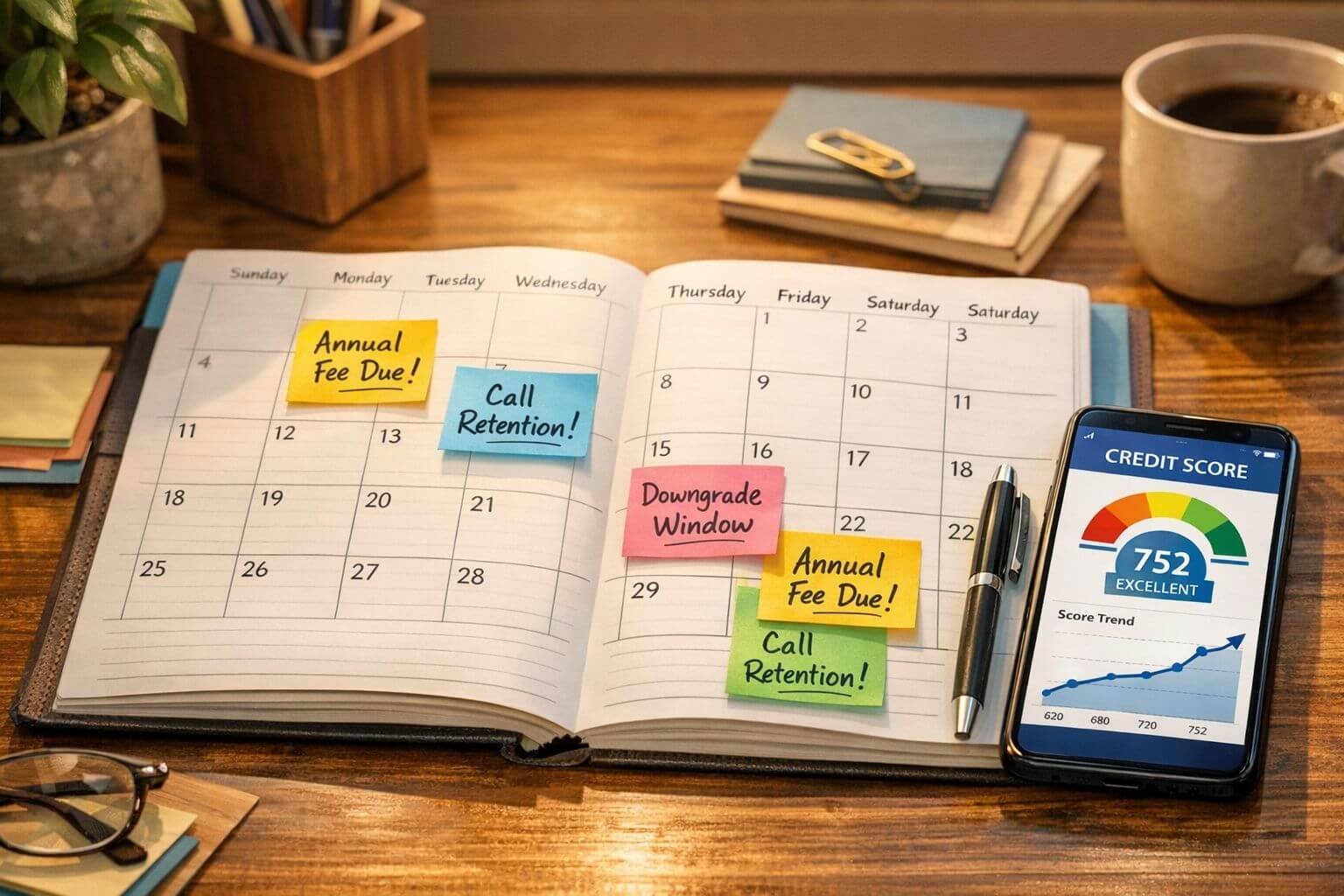
How to Revisit Your Card Lineup Every 12–24 Months
A downgrade isn’t a one-time decision—it’s part of an ongoing card management strategy. Set a recurring calendar reminder 45 days before each card’s annual fee date.
Annual review framework:
- List every card with an annual fee. Include the fee amount and the posting date.
- Calculate the actual value received. Add up credits used, points earned (valued at your target CPP), and benefits consumed (lounge visits, free night certificates, travel insurance claims).
- Compare value to fee. If the value exceeds the fee by a comfortable margin, keep it. If it’s close or negative, call for a retention offer.
- Decide: keep, downgrade, or cancel. Use the decision rules above.
- Check for upgrade offers. Sometimes Amex or Chase will offer bonus points to upgrade a no-fee card to a premium version—this can be a better path than applying for a new card.
As programs evolve—Bilt’s Rent Day caps, Chase’s shifting portal rates, Amex’s changing downgrade paths—the card that made sense last year may not make sense this year. Our 2026 award travel trends guide covers the broader shifts worth watching.
For comparing current no-fee alternatives, see our best no-annual-fee travel cards for 2026.
FAQs About Downgrades, Closures, and Keeping Points
Can I downgrade a travel credit card and keep points with every bank?
Yes, with caveats. Chase, Amex, Citi, and Capital One all allow product changes that preserve points. The specific downgrade targets and transfer capabilities vary by issuer. Bilt points live in your Bilt account regardless of card status.
Do I lose airline miles if I cancel a co-branded card?
No. Miles earned through co-branded cards (like a United or Delta card) belong to the airline loyalty program, not the bank. Canceling or downgrading the card doesn’t affect your airline mile balance.
How long do I have to downgrade after my annual fee posts?
Most banks give you 30–41 days after the fee posts to product change and receive a full refund. Chase is typically 41 days; Amex is 30 days. Don’t wait until the last day—call early.
Will a downgrade hurt my credit score?
No. A product change is not a new account and does not generate a hard inquiry. Your account age, credit limit, and payment history are preserved.
Can I downgrade and then upgrade back later?
Yes, but upgrade offers aren’t always available, and upgrading typically doesn’t earn a welcome bonus (though targeted upgrade offers sometimes include bonus points). Check your issuer’s current offers before assuming this path works.
What if Citi won’t let me downgrade?
Citi’s policies are inconsistent. If one agent refuses, call back and try again with a different representative. Some cardholders report success after multiple attempts.
Should I transfer my points before downgrading?
Only if you’re downgrading to a card that loses transfer capability and you don’t hold another card that preserves it. For example, if you’re downgrading your only Chase Sapphire card to a Freedom card and don’t have an Ink Business Preferred, consider transferring points to a partner first. But don’t rush—transferred points can’t be moved back.
Is it better to downgrade or cancel if I want a new welcome bonus?
Cancel if you plan to reapply for the same card and enough time has passed since your last bonus (48 months for Chase Sapphire, varies by issuer). Downgrade if you want to preserve your credit line and aren’t planning to reapply.
What’s a retention offer, and how do I get one?
A retention offer is an incentive (bonus points, statement credit, or fee waiver) that the bank offers to keep you from downgrading or canceling. Call the number on the back of your card and mention you’re evaluating whether to keep the card. Don’t threaten—just ask what options are available.
Do I need to use my new downgraded card?
Not necessarily, but some issuers may close inactive accounts after 12–24 months. Make at least one small purchase per quarter to keep the account active.
Conclusion
The decision to downgrade a travel credit card and keep points is one of the highest-value moves in card management—but only when executed with the right information. Each bank has different rules, different safe downgrade targets, and different consequences for getting it wrong.
Your next steps:
- Identify which annual fees are due within the next 60 days.
- Check the bank-by-bank rules above to confirm your points will survive a downgrade.
- Call for a retention offer first—you might get enough value to justify keeping the card another year.
- If downgrading, name the specific target card and confirm your points balance before hanging up.
- Set a calendar reminder to repeat this process in 12 months.
For help deciding what to do with the points you’ve preserved, our guide to booking business class with points and secrets to booking award flights with flexible points are good next reads.


Content on Award Travel Hub is independently created by Award Travel Hub Editorial Desk and, where noted, reviewed by Award Travel Hub Review Desk. Some pages may contain affiliate links, but compensation does not determine our coverage, opinions, or methodology.