
Airline Alliances:
How Oneworld, SkyTeam, and Star Alliance Work
Last updated: July 31, 2026
Quick Answer
The three major global airline alliances are Oneworld, SkyTeam, and Star Alliance. Each one links member airlines for coordinated schedules, reciprocal elite recognition, and the ability to book award seats across member carriers, but an alliance is not a single frequent flyer program. There is no shared award chart, shared points currency, or shared pool of award seats. Travelers never transfer bank points to an alliance; they transfer to one eligible airline loyalty program, then use that program’s rules and pricing to book flights operated by its alliance and non-alliance partners.
Key Takeaways
- An airline alliance is a commercial and customer-benefit partnership, not a merged loyalty program. Miles stay in the individual program where they were earned.
- Bank points transfer to specific airline programs (for example, a single Star Alliance carrier), never to “Star Alliance” as an entity. Check the credit card transfer partners landscape before planning.
- The program issuing the ticket controls award pricing, routing rules, permitted partners, change fees, and cancellation policy. The operating airline controls the aircraft, cabin, and onboard service.
- The same flight can cost different mileage amounts and different cash charges depending on which loyalty program issues the award.
- Award space visible on one program’s search tool may not appear in another program’s tool, and a seat for sale on the operating airline’s site does not prove partner award availability.
- Membership changes matter: ITA Airways joined Star Alliance on March 31, 2026, Hawaiian Airlines joined Oneworld on April 23, 2026, and Asiana’s announced Star Alliance departure is scheduled for December 16, 2026.
- SAS is a SkyTeam member. Copa Airlines is a Star Alliance member. Aeroflot’s SkyTeam membership and S7’s Oneworld membership are suspended.
- Reciprocal elite benefits such as priority check-in, extra baggage, and lounge access depend on tier, cabin, operating carrier, airport, and published exceptions. Alliance status does not guarantee any specific perk.
What are airline alliances and how do they work?
An airline alliance is a formal group of independent airlines that agree to cooperate on selected commercial and customer-facing activities: schedule coordination, connecting itineraries sold on one ticket, reciprocal frequent flyer earning and redemption, and reciprocal elite recognition across member carriers.
Each member keeps its own management, fleet, pricing, fare rules, and loyalty program. Cooperation happens through negotiated bilateral and multilateral agreements that sit underneath the alliance brand.
What alliances typically enable:
- Selling and ticketing itineraries that combine multiple member airlines
- Earning miles in one member program while flying another member
- Redeeming miles from one member program on eligible flights operated by other members
- Reciprocal recognition of elite tiers, mapped to alliance-wide status levels
- Coordinated terminals, transfer facilities, and connection support at shared hubs
What alliances do not do:
- Create one combined award chart or a single points currency
- Merge member loyalty programs or let travelers move miles between them
- Guarantee that every member can book every other member’s award space
- Standardize carrier-imposed surcharges, service fees, or cancellation rules
- Guarantee identical availability to every partner program
The practical takeaway: alliance membership defines who may cooperate. The loyalty program you actually use defines what you can book, at what price, under which rules.
Which are the biggest airline alliances in 2026?
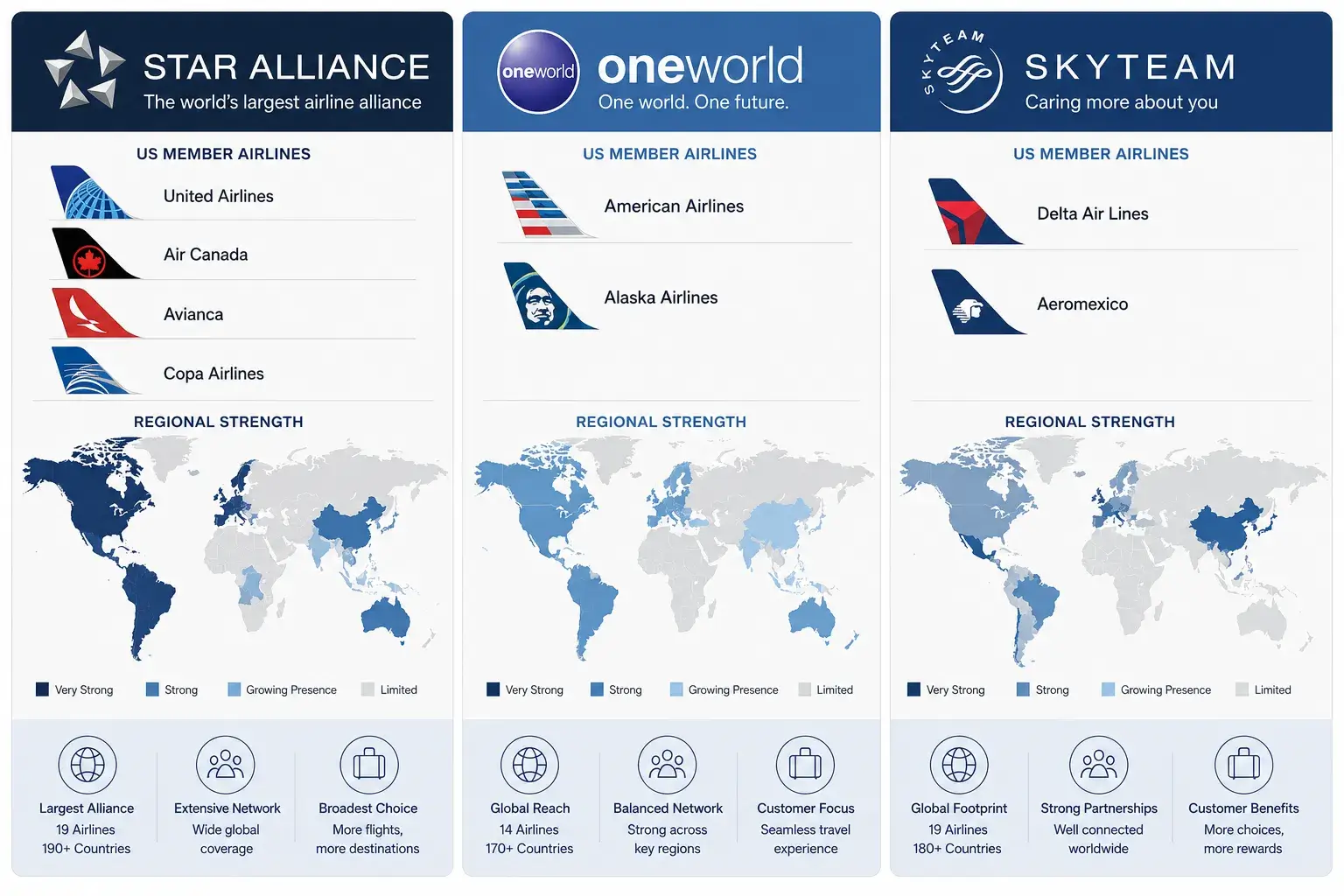
Star Alliance is the largest of the three by member count, Oneworld is the smallest, and SkyTeam sits in between. Because member rosters shift with additions, suspensions, and departures, treat any published count as a snapshot rather than a permanent figure and confirm current lists on the official alliance websites.
As of this update (July 31, 2026), the broad picture looks like this:
| Alliance | U.S. member airlines | Frequently cited network strengths | ATH guide |
|---|---|---|---|
| Star Alliance | United | Broad multi-continent coverage, including large European and Asian member networks plus Latin American members | Star Alliance award booking guide |
| Oneworld | American Airlines, Alaska Airlines, Hawaiian Airlines | Strong transatlantic, Middle East, Northeast Asia, and Pacific presence through its member mix | Oneworld award booking guide |
| SkyTeam | Delta Air Lines | Deep Western European, Northern European, East Asian, and Latin American coverage through its member mix | SkyTeam award booking guide |
Each alliance publishes its own destination and country totals, and those figures are calculated differently by each group (some count all member destinations including regional subsidiaries). Rather than reprinting numbers that change, compare the specific routes you actually fly.
Decision rule: if you fly a small number of repeat routes, ignore alliance size entirely. Count how many members serve your city pairs in the cabin you want, then look at which of those airlines’ programs accept your points.
Star Alliance vs Oneworld vs SkyTeam: which is best?
No alliance is universally best. The right one depends on your home airport, the routes and regions you fly, which airline programs accept transfers from the points you hold, and whether you value elite recognition or award redemption more.
Ask these questions in order:
- Where do you start most trips? A United hub, a Delta hub, and an American hub each push you toward a different alliance for practical connections and status usefulness.
- Where do you want to go, in which cabin? Long-haul premium cabin access varies by member airline, season, and route, not by alliance as a whole.
- Which points do you hold? Bank transfer partners determine which member programs are realistically usable. A large alliance is not helpful if none of its member programs accept your currency.
- What matters more, earning or burning? Elite recognition rewards concentrating credited flying with one alliance. Award redemption rewards flexibility across many programs, including non-alliance partners.
Common mistake: choosing an alliance based on a blog headline about one sweet spot. Sweet spots get repriced, surcharge treatment changes, and partner access gets restricted. A durable strategy is built around your geography and your points portfolio, not a single redemption.
For route-level detail, program-by-program booking notes, and search guidance, use the three dedicated guides: Star Alliance, Oneworld, and SkyTeam.
Which alliance has the most destinations, and is one best for international travel?
Star Alliance generally reports the largest combined destination footprint of the three, but destination counts are self-reported, methodologies differ, and totals change as members join or leave. No single alliance is best for all international travel.
Why raw destination counts mislead:
- A destination served once weekly by a regional subsidiary counts the same as a daily widebody route.
- Award seat access, not route existence, determines whether points get you there.
- Non-alliance partnerships can cover the exact gap you care about. American works with several non-alliance carriers, Delta works with airlines outside SkyTeam, and Alaska maintains partners beyond Oneworld.
- Regional depth varies inside each alliance. Two members serving the same continent may have almost no overlap in secondary cities.
Better approach for international planning: pick the region first, then list every airline that flies your target route (alliance or not), then check which loyalty programs can issue awards on those carriers. That order produces usable options far more often than starting from “which alliance is best.”
Start route research from the airlines hub, which organizes individual carrier and program guides.
Current membership and 2026 transition notes
Alliance rosters changed meaningfully in 2026, and several widely repeated details in older articles are now wrong. The list below reflects verified status as of July 31, 2026. Always confirm against the official Star Alliance, Oneworld, and SkyTeam member pages before transferring points.
Confirmed changes and clarifications:
- ITA Airways joined Star Alliance on March 31, 2026. ITA is not a SkyTeam member. Older guides that list the carrier under SkyTeam (a legacy of Alitalia’s membership) are outdated.
- Hawaiian Airlines joined Oneworld on April 23, 2026, following the Alaska Air Group combination. Alaska Airlines remains an Oneworld member.
- SAS (Scandinavian Airlines) is a SkyTeam member, not a Star Alliance member. The SAS program guide covers current details.
- Copa Airlines is a Star Alliance member, not a SkyTeam member.
- Fiji Airways and Oman Air are full Oneworld members.
- Philippine Airlines is an Oneworld member-designate. Treat it as a future member until Oneworld confirms completed entry; do not assume Oneworld award access or full reciprocal benefits before then.
- Asiana Airlines remains a Star Alliance member until its announced departure on December 16, 2026. This is a pending change tied to the Korean Air integration. Awards for travel after that date carry added risk.
- Aeroflot’s SkyTeam membership is suspended. Do not treat it as an active member.
- S7 Airlines’ Oneworld membership remains suspended. Do not treat it as an active member.
Why these distinctions matter for points: partner award access follows current membership and current bilateral agreements. If a carrier is suspended, departing, or not yet fully integrated, partner redemptions may be unavailable, may be withdrawn on short notice, or may require the operating airline’s own program instead.
Edge case to plan around: if you hold an award on a departing member for travel after its exit date, confirm the issuing program’s policy on involuntary changes and reaccommodation. The issuing program, not the alliance, decides what happens.
Airline alliances vs codeshare agreements: what’s the difference?
An alliance is a multi-airline branded partnership with reciprocal loyalty and elite recognition. A codeshare is a narrower commercial arrangement in which one airline sells seats on another airline’s flight under its own flight number. Codeshares can exist between alliance members, between airlines in different alliances, or between airlines with no alliance at all.
Distinguishing the arrangements matters because each type carries different loyalty consequences:
- Alliance membership: multilateral. Enables reciprocal earning, redemption, and status recognition across members, subject to each program’s rules.
- Bilateral airline partnership: a two-airline agreement, often including mileage earning and award redemption, that can exist entirely outside any alliance.
- Codeshare: a marketing and ticketing arrangement. A flight sold as one airline’s flight number but operated by another. Codeshare availability is a sales inventory question and is not the same as partner-award availability.
- Joint venture: deeper cooperation on specific markets (often transatlantic or transpacific), with shared revenue and coordinated pricing. Joint ventures usually sit inside an alliance but involve only some members.
- Ownership or merger: one airline owning or absorbing another. This can eventually change alliance membership, as the Alaska and Hawaiian combination did.
- Bank transfer partnership: a relationship between a credit card issuer and an individual airline program. Completely separate from any alliance.
- Non-alliance loyalty partner: an airline whose flights a program can book even though the two carriers share no alliance.
An airline can have genuinely useful partners outside its alliance. Depending on the issuing program’s rules, a single award ticket may legitimately include both alliance and non-alliance partner segments. It is inaccurate to say alliance awards can never include a non-alliance carrier; it depends on the ticketing program’s published rules and ticketing capability.
Quick example of the distinction: seeing a flight sold with your program’s own flight code (a codeshare) tells you the seat is available for cash sale. It says nothing about whether partner award inventory has been released to your program for the same flight.
How do airline alliances affect frequent flyer miles?
Alliance membership expands where you can earn and redeem miles, but your miles never leave the program that holds them. There is no alliance-level balance, and alliance membership does not let you combine or transfer miles between member programs.
How it works in practice:
- Earning: flying a member airline typically lets you credit the flight to a different member’s program. Accrual rates depend on the fare class, the marketing and operating carrier, and the earning program’s partner earning chart. Some deeply discounted fares earn little or nothing.
- Redeeming: you spend miles from one program to book eligible flights on member (and sometimes non-member) airlines. The issuing program sets the price and rules.
- Elite qualification: partner flying may or may not count toward the earning program’s elite thresholds, and often counts differently than flights on the program’s own metal.
- No pooling across programs: miles in one member program cannot be moved into another member program. Alliance membership creates redemption access, not currency portability.
Decision rule for crediting: before flying a partner, compare the partner earning chart of two or three eligible member programs for your exact fare class. Crediting a single long-haul ticket to the wrong program can cost thousands of miles.
Can I use my miles across different airline alliances?
Miles in one program can often be used on airlines outside that program’s alliance, because many airlines maintain individual partnerships beyond alliance membership. What you cannot do is move miles between programs simply because both airlines share an alliance.
Three separate concepts get confused here:
- Cross-alliance redemption: allowed when the issuing program lists that carrier as a redemption partner. For example, several U.S. programs can book carriers that belong to a different alliance or none at all, subject to each program’s published partner list.
- Mixed-alliance awards on one ticket: possible when the issuing program’s routing and ticketing rules permit it. Some programs allow combining their own flights with one or more partners; others restrict awards to a single partner per ticket. Check the issuing program’s rules rather than assuming.
- Moving miles between airline programs: generally not possible, alliance or otherwise, outside a handful of specific corporate-family arrangements.
If you want maximum cross-alliance flexibility, hold transferable currencies rather than concentrating miles in one airline program. Bank points can generally be directed to programs in all three alliances, which is why the best transferable points programs tend to anchor a flexible award strategy.
How do alliance award bookings actually work?
An alliance award is issued by one loyalty program and flown on one or more airlines. The issuing program controls the mileage price, routing rules, permitted partners, stopover and open-jaw allowances, change and cancellation policy, and any service fees. The operating airline controls the aircraft, seat, cabin product, catering, and day-of-travel handling.
Key mechanics travelers should internalize:
- Miles stay put. You redeem from a single program’s balance for the whole itinerary.
- Pricing is program-specific. The identical seat on the identical flight may require different mileage amounts and different cash charges depending on which program issues the ticket.
- Availability is program-specific. Partner award inventory is released under negotiated agreements. Two programs in the same alliance may see different options for the same flight, and one may see nothing at all.
- Operating airline visibility is not proof. A seat for sale on the operating airline’s website, or even an award seat shown in the operating airline’s own program, does not confirm that partner award space exists for your program.
- Codeshare inventory is not award inventory. These are separate buckets.
- Confirm in the exact program you plan to use. Search that program’s own award tool or contact that program directly before moving points.
Common mistake: finding availability on a well-known partner search tool and assuming every alliance program can book it. Search tools display what one program’s system exposes. Verify in your intended issuing program.
How do transferable points connect to alliances?
Bank points never go to an alliance. They transfer to an individual airline loyalty program that participates in a given bank’s program, and that airline program then issues the award. Transfer partner rosters, ratios, and processing behavior change without notice, so verify current details on the issuer’s official transfer page before planning.
Because partner lists shift, this guide does not reproduce a static bank-to-airline matrix. Use these resources instead:
- The interactive credit card transfer partners table to see which airline programs currently accept your points
- Individual issuer guides for program mechanics and account requirements: Chase Ultimate Rewards, Amex Membership Rewards, Capital One miles, Citi ThankYou Rewards, and Bilt Rewards
- The award travel calculators to compare cents-per-point outcomes across two or more program options before committing
Timing realities to respect:
- Transfer processing times vary by issuer, receiving program, and account status. Do not assume a transfer will complete instantly or within any fixed window.
- Transfer bonuses appear irregularly. Do not plan around an expected bonus schedule, and do not let a bonus push you into a redemption you would otherwise reject.
- Treat every transfer as final. Bank-to-airline conversions are generally irreversible, and a completed transfer does not guarantee the flight will still be available when the miles land.
Award availability, pricing, and cash charges
Award pricing and cash charges depend on the loyalty program issuing the ticket, not on the alliance. Two programs in the same alliance can quote different mileage totals, different taxes and fees, and different treatment of carrier-imposed surcharges for the identical flight.
What drives the mileage price:
- Whether the issuing program uses a published award chart, dynamic pricing, or a hybrid
- Cabin, distance or region bands, and season
- Whether the flight is on the program’s own metal or a partner
- Routing rules, connection allowances, and mixed-cabin handling (mixed-cabin pricing is handled differently by different programs; do not assume the highest cabin always sets the price)
What drives the cash portion:
- Government taxes and airport charges, which are itinerary-specific
- Carrier-imposed surcharges. The operating airline may file these, but whether and how much a given program passes through on an award depends on that program’s policy, the itinerary, the origin country, and current rules.
- Program service fees for phone booking, close-in ticketing, changes, or cancellation, all of which vary and change
Because surcharge pass-through is program-specific and changes over time, published “high surcharge airline” and “low surcharge airline” lists are unreliable. Price the exact itinerary in each candidate program and compare the total: miles plus cash.
Practical comparison checklist:
- Price the same flights in every program that can issue the award.
- Note mileage, taxes, surcharges, and any booking fee separately.
- Convert to cents per point using the calculators.
- Factor in cancellation flexibility, since a cheaper award with a punitive cancellation policy can cost more in practice.
Reciprocal elite benefits and lounge access rules
Elite status earned with one member airline is generally mapped to an alliance-wide tier that other members recognize. Eligible benefits can include priority check-in, priority boarding, extra checked baggage, priority waitlisting, and lounge access. None of it is automatic in every situation.
Benefit delivery depends on several variables at once:
- Alliance tier mapping. Each alliance publishes its own tier structure, and each member airline maps its internal tiers into that structure. Mid-tier status in one program may map lower than travelers expect.
- Operating and marketing carrier. Benefits usually attach to a qualifying alliance-member flight. Regional affiliates, non-alliance codeshares, and separately ticketed segments may fall outside the entitlement.
- Cabin and fare. Some benefits are cabin-linked rather than status-linked, and basic-economy style fares often carry exclusions.
- Airport and lounge operator. Lounge access rules differ by lounge, by airport, and by contract. Some lounges limit access to specific tiers, restrict guests, exclude domestic itineraries, or apply capacity limits.
- Published exceptions. Each alliance and each airline maintains exception lists, including markets where reciprocal benefits do not apply.
For business travelers: the most reliable alliance benefits are the operational ones. Single-ticket itineraries across members generally mean coordinated connections, protection when a flight goes wrong, and (where the airlines’ agreements allow) through-checked baggage. Through-checking is not guaranteed by alliance membership alone; it depends on the airlines involved, the airport, and whether the segments are on one ticket.
Decision rule: if lounge access or baggage allowance drives a booking decision, verify entitlement on the alliance’s official benefits page and the operating airline’s status page for your specific tier, cabin, and airport before you buy. Elite status also does not guarantee better award availability.
Safe partner-award booking process
Follow a fixed sequence and the most expensive mistakes disappear. The order matters most at the end: confirm bookability first, transfer second.
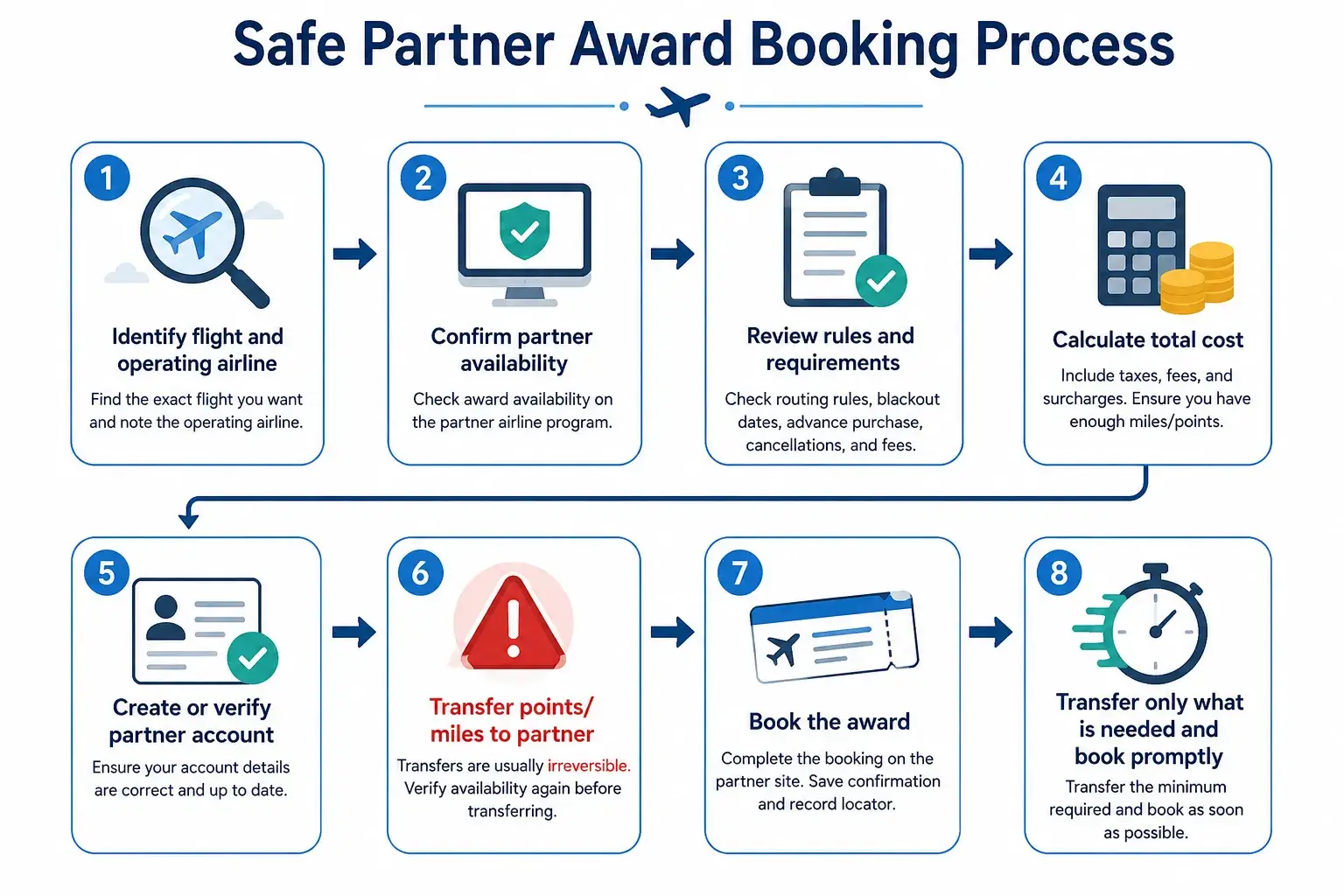
- Identify the flight and operating airline. Note flight number, date, cabin, and which carrier operates the metal (not just the marketing code).
- Determine the alliance and any useful non-alliance partnerships. Some of the best options come from bilateral partners outside the alliance.
- List loyalty programs that could issue the ticket and that accept transfers from the points currency you actually hold.
- Search the exact flight in each usable program. Use each program’s own award search, or contact the program directly if partner space is not shown online.
- Compare total cost and terms: mileage required, transfer ratio, taxes and carrier-imposed surcharges, service fees, change and cancellation rules, and expected transfer timing.
- Confirm the award is bookable before transferring. If a program cannot quote and hold or confirm the space, treat that as a red flag.
- Verify account details: correct loyalty account, exact receiving mileage amount, name matching, and passenger information for every traveler.
- Transfer only what is needed, then book promptly once the miles post.
Treat the transfer as irreversible. Award space can vanish while a transfer processes, and a completed transfer never guarantees the seat.
Why would an airline leave an alliance, and are new alliances forming?
Airlines leave alliances mainly because of mergers, ownership changes, strategic shifts toward bilateral or joint-venture partnerships, or geopolitical and regulatory disruption. Asiana’s announced Star Alliance departure on December 16, 2026 follows its integration with Korean Air, a SkyTeam member, which illustrates the most common driver: corporate consolidation.
Typical reasons for exit or suspension:
- Merger or acquisition. When a member is absorbed by a carrier in a different alliance, the acquired airline generally follows the parent. The Alaska and Hawaiian combination moved Hawaiian into Oneworld in April 2026.
- Strategic realignment. Some carriers conclude that targeted bilateral partnerships and joint ventures deliver more value than full alliance membership and its costs and obligations.
- Geopolitical and regulatory events. Aeroflot’s SkyTeam membership and S7’s Oneworld membership are both suspended, reflecting how external constraints can halt participation without a formal exit.
- Network overlap or economics. Membership carries fees, IT integration requirements, and service standards that may not pay off for smaller or highly specialized carriers.
On the question of new alliances forming: the industry trend through 2026 has been consolidation and deeper bilateral cooperation rather than the launch of a fourth global alliance. Growth has come from members joining existing alliances (ITA Airways to Star Alliance, Hawaiian and Fiji Airways to Oneworld, Philippine Airlines as a oneworld member-designate) and from expanding non-alliance partner networks, including the loyalty tie-ups built by large Gulf carriers that sit outside all three alliances.
What this means for travelers: value increasingly sits in individual airline partnerships, not alliance branding alone. Programs that book widely across alliances and independents often produce better options than any single alliance roster.
Does my airline belong to an alliance?
Most large U.S. and international network carriers belong to one of the three alliances, while most low-cost and ultra-low-cost carriers do not. The fastest way to confirm is the official alliance member pages, since membership changes.
U.S. carriers, as of July 31, 2026:
- United Airlines: Star Alliance
- American Airlines: Oneworld
- Alaska Airlines: Oneworld
- Hawaiian Airlines: Oneworld (joined April 23, 2026)
- Delta Air Lines: SkyTeam
- Southwest, JetBlue, Frontier, and Spirit: no alliance membership (though some maintain individual partnerships)
Several major international carriers also operate outside the three alliances, including Emirates, Etihad, and Virgin Atlantic (Virgin Atlantic works through bilateral partnerships and its own joint ventures rather than alliance membership). Non-alliance carriers can still be excellent partner-award options when a program lists them.
How to maximize benefits from airline alliances
The highest-value approach combines one alliance for status with broad transferable points for redemptions. Concentrating credited flying builds recognizable elite tiers; holding flexible currencies keeps redemption options open across all three alliances plus independents.
Practical tactics:
- Concentrate credited flying, diversify redemption currency. Credit paid flights to one member program to reach a tier, while keeping bank points unassigned until a specific award is confirmed.
- Book multi-carrier trips on a single ticket where possible. One ticket across members generally improves connection protection and baggage handling compared with separately purchased segments.
- Compare at least two issuing programs for every partner award. Total cost (miles plus cash) and cancellation terms often differ more than travelers expect.
- Check non-alliance partners before settling. The best option for a route is sometimes a program that has no alliance relationship with the operating airline at all.
- Track transfer bonuses opportunistically, not as a plan. Bonuses are irregular; treat them as upside on a redemption that already makes sense.
- Verify benefit entitlement before relying on it. Lounge, baggage, and priority benefits carry conditions by tier, cabin, carrier, and airport.
- Re-verify before every booking cycle. Award charts, partner lists, surcharge policies, and membership rosters all change.
Business traveler note: for corporate travelers whose employer chooses the itinerary, alliance value concentrates in status recognition and operational reliability rather than award pricing. Alliance-wide priority check-in, boarding, baggage allowances, and lounge access (where eligible) are the benefits most likely to apply on routine paid tickets, subject to published conditions.
Common mistakes to avoid
- Transferring bank points before confirming that the specific award is bookable in the receiving program.
- Assuming an alliance has one award chart or one shared pool of seats.
- Trusting a seat visible on the operating airline’s website as proof of partner award availability.
- Confusing codeshare sales inventory with partner award inventory.
- Using outdated membership information (ITA under SkyTeam, SAS under Star Alliance, Copa under SkyTeam, Aeroflot or S7 as active members).
- Booking travel on a departing member for dates after its scheduled exit without checking the issuing program’s reaccommodation policy.
- Assuming reciprocal lounge access applies to every tier, cabin, airport, and itinerary.
- Comparing only mileage cost while ignoring surcharges, fees, and cancellation terms.
- Treating any published cents-per-point figure as a standard rather than a personal benchmark.
- Expecting elite status to unlock partner award space it does not control.
FAQs
What are the three major airline alliances?
Oneworld, SkyTeam, and Star Alliance. Each links member airlines for coordinated schedules, reciprocal mileage earning and redemption, and reciprocal elite recognition, without merging their loyalty programs.
Which airline alliance is best?
There is no universally best alliance. The answer depends on your home airport, the routes and regions you fly, which member programs accept your points, and whether elite recognition or award redemption matters more to you.
Can points be transferred directly to an alliance?
No. Bank points transfer only to individual airline loyalty programs. That program then issues the award on eligible alliance and non-alliance partner flights. Check current partners in the transfer partners table.
Can miles from one member airline be moved to another member?
Generally no. Alliance membership creates redemption access, not currency portability. Miles remain in the program where they were earned.
Can one member’s miles book every other alliance airline?
No. Each program publishes its own partner redemption list and routing rules, and some member-to-member redemptions are unavailable or restricted. Verify in the specific program.
Why does the same flight cost different amounts through different programs?
Because the issuing program sets the mileage price and cash charges. Award chart structure, dynamic pricing, partner award rates, and surcharge pass-through policies all vary by program.
Does every program see the same award space?
No. Partner award inventory is released under negotiated agreements, so two programs in the same alliance can see different options, or one may see none, for the identical flight.
Can non-alliance partners be booked with alliance member miles?
Often yes. Many airlines maintain bilateral partnerships outside their alliance, and their programs can issue awards on those carriers when their rules allow it.
Can airlines from different alliances appear on one award ticket?
Sometimes. It depends entirely on the issuing program’s routing, partner, and ticketing rules. Some programs permit mixed-partner awards; others limit an award to one partner per ticket.
Does alliance elite status guarantee lounge access?
No. Lounge access depends on your mapped alliance tier, the operating and marketing airline, cabin, airport, lounge operator rules, and published exceptions. Verify on the alliance benefits page and the operating airline’s rules.
Which alliance are United, American, Alaska, Hawaiian, and Delta in?
United is Star Alliance. American, Alaska, and Hawaiian are Oneworld (Hawaiian joined April 23, 2026). Delta is SkyTeam.
Which alliance are ITA Airways, SAS, Copa, and Asiana in?
ITA Airways joined Star Alliance on March 31, 2026. SAS is a SkyTeam member. Copa Airlines is a Star Alliance member. Asiana remains a Star Alliance member until its announced departure on December 16, 2026.
Is Philippine Airlines already an Oneworld member?
Philippine Airlines is an Oneworld member-designate. Treat it as a future member and confirm on Oneworld’s official site before assuming full award access or reciprocal benefits.
Where can readers compare current credit card transfer partners?
Use the interactive transfer partners resource and the individual issuer guides, which reflect current partners, ratios, and program mechanics more reliably than any static list.
Related reading
- Star Alliance award booking guide
- Oneworld alliance award booking guide
- SkyTeam alliance award booking guide
- Airlines hub for individual carrier and program guides
- Award travel calculators for cents-per-point and transfer comparisons
- Bank program guides for transferable points mechanics
Sources
- Star Alliance, official member airlines and news releases (2026)
- Oneworld, official member airlines and travel benefits pages (2026)
- SkyTeam, official member airlines and alliance FAQs (2026)
- Official airline loyalty program terms and partner award rules (2026)
- Official credit card issuer transfer partner pages (2026)
Membership, pricing, and benefit details change frequently. Verify current information on the official alliance, airline, and issuer websites before transferring points or booking.


Content on Award Travel Hub is independently created by Award Travel Hub Editorial Desk and, where noted, reviewed by Award Travel Hub Review Desk. Some pages may contain affiliate links, but compensation does not determine our coverage, opinions, or methodology.