
Hotel Transfer Partners: Compare Programs, Ratios, and Rules

Last updated: July 31, 2026
Quick Answer
Hotel transfer partners are hotel loyalty programs that accept points from eligible transferable-rewards programs such as American Express Membership Rewards, Chase Ultimate Rewards, Capital One Miles, Citi ThankYou Rewards, Bilt Rewards, Wells Fargo Rewards, and Rove Miles. Which partners are available, at what ratio, in what minimum increment, and how quickly points arrive all vary by program, by card, and sometimes by account. Because a completed transfer should be treated as final, confirm that the exact award you want is bookable before moving any points, then transfer only the amount required.
Key Takeaways
- Transfers move points one direction only. Points sent to a hotel program generally cannot be returned to the issuer currency, so verify award availability first.
- Partner lists change. Use the interactive table on this page rather than a memorized list, and confirm final terms inside your own rewards account.
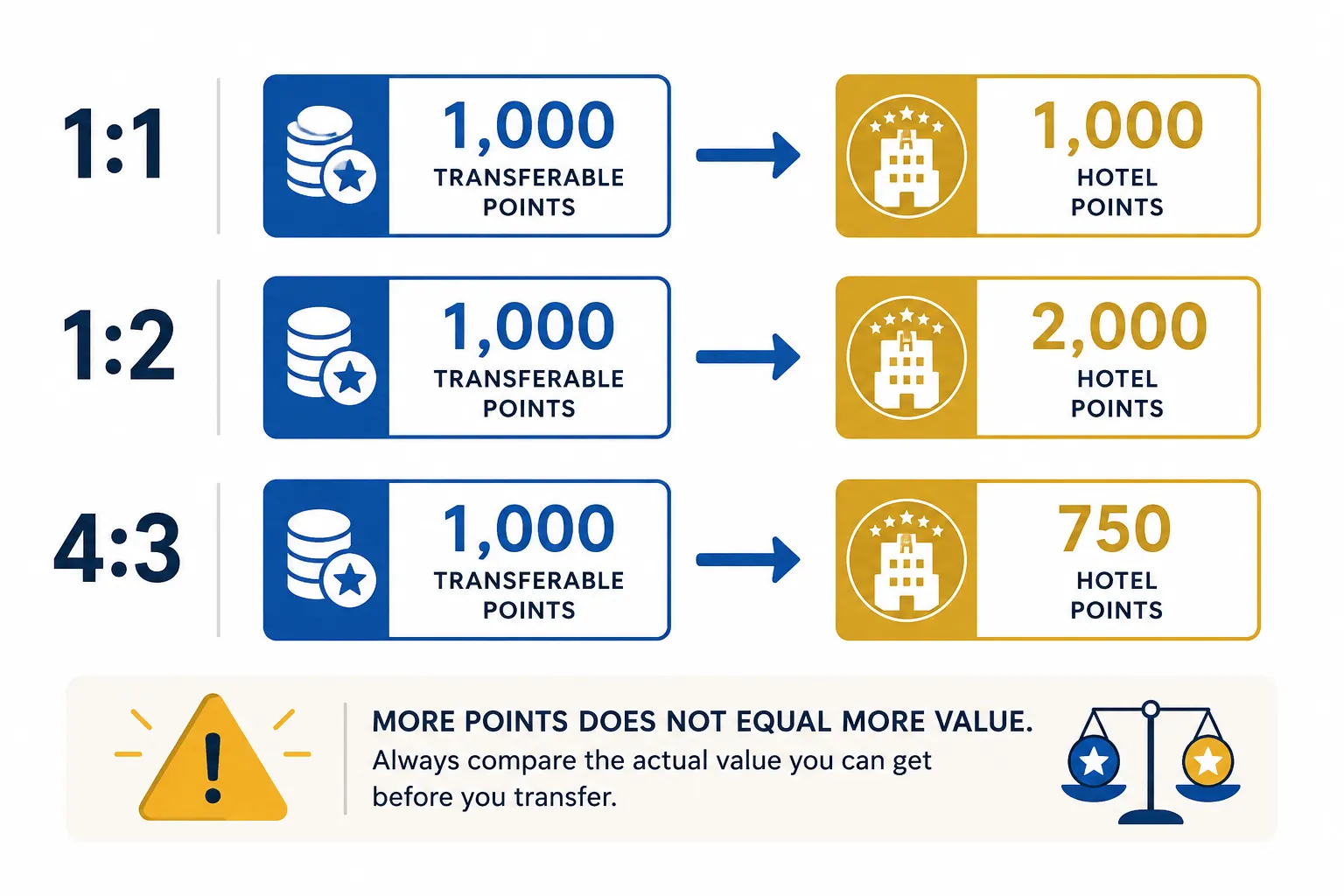
- Ratios are written as transferable points to hotel points. A 1:2 ratio produces more hotel points than 1:1, but that does not automatically mean better value.
- Chase to World of Hyatt is no longer universally 1:1. Treatment depends on the card and account-opening date, so check current Chase terms before transferring.
- Capital One is not limited to a single hotel partner, Wells Fargo includes Choice and Wyndham, and Rove Miles (not a bank or card issuer) currently lists Accor as its hotel loyalty transfer partner.
- Transferring is one option among several: paying cash, booking an issuer travel portal, using a premium hotel collection, redeeming a free-night certificate, or using points-and-cash where offered.
- Timing displayed for any transfer is an estimate. Awards can sell out while points are processing.
- “Hotel transfer partner” also gets used to describe airport shuttle and ground-transportation vendors. Those are property services, not loyalty transfers, and are covered separately below.
Compare current Hotel Transfer Partners
The table below is the live source of truth for hotel transfer relationships, ratios, estimated transfer times, active bonuses, and links to each hotel program. Filter by issuer or search by program name, and reset to see everything.
Two notes on how to use it. First, displayed transfer times are estimates based on typical processing, not guarantees. Second, the terms shown inside your eligible rewards account at the moment of transfer control the actual ratio, minimum, increment, and any bonus. If the two ever disagree, your account wins.
What are hotel transfer partners and how do they work?
A hotel transfer partner is a hotel loyalty program that has agreed to accept points from a bank or rewards currency, converting them into that hotel program’s own points at a published ratio. You then book an award stay directly with the hotel program using its own pricing rules.
The mechanics are consistent across issuers:
- You hold points in a transferable currency earned on an eligible card or account.
- You initiate a transfer to a linked hotel loyalty account, usually one you own, with matching name details.
- The points leave the issuer balance and arrive as hotel points, sometimes instantly, sometimes after hours or days.
- You book the award through the hotel program, subject to its availability, taxes, and any mandatory charges.
Two constraints matter more than anything else. Availability is not reserved while points move, and the transfer is effectively irreversible. That combination is why the practical order of operations is always “find the award, then transfer,” never the reverse.
Common mistake: transferring a round number of points “to be ready” for a trip that has not been booked. If the property closes award inventory, raises its rate, or the plan changes, those points are stuck in a single hotel currency.
How do you read ratios, transfer times, and bonus badges?
Ratios in the table are written as transferable points to hotel points, and the first number is always what leaves your issuer account.
- 1:1 means 1,000 transferable points become 1,000 hotel points.
- 1:2 means 1,000 transferable points become 2,000 hotel points.
- 4:3 means 1,000 transferable points become 750 hotel points.
More hotel points is not the same as more value. Hotel currencies price awards differently, so a program that gives you double the points may also charge several times as many points per night. Value comes from comparing the points required for your specific stay against the cash price you would otherwise pay, not from the size of the resulting balance.
Three other fields deserve attention:
- Minimum and increment: many programs require a minimum transfer and move points only in set blocks (often 1,000). That can force you to send more than the award needs.
- Estimated time: treat as an estimate. Instant transfers exist, but so do multi-day queues, manual reviews, and weekend or holiday delays.
- Bonus badge: a limited-time uplift on the base ratio. A bonus improves a transfer you were already going to make; it is a weak reason to enter a hotel currency you have no confirmed use for. Track promotions on the current and historical transfer bonuses resources alongside the credit card transfer partners guide.
Which hotel programs have transfer partnerships in 2026?
Nine hotel loyalty programs are covered in depth on this site, spanning global chains and curated independent collections. No hotel brand is required to accept point transfers, so many independent hotels, small regional chains, and vacation-rental platforms have no transfer relationship at all.
A few current points worth stating plainly, since older articles often get them wrong:
- Capital One is not limited to Wyndham. Check the filtered table for its current hotel partners.
- Citi does not currently list IHG One Rewards as a U.S. hotel transfer partner.
- Citi does currently include I Prefer Hotel Rewards (Preferred Hotels & Resorts).
- Bilt does not currently list Choice Privileges.
- Wells Fargo Rewards includes both Choice and Wyndham.
- Rove Miles currently lists Accor as its hotel loyalty transfer partner. Rove is a rewards program, not a bank or credit card issuer.
Complete issuer-to-hotel lists are deliberately left out of this prose because they change. Filter the table above instead, and cross-check the issuer side on the Bank Transfer Partners hub.
Hotel program directory (A to Z)
- ALL, Accor Live Limitless: a global group spanning economy through luxury brands, with a euro-denominated reward currency and strong European, Asian, and Middle Eastern presence.
- Choice Privileges: largely economy, midscale, and upper-midscale brands concentrated in North America, plus upscale and independent collections.
- Hilton Honors: a broad global portfolio from focused-service brands to luxury, with dynamic award pricing and frequent promotions.
- World of Hyatt: a smaller footprint with category-based award pricing on many properties, plus all-inclusive and lifestyle brands.
- IHG One Rewards: wide brand range from economy to luxury, with dynamic Reward Nights pricing that varies by property and date.
- Marriott Bonvoy: the largest brand family among these programs, covering select-service through luxury, with dynamic award rates.
- I Prefer Hotel Rewards: the loyalty program for Preferred Hotels & Resorts, a collection of independent hotels and resorts.
- Leaders Club: the membership program for The Leading Hotels of the World, focused on independent luxury properties.
- Wyndham Rewards: economy through upscale brands plus vacation rentals, with award tiers that behave differently from fully dynamic programs.
Which are the best hotel transfer partners for 2026?
There is no universally best hotel transfer partner. The right choice depends on the specific property and dates you want, the ratio available on your card, whether an award is actually bookable, mandatory fees, cancellation terms, elite benefits, the points you would forfeit by not paying cash, and what else those transferable points could buy.
Use decision rules instead of rankings:
- Choose a transfer if the hotel program prices your exact stay well below the realistic cash cost and the award is confirmed bookable at the moment you transfer.
- Choose the issuer portal if the portal price is competitive and you want a fixed, predictable redemption rate without entering a hotel currency.
- Choose cash if the paid rate is low, if you need elite-night credit and points earning, or if flexible cancellation matters more than saving points.
- Choose a different currency entirely if the same points would deliver a better outcome on the airline side. Compare against the options on the airlines hub before committing.
Edge case: a stay that looks strong on points can lose its edge once resort fees, parking, and taxes are added on the award side but bundled or discounted on a package rate. Price both totals, not just the headline.
Transfers versus portals, hotel cards, and premium hotel collections
These five paths are frequently confused, and each has different economics, protections, and earning behavior.
| Option | What it is | Key considerations |
|---|---|---|
| Transfer to a hotel program | Convert issuer points into hotel points, then book an award | Irreversible, ratio-dependent, subject to hotel award availability and rules |
| Issuer travel portal | Book a hotel through the bank’s own booking platform using points or cash | Usually a fixed points value, but often books as a third-party reservation |
| Premium hotel collection | Issuer or network program (available on some premium cards) offering added on-property benefits on paid rates | Paid stay, rate restrictions may apply, benefits vary by property |
| Cobranded hotel card or free-night certificate | Card issued with a hotel brand, sometimes including an annual certificate | Certificates carry caps, expiration, and blackout or availability rules |
| Buying, combining, or converting hotel points | Purchase points, pool them where permitted, or convert from another currency | Cost per point and program permissions vary, and some transfers carry fees |
Decision rule: if elite-night credit, brand promotions, or on-property recognition are the priority, a paid stay (with or without a premium collection benefit or cobranded card) is usually the better fit than an award booking. If minimizing out-of-pocket cost is the priority and the award math is strong, the transfer path makes more sense. Verify each program’s current rules for elite-night credit on award stays, since they differ by brand and change over time.
How much does it cost to use hotel transfer partners?
Transferring points to a hotel program typically has no transfer fee from major U.S. issuers, but “no fee” is not the same as “no cost.” Verify current terms in your account, because some programs charge fees for certain transfers, gifting, or point purchases.
The real costs to account for:
- Opportunity cost: points spent on a hotel award cannot be used for flights, statement credits, or another program.
- Minimum increments: rounding up to the next 1,000-point block can leave points stranded in a single hotel currency.
- Unavoidable award charges: taxes, resort or destination fees, and parking may still be due on award stays at some properties. Policies vary by brand and by hotel, so check the specific property’s terms.
- Forgone earning: award stays generally do not earn base points, and elite-night credit treatment differs by program.
- Ratio erosion: at a 4:3 ratio, 25% of the transferable points disappear on the way in, before any award is priced.
How do you compare value before transferring?
Use one formula, applied to the actual stay you would otherwise book:
Transferable-point value = (comparable cash cost avoided − unavoidable award charges) ÷ transferable points required
The “comparable cash cost avoided” must be the rate you would realistically book, including taxes and mandatory fees, not an inflated flexible rate you would never pay.
Hypothetical example (illustrative only, not a live rate): a two-night stay prices at $600 all-in on cash. The same stay prices at 40,000 hotel points plus $40 in unavoidable fees. If your card transfers at 1:1, you need 40,000 transferable points, and the value is ($600 − $40) ÷ 40,000 = 1.4 cents per transferable point. If the same stay required a 4:3 transfer, you would need roughly 53,300 transferable points, and the value falls to about 1.05 cents. Same hotel, same award, different answer.
Run the calculation both ways before deciding, and use the award travel calculators to compare against your other redemption options. Avoid fixed cents-per-point thresholds copied from other sites. A “good” number depends on what you would otherwise do with the points and how much cash you are actually willing to spend on the stay.
Eligibility, timing, and account requirements
Eligibility is set by the issuer and the receiving hotel program, not by the card’s marketing. Some cards can transfer at full ratios, some cannot transfer at all, and some ratios depend on when the account was opened.
Points to verify before you start:
- Card and account eligibility: confirm your specific product can transfer to that hotel program at the ratio shown. Details live on the issuer pages: Amex Membership Rewards, Chase Ultimate Rewards, Capital One miles, Citi ThankYou Rewards, Bilt Rewards, Wells Fargo Rewards, and Rove Miles.
- Account ownership and naming: most programs require the hotel account to match the rewards account holder, and name mismatches are a common cause of failed or delayed transfers.
- Account standing: the hotel account usually must be active and in good standing, and some programs require it to have been open for a set period.
- Timing: some transfers post in minutes, others take days. Weekends, holidays, and new-account links tend to be slower.
- Chase to World of Hyatt specifically: treatment now depends on the card and account-opening date. Applicable newer accounts may receive 4 Hyatt points per 3 Chase points, while qualifying accounts opened before June 15, 2026 retain 1:1 through September 30, 2026. Confirm your own terms with Chase before transferring.
Can you book hotel transfers in advance? You can book award stays as soon as the hotel program opens its booking calendar, which is commonly around 12 months out but varies by brand and property. What you cannot do is reserve a transfer rate or hold award inventory. Transfer when you are ready to book, then book immediately.
Safe transfer checklist
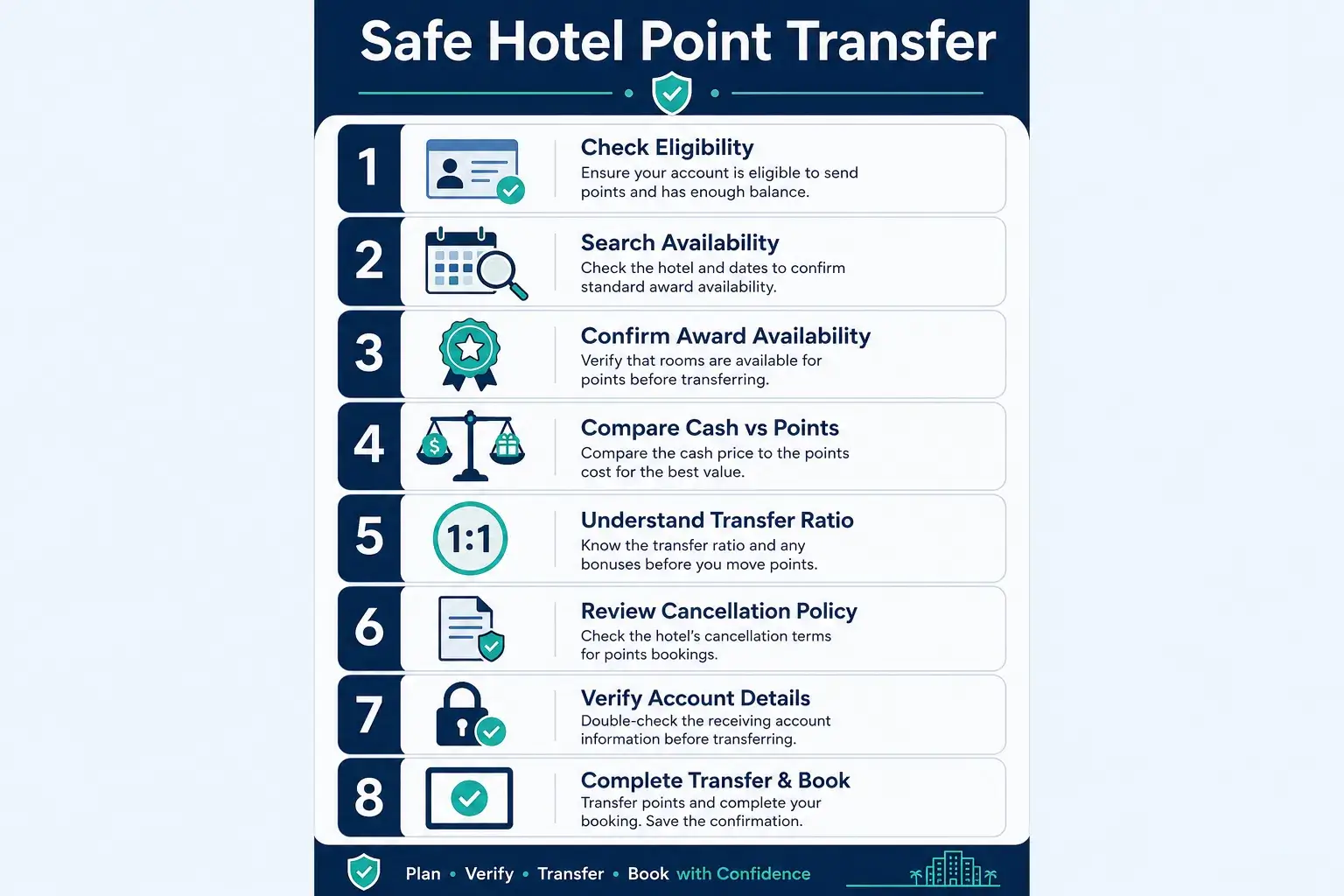
Work through these eight steps in order. If any step fails, stop.
- Confirm your card and account are eligible to transfer to that hotel program.
- Search the hotel program directly for the exact property, dates, room type, and number of guests.
- Confirm the award is genuinely bookable, not just displayed as a rate.
- Compare the complete cash price (taxes and mandatory fees included) against the points requirement.
- Verify the current ratio, minimum, increment, estimated timing, and any active bonus in your own account.
- Review cancellation terms, resort or destination fees, elite-night credit treatment, and account-ownership rules.
- Confirm the receiving hotel account number and the exact amount.
- Transfer only what the award needs, then book promptly once the points arrive.
Do not treat a small “test” transfer as a safety net. It consumes points, may not be reversible, and does not confirm that a larger transfer will post any faster.
Hotel transfer partners not showing up: what to do
If an expected hotel partner is missing, the cause is usually a filter, an eligibility rule, or a relationship that has ended. Work through the checks below before assuming an error.
- Clear the search box and press reset on the table, then reconfirm the hotel filter is applied.
- Check whether your specific card is transfer-eligible. Cash-back and no-annual-fee products in the same family often are not.
- Log in to your rewards account and view the live partner list there, since regional and account-level differences exist.
- Consider that the partnership may have ended or paused. Older blog posts and cached pages frequently list retired relationships.
- Look for a temporary outage. Hotel programs occasionally suspend inbound transfers during system migrations or promotions.
- If the hotel account link fails, verify the member number, name spelling, and account age with the hotel program’s support team.
Hotel transfer partners versus airport shuttles and ground transfers
In the points world, “hotel transfer partner” means a loyalty program that accepts point transfers. In the travel-booking world, the same phrase sometimes refers to airport transfer or shuttle vendors that a hotel works with. These are unrelated, and mixing them up leads to bad expectations.
Practical distinctions for U.S. travelers:
- Loyalty transfers convert rewards currency and have nothing to do with getting from the airport to the property.
- Ground transfers, shuttles, luggage assistance, and porter service are property or vendor services. Availability, cost, hours, luggage limits, child seats, and accessibility vary by hotel and by market, so confirm details with the specific property before arrival rather than assuming a brand-wide standard.
- Not all hotels offer either one. Many independent hotels belong to no transfer-eligible loyalty program, and many properties provide no shuttle at all.
- Alternatives to hotel-arranged ground transport include public transit, rideshare, taxis, rental cars, and third-party private transfer companies. None is universally cheapest or fastest.
To find which loyalty program a hotel belongs to, identify the brand’s parent program (for example, a Kimpton sits under IHG One Rewards), then filter this page’s table for that program to see which rewards currencies transfer in.
Families, business travelers, and other real-world constraints
Award bookings behave differently from paid rates in ways that hit families and business travelers hardest.
Families with children:
- Award inventory is often tied to a standard room, which may not sleep four or five people. Check occupancy limits before transferring.
- Two award rooms may cost more points than one paid suite, or vice versa. Price both.
- Points-and-cash options, where offered, can bridge a shortfall without a second transfer.
- Confirm crib, rollaway, connecting-room, and breakfast policies with the property, since these vary by hotel rather than by chain.
Business travelers:
- Negotiated corporate rates, refundable terms, and expense documentation often outweigh a modest points saving.
- Elite-night credit and points earning on paid stays have real value if status matters for the year. Program rules differ, so verify how each brand treats award stays.
- Reimbursed lodging is usually a poor use of points. Keep the transferable balance for travel you are paying for yourself.
Are hotel transfer partners worth the money? They are worth using when a specific award beats the realistic cash total by a margin large enough to justify losing flexibility. They are not worth using speculatively, and they are rarely worth it when a stay is cheap in cash or fully reimbursed.
Alternatives and common mistakes
Alternatives to transferring points, none universally better than the others: paying cash, booking through an issuer travel portal, using a premium hotel collection benefit on a paid rate, using a cobranded hotel card or free-night certificate, redeeming points-and-cash, combining points across accounts where the program permits, or buying hotel points during a promotion when the purchase price beats the cash rate.
Mistakes that cost the most:
- Transferring before confirming a bookable award.
- Assuming a ratio from an old article instead of checking current terms.
- Chasing a transfer bonus into a currency with no planned use.
- Ignoring minimum increments and stranding points.
- Overlooking mandatory fees, cancellation windows, or occupancy limits.
- Draining a flexible balance that had a stronger airline use, especially for premium-cabin awards.
- Booking an award for a trip that is likely to change, when the paid rate is fully refundable.
FAQs
How do hotel transfer ratios work? Ratios are written as transferable points to hotel points. At 1:1, 1,000 transferable points become 1,000 hotel points. At 1:2, they become 2,000. At 4:3, they become 750. More hotel points does not automatically mean better value, because each program prices awards differently.
How long do hotel point transfers take? It varies by program and account, from near-instant to several days. Any time shown in the comparison table is an estimate, not a guarantee, and awards can sell out while a transfer is processing.
Can a hotel point transfer be reversed? Treat every completed transfer as final. Some issuers will consider exceptions in limited circumstances, but there is no reliable way to move hotel points back into a transferable currency.
Can points be transferred to another person’s hotel account? Usually no. Most programs require the receiving hotel account to belong to the rewards account holder, though some allow authorized users or household members. Check the issuer’s current rules before assuming.
Do award stays earn elite-night credit? It depends on the hotel program, and policies change. Some brands award elite-night credit on award stays and some do not, so verify the current terms in the specific program before counting on nights.
Are resort fees charged on award stays? Sometimes. Certain programs waive resort or destination fees on award nights and others do not, and policies can vary by property. Check the individual hotel’s award terms before booking.
Do transfer bonuses make a transfer worthwhile? A bonus improves a transfer you already planned to make. It does not fix a weak redemption, and moving points into a hotel currency without a confirmed use is risky even with an attractive bonus.
Is Chase to World of Hyatt still 1:1? Not universally. Treatment now depends on the card and account-opening date. Applicable newer accounts may receive 4 Hyatt points per 3 Chase points, while qualifying accounts opened before June 15, 2026 retain 1:1 through September 30, 2026. Confirm current terms directly with Chase.
Can U.S. Amex Membership Rewards points transfer to Accor? Do not assume so. Availability differs by region, and U.S. members should confirm the current partner list inside their own Membership Rewards account before planning around it.
Where can current hotel partner information be found? The interactive table on this page reflects current partners, ratios, estimated timing, and bonuses. Always confirm final terms in your own rewards account immediately before transferring.
Related reading
- Bank and credit card transfer partners hub
- Complete credit card transfer partners guide
- Award travel calculators
- Airline transfer partners hub
- Award Travel Hub home





Content on Award Travel Hub is independently created by Award Travel Hub Editorial Desk and, where noted, reviewed by Award Travel Hub Review Desk. Some pages may contain affiliate links, but compensation does not determine our coverage, opinions, or methodology.