
Last Updated: July 18, 2026
A no-fee card can be the right move if it earns useful travel rewards without forcing a break-even calculation every year. The best travel credit cards no annual fee in 2026 are not replacements for premium cards with lounge access or richer insurance, but they can be smart starting points, downgrade options, and long-term keepers.
The practical answer: Wells Fargo Autograph is the strongest overall no annual fee travel card for most U.S. travelers in 2026 because it earns 3x points in several useful categories, has no foreign transaction fees, and now sits inside a growing transferable-points ecosystem.
Capital One VentureOne is the better fit if simple airline and hotel transfer access matters more than bonus categories. Bank of America Travel Rewards and Discover it Miles are better for flat-rate earning with less award travel complexity.
No-fee cards still require discipline. Rewards can lose value through dynamic pricing, program devaluations, limited award availability, transfer delays, and fuel surcharges. The right card should match how travel is actually booked, not how a bank advertises it.
Key Takeaways
- Best overall no-fee travel card for 2026: Wells Fargo Autograph, due to broad 3x categories, no annual fee, no foreign transaction fees, and transfer partner access.
- Best for simple flat-rate earning: Bank of America Travel Rewards or Discover it Miles, depending on whether fixed-value redemptions or first-year matching matter more.
- Best no-fee card with transfer partners: Capital One VentureOne for simple access to Capital One miles partners; Wells Fargo Autograph is also strong for category spend.
- No-fee cards are not always best for premium cabin awards: A $95 annual-fee card can outperform if it unlocks better transfer partners, stronger earning, travel insurance, or higher redemption value.
- Do not transfer points until award space is confirmed: Transferable points are flexible before transfer but usually locked into one airline or hotel program after transfer.
Why a No Annual Fee Travel Card Can Make Sense
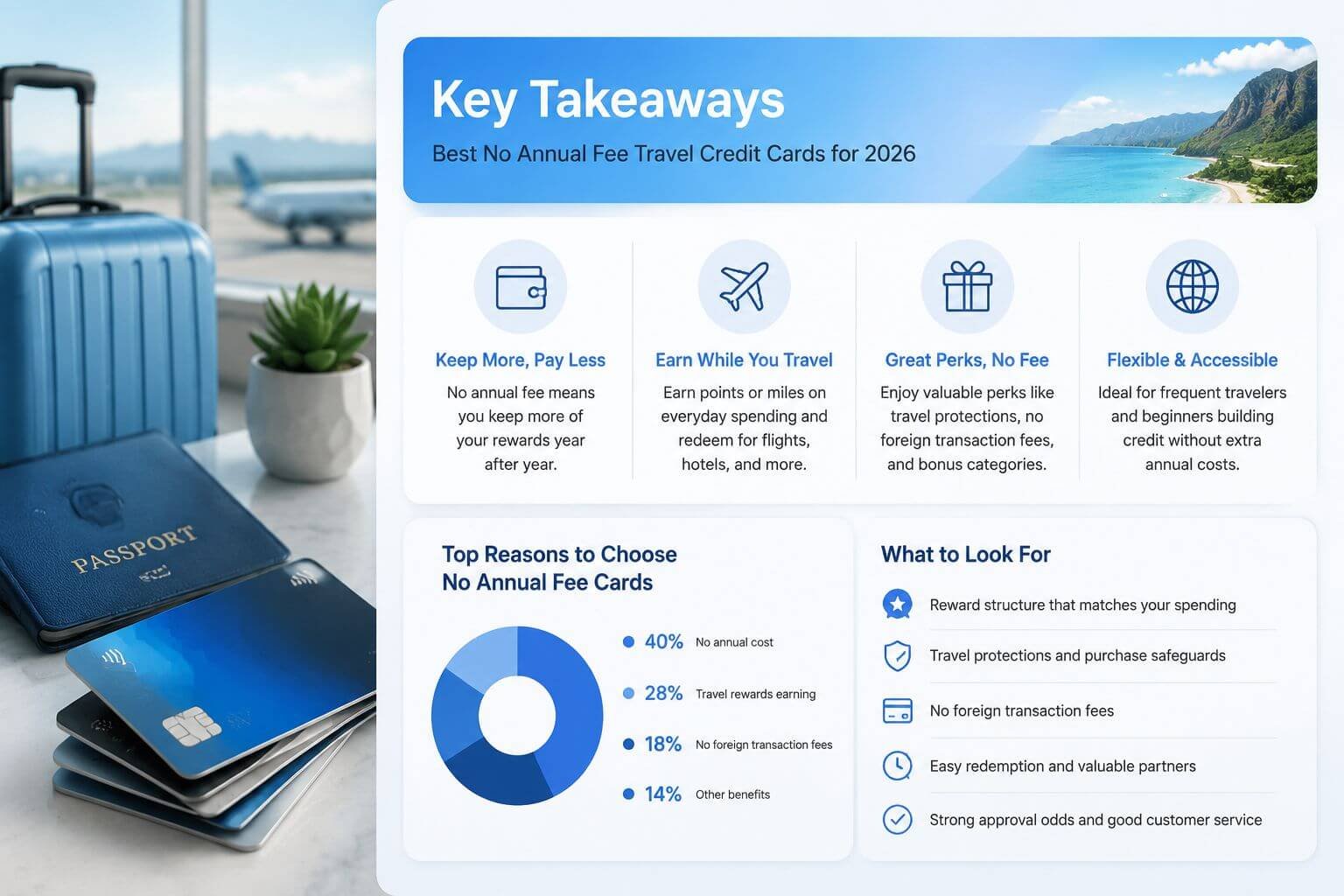
A no annual fee travel card makes sense when the card earns usable rewards without adding pressure to justify a yearly fee.
That matters more in 2026 because many premium travel cards now have higher fees and more coupon-style credits. Those credits can be valuable, but only if they match real spending. A no-fee card avoids that problem.
A no-fee travel card is best when:
- You travel a few times per year.
- You want rewards without tracking annual credits.
- You need a card for foreign purchases with no foreign transaction fees.
- You want to keep credit history open after downgrading a paid card.
- You are building a transferable points setup slowly.
- You do not need lounge access, elite status shortcuts, or premium insurance.
You may be interested



A no-fee card is not ideal when:
- You regularly book international business class deals.
- You need strong trip delay, cancellation, or rental car coverage.
- You want premium cabin awards through many partner airlines.
- You spend heavily in categories where a paid card earns much more.
- You can easily use annual credits on a premium card.
Rule of thumb: if a card’s benefits require a spreadsheet to justify, a no annual fee card may be the better default.
What “no annual fee” does not mean
No annual fee does not mean free travel.
You may still pay:
- Interest if you carry a balance.
- Late fees if you miss payments.
- Cash advance fees.
- Award taxes and fees.
- Fuel surcharges on some partner airlines.
- Higher prices through a bank travel portal.
Fuel surcharges are extra carrier-imposed fees added to some award tickets. They can turn a “cheap” award into a poor redemption. For example, a business class award might cost 55,000 miles plus $650 in surcharges. If a cash ticket is only $1,500, the travel rewards math may not work.
Dynamic pricing is another risk. Airlines and hotels can price awards based on demand, cash prices, or internal formulas. That means the same route can cost 20,000 miles one day and 80,000 miles another day.
For a deeper framework on travel card tradeoffs, see our guide to the best travel credit cards for 2026.
Quick comparison: best no annual fee travel cards for 2026
| Card | Best for | 2026 earning highlights | Welcome offer to check | Transfer partners? | Main tradeoff |
|---|---|---|---|---|---|
| Wells Fargo Autograph | Overall value | 3x restaurants, travel, gas, transit, streaming, phone plans; 1x other | 20,000 points after $1,000 in 3 months | Yes | Partner network is smaller than Chase, Amex, or Capital One |
| Capital One VentureOne | Transfer partners | 1.25x miles on purchases; 5x hotels and rental cars via Capital One Travel | 20,000 miles after $500 in 3 months | Yes | Lower everyday earn rate |
| Bank of America Travel Rewards | Flat-rate simplicity | 1.5x points on purchases | 25,000 online bonus points after $1,000 in 90 days | No | Best value often tied to statement credits, not airline transfers |
| Discover it Miles | First-year flat-rate earning | 1.5x miles, typically matched after first year | First-year match instead of traditional bonus | No | Discover acceptance can lag abroad |
| Citi Strata Card | Bonus categories | Strong everyday categories, often including supermarkets, transit, gas or EV charging, and travel portal bonuses | Offer varies; verify before applying | Limited or program-dependent | Best transfer value may require pairing with another Citi card |
| Bilt Mastercard | Rent plus travel transfers | Rent rewards, dining, travel, and selected bonus days | Usually no public welcome bonus | Yes | Rent rules and monthly transaction requirements matter |
Offers and earning rates can change. Always check the live card terms before applying.
Best No Annual Fee Travel Card Overall for 2026

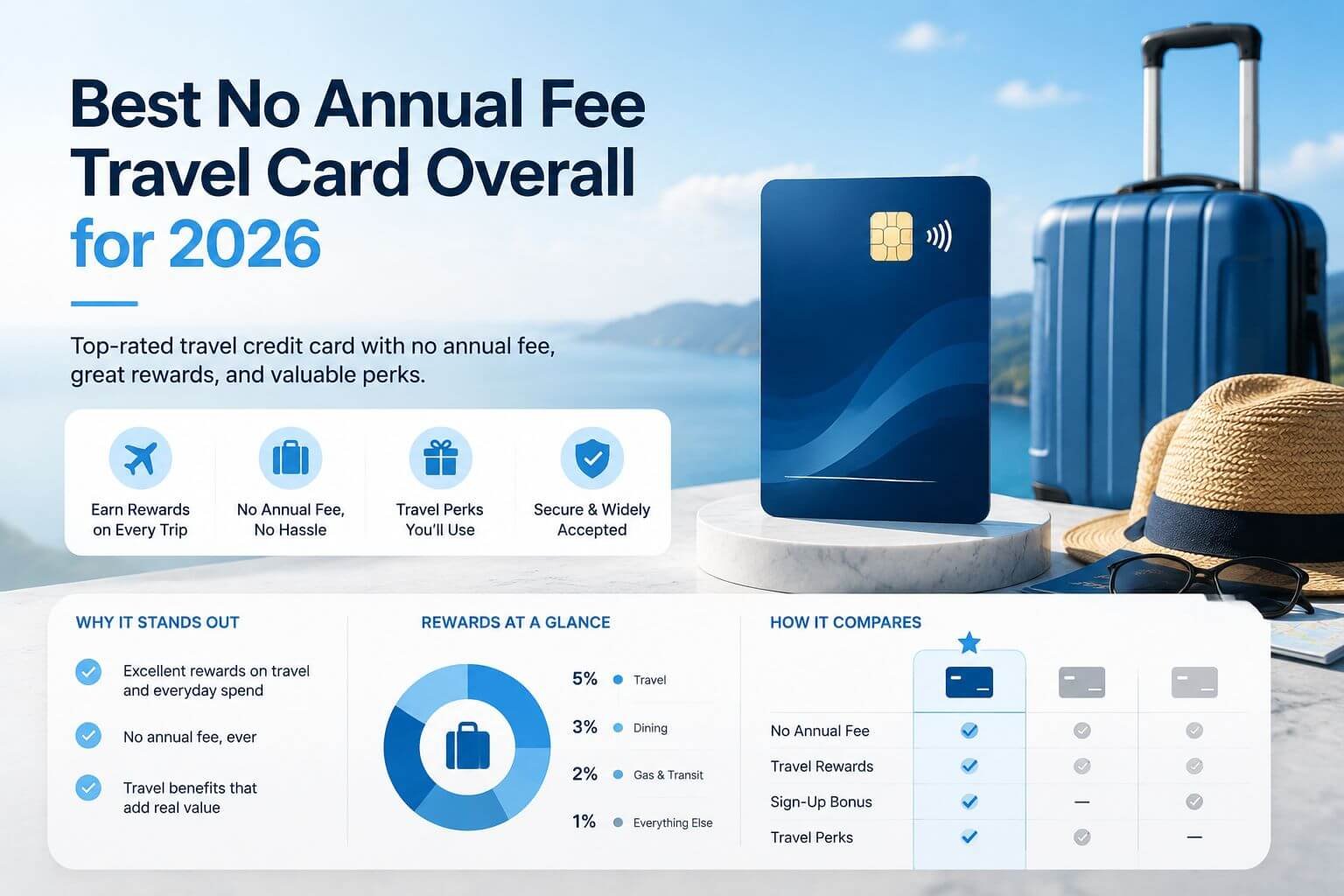
Best overall pick: Wells Fargo Autograph Card
Wells Fargo Autograph is the best overall choice among the best travel credit cards no annual fee in 2026 because it combines broad bonus categories with no foreign transaction fees and useful travel rewards.
The card earns:
- 3x points at restaurants.
- 3x points on travel.
- 3x points at gas stations.
- 3x points on transit.
- 3x points on popular streaming services.
- 3x points on phone plans.
- 1x point on other purchases.
Its common 2026 welcome offer is 20,000 bonus points after $1,000 in purchases in the first 3 months, though applicants should confirm the current offer before applying.
It also has no annual fee and no foreign transaction fees. That makes it useful for international trips where a 3% foreign transaction fee would erase much of the reward value.
Why Wells Fargo Autograph wins
The card works because the 3x categories match real spending.
A traveler who spends $500 per month across restaurants, gas, transit, phone, and streaming could earn:
- $500 monthly spend x 3 points = 1,500 points per month.
- 1,500 points x 12 months = 18,000 points per year.
That is before the welcome bonus or any travel spending.
If those points are redeemed at a simple 1 cent per point, 18,000 points are worth about $180. If transferred to a partner for a strong award, the redemption value could be higher.
For example, if 20,000 transferred points help book a flight that would cost $320 after subtracting taxes, that is:
- $320 cash value divided by 20,000 points = 1.6 cents per point.
That is a solid redemption for a no-fee setup. For more on this math, use our cents per point calculation guide.
Best for
- Travelers who want one no-fee card for daily categories.
- People who spend on dining, gas, transit, and phone plans.
- International travelers who need no foreign transaction fees.
- Users who want transferable points without paying an annual fee.
Not for
- Travelers who want a large points ecosystem like Chase points or Amex points.
- People who spend mostly outside the 3x categories.
- Users who need premium travel insurance.
- Travelers focused only on First Class redemptions.
Practical booking example
Assume a traveler earns 40,000 Wells Fargo points from the welcome bonus and yearly category spend.
A possible booking strategy:
- Search cash fares first.
- Search award availability with Wells Fargo transfer partners.
- Compare the cash price minus taxes against the points cost.
- Transfer only if the award is available and the CPP is strong.
Example:
- Cash fare: $620.
- Award price: 30,000 points transferred to an airline partner.
- Taxes and fees: $80.
- Net value: $540.
- CPP: $540 divided by 30,000 = 1.8 CPP.
That can be a good use of points. But if the airline adds $300 in surcharges and fees, the value falls fast.
For award searches, start with our guide to the best award search tools for beginners.
Best for Flat-Rate Earning
Flat-rate cards are best for travelers who do not want to track bonus categories.
They are also useful for spending that does not fit cleanly into travel, dining, grocery, or gas categories. Think medical bills, insurance, taxes, home repairs, and school expenses.
Best flat-rate pick: Bank of America Travel Rewards
The Bank of America Travel Rewards credit card is a strong no annual fee travel card for simple earning.
Typical 2026 structure:
- 1.5 points per dollar on purchases.
- No annual fee.
- No foreign transaction fees.
- Common online welcome offer: 25,000 bonus points after $1,000 in purchases in the first 90 days.
- Points can usually be redeemed as statement credits toward travel and dining purchases.
This card is especially useful for Bank of America Preferred Rewards members, who can earn a higher effective rate depending on their tier. That can make the card more competitive than it looks at first glance.
Best for
- Simple rewards with no transfer-partner learning curve.
- Travelers who want to erase travel purchases.
- Bank of America customers with Preferred Rewards.
- People who dislike award charts and airline program rules.
Not for
- Premium cabin awards.
- Airline sweet spots.
- Users who want transferable points.
- Travelers trying to maximize points through alliance partners.
Discover it Miles: best first-year flat-rate option
Discover it Miles is another simple choice.
Typical structure:
- 1.5x miles on purchases.
- No annual fee.
- No foreign transaction fees.
- Discover often matches all miles earned at the end of the first year for new cardmembers.
That match can make the first-year earning rate attractive. For example:
- $12,000 annual spend x 1.5 miles = 18,000 miles.
- First-year match = another 18,000 miles.
- Total first-year miles = 36,000 miles.
If redeemed at 1 cent each, that is about $360 in value.
The drawback is acceptance. Discover is accepted widely in the U.S., but international acceptance can be weaker than Visa or Mastercard. That matters for a travel card.
Capital One VentureOne: flat-rate with transfer upside
Capital One VentureOne earns:
- 1.25 miles per dollar on purchases.
- 5x miles on hotels and rental cars booked through Capital One Travel.
- Common welcome offer: 20,000 miles after $500 in purchases in 3 months.
- No annual fee.
- No foreign transaction fees.
The everyday earn rate is lower than 1.5x cards. But Capital One miles can transfer to airline and hotel partners, which gives the card more upside.
A VentureOne user might transfer miles to programs such as Air France-KLM Flying Blue, Avianca LifeMiles, British Airways Executive Club, or Wyndham Rewards. Transfer ratios vary by partner, though many key airline partners are 1:1.
This card makes sense if transfer flexibility is worth more than a slightly higher flat earning rate.
For a broader look at transfer value, see our guide to credit card transfer partners.
Best for Bonus Categories

Bonus-category cards can beat flat-rate cards if the categories match real spending.
The risk is complexity. A card that earns 3x in categories you rarely use is not better than a simple 1.5x card.
Best bonus-category pick: Wells Fargo Autograph
Wells Fargo Autograph is again the strongest no-fee bonus-category travel card for most users.
Its 3x categories are broad enough to matter:
- Restaurants.
- Travel.
- Gas.
- Transit.
- Streaming.
- Phone plans.
This mix helps travelers earn rewards before and during trips. Transit can include rideshare, parking, tolls, trains, and similar purchases depending on merchant coding. Travel can include airlines, hotels, car rentals, cruises, and travel agencies, but merchant coding can vary.
Citi Strata Card: strong categories, more caveats
The no annual fee Citi Strata Card is worth a look for users who like Citi points.
Its 2026 earning structure may include elevated rewards on categories such as supermarkets, gas or EV charging, transit, dining, and select bookings through Citi Travel. Offers and category details can change, so check current terms.
The key issue is redemption flexibility. Citi points can be valuable, but no-fee Citi cards often have more limited transfer options unless paired with a higher-tier Citi card. That means the best use of points may not be available from the no-fee card alone.
This is where a decision framework helps:
| If you want | Better choice |
|---|---|
| Broad 3x categories with simple travel use | Wells Fargo Autograph |
| Citi ecosystem setup for later upgrades | Citi Strata |
| Simple statement credits | Bank of America Travel Rewards |
| Airline transfers on a no-fee card | Capital One VentureOne |
| Rent rewards and transfers | Bilt Mastercard |
Bilt Mastercard: valuable but not a default travel card
Bilt Mastercard can be excellent for renters because it allows eligible rent payments to earn points without the usual card processing fee, subject to program rules.
It also has airline and hotel points transfer partners. These have included valuable programs such as World of Hyatt, United MileagePlus, Alaska Airlines Mileage Plan, and other partners over time.
But Bilt is not the default pick for every traveler because:
- It usually has no large public welcome bonus.
- Users generally must make a minimum number of transactions each statement period to earn points.
- Rent rules can change.
- Transfer partners and bonus days may shift.
- It is most useful if rent is a major expense.
For renters who can follow the program rules, Bilt points can be very strong. For non-renters, Wells Fargo Autograph or VentureOne is usually simpler.
Best No-Fee Card With Transfer Partners
The best no-fee card with transfer partners depends on how you book awards.
Best for simple transfer access: Capital One VentureOne.
Best for category earning plus transfers: Wells Fargo Autograph.
Best for rent plus high-value partners: Bilt Mastercard.
Transferable points are valuable because they can move to partner airlines or hotel programs. But they are only powerful when award space exists.
Award space means seats or rooms that can be booked with points. It is not the same as a seat being for sale with cash. A flight can have nine Business Class seats for sale and zero saver-level award seats.
Capital One VentureOne: best no-fee transfer starter card
Capital One VentureOne is a practical no-fee entry into Capital One miles.
Capital One transfer partners include a strong mix of airline programs. Examples include:
- Air France-KLM Flying Blue.
- Avianca LifeMiles.
- British Airways Executive Club.
- Air Canada Aeroplan.
- Turkish Airlines Miles&Smiles.
- Virgin Atlantic Flying Club.
- Wyndham Rewards.
The card’s weak point is earning. At 1.25x miles on most purchases, it earns less than the Capital One Venture Rewards card, which has a $95 annual fee and earns 2x miles on purchases.
That creates a clear upgrade question:
- If you spend $10,000 per year, VentureOne earns about 12,500 miles.
- Venture earns about 20,000 miles.
- Difference: 7,500 miles.
- If miles are worth 1.5 CPP to you, that difference is about $112.50.
At that point, a $95 annual fee may make sense if you value the extra miles and use the card well.
Wells Fargo Autograph: better earning, smaller ecosystem
Wells Fargo Autograph earns faster in its bonus categories, but its points transfer partners are still more limited than Capital One, Chase, Amex, or Citi.
That does not make the card weak. It means the best use of points depends on the exact partner and route.
Good uses may include:
- Flying Blue Promo Rewards when award availability is strong.
- Avianca LifeMiles Star Alliance redemptions with low surcharges.
- British Airways Avios for short nonstop flights.
- Hotel points transfers when cash rates are high and award prices are fair.
Bad uses may include:
- Transfers made before finding award space.
- Awards with heavy fuel surcharges.
- Dynamic pricing at poor rates.
- Hotel transfers where points are worth less than cash-back value.
Step-by-step guide before transferring points
Use this booking walkthrough before moving points from any no-fee card:
- Set the route and dates. Be flexible by at least a few days if possible.
- Search cash prices. This sets the value benchmark.
- Check alliance partners. For example, Star Alliance, Oneworld, or SkyTeam programs may book the same flight at different prices.
- Search award space. Use the airline site and award search tools.
- Check taxes and surcharges. High fees can ruin the redemption.
- Calculate CPP. Subtract taxes from the cash price, then divide by points used.
- Confirm transfer ratio and timing. Some transfers are instant; others are not.
- Transfer only when ready to book. Transfers usually cannot be reversed.
For more detail on redemption strategy, see our guide to redeeming points for flights in 2026.
Common pitfalls to avoid
No-fee travel cards are lower risk than premium cards, but mistakes still cost money.
Avoid these errors:
- Applying for a card only because it has no annual fee.
- Ignoring foreign transaction fees.
- Using a travel portal without comparing airline or hotel prices.
- Transferring points before confirming award availability.
- Overvaluing hotel points after a devaluation.
- Forgetting that married segments can hide award space on some routes.
- Assuming all partner airlines have the same award charts.
- Booking awards with high surcharges and fees.
- Carrying a balance to earn rewards.
Married segments are airline inventory rules where award space appears only when flights are booked together. For example, New York to Doha to Bangkok may show space, while New York to Doha alone does not.
For more traps to watch, read common mistakes when using travel credit cards.
No-Fee vs. Annual-Fee: When to Upgrade
A no-fee card is not always the best long-term card. Sometimes a $95 annual-fee card gives better value.
The upgrade should be based on travel rewards math, not the size of the welcome bonus alone.
Upgrade when the math is clear
Consider upgrading from a no-fee card when at least one of these is true:
- The paid card earns enough extra points to beat the fee.
- It unlocks better transfer partners.
- It adds travel insurance you would otherwise buy.
- It gives a useful hotel or airline credit.
- It improves redemption value through a travel portal.
- It pairs with no-fee cards to make points transferable.
Example:
A traveler has a no-fee cash-back or points card but wants to transfer Chase points to Hyatt, United, or Air Canada Aeroplan. A no-fee Chase Freedom card alone does not unlock full Chase points transfers. Adding a Chase Sapphire Preferred can make those points more useful.
That does not mean everyone should upgrade. It means the ecosystem matters.
Compare options before paying a fee
| Situation | Stay no-fee | Consider annual fee |
|---|---|---|
| One or two domestic trips per year | Yes | Maybe not |
| International trips with no checked bags | Yes | Maybe |
| Frequent business class awards | Usually not enough | Yes |
| Heavy dining and travel spend | Maybe | Often yes |
| Need trip delay insurance | Usually weak | Yes |
| Want hotel status or free night credits | Usually no | Yes |
| Avoiding complexity is the priority | Yes | No |
Entry-level annual-fee cards worth comparing
The most common step up is a card in the $95 annual-fee range.
Examples include:
- Chase Sapphire Preferred.
- Capital One Venture Rewards.
- Citi Strata Premier.
- Airline cards with free checked bags.
- Hotel cards with annual free night certificates.
These cards may beat no-fee options if the benefits match your travel pattern.
For example, a United flyer who checks bags several times per year may get more value from an airline card than from a general no-fee travel card. A Hyatt user may prefer a Chase points setup because World of Hyatt can still offer strong hotel redemption value, despite devaluation risk.
If the goal is to keep points alive while reducing fees, read our guide on how to downgrade a travel credit card and keep points.
Decision framework: choose the right no-fee card
Use this simple framework:
- Want one card for everyday categories? Choose Wells Fargo Autograph.
- Want airline and hotel transfer partners with no fee? Choose Capital One VentureOne.
- Want simple travel statement credits? Choose Bank of America Travel Rewards.
- Want a strong first-year flat-rate return? Choose Discover it Miles.
- Pay rent and can follow rules? Consider Bilt Mastercard.
- Want Citi points for future pairing? Consider Citi Strata, but check transfer limits.
The best travel credit cards no annual fee are not always the highest-value cards on paper. They are the cards that fit your actual booking strategy.
FAQ
What is the best no annual fee travel credit card for 2026?
For most travelers, Wells Fargo Autograph is the best overall no annual fee travel card in 2026. It has broad 3x categories, no foreign transaction fees, and access to transfer partners.
Which no-fee travel card is best for transferable points?
Capital One VentureOne is a strong no-fee pick for transferable points because it earns Capital One miles and can access many airline and hotel partners. Wells Fargo Autograph is also strong if its 3x categories match your spending.
Are no annual fee travel cards good for international trips?
Yes, but only if the card has no foreign transaction fees and good international acceptance. Visa and Mastercard products are usually safer abroad than Discover due to broader acceptance.
Can no-fee cards book business class awards?
Yes, but earning enough points may take longer. Business class deals usually require flexible dates, award availability, partner airlines, and careful checks for fuel surcharges.
Should beginners start with a no-fee travel card?
Often, yes. A no-fee card reduces pressure and lets users learn points transfer partners, award charts, transfer ratios, and travel rewards math before paying an annual fee.
When is an annual-fee card better?
An annual-fee card is better when the extra earning, transfer partners, travel insurance, statement credits, or checked bag benefits are worth more than the fee.
Conclusion
The best travel credit cards no annual fee in 2026 give travelers a low-risk way to earn useful rewards without chasing credits or justifying a premium annual fee.
For most users, start with Wells Fargo Autograph. It has the best mix of broad bonus categories, no foreign transaction fees, and transferable-points potential. Choose Capital One VentureOne if transfer partners are the main goal. Choose Bank of America Travel Rewards or Discover it Miles if simple flat-rate earning matters more than airline programs.
Before applying, take three steps:
- Match the card to your real spending.
- Check the live welcome offer and current terms.
- Decide whether you want simple statement credits or transfer partners.
Then, before transferring points, confirm award space, taxes, fees, transfer ratios, and the cash price. That one habit will help avoid the most common points mistake: locking flexible rewards into a program before the redemption is ready.
For a deeper next step, compare no-fee cards against the broader best no-annual-fee travel cards guide and review the best transferable points programs for 2026 before building your long-term card strategy.




Content on Award Travel Hub is independently created by Award Travel Hub Editorial Desk and, where noted, reviewed by Award Travel Hub Review Desk. Some pages may contain affiliate links, but compensation does not determine our coverage, opinions, or methodology.