

Last Updated: October 30, 2026
A $395 travel card can deliver more usable value than a $795 card, even before earning a single point. For readers researching “maximizing travel rewards top credit cards,” the best starting point is not the largest welcome offer. It is the combination of earning rates, useful transfer partners, and benefits that replace spending already in the budget.
For 2026, Chase Sapphire Preferred is a strong starting point for flexible rewards, Citi Strata Premier suits broad everyday spending, and Capital One Venture X offers a relatively straightforward premium package. Chase Sapphire Reserve and American Express Platinum deserve consideration when their specific benefits justify their higher fees.
The selections below prioritize ongoing value over first-year promotions. Offers, eligibility rules, partner rosters, and benefits can change; confirm the application terms before applying.
What Changed for Travel Rewards Cards in 2026
Premium cards now require closer attention to how benefits work, not just their advertised totals. A general travel credit is usually easier to use than a prepaid hotel credit with a minimum stay, a restricted restaurant list, or monthly expiration rules.

Higher fees require more selective benefit valuations
Chase Sapphire Reserve now carries a $795 annual fee and a $195 authorized-user fee. Its core earning structure includes 8x through Chase Travel, 4x on flights and hotels booked directly, and 3x on dining worldwide.
Its $300 general travel credit is relatively flexible. The advertised hotel, dining, and lifestyle credits require more scrutiny. Qualifying prepaid stays through The Edit, select OpenTable restaurants, enrollment requirements, and booking restrictions can limit their practical value.
Amex Platinum also needs a fresh calculation after its premium-card refresh. Its U.S. consumer annual fee is $895, making it especially important to separate benefits that replace existing purchases from credits that encourage new spending. Expanded hotel, dining, and lifestyle benefits do not automatically make it a better everyday earning card.
You may be interested



Use this rule: value a credit at the amount it saves on a purchase you would otherwise make, not its maximum advertised amount.
Portal value is no longer a simple fixed assumption
Chase Points Boost can offer Sapphire Reserve cardholders up to 2 cents per point on selected Chase Travel bookings. That is not a universal redemption rate.
Offers rotate, availability varies, and the portal price still matters. A promotional redemption can be less attractive if the same itinerary costs less elsewhere. Legacy-point treatment and card-specific terms also require checking.
Capital One Venture X retains a simpler headline structure: a $395 annual fee, a $300 annual Capital One Travel credit, and 10,000 anniversary miles. However, lounge access deserves a fresh review in 2026. Guest and authorized-user access should not be assumed free; applicable charges, spending thresholds, and enrollment rules matter.
For a broader comparison, see the 2026 travel rewards cards ranked by net value.
Transfer access matters more than partner counts
A program with more partners is not necessarily better for your trips. One useful hotel partner or an airline with reliable award availability can outweigh several rarely used programs.
Chase points transfer 1:1 to participating airline and hotel partners, including United, Air Canada Aeroplan, and World of Hyatt. Amex points, Capital One miles, and Citi points have a mix of transfer ratios, with exceptions to their common 1:1 airline transfers. Bilt points require separate attention to current account eligibility and program rules.
Partner rosters change, so a static partner count should not drive an application. Compare the actual programs, ratios, and booking options in the guide to credit card transfer partners.
Top Travel Credit Cards for Maximizing Rewards
These recommendations separate three jobs: accessing useful transferable points, earning efficiently without a large fee, and paying for premium travel benefits. No single card wins all three.

1. Best Card for Flexible Transferable Points
Pick: Chase Sapphire Preferred. Best for travelers who want useful airline and hotel partners without a premium annual fee.
The $95 annual fee makes Sapphire Preferred easier to keep through years with lighter travel. Its main earning categories include:
- 5x on eligible travel purchased through Chase Travel.
- 3x on dining, select streaming, and eligible online groceries.
- 2x on other travel.
- 1x on other purchases.
Online grocery exclusions include Target, Walmart, and wholesale clubs. Purchases qualifying for the annual $50 Chase Travel hotel credit do not earn points.
The October 2026 offer supplied for this review is 75,000 points after $5,000 in purchases within three months. Confirm the offer displayed on your application; eligibility restrictions and targeted offers can differ.
Why it earns this position: Chase combines useful domestic airline access with World of Hyatt transfers. That makes it practical for travelers who want both straightforward hotel bookings and access to international partner airlines.
Consider a hypothetical hotel stay costing $360 before taxes or 18,000 Hyatt points. If the cash total is $400 and the award has no mandatory cash charge:
$400 ÷ 18,000 × 100 = 2.22 cents per point.
That is strong redemption value if the room is available and you would otherwise pay that cash rate. It is less meaningful if a comparable hotel costs $230.
For flights, search both the operating airline and eligible alliance partners. The same seat can have different mileage prices and surcharges across programs. Dynamic pricing and partner award charts can produce very different results.
Not for: Travelers who mainly want lounge access, or those whose spending falls outside its bonus categories. Its 1x base rate makes a complementary everyday card useful.
2. Best Card for Low Annual Fee Travelers
Pick: Citi Strata Premier. Best for travelers whose grocery, restaurant, fuel, and direct travel spending outweigh the appeal of premium perks.
Citi Strata Premier carries a $95 annual fee. It earns 3x at restaurants, supermarkets, gas stations, EV charging stations, and on air travel and other hotel purchases. Eligible hotels, car rentals, and attractions booked through Citi Travel earn 10x.
That broad category coverage makes it a strong one-card option. A traveler spending $18,000 annually across eligible 3x categories would earn 54,000 Citi points before other purchases or any welcome bonus.
Welcome offers change. Check the current bonus, required spending, deadline, and prior-cardholder restrictions rather than relying on an older promotion.
Citi’s airline partners can support valuable international redemptions, but program rules matter. A low mileage price may come with fuel surcharges, limited award space, or a booking process that takes more work. Not every hotel transfer uses the same ratio, either.
Its annual hotel benefit also deserves a conservative valuation: eligible reservations must meet booking-channel and spending requirements. Compare the final Citi Travel price with booking directly, including lost hotel points or elite benefits.
Not for: Someone seeking a simple domestic airline program without learning partner bookings, or someone who will rarely use its transfer options. The Citi travel rewards card comparison explains how the broader ThankYou setup fits together.
If “low fee” means no annual fee: Capital One VentureOne is an alternative, with 1.25 miles per dollar on general purchases and access to transfer partners. The tradeoff is slower everyday earning.
At $20,000 in annual nonbonus spending, 1.25x produces 25,000 miles; 2x produces 40,000. That 15,000-mile gap is the opportunity cost to compare with a paid card’s fee, not a reason to pay a fee automatically. Review other no-annual-fee travel credit cards before choosing.
3. Best Premium Card for Frequent Travelers
Pick: Capital One Venture X. Best for travelers who can use its portal credit naturally and want strong everyday earning.
Venture X charges $395 annually and earns:
- 10x on hotels and rental cars through Capital One Travel.
- 5x on flights and vacation rentals through Capital One Travel.
- 2x on other purchases.
The October 2026 offer supplied for this review is 75,000 miles after $4,000 in qualifying purchases. Confirm the spending deadline and offer terms on the application.
The $300 annual portal credit and 10,000 anniversary miles create a useful starting calculation. At 1 cent per mile toward eligible travel purchases, the anniversary miles provide $100 in travel value after renewal.
That does not make the card free. You must use the portal credit, compare portal pricing, and account for the annual fee paid upfront. Purchases covered by the travel credit do not earn miles.
Venture X is particularly effective for spending that would otherwise earn 1x. Its transfer partners can also support premium cabin awards, but most transfers are irreversible. Common exceptions to 1:1 ratios include EVA Air at 2:1.5 and Accor Live Limitless at 2:1; verify the live transfer screen.
Not for: Travelers who avoid portals, need free lounge access for several companions, or cannot use the annual credit without changing plans. Check current access policies before assigning lounge value. The airport lounge cost-per-visit guide provides a useful framework.
When Sapphire Reserve is the better premium choice
Reserve can win for travelers who spend heavily on directly booked flights and hotels, use Chase’s partners, and receive genuine value from its restricted benefits.
Its supplied offer is 100,000 points after $6,000 in purchases within three months. Chase advertises up to $2,000 in value through select Chase Travel bookings, but that depends on qualifying redemption opportunities, not a guaranteed cash value.
The break-even question is ongoing value. After the $300 general travel credit, $495 of the annual fee remains to justify through other benefits and incremental rewards. Do not count the welcome bonus toward every future year.
When Amex Platinum is the better premium choice
Platinum is more compelling as an airfare-and-benefits card than as a general spending card. It earns 5x on flights booked directly with airlines or through Amex Travel, up to $500,000 in qualifying purchases per calendar year, and 5x on eligible prepaid hotels through Amex Travel. Most other spending earns 1x.
Amex points offer broad airline transfer options. Most airline transfers are 1:1, but exceptions matter: JetBlue commonly transfers at 250 Membership Rewards points to 200 TrueBlue points.
Welcome offers can vary by applicant and application channel; use the offer actually presented, including eligibility language. At a $895 annual fee, Platinum needs meaningful lounge use and benefits that fit existing habits. Avoid treating multiple restricted credits as cash equivalents.
How to Build a Two- or Three-Card Travel Rewards Strategy
Start with one transfer-enabled card and one card that improves everyday earning. Add a third only when it fills a measurable gap. Spreading spending across too many programs can leave several balances too small for a useful booking.
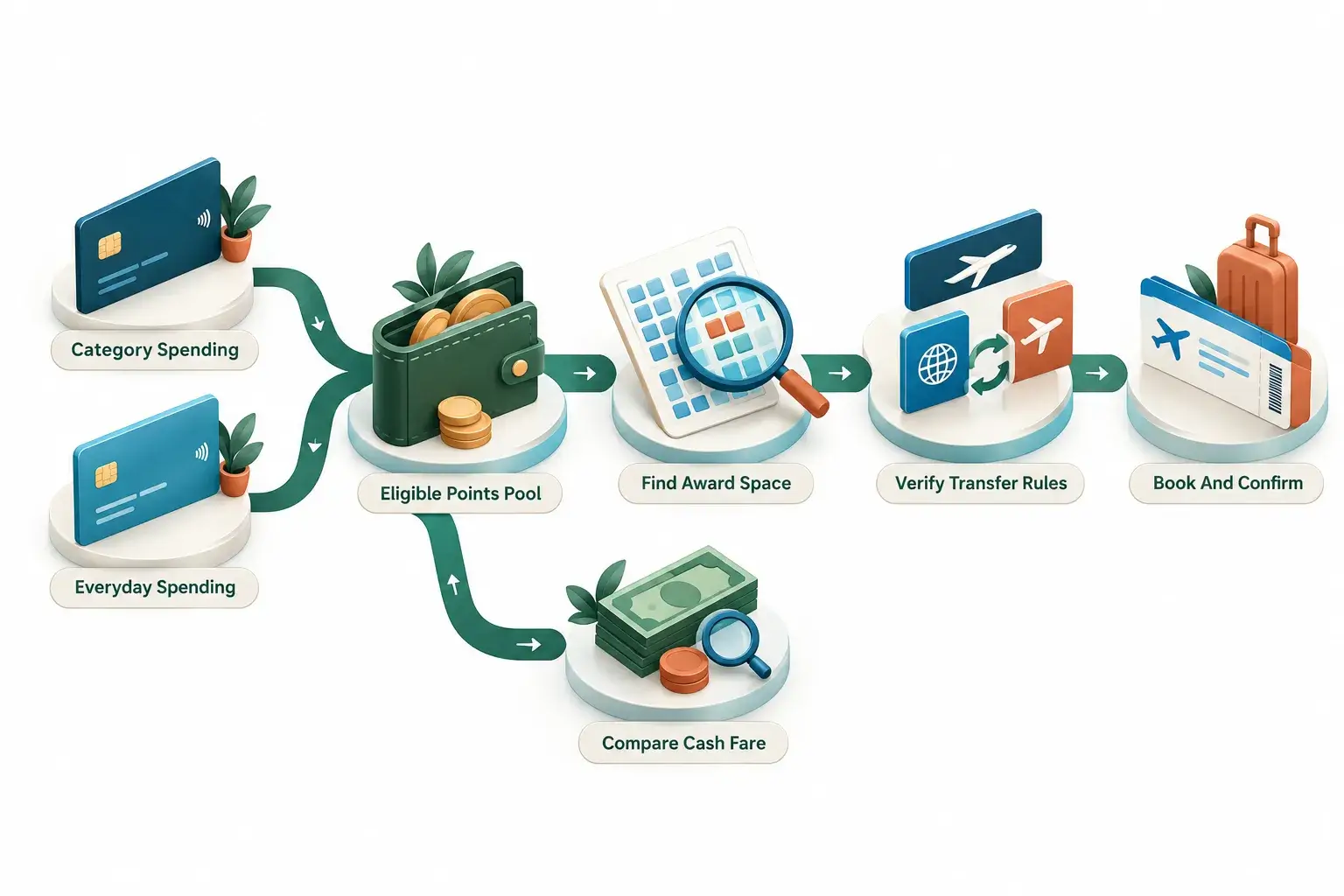
Build around one primary points currency
A practical Chase setup pairs Sapphire Preferred with Freedom Unlimited. Freedom Unlimited earns 1.5% cash back on general purchases, represented as Ultimate Rewards points; eligible points can be combined with Sapphire Preferred for partner transfers.
On $24,000 in annual nonbonus spending:
- Sapphire Preferred alone at 1x earns 24,000 points.
- Freedom Unlimited at 1.5x earns 36,000 points.
- The difference is 12,000 points without another annual fee.
Use Sapphire Preferred abroad: Freedom Unlimited charges a foreign transaction fee.
A Citi alternative pairs Strata Premier with Double Cash. Double Cash earns 2% total cash back, 1% when buying and another 1% when paying, through ThankYou points. Eligible points can be combined for broader transfer access through Premier. Double Cash also has a foreign transaction fee.
Points generally cannot move directly between unrelated bank currencies. Chase points cannot become Amex points, for example. Household transfers and account combinations follow issuer-specific rules.
Use the travel card setup comparison to compare combinations against actual spending.
Add a third card only for a separate job
A third card should solve a problem: checked-bag fees, recurring hotel stays, lounge access, or a spending category the first two cards miss.
An airline-specific card can be worth keeping for baggage savings even when a transferable-points card earns better rewards. Hotel cards can make sense for usable anniversary certificates, but certificate limits and availability reduce their flexibility.
Avoid opening three cards simply to pursue three bonuses. Minimum-spending requirements should fit normal purchases. Interest, payment fees, or unnecessary spending can exceed the rewards earned.
Follow a booking walkthrough before transferring
Consider this hypothetical business class booking:
- Cash ticket you would realistically buy: $2,400.
- Partner award: 70,000 airline miles plus $250.
- Bank transfer ratio: 1:1.
The redemption value is:
($2,400 − $250) ÷ 70,000 × 100 = 3.07 CPP.
With a hypothetical 25% transfer bonus, 56,000 bank points would produce 70,000 airline miles. The value per bank point becomes approximately 3.84 cents. Confirm transfer increments and bonus terms.
That result still needs context. A separate positioning flight, overnight hotel, or expensive return ticket can erase much of the advantage. Comparing against a $7,000 business class fare you would never buy also overstates your personal savings.
Use this step-by-step guide:
- Search your dates with award search tools.
- Confirm the seat through the program that will issue the ticket.
- Check transfer ratios, timing, and bonus eligibility.
- Review cancellation rules, stopovers, and surcharges and fees.
- Transfer only the required points, then book and confirm ticketing.
Transfers may be delayed, and award availability can disappear. Married segments, seats offered only as part of a connecting itinerary, can also prevent booking one flight separately.
Keep uncommitted points flexible. Speculative transfers increase devaluation risk, especially for scarce Business Class deals and First Class redemptions.
FAQ
Which travel card earns the most points per dollar?
Portal hotel bookings can earn 10x on Venture X and Citi Strata Premier, but that does not make either best for every purchase. Compare annual earnings across your actual categories and subtract fees and booking-channel costs.
Are travel credit card annual fees worth it?
Only when realistic rewards and usable benefits exceed the fee and the value of a simpler alternative. Calculate renewal-year value separately from the welcome bonus, and pay balances in full.
Do credit card travel rewards expire?
Many bank points remain valid while the account is open and in good standing, but closure, inactivity rules, and program terms can affect them. Once transferred, airline miles or hotel points follow the receiving program’s expiration policies.
Do points bookings include travel insurance?
Not automatically. Coverage depends on the card’s benefits guide, eligible payment method, and covered event. Paying award taxes with a card may trigger some protections, but never assume comprehensive coverage.
Are these cards suitable for fair credit?
Most leading transferable-points cards target applicants with good to excellent credit. Approval depends on more than a score. With fair credit, prioritize payment history and low balances over applying for multiple premium cards.
Conclusion
Choose the transfer program that serves your next realistic trip, then add an everyday earning card only if the improvement justifies the complexity. Before applying, price one actual award and calculate the card’s renewal-year value without its welcome bonus.





Content on Award Travel Hub is independently created by Award Travel Hub Editorial Desk and, where noted, reviewed by Award Travel Hub Review Desk. Some pages may contain affiliate links, but compensation does not determine our coverage, opinions, or methodology.