
Last updated: September 29, 2026
Quick Answer
Citi cards built around ThankYou Points now compete directly with Chase and Amex for serious points earners, mainly through Citi Strata Premier and Citi Strata Elite, which unlock transfers to roughly 15 to 19 airline and hotel partners. The catch: only premium-tier Citi cards unlock those transfers, so pairing a no-fee category card like Custom Cash with a transfer-enabled card is the strategy that actually makes Citi points worth holding.
Key Takeaways
Citi’s current travel-focused lineup centers on Strata Elite (premium, $595 annual fee) and Strata Premier ($95 annual fee); the old Prestige card is closed to new applicants.
Only Strata Premier, Strata Elite, and the business-focused Strata/Access More cards carry 1:1 transfer access to airline and hotel partners; no-fee cards like Custom Cash and Double Cash do not, on their own.
Pooling ThankYou points from a no-fee card into a premium account is required to make those points transferable, a mechanic similar to Chase’s Sapphire ecosystem.
Citi’s partner roster sits between Chase and Amex in size, with standout options like Turkish Airlines Miles&Smiles, Virgin Atlantic Flying Club, JetBlue, and Choice Privileges at an enhanced 1:1.5 ratio.
American Airlines AAdvantage was added as a transfer partner in July 2025; Aeromexico was removed in January 2026, the partner list is not static.
Active transfer bonuses as of late August 2026 include 25% to Leading Hotels of the World / Leaders Club and 40% to Turkish Airlines Miles&Smiles, both meaningfully improving redemption math.
You may be interested
ThankYou points redeemed for cash back or gift cards are worth a flat 1 cent each; transfers to partner airlines for premium cabin awards can push value well above 1.5 cents per point when award space cooperates.



Why Citi Is the Overlooked Transferable Points Ecosystem
Citi’s ThankYou program gets less attention than Chase Ultimate Rewards or Amex Membership Rewards mainly because fewer cardholders understand which Citi cards actually unlock transfer partners. That gap creates both a risk and an opportunity: cardholders who don’t move points into the right account leave value on the table, while those who understand the pooling rules get a partner list that rivals the bigger programs.
The lineup has also been refreshed. Citi retired the long-running Prestige card and replaced the premium slot with Strata Elite, while Strata Premier took over as the everyday travel workhorse. Below is a snapshot of where each current Citi card fits.
CardAnnual FeeBest ForTransfer AccessStrata Elite$595Lounge access, hotel credits, top earning ratesYes, 1:1 to partnersStrata Premier$95Everyday travel earning without a high feeYes, 1:1 to partnersCustom Cash$05% back on top monthly spend categoryNo (unless pooled)Double Cash$0Flat-rate spending outside bonus categoriesNo (unless pooled)Rewards+$0Small everyday spend, round-up earningNo (unless pooled)AAdvantage co-brand cards$99,$595Direct AAdvantage mile earning, checked bagsN/A, earns miles directly
For a broader look at how Citi’s transfer partners stack up against other programs, the Citi Transfer Partners Guide breaks down the full roster in more depth.
What Are Citi ThankYou Points Worth
Citi ThankYou points are worth roughly 1 cent each toward cash back or gift cards, around 1 to 1.25 cents through the Citi Travel portal depending on the card, and typically 1.3 to more than 2 cents per point when transferred to an airline or hotel partner for a strong redemption. That top-end value depends entirely on award availability and the specific route booked, it is not guaranteed on every transfer.
A concrete example: transferring 70,000 ThankYou points to Turkish Airlines Miles&Smiles during the active 40% transfer bonus (live since August 31, 2026) turns into 98,000 Miles&Smiles miles. If that redemption books a one-way Star Alliance business class award that would otherwise cost $3,500 cash, the effective value works out to roughly 3.6 cents per point, well above the flat cash-back rate. That math only holds if Star Alliance award space is actually available on the desired route and date, which requires checking partner airline award search tools directly rather than assuming space exists.
The Premium Tier: Strata Elite
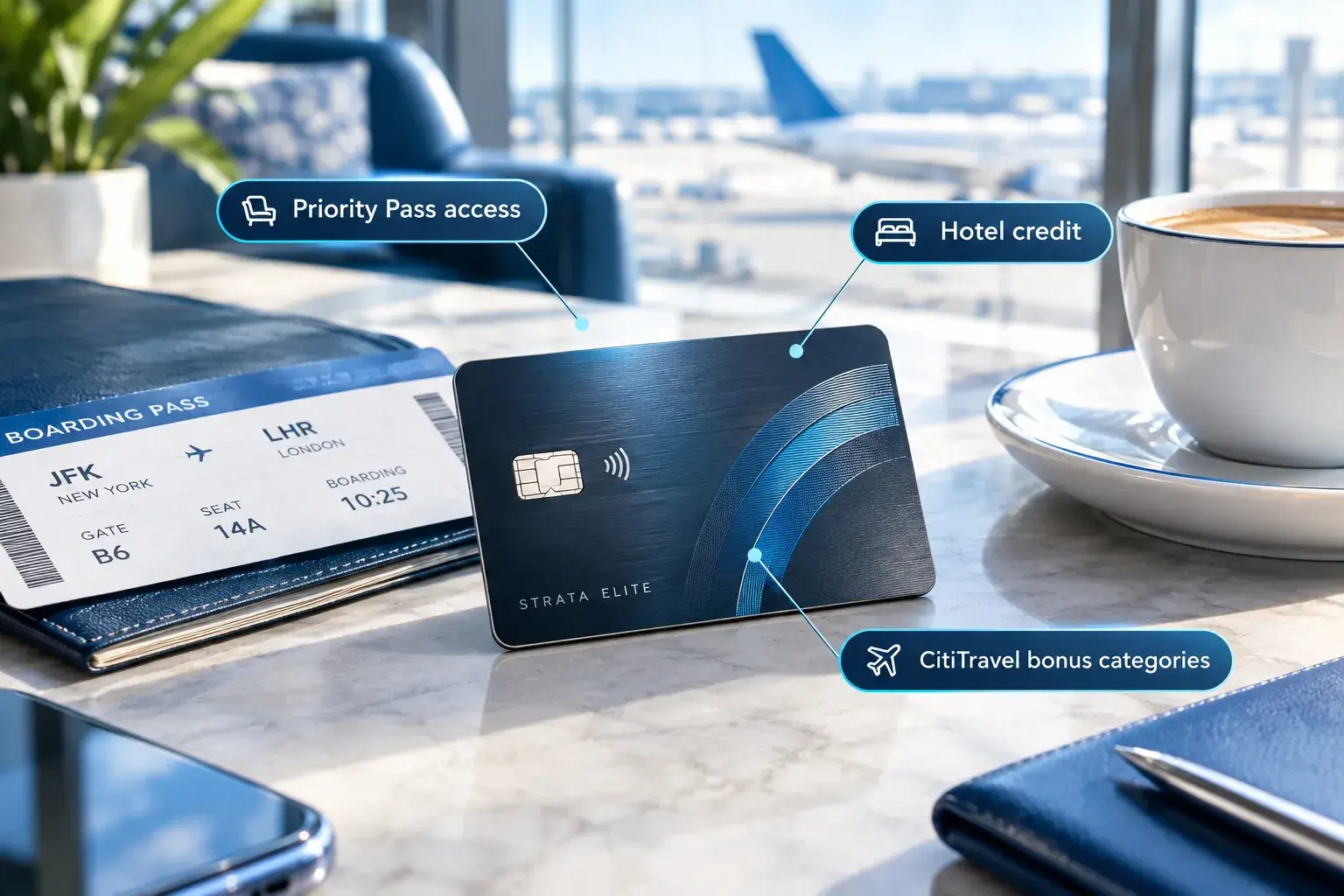
Strata Elite bundles Priority Pass lounge access, a $300 annual hotel credit for bookings through the Citi Travel portal, and a Blacklane airport transfer credit. The lounge benefit is worth evaluating against cost per visit rather than assuming automatic value, a point covered in more detail in Airport Lounge Access Credit Cards 2026: Cost-Per-Visit Math.
Best Citi Card for International Travel 2026
Strata Elite is the strongest Citi card for international travel in 2026 because it combines lounge access, no foreign transaction fees, and the widest ThankYou transfer access on the airline side. It suits travelers who fly internationally at least a few times a year and can consistently use the hotel and airport transfer credits, since those credits offset a meaningful share of the $595 fee.
Choose Strata Elite if: annual international travel is a given, lounge access gets used regularly, and the CitiTravel hotel credit fits normal booking habits.
Skip Strata Elite if: travel is mostly domestic, lounge visits would be occasional, or the hotel credit’s CitiTravel-only restriction doesn’t match how hotels are usually booked.
Citi Card Travel Insurance Coverage: What’s Included
Strata Elite includes trip cancellation and interruption coverage, trip delay reimbursement, and baggage delay coverage, along with rental car collision coverage, protections comparable to what Chase Sapphire Reserve and Amex Platinum offer on their premium cards. Coverage details and reimbursement caps vary by benefit and should be confirmed in the current guide to benefits before relying on them for an upcoming trip, since insurance terms on premium cards get adjusted more often than earning rates.
Citi Card Travel Credits vs Other Premium Cards
Citi’s travel credits on Strata Elite are narrower than some competitors because the $300 hotel credit only applies to bookings made through CitiTravel.com, similar to the restricted-portal design Amex uses for its Fine Hotels & Resorts credit on Platinum. That is a real limitation: travelers who prefer booking directly with hotel loyalty programs to earn elite night credit and status benefits may find the CitiTravel requirement gets in the way, effectively lowering the credit’s practical value for anyone who books outside that portal.
The Workhorse: Strata Premier
Citi Strata Premier is the mid-tier travel card most Citi cardholders should actually carry, at a $95 annual fee with earning strong enough to justify the cost for regular travelers. It earns 10x ThankYou points on hotels, car rentals, and attractions booked through CitiTravel.com, and 3x on restaurants, supermarkets, gas stations, and air travel and hotels booked directly.
Strata Premier includes a $100 annual hotel credit (again tied to CitiTravel bookings) and carries no foreign transaction fees, making it a reasonable everyday travel card for someone who wants transfer access without paying a premium-tier fee.
Citi Premier Card vs Prestige: Which Is Better
This comparison is largely moot in 2026 because Citi Prestige is closed to new applicants; Strata Premier and Strata Elite replaced it in the current lineup. Existing Prestige cardholders grandfathered into the card should compare their current earning rates and benefits against Strata Premier or Strata Elite directly, since Citi has occasionally allowed product changes between these cards. For anyone starting fresh, the real decision is Strata Premier versus Strata Elite, not Premier versus a discontinued product.
Citi Card Annual Fee Worth It for Travel
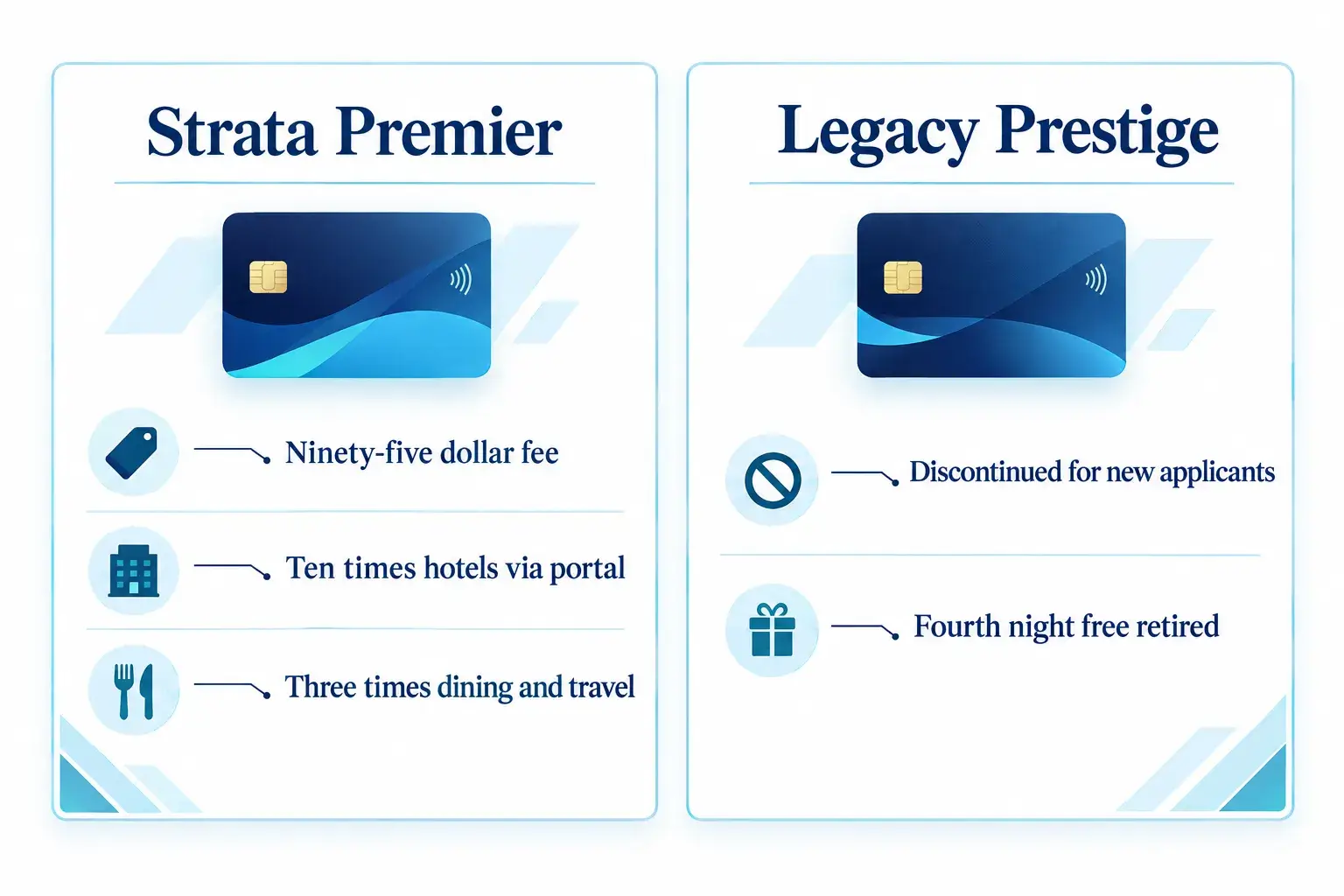
A Citi card’s annual fee is worth paying for travel rewards when the cardholder’s spending in bonus categories, plus usable credits, exceeds the fee in the first year. Strata Premier’s $95 fee is easy to clear for most travelers who eat out and book any travel through CitiTravel, since the $100 hotel credit alone nearly covers it if used. Strata Elite’s $595 fee requires more deliberate use of the lounge access, hotel credit, and Blacklane credit to justify, it is not a card to hold passively.
Rule of thumb: if a cardholder can reliably use at least 60 to 70 percent of a premium card’s stated credits, the fee is generally worth it.
Common mistake: keeping a premium Citi card open on autopilot without tracking whether the hotel or lounge credits actually get used each year.
For a side-by-side look at how Citi’s fee structure compares to other transferable points cards, see Compare Travel Credit Cards: Pick the Right Setup 2026.
The Category Cards: Custom Cash and Double Cash
Citi Custom Cash and Double Cash are no-annual-fee cards that earn ThankYou points but cannot transfer those points to airline or hotel partners on their own. Custom Cash earns 5% back (as ThankYou points) on the single highest-spend eligible category each billing cycle, up to $500 in spend per quarter, then 1% after that. Double Cash earns a flat 2% equivalent, 1% when a purchase posts, 1% when it’s paid off.
Can You Use Citi ThankYou Points for Cash Back
Yes. ThankYou points earned on any Citi card, including Custom Cash and Double Cash, can be redeemed for cash back, statement credit, or gift cards at a flat rate of roughly 1 cent per point. That is the ceiling for value on these no-fee cards unless the points get pooled into a premium account, cash back is a safe fallback, not a strategy for maximizing points.
Is Citi Card Good for Beginners or Do You Need Good Credit
Citi’s no-fee ThankYou cards, particularly Custom Cash and Double Cash, work well for beginners because they carry no annual fee and reward straightforward spending without complicated category rotations. Approval typically requires good to excellent credit (roughly 670 or higher, though Citi does not publish a hard cutoff), similar to other major transferable points cards from Chase and Amex.
Choose Custom Cash or Double Cash if: building a Citi relationship before adding a premium card, or wanting flat cash back without a fee.
Choose Strata Premier instead if: transfer partner access is the goal from day one, since no-fee cards alone don’t provide it.
How to Maximize Citi Points on Everyday Purchases
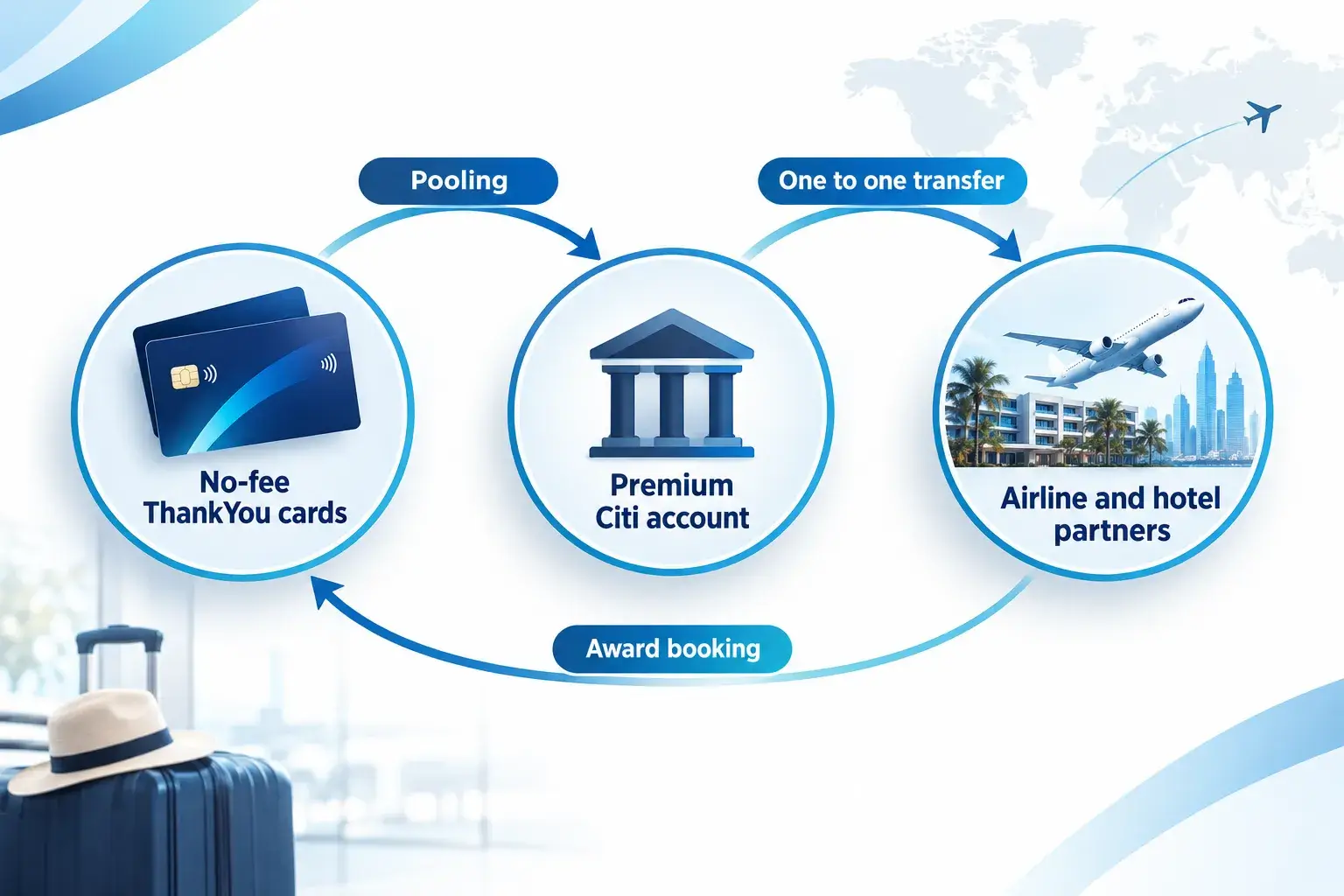
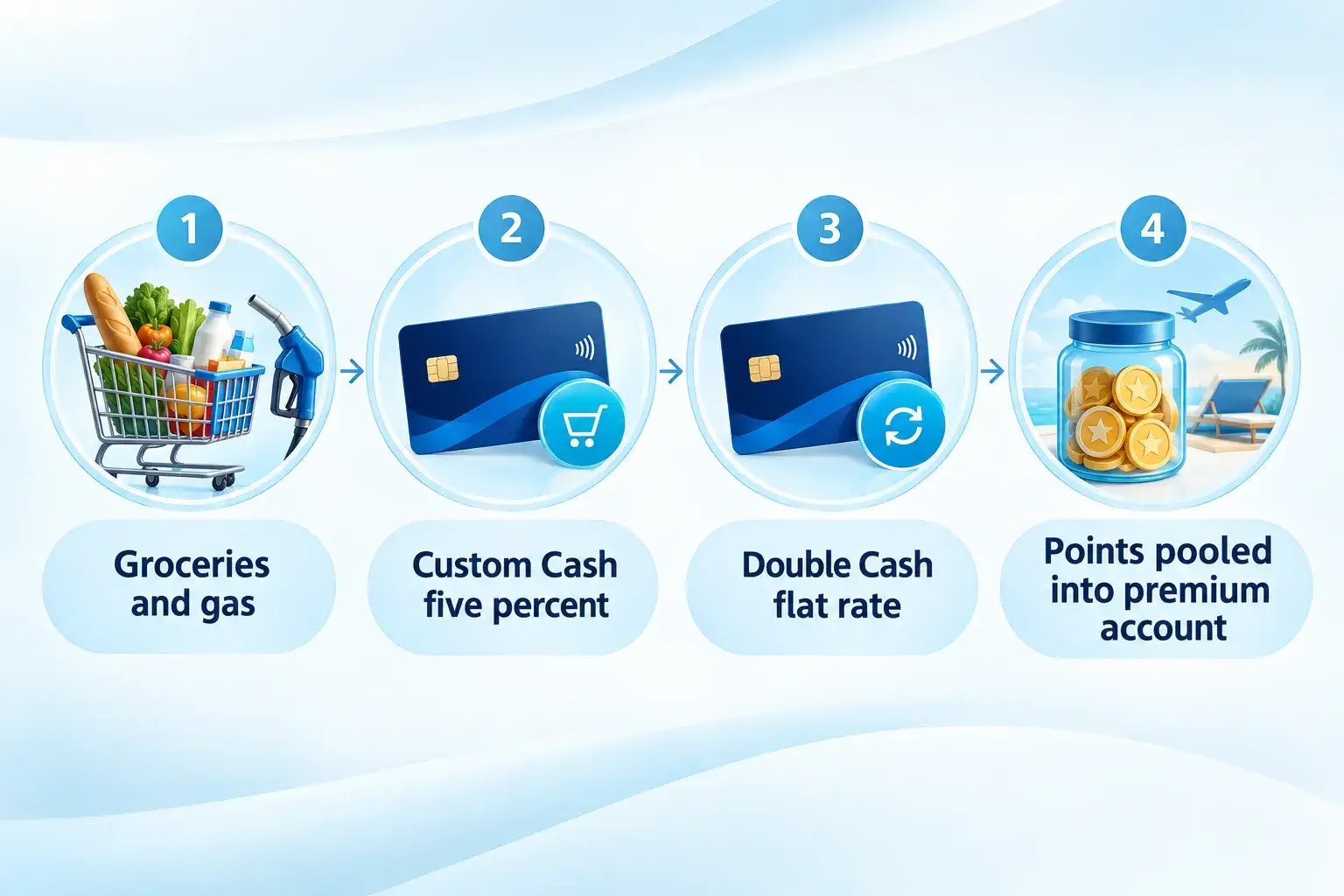
Maximizing Citi points on everyday spending means matching purchases to whichever category card earns the highest rate, then routing all points into a premium account for transfer access. A practical setup: use Custom Cash for its top 5% category each quarter (rotating spend to match), use Double Cash for everything else at 2%, and hold Strata Premier or Strata Elite as the “hub” account that receives pooled points and unlocks transfers.
This mirrors the Chase Freedom-plus-Sapphire pairing strategy that many transferable points users already know, Citi requires the same discipline to avoid stranding points in a non-transferable account.
The Co-Brand Cards Worth Knowing
Citi’s co-brand lineup is smaller than Chase’s but still relevant for travelers loyal to a specific airline. The AAdvantage Platinum Select and AAdvantage Executive World Elite cards earn American Airlines miles directly rather than ThankYou points, and the Executive card includes Admirals Club lounge access at a $595 fee comparable to Strata Elite.
Citi Cards No Foreign Transaction Fee
Most of Citi’s current travel-relevant cards, including Strata Elite, Strata Premier, and the AAdvantage co-brand cards, charge no foreign transaction fees. Citi’s no-fee category cards like Double Cash and Custom Cash do carry foreign transaction fees, so they are not the right cards to bring on an international trip. Anyone building a wallet specifically for travel abroad should also compare options in Best No Foreign Transaction Fee Credit Cards 2026 before deciding which non-Citi cards to pair alongside a Citi travel card.
How ThankYou Points Move Between Citi Cards
ThankYou points earned on any eligible Citi card can be combined into a single ThankYou account, but only points sitting in an account tied to a transfer-enabled card (Strata Premier, Strata Elite, or the business Strata/Access More cards) can actually move to airline and hotel partners. Points sitting only in a Custom Cash or Double Cash account are locked to cash-back-style redemptions until pooled.
How to Transfer Citi ThankYou Points to Airlines
Current partner coverage runs between roughly 15 and 19 airline and hotel programs depending on the tracker, reflecting minor timing differences after recent additions and removals:
American Airlines AAdvantage was added in July 2025 for Strata-level cardholders, a significant addition given American’s large route network.
Aeromexico was removed as a partner on January 25, 2026.
Core airline partners include Air France/KLM Flying Blue, Avianca LifeMiles, Cathay Pacific Asia Miles, EVA Air Infinity MileageLands, Emirates Skywards, Etihad Guest, JetBlue TrueBlue, Malaysia Airlines Enrich, Qantas Frequent Flyer, Qatar Airways Avios, Singapore Airlines KrisFlyer, Turkish Airlines Miles&Smiles, Virgin Atlantic Flying Club, and Aer Lingus Avios.
Hotel partners include Accor Live Limitless, Choice Privileges, Leaders Club (Leading Hotels of the World), Wyndham Rewards, and Preferred Hotels & Resorts.
Two active transfer bonuses are worth checking before moving points: a 25% bonus to Leading Hotels of the World / Leaders Club running August 23 through September 19, 2026 (effectively a 4:1 ratio instead of the standard 5:1), and a 40% bonus to Turkish Airlines Miles&Smiles that launched August 31, 2026. Details on the hotel bonus and Virgin Atlantic transfer mechanics are covered in Citi ThankYou Leading Hotels Transfer Bonus 2026 and the Citi to Turkish Airlines Transfer Bonus 2026 guide.
Common mistake: transferring points speculatively before confirming award space on the target airline’s own award search tool. Transfers are typically one-way and cannot be reversed, so unused miles sitting in a partner account carry their own devaluation risk if that program changes its award chart later.
Citi Card Sign-Up Bonus: How Long to Get Points
Citi typically posts a sign-up bonus within one to two billing cycles after meeting the minimum spend requirement, though it can take up to eight weeks in some cases. The exact timing depends on when the spend threshold is met relative to the statement closing date, so hitting the minimum spend early in a billing cycle generally gets the bonus posted faster than hitting it right before the deadline.
What Happens to Citi Points if You Close Your Card
Closing a Citi card typically forfeits any ThankYou points remaining in that card’s linked account unless they are redeemed or transferred beforehand, though points already pooled into a shared ThankYou account tied to another open eligible card are usually protected. The safest approach before closing any Citi card is to transfer or redeem the balance first, then confirm the account closure, don’t assume points will carry over automatically.
Citi ThankYou Points Expiration Policy
ThankYou points generally do not expire as long as the linked account remains open and in good standing, similar to how Chase and Amex handle points on open accounts. Points can be forfeited for account closure, serious delinquency, or fraud-related account actions, so the expiration risk is tied to account status rather than a fixed calendar date.
Where Citi Wins and Where It Still Falls Short
Citi cards earn their place in a transferable points strategy primarily through partner-specific sweet spots, Turkish Airlines, Virgin Atlantic, JetBlue, and Choice Privileges access give Citi points genuine, distinct value rather than making Citi a simple substitute for Chase or Amex. Where Citi falls short is breadth: Amex Membership Rewards generally offers more airline partners and a stronger history of resisting dynamic devaluation, while Chase Ultimate Rewards pairs a smaller partner list with a more consistent travel portal experience through cards compared in Best Travel Chase Cards 2026: Compare the Full Lineup.
Citi’s biggest structural weakness is the split between transfer-enabled and non-transfer cards, which creates real risk of stranding points for anyone who doesn’t understand the pooling rule. Dynamic pricing on partner airlines, fuel surcharges on a handful of programs like some Middle East carriers, and the CitiTravel-only restriction on hotel credits are additional tradeoffs to factor in before assuming a Citi card will outperform an existing Chase or Amex setup.
FAQ
Is Citi Strata Elite worth the $595 annual fee compared to Amex Platinum or Chase Sapphire Reserve?
It depends on whether the lounge access, hotel credit, and airport transfer credit get used consistently. Travelers who already have Priority Pass through another card, or who rarely book through CitiTravel, will likely find the fee harder to justify than with Amex Platinum or Sapphire Reserve.
Can Citi ThankYou points be pooled across multiple Citi cards in one household?
Yes, ThankYou points can typically be combined across eligible Citi cards held by the same person, and in some cases across authorized users, as long as at least one account in the pool has transfer access.
Do Citi cards offer a travel portal like Chase or Amex?
Yes, CitiTravel.com functions as Citi’s booking portal, and it also drives the highest earning multipliers on Strata Premier and Strata Elite for hotels, car rentals, and attractions.
Which Citi card should someone get first if they already have Chase and Amex cards?
Strata Premier is the logical starting point for its $95 fee and transfer access; Strata Elite only makes sense once travel frequency and lounge usage justify the higher fee.
Are Citi transfer partners better than Chase’s for premium cabin awards?
Citi’s roster leans stronger for a few specific programs, particularly Turkish Airlines and Virgin Atlantic, but Chase’s United and Hyatt access covers different sweet spots. The better program depends on the specific route and cabin being targeted.
Does Citi charge foreign transaction fees on its travel cards?
No, Strata Elite, Strata Premier, and Citi’s AAdvantage co-brand cards do not charge foreign transaction fees, though the no-fee category cards like Double Cash and Custom Cash do.
Conclusion
Citi’s 2026 lineup rewards cardholders who understand one rule: transfer access lives only on Strata Premier, Strata Elite, and the business Strata/Access More cards. Everything else in the ThankYou family, Custom Cash, Double Cash, Rewards+, earns points that need to be pooled into one of those accounts before they’re worth more than a flat cent each.
For someone already running a Chase or Amex points strategy, the practical next step is deciding whether Citi’s specific sweet spots, Turkish Airlines, Virgin Atlantic, JetBlue, and enhanced Choice Privileges transfers, fill a gap the existing setup doesn’t cover. If they do, Strata Premier is the low-fee entry point; Strata Elite is worth it only for travelers who will actually use its lounge and credit benefits. Before transferring any points, confirm award availability directly on the partner airline’s search tool, and check whether an active transfer bonus like the current Leading Hotels of the World or Turkish Airlines promotions, improves the math first.


Content on Award Travel Hub is independently created by Award Travel Hub Editorial Desk and, where noted, reviewed by Award Travel Hub Review Desk. Some pages may contain affiliate links, but compensation does not determine our coverage, opinions, or methodology.