
Last updated: October 27, 2026
Quick Answer: A premium card pays off when the credits you would have spent money on anyway, plus the extra points you earn over a no-fee card, plus the realistic value of lounges, status, and insurance, add up to more than the annual fee. Using a credit card annual fee ROI calculator with conservative inputs (1.5 cents per transferable point), a $795 Chase Sapphire Reserve or $895 Amex Platinum clears its fee only for frequent travelers who naturally use most of the credits. Light users usually come out ahead by downgrading.
Key Takeaways
- Count credits at what you would actually pay out of pocket, not face value. Most cardholders should discount coupon-style credits by 50% or more.
- Measure earning against a no-fee card, not against zero. A 3x dining card only adds value if your fallback card earns less than 3x.
- This article values Chase points, Amex points, and Capital One miles at a flat 1.5 cents per point (CPP) and IHG points at 0.5 CPP.
- Welcome bonuses belong in a year-one calculation only. Keep-or-cancel decisions should use year-two math.
- The Amex Platinum ($895) and Sapphire Reserve ($795) fees now hit existing cardholders at renewal; IHG’s higher fees are expected at 2027 renewals.
- J.D. Power’s 2026 U.S. Credit Card Satisfaction Study found only 29% of cardholders use their cards in ways that maximize rewards, and average benefits used fell from 2.5 to 2.3.
- If your net ROI is negative two years running, downgrade to a no-fee card in the same family so you keep your points.
The Annual Fee ROI Formula: How a Credit Card Annual Fee ROI Calculator Works
A credit card annual fee ROI calculator compares the realistic dollar value a card gives you each year against its annual fee. The output is a single net number: positive means keep, negative means downgrade or cancel.
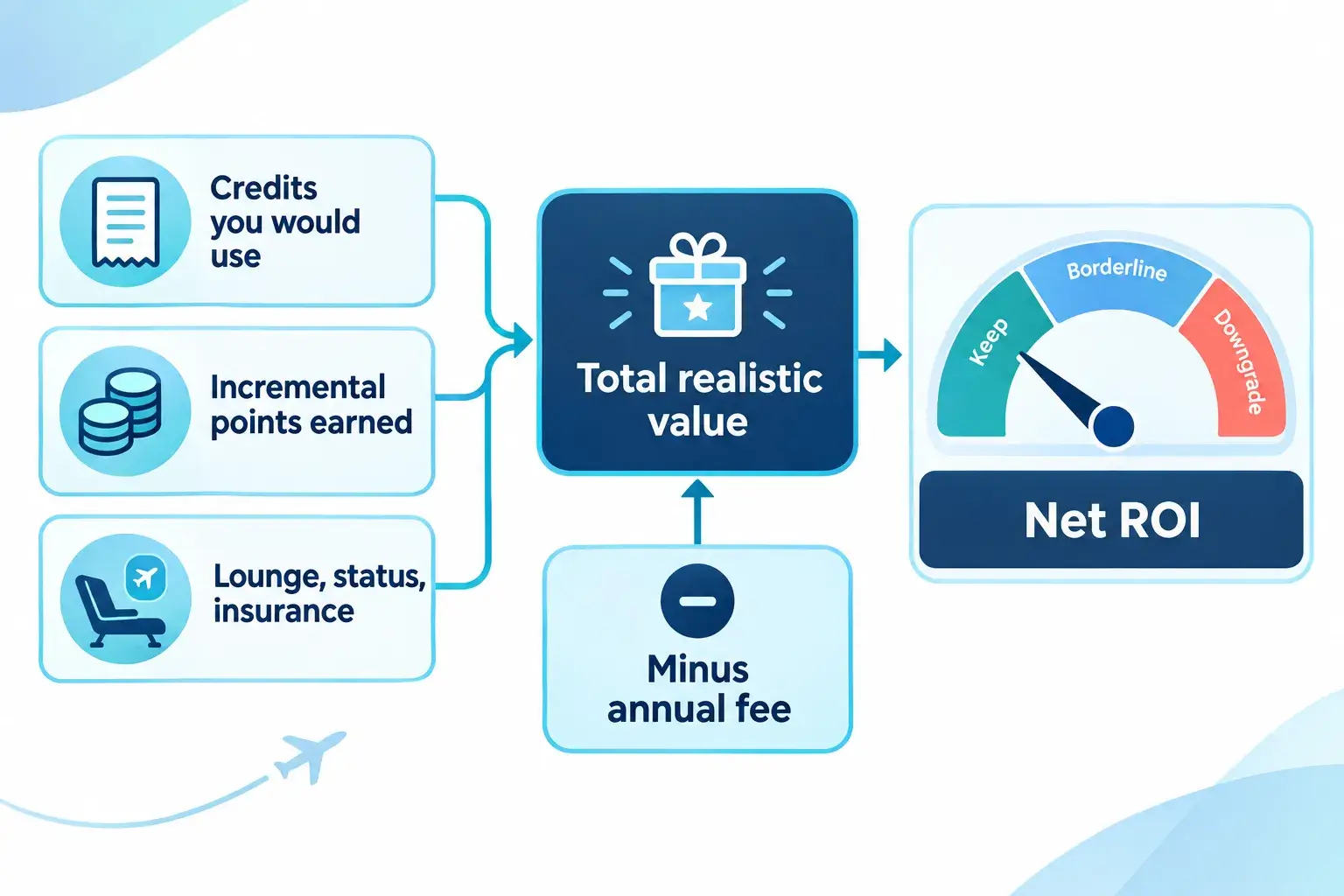
The formula used throughout this guide:
Net ROI = (Credits you’d actually use) + (Incremental points x CPP) + (Lounge, status, and insurance value) − Annual fee
Each input has a rule:
- Credits: value at your real out-of-pocket replacement cost.
- Incremental points: only the points above what a no-fee card would earn on the same spend.
- Perks: price at what you would pay for a comparable benefit, or zero if you would not pay for it.
Decision rule: Keep the card if net ROI is positive by a comfortable margin (roughly $100 or more). Treat results within $100 of zero as borderline, because one unused credit flips the answer.
How do sign-up bonuses affect credit card ROI calculations?
Sign-up bonuses dominate year one and disappear after that. A 100,000-point bonus on the Sapphire Reserve is worth about $1,500 at 1.5 CPP, which can cover nearly two years of fees by itself.
You may be interested



Run two separate calculations:
- Year-one ROI: formula above, plus the bonus value, minus the opportunity cost of the minimum spend (points you would have earned on another card).
- Ongoing ROI: formula without the bonus. This is the number that decides whether to keep the card at renewal.
Common mistake: Using the bonus to justify keeping a card in year three. The bonus is already spent. For current offers, see our ranked list of the best credit card welcome bonuses for October 2026.
Step 1: Value Credits at What You’d Actually Spend
Value each credit at the amount you would have spent anyway on that exact merchant or category. A $300 StubHub credit is worth $0 to someone who doesn’t buy event tickets, and close to $300 to someone who does.
Use this discount scale:
| Credit type | Example | Suggested valuation |
|---|---|---|
| Broad, automatic | Sapphire Reserve $300 travel credit | 100% |
| Broad but booking-channel restricted | Venture X $300 Capital One Travel credit | 80-90% |
| Semiannual or monthly, specific merchant | Resy, Uber Cash, DoorDash | 40-70% |
| Hotel credits tied to a prepaid collection | Chase The Edit, Amex Fine Hotels + Resorts | 30-60% |
| Lifestyle subscriptions you don’t use | lululemon, ŌURA, Peloton, Apple TV | 0-20% |
Which annual fee credit cards have travel credits that offset costs?
The cards with the most flexible offsets are the Chase Sapphire Reserve ($300 travel credit applied automatically to most travel purchases) and the Capital One Venture X ($300 annual credit, but only through Capital One Travel). The Amex Platinum offers larger headline totals but splits them across many merchants and time windows, which is where breakage happens.
Edge case: Booking-portal credits can cost more than they appear. If Capital One Travel prices a hotel $40 above booking direct, and you lose elite credit, your $300 credit is closer to $260 in real value.
Step 2: Calculate Incremental Earning vs a No-Fee Card
Incremental earning is the extra points a premium card earns compared with the no-fee card you would otherwise use for the same purchases. Multiply the point difference by your CPP to get dollars.
Earning rates used here (confirm before applying, since issuers change them):
- Chase Sapphire Reserve: 8x on Chase Travel, 4x on flights and hotels booked direct, 3x dining, 1x other.
- Amex Platinum: 5x on flights booked direct or through Amex Travel (annual cap applies), 5x prepaid hotels via Amex Travel, 1x other.
- Capital One Venture X: 10x hotels and rental cars and 5x flights via Capital One Travel, 2x everything else.
- No-fee baseline: a card earning 1.5x on everything (for example, Chase Freedom Unlimited, which also earns 3x dining).
Quick example: A Sapphire Reserve holder spends $8,000 a year on flights and hotels booked direct. That’s 4x versus 1.5x, or 2.5 extra points per dollar. 20,000 extra points x 1.5 cents = $300. But on $6,000 of dining, the Reserve’s 3x matches Freedom Unlimited’s 3x, so the incremental value is $0.
How much do I need to spend for a premium credit card to be worth it?
Divide the “uncovered” fee (fee minus credits and perks you’d really use) by your incremental earn rate per dollar. If $200 of the Reserve’s fee is uncovered and you earn 2.5 extra points on direct travel (3.75 cents per dollar at 1.5 CPP), you need about $5,300 a year in direct travel spend to break even.
Common mistake: Putting non-bonus spend on a 1x premium card. That earns less than a 1.5x no-fee card, which lowers your ROI.
Step 3: Price Lounge Access, Status, and Insurance
Lounge access, hotel status, and travel insurance have real value only if you’d use them and would otherwise pay for them. Price each one conservatively and per use.

Practical pricing guide:
- Lounges: multiply expected visits by a realistic per-visit value ($25,$40, roughly a day-pass price or an airport meal you’d skip). Our breakdown of airport lounge access credit cards and cost-per-visit math covers which networks deliver the most.
- Hotel status: count only perks you’d actually receive at hotels you already book, such as late checkout or breakfast.
- Insurance: primary rental car coverage, trip delay, and trip cancellation are worth the premium you’d otherwise pay. Rarely more than $50,$100 a year for most travelers.
Decision rule: If lounge value is carrying more than half of your positive ROI, test the result at half the visits. Crowding and guest restrictions can cut lounge value quickly.
Which Credit Card Annual Fees Increased in 2026?
The biggest fee changes affecting 2026 renewals are the Amex Platinum at $895, the Chase Sapphire Reserve at $795, and IHG’s refreshed co-branded lineup. Renewal timing matters, because existing cardholders often pay the old fee until their anniversary.
| Card | Current annual fee | What changed | When existing holders pay |
|---|---|---|---|
| Amex Platinum | $895 | Up from $695 with new Resy, lululemon, Uber One, ŌURA credits | Renewals on or after Jan. 2, 2026 |
| Chase Sapphire Reserve | $795 | Up from $550; value shifted to limited-use credits | Already in effect at renewal |
| IHG One Rewards Premier | $150 (reported) | Up from $99 | Expected at 2027 renewal |
| IHG Business | $200 (reported) | Up from $99 | Expected at 2027 renewal |
| IHG Premier Select (new) | $350 | New card with dining, airline, elite-night, anniversary benefits | New applicants |
| Capital One Venture X | $395 | Verify current fee before applying | Check issuer terms |
Sapphire Reserve authorized users now cost $195 each; include this in your calculator if you add family members. For IHG renewal timing, see our IHG card annual fee increase renewal guide.
Worked Examples for Four Premium Cards at 2026 Fees
These examples assume a frequent but not extreme traveler and use 1.5 CPP for transferable points. Swap in your own spend and usage to run your personal credit card annual fee ROI calculator.
Does the Chase Sapphire Reserve annual fee pay for itself?
Yes for travelers who use the travel credit, one Edit hotel stay, and some dining credits. No for light travelers.
| Input | Assumption | Value |
|---|---|---|
| $300 travel credit | Used fully | $300 |
| $500 The Edit credit | One stay a year | $250 |
| $300 dining credit | One Exclusive Tables meal | $100 |
| Apple, DoorDash, StubHub, Lyft, Peloton | Light use | $110 |
| Incremental earning | $8,000 direct travel at +2.5x | $300 |
| Lounges | 6 visits | $180 |
| Insurance | Primary rental, trip delay | $50 |
| Total value | $1,290 | |
| Net after $795 fee | +$495 |
A light user who only uses the $300 travel credit and some dining value lands around −$300.
Amex Platinum ($895)
Net is about +$700 for a disciplined coupon user: $300 of the $600 hotel credit, $200 of Resy, $120 of Uber Cash, $100 of the airline fee credit, plus partial digital entertainment, CLEAR, and Saks use (about $990 total), $315 from 21,000 incremental points on $6,000 of airfare, and $280 in lounge visits. Count lululemon and ŌURA at $0 unless you already buy those products. Not for: anyone who won’t track monthly and quarterly credits. That cardholder is likely −$300 or worse.
Capital One Venture X ($395)
Net is about +$330: $250 for the portal travel credit, $150 for the 10,000 anniversary miles, $225 from 15,000 incremental miles on $30,000 of everyday spend at 2x versus 1.5x, and $100 in lounge value. Best for: simple, high-volume spenders who want one card.
IHG One Rewards Premier ($150, reported)
Net is about +$175 for someone who stays at IHG once or twice a year: an anniversary night (about $200 at 0.5 CPP), fourth-night-free savings on one award stay ($100), and Platinum status ($25). Confirm the refreshed card’s benefit terms before renewal. Zero IHG stays means a negative ROI.
Who Should Get a Premium Credit Card With Annual Fees?
Premium cards fit debt-free travelers who fly several times a year, already spend in the credit categories, and redeem transferable points through partner airlines for Premium Cabin awards. They don’t fit anyone carrying a balance, because interest erases rewards quickly.
J.D. Power’s 2026 study found that 60% of cardholders were financially unhealthy, and John Cabell described premium value as tilted toward “debt-free rewards hunters.” That matches the math above.
What are the best credit cards with annual fees that pay for themselves?
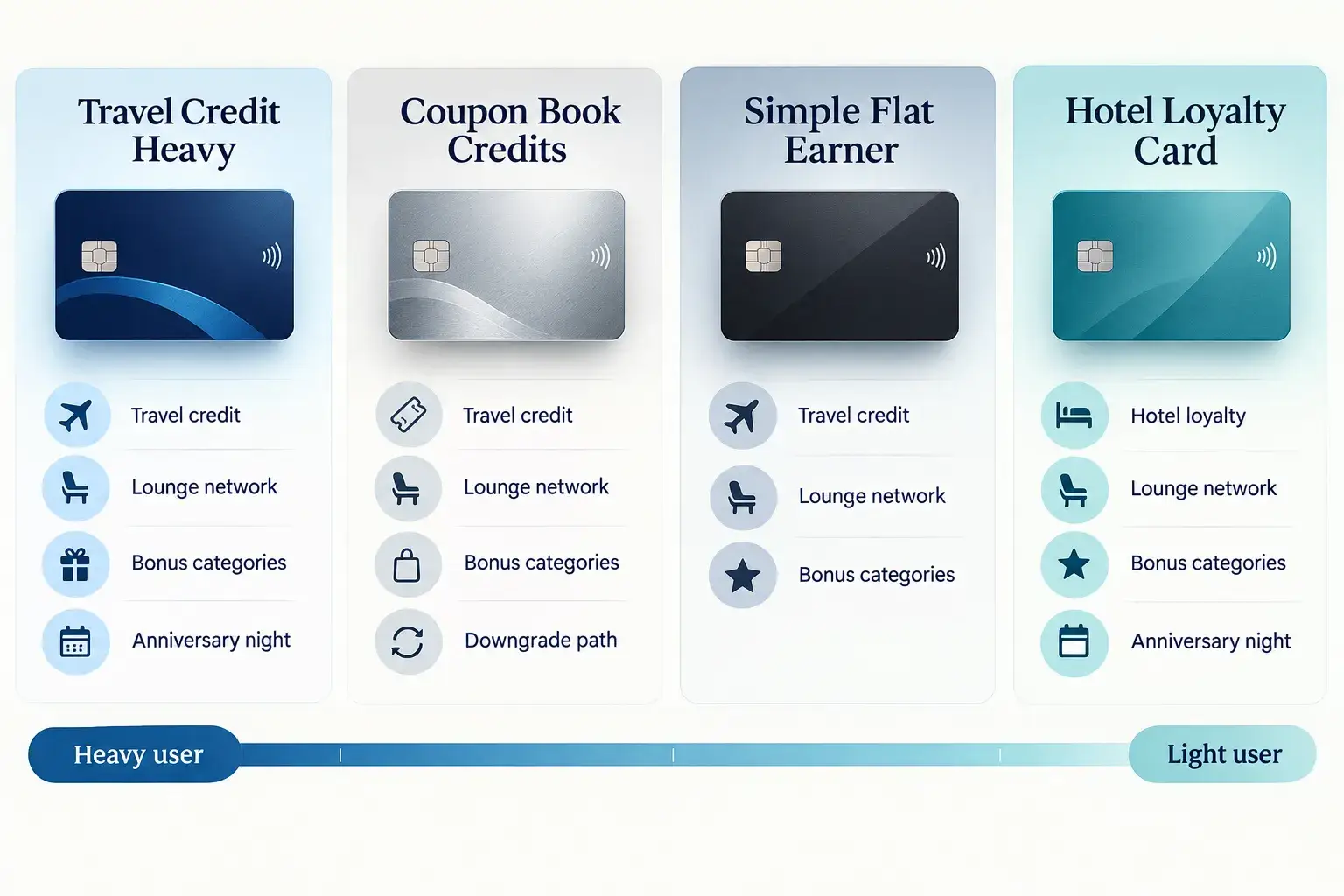
Based on the worked examples, the most forgiving cards are those with broad, easy credits relative to the fee:
- Capital One Venture X: best for simplicity; the credit and anniversary miles nearly offset the fee.
- Chase Sapphire Reserve: best for travelers who use the $300 travel credit and value Chase points transfer partners such as Hyatt.
- Amex Platinum: best for lounge-heavy flyers who naturally use several credits.
- Hotel co-brands: best when the anniversary night alone exceeds the fee.
Strong redemption value also raises ROI. Our credit card transfer partners ratio chart shows where 1.5 CPP is conservative and where it’s optimistic.
When the Math Says Downgrade
Downgrade when your ongoing net ROI is negative, or within $100 of zero with no clear plan to use more benefits. A product change keeps your account history and often your points.
When is a credit card annual fee not worth it?
- You carry a balance month to month.
- More than half your “value” comes from credits you’d never pay cash for.
- Your fallback no-fee card earns the same rate on your main spending.
- You fly fewer than three or four round trips a year.
Downgrade paths to check
| Card | Common downgrade options | Points note |
|---|---|---|
| Chase Sapphire Reserve | Sapphire Preferred, Freedom Unlimited, Freedom Flex | Points stay; transfers require a Sapphire or Ink card |
| Amex Platinum | Gold or Green (when offered) | Keep an open Membership Rewards card before closing |
| Capital One Venture X | Venture or VentureOne | Miles stay with the account |
| IHG Premier | IHG Traveler (no fee) | IHG points live in your loyalty account |
Availability varies by account, so confirm with the issuer. Our guide on how to downgrade a travel credit card and keep your points walks through each issuer’s process.
Can you get annual fees waived or refunded on credit cards?
Outright waivers are rare, but retention offers (bonus points or statement credits after the fee posts) are common. Most issuers refund the fee if you cancel within about 30 days of it posting; check your card’s terms. Learn the timing in our guide to travel card annual fee waivers and retention offers.
Credit Card Annual Fee ROI Calculator Tools and Apps
A spreadsheet with the formula above is the most accurate tool, because you control every assumption. Issuer apps show which credits you’ve used, which helps you fill in Step 1 with real data instead of guesses.
Useful additions:
- Track credit usage monthly in the issuer app or a simple checklist.
- Use award search tools to confirm your CPP assumption on routes you actually book.
- Revisit your inputs 45 days before renewal.
Common Mistakes When Calculating Credit Card Annual Fee Value
- Counting face value: the advertised “$3,000 in value” is not your value.
- Ignoring the baseline card: comparing 3x dining to zero instead of to 3x on a no-fee card.
- Inflating CPP: assuming 2+ cents per point when your history shows cash-portal redemptions near 1 cent.
- Forgetting devaluation risk: award charts and dynamic pricing can cut point value mid-year.
- Double counting: valuing both a hotel credit and the hotel stay it was used on.
FAQ
What CPP should I use in a credit card annual fee ROI calculator? Use 1.5 cents for Chase, Amex, and Capital One points unless your own redemptions consistently beat that. Use your actual history, not best-case premium cabin redemptions.
Is the Amex Platinum worth $895 in 2026? Only if you use most of the hotel, Resy, Uber, and airline credits and value lounge access. Infrequent travelers typically lose money.
Should I include authorized user fees? Yes. A $195 Sapphire Reserve authorized user should be added to the fee side unless their perks, such as lounge access, cover it.
Do I lose points if I downgrade? Usually not with a product change within the same issuer family. Closing your only Amex Membership Rewards card can forfeit points, so transfer or redeem first.
When should I run the calculation? About 45 days before your annual fee posts, so you have time to request a retention offer or product change.
Is a no-fee card better for most people? For people who don’t travel often or who carry a balance, yes. Our comparison of no annual fee vs premium cards covers the tradeoffs.
Conclusion
After the 2026 fee hikes, premium cards still pay off, but only for cardholders who use them deliberately. The Venture X is the easiest to justify, the Sapphire Reserve works for travelers who use its travel and hotel credits, and the Amex Platinum rewards people willing to manage a coupon book. Everyone else should run the numbers honestly.
Next steps:
- List every credit and value it at your real out-of-pocket cost.
- Calculate incremental points against your best no-fee card at 1.5 CPP.
- Price lounges, status, and insurance conservatively.
- If net ROI is negative, ask for a retention offer, then downgrade within the same family to protect your points.


Content on Award Travel Hub is independently created by Award Travel Hub Editorial Desk and, where noted, reviewed by Award Travel Hub Review Desk. Some pages may contain affiliate links, but compensation does not determine our coverage, opinions, or methodology.