

Last updated: October 26, 2026
Quick Answer: A $395 card can offer better value than an $895 card even when the more expensive card advertises thousands in benefits. Compare premium travel card annual fees against credits that replace existing spending, not the issuer’s maximum benefit total. Venture X has the lowest fee among the five core cards below; Amex Platinum and Business Platinum share the highest at $895.
Key Takeaways
- Annual fees range from $395 for Venture X to $895 for the two Platinum cards.
- A restricted booking credit is not equivalent to cash or a broad travel credit.
- Monthly, quarterly, and semiannual credits can expire before you use them.
- Venture X anniversary miles start after the first year, not at account opening.
- Authorized-user fees and lounge guest charges can change household economics.
- Welcome bonuses should not determine whether a card is worth renewing.
- Occasional travelers should compare premium cards with lower-fee alternatives.
Premium Travel Card Fees in 2026: The New $895 Ceiling
The practical question is how much of a premium card’s fee your normal spending can recover. Amex Platinum and Business Platinum sit at the $895 ceiling in this comparison, but a higher fee does not guarantee better travel value.

This tracker covers five major products: Capital One Venture X, Citi Strata Elite, Chase Sapphire Reserve, Amex Platinum, and Amex Business Platinum. It is not an exhaustive inventory of airline, hotel, invitation-only, business, or legacy cards in the same price range.
Product terms can change. Check the application’s pricing disclosure and your account’s benefit terms before applying or renewing, especially for enrollment requirements and transition dates.
Which premium travel cards have the highest and lowest annual fees?
Among these five cards, Venture X is the lowest at $395, followed by Citi Strata Elite at $595. Sapphire Reserve costs $795, while both Platinum products cost $895.
Choose the higher-fee card only when its additional benefits cover the price difference. Paying more solely for access to transferable points rarely makes sense without comparing cheaper cards in the same ecosystem.
Fee and Credit Tracker: Every $395 – $895 Card Side by Side
The table separates annual fees from headline credits and additional-card costs. Credit totals are maximum allowances, not guaranteed savings, and most benefits are shared across the account rather than multiplied for each authorized user.

| Card | Annual fee | Headline recurring credits and restrictions | Additional-card fee |
|---|---|---|---|
| Capital One Venture X | $395 | $300 annual Capital One Travel booking credit; 10,000 anniversary miles starting at the first anniversary | No standard additional-card fee; optional lounge access costs $125 annually per additional cardholder under 2026 rules |
| Citi Strata Elite | $595 | $300 annual hotel benefit through Citi Travel, minimum two-night stay; $200 annual Splurge Credit at eligible selected brands; $200 Blacklane credit split into $100 per half-year | $175 per authorized user |
| Chase Sapphire Reserve | $795 | $300 annual travel credit; $500 annual The Edit hotel credit through two eligible $250 uses, minimum two-night stays; $300 dining credit split semiannually; $300 StubHub/viagogo credit split semiannually, activation required | $195 per authorized user |
| Amex Platinum | $895 | $600 eligible prepaid hotel credit split semiannually; $400 Resy credit split quarterly; $300 lululemon credit split quarterly; $300 digital entertainment credit split monthly; $200 airline incidental credit; $200 Uber Cash; $120 Uber One credit | $195 per Additional Platinum Card; no-fee Companion cards have fewer benefits |
| Amex Business Platinum | $895 | $600 eligible prepaid hotel credit split semiannually; $200 airline incidental credit; $200 Hilton credit split quarterly; $120 wireless credit split monthly; conditional Dell and Adobe credits | $400 per Employee Business Platinum Card; other employee-card options differ |
You may be interested



Important distinctions: Venture X’s booking credit is not a statement credit, and anniversary miles are rewards rather than cash. Amex Uber Cash is also different from a statement credit.
Amex Platinum benefits audit: What needs activation?
Many Platinum benefits require enrollment, including Resy, lululemon, digital entertainment, and airline incidental credits. Airline credits require selecting an eligible airline and generally do not cover airfare.
The hotel credit requires an eligible prepaid Fine Hotels + Resorts or The Hotel Collection booking through Amex Travel. The Hotel Collection requires at least two nights. Other benefits, including CLEAR Plus, Saks, and Walmart+, may add value, but should be counted only when useful.
For product-level context, see the Amex travel card comparison.
What restrictions matter on the other cards?
- Sapphire Reserve: Dining credits apply to participating restaurants, not all restaurant spending. The Edit requires eligible bookings. Entertainment credits require activation.
- Strata Elite: The Splurge Credit requires selecting eligible brands. Blacklane credits apply to a specific chauffeur service, not general rideshare spending.
- Business Platinum: Enrollment applies to many credits. Dell and Adobe benefits include purchase or spending conditions; do not treat their maximum advertised amounts as automatic savings.
The Citi Strata Elite overview provides additional context on Citi’s premium offering.
Easy-to-Use Credits vs Coupon-Book Credits
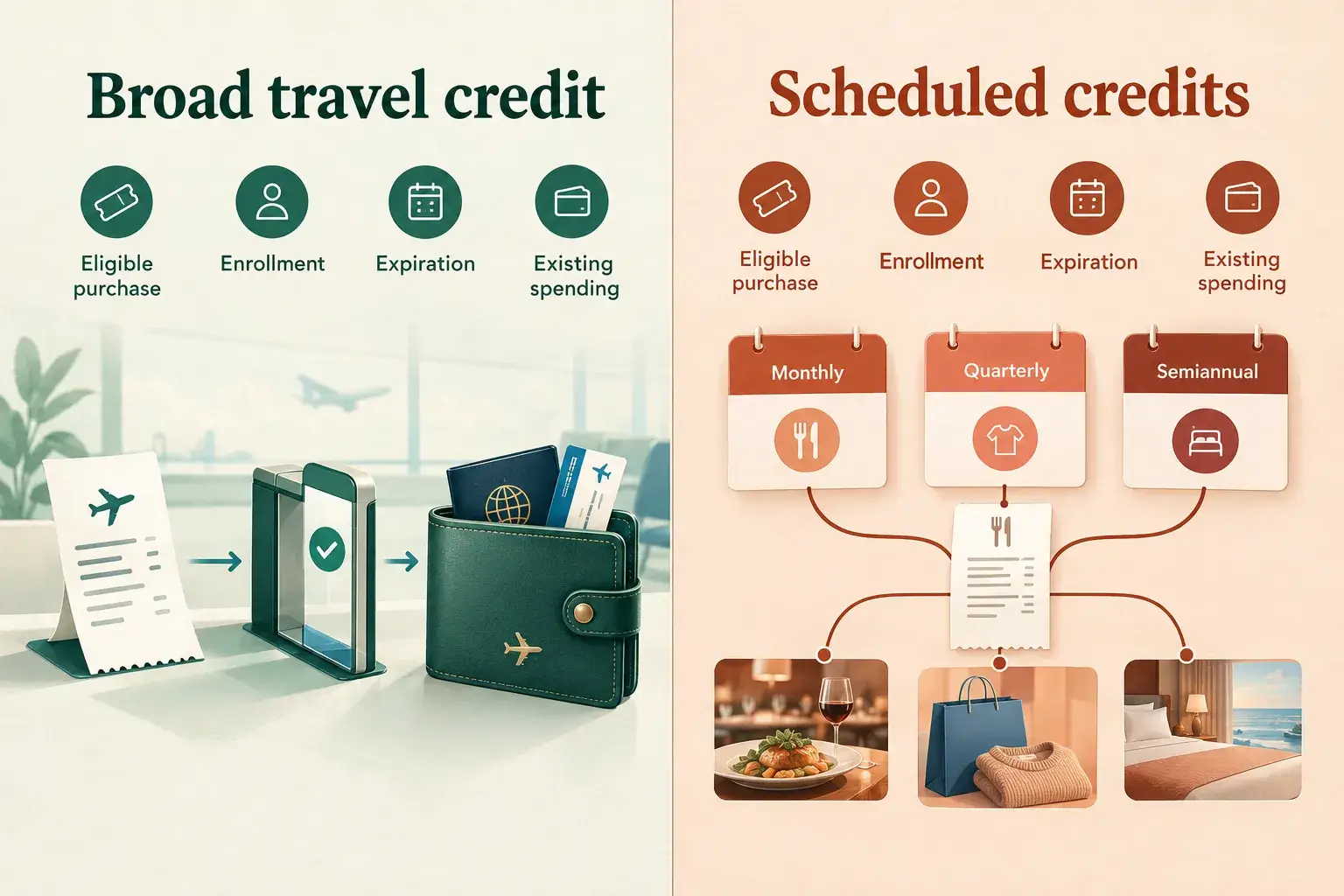
Credits are most valuable when they reimburse purchases you would make anyway, through your preferred booking channel. Credits lose value when they require extra spending, inconvenient timing, or a more expensive reservation.
Premium travel card annual fees versus benefits: What credits count?
Count the spending replaced, not just the reimbursement received.
Suppose an eligible portal hotel costs $340, while the same refundable room costs $300 directly. A $300 booking credit provides only $260 of savings relative to the direct option, assuming the reservations otherwise match.
Also account for:
- Lost hotel points, elite-night credit, or status benefits on ineligible third-party bookings.
- Different cancellation rules and customer-service arrangements.
- Credits that expire monthly, quarterly, or semiannually.
- Enrollment completed after a purchase rather than before it.
- Purchases excluded by merchant, location, or transaction type.
Common mistake: Buying something unnecessary to “recover” the annual fee. A $75 purchase made only to use a $75 credit does not create $75 of savings.
Do premium travel cards pay for themselves with credits?
Some do, but only for cardholders whose existing purchases match the rules. Broad travel credits are usually easier to use than credits tied to specific merchants or prepaid luxury hotels.
Sapphire Reserve’s $300 travel credit is relatively flexible. Venture X’s $300 credit is simpler than juggling multiple merchant credits, but requires Capital One Travel and expires at the next account anniversary.
A useful rule: assign no value to a credit until you can identify the purchase it will replace. For lounge access, count what you would actually pay, not the lounge’s advertised admission price.
Net Annual Fee Under Three Usage Scenarios
A realistic net fee equals the annual fee minus usable recurring credits and conservatively valued anniversary rewards. The examples below are illustrations, not average outcomes; they exclude welcome bonuses, interest, lounges, insurance, and points earned from purchases.
| Card | No usable credits | Travel-focused use | Existing-spend match |
|---|---|---|---|
| Venture X | $395 | $95 | -$5 after anniversary miles |
| Strata Elite | $595 | $295 | $95 |
| Sapphire Reserve | $795 | $495 | $195 |
| Amex Platinum | $895 | $695 | $195 |
| Business Platinum | $895 | $695 | $375 |
Assumptions behind the estimates:
- Venture X: Travel use captures the full $300 booking credit without a price premium. Existing-spend matching also values 10,000 anniversary miles at $100 using eligible travel redemptions.
- Strata Elite: Travel use captures the $300 hotel benefit. Existing-spend matching adds $200 of eligible Splurge purchases, but no Blacklane value.
- Sapphire Reserve: Travel use captures $300. Existing-spend matching adds the full $300 dining credit, but no hotel or entertainment credits.
- Platinum: Travel use captures $200 in eligible airline incidentals. Existing-spend matching adds $200 Uber Cash and $300 digital entertainment, all replacing planned spending.
- Business Platinum: Travel use captures $200 in airline incidentals. Existing-spend matching adds $120 wireless and all four $50 Hilton credits.
The Business Platinum estimate assumes eligible Hilton purchases in every quarter. Missing one quarter raises the modeled cost by $50.
How should premium travel card annual fees affect points valuations?
Keep annual credits separate from redemption value. Amex points, Chase points, Capital One miles, and Citi points can deliver strong returns, but premium cabin awards depend on award availability, transfer ratios, and surcharges and fees.
For example, a hypothetical $2,000 flight booked for 100,000 points plus $200 has a redemption value of 1.8 cents per point (CPP):
($2,000 − $200) ÷ 100,000 × 100 = 1.8 CPP
That does not mean every point earned is worth 1.8 cents. Compare the cash fare you would actually buy, account for devaluation risk, and confirm award space before transferring.
Use the credit card annual fee ROI calculator to substitute your own assumptions.
Recent Fee Increases and What Changed With Each
The largest recent changes came from Chase and Amex in 2025. There is no fixed schedule for premium card fee increases; issuers may reprice cards alongside benefit refreshes, with different effective dates for applicants and existing cardholders.
| Card | 2024 annual fee | Fee used in this 2026 tracker | Most recent increase or launch |
|---|---|---|---|
| Venture X | $395 | $395 | Launched November 9, 2021; no increase reflected here |
| Strata Elite | Not available | $595 | Launched July 27, 2025; launch price, not an increase |
| Sapphire Reserve | $550 | $795 | New pricing June 23, 2025; existing-account renewals from October 26, 2025 |
| Amex Platinum | $695 | $895 | Refresh introduced September 18, 2025; existing-account renewals from January 2, 2026 |
| Business Platinum | $695 | $895 | Refresh introduced September 18, 2025; existing-account transition governed by renewal notices |
How do travel card annual fees compare with 2024?
Sapphire Reserve is $245 more expensive than in 2024. Each Platinum product is $200 more expensive, while Venture X retains its $395 fee in this comparison.
Chase added or expanded hotel, dining, entertainment, and subscription benefits. Amex expanded hotel credits and introduced or increased several lifestyle benefits, including Resy, lululemon, and Uber One on the consumer Platinum.
Those changes favor cardholders who already use the participating services. They do not automatically improve value for travelers who mainly want transfer partners and occasional lounge visits.
How often do premium travel card annual fees increase?
There is no annual repricing rule. Review each renewal notice rather than assuming last year’s fee or benefits still apply.
A benefit reduction can also raise your effective cost without changing the fee. Venture X’s 2026 lounge-access changes illustrate why household guest and authorized-user rules deserve a separate check.
How to Decide Which Premium Fee Is Worth Paying
Choose the card with the strongest recurring value for your travel pattern, not the longest benefit list. Compare the premium card against your best lower-fee alternative, since only the additional value justifies the higher price.
What is the best premium travel card for the annual fee?
- Venture X: Best for travelers comfortable booking through Capital One Travel and using anniversary miles. Not for travelers who avoid portals or need complimentary lounge access for several additional cardholders.
- Sapphire Reserve: Best for travelers who use the broad travel credit plus eligible dining or hotel benefits. Not for cardholders relying mainly on occasional lounge visits.
- Strata Elite: Best when the hotel benefit and selected-brand spending fit existing plans.
- Platinum: Best when several travel and lifestyle credits replace real spending.
- Business Platinum: Best when business purchases naturally qualify for its credits, without chasing spending thresholds.
For a direct comparison of the two common alternatives, review Venture X versus Sapphire Reserve.
Are premium travel card annual fees worth it for occasional travelers?
Often not. One or two annual trips may not generate enough eligible spending or lounge use to justify a premium fee.
A lower-fee transferable-points card may preserve the booking strategy you need. Compare points transfer partners and program rules rather than assuming premium pricing creates access to better award charts.
How can you get a premium travel card annual fee waived?
Ask about retention offers, but do not assume the issuer will waive the fee. Offers may involve statement credits, points, or additional spending requirements.
Eligible military cardholders may receive relief under applicable law or issuer policies; eligibility differs between consumer and business accounts. See the guide to annual fee waivers and retention offers.
Can you cancel after the annual fee posts?
Usually, but refund eligibility and deadlines vary. Contact the issuer promptly, confirm the policy, and protect points before closing or downgrading.
Read the guide to downgrading while keeping points before changing an account. Avoid canceling a newly opened card early merely to capture a bonus.
Frequently Asked Questions
Annual-fee decisions depend on account terms, actual spending, and renewal timing. These answers address common situations without assuming every issuer follows the same rules.
Do you have to pay the annual fee in the first year?
Yes, unless the specific application offer expressly waives it. None of the five standard products compared here should be assumed to offer a first-year waiver.
Is a premium travel card annual fee tax deductible?
Personal card fees generally are not deductible. A business card fee may qualify as an ordinary and necessary business expense; mixed-use accounts require appropriate allocation. Confirm treatment with a tax professional.
Does a negative net fee mean the issuer pays you?
No. A negative modeled fee means usable benefits exceed the fee under stated assumptions. Restricted credits and anniversary miles are not an unrestricted cash payment.
Do authorized users get separate statement credits?
Usually not. Most spending credits are shared across the account. Lounge access and other individual benefits depend on the card’s additional-user rules.
Should welcome bonuses count toward renewal value?
No. Evaluate welcome bonuses separately from recurring value. A strong first-year bonus can justify applying without making the card worth keeping.
Should you transfer points before canceling?
Not automatically. First check whether another eligible account can preserve the points. Speculative transfers introduce expiration rules, limited award availability, and devaluation risk.
Conclusion
The right premium card is the one whose recurring benefits replace enough real spending to justify its fee. Venture X offers the lowest entry cost here, while the higher-fee cards require a closer match between their credits and your habits.
Before renewal, list usable credits, subtract booking premiums and additional-user costs, and compare the balance with a lower-fee setup. Then decide whether to keep, downgrade, or cancel before the issuer’s refund deadline.





Content on Award Travel Hub is independently created by Award Travel Hub Editorial Desk and, where noted, reviewed by Award Travel Hub Review Desk. Some pages may contain affiliate links, but compensation does not determine our coverage, opinions, or methodology.