

Last Updated: November 19, 2026
A single premium card earning 1X on your electricity bill is quietly costing you a business class seat every few years. The best travel rewards credit card for most intermediate points collectors in 2026 is not one card at all. It is a deliberate two-card pairing: one card that unlocks transfer partners and travel categories, and a second that captures the spending the first one ignores.
This guide compares the strongest pairings from Chase, Amex, and Capital One, plus one cross-bank setup, using consistent valuations so you can see the actual earning gap each second card fills. It also covers the 2026 changes that matter, including the Chase, Hyatt transfer devaluation and the refreshed Sapphire Preferred.
Valuation assumption used throughout: transferable points and miles are valued at 1.5 cents per point (CPP). That is a conservative midpoint. Careful premium cabin redemptions can exceed 2 CPP, while portal bookings or cash-out options often land at 1 CPP or less.
Why Two Cards Beat One for Travel Rewards
Most travel cards are built around a few bonus categories. Outside those categories, many earn just 1X. A second card fixes that leak without adding much complexity, especially when both cards feed the same points pool.
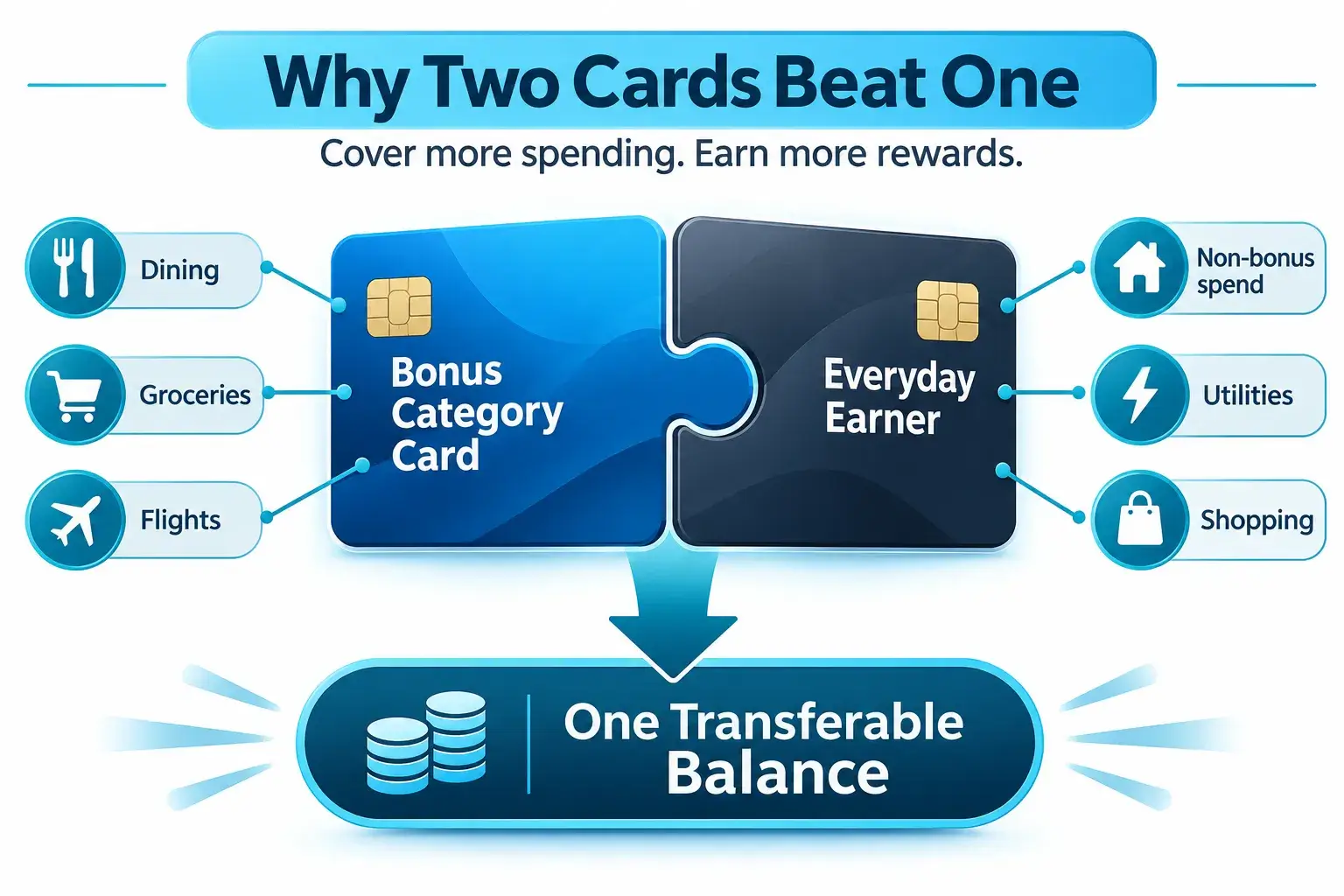
The practical answer is simple. Pair a “transfer card” with an “everyday earner” from the same bank. The transfer card gives your points access to partner airlines and hotel programs. The everyday card earns more on non-bonus spending, then moves its rewards into the transfer card’s account.
Here is how pooling works at each major bank:
How much can a two-card strategy actually earn? Consider $36,000 in annual spending. A typical household might spend $8,000 on dining and groceries, $4,000 on travel, and $24,000 on everything else. If that “everything else” moves from 1X to 1.5X or 2X, it adds 12,000 to 24,000 points a year. At 1.5 CPP, that is roughly $180 to $360 in value, often enough to justify the setup on its own.
You may be interested



Do sign-up bonuses stack if you apply for two cards at once? Usually yes, as long as you qualify for each offer and can meet both spending requirements. Banks set their own rules, though. Chase’s 5/24 guideline, Amex’s lifetime language on welcome offers, and Capital One’s sensitivity to recent applications can all block approval or bonus eligibility. Opening both cards the same week also splits your organic spend across two minimum-spend clocks, which is the most common reason people miss a bonus. Staggering applications by one or two months is often safer. Our guide on how to maximize credit card sign-up bonus rewards covers timing in more detail.
How to avoid overspending to earn more points: treat category multipliers as routing rules, not spending goals. No 3X category can make up for 20% APR interest. If you would not buy it in cash, the points are not a reason to buy it.
1. Best Chase Pairing: Sapphire Plus Freedom
Chase Sapphire Preferred plus Freedom Unlimited remains the most recommended general-purpose pairing in 2026, and the logic still holds. Sapphire Preferred supplies transfer access and travel earning. Freedom Unlimited earns 1.5% back on non-bonus purchases, which becomes 1.5X transferable Ultimate Rewards points once combined.

What changed in 2026. Chase refreshed Sapphire Preferred this year. The annual fee stays at $95, but the annual Chase Travel hotel credit doubled from $50 to $100. Chase also added or expanded bonus categories including gas, EV charging, online groceries, streaming, and vacation-home rentals. For many households, the card now covers more spending directly, which narrows the gap the Freedom card needs to fill.
The less welcome change: transfers to World of Hyatt for affected Sapphire Preferred cardholders moved from 1:1 to 4:3. That means 1,000 Ultimate Rewards points now become 750 Hyatt points. Cardholders who applied before June 15, 2026, saw this take effect on October 1, 2026.
Hyatt math after the change. A Category 4 Hyatt night at 15,000 points used to cost 15,000 Chase points. It now costs 20,000. If that room sells for $300 cash, your redemption value drops from 2.0 CPP to 1.5 CPP, before considering that award nights avoid some taxes. Hyatt is still a decent use of Chase points, but it is no longer the obvious default. If Hyatt was your main reason for holding Chase points, see our best credit card combo for Hyatt and American Airlines for alternatives.
Where the pairing still wins. Chase’s airline partners remain useful for premium cabin awards. United for Star Alliance space, Air Canada Aeroplan for partner business class with low or no fuel surcharges on many carriers, and Flying Blue for monthly promo awards to Europe are all realistic options. Remember that Chase transfers are one-way and cannot be reversed, so confirm award space before moving points.
Effective return at 1.5 CPP:
Best for: first-time pairing users, airline-focused redeemers, and anyone who wants a low total fee of $95 a year. This is also the best card pairing for someone new to rewards programs because the rules are simple and only one card has a fee.
Not for: travelers whose main goal was cheap Hyatt nights, or heavy spenders who would earn more with a flat 2X card.
Adding Chase Freedom Flex as a third card creates the familiar “trifecta” variant. It adds rotating 5% quarterly categories, but it also adds activation and tracking. For readers who only travel a few times a year, the two-card version usually captures most of the value. Our Chase Freedom Unlimited review breaks down its full category list.
2. Best Amex Pairing: Gold Plus Platinum or Blue Business Plus
Amex offers two very different pairings around the Gold card. One is a premium-category stack built for frequent flyers. The other is a value pairing that fills Gold’s main weakness: 1X on everyday purchases.
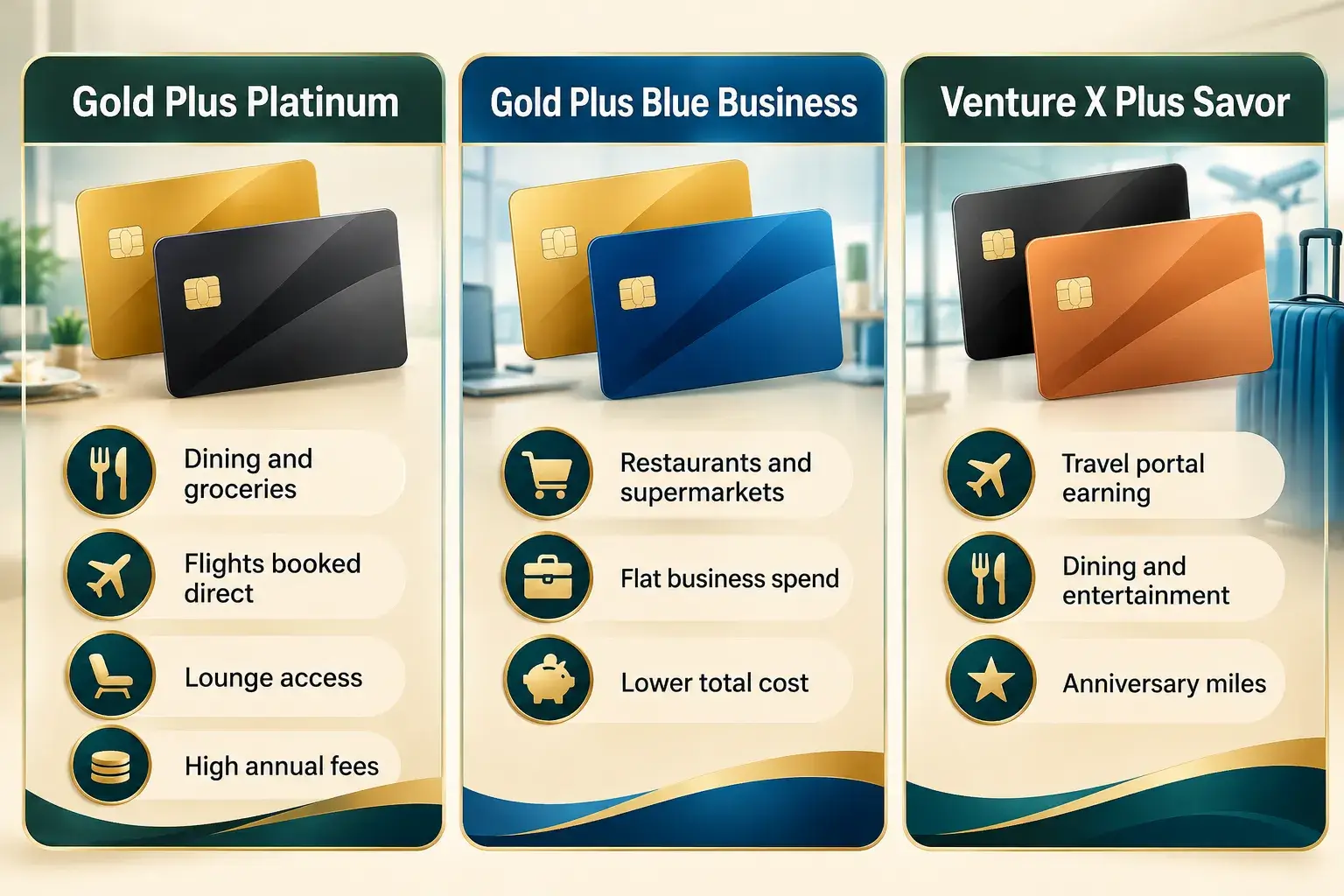
Gold plus Platinum: premium, not cheap. The Gold card earns 4X Membership Rewards points at restaurants and 4X at U.S. supermarkets, subject to annual spending caps. The Platinum card earns 5X on flights booked directly with airlines or through Amex Travel, also subject to an annual cap. Together, they cover dining, groceries, and airfare at strong rates.
The tradeoff is cost. Combined annual fees run well over $1,000, and both cards depend on credits you must actively use. Platinum only pays off if you use lounge access, hotel status, and enough statement credits to offset most of its fee. If you would let even half the credits expire, this is not a value pairing. Use our credit card annual fee ROI calculator before committing.
Notice the gap: neither Gold nor Platinum earns well on non-bonus spending. That is why many experienced Amex users skip Platinum entirely.
Gold plus Blue Business Plus: the practical choice. Blue Business Plus has no annual fee and earns 2X Membership Rewards points on everyday business purchases up to $50,000 per year, then 1X. It requires a business, but sole proprietors and freelancers often qualify. That 2X rate is what fills Gold’s gap.
Effective return at 1.5 CPP:
Amex transfer partners worth knowing. Membership Rewards points transfer to a deep list of partner airlines, including ANA, Virgin Atlantic, Air France-KLM Flying Blue, Avianca LifeMiles, and British Airways. Amex also runs frequent transfer bonuses. Watch for fuel surcharges, though. British Airways and some Virgin Atlantic awards can add hundreds of dollars in carrier-imposed fees, which can sink the redemption value. Amex also charges a small excise tax offset fee on transfers to U.S. airlines.
Best for: food-heavy households and freelancers (Gold plus Blue Business Plus), or frequent paid flyers who will use Platinum benefits (Gold plus Platinum).
Not for: anyone who dislikes tracking credits, or those without business activity for Blue Business Plus. For a broader card-by-card view, see our comparison of the best Amex travel credit cards for 2026.
3. Best Capital One Pairing: Venture X Plus Savor
Capital One Venture X is one of the strongest premium anchor cards in 2026 because it solves the non-bonus problem by itself. It earns 2X miles on general purchases. The Savor card then adds higher earning in categories where Venture X only earns 2X.

Venture X fundamentals. As of November 2026, Venture X carries a $395 annual fee. It includes a $300 annual Capital One Travel credit and 10,000 anniversary miles, plus access to more than 1,300 lounges. If you use the travel credit, the net cost is roughly $95. The anniversary miles, worth about $150 at 1.5 CPP, can push the card into positive value before you earn anything. Venture X also earns elevated rates on hotels, rental cars, and flights booked through Capital One Travel.
What Savor adds. The no-annual-fee Savor earns 3% cash back on dining, entertainment, popular streaming services, and grocery stores (excluding superstores like Walmart and Target). Capital One allows you to move Savor rewards into your Venture X account, where they become transferable miles. That turns 3% cash back into 3X miles.
Effective return at 1.5 CPP:
Transfer considerations. Capital One miles transfer to partners such as Turkish Miles&Smiles, Flying Blue, Avianca LifeMiles, Air Canada Aeroplan, and Virgin Red. Most transfer at 1:1, but some partners use lower transfer ratios. Check each ratio before assuming parity. Capital One has no domestic U.S. airline partner, which matters if you primarily fly domestic economy.
Business owners: Venture X Business launched an unusually aggressive limited-time offer starting October 20, 2026, worth up to $4,300 in travel value for eligible new cardholders. It requires high spending thresholds, so it only makes sense if that spend is already in your budget. Check our ranked list of the best credit card welcome bonuses for current terms on Savor and other second cards.
Best for: people who want simple, high flat earning plus premium travel perks at a low net cost. Also strong for international travel, since neither card charges foreign transaction fees.
Not for: those who rarely book through a travel portal and would struggle to use the $300 credit.
4. Best Cross-Bank Pairing for Maximum Flexibility
Pairing cards from two banks gives up pooling but gains access to two partner lists. This matters most when you redeem for premium cabin awards, because award space often appears on one partner but not another.
Recommended setup: Amex Gold plus Capital One Venture X. Gold covers dining and groceries at 4X. Venture X covers everything else at 2X. Neither card has to stretch beyond what it does best, and together they create two separate pools with broad overlap on partners like Flying Blue, Avianca LifeMiles, and Aeroplan, plus unique options on each side.
Why two pools help with award availability. Suppose you want a business class seat from New York to Europe. Flying Blue might price it at 60,000 to 90,000 miles one way plus moderate taxes, depending on dynamic pricing. Both Amex and Capital One transfer there, so you can top off from either balance. If a transfer bonus appears at one bank, you transfer from that side. That flexibility reduces the risk of being short points when good space opens up.
Real-world booking walkthrough:
- Search award space first using an award search tool or the partner’s own site.
- Confirm the full price, including taxes, fuel surcharges, and fees.
- Compare against the cash fare. At a $3,500 fare and 75,000 points plus $200, the value is about 4.4 CPP.
- Check for active transfer bonuses at each bank.
- Transfer only what you need, then book immediately. Most transfers are instant, but some partners take days.
Other cross-bank options. Bilt points pair well with any of the above for renters, since Bilt earns on rent without a transaction fee and offers useful partners. Citi points give access to partners like Turkish and Virgin Atlantic. Our ranking of the best credit card transfer partners for 2026 shows which partners each program shares.
What about airline cards instead? Co-branded cards make sense if you are loyal to one airline and use benefits like free checked bags or priority boarding. They lock your earnings into one program, which raises devaluation risk. Most intermediate users do better holding one airline card at most, alongside a transferable points pairing.
Best for: premium cabin redeemers and travelers who value flexibility across alliance partners.
Not for: anyone who wants one balance to manage, or households that cannot spend enough to grow two pools meaningfully.
How to Choose the Right Combo for Your Spending
Start with your spending, not the card marketing. Pull 12 months of statements and group purchases into dining, groceries, travel, and everything else. Then match the pairing to your largest category.
Decision framework:
- Dining and groceries over 30% of spend: Amex Gold plus Blue Business Plus, or Gold plus Venture X.
- Mostly non-bonus spend: Venture X plus Savor.
- Low fee tolerance: Sapphire Preferred plus Freedom Unlimited.
- No annual fees at all: Freedom Unlimited plus Savor work for cash back, but neither unlocks transfer partners alone. See our list of the best travel credit cards with no annual fee.
- Flights vs. hotels: airline redemptions usually give higher CPP on premium cabins. Hotel redemptions are more predictable but often closer to 1 CPP, especially now that Chase, Hyatt transfers cost more.
Is upgrading to a premium card worth it? Only if credits and perks you already use exceed the fee difference. A $395 card with a $300 credit you use is cheaper than a $95 card for many travelers.
Can you maximize both cards if you only travel a few times a year? Yes, if annual fees are low and you redeem for one or two high-value trips. Points do not need frequent travel. They need patience and a booking plan.
How often should you switch combos? Review once a year, ideally before annual fees post. Devaluations, category changes, and new offers can shift the math. Regulators are also watching: the CFPB has signaled scrutiny of unexplained devaluations and buried terms, and network fee changes may influence future rewards rates. Neither changes your cards today, but both are reasons not to hoard points for years.
Common mistakes to avoid:
- Forgetting to combine everyday-card rewards into the transfer account.
- Transferring points before confirming award space.
- Ignoring fuel surcharges on partner bookings.
- Keeping a premium card whose credits go unused.
FAQ
What two credit cards should be paired for maximum travel rewards?
For most people, a transfer card plus a high-earning everyday card from the same bank. Sapphire Preferred plus Freedom Unlimited and Venture X plus Savor are the simplest options.
Which pairing is best for international travel?
Venture X plus Savor or Amex Gold plus Venture X. Both avoid foreign transaction fees and offer broad partner airline access.
Do transfer partners work the same way at every bank?
No. Transfer ratios, speeds, and fees vary. Chase and Capital One transfers are generally one-way, and Amex adds a small fee for U.S. airline transfers.
Is the Chase pairing still worth it after the Hyatt change?
Yes for airline redemptions and flexibility. It is weaker for travelers who mainly booked Hyatt hotels.
What is the best combo for someone new to rewards?
Sapphire Preferred plus Freedom Unlimited, due to its low total fee and simple rules.
Conclusion
The right second card should fix one specific gap in your current earning, not add complexity for its own sake. Pick the pairing that matches your largest spending category, confirm the welcome offer and application rules, and set a reminder to review it before your next annual fee. For a wider view of standalone options, read our guide to the best credit card for travel by spending style.
Meta Title: Best Travel Rewards Credit Card Combos for 2026 Compared
Meta Description: The best travel rewards credit card setup often uses two cards. Compare 2026 Chase, Amex, and Capital One combos that maximize points on every purchase.


Content on Award Travel Hub is independently created by Award Travel Hub Editorial Desk and, where noted, reviewed by Award Travel Hub Review Desk. Some pages may contain affiliate links, but compensation does not determine our coverage, opinions, or methodology.