
Last Updated: August 23, 2026
A 150,000-point welcome offer can look like the best credit card for travel, but it may still be the wrong card if the annual fee, credits, transfer partners, or award availability do not match how you book.
The practical answer for 2026: most travelers should start with a flexible mid-tier card, then add a premium card only if the credits and lounge access replace real travel costs. Chase Sapphire Preferred remains the cleanest first choice for many U.S.-based travelers. Frequent flyers should compare Sapphire Reserve, Capital One Venture X, and Amex Platinum. Food-heavy spenders should look hard at Amex Gold or Capital One Savor.
The biggest mistake is picking a card by headline bonus alone. The better move is to match the card to your actual spending, your airport habits, and the points transfer partners you will use.
Key Takeaways
- Best overall for most travelers: Chase Sapphire Preferred, because it has strong Chase points, a moderate fee, and useful airline and hotel partners.
- Best premium value: Capital One Venture X is often easier to justify than higher-fee premium cards if you use the travel credit.
- Best premium upside: Chase Sapphire Reserve and Amex Platinum can win, but only if lounge access, credits, and transfer partners fit your trips.
- Best everyday earning: Amex Gold is strong for dining and U.S. supermarkets; Capital One Savor is useful when paired with a Capital One miles card.
- Best decision rule: Pick the card that helps you book real trips, not the one with the flashiest marketing.
For a broader card-by-card overview, see Award Travel Hub’s Best Travel Credit Cards 2026 comparison.
How We Ranked the Best Travel Cards for 2026

The best travel rewards card is not always the card with the biggest bonus. It is the card that turns your spending into trips at a fair cost.
This ranking uses five factors:
- Transferable points value
- Welcome offer value
- Annual fee break-even math
- Travel benefits you can actually use
- Application rules and long-term fit
Our 2026 points valuation framework
These are practical working values for intermediate award travelers. They assume smart use of points transfer partners, but not perfect redemptions every time.
| Points currency | 2026 working value | Best use of points | Main risk |
|---|---|---|---|
| Chase Ultimate Rewards | 1.7 CPP | Hyatt, United, Air Canada Aeroplan, Air France-KLM Flying Blue | Hyatt devaluation risk, award space limits |
| Amex Membership Rewards | 1.6 CPP | ANA, Air Canada, Flying Blue, Virgin Atlantic, Hilton during bonuses | Fuel surcharges, transfer complexity |
| Capital One miles | 1.5 CPP | Avianca LifeMiles, Turkish, Aeroplan, Flying Blue, Qantas | Partner rules, transfer delays |
| Citi ThankYou Points | 1.5 CPP | Turkish, Qatar Avios, Flying Blue, Choice, Wyndham | Fewer premium card protections |
| Bilt points | 1.7 CPP | Hyatt, Alaska, United, Air Canada | No big welcome offer, rent rules |
You may be interested



CPP means cents per point. If a flight costs $1,200 cash or 60,000 points plus $100 in taxes, the value is:
($1,200 – $100) ÷ 60,000 = 1.83 CPP
That is good if your opportunity cost is lower than 1.83 CPP. It is poor if you could use those points for a better premium cabin award.
For a deeper breakdown of points currencies and transfer ratios, use the Best Transferable Points Programs 2026 guide.
What counts as real value?
A travel credit is valuable only if it replaces spending you would have made anyway.
Count it at full value if:
- You already book paid travel each year.
- The credit is easy to use.
- It does not force a higher price.
- It does not require a booking channel you dislike.
Discount it if:
- It only works through a travel portal.
- It is split into monthly credits.
- It pushes you to spend more.
- It expires before your normal trip cycle.
This matters in 2026 because premium travel cards have moved toward large annual fees with many credits. Those credits can work well, but they are not cash.
Welcome offers matter, but timing matters more
Mid-2026 has several large travel card welcome offers. Examples visible in the market include:
- Chase Sapphire Reserve: 150,000 Chase points after required spending
- Chase Sapphire Preferred: 75,000 Chase points
- Amex Platinum: targeted offers as high as 175,000 Amex points
- Amex Gold: targeted offers as high as 100,000 Amex points
- Citi Strata Elite: 75,000 Citi points
- Capital One Venture X: commonly seen around 75,000 miles
Offers change often. Always confirm the current offer, spending requirement, annual fee, and eligibility terms before applying.
Application rules that can change the answer
The best credit card for travel on paper may be unavailable if your application history blocks approval.
Key rules to watch:
- Chase 5/24: Chase often declines applicants who opened 5 or more personal cards across issuers in the past 24 months.
- Chase Sapphire bonus rules: Sapphire bonus eligibility depends on current Sapphire ownership and prior Sapphire bonus timing.
- Amex once-per-lifetime language: American Express often limits welcome bonuses to once per card lifetime, with possible family restrictions.
- Capital One approvals: Capital One may pull from all three credit bureaus and can be sensitive to recent accounts.
- Citi bonus rules: Citi ThankYou bonus restrictions vary by product family and timing.
If you are early in the points game, Chase usually deserves priority because of 5/24. If you are already over 5/24, Amex, Capital One, Citi, or Bilt may fit better.
Best Overall: The Chase Sapphire Preferred Case
The Chase Sapphire Preferred is still the best credit card for travel for many U.S. travelers in 2026 because it balances value, simplicity, and partner strength.
It has a moderate annual fee, strong transfer partners, good travel protections, and easy pairing with no-fee Chase cards.
Why Chase Sapphire Preferred works
Best for:
- Travelers who want one main travel card
- People under Chase 5/24
- Hyatt users
- Award travelers who value simple partner options
- Anyone who wants good value without a premium annual fee
Not for:
- Heavy lounge users
- Travelers who want luxury credits
- People who need top-tier airport benefits
- Big grocery spenders who prefer Amex Gold
Chase Sapphire Preferred 2026 snapshot
| Feature | Chase Sapphire Preferred |
|---|---|
| Annual fee | $95 |
| Welcome offer example | 75,000 Chase points |
| Foreign transaction fee | None |
| Lounge access | None |
| Travel credit | Up to $50 hotel credit through Chase Travel, if used |
| Transfer partners | Airlines and hotels, mostly 1:1 |
| Best transfer partner | Hyatt for hotels; Aeroplan/Flying Blue/United for flights |
| Best estimated first-year value | 75,000 × 1.7 CPP = $1,275 before fee |
After the $95 annual fee, the welcome offer alone can be worth about $1,180 using a 1.7 CPP working value. If the hotel credit is useful, the first-year value improves.
Why Chase points are useful
Chase points are strong because the partner list is practical.
Useful transfer partners include:
- World of Hyatt
- United MileagePlus
- Air Canada Aeroplan
- Air France-KLM Flying Blue
- Virgin Atlantic Flying Club
- Southwest Rapid Rewards
- British Airways Avios
- Singapore KrisFlyer
Hyatt is the key hotel advantage. Hyatt still has award charts, though categories can change. That makes Hyatt points easier to plan than many hotel points tied to dynamic pricing.
Real-world example: Hyatt vs cash
Assume a Hyatt hotel costs:
- Cash rate: $420
- Points rate: 18,000 Hyatt points
- Taxes and fees on award: $0
CPP math:
$420 ÷ 18,000 = 2.33 CPP
That is a strong use of Chase points. It beats the 1.7 CPP working value and avoids cash hotel taxes in many cases.
But this only works if there is award availability. Hyatt standard rooms can disappear fast in peak cities and resort markets.
Booking strategy with Sapphire Preferred
Use this order:
- Search cash prices.
- Search award space with Hyatt or airline partners.
- Compare CPP after taxes and fees.
- Transfer only when ready to book.
- Keep points flexible until award space is confirmed.
Do not transfer Chase points to a partner just because a trip is “likely.” Transfers are usually one-way. If the award space vanishes, you may be stuck with airline miles or hotel points you do not need.
For card-level details, compare this with Award Travel Hub’s Chase Sapphire Preferred 2026 guide.
Best Premium: Sapphire Reserve, Venture X, and Amex Platinum Compared
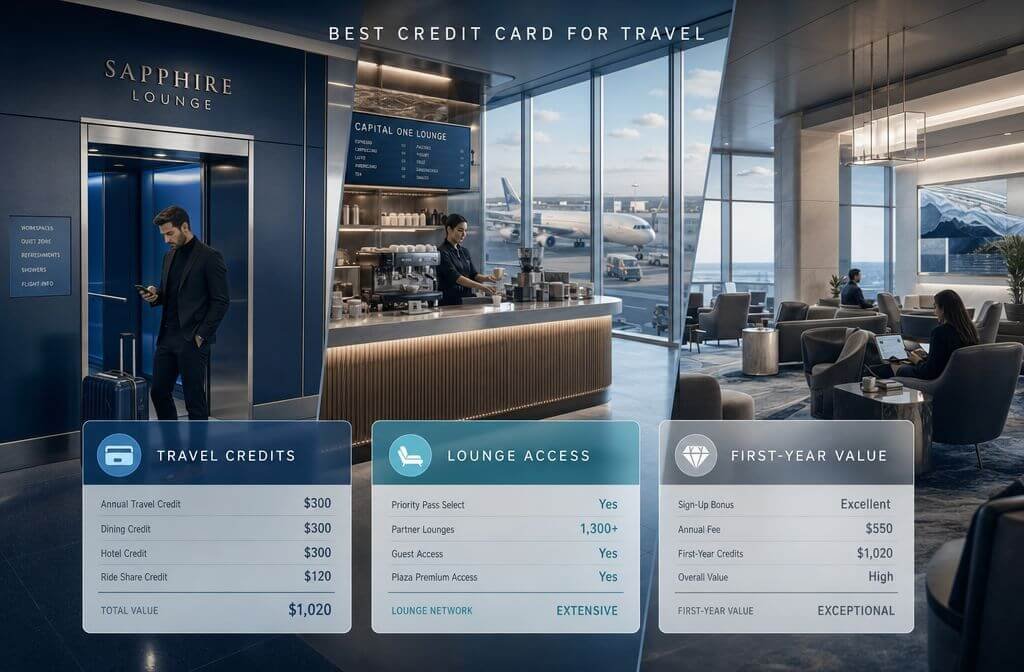
Premium cards can be worth it in 2026, but only when you use the benefits without changing your habits too much.
The best premium travel card depends on whether you value transfer partners, lounge access, statement credits, or simplicity.
Premium card comparison table
| Card | Annual fee | Welcome offer example | Travel credit | Lounge access | Foreign transaction fee | 2026 best fit |
|---|---|---|---|---|---|---|
| Chase Sapphire Reserve | About $795 | 150,000 Chase points | Broad annual travel credit | Priority Pass and Sapphire Lounge access | None | Frequent travelers who value Chase points |
| Capital One Venture X | $395 | Often 75,000 miles | $300 Capital One Travel credit | Capital One Lounges and Priority Pass | None | Premium value with simpler math |
| Amex Platinum | About $895 | Targeted offers as high as 175,000 points | Many lifestyle and travel credits | Centurion, Priority Pass, Delta access rules apply | None | Lounge-heavy travelers who use credits |
| Citi Strata Elite | $595 | 75,000 Citi points | Citi travel credits and premium perks | Benefits vary by current terms | None | Citi users who value ThankYou partners |
Fees and benefits can change. Always check current terms before applying.
Why Sapphire Reserve can be the best credit card for travel for frequent flyers
The Sapphire Reserve works best when you want stronger travel perks but still value Chase’s partner network.
Using ATH’s 1.7 CPP value:
- 150,000 Chase points = $2,550
- Add a $300 travel credit if fully used
- Subtract a $795 annual fee
- Estimated first-year value: $2,055
That is strong, but it assumes you value Chase points at 1.7 CPP and use the travel credit.
The real question is year two. Without the huge bonus, you need to justify the fee through:
- Travel credit
- Lounge visits
- Travel protections
- Higher portal value, if relevant
- Better earning on travel
- Chase partner transfers
If you visit lounges only once per year, the Reserve may not beat the Preferred.
For a deeper fee comparison, see Are Premium Travel Cards Worth It in 2026?.
Why Venture X is often the cleanest premium value
Capital One Venture X is popular because the math is easier.
Typical value:
- 75,000 miles × 1.5 CPP = $1,125
- $300 annual Capital One Travel credit
- 10,000 anniversary miles after renewal = about $150
- $395 annual fee
If you use the portal credit without overpaying, the long-term cost can be low. That makes Venture X a strong choice for travelers who want premium benefits but do not want to manage many coupons.
Capital One miles transfer to useful partner airlines, including:
- Air Canada Aeroplan
- Avianca LifeMiles
- Air France-KLM Flying Blue
- British Airways Avios
- Turkish Miles&Smiles
- Qantas Frequent Flyer
- Virgin Red
The downside: Capital One does not have a major U.S. airline partner like United or American. Some partners have tricky program rules, fuel surcharges, or inconsistent award space.
Why Amex Platinum is powerful but not simple
Amex Platinum can deliver high value, especially with a targeted offer as high as 175,000 Amex points.
Using 1.6 CPP:
- 175,000 Amex points = $2,800
- Subtract about $895 annual fee
- First-year value before credits: $1,905
That looks excellent. But Amex Platinum’s long-term value depends on credits, lounge access, and Amex transfer partners.
The Platinum is best for:
- Frequent airport lounge users
- Travelers who use Centurion Lounges
- People who can use airline fee credits and hotel credits
- Award travelers who know Amex airline partners well
- Premium cabin awards through ANA, Aeroplan, Flying Blue, or Virgin Atlantic
It is not ideal if you dislike managing credits or if your home airport lacks useful lounge coverage.
Premium cabin example: Amex points to business class
Assume a one-way business class ticket to Europe costs:
- Cash price: $3,200
- Award price through a partner airline: 70,000 miles
- Taxes and fees: $250
CPP math:
($3,200 – $250) ÷ 70,000 = 4.21 CPP
That is excellent. But if the same award has $900 fuel surcharges, the math changes:
($3,200 – $900) ÷ 70,000 = 3.29 CPP
Still good, but less attractive. Fuel surcharges are extra cash fees added by some airline programs. They can make an award feel less “free.”
For routes like Emirates or British Airways premium cabins, always price surcharges before transferring. See Award Travel Hub’s analysis of Emirates surcharges to Europe in 2026 for why fees matter.
Best premium card decision rule
Choose:
- Sapphire Reserve if you want Chase points, travel protections, and broad travel credit value.
- Venture X if you want premium benefits with easier break-even math.
- Amex Platinum if lounge access and Amex transfer partners matter more than simplicity.
- Citi Strata Elite if you are building around Citi points and can use the card’s travel credits.
Best for Beginners: No-Fee Travel Cards That Actually Earn Real Value
No-annual-fee travel cards can be useful, but they come with limits. Many do not unlock full transfer partner access unless paired with a premium or mid-tier card.
That does not make them bad. It means they work best as part of a card setup.
Best no-fee options to consider
| Card | Annual fee | Foreign transaction fee | Transfer partner access | Best use |
|---|---|---|---|---|
| Capital One VentureOne | $0 | None | Yes, with Capital One miles | Simple no-fee miles |
| Bilt Mastercard | $0 | None | Yes, Bilt transfer partners | Rent and dining |
| Chase Freedom Unlimited | $0 | Usually 3% | Only with Sapphire/Ink pairing | Everyday Chase points |
| Chase Freedom Flex | $0 | Usually 3% | Only with Sapphire/Ink pairing | Rotating categories |
| Capital One Savor | $0 | None | Converts to miles if paired with Venture card | Dining and entertainment |
For more no-fee card options, see the Best No-Annual-Fee Travel Cards 2026 guide.
Why Bilt is different
Bilt is unusual because it earns transferable points with no annual fee and has valuable partners. It can be especially useful for renters.
Bilt points transfer to partners such as:
- Hyatt
- Alaska Airlines
- United
- Air Canada Aeroplan
- Air France-KLM Flying Blue
- Virgin
- IHG and Marriott
The tradeoff is simple: Bilt usually does not offer a large welcome bonus. The value is in ongoing rent earning and partner access.
When no-fee cards are not enough
A no-fee setup may fall short if you want:
- Premium travel insurance
- Lounge access
- Stronger portal redemption value
- Large welcome bonuses
- Better travel protections
- More bonus categories
No-fee cards are best for building a base, not replacing a complete travel strategy.
Common beginner mistake
Do not redeem transferable points for low-value cash equivalents unless there is a clear reason.
Example:
- 50,000 Chase points as poor cash value: maybe $500
- 50,000 Chase points transferred to Hyatt at 2 CPP: $1,000
- Difference: $500 lost value
That does not mean every transfer is good. It means you should compare options before redeeming.
For common errors, review Avoid These Common Mistakes When Using Travel Credit Cards.
Best for Foodies and Everyday Spend: Amex Gold and Capital One Savor
The best credit card for travel is often the card that earns the most points on your normal life.
For many households, that means dining, groceries, and delivery apps.
Amex Gold: strong earning, higher management
Amex Gold is one of the strongest everyday earning cards for people who spend heavily on food.
Best for:
- Dining spend
- U.S. supermarket spend
- People who use Amex transfer partners
- Travelers who can use monthly credits
Not for:
- People who dislike coupon-style credits
- Travelers who want lounge access
- Anyone who cannot use Amex partners well
Typical 2026 offer language includes targeted offers as high as 100,000 Amex points after a large spending requirement. At 1.6 CPP, that can be worth up to $1,600 before the annual fee.
But the annual fee is not the only issue. Amex Gold’s credits often require specific merchants or monthly use. Count only credits you would use naturally.
Capital One Savor: no-fee earning with a Venture pairing
Capital One Savor is a strong no-annual-fee card for dining, entertainment, and grocery-type spending. The key is pairing.
Cash back from Savor can become more useful when paired with a Capital One miles card, such as Venture X or Venture. That can turn everyday rewards into transferable miles.
Best for:
- No annual fee
- Dining and entertainment
- Capital One miles users
- Simple earning
Not for:
- People who want premium travel perks from one card
- Travelers who do not have or want a Venture-family card
- People focused on Hyatt or Chase partners
Food spend example
Assume a household spends:
- Dining: $700/month
- Groceries: $800/month
- Total food spend: $1,500/month
- Annual food spend: $18,000
If a card earns strong multipliers on that spend, the difference can be large.
At 4x, $18,000 earns 72,000 points.
At 1x, $18,000 earns 18,000 points.
Difference: 54,000 points
At 1.6 CPP, that is about $864 in extra travel value before fees and credits.
That is why everyday spend can matter more than a one-time bonus after year one.
Transfer bonuses can improve the math
Transfer bonuses can turn a good redemption into a better one. For example, a 20% transfer bonus means:
- Transfer 50,000 bank points
- Receive 60,000 airline miles
That can help with business class deals or first class redemptions. But do not transfer speculatively unless you are comfortable holding that partner currency.
Transfer bonuses are useful only when:
- Award space is available
- The partner price is fair
- Surcharges and fees are acceptable
- You can book before the space disappears
- The transfer ratio and bonus are confirmed in your account
Track current and past offers with Award Travel Hub’s Credit Card Transfer Bonuses guide.
Best for Hotel and Airline Loyalists
Hotel and airline cards can be useful, but they should not replace transferable points for most intermediate travelers.
They are best when you already know the program fits your travel.
When hotel cards make sense
Hotel cards can justify their annual fees through:
- Free night certificates
- Elite status
- Bonus points at that hotel chain
- Resort credits
- Award discounts
- Late checkout or breakfast benefits
But hotel points carry devaluation risk. Many hotel programs use dynamic pricing, which means award prices can rise when cash rates rise. Even programs with award charts can move properties into higher categories.
Best hotel card use case:
You stay with one chain often and can use the annual certificate at a property that costs more than the annual fee.
Poor hotel card use case:
You earn hotel points slowly and redeem them at low-value properties with high resort fees.
For chain-specific planning, compare Award Travel Hub’s Best Hotel Credit Cards 2026 after devaluations.
When airline cards make sense
Airline cards are best for program-specific perks.
Examples include:
- Free checked bags
- Priority boarding
- Award discounts
- Elite status shortcuts
- Companion benefits
- Lounge access on premium cards
They are less useful as everyday spending cards unless you are chasing a specific benefit.
Airline card decision rule
Choose an airline card if the benefits beat the fee without counting low-value miles.
Example:
- Annual fee: $150
- Checked bag savings: $35 each way
- Two round trips with one checked bag: $140
- Priority boarding and award discounts: extra value
In this case, the card may be worth it even before rewards.
But if you fly that airline once per year with carry-on only, a transferable points card is usually better.
Program rules matter
Airline miles are less flexible than transferable points. Watch for:
- Dynamic pricing
- Married segments
- Limited saver award space
- Partner award restrictions
- Close-in booking behavior
- Fuel surcharges
- Stopover rules
- Positioning flights
Married segments mean an airline may show award space only when two flights are booked together. A flight might appear available from New York to Paris via London, but not from New York to London alone.
Positioning flights are separate flights used to reach a better award departure city. They can unlock premium cabin awards, but they add risk if delays occur.
Before transferring points, search with multiple award search tools. Award Travel Hub’s Best Award Search Tools for Beginners in 2026 can help reduce wasted time.
Annual Fee Break-Even Matrix by Travel Spend
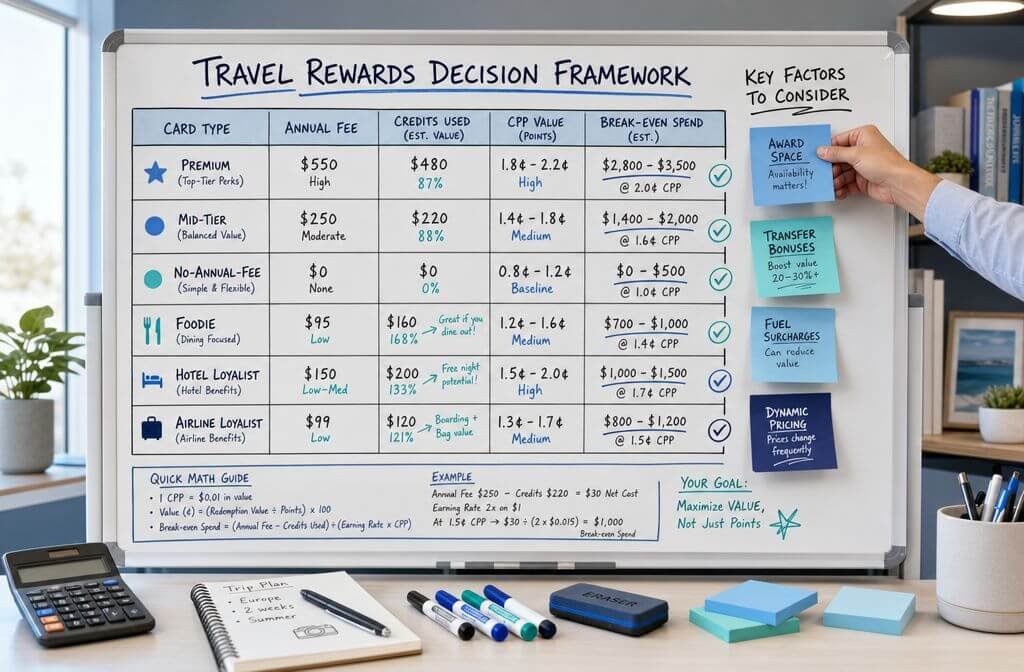
This matrix estimates first-year value using the 2026 working CPP values above. It does not count every possible credit because many credits depend on personal use.
| Card | Annual fee | Welcome offer example | Points value | Easy credits counted | Estimated first-year net | Best for |
|---|---|---|---|---|---|---|
| Chase Sapphire Preferred | $95 | 75,000 Chase points | $1,275 | $50 hotel credit if used | $1,180–$1,230 | Most travelers |
| Chase Sapphire Reserve | ~$795 | 150,000 Chase points | $2,550 | $300 travel credit | ~$2,055 | Frequent travelers |
| Capital One Venture X | $395 | 75,000 miles | $1,125 | $300 travel credit | ~$1,030 | Simple premium value |
| Amex Platinum | ~$895 | Up to 175,000 points | $2,800 | Varies widely | ~$1,905 before credits | Lounge-heavy travelers |
| Amex Gold | ~$325 | Up to 100,000 points | $1,600 | Varies widely | ~$1,275 before credits | Food spend |
| Citi Strata Elite | $595 | 75,000 Citi points | $1,125 | Travel credits vary | ~$530 before credits | Citi ecosystem users |
| Bilt Mastercard | $0 | Usually no major bonus | N/A | N/A | Spend-based | Renters |
| Capital One Savor | $0 | Varies | Cash back or miles pairing | N/A | Spend-based | Dining and entertainment |
Break-even rules of thumb
Use these rules before applying:
- $0 annual fee: Good if it earns useful points and has no foreign transaction fee.
- $95 annual fee: Easy to justify with one good transfer redemption.
- $395 annual fee: Needs a simple travel credit or regular lounge use.
- $595+ annual fee: Needs real travel habits, not hopeful credit use.
- $795+ annual fee: Should replace real costs or deliver high-value premium travel.
Travel spend scenarios
Scenario 1: One international trip per year
Best fit: Chase Sapphire Preferred or Venture X
Why: You need no foreign transaction fees, transfer partners, and enough flexibility. Lounge access is nice, but not essential.
Scenario 2: Monthly domestic flights
Best fit: Sapphire Reserve, Venture X, or Amex Platinum
Why: Lounge access, travel protections, and credits can matter more when you travel often.
Scenario 3: Family that spends heavily on food
Best fit: Amex Gold plus a premium or mid-tier travel card
Why: Food multipliers can build Amex points fast, but you still need a booking strategy.
Scenario 4: Renter in a high-cost city
Best fit: Bilt plus a Chase or Capital One card
Why: Rent can produce meaningful Bilt points, and the no-fee structure keeps risk low.
Scenario 5: Hotel-focused traveler
Best fit: Chase Sapphire Preferred or Reserve plus a Hyatt strategy
Why: Hyatt remains one of the best transfer sweet spots, but award availability and category changes matter.
How to Pick Your Card in Five Questions
Use this decision framework before applying.
1. Which points transfer partners will you actually use?
Do not choose Amex just because it has many partners. Do not choose Chase just because Hyatt is strong. Match the bank to your trips.
Ask:
- Which airports do you use?
- Which alliance partners serve your routes?
- Do you book economy, business class, or hotels?
- Are you comfortable with foreign airline programs?
- Can you handle transfer delays and partner rules?
For bank-by-bank partner lists, use Award Travel Hub’s Bank Transfer Partners Guide 2026.
2. Do you need lounge access?
Lounge access has become more valuable because airports are crowded and food costs are high. But it is still easy to overpay.
Estimate your use:
- 1–2 visits per year: probably not worth a premium card by itself
- 4–8 visits per year: may support Venture X or Sapphire Reserve
- 10+ visits per year: Amex Platinum, Sapphire Reserve, or Venture X may be worth comparing closely
Also check your home airport. A great lounge network is less useful if it is not where you fly.
3. Will you use the travel credits at face value?
A $300 travel credit is not always worth $300.
Value it at:
- 100% if it works on travel you already buy
- 70%–90% if it requires a portal but prices are fair
- 50% or less if it forces unwanted merchants or timing
- $0 if you will forget to use it
This is where many premium card mistakes happen.
4. What spending category drives your points?
Pick based on real spend.
- Dining and groceries: Amex Gold or Capital One Savor
- General travel: Sapphire Reserve or Preferred
- Simple everyday spend: Venture X or Venture
- Rent: Bilt
- Hotels: Chase plus Hyatt, or a hotel co-branded card
- Airline perks: airline card only if benefits beat the fee
5. Are you applying in the right order?
For many people, the best order is:
- Chase cards while under 5/24
- Capital One if approval odds are strong
- Amex for large targeted offers and category earning
- Citi for ThankYou points and niche partners
- Bilt if rent earning matters
This is not a universal rule. It is a risk-control rule.
Common Pitfalls to Avoid
Transferring before confirming award space
This is the biggest mistake. Transfers are usually final. Search first, confirm availability, then transfer.
Ignoring surcharges and fees
Some premium cabin awards carry high fuel surcharges. A 70,000-mile business class award with $900 in fees may still be good, but it is not the same as one with $80 in fees.
Assuming dynamic pricing will stay low
Airlines and hotels can raise award prices at any time. Dynamic pricing often gets worse during holidays, peak summer dates, and major events.
Overvaluing lounge access
A lounge visit is not worth $50 if you would have eaten at home or brought snacks. Use realistic values.
Chasing every transfer bonus
Transfer bonuses are useful when they match a booking. They are risky when they push you into a program you do not understand.
Forgetting opportunity cost
If you spend $6,000 to earn a bonus, ask what else that spend could have earned. The welcome offer may still be worth it, but the comparison matters.
FAQ: Best Credit Card for Travel in 2026
What is the best credit card for travel for most people in 2026?
For many travelers, Chase Sapphire Preferred is the best starting point. It has a moderate fee, strong Chase points, useful transfer partners, and simple travel value.
Is Chase Sapphire Reserve worth it over Sapphire Preferred?
It can be worth it if you use the travel credit, lounge access, and travel protections often. If you travel only once or twice per year, Sapphire Preferred may be the better value.
Are Amex points better than Chase points?
Not always. Amex points can be excellent for premium cabin awards, especially through partner airlines. Chase points are often easier for Hyatt stays and simpler redemptions.
Should I get Venture X or Amex Platinum?
Choose Venture X if you want simpler premium value and a lower annual fee. Choose Amex Platinum if you use Centurion Lounges, can manage credits, and know Amex transfer partners.
Are no-annual-fee travel cards worth it?
Yes, but mostly as part of a broader setup. Bilt, VentureOne, Savor, and Chase Freedom cards can be useful, but some need a paired premium or mid-tier card for full transfer value.
When should I transfer points to airline miles?
Transfer only after you find award space, confirm the price, check taxes and fuel surcharges, and verify the transfer ratio. Avoid speculative transfers unless you accept the risk.
Conclusion
The best credit card for travel in 2026 is the card that fits your spending and booking strategy.
For most travelers, Chase Sapphire Preferred remains the strongest first choice. It keeps fees low, earns valuable Chase points, and gives access to Hyatt and useful airline partners.
For premium travelers, compare Sapphire Reserve, Venture X, and Amex Platinum with real break-even math. Venture X often wins on simplicity. Sapphire Reserve can win for Chase loyalists and frequent travelers. Amex Platinum can win for lounge-heavy travelers who use its credits and transfer partners well.
For everyday spend, do not ignore Amex Gold, Capital One Savor, Bilt, and no-fee companion cards. The points you earn from normal life often matter more than the card you use once a year for travel.
Next steps:
- List your top three travel goals for the next 12 months.
- Check which bank has the best transfer partners for those trips.
- Compare annual fee break-even math.
- Search award availability before transferring points.
- Apply only when the welcome offer, spending requirement, and application rules make sense.
The right card should make booking easier, not more complicated.


Content on Award Travel Hub is independently created by Award Travel Hub Editorial Desk and, where noted, reviewed by Award Travel Hub Review Desk. Some pages may contain affiliate links, but compensation does not determine our coverage, opinions, or methodology.