
Last Updated: August 5, 2026
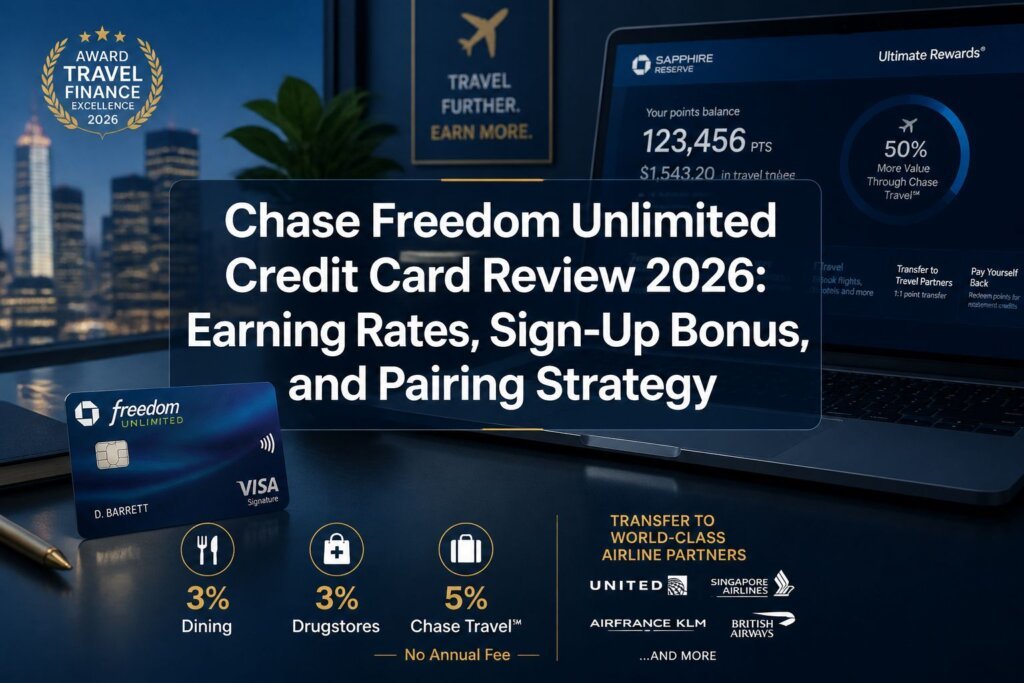
A no-annual-fee card can be more useful than a premium card when it fills the right gap. In 2026, the Chase Freedom Unlimited credit card earns a flat 1.5% cash back on all purchases, plus 3% on dining and drugstores and 5% on travel booked through Chase Travel. The real value comes when you pair it with a Sapphire or Ink card and turn that cash back into transferable Chase points.
That is the key decision: use the Freedom Unlimited as a simple cash-back card, or make it part of a Chase Ultimate Rewards strategy.
For most beginners building a Chase Trifecta, the Freedom Unlimited is the flat-rate earner. For churners, it is often the predictable third Chase card after a Sapphire and a Freedom Flex. It is not flashy, but it covers the spend that does not fit into bonus categories.
Key Takeaways
Best role: A no-annual-fee 1.5x “everything else” card inside a Chase points setup.
Current 2026 bonus: The standard public offer is generally $200 cash back after $500 in purchases in the first 3 months. A limited $250 offer ran earlier in 2026 and has ended.
Best pairing: Combine with Chase Sapphire Preferred, Sapphire Reserve, or eligible Ink cards to unlock points transfer partners.
You may be interested
Best use of points: Transfer to high-value partners when award availability supports the booking.
Watchouts: Chase 5/24, opportunity cost, dynamic pricing, fuel surcharges, and the fact that 1.5x is not the best rate for every purchase.



Chase Freedom Unlimited at a Glance: 2026 Snapshot
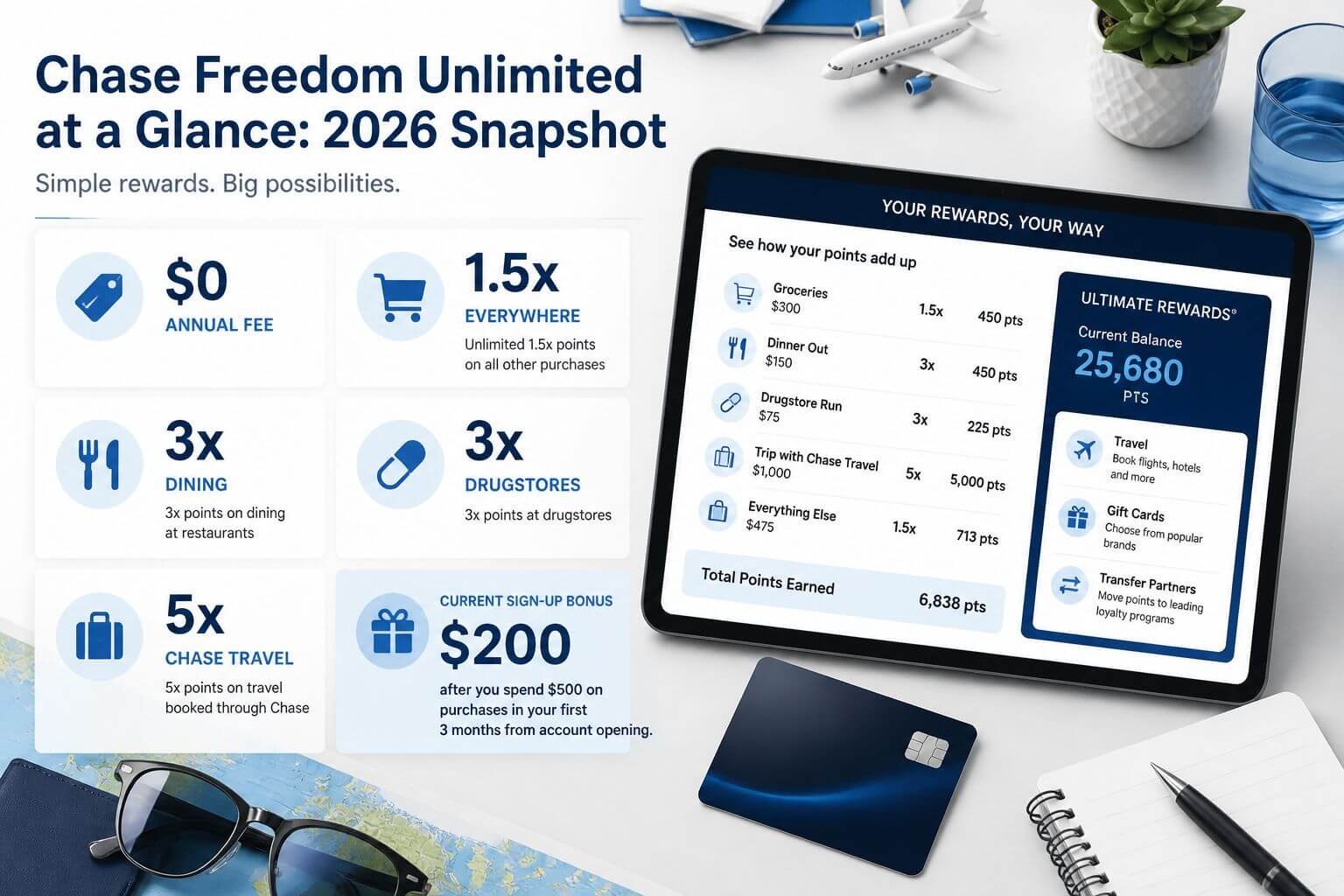
The Chase Freedom Unlimited credit card is a no-annual-fee card that earns Chase Ultimate Rewards points marketed as cash back. On its own, those points are usually worth 1 cent each when redeemed for cash back.
When paired with the right premium Chase card, those same points can become transferable points. That is where the card becomes more interesting for award travel.
Best for:
✅ Beginners building Chase Ultimate Rewards
✅ Anyone who wants a simple 1.5x card
✅ Chase Trifecta users who need a flat-rate earner
✅ Households that prefer low-fee cards
Not for:
❌ Travelers who need no foreign transaction fees
❌ People over Chase 5/24
❌ Users who want airport lounge access or premium protections
❌ Anyone who only wants the highest possible earning rate on every category
The card is also a useful long-term keeper. Since it has no annual fee, it can help preserve credit history after a downgrade or product change. If you are deciding whether to keep, downgrade, or cancel cards, see our credit card downgrade versus cancel decision guide.
Earning Rates: 1.5x Everywhere Plus Category Bonuses
The main reason to hold the Chase Freedom Unlimited credit card is its simple earning structure.
2026 earning rates
The 1.5x rate is not the highest flat-rate return on the market. Some no-fee cards earn 2% cash back. But the Freedom Unlimited is stronger when those 1.5x points can be moved into a Sapphire or Ink account and transferred to airline miles or hotel points.
That is the important travel rewards math.
If you redeem at 1 cent per point, 1.5x equals 1.5% back.
If you transfer points and redeem at 1.85 cents per point, 1.5x becomes:
1.5 points × 1.85 CPP = 2.775% effective travel value
That is why a 1.5x card can still make sense.
When 3x dining and drugstores matter
The 3x dining and drugstore categories are useful because they are automatic. No activation is needed.
Dining at 3x is solid, though not always best-in-class. If you already have Amex points, Capital One miles, Citi points, or Bilt points cards that earn strong dining rates, compare options before assuming Chase is best.
Drugstores are more interesting. Many users overlook this category, but it can be valuable for:
Prescriptions
Over-the-counter medicine
Household basics
Personal care items
Some gift card purchases, where allowed and not abused
Do not manufacture spend or trigger account review risk. Chase can close accounts or claw back rewards if it sees behavior that violates program rules. For welcome bonus behavior to avoid, read our guide to credit card welcome bonus clawbacks.
Chase Travel at 5x: useful, but not automatic
The card earns 5x on travel booked through Chase Travel. This can be a good deal, but compare options.
Before booking through the portal, check:
Is the cash price the same as booking direct?
Will the hotel booking earn elite credit?
Are cancellation rules worse?
Is there a better award booking through transfer partners?
Are you giving up protections or loyalty benefits?
For flights, booking through Chase Travel can make sense when prices match the airline. For hotels, be more careful. Many hotel chains do not honor elite benefits or points earning on third-party bookings.
Freedom Unlimited vs. Freedom Flex
The Freedom Unlimited and Freedom Flex are often compared as the second or third Chase card.
The Freedom Flex can be stronger during quarters with useful 5x categories. In Q2 2026, Chase Freedom bonus categories include Amazon, Whole Foods, Chase Travel, and Feeding America donations. If you hold a Freedom Flex or older Freedom card, see our guide to Chase Freedom Q2 2026 bonus categories.
But the Freedom Unlimited usually wins for predictable spend. It does not require activation. It does not depend on rotating categories. It just earns 1.5x everywhere.
Sign-Up Bonus and Spending Requirement
The standard 2026 offer for the Chase Freedom Unlimited credit card is typically:
OfferSpending requirementTimeline$200 cash back bonus$500 in purchasesFirst 3 months
Earlier in 2026, Chase ran a limited-time $250 cash back offer after $500 in purchases in the first 3 months. That elevated offer was available online from March 12 through April 30, 2026, and remained available in some branches through May 3, 2026. As of May 2026, the card generally reverted to the standard $200 bonus.
There was also a richer $300 offer in late 2025 and early 2026, but that has not been the normal baseline.
Is the $200 bonus worth applying for?
For many beginners, yes. The spending requirement is low, and the card has no annual fee.
A $200 bonus after $500 spend is still strong for a no-fee card. The key question is not whether the bonus is easy. It is whether using a 5/24 slot is worth it.
If you are under Chase 5/24 and plan to build a Chase setup, this can be reasonable. If you have limited card slots and want a Sapphire welcome bonus first, prioritize the Sapphire.
For a broader card comparison, see our best travel credit cards 2026 guide.
Should you wait for a higher offer?
Maybe.
A simple decision framework:
Apply now if you need a no-fee Chase card, can use the bonus, and are building a Trifecta.
Wait if you are not in a rush and would only apply for an elevated $250 or $300 offer.
Skip for now if you are close to 5/24 and have not yet earned a Sapphire bonus.
Do not apply only because a limited-time offer appears. A good bonus can still be the wrong move if it blocks a better Chase card later.
Pairing the Freedom Unlimited with Sapphire or Ink Cards
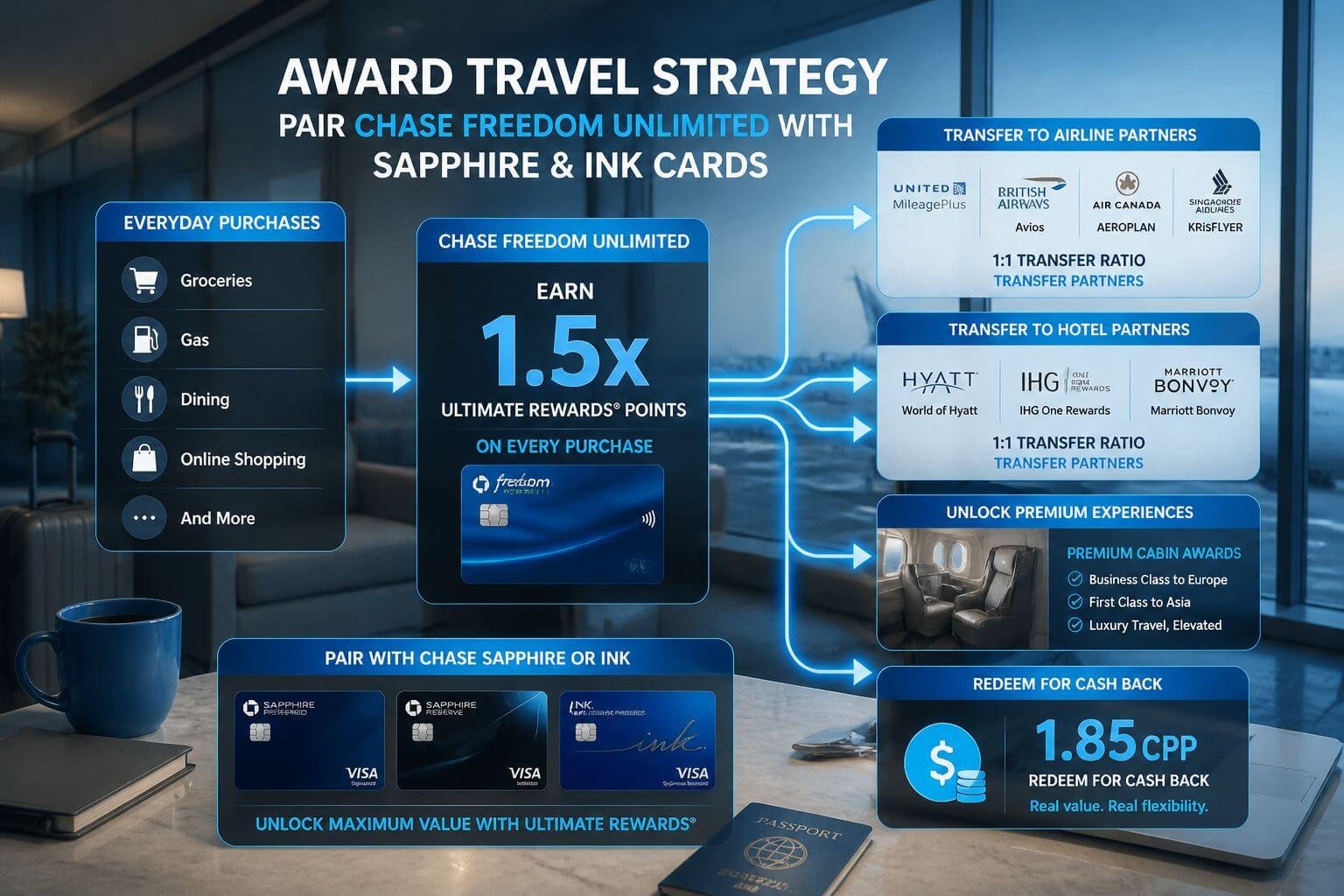
The Chase Freedom Unlimited credit card is much more powerful when paired with a card that unlocks Chase transfer partners.
Eligible cards that can unlock transfers include:
Some legacy premium Chase cards
On its own, Freedom Unlimited points are cash-back points. With a Sapphire or eligible Ink card, you can combine points into that premium account and transfer to airline and hotel partners.
For the full list of partners and transfer ratios, use our Chase Transfer Partners Guide 2026.
Why pairing matters
Chase points can transfer to partners such as:
United MileagePlus
Southwest Rapid Rewards
Air Canada Aeroplan
British Airways Executive Club
Iberia Plus
Air France-KLM Flying Blue
Virgin Atlantic Flying Club
World of Hyatt
IHG One Rewards
Marriott Bonvoy
Transfer ratios are usually 1:1, though not all partners offer equal value. Some programs use award charts. Others use dynamic pricing. Some add fuel surcharges. Some have limited award availability or married segment logic that hides space on certain routes.
That is why the best use of points depends on the booking.
Chase Trifecta setup
A common Chase Trifecta looks like this:
CardRoleChase Sapphire PreferredTransfer partners, travel protections, annual fee anchorChase Freedom Unlimited1.5x everywhereChase Freedom Flex5x rotating categoriesOptional Ink cardBusiness categories and larger welcome bonuses
For many users, the Chase Sapphire Preferred is the best first premium card because it unlocks transfers with a lower annual fee than the Reserve. For details, see our Chase Sapphire Preferred 2026 guide.
Pairing strategy: which card should get each purchase?
The main mistake is putting all spend on one card for simplicity. That can be fine if you value time over optimization. But if you want to maximize points, use each card for its strongest category.
Transfer partners vs. cash back
Not every transfer is good.
Transfer when:
You have found award space.
The award price beats the cash price.
Taxes, surcharges and fees are reasonable.
You understand cancellation rules.
The transfer is instant or fast enough for the booking.
Do not transfer speculatively unless there is a strong reason. Transfers are usually one-way. Once Chase points become airline miles or hotel points, you take on that program’s devaluation risk.
This matters across all transferable points programs, not just Chase. Amex points, Capital One miles, Citi points, and Bilt points can all lose value when partner airlines change award charts or move further into dynamic pricing. For a cross-bank view, see our guide to comparing transfer partners in 2026.
Real-World Examples: Cash Back vs. Ultimate Rewards Transfer Math
The Freedom Unlimited looks simple, but the value changes based on redemption.
Example 1: $20,000 in non-bonus annual spend
Assume $20,000 in purchases that do not earn higher category bonuses elsewhere.
Redemption typePoints earnedValue per pointTotal valueCash back30,0001.0 CPP$300Travel transfer30,0001.5 CPP$450Strong award redemption30,0001.85 CPP$555Excellent sweet spot30,0002.3 CPP$690
The card earns the same 30,000 points either way. The booking strategy determines the value.
Example 2: Hyatt hotel redemption
Assume a Hyatt hotel costs:
15,000 points per night
$310 cash rate after taxes
No resort fee on award stay for eligible bookings
Value:
$310 ÷ 15,000 = 2.07 CPP
If you earned those points at 1.5x, your effective return is:
1.5 × 2.07 = 3.105%
That is a strong result for non-bonus spend.
World of Hyatt is often one of the best Chase points transfer partners, but it is not always perfect. Award availability can be limited. Popular properties may not release standard rooms. Cash rates may also be low enough that paying cash is better.
Example 3: Business class award
Assume you find a one-way business class award to Europe:
60,000 airline miles
$120 taxes and fees
Comparable cash fare: $2,400
Redemption value:
($2,400 – $120) ÷ 60,000 = 3.8 CPP
That is excellent on paper. But the real-world value depends on whether you would have paid that fare. If your true alternative was a $750 economy ticket, the personal value is lower.
This is where travel rewards math can get inflated. Use realistic comparisons.
For premium cabin awards, check:
Partner airlines
Alliance partners
Award space
Surcharges and fees
Transfer ratios
Transfer bonuses
Positioning flights
Stopovers
Married segments
Cancellation rules
If you are new to premium cabin awards, our guide on how to book business class with points in 2026 gives a practical booking walkthrough.
Example 4: Transfer bonus opportunity
Suppose Chase offers a 20% transfer bonus to Avios. You transfer:
50,000 Chase points
Receive 60,000 Avios
Book a partner airline award that normally prices well through Avios
This can improve your cents per point. But only if award space exists and surcharges are reasonable.
Transfer bonuses can create sweet spots, but they can also push users into bad redemptions. Always search first, transfer second. You can monitor current opportunities in our credit card transfer bonuses tracker.
5/24 Rule, Eligibility, and Application Strategy
The Chase Freedom Unlimited credit card is generally subject to Chase’s 5/24 rule.
That means Chase may deny you if you have opened 5 or more personal credit cards across all banks in the past 24 months. Some business cards may not appear on your personal credit report, but many personal cards do.
Basic eligibility checklist
Before applying, check:
Are you under 5/24?
Have you received a bonus on this exact card before?
Do you currently hold the card?
Can you meet the $500 spending requirement naturally?
Do you have a better Chase card to apply for first?
Is your credit profile strong enough for a new account?
For churners, the biggest issue is opportunity cost. A Freedom Unlimited approval uses a Chase slot that could have gone to a Sapphire, Ink, Southwest, Hyatt, United, or Marriott card.
Application order
A common beginner order:
Chase Freedom Unlimited
Chase Freedom Flex
Ink Business Preferred or other Ink card, if eligible
Co-branded Chase card based on travel goals
This order is not universal.
Choose based on your trip plan. If your goal is Hyatt hotels, Chase points are strong. If your goal is United flights, Chase can help, but compare United card perks. If your goal is international first class redemptions, you may also need Amex points, Citi points, Capital One miles, or Bilt points for access to more partner airlines.
Product change rules
Chase often allows product changes within the same card family, but rules vary. In general:
Product changes do not earn a new welcome bonus.
You may need the card open for at least 12 months before some changes.
Sapphire bonus eligibility is separate and often more restrictive.
Holding or recently holding a Sapphire card can affect future Sapphire bonus plans.
Product-changing into a Freedom card can preserve account history.
Do not product change before checking your long-term strategy. If you downgrade a Sapphire to Freedom Unlimited, you may lose transfer partner access unless you hold another eligible premium Chase card.
Two-player strategy
Couples can build a stronger setup by coordinating applications. One person may hold the Sapphire Preferred while both earn on Freedom cards. Points can often be combined within household rules, but do not assume every transfer is allowed. Follow Chase’s current terms.
For planning applications across two people, see our two-player mode credit card strategy guide.
Pros, Cons, and Who Should Skip the Freedom Unlimited
The Chase Freedom Unlimited credit card is a strong card, but not for everyone.
Pros
✅ No annual fee
Easy to keep long term.
✅ Simple 1.5x earning
Useful for non-bonus spending that would otherwise earn only 1x.
✅ 3x dining and drugstores
Strong automatic categories for a no-fee card.
✅ 5x Chase Travel
Useful when portal pricing and rules are competitive.
✅ Pairs well with Sapphire and Ink
This is the main reason award travelers should care.
✅ Low welcome bonus threshold
The standard $500 spend requirement is easy for most households.
Cons
❌ Foreign transaction fee
Not a good card for international purchases.
❌ 1.5x is not always best
A 2% cash-back card may be better if you do not use Chase transfer partners.
❌ No premium travel perks
No lounge access, broad travel credits, or high-end insurance package.
❌ Chase Travel can be limiting
Portal bookings may have different rules than booking direct.
❌ Transfer value is not guaranteed
Award availability, fuel surcharges, dynamic pricing, and devaluations can reduce value.
Who should get the card?
The Freedom Unlimited makes sense if:
You are under 5/24.
You want a no-fee Chase card.
You already have or plan to get a Sapphire or eligible Ink card.
You need a card for everyday non-bonus spend.
You want simple earning without rotating categories.
Conclusion
The Chase Freedom Unlimited credit card is not the most exciting card in the Chase lineup, but it is one of the most useful. Its value comes from consistency: 1.5x on everything, 3x on dining and drugstores, 5x through Chase Travel, and no annual fee.
For cash-back users, it is a simple starter card with an easy welcome bonus. For award travelers, it becomes more valuable when paired with the Chase Sapphire Preferred, Sapphire Reserve, or an eligible Ink card. That pairing turns everyday cash back into transferable Chase points that can be used for Hyatt stays, partner airline awards, business class deals, and other high-value redemptions.
The best next step is simple:
Check your 5/24 status.
Decide whether Sapphire or Freedom Unlimited should come first.
Apply only if the welcome bonus fits your plan.
Use the card for non-bonus spend.
Transfer points only after finding real award space.
The Freedom Unlimited is best viewed as a tool, not a complete strategy. Use it to build points. Use Sapphire or Ink to unlock partners. Then compare cash prices, award charts, dynamic pricing, taxes, fuel surcharges, and transfer bonuses before booking.
That is how you avoid wasting Chase points and turn a no-annual-fee card into real travel value.


Content on Award Travel Hub is independently created by Award Travel Hub Editorial Desk and, where noted, reviewed by Award Travel Hub Review Desk. Some pages may contain affiliate links, but compensation does not determine our coverage, opinions, or methodology.