
Last updated: November 20, 2026
Chase went more than five years without adding a single new airline transfer partner. That streak ended on November 18, 2026, when Qantas Frequent Flyer and Cathay Asia Miles joined the Ultimate Rewards lineup at a 1:1 ratio. For anyone tracking Chase Qantas Cathay transfer partners, this is the most meaningful change to Chase’s airline roster since Air Canada Aeroplan arrived in 2021, and it finally gives Ultimate Rewards real depth in the Oneworld alliance.
Chase Adds Qantas and Cathay Pacific: What’s New?
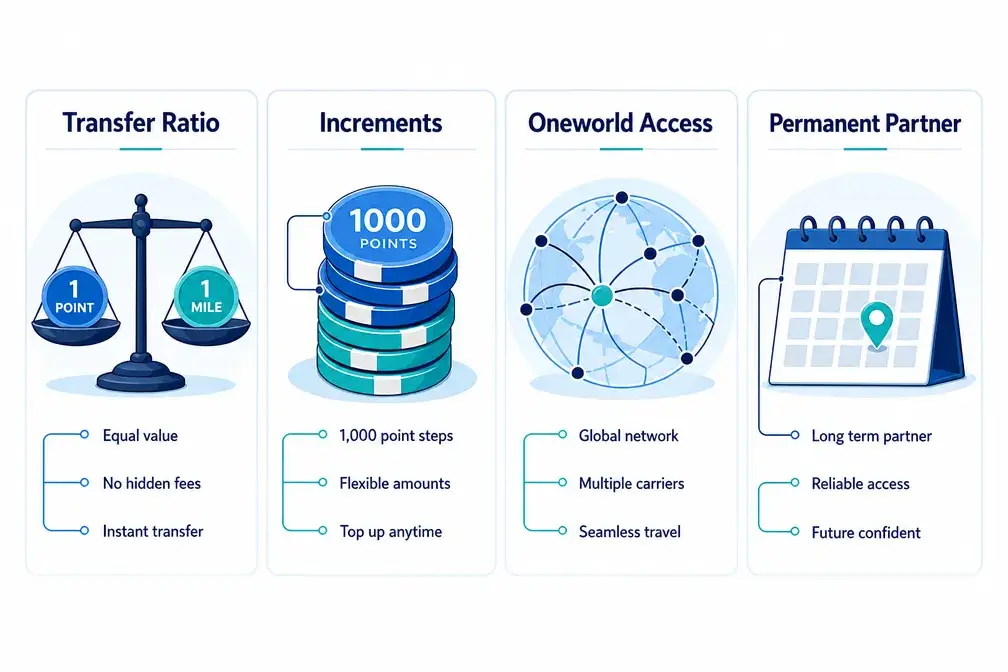
Chase added Qantas Frequent Flyer and Cathay Asia Miles as Ultimate Rewards transfer partners on November 18, 2026. Both transfer at 1:1 in 1,000-point increments, and both are permanent additions to the partner lineup rather than limited-time promotions.
Before this, Chase cardholders had only two Oneworld programs to work with: British Airways Executive Club (Avios) and Iberia Plus. That was workable for short-haul American Airlines flights and transatlantic Avios redemptions, but it left big gaps across the Pacific. Adding Qantas and Cathay brings Chase to four Oneworld loyalty programs and opens direct booking access to Qantas, Cathay Pacific, American Airlines, Alaska Airlines, Japan Airlines, Royal Air Maroc, LATAM and other member carriers.
The strategic point is not simply “two more programs.” It’s inventory. Qantas and Cathay have both tightened the premium-cabin award space they release to outside programs. Booking through the operating airline’s own program is often the only way to see that space at all. NerdWallet reporter Benjamin Din framed the main advantage exactly that way: airlines routinely hold back seats for their own members.
Two caveats worth setting up front:
- No launch transfer bonus. Neither partnership debuted with a promotional bonus. A future bonus is plausible, but transfers are irreversible, so speculative transfers are a bad idea.
- Transfer speed is unsettled. Thrifty Traveler listed processing times as TBD on launch day. LoyaltyLobby reported transfers could take up to seven business days, with many clearing the next business day.
New Chase Transfer Partners at a Glance
Both new programs transfer at 1,000 Chase points to 1,000 airline miles, with a 1,000-point minimum and no transfer fee from Chase. There is no cap, no expiration on the ratio, and no introductory bonus attached.
Counting conventions differ across outlets, but NerdWallet puts Chase’s roster at 12 airline programs and four hotel programs after the additions. Other publishers count differently because Air France and KLM share Flying Blue yet sometimes appear as separate entries. The full current roster, including Hyatt, Marriott, IHG and Southwest, is tracked in our Chase Ultimate Rewards transfer partners guide.
You may be interested



One clarification that matters for readers skimming headlines: these are permanent partner additions, not transfer bonuses. Chase bonuses (such as recent Avios and Aeroplan promos) come and go. Partner status does not. If a bonus later lands on Qantas or Cathay, it stacks on top of the base 1:1 rate.
Best Ways to Use Chase Points With Qantas
Qantas Frequent Flyer is most useful for Australia and the South Pacific, plus a distance-based partner award chart that prices some American Airlines and Alaska Airlines segments well. Transfer only after you’ve located award space on the Qantas site.
Where Qantas earns its place in the lineup:
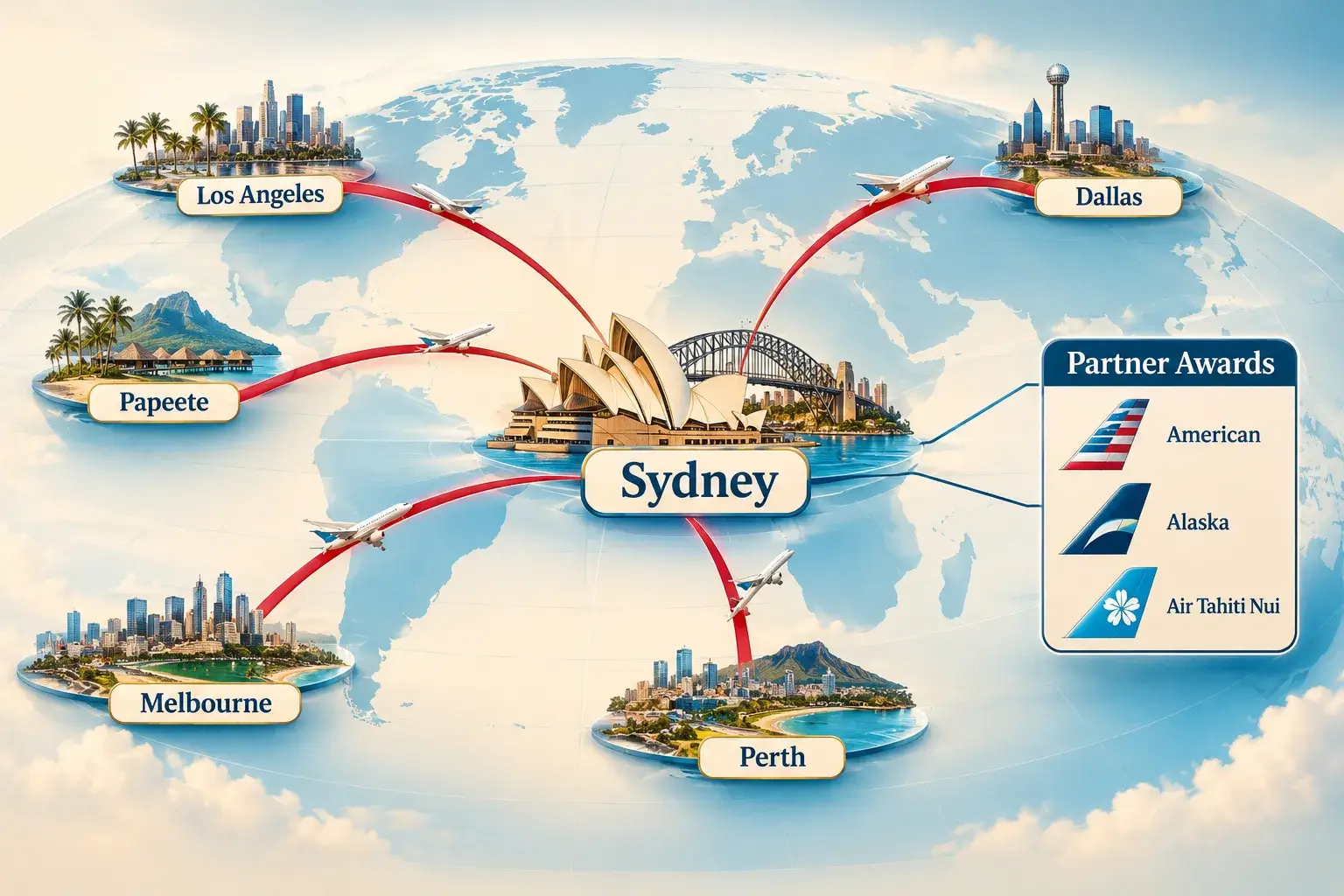
- Qantas-operated business class to Australia. Qantas releases Classic Reward seats on its own long-haul routes (Los Angeles, Dallas/Fort Worth, San Francisco and New York via Auckland) that partner programs frequently cannot see. These are capacity-controlled and often snapped up 11 to 12 months out, so set alerts.
- Australian domestic flights. Short Classic Reward hops like Sydney, Melbourne or Sydney, Brisbane price cheaply and carry modest carrier charges. This is one of the cleanest uses of Chase points for an Aussie trip, because cash fares inside Australia are not always low.
- Air Tahiti Nui to Papeete. Qantas is one of the few mileage programs that partners with Air Tahiti Nui, making French Polynesia reachable without buying a pricey cash ticket.
- American and Alaska partner awards. Qantas’ distance-based chart can undercut AAdvantage on certain mid-haul routes, though American has grown stingier with partner space.
Best for: travelers headed to Australia, New Zealand or Tahiti, and anyone who has watched Qantas business class vanish from partner search tools.
Not for: transatlantic Europe trips. Avios, Flying Blue or Aeroplan almost always price better, and Qantas layers carrier charges on some partner itineraries.
The common mistake here is assuming Qantas prices everything well because the chart is distance-based. It doesn’t. Qantas adds carrier charges on many partner redemptions, and its own long-haul awards carry taxes and fees that can run into the hundreds of dollars round trip. Run the cents-per-point math against the cash fare before you move anything. For a broader view of how Qantas stacks up across banks, see our Qantas Frequent Flyer transfer partners guide.
Best Ways to Use Chase Points With Cathay Asia Miles
Cathay Asia Miles is the stronger of the two additions for most U.S. travelers, because it unlocks Cathay Pacific’s own business and first class inventory to Hong Kong and beyond. Thrifty Traveler cited U.S.,Asia business class awards starting around 91,000 Asia Miles one way, with taxes, fees and route distance affecting the final cost.

What makes Asia Miles worth a transfer:
- Cathay’s Aria Suite business class. The newest Cathay business product, with closing doors, flies select routes from Hong Kong to North America, Europe, Australia and Asia. Partner programs often can’t see the same premium-cabin inventory Cathay holds for its own members.
- Onward connections past Hong Kong. Asia Miles prices a Hong Kong connection onward to Bangkok, Singapore, Tokyo or Manila on a single award, which is usually cheaper than two separate tickets.
- Partner awards on Japan Airlines, British Airways and Royal Air Maroc. Japan Airlines business class to Tokyo is a legitimate sweet spot. Royal Air Maroc opens Casablanca and onward African routings that are hard to reach with other Chase partners. British Airways awards are bookable but come with heavy fuel surcharges, so check the fee total before committing.
- First class redemptions. Cathay first class space is genuinely scarce and mostly releases close to departure or at the 360-day mark. Treat it as opportunistic, not plannable.
The availability argument is the real story. If an award search tool shows nothing on Cathay through AAdvantage or Alaska, log into Asia Miles directly and search again. The inventory sets are not identical.
A caution: Asia Miles uses a distance-based chart with standard, choice and tailored tiers, and the cheaper standard tier is the one worth transferring for. Tailored pricing can cost multiples of the standard rate, which erodes value fast. More detail sits in our Cathay Pacific transfer partners overview.
Chase vs. Amex, Capital One, and Other Transfer Options
Chase now offers one of the best Cathay transfer rates among U.S. transferable points programs, because American Express cut its Membership Rewards to Asia Miles ratio from 1:1 to 1,000:800 earlier in 2026. Qantas is more widely available across issuers, so Chase’s advantage there is access, not exclusivity.
Ratios listed reflect publicly posted rates as of November 2026; always confirm on the issuer’s transfer page before moving points, since ratios change without much notice.
Three points of practical interpretation:
- A good ratio is not a good redemption. A 1:1 transfer into an award that prices at 0.9 cents per point is still a poor use of Chase points. Compare the award cost plus taxes against the cash fare, then against what another program charges for the same seat.
- Amex holders are now at a structural disadvantage on Cathay. At 1,000:800, a 91,000-mile business class award requires roughly 113,750 Amex points versus 91,000 Chase points. That gap is large enough to change which card you spend on.
- Competing programs still win sometimes. Alaska Mileage Plan and AAdvantage occasionally price the same Cathay or Qantas seat lower. Capital One and Citi both reach Cathay at 1:1 too, as covered in our Citi ThankYou to Cathay Pacific transfer guide and the broader Chase vs. Amex vs. Citi vs. Capital One comparison.
Transfer bonuses change the math further. A 25% to 30% bonus elsewhere can beat Chase’s flat 1:1, which is why it pays to check the current transfer bonuses for November 2026 before you commit.
Which Chase Credit Cards Qualify?
Only Chase’s premium Ultimate Rewards cards can transfer points to airline partners. That list includes Chase Sapphire Preferred, Chase Sapphire Reserve, Ink Business Preferred and Chase Sapphire Reserve for Business.
Cards that cannot transfer on their own include Chase Freedom Flex, Chase Freedom Unlimited, Ink Business Cash and Ink Business Unlimited. Points earned on those cards are still usable, but only after a workaround.
The combining step: move points from a non-transfer card into an eligible card’s account first. Chase allows moving points between your own Ultimate Rewards accounts, and to a household member or authorized user in some cases. Once the points land in a Sapphire or Ink Preferred account, they can be transferred to Qantas or Cathay at 1:1.
A practical example: 60,000 points earned on a Freedom Unlimited at 1.5x are worth 1.5 cents each in the Chase travel portal with a Sapphire Reserve, but moved to Sapphire Reserve and then to Asia Miles, those same points can book part of a business class seat to Hong Kong worth far more. The holding card determines your options, which is why the annual fee math on Sapphire Preferred vs. Sapphire Reserve matters for anyone who wants partner access.
And yes, the same card can transfer to both Qantas and Cathay. There is no restriction on using multiple partners from one account.
How to Transfer Chase Points to Qantas or Cathay
The process runs through the Chase Ultimate Rewards portal and takes a few minutes, but the order of operations matters: find the award seat first, then transfer. Transfers are final.
Step by step:
- Search for award space first. Use the Qantas Classic Rewards search or the Asia Miles award search while logged in. Confirm the exact date, cabin, routing, mileage cost and taxes.
- Link your loyalty account. In Chase’s transfer section, add Qantas Frequent Flyer or Cathay Asia Miles. The name on your airline account must match the name on your Chase account. Mismatches are the single most common cause of failed transfers.
- Transfer in 1,000-point increments. Move only what the award requires, rounded up to the next 1,000. Do not pad “just in case.”
- Wait for the miles to post. Many transfers clear by the next business day, but up to seven business days has been reported. Avoid booking anything time-sensitive on launch-era assumptions.
- Book immediately once miles arrive. Award space can disappear in hours. Have the itinerary open and ready.
Chase charges no fee to transfer. Taxes and carrier charges are paid to the airline at booking, in cash, and those can be significant on British Airways-operated segments.
Common pitfalls to avoid: transferring before confirming the award is bookable online (some partner awards require a phone call), forgetting that Qantas charges a joining fee for new Frequent Flyer members in some markets, and assuming the Chase travel portal and partner transfers are interchangeable. They are not, as our Chase travel portal vs. transfer partners breakdown explains.
Should You Transfer Your Chase Points?
Transfer only when you have confirmed award space and the redemption beats both the cash fare and the Chase portal rate. Otherwise, keep your points flexible. Chase points sitting in Ultimate Rewards can still become Hyatt, Aeroplan, Flying Blue or Avios; once they’re Qantas Points, they’re Qantas Points forever.
Who benefits most:
- Australia and South Pacific travelers. Qantas direct access solves a real gap in Chase’s lineup.
- Asia-bound premium cabin flyers. Asia Miles at 1:1 is currently stronger than the Amex route.
- Amex-heavy households. The Cathay ratio difference is a reason to shift spend toward a Sapphire or Ink Preferred card.
Choose Qantas if your itinerary touches Australia, New Zealand or Tahiti, or if you need Qantas-operated long-haul business class that partners can’t see.
Choose Cathay if you’re flying to or through Hong Kong, want Japan Airlines business class, or need onward Asian connections on one award.
Keep points in Chase if you don’t have confirmed space, if a competing program prices the same seat lower, or if a transfer bonus is plausible in the next few weeks. Hyatt redemptions, in particular, frequently outperform airline transfers on a cents-per-point basis.
The devaluation risk is real on both sides. Qantas revised its Classic Rewards pricing in recent years, and Cathay has adjusted its chart tiers. Neither program guarantees today’s rates tomorrow, which is another argument for transferring on demand rather than stockpiling.
Frequently Asked Questions
What’s the transfer rate from Chase Ultimate Rewards to Qantas miles?
1:1. Every 1,000 Chase points becomes 1,000 Qantas Points, with no fee from Chase and a 1,000-point minimum.
How do you transfer Chase points to Cathay Pacific?
Log into the Chase Ultimate Rewards portal, link your Cathay Asia Miles account using a name that matches your Chase account exactly, then transfer in 1,000-point increments. Confirm award space before transferring, since transfers cannot be reversed.
How long does it take to transfer Chase points to an airline?
Many Chase transfers to Qantas and Cathay have posted by the next business day, but up to seven business days has been reported. Do not rely on instant posting for same-day bookings.
Which Chase credit cards offer Qantas and Cathay transfers?
Chase Sapphire Preferred, Chase Sapphire Reserve, Ink Business Preferred and Chase Sapphire Reserve for Business. Freedom and Ink Cash/Unlimited points must first be combined into one of those accounts.
Is there a minimum transfer amount to Qantas or Cathay?
Yes. Both require a minimum of 1,000 points, and all transfers must be made in 1,000-point increments.
Are there fees for transferring Chase points to airlines?
Chase charges no transfer fee. You will still pay taxes, carrier charges and fuel surcharges in cash to the airline when you book, and those can be substantial on British Airways-operated flights.
Do you lose value when transferring Chase points to airline partners?
Not at a 1:1 ratio, but you lose flexibility. If the resulting award prices poorly, or you never book it, the transfer destroys value. Always compare the award cost plus fees against the cash fare first.
Can you transfer Chase points to both Qantas and Cathay from the same card?
Yes. An eligible Sapphire or Ink Business Preferred account can transfer to both programs, with no restriction on using multiple partners.
Should I transfer to Qantas or book directly through Chase?
Transfer when the partner award clearly beats the portal price. The Chase travel portal values points at 1.25 to 2 cents depending on the card, so a Qantas or Cathay award needs to exceed that rate after taxes and fees to be worth it.
Is it worth transferring Chase points to Qantas or Cathay Pacific?
It is worth it when you have confirmed premium-cabin award space that partner programs can’t access and the cash fare is high. For economy flights or routes well served by Avios, Aeroplan or Flying Blue, it usually is not.
Bottom Line
The addition of Qantas Frequent Flyer and Cathay Asia Miles on November 18, 2026 meaningfully improves Chase Ultimate Rewards, particularly for Pacific and Asia itineraries where Chase previously had thin coverage. At 1:1 with 1,000-point increments and no transfer fee, the terms are clean. The Cathay rate is currently better than Amex’s reduced 1,000:800 ratio, which is the single most consequential detail for anyone deciding where to put spend.
Keep expectations grounded. Award availability on both carriers is limited, taxes and carrier charges can be meaningful, and there’s no launch bonus to sweeten the math. The value comes from access to inventory that partner programs don’t see, not from the ratio itself.
Next steps: check Qantas Classic Rewards and the Asia Miles award search for your dates before touching your points balance, compare the result against other Chase transfer partners and the cash fare, and only then transfer. Flexibility is the asset. Spend it deliberately.


Content on Award Travel Hub is independently created by Award Travel Hub Editorial Desk and, where noted, reviewed by Award Travel Hub Review Desk. Some pages may contain affiliate links, but compensation does not determine our coverage, opinions, or methodology.