
Last updated: November 16, 2026
A $100 fee gap hides a much bigger difference. The American Express Platinum Card now costs $895 a year, and the Chase Sapphire Reserve costs $795. For most travelers, though, the fee is not what decides the comparison. What decides it is how much of each card’s credit value you will actually use without changing your habits. After both refreshes, the Sapphire Reserve is easier to break even on. The Amex Platinum has a higher ceiling for travelers who already book Fine Hotels + Resorts, fly from Centurion Lounge airports, and use the lifestyle credits anyway.
Amex Platinum vs Sapphire Reserve at a Glance
Short answer: Choose the Sapphire Reserve if you want simpler credits, strong dining and travel earning, and a broad $300 travel credit that pays out automatically. Choose the American Express Platinum Card if you value Centurion Lounges, premium hotel booking benefits, and a long list of monthly and semiannual credits, and you will track them.
Both cards went through major refreshes. American Express updated the U.S. Consumer Platinum on September 18, 2025, raised the annual fee to $895, and added or expanded credits for Resy, lululemon, Uber One, Oura, digital entertainment, and hotels. Existing cardmembers began paying the higher fee at renewals on or after January 2, 2026. Chase moved the Sapphire Reserve to $795 and rebuilt its benefits around The Edit hotel credit, a dining credit, and partner subscriptions.
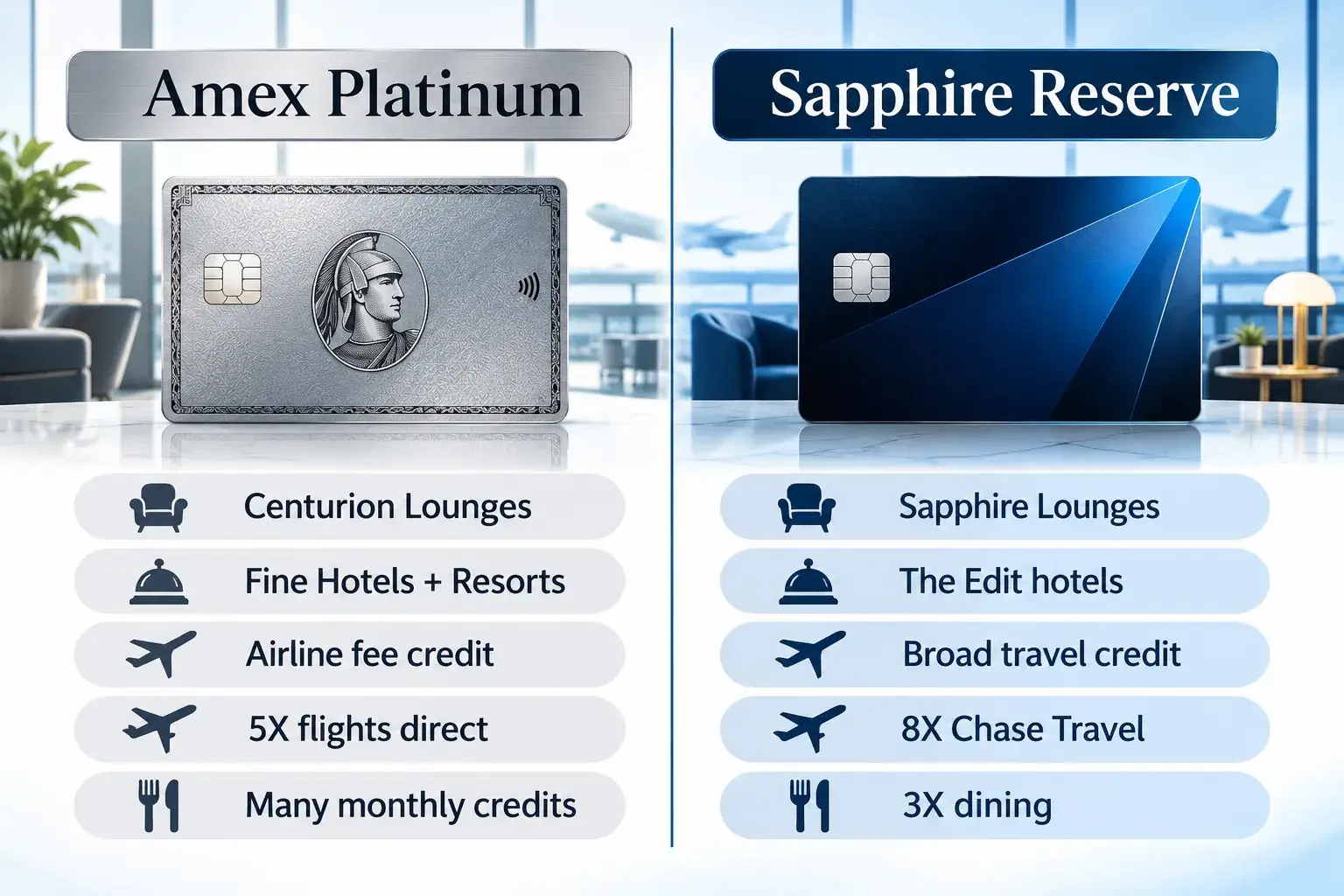
| Feature | Amex Platinum | Chase Sapphire Reserve |
|---|---|---|
| Annual fee | $895 | $795 |
| Authorized user fee | $195 | $195 |
| Main travel credit | $200 airline incidental fees (one airline) | $300 broad travel credit |
| Hotel credit | Up to $600 (two $300 periods), FHR or Hotel Collection | Up to $500 (two $250 periods), The Edit |
| Top earning rate | 5X flights direct or via Amex Travel (up to $500,000 per year) | 8X via Chase Travel |
| Dining earning | 1X | 3X worldwide |
| Hotel program size | 3,100+ properties | 1,400+ hotels |
| Currency | Amex Membership Rewards | Chase Ultimate Rewards |
Amex advertises more than $3,500 in potential annual value for the Platinum. Much of that total is spread across narrow, enrollment-required benefits instead of one flexible credit. Chase’s headline value is easier to collect because its largest everyday credit covers airfare, hotels, rental cars, transit, taxis, tolls, and parking.
Best for Amex Platinum: frequent flyers who use Centurion Lounges, luxury hotel guests who book prepaid FHR stays, and people who already spend with Uber, Resy restaurants, and similar partners.
Best for Sapphire Reserve: travelers who dine out often, want easy credits, and redeem with Hyatt or United.
Can you hold both? Yes. Amex and Chase are separate issuers, so there is no rule against carrying both. The real question is whether $1,690 in combined fees pays off. For most people it does not, unless both sets of credits get used almost in full.
Annual Fees and Statement Credits Compared
Short answer: The Sapphire Reserve’s credits are easier to use, so its effective fee is often lower even though both cards advertise far more value than they charge. The American Express Platinum Card can return more total value, but only if you use several narrow credits on schedule.
Where the credits actually differ
The most important difference is flexibility. Chase’s $300 travel credit applies automatically to almost any travel purchase, so most travelers recover it within a few months. Amex’s $200 airline fee credit only works with one airline you choose and covers qualifying incidental fees such as checked bags or seat fees, not regular tickets.
You may be interested



Hotel credits are closer but still differ:
- Amex: up to $600 per year, split into two $300 periods, on prepaid Fine Hotels + Resorts or The Hotel Collection bookings through Amex Travel.
- Chase: up to $500 per year, split into two $250 credits, on prepaid stays of at least two nights through The Edit.
- Chase 2026 extra: an additional $250 hotel credit for selected Chase Travel bookings, scheduled to expire December 31, 2026 unless renewed. If you hold the Reserve, check whether you have used it before year end.
- Amex 2027 change: for new bookings starting January 1, 2027, a two-night minimum applies more broadly to the Platinum hotel credit structure. Short one-night stays will be harder to use for the credit.
Chase also includes a $300 dining credit, Apple subscriptions, DoorDash promotions, StubHub credits, Lyft credits, and Peloton credits. Amex covers Resy dining, lululemon, Uber and Uber One, digital entertainment, Oura, and others. For a full list, see the American Express Platinum Benefits: Full 2026 Breakdown.
Rule of thumb: value a credit at what you would have spent in cash anyway, not at its face value. A $100 credit you have to go out of your way to use is often worth $30 to $50.
Effective fee example
Assume a traveler uses these credits fully and values them at face value:
- Sapphire Reserve: $795 minus $300 travel credit minus $500 Edit credit = -$5. Before dining, subscriptions, or lounges, the card has already covered its fee.
- Amex Platinum: $895 minus $600 hotel credit minus $200 airline credit = $95. Uber, Resy, entertainment, and other credits then need to make up the rest.
Common mistake: counting hotel credits at full value when the prepaid FHR or Edit rate is higher than a comparable direct rate. A $300 credit on a stay that costs $150 more than booking direct is really worth about $150.
Earning Rates and Everyday Value
Short answer: The Sapphire Reserve earns better on everyday spending, especially dining. The Amex Platinum wins on airfare booked directly. Neither card is a good choice for non-bonus spending at 1X.
| Spending category | Amex Platinum | Sapphire Reserve |
|---|---|---|
| Flights booked directly | 5X (up to $500,000 per year) | 4X |
| Hotels booked directly | 1X | 4X |
| Chase Travel / Amex Travel | 5X flights, 5X prepaid hotels | 8X |
| Dining worldwide | 1X | 3X |
| Everything else | 1X | 1X |
Dining: this is the clearest gap. A household spending $8,000 a year at restaurants earns 24,000 Chase points on the Reserve and 8,000 Amex points on the Platinum. At a conservative 1.5 cents per point, that difference is worth about $240 a year.
Airfare: a flyer who spends $10,000 a year on direct airfare earns 50,000 Amex points compared with 40,000 Chase points. The 5X rate is one of the main reasons the Platinum earns a spot in a points strategy.
Portal bookings: Chase’s 8X looks strong, but portal bookings can have weaker cancellation terms, and hotel stays booked through a portal usually do not earn hotel elite credit or points. Compare the portal price with the direct price before booking.
Decision rule: if more than one-third of your card spending is dining, the Reserve almost always earns more. If most of your travel spending is airfare booked directly with airlines, the Platinum earns more on that part. Many experienced users pair the Platinum with the Amex Gold Card for dining and groceries.
International travel: neither card charges foreign transaction fees, so both work well abroad. The Reserve’s 3X on dining worldwide makes it the better daily card overseas. Amex acceptance is also less consistent in some countries, so carrying a Visa or Mastercard as a backup is sensible.
Lounge Access and Travel Perks
Short answer: Yes, the American Express Platinum Card includes airport lounge access, and it has the largest proprietary lounge network of the two cards, including Centurion Lounges, Delta Sky Clubs when flying Delta (with visit limits), and Priority Pass. The Sapphire Reserve offers Priority Pass and Chase Sapphire Lounges, a smaller network but one that is growing.

Lounge networks
- Amex Platinum: American Express Global Lounge Collection, including Centurion Lounges, Priority Pass Select after enrollment, Delta Sky Club access when flying same-day Delta with an annual visit cap, plus Escape and Plaza Premium locations in the network.
- Sapphire Reserve: Priority Pass Select after enrollment and Chase Sapphire Lounges by The Club. See current Chase Sapphire Lounge locations before planning around one.
Guest policies change often. Both issuers have tightened guest access in recent years, and Centurion guest access is tied to spending thresholds. Before you count on bringing a companion, check the current policy for your specific lounge.
Other travel perks
- Amex: hotel elite status with Hilton Honors Gold and Marriott Bonvoy Gold (enrollment required), car rental status, Global Entry or TSA PreCheck credit, and FHR benefits such as breakfast and late checkout.
- Chase: strong travel insurance coverage, including primary rental car coverage, trip delay, and trip cancellation coverage, plus a Global Entry or TSA PreCheck credit and Edit hotel benefits. For more on coverage, read about rental car insurance and credit card CDW.
Edge case: if your home airport has no Centurion Lounge and you rarely fly Delta, the Platinum’s lounge advantage shrinks sharply. Priority Pass alone is not worth an extra $100.
Business or leisure? The Platinum fits business travelers who fly often, value lounges, and stay at premium hotels. The Reserve fits leisure travelers who want insurance protection, strong dining earning, and credits that do not require planning.
Transfer Partners and Redemption Value
Short answer: Amex Membership Rewards has more airline partners, which is useful for premium cabin awards. Chase Ultimate Rewards has Hyatt, which is the best hotel transfer partner for most travelers. Neither currency is clearly better; it depends on which programs fit your trips.
Key Amex sweet spots:
- ANA Mileage Club: round-trip business class to Japan at relatively low mileage rates when award space opens. Space is limited and the program requires round-trip bookings.
- Virgin Atlantic Flying Club: ANA and Delta One awards at good rates on select routes, though pricing can change without notice.
- Air France-KLM Flying Blue: monthly Promo Rewards to Europe, but expect fuel surcharges.
- Aeroplan and Avianca LifeMiles: Star Alliance business class with no or low surcharges in many cases.
Key Chase sweet spots:
- World of Hyatt: category 1 to 4 award nights often deliver well above 1.5 cents per point. This is the single strongest reason to hold Chase points.
- United MileagePlus: good for domestic and saver space, but dynamic pricing limits value on many dates.
- Aeroplan, Flying Blue, Virgin Atlantic: overlap with Amex, so both currencies can book many of the same seats.
Our Credit Card Transfer Partners 2026: Full Ratio Chart lists every partner and ratio.
Valuation: a fair planning estimate is 1.5 to 2 cents per point for both currencies when transferred to good partners, and closer to 1 cent for portal bookings at fixed value. Chase’s points boost on select portal bookings can raise this, but only on specific flights and hotels.
Booking walkthrough example: a New York to Tokyo business class seat on ANA might cost about 100,000 points one-way through Virgin Atlantic, plus around $200 in taxes and fees. If the cash fare is $6,000, you get about 5.8 cents per point after fees. If award space is not available on your dates, this sweet spot is worth nothing to you.
Common mistakes to avoid:
- Transferring points before confirming award space. Transfers are permanent.
- Ignoring transfer timing. Most Amex and Chase airline transfers are instant, but some take days.
- Missing transfer bonuses. Check current credit card transfer bonuses before moving points.
- Forgetting devaluation risk. Do not stockpile points in one airline program.
Break-Even Math: Which Card Wins for Your Profile
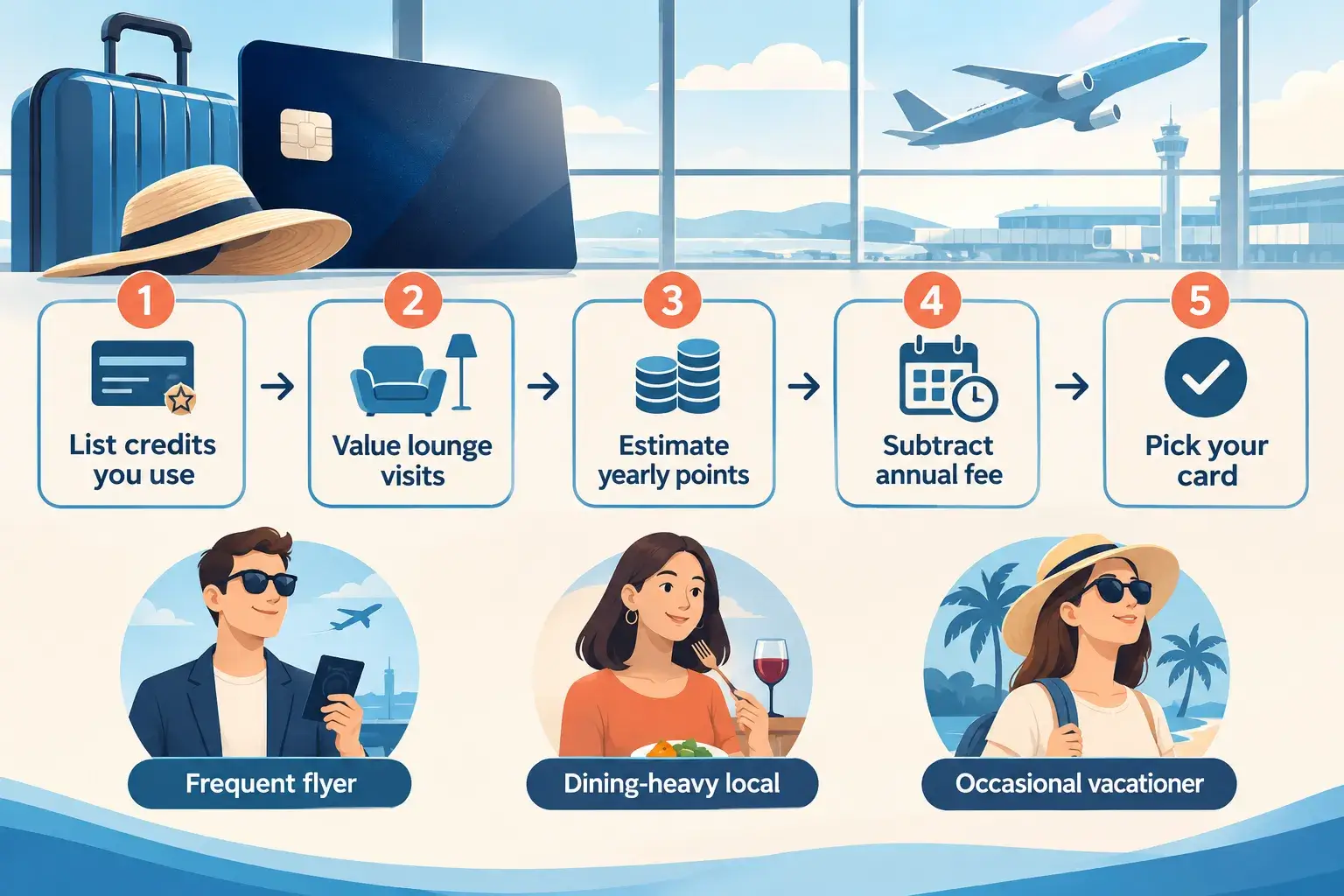
Short answer: for most travelers, the Sapphire Reserve covers its fee with less effort. The Amex Platinum wins for frequent flyers and luxury hotel guests who already use its credits and lounges. The three profiles below assume realistic credit usage and value points at 1.5 cents.
Profile 1: Frequent business flyer
Assumptions: $15,000 in airfare, $5,000 dining, $10,000 other, two FHR stays, 12 lounge visits.
| Item | Amex Platinum | Sapphire Reserve |
|---|---|---|
| Points value | (75,000 + 5,000 + 10,000) x 1.5c = $1,350 | (60,000 + 15,000 + 10,000) x 1.5c = $1,275 |
| Travel or airline credit | $150 (partial use) | $300 |
| Hotel credit | $500 | $400 |
| Other credits used | $400 | $250 |
| Lounge value (estimate) | $300 | $200 |
| Total minus fee | $1,805 | $1,630 |
Winner: Amex Platinum, mainly because of 5X airfare and better lounge access.
Profile 2: Dining-heavy city traveler
Assumptions: $4,000 airfare, $12,000 dining, $10,000 other, one hotel stay, 4 lounge visits.
- Amex Platinum: points worth $555, credits used about $700 (lower usage), lounges $100. Net after fee: $460.
- Sapphire Reserve: points worth $930 (with flights at 4X), credits used about $950 including dining credit, lounges $80. Net after fee: $1,165.
Winner: Sapphire Reserve, by a wide margin.
Profile 3: Occasional vacationer
Assumptions: two trips per year, $3,000 airfare, $4,000 dining, $8,000 other, no premium hotel stays.
- Amex Platinum: credits used may only reach $300 to $400. Net after fee is likely negative.
- Sapphire Reserve: $300 travel credit plus partial dining credit and points. Close to break-even, but not clearly positive.
Winner: neither. A mid-tier card such as the Chase Sapphire Preferred is likely a better fit. Run your own numbers with the Credit Card Annual Fee ROI Calculator.
Decision framework
- Choose the Amex Platinum if you spend $10,000 or more a year on direct airfare, live near a Centurion Lounge, and will book at least one prepaid FHR stay every six months.
- Choose the Sapphire Reserve if dining is a large part of your spending, you want automatic credits, or you value Hyatt.
- Choose neither if you travel only once or twice a year.
- Consider the welcome offer too: Chase’s current public offer is 100,000 points after $6,000 in purchases within three months, which can cover several years of fees by itself.
FAQ
What is the main difference between the Amex Platinum and Sapphire Reserve?
The Amex Platinum focuses on lounges, luxury hotels, and many narrow credits. The Sapphire Reserve focuses on broad travel credits, dining earning, and easier value.
How much are the annual fees on both cards?
The Amex Platinum costs $895 and the Sapphire Reserve costs $795. Authorized users cost $195 on either card.
Does the Amex Platinum charge foreign transaction fees?
No. Neither card charges foreign transaction fees, though Amex acceptance can be weaker abroad.
Which card is better for dining rewards?
The Sapphire Reserve, at 3X worldwide plus a dining credit, compared with 1X on the Amex Platinum.
Can you hold both cards at the same time?
Yes. They come from different issuers, but combined fees of $1,690 only make sense if you use most credits on both.
What is the most common premium card mistake?
Valuing every credit at face value. Count only what you would have spent anyway.
Conclusion
After both refreshes, the Chase Sapphire Reserve is the easier card to justify for most intermediate points users, thanks to the flexible $300 travel credit, 3X dining, and Hyatt access. The American Express Platinum Card remains the stronger option for frequent flyers and luxury hotel guests who will actually use Centurion Lounges, FHR credits, and 5X airfare.
Next steps:
- List the credits you would use without changing habits, and value them honestly.
- Check your home airport for Centurion and Sapphire Lounges.
- Compare which transfer partners match your next two trips.
- Reserve holders: use the extra $250 Chase Travel hotel credit before December 31, 2026.
- Platinum holders: book short hotel stays before the January 1, 2027 change.





Content on Award Travel Hub is independently created by Award Travel Hub Editorial Desk and, where noted, reviewed by Award Travel Hub Review Desk. Some pages may contain affiliate links, but compensation does not determine our coverage, opinions, or methodology.