
Last Updated: November 7, 2026
In a Morgan Stanley AlphaWise survey of about 3,500 U.S. consumers, 67% named the annual fee as the most important factor when choosing a card. That ranked ahead of interest rates (64%) and rewards (55%). That instinct is reasonable, but it often leads people to the wrong conclusion. The best travel credit card is not the one with the lowest fee or the most perks. It is the card whose fee you can clearly earn back with your own spending and travel habits.
This guide sorts the strongest 2026 options into three tiers: $0, around $95, and premium. Each tier includes break-even math, so you can see when stepping up is worth it and when it is not.
A quick note on accuracy: welcome offers, fees, and credits change often. Late 2026 alone brought a new IHG premium card and an announced fee increase on the Citi/AAdvantage Platinum Select. Check the issuer’s site for current terms before you apply.
How to Choose a Travel Credit Card by Annual Fee
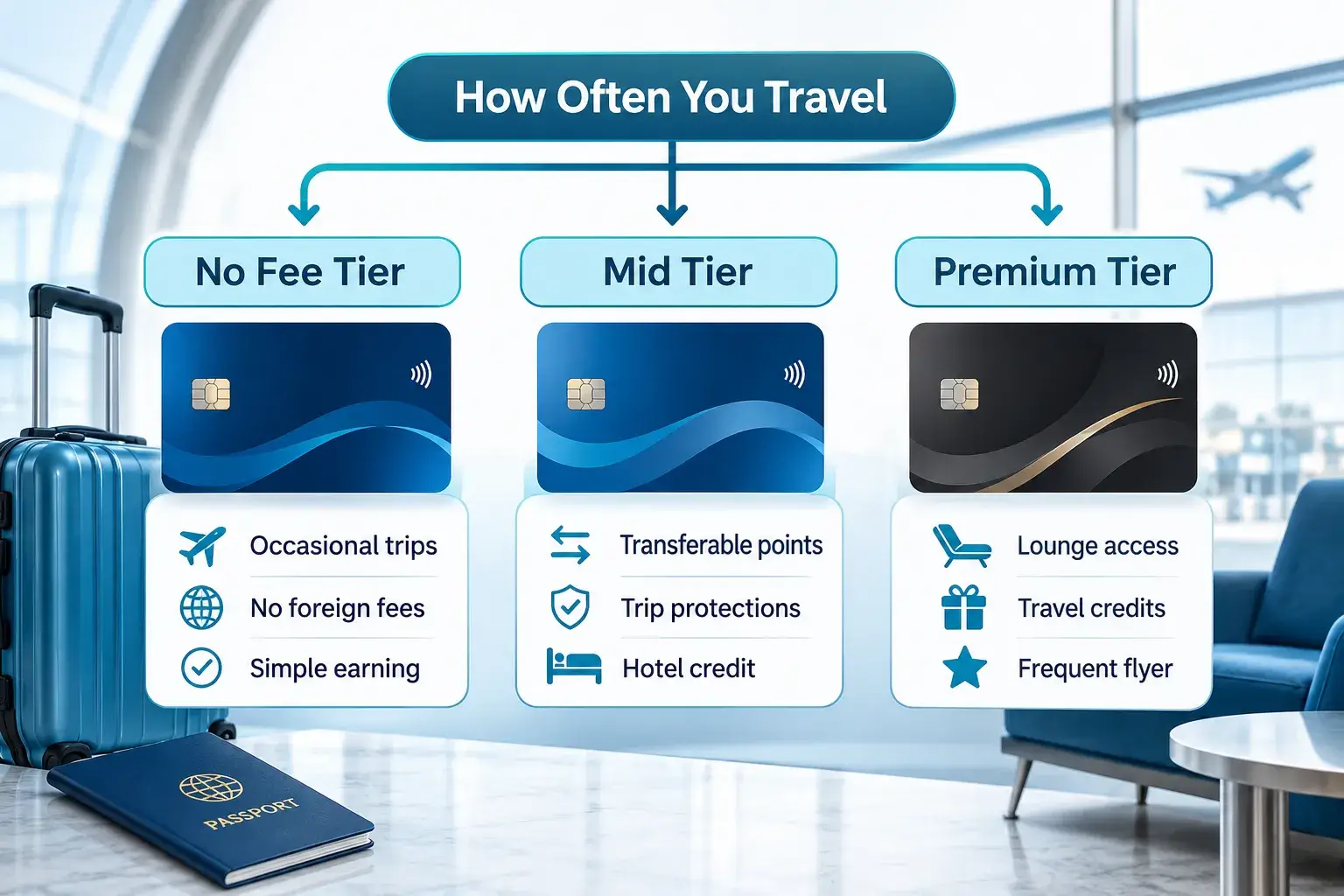
Start with three questions. Your answers will usually point to the right tier before you compare a single card.
- How many trips do you take per year? One trip a year rarely justifies a premium card. Four or more trips with frequent airport time can.
- Will you actually redeem through transfer partners? Transferable points, such as Chase points, Citi points, Capital One miles, Amex points, and Bilt points, are often worth more than 1 cent per point (CPP). That only helps if you are willing to search for award availability and transfer points to partner airlines or hotel programs.
- Which credits will you use without changing your behavior? A $300 travel credit you would use anyway works like a $300 fee reduction. A Dunkin’ credit you only use because it exists is worth much less than its face value.
What travel cards actually offer
Most travel cards combine four types of value:
- Earning rates on travel, dining, and other everyday categories.
- Redemption flexibility. Fixed-value points are simple. Transferable points have more upside.
- Protections, such as rental car coverage, trip delay insurance, and trip cancellation coverage.
- Perks, including statement credits, lounge access, and elite status.
Fee tiers mostly reflect how much of the last two categories a card includes.
Airline and hotel cards vs. general travel cards
Co-branded airline and hotel cards earn one program’s currency. They often include free checked bags, anniversary nights, or a path toward status. General travel cards earn transferable points that can move to many points transfer partners. If you fly one airline out of a hub city, a co-brand card can make sense as a second card. For a first card, a general travel card is usually the safer choice because it limits devaluation risk to more than one program.
You may be interested



For a full ranking across categories, see the best travel credit cards for 2026. For a more detailed decision process, read how to choose the best travel credit card for you.
Best No-Annual-Fee Travel Credit Cards
A $0 card is the right starting point if you travel once or twice a year, are new to travel rewards, or want a permanent card to keep your credit history long. The tradeoff is fewer protections and, on most cards, weaker transfer options.
1. Wells Fargo Autograph: best overall $0 travel card
The Autograph is the most broadly useful no-fee pick in 2026. It earns 3X points on travel, dining, gas, transit, popular streaming services, and phone plans. It charges no foreign transaction fees. The current welcome offer is 20,000 points after $1,000 in spending, a low threshold for a first card.
It also gives you access to Wells Fargo’s airline and hotel transfer partners. That is unusual at $0, though the partner list is shorter than what Chase, Amex, or Citi offer.
Best for: First-time travel cardholders who spend across many everyday categories and want a card that also works abroad. Not for: Readers who already hold a Chase or Citi ecosystem card and want every point in one place.
2. Capital One VentureOne: simple $0 card for international trips
VentureOne earns a flat 1.25 miles per dollar, has no foreign transaction fees, and lets you transfer Capital One miles to airline and hotel partners. The earning rate is modest. Its main value is as a low-cost way to start a Capital One miles balance that you can combine with a Venture or Venture X later.
3. Chase Freedom Unlimited: best $0 card if you plan to move up to Chase
On its own, Freedom Unlimited earns cash back that you redeem at a fixed value. Paired with a Sapphire card, those points become transferable Chase points. Keep in mind that it charges foreign transaction fees, so it should not be your card abroad.
Which $0 card has the best welcome offer?
Among no-fee cards, offers are usually small, often equal to $200 to $250 in value. If the welcome offer is your main goal, the $95 tier will almost always pay more. More no-fee options are covered in best travel credit cards with no annual fee.
Best Travel Credit Cards Around $95
The $95 tier is where most intermediate users get the most value. You get fully transferable points, real travel protections, and large welcome offers, while the fee stays small enough that one or two credits can cover it.

1. Chase Sapphire Preferred: best all-around $95 card
The Sapphire Preferred is still the default recommendation for this tier. The current offer is 75,000 points after $5,000 in spending within the qualifying period. It includes an annual hotel credit through Chase Travel (currently listed at up to $100), primary rental car coverage, and trip cancellation, interruption, and delay protection. It has no foreign transaction fees.
Its biggest strength is access to Chase points transfer partners. A Hyatt redemption or a business class deal through a partner airline can push value well above 1.5 CPP.
Example: 75,000 points redeemed for a cash flight at about 1 cent each is worth roughly $750. If you transfer those points for a premium cabin award that would cost $3,000 in cash and pay $200 in taxes, you get about 3.7 CPP. That is the upside. The downside is that saver award space on popular routes can be limited.
2. Citi Strata Premier: best $95 card for category-heavy spending
The Strata Premier earns 3X on air travel, other hotels, dining, supermarkets, gas, and EV charging. It earns 10X on hotels, car rentals, and attractions booked through Citi Travel. The offer as of late October 2026 is 60,000 ThankYou points after $4,000 in spending. The annual $100 hotel benefit applies to one qualifying stay of $500 or more booked through Citi Travel. It has no foreign transaction fees.
Citi points transfer to several partner airlines that are useful for sweet spots, including some programs that Chase does not offer. The main limitation is the hotel benefit. If you never book a $500-plus stay through Citi Travel, the fee is not offset.
3. Capital One Venture: best $95 card for simplicity
The Venture earns 2X miles on most purchases and has no foreign transaction fees. You can redeem miles at a fixed value against travel purchases or transfer them to partners. It suits travelers who do not want to track bonus categories.
Is a $95 fee worth it?
Usually, yes, if you use the main credit and redeem through transfer partners at least once a year. If you only redeem for cash-value travel, a strong $0 card may come out close or ahead. One co-brand pricing note: the Citi/AAdvantage Platinum Select fee rises from $99 to $150 on January 24, 2027. New applicants still get a first-year waiver. The card adds benefits such as inflight credits and a Global Entry or TSA PreCheck credit, but it no longer competes in the $95 tier.
Best Premium Travel Credit Cards
Premium cards make sense when you travel often enough to use lounges, credits, and status perks every year. They are a poor fit if you travel once a year. The credits are real, but they usually require enrollment, specific booking channels, or monthly use.
1. Chase Sapphire Reserve: best premium card for frequent flyers
The Sapphire Reserve has a $795 annual fee. It includes a $300 annual travel credit, Priority Pass and Chase Sapphire Lounge access, and a current offer of 100,000 points after $6,000 in spending. It earns 8X on Chase Travel, 4X on flights and hotels booked directly, and 3X on dining.
After the easy-to-use travel credit, the net cost is about $495. Lounge access and other credits need to cover that gap.
Best for: Travelers taking four or more trips a year who use lounges and redeem Chase points for premium cabin awards. Not for: Anyone who will not use the lounge network or who mostly redeems for cash.
2. American Express Gold: upper-mid-tier card for dining-heavy spenders
At $325, the Gold Card sits between the mid and premium tiers. It earns 4X at restaurants worldwide and at U.S. supermarkets. Its credits include up to $120 in dining credits, $100 in Resy credits, $84 in Dunkin’ credits, and $120 in Uber Cash. All of them require enrollment and monthly or semiannual use. It does not include lounge access.
If you use most of the credits naturally, the effective fee is close to zero. If you miss them, you are paying $325 for a strong earning rate on dining and groceries. Compare it with the rest of the lineup in best Amex travel credit cards.
3. IHG One Rewards Premier Select: new hotel-focused premium option
Launched October 1, 2026, this card costs $350. It includes up to $300 in annual IHG food-and-beverage rewards, a $200 airline statement credit, up to $50 in United TravelBank cash, an anniversary night capped at 60,000 points, automatic Platinum status, and 20 elite-night credits each year. The launch offer is 200,000 IHG points after $5,000 in spending within three months and runs through November 18, 2026.
Keep in mind that IHG points are not transferable and are usually worth well under 1 cent each. This card fits travelers who regularly stay at IHG properties, not most other travelers.
Do premium cards provide elite status or lounge access?
Most general premium cards include lounge access. Status is more common with co-brand cards, such as automatic IHG Platinum. General cards rarely provide airline elite status directly. For a deeper look at the costs, read are premium travel cards worth it in 2026.
Annual Fee Break-Even Math by Tier
Use this formula to compare cards:
Incremental value = (extra points earned × CPP) + credits you would use anyway + welcome offer value (first year only) − annual fee
Assumptions: transferable points are valued at 1.25 CPP for a cautious estimate and 1.6 CPP for travelers who regularly use partner awards. Credits count only if you would spend that money anyway.
| Upgrade | Net fee after credits used | Extra earn vs. $0 card | Ongoing spend to break even |
|---|---|---|---|
| VentureOne to Venture | $95 | 0.75 miles per dollar | about $10,100 at 1.25 CPP |
| Autograph to Sapphire Preferred | $0 to $45 if hotel credit is used | Similar earn rate; higher redemption value | value mainly from transfers and protections |
| Autograph to Strata Premier | $0 if the $100 hotel benefit is used | Supermarkets and airfare earn 3X | positive if the hotel benefit is used |
| Sapphire Preferred to Sapphire Reserve | about $400 extra net | 1X more on dining, more on travel | rarely covered by spending alone; needs lounge value |
How to read the table:
- $0 to $95: On a 2X versus 1.25X comparison, $95 ÷ (0.75 × $0.0125) equals about $10,100 in yearly spending. If you use the card’s credit, the break-even falls close to zero. The step up then mostly gives you better transfer value and trip protections.
- $95 to premium: About $400 in extra net cost cannot be covered by spending alone at normal budgets. To justify the Reserve, you need roughly 10 or more lounge visits a year that you value at $25 to $40 each, plus redemptions where 8X on Chase Travel matters.
- First-year math is different. A 75,000-point offer worth about $940 at 1.25 CPP covers almost any first-year fee. Judge the card on second-year value. Run your own numbers with the credit card annual fee ROI calculator.
Does a travel card really pay for itself?
A $95 card often does for active users. A premium card pays for itself only if you use its credits without extra effort and travel often. The most common mistake is counting every credit at full value, then paying the second-year fee for perks you never use.
How to Upgrade From One Tier to the Next
Moving up works best when you keep your no-fee card and add a higher-tier card, rather than replacing one with the other.
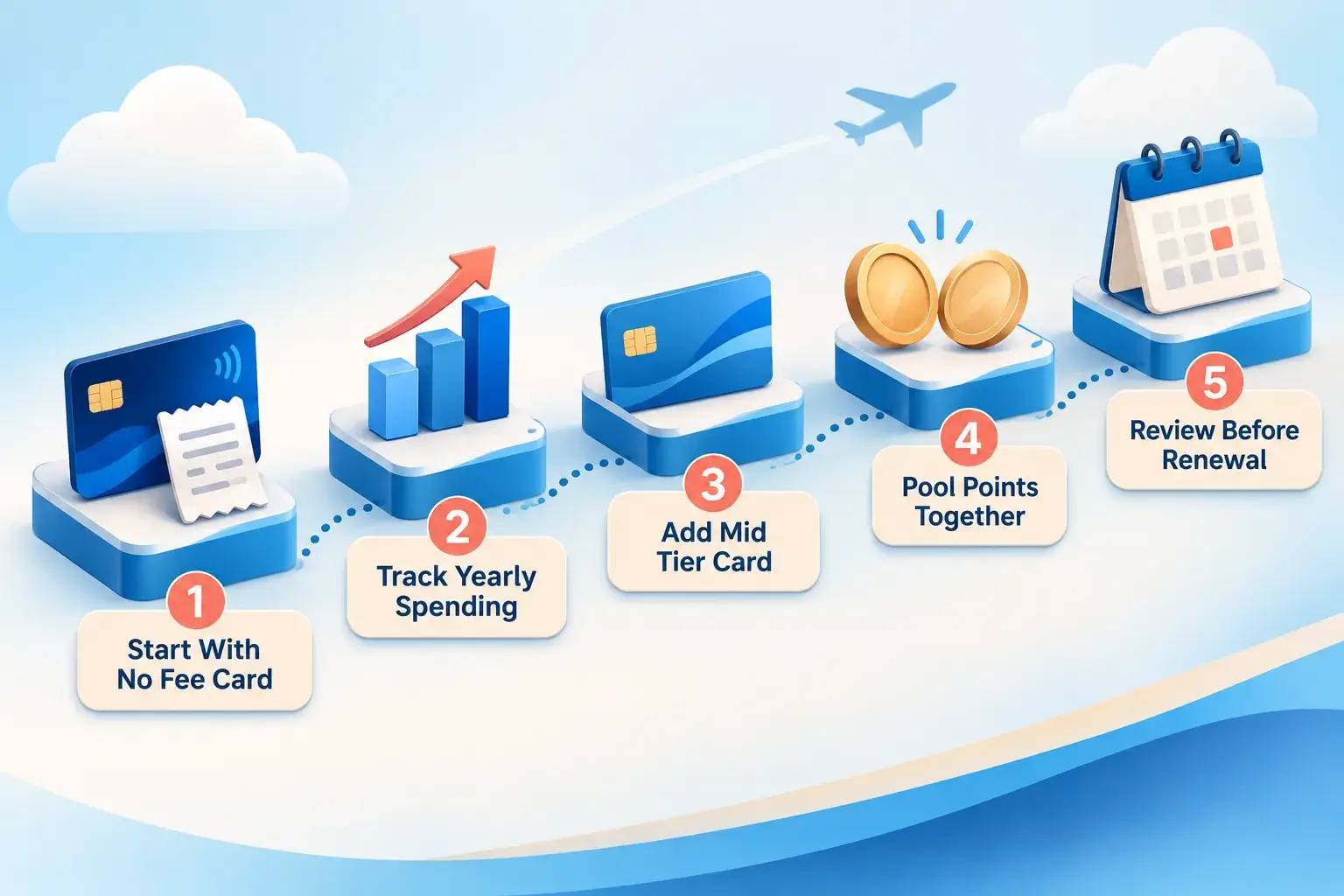
- Start with a $0 card that matches the ecosystem you will grow into, such as Freedom Unlimited for Chase or VentureOne for Capital One.
- Track 12 months of spending. If your yearly travel and dining spending is above about $8,000 to $10,000, a $95 card likely makes sense.
- Apply for the $95 card when its welcome offer is high and you can meet the minimum spend through normal expenses.
- Pool your points. Combine Chase points or Capital One miles from the no-fee card into the transferable account to improve redemption value.
- Review the card before each renewal. If credits went unused, ask for a retention offer or downgrade. See how to downgrade a travel credit card and keep your points.
Holding more than one card at a time is normal and often the best setup. A common pairing is a $0 card for everyday categories with a $95 card for transfers and protections. If you go abroad often, make sure the card you use outside the U.S. has no foreign transaction fees. Options are listed in best no foreign transaction fee credit cards.
FAQ
What is the best travel credit card if I only travel once a year? The Wells Fargo Autograph is a strong choice. It has no fee, no foreign transaction fees, and earns 3X on dining and gas year-round.
Which tier has the best sign-up bonuses? The $95 and premium tiers. Currently, the Sapphire Preferred offers 75,000 points, and the Sapphire Reserve offers 100,000 points. No-fee offers are much smaller.
What is the best travel credit card for international travel? At $0, the Autograph or VentureOne. At $95, the Sapphire Preferred, which pairs no foreign transaction fees with strong trip protections.
What is the biggest mistake people make with travel cards? Choosing a card based on the total value of its credits instead of the credits they will actually use, and never checking the card before the renewal fee posts.
Can I use multiple travel cards at the same time? Yes. Pairing cards within one ecosystem, such as Freedom Unlimited with Sapphire Preferred, usually gets the most value from each dollar spent.
Conclusion
Choose the lowest tier where the card’s fee is covered by credits you would use anyway. For most readers, that means starting with a $0 card, moving to a $95 transferable-points card after one year of tracked spending, and considering a premium card only when lounge visits and travel credits show up in your actual travel calendar. As a next step, check today’s welcome offers on the Sapphire Preferred and Strata Premier and compare them with your expected spending over the next three months.


Content on Award Travel Hub is independently created by Award Travel Hub Editorial Desk and, where noted, reviewed by Award Travel Hub Review Desk. Some pages may contain affiliate links, but compensation does not determine our coverage, opinions, or methodology.