

Last updated: October 31, 2026
The Amex Platinum now costs $895 a year, the Chase Sapphire Reserve costs $795, and lounge guest access has become noticeably harder to get. So are premium travel cards worth it in 2026? For frequent travelers who use most of the credits and transfer points to partner airlines, yes, usually. For travelers who fly a few times a year and mainly wanted lounge access for a partner or family, the math has moved against them, and a mid-tier card is often the better choice.
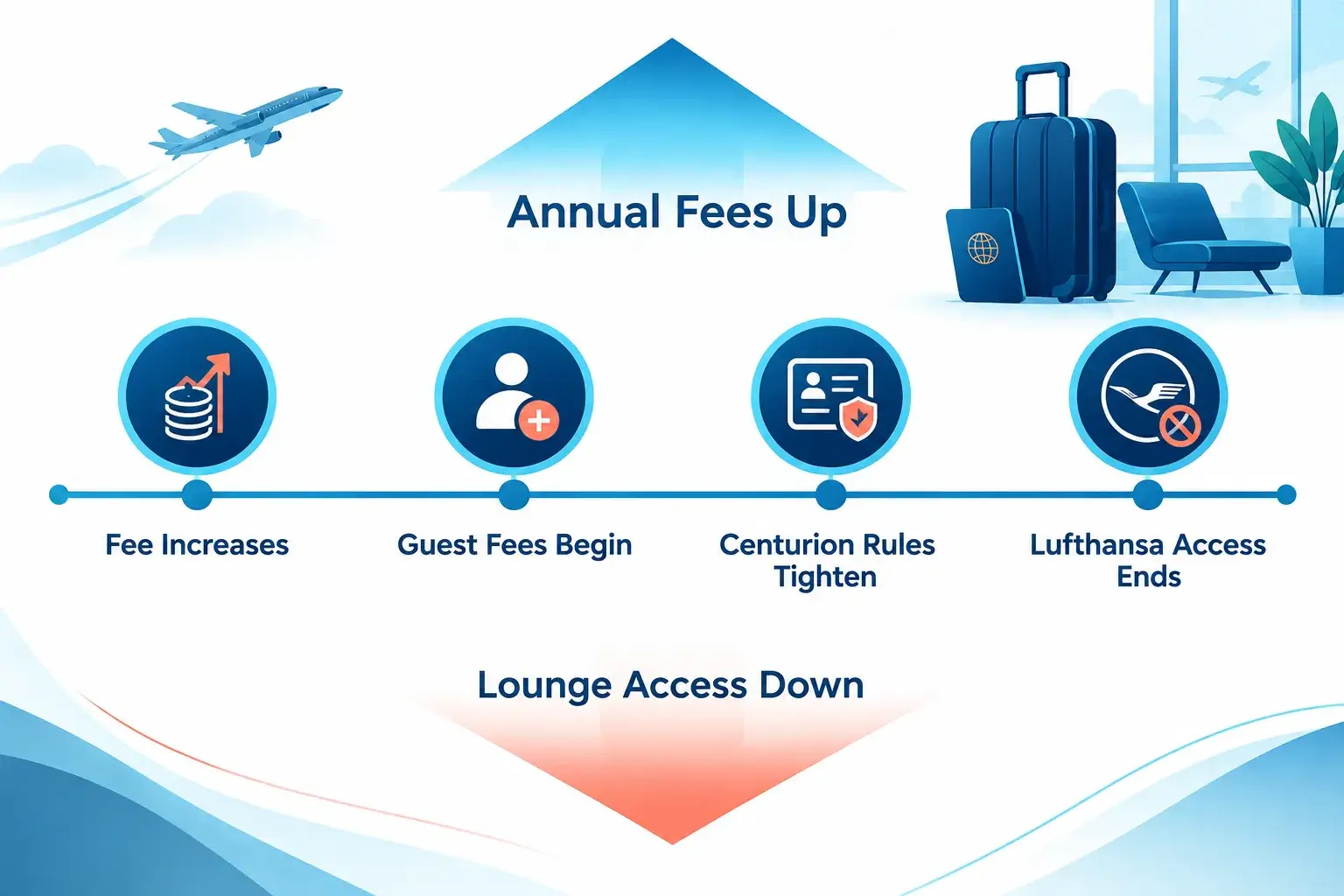
What Changed in 2026: Fees Up, Lounge Access Down
The short answer: annual fees went up sharply while lounge access got tighter, so the break-even bar is much higher than it was two years ago. Issuers added new statement credits to justify the increases, but credits only count if you would have spent that money anyway.
Here is where the major cards stand:
| Card | Current annual fee | Previous fee | Lounge network highlights |
|---|---|---|---|
| Amex Platinum | $895 | $695 | 1,550+ lounges in 140 countries, Centurion, Priority Pass, Plaza Premium, Escape, limited Delta Sky Club |
| Chase Sapphire Reserve | $795 | $550 | Sapphire Lounges, 1,300+ Priority Pass lounges |
| Capital One Venture X | $395 | $395 | Capital One Lounges and Landings, 1,300+ Priority Pass lounges |
| Citi/AAdvantage Executive | $695 | , | Admirals Club membership |
| United Club Card | $695 | , | United Club membership |
| Delta SkyMiles Reserve | $650 | , | Sky Club access (with limits) |
The access side changed just as much:
- Capital One: Since February 1, 2026, standard Venture X cardholders generally pay $45 per adult guest, $25 per child 17 or younger, and $35 per Priority Pass guest. Complimentary guests return after $75,000 in annual spending. Authorized users may also face a $125 annual lounge-access fee.
- Amex Centurion Lounges: Starting July 2026, guests must be on the cardholder’s flight itinerary, and connecting access is limited to up to five hours before the next departure.
- Amex Lufthansa access: Ended October 1, 2026. Platinum cardholders no longer get into Lufthansa Business or Senator Lounges through the old partnership. Details are in our coverage of the Amex Platinum Lufthansa lounge access change.
- International Amex products: Australian and New Zealand Platinum cards dropped complimentary Priority Pass for additional cardholders and cut Plaza Premium guests from two to one. These don’t affect U.S. cards directly, but they show the direction of travel.
Common mistake: Treating a fee increase as offset dollar-for-dollar by new credits. A $200 fee jump paired with $300 in credits you only partly use is a net loss. To track every change in one place, see our comparison of the best travel credit cards after the 2026 fee changes.
Lounge Access After the Cutbacks: Guest Rules and Crowding
Lounge access still works well for solo travelers, but it is worth far less for couples and families than it was in 2024. Guest rules now drive most of the value difference between cards, and crowding is the reason issuers keep tightening.
J.D. Power’s 2026 lounge research surveyed 2,991 lounge users, and 46% said the lounge they use most is usually moderately or severely overcrowded. Ben Schlappig of One Mile at a Time has pointed to the rapid growth of bank-issued premium cards as a major driver, not just airline capacity. In plain terms, the cards created the crowds, and the cutbacks are the correction.
How guest rules compare now
- Chase Sapphire Reserve: Still includes up to two complimentary guests at Sapphire Lounges. For a couple traveling together, this is now the most generous guest policy among the big three.
- Amex Platinum: Centurion guests must share the cardholder’s itinerary, so dropping a friend at a different gate no longer works. Check current guest-fee and spending-threshold rules before you count guest value.
- Capital One Venture X: Paid guests unless you spend $75,000 a year. A family of four (two adults, two kids) would pay $95 per visit for the three guests at a Capital One Lounge.
A quick per-visit example
Assume a couple takes four round trips a year and visits a lounge on each outbound and return, so eight visits. On the Venture X, the guest fee alone is 8 x $45 = $360, nearly the entire $395 annual fee. The same couple on the Sapphire Reserve pays nothing extra for the guest at Sapphire Lounges, but only where a Sapphire Lounge exists. Check the Chase Sapphire lounge locations against your home airport before assuming that value.
You may be interested



Decision rule: If your home airport has no proprietary lounge from your issuer, value lounge access at Priority Pass levels, which are generally lower in quality and more crowded. For full cost-per-visit math by card, see airport lounge access credit cards and cost-per-visit math.
Which Premium Card Still Delivers the Most Net Value
For most intermediate points users, the Venture X delivers the best net value because its $395 fee is easy to offset; the Sapphire Reserve wins for couples near Sapphire Lounges; the Platinum only wins for people who use nearly every credit. Net value means credits and perks you would actually pay for, minus the fee.

Use this simple framework. Value each credit at what you would have spent without it, not its face value. Then add lounge value and earning value from points.
| Factor | Amex Platinum | Chase Sapphire Reserve | Capital One Venture X |
|---|---|---|---|
| Annual fee | $895 | $795 | $395 |
| Credit structure | Many small, category-specific credits | Mix of travel and lifestyle credits | Simple travel credit plus anniversary bonus |
| Guest access | Same-itinerary rule at Centurion | Up to two guests at Sapphire Lounges | Paid guests below $75,000 spend |
| Transfer partners | Strong, especially for premium cabin awards | Strong, including Hyatt | Solid, fewer U.S. sweet spots |
| Effort to break even | High | Moderate to high | Low |
Break-even math with realistic assumptions
Suppose you value Amex points, Chase points, and Capital One miles at about 1.5 cents per point when transferred to partners. That is a conservative CPP for business class deals booked through partner airlines, though actual redemption value varies with award availability, fuel surcharges, and dynamic pricing.
- Platinum: If you realistically use $500 of the credits, you need $395 of value from lounges and earning. Since the Platinum’s everyday earning is weak outside flights, that gap often comes down to lounge use alone.
- Sapphire Reserve: If you use $450 of credits, you need $345 more. Earning 3x on dining and travel at 1.5 CPP means roughly 4.5% back, so about $7,700 in bonus-category spend covers the gap before lounge value.
- Venture X: The $300 travel credit (used through the Capital One portal) plus the 10,000-mile anniversary bonus (about $150 at 1.5 CPP) already exceeds the $395 fee.
Edge case: If you redeem points mostly for cash back or gift cards at 1 cent, none of these cards earn enough to matter. Your value then depends almost entirely on credits. Learn how to set realistic targets in what travel points are really worth in 2026.
Who Should Keep a Premium Card
Keep a premium card if you travel at least six to eight times a year, use most of the credits without changing your habits, and transfer points for premium cabin awards. All three conditions matter. Meeting only one usually doesn’t justify an $795 or $895 fee.
Best for:
- Frequent solo business travelers who pass through Centurion or Sapphire Lounge airports and don’t need guest access.
- Couples near a Sapphire Lounge hub who benefit from the two-guest policy.
- Points collectors booking First Class redemptions or international business class, where transfer bonuses and partner sweet spots can push value well above 1.5 cents per point.
- High spenders on the Venture X who clear $75,000 a year and restore complimentary guests.
- Travelers who value insurance protections such as trip delay and primary rental car coverage. Review the terms in our guide to credit card travel insurance.
Premium card vs. airline status: If you are loyal to one airline, a co-branded card like the Citi/AAdvantage Executive ($695, with Admirals Club membership) can beat a bank card. You get a club that works on every trip with that airline and, often, authorized-user access. Transferable points remain more flexible, though, and protect you against a single program’s devaluation risk.
Common mistake: Keeping a premium card because of a credit you “might” use. Before your renewal, total the credits you actually used in the past 12 months. If that number plus realistic lounge value doesn’t clear the fee, the card isn’t working for you.
Who Should Downgrade to a Mid-Tier Card
Downgrade if you fly two to four times a year, mainly wanted lounge access for a partner or family, or regularly leave credits unused. A mid-tier card keeps your transferable points alive and access to points transfer partners, at a fraction of the cost.

Not for premium cards:
- Families who relied on Venture X authorized users for independent lounge access, now facing a $125 fee per user plus guest fees.
- Travelers whose home airport has no Centurion, Sapphire, or Capital One lounge.
- Anyone redeeming points mostly at 1 cent each.
Mid-tier alternatives to consider
Common options include the Chase Sapphire Preferred, the Amex Gold, the Capital One Venture Rewards, and Citi Strata cards. These typically carry fees well under $400 and still earn points that transfer to partner airlines and hotel programs. Confirm current fees on the issuer site, since they change. The Amex Gold, for example, keeps strong earning on dining and groceries for Amex points; see our Amex Gold Card review for 2026.
What happens when you downgrade
- Points: Usually preserved if you product-change within the same issuer and the new card earns transferable points. Moving to a no-fee card may limit transfer access.
- Lounge access: Ends immediately, including Priority Pass.
- Credits and insurance: Premium protections and remaining credits typically stop.
- Credit history: A product change keeps the account age, unlike a cancellation.
Decision rule: Transfer or redeem points before canceling outright, and product-change instead of canceling when possible. Our step-by-step guide on how to downgrade a travel credit card and keep your points covers timing around fee posting and refund windows.
Our Updated Recommendation
Premium travel cards are still worth it in 2026 for a narrower group than before: frequent travelers who use the credits and redeem points for high-value awards. Everyone else should run the numbers at renewal and lean toward a mid-tier card.
A premium card earns its fee through use, not ownership. If you cannot list the credits and lounge visits that cover the fee, downgrade.
Practical next steps:
- Audit last year’s use. Add up credits used, lounge visits, and points earned, valued at a realistic CPP.
- Check your home airport. Proprietary lounges are worth far more than Priority Pass alone.
- Count guests honestly. If you usually travel with others, price in guest fees.
- Compare one mid-tier option from the same issuer to keep your points ecosystem.
- Act before the fee posts, or within the refund window after it posts.
If the Venture X fits your travel, it remains the easiest card to justify. If you travel as a couple near Sapphire Lounges, the Reserve is the stronger choice. The Platinum makes sense mainly for heavy, organized users.
FAQ
How much do you need to spend to justify an $895 annual fee? Spend matters less than credit use. If you use about $500 of Platinum credits, you still need around $395 from lounges, earning, or protections. Most cardholders close that gap through lounge visits, not spending.
Can you get lounge access without paying $895 a year? Yes. The Capital One Venture X costs $395 and includes Capital One Lounges and Priority Pass. Guest fees now apply for most cardholders.
Is a premium card worth it if you fly only a few times a year? Usually not. With two to four trips, lounge value is small, and a mid-tier card earning transferable points is often better.
What are the biggest mistakes with premium cards? Counting credits at face value, ignoring guest fees, and redeeming points at 1 cent each instead of transferring to partners.
What happens to my points if I downgrade? Points typically stay if you product-change to another card in the same issuer’s rewards family. Confirm transfer access on the new card first.
Are premium card benefits getting worse in 2026? Lounge access is. Guest fees, itinerary rules, authorized-user fees, and the end of Amex Lufthansa lounge access all reduced value this year.




Content on Award Travel Hub is independently created by Award Travel Hub Editorial Desk and, where noted, reviewed by Award Travel Hub Review Desk. Some pages may contain affiliate links, but compensation does not determine our coverage, opinions, or methodology.