
Last updated: September 30, 2026
Transatlantic business class awards for July often disappear within the first 48 hours after a schedule loads, then reappear for a few hours nine days before departure. Those two moments matter, and almost nothing in between does. Knowing when to book award flights to Europe is less about hunting for a magic price and more about showing up on the right calendar date with points already in the right place.
Quick Answer
Most airlines load award inventory 330 to 361 days before departure, so the first booking window for summer 2026 Europe travel opened between roughly June and August 2025. The second real window runs in the final 1 to 3 weeks before departure, when carriers release unsold premium seats. For peak summer transatlantic business class, book at schedule open. For shoulder season or flexible dates, waiting for the close-in dump is often the better play. Lufthansa Group is the exception: partner-accessible long-haul business class typically appears only around T-85 days.
Key Takeaways
The award calendar open range is 330 to 361 days. Aeroplan, Flying Blue, Virgin Atlantic, and Avios programs all sit near the top of that range; some carriers open closer to 330.
Peak summer (mid-June through August) rewards early booking. Popular US, Europe business class routes in those months are frequently gone within days of loading.
Shoulder season rewards patience. October through April dates often see more award space 2 to 6 weeks out than they did at schedule open.
Lufthansa, SWISS, and Austrian restrict partner access. Long-haul business class for partners generally opens around 85 days before departure, so a 300-day search will look empty.
Flying Blue Promo Rewards publish in the first week of each month and cover travel typically starting about 60 days out, with transatlantic business sometimes in the 45,000-55,000 mile range one-way. Inventory is limited and often gone within the first two weeks.
You may be interested
Transfer speed decides which window you can use. Instant-transfer partners let you book close-in space; slow transfers do not.
Never speculatively transfer points. Confirm award space first, then transfer, then book.
Book what’s bookable and adjust later when the program allows free or cheap changes. That’s the core risk-management move for early booking.



The Two Booking Windows: Schedule Open and Last-Minute Release
There are only two reliably productive times to search for transatlantic awards: the day a schedule loads, and the final weeks before departure. The months in between are usually dead space for premium cabins on popular routes.
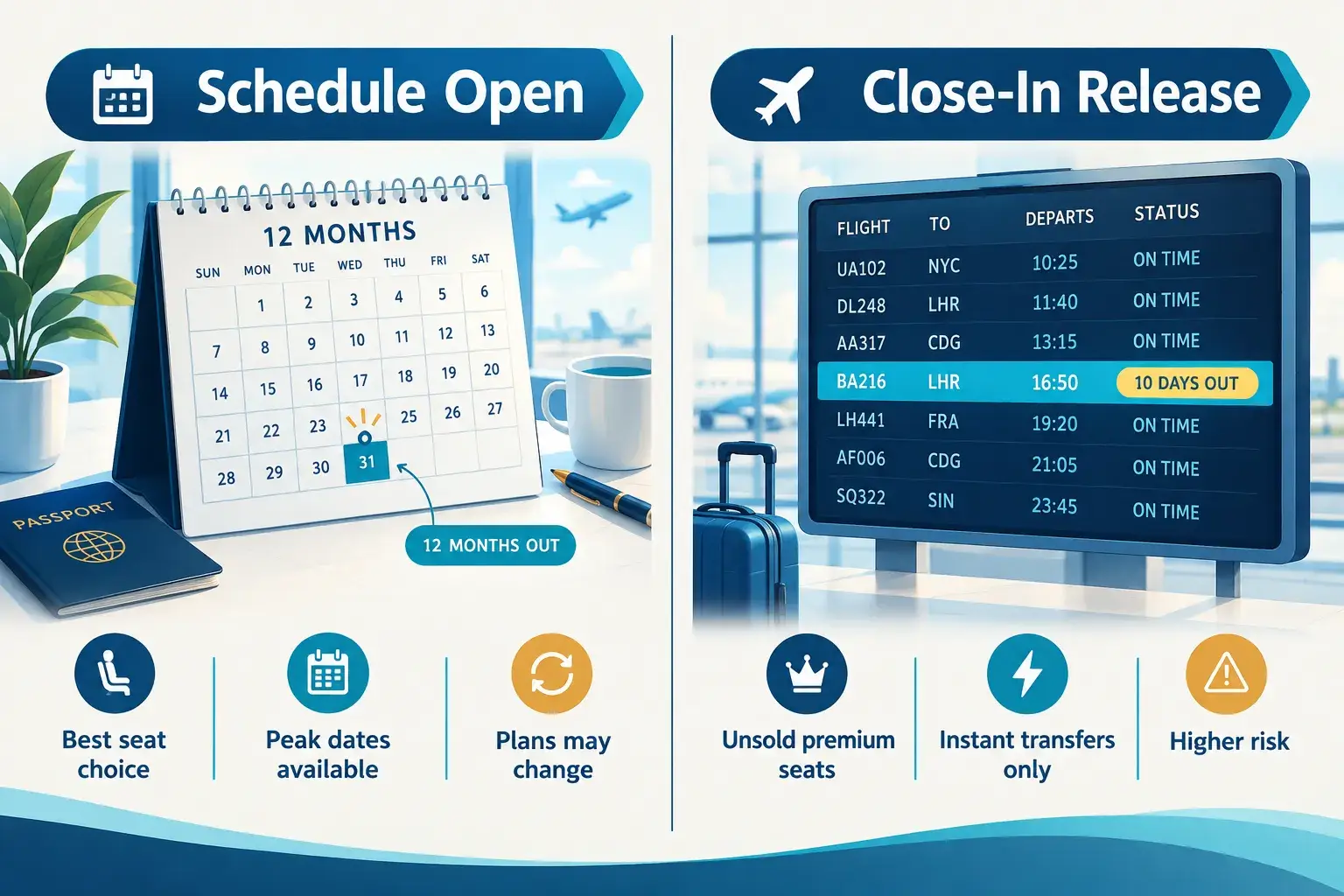
Window 1: Schedule open (roughly 330-361 days out). Airlines load their flight schedules and release an initial allocation of award seats. On transatlantic routes, that initial allocation is often one or two business class seats per flight per program. It’s the only time you can reliably choose your exact date, routing, and cabin for peak travel.
Window 2: Close-in release (roughly T-21 to T-3). Revenue management gives up on selling remaining premium seats for cash and moves them to award inventory. Some carriers reopen space 2 to 3 weeks out; others dump seats 3 to 5 days before departure.
FactorSchedule openClose-in releaseDate controlHigh, pick your exact itineraryLow, you take what appearsSeat countUsually 1-2 business seats per flightSometimes 2-4 if a flight is emptyPeak summer reliabilityGoodPoorShoulder season reliabilityGoodVery goodTransfer speed requiredNone, you have monthsInstant or same-day onlyBest forFamilies, fixed vacation dates, peak datesSolo/couple travelers with flexibility
Decision rule: if your dates are fixed and fall between mid-June and August, treat schedule open as your only real chance. If you can move your trip by a week and travel in shoulder season, the close-in window is often cheaper in miles and less stressful.
Common mistake: searching 5 to 8 months out, finding nothing, and concluding the route has no award space. That’s the worst possible search window. Space released at open is gone, and close-in space hasn’t been released yet.
The middle months are not evidence of scarcity. They’re evidence you searched at the wrong time.
Program-by-Program Award Calendar Open Dates
Award calendars for Europe open between roughly 330 and 361 days before departure, but the number that matters is how far out partner space is visible in the program you plan to book through, not how far out the operating airline sells its own seats.
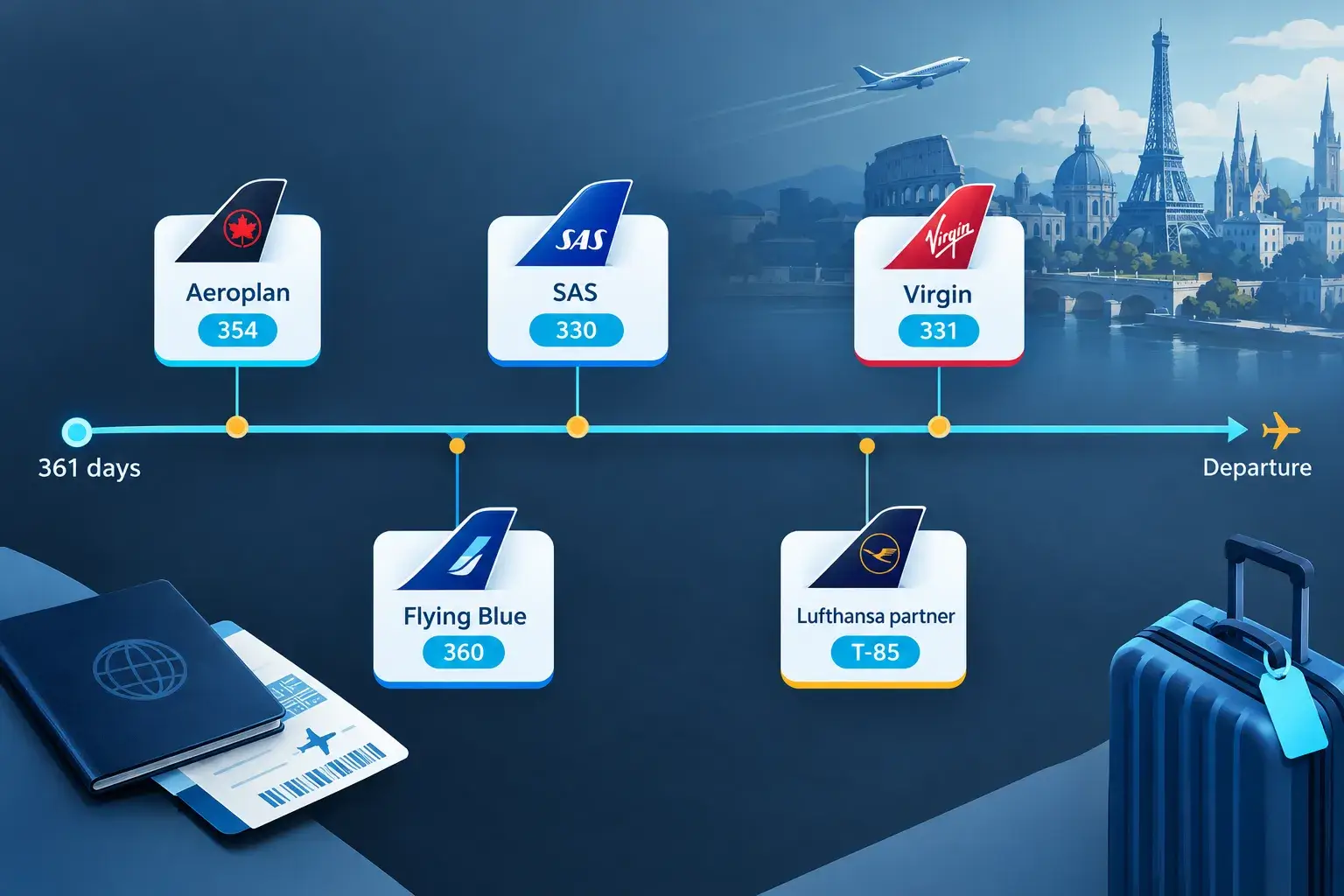
ProgramTypical calendar openNotes for Europe awardsAir France/KLM Flying Blue~360 daysDynamic pricing; monthly Promo Rewards published in the first week of each monthAir Canada Aeroplan~354 daysBroad partner access, published partner chart, strong Star Alliance visibilityVirgin Atlantic Flying Club~331 days for own metalGood for Delta and Virgin transatlantic; own-metal space varies widelyBritish Airways / Iberia / Aer Lingus (Avios)~354 daysIberia Avios is the low-surcharge path; BA adds heavy carrier-imposed feesUnited MileagePlus~337 daysDynamic pricing on own metal; partner space visible when partners release itAmerican AAdvantage~331 daysSaver space on partners like BA, Iberia, Finnair is the targetSAS EuroBonus~330 days (shifted to ~361 briefly in mid-2026, then reverted)Confirm before planning around a specific dateTurkish Miles&Smiles~11 months, loaded in bulkCoverage in 2026 pointed to a mid-September bulk load for the following 11 monthsLufthansa Group (LH/LX/OS) via partners~T-85 days for long-haul businessOwn-metal calendar opens far earlier; partner access does not
Two clarifications that save wasted searches:
“Calendar open” is not the same as “award space released.” Delta, United, and Air France all load schedules long before they decide how many award seats to release at saver-style pricing.
Partner programs sometimes see different inventory than the operating airline. Turkish business class, for example, has shown cheaper direct rates with partner visibility lagging or pricing higher.
For a broader look at how release timing works across regions, see the award booking calendar strategy guide on when airlines release space.
When Do Airlines Release Award Flight Seats to Europe, and Which Release Furthest in Advance?
Flying Blue (about 360 days), Aeroplan (about 354 days), and the Avios programs (about 354 days) sit at the far end of the transatlantic release range. That makes them the programs to check first if you’re booking nearly a year out.
)
Practical sequencing for a trip roughly 11-12 months away:
Flying Blue first (about 360 days). Widest calendar, and Air France/KLM release some business class at open.
Aeroplan and Avios next (about 354 days). Aeroplan for Star Alliance partners; Iberia Avios for low-surcharge transatlantic.
Virgin Atlantic, AAdvantage, SAS (about 330-337 days).
Lufthansa Group partner space last (about T-85). Nothing you do at 300 days will surface it.
Edge case worth knowing: SAS EuroBonus briefly moved its own-metal release to roughly 361 days in June 2026, then reverted in July to about 330 days. Partner visibility may still differ. Verify the current window on the program’s own site before you build a plan around a specific open date.
How to know when new award seats are released: check the airline’s own site for the last bookable date in its calendar. That date moves forward by one day, every day. If the furthest bookable date is currently 340 days out, you know that program’s window and can count forward to your target date.
Which Carriers Release Transatlantic Business Space Early Versus Close to Departure
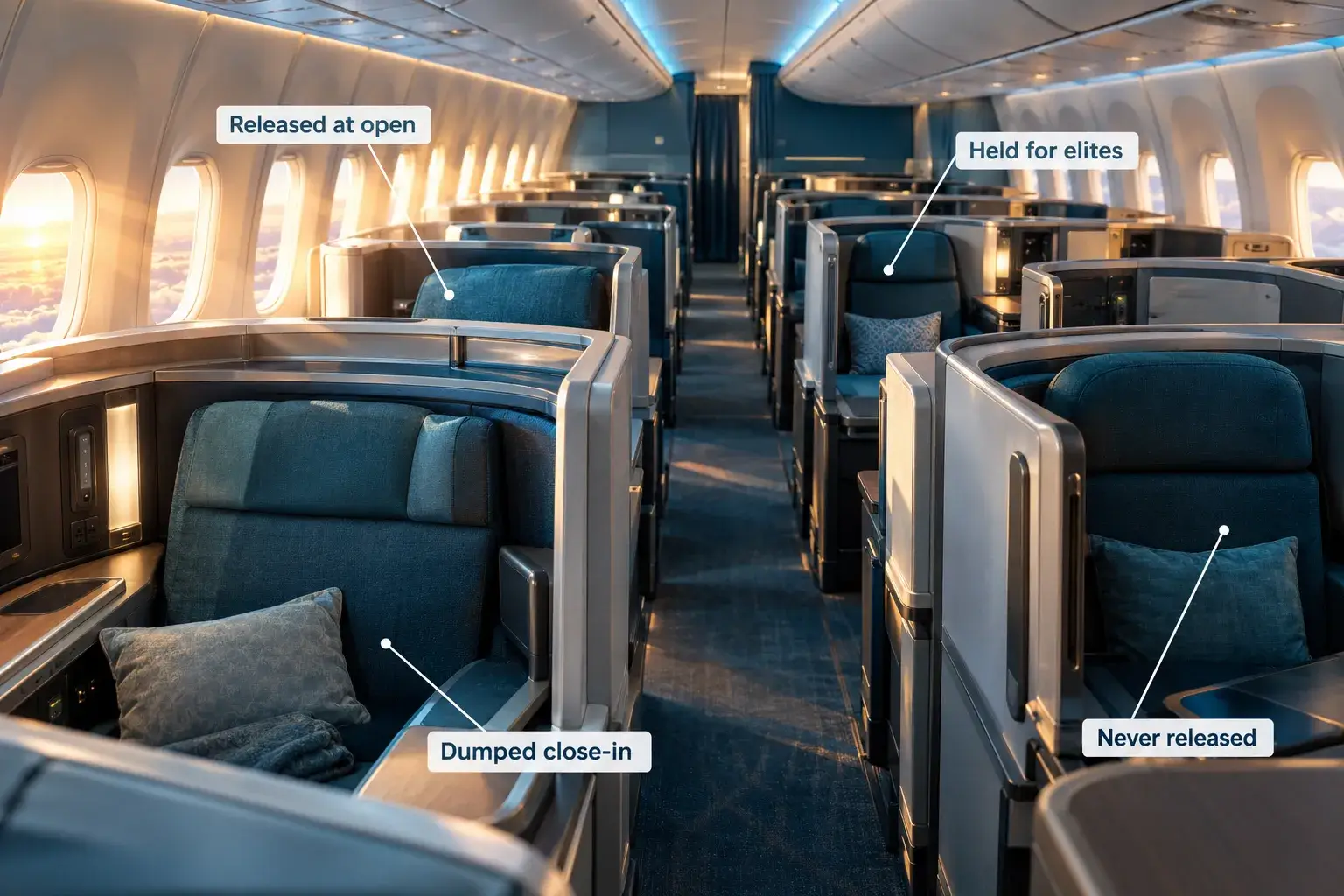
Air France/KLM, Iberia, Aer Lingus, Finnair, and TAP generally release at least some long-haul business class at or near schedule open. Lufthansa, SWISS, Austrian, and to a lesser degree Brussels hold most partner-accessible business class until about 85 days before departure.
Release at or near schedule open:
Air France and KLM (Flying Blue, dynamic pricing)
Iberia and Aer Lingus (Avios, low surcharges via Iberia Plus)
Finnair (bookable via AAdvantage, Alaska, Avios programs)
TAP Air Portugal (bookable via Aeroplan, United, Avios)
Delta One (generally visible via Virgin Atlantic and Flying Blue, priced dynamically)
Hold back and release late:
Lufthansa, SWISS, Austrian long-haul business for partners (about T-85)
United Polaris saver-style space on peak dates
British Airways Club Suite on peak summer dates (space exists, surcharges are the problem)
Decision rule: if your target is Lufthansa or SWISS business class from the US, don’t waste a year of searching. Set a calendar reminder for 90 days before your date and be ready to transfer to Aeroplan, United, or Avianca LifeMiles that week. For a fuller walkthrough of that ecosystem, see the Star Alliance business class awards guide.
Surcharge note that changes program choice: British Airways, Virgin Atlantic on own metal, and Lufthansa itself apply significant carrier-imposed surcharges on transatlantic awards. Iberia Plus, Aeroplan, and Flying Blue generally keep cash out-of-pocket far lower for the same physical seat. Pick the program partly on total cash cost, not just mileage. A 60,000-mile award with $600 in surcharges is usually worse than a 75,000-mile award with $90.
The Late-Release Pattern and How Close to Departure It Runs
The close-in window typically runs from about 21 days before departure down to roughly 3 days out, with the heaviest releases in the final 2 weeks. This is genuine award space, not error pricing, and it appears because the airline has stopped expecting a paid sale.
How the pattern usually plays out:
T-30 to T-21: first reopenings on weaker routes and off-peak dates.
T-14 to T-7: the most common dump window for transatlantic business class.
T-5 to T-3: final releases, often on flights with multiple open premium seats.
T-2 and inside: possible but unreliable; phone-agent-only inventory sometimes appears.
Requirements to actually use this window:
Points sitting in an instant-transfer currency, or already in the booking program.
A flexible departure city, or a same-day positioning plan.
Tolerance for a trip that may not confirm until days before travel.
Change and cancel rules you understand, in case you book a placeholder and improve it later.
Quick example (illustrative, using published-rate assumptions): a traveler with 90,000 Amex points watching Flying Blue for an October Boston, Paris business class seat finds space 11 days out at a dynamic rate near 60,000 miles plus roughly $110 in taxes. Amex to Flying Blue is typically instant, so the transfer and booking happen in the same sitting. At a nominal 1.6 cents per point of value on a $2,800 paid fare, that’s roughly 4.5 cents per point. The catch: had the seat not appeared, there was no fallback, because paid business class 11 days out would have cost several thousand dollars.
Do Award Flight Prices Go Down Closer to Travel Date?
Sometimes, but only in dynamic-pricing programs, and it’s not a trend you can plan around. Fixed-chart programs like Aeroplan’s partner chart and Iberia Plus don’t get cheaper as departure approaches; the seat either exists at the chart rate or it doesn’t.
Where prices actually move:
Flying Blue, United, Delta, Virgin Atlantic (dynamic): rates can drop close-in when demand is soft, and spike when it isn’t. Off-peak January Paris might price lower at T-10 than it did at T-300. Peak July almost never does.
Fixed or semi-fixed charts (Aeroplan partner awards, Iberia Avios, Turkish Miles&Smiles, Avianca LifeMiles): the mileage stays the same. Only availability changes.
Promo Rewards (Flying Blue): discounts are published monthly rather than drifting downward, which makes them a scheduled opportunity rather than a waiting game. The Flying Blue Promo Rewards guide covers how to find and book those fares.
Decision rule: if you’re in a dynamic program and traveling off-peak, waiting has genuine upside. If you’re in a fixed-chart program or traveling in peak summer, waiting only costs you availability. For more on managing volatile pricing, see the dynamic award pricing survival guide.
Peak Summer Versus Shoulder Season: Different Strategies Entirely
Peak summer Europe awards are an availability problem. Shoulder season Europe awards are a pricing problem. The strategies barely overlap.
Peak summer (mid-June to August):
Book at or within days of schedule open.
Expect 1-2 business class seats per flight per program; families of four rarely find four seats together at open.
Plan to fly on less popular days and through secondary gateways (Lisbon, Dublin, Copenhagen) rather than Paris, Rome, or Athens direct.
Strongest windows for summer 2026 were the October, December 2025 loading period, with a second wave of releases in January, February 2026.
Shoulder and off-peak (late September to early June, excluding holidays):
Dynamic programs often price lower, and space is broader.
Flying Blue Promo Rewards are most useful here, since promo travel windows typically start about 60 days out and often exclude peak dates.
The close-in window works far more reliably.
Why off-season Europe awards are cheaper: dynamic-pricing programs tie mileage rates to paid demand, and transatlantic demand falls sharply from November through March. When paid business class is soft, award rates follow. Fixed-chart programs don’t discount, but they do show more open seats, which produces the same practical result.
Traveling with kids changes the math considerably; the family of four Europe with points guide covers how to handle seat-count constraints.
Can You Book Award Flights to Europe 3 Months Before Travel?
Yes, and for some carriers 3 months out is actually the optimal moment. The 85 to 95 day range is precisely when Lufthansa, SWISS, and Austrian release long-haul business class to partner programs.
What’s realistic at T-90:
Good odds: Lufthansa Group business class via Aeroplan, United, or LifeMiles; TAP business; Iberia and Aer Lingus on off-peak dates; Flying Blue economy and premium economy.
Moderate odds: Air France/KLM business on shoulder-season dates at dynamic rates.
Poor odds: peak July or August business class on any nonstop to a major European capital.
Practical plan for a 90-day booking: search Aeroplan and United for Lufthansa Group space starting at day 95, check Flying Blue and Avios daily for reopened seats, and keep points unconverted until you find confirmed availability. If nothing surfaces by day 60, shift to monitoring the close-in window instead of continuing to search mid-range dates.
Is It Better to Book Round Trip or One-Way Award Flights to Europe?
Book two one-ways in most cases. One-way pricing gives you the flexibility to use the best program in each direction and to book the outbound now while the return is still uncertain.
When one-ways win:
Different programs are strongest outbound versus inbound (for example, Iberia Avios westbound to avoid surcharges, Flying Blue eastbound).
You want to lock half the trip while you keep hunting for the other half.
You’re mixing an open-jaw itinerary, flying into Lisbon and home from Rome.
When a round trip is better:
The program prices round trips at a discount or charges a single cancellation fee per ticket rather than per segment.
Iberia and some Avios routings occasionally price round trips more favorably than two one-ways.
You need a confirmed return for a visa or entry requirement.
Common pitfall: booking a one-way outbound in a program with married-segment logic and then discovering the return connection you wanted isn’t bookable as a standalone. Check both directions before committing either.
Why Flexible Points Beat Pre-Transferred Miles for Timing
Keeping points in Amex, Chase, Capital One, Citi, or Bilt preserves your ability to book whichever program has space. Once you transfer, the decision is locked, transfers are irreversible, and any devaluation in that program is your problem.
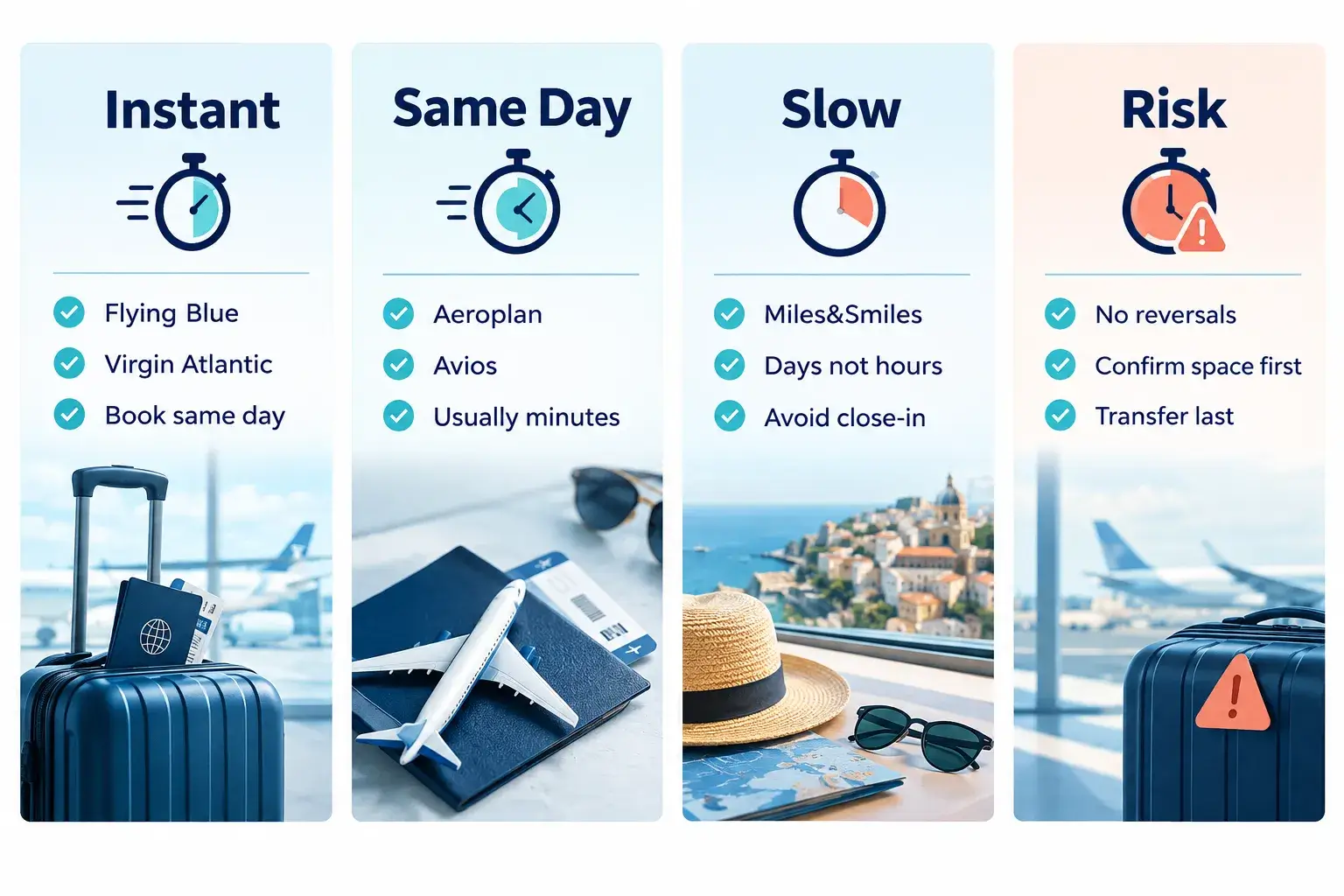
The rule that prevents the most expensive mistake: confirm the award seat is actually bookable, in the exact cabin and date you want, before you transfer a single point. Transfers cannot be reversed. If the seat vanishes during a multi-day transfer, you own miles in a program you may not use again for years.
Where slow transfers hurt most: Turkish Miles&Smiles has excellent published rates for Star Alliance transatlantic business, but transfers from some flexible currencies can take days. That combination makes it a poor fit for close-in booking and a fine fit for planned bookings you can wait on.
Transfer bonuses change the math, but not the timing rule. A 20% or 30% bonus is worth waiting for only if you have a confirmed use case and time on your side. The transfer bonus math guide walks through when chasing a bonus is worth the delay and when it isn’t. For general strategy on keeping currencies flexible, see the guide to booking award flights with flexible points.
Setting Alerts and Searching Without Burning Hours
Automate the monitoring and reserve manual searching for the two windows that matter. Daily manual searching 6 months out is wasted effort.
A workable monitoring setup:
Pick two target programs, not eight. One fixed-chart program (Aeroplan or Iberia Avios) and one dynamic program (Flying Blue) covers most transatlantic needs.
Set alerts for your exact dates and cabin in a multi-program award search tool. Compare features in the best award flight search tools for 2026 roundup.
Add a wider alert for your date range plus or minus 5 days, and for alternate European arrival cities.
Calendar reminders, not daily searches: one reminder at your program’s schedule open date, one at T-95 for Lufthansa Group space, and one at T-21 for the close-in window.
Check Flying Blue Promo Rewards in the first week of every month. Promo lists post then, and desirable business class routes often sell through within the first 1 to 2 weeks.
Verify on the airline’s own site before transferring. Aggregator data can lag by hours.
Do award flight prices change by day of week for European routes? Availability and dynamic pricing do shift by day of week, but not on a predictable weekly cycle. Tuesday and Wednesday departures are typically cheaper in miles and more available than Friday, Saturday, and Sunday departures, because paid business demand clusters around weekend leisure travel and Sunday-night repositioning. There’s no reliable “search on Tuesday for a better rate” effect. What matters is the travel day, not the search day.
For a deeper look at running several tools in parallel, see the guide on stacking award search tools.
When to Book Anything Bookable and Change Later
Book the imperfect award now if the program allows free or cheap changes and cancellations, then improve it as better space appears. This is the single most useful tactic for peak summer travel, and it only works if you’ve checked the change rules first.
Change and cancellation terms to verify before you use this strategy (they change, so confirm at booking):
Aeroplan: changes and cancellations generally permitted with a fee that varies by fare and timing; often modest for standard awards.
Flying Blue: cancellation typically carries a per-passenger fee; changes usually possible for a fee plus any fare difference in miles.
Avios programs (BA, Iberia, Aer Lingus): refunds generally available for a per-ticket fee, with Avios and most taxes returned.
United and American: award cancellations for tickets in their own programs are generally refundable without a fee, which makes them good placeholder programs.
Turkish Miles&Smiles: cancellation and change rules are less forgiving and harder to execute remotely.
The playbook:
At schedule open, book the best available award for your dates, even if it’s a connection instead of a nonstop or premium economy instead of business.
Set alerts for the itinerary you actually want.
When the better seat appears, book it (or change into it) and cancel the placeholder.
Confirm the refund posts before the original ticket’s deadline.
When this is not worth it: if the cancellation fee exceeds roughly 10% of the award’s value, or if the program refunds miles slowly, the placeholder costs more than it protects. Review the award ticket cancellation fees breakdown before committing points you may need elsewhere.
Common Mistakes People Make When Booking Award Flights to Europe
The most expensive errors are transferring points before confirming space and searching in the dead zone between the two release windows. Both waste resources that can’t be recovered.
Speculative transfers. Irreversible, and devaluation risk sits entirely with you.
Searching 5-8 months out and giving up. Wrong window, misleading result.
Ignoring surcharges. A British Airways or Virgin Atlantic own-metal award can carry several hundred dollars in carrier-imposed fees per person. Iberia Plus, Aeroplan, and Flying Blue are generally far cheaper in cash for the same crossing.
Expecting four business class seats at schedule open. Most transatlantic flights release one or two per program. Split the family across cabins or flights, or travel off-peak.
Forgetting positioning flight risk. A cheap positioning flight on a separate ticket has no protection if it’s delayed. Build in a buffer night or book the positioning leg on the same ticket where possible. The positioning flight booking guide covers the tradeoffs.
Booking the outbound and assuming the return will appear. It often doesn’t at peak times.
Missing the T-85 Lufthansa Group window by searching only at schedule open and then stopping.
Treating a found seat as guaranteed. Popular transatlantic business class awards can disappear within hours of release. If the space is right and the points are in place, book it.
FAQ
How far in advance should I book European award flights?
For peak summer business class, book at schedule open, roughly 330 to 360 days before departure depending on the program. For shoulder-season travel or flexible dates, either book at open or wait for the close-in window in the final 1 to 3 weeks.
How many months ahead can you book Lufthansa award flights to Europe?
Lufthansa’s own calendar opens roughly a year out, but partner-accessible long-haul business class typically appears only around 85 days before departure. Searching Aeroplan or United at 300 days out will usually show nothing in business class.
What’s the difference between booking early and booking last minute?
Booking early gives you date and routing control but requires committing points months ahead. Booking last minute can yield better dynamic pricing and more seats on soft flights, but demands instant-transfer points, flexibility, and tolerance for an unconfirmed trip.
What happens if award availability opens and sells out fast?
Set alerts for reopenings, check alternate European arrival cities and nearby US departure airports, and monitor the T-21 to T-3 close-in window. Airlines frequently reopen premium seats they couldn’t sell for cash.
Which program should I check first for Europe?
Flying Blue for the widest calendar and monthly Promo Rewards, Aeroplan for predictable partner-chart pricing across Star Alliance, and Iberia Avios for low surcharges. Check the operating airline’s own site to verify space before transferring.
Do I need to transfer points before searching?
No, and you shouldn’t. Search with an award tool and confirm bookable space on the program’s own site first. Transfer only after you can see the exact seat, date, and cabin you intend to book, because transfers are irreversible.
Conclusion and Next Steps
Timing beats effort on transatlantic awards. Two windows produce nearly all the good bookings: schedule open at 330 to 361 days, and the close-in dump inside the final 3 weeks. Everything else is noise, with one important exception for Lufthansa Group business class at about T-85.
Do these five things this week:
Write down your travel dates and count backward to each target program’s calendar open date.
Pick two programs, one fixed-chart and one dynamic, and learn their change and cancellation rules before you book anything.
Set alerts for your exact itinerary plus a wider date and airport range.
Leave your points in Amex, Chase, Capital One, Citi, or Bilt until you can see confirmed award space.
Add three calendar reminders: schedule open, T-95, and T-21.
If you’re planning summer travel specifically, read the guide on when to book summer 2026 award flights to Europe from the West Coast next. If you’re setting up monitoring for the first time, start with the best award travel tools and alerts to set up for 2026 bookings.


Content on Award Travel Hub is independently created by Award Travel Hub Editorial Desk and, where noted, reviewed by Award Travel Hub Review Desk. Some pages may contain affiliate links, but compensation does not determine our coverage, opinions, or methodology.