
Last Updated: November 9, 2026
A 4,500-point award can cover a flight that sells for $300 or more in cash the week before departure. That gap is the core of Atmos Rewards’ best partner sweet spots in 2026. While most U.S. programs have moved to dynamic pricing, Atmos still prices partner awards on a distance-based chart. The result is a program whose strongest value sits on short flights, not in aspirational long-haul first class.
This guide covers where those sub-10,000-point awards live, which partner routes fit, what you will pay on top in fees, and how to earn the points quickly. The short answer: focus on partner flights under 700 miles in the Americas, use the shortest distance bands elsewhere, and only redeem when the cash fare is high enough to justify spending points.
How Atmos Rewards Partner Award Pricing Works Now
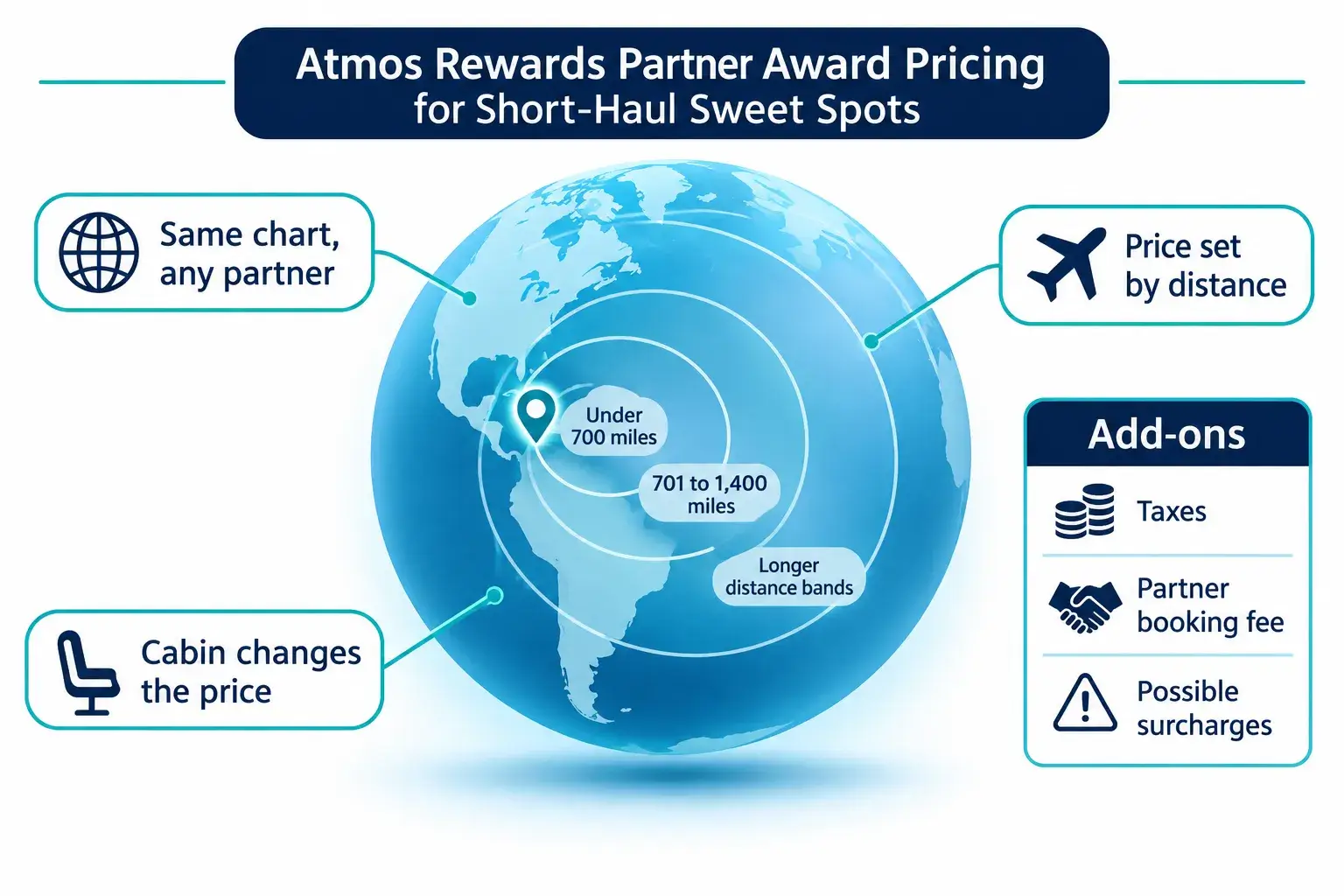
Atmos Rewards uses one regional partner chart for participating carriers. The airline operating the flight matters less than three variables: distance flown, region, and cabin. A 300-mile flight on American Airlines prices the same way as a 300-mile flight on another partner in the same region.
The distance bands that matter
The core sweet spot is the Americas band for flights under 700 miles:
| Region | Distance | Economy | Business |
|---|---|---|---|
| Within the Americas | 0-700 miles | 4,500 points | 9,000 points |
Both figures sit under the 10,000-point ceiling. That is unusual. Few programs let you book a short business-class partner award for less than 10,000 miles one way.
Outside the Americas, the shortest bands cost more. Short economy awards in Europe and Asia-Pacific can still land under 10,000 points, but business class in those regions generally exceeds that threshold. Confirm the current price on the Atmos search results before transferring any points. The chart has changed before, and you can review what shifted in our breakdown of the Alaska Airlines Atmos Rewards award chart changes.
What counts as short haul
For sweet-spot purposes, “short haul” means the flight distance falls inside the lowest band. Distance is measured segment by segment, so check the actual mileage. A route that feels short can cross 700 miles and jump to a higher price. Free tools such as Great Circle Mapper make this a 30-second check.
Fees and surcharges on top
Every partner award carries costs beyond the points:
- Partner booking fee: $20 each way per passenger, up from $12.50 as of July 1, 2026. It is generally nonrefundable. Atmos Summit cardholders have it waived.
- Government taxes: These are usually small on U.S. domestic flights but higher on some international departures, such as flights leaving the UK.
- Carrier surcharges: These vary by partner and route. Check the final total before you confirm.
You may be interested



On a 4,500-point award, a $20 fee plus taxes can be 20% or more of the redemption’s cash-equivalent value. Factor it into your math every time.
For broader program context, including what changed when the two carriers combined, see our explainer on the Alaska-Hawaiian Atmos Rewards merger.
Best Partner Awards Under 10,000 Points in North America
The Americas band offers the strongest value in the program. It also has the most usable availability because American Airlines, the largest partner, flies thousands of short daily segments.

1. Short American Airlines domestic hops for 4,500 points
Routes like Dallas, Austin, Charlotte, Washington, Chicago, St. Louis, and Philadelphia, Boston all fall well under 700 miles. These are business-heavy routes where cash fares spike close to departure.
Real-world example: A same-week Dallas, Austin fare of $259 versus 4,500 points plus about $5.60 in taxes and the $20 partner fee. Subtract the cash costs from the fare, and you get roughly $233 of value, or about 5.2 cents per point (CPP). That is excellent for points many members value around 1.3 to 1.5 cents each.
The same route booked three weeks out at $89 is a different story. After fees, you would get under 1.5 CPP. Pay cash instead.
Best for: Last-minute or peak-date trips on short business routes. Not for: Routes with cheap advance fares or frequent sales.
2. Short business class on American for 9,000 points
The 9,000-point business band works best when paid first class is expensive. On a short domestic flight, you are typically buying a recliner seat, priority boarding, and checked bags, not a lie-flat bed.
If you can upgrade on a cheap ticket another way, this redemption loses its appeal. When paid first class runs $400 or more on a 500-mile route, though, 9,000 points can be justified, especially when checked bags matter.
3. Miami to the Caribbean and Mexico border-region hops
American’s Miami hub sends short flights to Nassau (about 185 miles), Freeport, and other nearby islands. These often price high during holidays and spring break. At 4,500 points in economy or 9,000 in business, they work well as quick getaway awards or as positioning flights before a longer trip.
Check international departure taxes on the return leg. They are higher than U.S. domestic taxes and can reduce your value.
4. Positioning flights for longer award trips
A short partner award can solve an expensive positioning problem. If you have a long-haul award from a hub but live 400 miles away, a 4,500-point connector is often cheaper than a last-minute cash ticket. Book it on a separate reservation, and leave a generous buffer. Separate tickets are not protected if the first flight is delayed.
How this compares to other programs
For the same short American flight, American AAdvantage uses dynamic pricing and often charges more on peak dates. British Airways Avios also offers distance-based short-haul pricing but adds per-segment pricing and peak or off-peak rules. Atmos is often the simpler and cheaper option for nonstop short flights, particularly on high-demand dates. Run all three before you decide, since prices shift by date.
Best Partner Awards Under 10,000 Points in Asia and the Pacific
Asia-Pacific short-haul awards do not reach the Americas’ 4,500-point floor, but the shortest economy bands can still be very useful. These work best for intra-regional legs on a bigger trip, where cash fares for one-way tickets can be surprisingly high.
5. Japan Airlines domestic flights
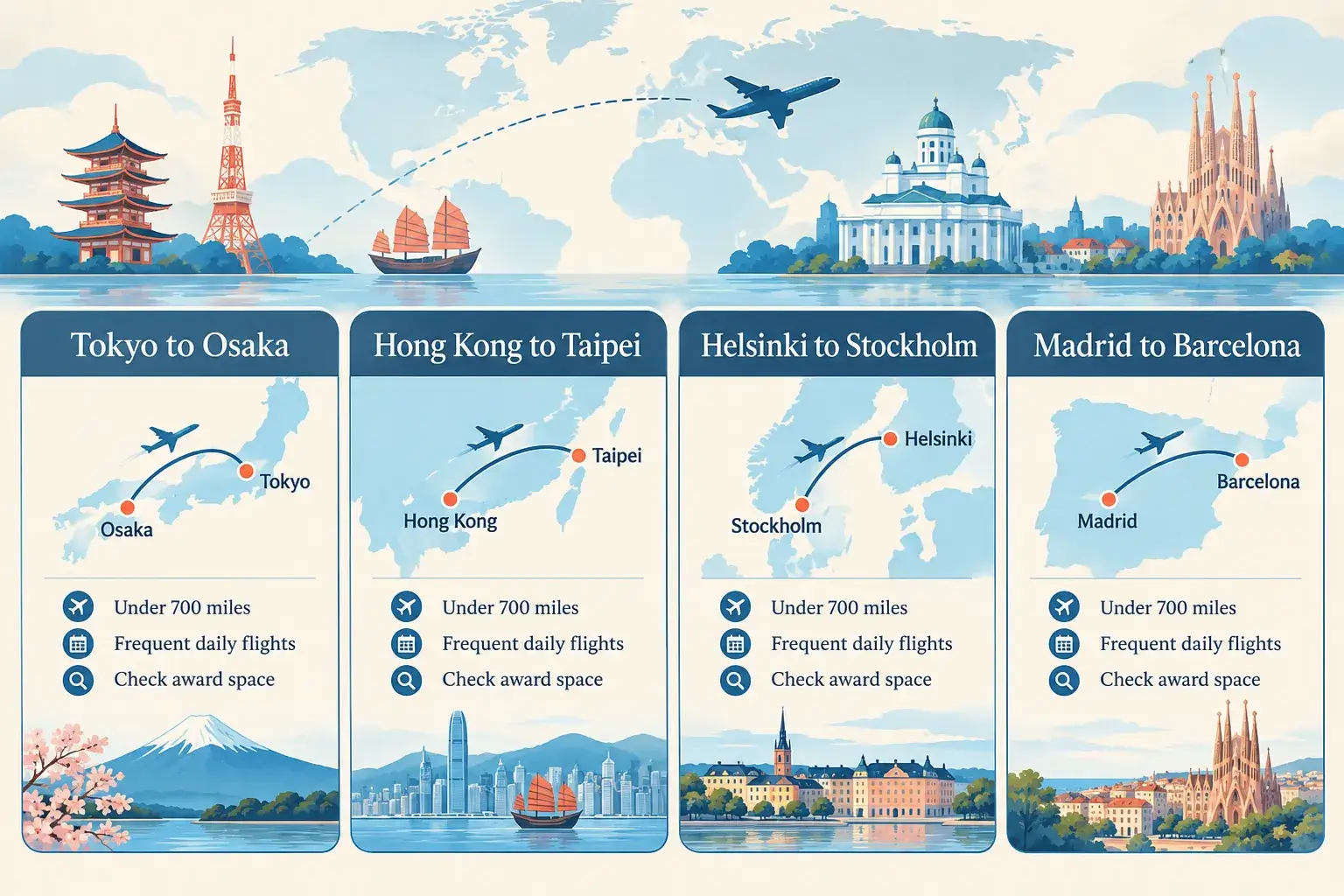
Tokyo, Osaka, Tokyo, Sapporo, and Tokyo, Fukuoka all fall in short-distance bands. JAL runs these routes often, and award availability is generally reasonable outside Japanese holiday periods such as Golden Week, Obon, and New Year.
These awards pair well with a long-haul trip to Japan. If you are planning that larger itinerary, our guide to the best points for Japan business class covers the transpacific side.
Watch out: Rail is often faster door to door on Tokyo, Osaka. Compare the train fare before spending points.
6. Cathay Pacific Hong Kong to Taipei
Hong Kong, Taipei is around 500 miles and one of the busiest short international routes in Asia. Cathay operates many daily flights, sometimes with widebody aircraft. Economy awards fall in the lowest band, and one-way cash fares can be expensive on short notice.
Taxes from Hong Kong are moderate. Check the total before confirming, since surcharge treatment on some partners can change the math.
7. Malaysia Airlines and Qantas short sectors
Kuala Lumpur, Singapore is roughly 200 miles, a classic short international hop. Qantas domestic routes like Sydney, Melbourne and Sydney, Brisbane are similarly short and heavily flown. Both work best when you need a one-way ticket on a busy date.
Best for: Filling a gap within a multi-city Asia-Pacific trip. Not for: Routes with cheap low-cost carrier competition, where cash fares often beat the value of the points.
Hawaiian interisland flights are a separate topic. They are operated within the Atmos family rather than by a partner, so they do not price on the partner chart. For island-hopping strategy, see our coverage of Atmos Rewards sweet spots to Hawaii and Asia.
Best Partner Awards Under 10,000 Points in Europe
Europe is where short-haul cash fares can be either very cheap or very expensive, often on the same route. The award math depends on timing more than anywhere else.
8. Finnair Helsinki to the Nordics and Baltics
Helsinki, Stockholm (about 250 miles), Helsinki, Tallinn, and Helsinki, Copenhagen are short, frequent, and often priced high for one-way bookings. Finnair award space on these routes is typically decent. Short economy awards fit under 10,000 points.
9. Iberia Madrid to Barcelona and domestic Spain
Madrid, Barcelona is one of Europe’s busiest air corridors at roughly 300 miles. Iberia flies it frequently, and short domestic Spanish sectors to cities like Seville and Valencia also fit the lowest band.
As in Japan, high-speed rail competes directly. Book the award only when trains are sold out or flying fits your connection better.
10. British Airways short UK and European flights
London, Edinburgh and London, Amsterdam fall within short distance bands. The catch is departure tax. UK Air Passenger Duty applies to flights leaving the UK and can erode the value of a cheap economy award. Domestic UK departures also include APD, so check the final total before you click book.
Also compare BA’s own Avios pricing on the same flight. For some off-peak short-haul dates, Avios can be competitive, and Avios are easier to earn from Amex, Chase, and Capital One.
Is Europe worth it?
Sometimes. Low-cost carriers often sell short European routes cheaply in advance. Use Atmos points when you are booking close in, flying on a peak date, or need a full-service carrier with a checked bag included. Otherwise, cash is usually the better use.
Finding Availability for Low-Cost Partner Awards
Short-haul partner award space is usually easier to find than long-haul premium space, but it is not unlimited. Use a consistent process.
Search on the Atmos site first
Most oneworld partners and many non-alliance partners can be searched and booked online through the Alaska website. That includes American Airlines, British Airways, Cathay Pacific, Finnair, Iberia, Japan Airlines, Malaysia Airlines, and Qantas on many routes. Some itineraries or partners may not display online and require a call. If you see space on the partner’s own site but not on Atmos, call before assuming it is unavailable.
A practical booking walkthrough
- Confirm the distance. Make sure the segment falls in the band you expect.
- Check the cash fare. Compare against the cheapest fare that includes the bags and flexibility you need.
- Search Atmos for the nonstop. Connections add distance and can push the price into a higher band.
- Review the total cost. Add the $20 partner fee, taxes, and any surcharges.
- Calculate CPP. Subtract the cash costs from the fare, then divide by the points. Aim for clearly above your baseline valuation.
- Transfer only after confirming space. Transfers are generally one-way and cannot be reversed.
Use award search tools to save time
Multi-program search tools can show partner space across many dates at once. Set alerts for specific routes if your dates are fixed. Our guide to the best ways to find partner award space covers tools and search techniques in more detail.
Common pitfalls
- Ignoring the fee: At 4,500 points, the $20 fee matters.
- Booking connections: A connection can cross into a higher band.
- Redeeming on cheap fares: A $79 fare is not worth 4,500 points plus fees.
- Assuming change flexibility: The partner booking fee is generally nonrefundable even when points are redeposited.
Earning Atmos Points Quickly for These Redemptions
At 4,500 to 9,000 points per award, you do not need a large balance. A few targeted moves can fund several trips.
Transfer partners that feed Atmos
- Bilt Rewards: Transfers at 1:1. This is the most direct transferable-points route into Atmos. Watch for occasional transfer bonuses.
- Marriott Bonvoy: Converts at 3:1, with a bonus on larger transfers. It is useful for topping off a balance but usually poor value as a primary source.
- Bank of America: Alaska has announced transfer functionality for 2027, but the ratio and eligible cards had not been disclosed as of early November 2026.
Amex points, Chase points, Capital One miles, and Citi points do not currently transfer directly to Atmos. If those are your main currencies, compare BA Avios or American AAdvantage for the same short flights. Our roundup of Alaska Atmos Rewards transfer partners tracks current options.
Should you transfer to Atmos or to the operating airline?
Choose whichever program prices the specific flight cheapest after fees. Atmos usually wins on short nonstop flights in the Americas. On some European or Asian routes, the operating airline’s own program or Avios may cost less. Price both before transferring.
Flying and co-brand cards
Beginning January 1, 2027, members can choose to earn by distance flown, price paid, or segments flown. The selection window opened October 1, 2026. Existing members who do nothing stay on distance-based earning. New members joining from January 1 default to price-based earning. You can change your method once per calendar year.
Short-haul flyers who take many inexpensive flights may benefit from segment-based earning. Long-distance economy flyers often do better on distance. Co-brand Atmos cards remain the fastest way to build a balance, and the Summit card waives the $20 partner fee, which adds up across several short awards.
The expanded Atmos Communities, now six including Global Locals and Families on the Go, may also offer targeted bonus-point challenges and partner offers. Enroll in any that fit your travel pattern.
FAQ
What are Atmos Rewards partner sweet spots? They are partner awards where the distance-based chart prices a flight far below its typical cash fare. The most consistent examples are flights under 700 miles in the Americas at 4,500 points in economy or 9,000 in business.
Do Atmos partner awards have extra fees? Yes. Expect a $20 partner booking fee each way per passenger, plus government taxes and, on some routes, carrier surcharges. Summit cardholders have the partner fee waived.
Which partner has the best short-haul availability? American Airlines, thanks to its route volume in the Americas. In Asia, JAL and Cathay Pacific are reliable options, and Finnair and Iberia perform well in Europe.
Are these awards always worth it? No. They are worth it when cash fares are high, such as close-in, peak dates, or business routes. When fares are low, pay cash and save your points.
Can I book every partner online? Many oneworld and non-alliance partners can be booked online. Some routes or partners require calling Atmos, so do not give up on space the website does not show.
Conclusion
The best Atmos Rewards partner sweet spots are practical, not glamorous. They are short flights priced by distance, redeemed when cash fares spike. Start with American Airlines nonstops under 700 miles, confirm the total cost including the $20 fee, and only transfer Bilt points once you have verified award space. If short-haul awards fit your travel, review our full Alaska Atmos Rewards guide next to align your earning method and card strategy for 2027.




Content on Award Travel Hub is independently created by Award Travel Hub Editorial Desk and, where noted, reviewed by Award Travel Hub Review Desk. Some pages may contain affiliate links, but compensation does not determine our coverage, opinions, or methodology.