Last updated: July 1, 2026
Quick Answer: Transfer bonuses are worth chasing when the incremental points you gain exceed the cost of any upgrade required to access them—measured in cents per point (CPP). For standard 25–50% bonuses with no upgrade cost, the math almost always favors transferring. For elite-tier upsells that unlock 100–125% bonuses, the decision depends entirely on how many points you’re moving and what you’ll do with them. This guide gives you the exact framework to decide.
Key Takeaways
- A transfer bonus multiplies the points that land in a partner program, not your bank balance. A 100% bonus on 100,000 Bilt points yields 200,000 Wyndham points—not 100,000.
- The core question is always: does the value of extra points exceed the cost to access them?
- For elite-tier upsells (like Bilt’s Wyndham promo), the breakeven cost drops as transfer volume increases—large transfers justify higher upgrade costs.
- Speculative transfers (no confirmed award space) are the most common and costly mistake.
- 2026 has seen some of the highest transfer bonuses on record: Chase’s 70% to IHG, Choice’s 100% to Flying Blue, and Bilt’s tiered up-to-125% to Wyndham.
- Always verify award availability before transferring. Points transferred are non-reversible.
- CPP benchmarks matter: Wyndham points are generally worth 0.7–0.9 CPP; Flying Blue miles 1.2–1.8 CPP for premium cabins.
- Devaluation risk is real—a bonus that looks great today may lose value if the program reprices awards next quarter.
How Transfer Bonuses Work Across Banks, Bilt, and Programs
Transfer bonuses temporarily increase the ratio at which your transferable points convert to a partner program’s currency. Normally, most bank-to-partner transfers happen at a 1:1 ratio. A 25% bonus changes that to 1:1.25; a 100% bonus doubles your output to 1:2.
In 2026, transfer bonuses have appeared across every major bank program:
- Chase Ultimate Rewards: 20% to Air Canada Aeroplan and 70% to IHG One Rewards (both April 2026)
- Citi ThankYou: 30% to Virgin Atlantic Flying Club and 25% to Avianca LifeMiles (March–April 2026)
- Capital One: 30% to JAL Mileage Bank (April 2026)
- Choice Privileges: 100% to Air France/KLM Flying Blue (March–April 2026)
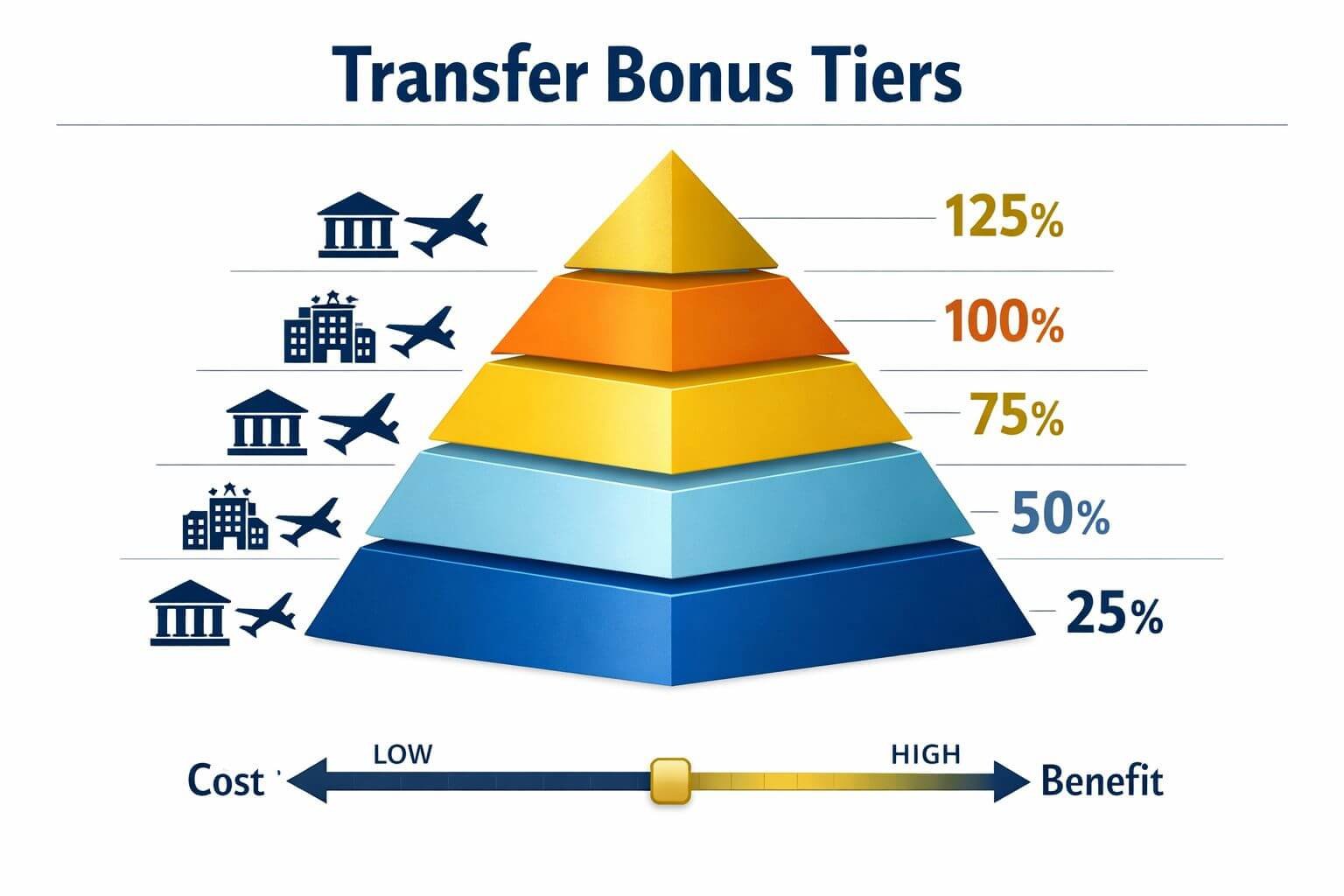
- Bilt Rewards: Tiered 25–125% to Wyndham, with higher tiers available to elite Bilt members who used Bilt Cash to buy up their status tier (April 2026)
The Bilt-Wyndham structure is the most instructive example of transfer bonus math 2026 elite tier boosts worth it analysis because it explicitly ties bonus size to elite status, and allows members to purchase a higher tier. That’s the scenario this article focuses on most.
For a full tracker of active and historical bonuses, see the Credit Card Transfer Bonuses: Current and Historical Offers page.
The Core Math: Extra Points vs. Extra Cost
The formula is straightforward:
Incremental Points Gained = Transfer Amount × Bonus Rate
Breakeven Cost = Incremental Points × CPP of the Partner Program
If you can access a 100% bonus tier for $30 in Bilt Cash, and you’re transferring 100,000 points to Wyndham (where points are worth ~0.8 CPP), the incremental 100,000 Wyndham points are worth roughly $800. Paying $30 to unlock that is an obvious win.
You may be interested



The math gets tighter at lower transfer volumes and lower CPP programs.
The Bonus Value Matrix
The table below shows incremental points gained at each bonus level, for three common transfer amounts. Assumptions: base transfer ratio is 1:1; no bonus = 0 incremental points.
| Transfer Amount | 25% Bonus | 50% Bonus | 75% Bonus | 100% Bonus | 125% Bonus |
|---|---|---|---|---|---|
| 50,000 pts | +12,500 | +25,000 | +37,500 | +50,000 | +62,500 |
| 100,000 pts | +25,000 | +50,000 | +75,000 | +100,000 | +125,000 |
| 150,000 pts | +37,500 | +75,000 | +112,500 | +150,000 | +187,500 |
Breakeven Cost by CPP
Using Wyndham at 0.8 CPP and Flying Blue at 1.5 CPP (conservative estimate for business class sweet spots):
| Incremental Points | Wyndham Value (0.8 CPP) | Flying Blue Value (1.5 CPP) |
|---|---|---|
| +12,500 | $100 | $188 |
| +25,000 | $200 | $375 |
| +50,000 | $400 | $750 |
| +100,000 | $800 | $1,500 |
| +125,000 | $1,000 | $1,875 |
The breakeven cost is the maximum you should pay to access a given bonus tier. Any upgrade cost below that number is profitable; above it, you’re overpaying.
For CPP benchmarks by program, the 2026 Guide to Cents-Per-Point covers current valuations in detail.
Three Worked Examples: Transfer Bonus Math 2026 Elite Tier Boosts Worth It
These examples use realistic 2026 program assumptions. All CPP figures are estimates based on typical redemption values—your actual value will vary based on award availability and cash price of the flight or hotel.
Example 1: Clearly Worth It — Bilt to Wyndham at 125% (100,000 Points)
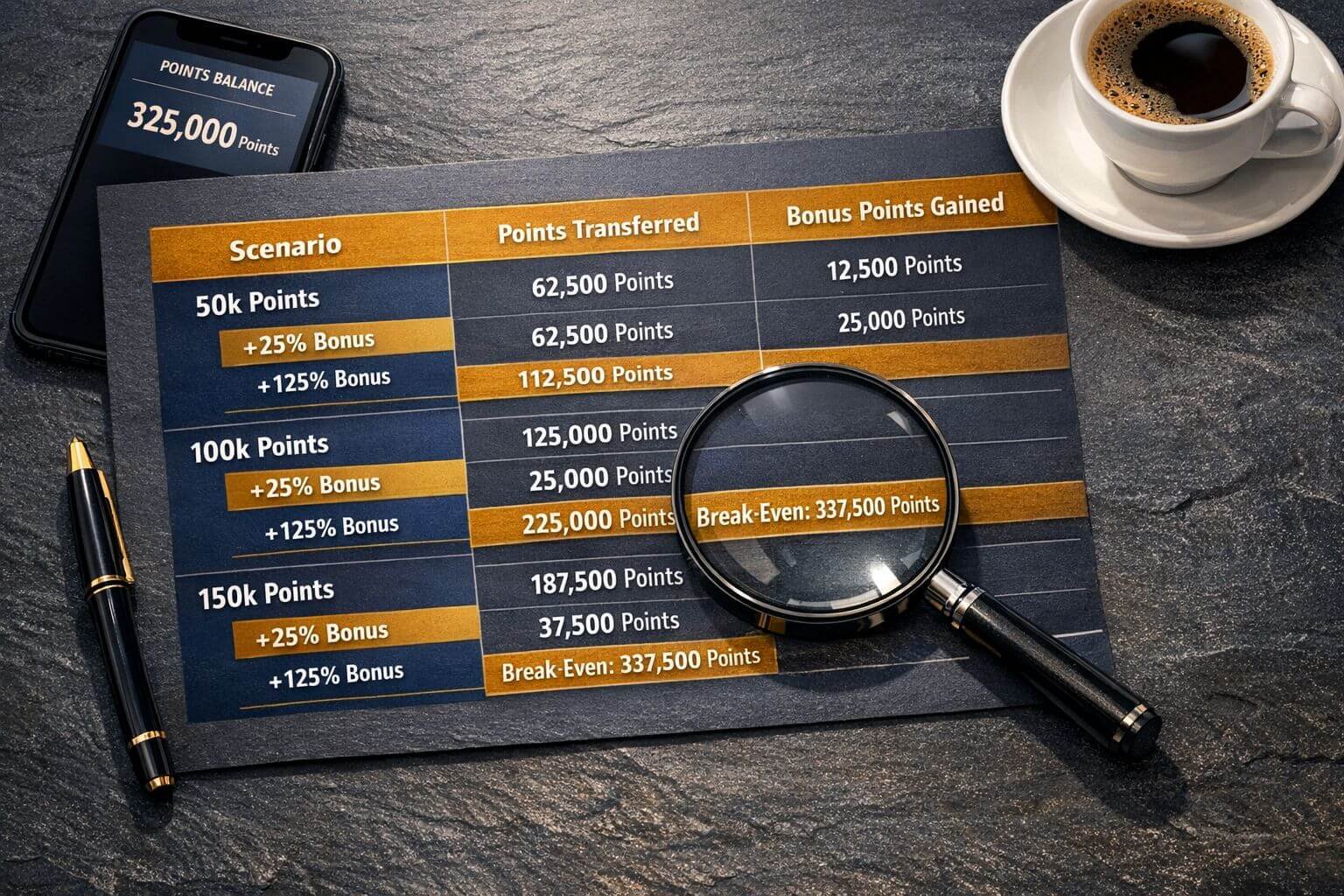
Scenario: A Bilt member holds 100,000 Bilt points and wants to transfer to Wyndham during the April 2026 Rent Day promotion. Their current elite tier qualifies for a 100% bonus, but they can spend $40 in Bilt Cash to bump to the next tier and access a 125% bonus.
- At 100% bonus: 100,000 Bilt → 200,000 Wyndham points
- At 125% bonus: 100,000 Bilt → 225,000 Wyndham points
- Incremental gain from upgrade: 25,000 Wyndham points
- Value of 25,000 Wyndham points at 0.8 CPP: ~$200
- Cost of tier upgrade: $40
- Net gain: ~$160
Verdict: Pay the $40. The upgrade cost is 20% of the incremental value. This is one of the clearest cases where transfer bonus math 2026 elite tier boosts worth it analysis produces a strong yes.
For full details on this specific promotion, see the Bilt Rent Day April 2026 Wyndham Transfer Bonus Guide.
Example 2: Break-Even — Bilt to Wyndham at 125% (50,000 Points)
Scenario: Same promotion, same $40 upgrade cost—but this member only has 50,000 Bilt points to transfer.
- At 100% bonus: 50,000 Bilt → 100,000 Wyndham points
- At 125% bonus: 50,000 Bilt → 112,500 Wyndham points
- Incremental gain from upgrade: 12,500 Wyndham points
- Value of 12,500 Wyndham points at 0.8 CPP: ~$100
- Cost of tier upgrade: $40
- Net gain: ~$60
Verdict: Marginal. The math is positive, but the $40 buys only $100 in incremental value. If Wyndham’s redemption value is closer to 0.6 CPP for the properties you want, the gain drops to $75—and suddenly a $40 upgrade for $35 in net value is barely worth the effort. Proceed only if you have a specific, confirmed redemption in mind.
Example 3: Not Worth It — Small Transfer, High Upgrade Cost
Scenario: A member wants to access a hypothetical elite tier that unlocks a 50% transfer bonus to a hotel program (valued at 0.5 CPP), but the tier upgrade costs $75. They’re transferring 30,000 points.
- Without bonus: 30,000 points transfer 1:1
- At 50% bonus: 30,000 → 45,000 points
- Incremental gain: 15,000 points
- Value at 0.5 CPP: $75
- Cost of upgrade: $75
- Net gain: $0
Verdict: Skip it. This is a pure break-even at best—and that assumes you actually redeem those points at 0.5 CPP. If the program has limited availability or you don’t use the points for 12+ months, devaluation risk makes this a likely loss.
Common mistake: Counting the value of all transferred points toward the upgrade cost justification, rather than only the incremental points the upgrade unlocks. The upgrade only buys you the difference between bonus tiers.
When Elite-Tier Upsells Make Sense—and When They Don’t
The transfer bonus math 2026 elite tier boosts worth it question has a consistent answer: it depends on transfer volume, CPP, and whether you have confirmed award space.
✅ Upsells make sense when:
- You’re transferring 75,000+ points (larger volumes amplify incremental gains)
- The partner program has high CPP potential (Flying Blue business class, Wyndham all-inclusive resorts)
- You have confirmed award availability before you transfer
- The upgrade cost is less than 25% of the incremental point value
- The bonus is time-limited and you were planning to transfer anyway
❌ Upsells don’t make sense when:
- You’re speculating on future award availability
- Transfer volume is under 50,000 points and the upgrade cost exceeds $30–40
- The partner program has a history of dynamic pricing that erodes CPP (IHG, Marriott)
- You already hold points in the partner program and don’t need more
- The tier upgrade has ongoing costs (annual fees, minimum spend) beyond the one-time bump
Best for: Members with a specific redemption target, confirmed space, and enough points to make the incremental gain meaningful.
Not for: Members building a speculative points balance without a near-term booking in mind.
For a broader view of how status strategy interacts with transfer timing, see Transfer Bonus Strategy: When to Transfer Points in 2026.
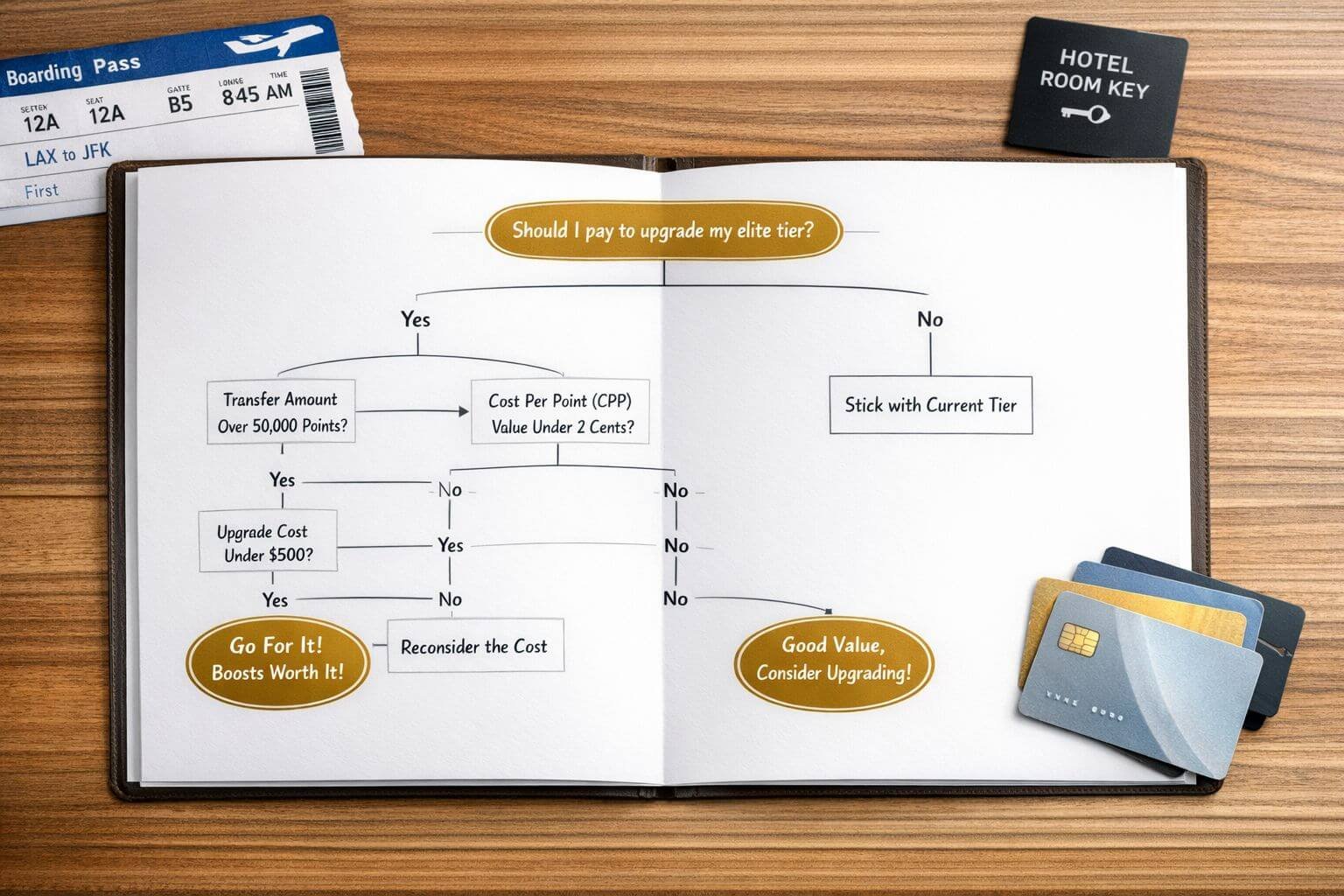
A Simple Checklist Before You Pay for Any Transfer Boost
Use this before committing to any elite-tier upsell or bonus transfer in 2026.
Step 1: Identify your transfer amount Know exactly how many points you’re moving. The incremental gain scales with volume—small transfers rarely justify upgrade costs.
Step 2: Calculate incremental points Subtract the lower bonus tier from the higher tier, then multiply by your transfer amount. Formula: (Higher Bonus % − Lower Bonus %) × Transfer Amount = Incremental Points
Step 3: Value those incremental points Use a realistic CPP for the partner program based on your intended redemption—not the program’s best-case scenario. Formula: Incremental Points × CPP = Incremental Value in Dollars
Step 4: Compare to upgrade cost If upgrade cost < 50% of incremental value: strong yes. If upgrade cost is 50–80%: marginal, proceed only with confirmed space. If upgrade cost > 80%: skip.
Step 5: Confirm award availability first Search for the award before transferring. Points transfers are one-way and irreversible. Use tools like Point.me, Seats.aero, or the partner program’s own search engine.
Step 6: Check for devaluation risk Is the partner program mid-restructure? Citi’s ThankYou-to-Choice Privileges ratio dropped from 1:2 to 1:1.5 in April 2026. Transferring into a program on the eve of a devaluation wipes out bonus gains.
Step 7: Transfer and book immediately Once you’ve confirmed space and done the math, transfer and book in the same session. Award space disappears.
For a step-by-step look at how this applies to a specific high-value bonus, the Chase to Avios 20% Transfer Bonus March 2026 Guide and the Citi ThankYou 30% Transfer Bonus to Virgin Atlantic 2026 walkthrough both illustrate the confirm-then-transfer discipline well.
FAQ: Transfer Bonus Math and Elite-Tier Upsells
Q: Does a transfer bonus increase the points in my bank account or just what lands in the partner program? A: Only what lands in the partner program. Your bank balance decreases by the normal transfer amount. The bonus points appear only in the partner’s account.
Q: Can I transfer a small amount now to test, then transfer more later to capture the bonus? A: Only if the bonus is still active when you transfer the larger amount. Bonuses are time-limited. Partial transfers don’t lock in a rate for future transfers.
Q: What’s a realistic CPP for Wyndham points in 2026? A: Approximately 0.7–0.9 CPP for standard redemptions. All-inclusive resort bookings (Wyndham’s Vacasa and Margaritaville properties) can push toward 1.0–1.1 CPP, but availability is limited. Use 0.8 CPP as a conservative planning estimate.
Q: Is the Chase 70% IHG bonus from April 2026 worth using? A: It depends on the property. IHG uses dynamic pricing, so the same hotel can cost 15,000 or 60,000 points on different dates. The 70% bonus is genuinely valuable for high-cash-rate properties where you’ve confirmed point pricing is capped or favorable. Speculative transfers to IHG carry meaningful devaluation risk.
Q: What’s the minimum transfer amount where an elite-tier upsell starts making sense? A: As a rule of thumb, 75,000+ points at a 25-percentage-point bonus difference, with an upgrade cost under $40. Below that, the incremental gain rarely justifies the cost and complexity.
Q: Do all Bilt elite tiers get a transfer bonus to Wyndham, or only the top tier? A: During the April 2026 Rent Day promotion, Bilt offered a tiered structure where all elite members received some bonus level (starting at 25%), with the top tier reaching 125%. Members could use Bilt Cash to buy up one tier. The exact tier structure varies by promotion—check the current Rent Day terms each month.
Q: What happens if I transfer for a bonus and the award disappears? A: You’re stuck with points in the partner program. This is why confirming award space before transferring is non-negotiable. Points in a partner program cannot be returned to your bank account.
Q: Are there transfer bonuses that don’t require any elite status or upgrade? A: Yes—most bank transfer bonuses (Chase, Citi, Capital One, Amex) are available to all cardholders during promotional windows. The Bilt elite-tier structure is unusual in tying bonus size to status level. Standard promos like the Choice 100% to Flying Blue or Capital One 30% to JAL require no status at all.
Q: How do I find out if a transfer bonus is currently active? A: Check the Credit Card Transfer Bonuses tracker for a current list. Individual bank portals also show active bonuses when you initiate a transfer.
Q: Is it ever worth transferring just to capture a bonus, without a specific redemption in mind? A: Rarely. The risk of devaluation, program changes, or simply not finding award space outweighs the speculative gain. The one exception: if you’re transferring to a program you use regularly and the bonus meaningfully accelerates a redemption you’d make anyway within 12 months.
Conclusion
Transfer bonus math in 2026 doesn’t require a spreadsheet—it requires a clear framework applied consistently. The core rule: calculate only the incremental points the upgrade unlocks, value them at a realistic CPP for your actual redemption, and compare that to the upgrade cost. If the cost is less than half the incremental value and you have confirmed award space, the answer is almost always yes.
The Bilt-Wyndham tiered bonus is the clearest current example of this math in action, but the same framework applies to every elite-tier upsell and promotional bonus across Amex, Chase, Capital One, Citi, and Bilt programs.
Next steps:
- Check the Credit Card Transfer Bonuses tracker for currently active bonuses.
- Use the 2026 Cents-Per-Point guide to benchmark the partner program you’re considering.
- Search for award availability before running the math—if the space isn’t there, the math is irrelevant.
- For program-specific breakdowns, see the Best Use of 100,000 Points: Transfer Partner Value 2026 guide and the Comparing Transfer Partners 2026 overview.
The math is reusable. Run it every time a new promo appears, and you’ll never overpay for a transfer bonus again.


Content on Award Travel Hub is independently created by Award Travel Hub Editorial Desk and, where noted, reviewed by Award Travel Hub Review Desk. Some pages may contain affiliate links, but compensation does not determine our coverage, opinions, or methodology.