

Last Updated: November 11, 2026
Amex advertises more than $3,500 in annual value on the American Express Platinum Card, but independent reviewers estimate that a realistic frequent traveler captures closer to $1,500 to $2,000. That gap decides whether the $895 annual fee is a smart purchase or an expensive habit. This guide sorts readers into traveler profiles, applies realistic usage rates instead of face value, and ends with a five-question fit test you can finish in a few minutes.
The American Express Platinum Card in 2026: Fee and Core Benefits
The American Express Platinum Card costs $895 per year in 2026, and it only pays off for cardholders who reliably use lounge access, the Lodging Credit, and at least a few lifestyle credits. Additional Platinum cards cost $195 each, and Companion Platinum cards carry no annual fee. Ordinary spending earns just 1 Membership Rewards point per dollar outside the bonus categories, so this card is a benefits product, not an everyday earner.

What the $895 fee buys
The refreshed card leans on three pillars: airport lounges, premium hotel booking benefits, and a long list of monthly, semiannual, and annual credits. Most credits require enrollment in your Amex account before they work, and several reset on a calendar schedule. A credit you forget to enroll in or use before it resets is worth $0.
| Benefit | Advertised value | How it works | Realistic usage risk |
|---|---|---|---|
| Lodging Credit | Up to $600/year | Up to $300 per Jan, Jun and Jul, Dec period on prepaid Fine Hotels + Resorts, The Hotel Collection, or Airbnb Luxe through Amex Travel | High if you don’t stay at luxury properties twice a year |
| Airbnb Experiences Credit | Up to $250 | Unlocks only after a qualifying prepaid Airbnb Luxe booking through Amex Travel; applies for the rest of that calendar year | Very high for most cardholders |
| lululemon credit | Up to $300/year | Statement credits at lululemon, enrollment required | Moderate, depends on brand habits |
| Uber One membership | $120/year | Covers an auto-renewing Uber One membership | Low if you already use Uber |
| ŌURA Ring credit | $200 | Toward an ŌURA Ring purchase | Value only if you’d buy one anyway |
| Lounge access | Not cash-valued by Amex | 1,550+ lounges, including Centurion, Priority Pass (enrollment required), Escape, Plaza Premium, and limited Delta Sky Club visits | Depends entirely on how often you fly |
The card also carries legacy credits such as airline incidental fees, Uber Cash, digital entertainment, and dining-related benefits. Terms change frequently, so confirm current amounts in our full 2026 breakdown of American Express Platinum benefits before you count on any specific credit.
Changes to watch before 2027
Starting January 1, 2027, new Fine Hotels + Resorts bookings must be at least two nights to qualify for the Lodging Credit. The Hotel Collection and Airbnb Luxe already require two nights. Cardholders who used one-night FHR stays to burn the $300 each half-year will need a new plan.
Rule of thumb: Value each credit at what you would have paid in cash anyway, not at its face value. A $300 credit spent on something you didn’t need is worth far less than $300.
Credit approval itself is fast for most applicants, often instant online, though some applications go to manual review for a few days. Amex doesn’t publish a minimum credit score, but approvals generally go to applicants with good to excellent credit. Welcome offers vary by applicant and channel, and Amex’s eligibility language may restrict the bonus if you’ve held the card before or have a history of opening and closing Amex cards. Check the pop-up eligibility notice before you submit.
Traveler Profile 1: The Frequent Lounge User
If you fly 10 or more round trips per year through airports with Centurion Lounges or Priority Pass locations, the American Express Platinum Card is likely worth keeping on lounge value alone. This profile gets the most consistent return because lounge access doesn’t depend on shopping habits or reset dates.
What lounge access actually includes
- Centurion Lounges: Free entry for the cardholder. Guests generally cost $50 per adult and $30 per child ages 2-17 unless you spend $75,000 in a calendar year.
- Priority Pass: Available after enrollment. Coverage is broad internationally but uneven at U.S. airports.
- Delta Sky Club: 10 visits per program year when flying Delta the same day, excluding basic economy. Extra visits generally cost $50. Spending $75,000 in a calendar year unlocks unlimited access.
- Other networks: Escape Lounges, Plaza Premium, and partner lounges such as select Lufthansa lounges. See our coverage of expanded Amex Platinum Lufthansa lounge access.
You may be interested



All lounge access is subject to space availability. Crowding at popular Centurion Lounges is one of the most common complaints about the card.
Realistic value estimate
Assumptions: 24 airport departures per year, a lounge visit on 18 of them, and a value of $30 per visit (what you’d otherwise spend on food and drinks, not the walk-in price).
| Item | Estimated captured value |
|---|---|
| Lounge visits (18 × $30) | $540 |
| Uber One + partial Uber Cash | $200 |
| Airline incidental or similar travel credits (partial use) | $150 |
| Lodging Credit (one half-year period used) | $300 |
| Other lifestyle credits (partial use) | $150 |
| Total | $1,340 |
That’s roughly $445 above the fee before counting points earned on airfare booked directly with airlines. Strong, but not dramatic.
Best for: Flyers based at hubs like DFW, JFK, LAX, SFO, MIA, or ATL with Centurion Lounges; travelers who fly Delta but don’t need unlimited Sky Club access.
Not for: Travelers who usually fly with family (guest fees add up fast), or Delta loyalists who need unlimited Sky Club entry without $75,000 in spending. A Delta co-brand card may fit better. Compare options in our guide to are premium travel cards worth it in 2026.
Common mistake: Counting lounge visits at the $50 guest price. Unless you would have paid that, it inflates the math.
Traveler Profile 2: The Luxury Hotel Booker
Travelers who already book two or more premium hotel stays per year get the clearest return from the Lodging Credit and Fine Hotels + Resorts benefits. The key word is “already.” Booking luxury hotels just to use the credit usually costs more than it saves.

How the Lodging Credit plays out
Fine Hotels + Resorts bookings typically include daily breakfast for two, a property credit, room upgrade when available, and late checkout. The catch is that FHR rates must be prepaid through Amex Travel, and those rates are sometimes higher than booking direct or with a hotel loyalty program.
Example: a two-night FHR stay in Chicago priced at $780 prepaid. The same room costs $740 direct. After the $300 credit, you pay $480, plus you receive breakfast (around $80 value for two over two nights) and a $100 property credit you would actually use. Net effective cost is roughly $300 versus $740, a strong outcome. But if you would have stayed at a $250 midscale hotel instead, the “saving” is mostly spending you didn’t need.
Our American Express Fine Hotels and Resorts guide covers which properties tend to price competitively.
Points versus cash for the rest of the stay
Hotel bookers should also weigh using Amex points. Paying with points through Amex Travel usually returns about 0.7 cents per point on hotels, which is a poor redemption. Transferring to Hilton (1:2) or Marriott (1:1) can be better at specific properties, but transferring to airline partners for premium cabin awards often delivers 1.5 to 2+ cents per point. Read our breakdown of the American Express Travel portal versus transferring points before redeeming.
Best for: Travelers who take two leisure trips per year at four- and five-star hotels and can stay at least two nights each time.
Not for: Points-first hotel travelers who mostly redeem Hyatt or Marriott awards; travelers who stay one night at a time (especially after the 2027 two-night FHR rule).
Edge case: The $250 Airbnb Experiences Credit only unlocks after a prepaid Airbnb Luxe booking through Amex Travel. Unless you already plan a luxury rental, value it at zero.
Traveler Profile 3: The Occasional Traveler Chasing a Welcome Bonus
For travelers who fly two or three times per year, the American Express Platinum Card can make sense for one year because of the welcome bonus, but it rarely justifies a second annual fee. The bonus does the heavy lifting, and the credits mostly fill gaps.
Year-one math versus year-two math
Assumptions: a welcome bonus of 80,000 Membership Rewards points (offers vary, and some applicants see higher targeted offers), valued conservatively at 1.5 cents per point through transfer partners.
| Item | Year one | Year two |
|---|---|---|
| Welcome bonus (80,000 × 1.5 CPP) | $1,200 | $0 |
| Credits realistically used | $500 | $500 |
| Lounge visits (4 × $30) | $120 | $120 |
| Annual fee | −$895 | −$895 |
| Net | +$925 | −$275 |
That year-one value depends on redemption skill. Transferring 80,000 points to partners like Air France-KLM Flying Blue or ANA for business class can stretch the bonus well past 1.5 cents per point, but award availability is limited and fuel surcharges on some partners (British Airways, for example) erode the gain. Check our list of credit card transfer partners and ratios before transferring, and never transfer speculatively since Amex transfers can’t be reversed.
Can you downgrade later?
Amex generally lets cardholders product change from Platinum to another Membership Rewards card, such as the Gold, which keeps your points alive without a closed-account gap. Wait until after the first year, and note that a product change may affect future welcome bonus eligibility. Our guide to downgrading a travel credit card while keeping points walks through timing.
Common mistake: Applying for the bonus with no plan to redeem it. Points sitting unused carry devaluation risk, and the fee is real cash.
Domestic-only travelers: Lounges, Uber, and lifestyle credits work fine without international trips, though Priority Pass coverage at smaller U.S. airports is thin.
Who Should Skip Amex Platinum and What to Get Instead
Skip the Platinum if your spending is mostly groceries and dining, you fly fewer than four times a year, or you won’t track monthly credits. In those cases a lower-fee card earns more points and wastes less money.
Cardholders’ biggest complaints tend to be consistent: crowded Centurion Lounges, credits split into monthly or semiannual pieces, enrollment hassles, guest fees, and weak earning on non-bonus spending.
| If you are… | Consider instead | Why |
|---|---|---|
| A food and grocery spender | Amex Gold | Earns 4x at U.S. supermarkets and restaurants (caps apply), keeps Membership Rewards access, much lower fee |
| A flexible traveler wanting simpler credits | Chase Sapphire Reserve | Broad travel credit, Priority Pass, Chase points with Hyatt as a transfer partner |
| Fee-sensitive but want lounges | Capital One Venture X | Lower fee, Capital One lounges, travel portal credit that offsets much of the fee |
| A renter | Bilt card lineup | Earn points on rent; Bilt points transfer to Hyatt, United, and others |
| A Delta loyalist | Delta Reserve | Sky Club access and status-related perks without the Platinum’s lifestyle credits |
Amex Platinum versus Chase Sapphire Reserve: Platinum wins on lounge breadth and luxury hotel perks. The Reserve is usually easier to use because its credits are fewer and more flexible, and Chase points transfer to Hyatt, one of the strongest hotel sweet spots. Choose Platinum if lounges and FHR matter most; choose the Reserve if you want fewer moving parts.
Business owners: The Business Platinum is a separate product with different credits and earning, including bonus points on large purchases. It suits owners with heavy travel and big-ticket business expenses, but run the numbers on its own credits rather than assuming the personal card’s value carries over.
For a wider view, see our ranking of the best travel credit cards for 2026 by spending style.
A Five-Question Fit Test Before You Apply
Answer these five questions honestly. If you can say yes to at least three, including question 1 or 2, the American Express Platinum Card likely fits your travel pattern. If not, a lower-fee card is probably the better decision.
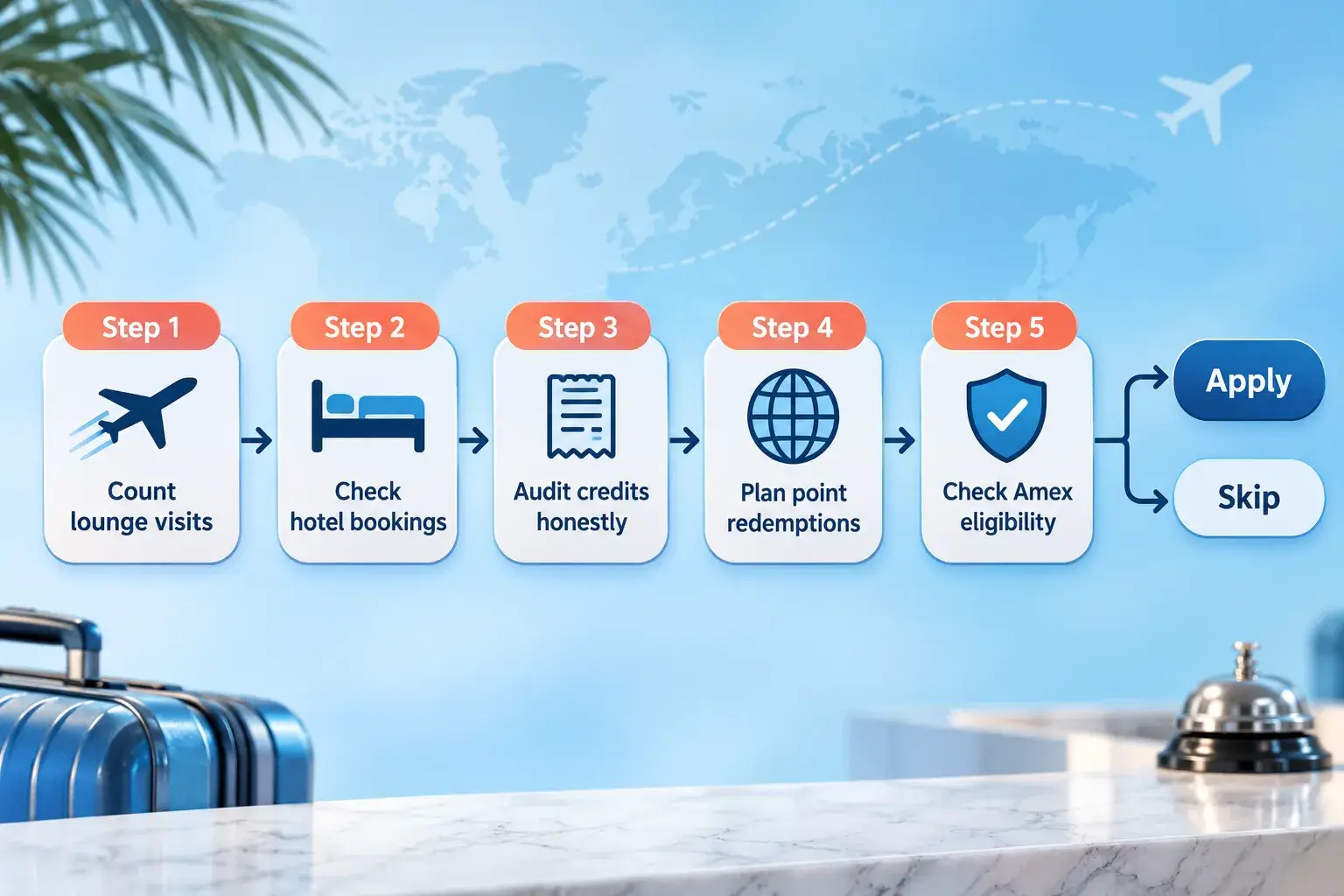
- Will you use an eligible lounge on at least 10 departures this year? Count airports you actually fly through, not lounges you’d like to visit.
- Will you book at least one prepaid two-night luxury stay in each half of the year? This is how the full $600 Lodging Credit becomes real money.
- Will you capture at least $400 in other credits without changing your spending? Uber, lululemon, digital entertainment, and similar credits only count if you’d buy those things anyway.
- Do you have a redemption plan for Amex points? Transferable points earn their value through partner airlines and premium cabin awards, not portal redemptions at under 1 cent per point.
- Are you eligible for the welcome bonus? Check Amex’s eligibility language during application. If the bonus is unavailable, year-one math weakens sharply.
Scoring your result
- Four or five yes answers: Strong fit. Apply, enroll in every credit on day one, and set calendar reminders for monthly and semiannual resets.
- Three yes answers: Good fit for year one. Reassess at month 11 before the second fee posts.
- Two or fewer: Skip. A mid-tier card like the Gold or a lower-fee premium card will likely deliver more net value.
Frequently Asked Questions
How much does the Amex Platinum cost per year? The annual fee is $895 in 2026. Each Additional Platinum Card costs $195, and Companion Platinum Cards have no annual fee.
Is Amex Platinum worth it if you don’t travel often? Usually not beyond year one. Infrequent travelers can profit from the welcome bonus, but realistic credit usage rarely covers $895 in later years.
Does Amex Platinum pay for itself with credits alone? Only for cardholders who naturally use most credits. Independent estimates put realistic annual value for frequent travelers at about $1,500 to $2,000, not the advertised $3,500+.
Is Delta Sky Club access unlimited with Amex Platinum? No. Cardholders get 10 visits per program year when flying Delta the same day, excluding basic economy. Unlimited access requires $75,000 in calendar-year spending.
What credit score do you need for Amex Platinum? Amex doesn’t publish a minimum. Approvals typically go to applicants with good to excellent credit and a solid payment history.
Can you downgrade Amex Platinum to avoid the fee? Generally yes. Amex often allows a product change to another card such as the Gold, which keeps Membership Rewards points active. Do it after the first year.
Conclusion and Next Steps
The American Express Platinum Card in 2026 is a strong fit for frequent lounge users and travelers who already book luxury hotels twice a year. It’s a reasonable one-year play for occasional travelers who have a solid plan for the welcome bonus. For everyone else, the $895 fee is hard to justify.
Next steps:
- Run your numbers with our credit card annual fee ROI calculator using realistic usage, not face value.
- If you apply, enroll in all credits immediately and map reset dates on a calendar.
- Before redeeming points, compare transfer partners against portal value, and watch for transfer bonuses.
- Reassess before each renewal, and product change rather than cancel if you want to keep your points.


Content on Award Travel Hub is independently created by Award Travel Hub Editorial Desk and, where noted, reviewed by Award Travel Hub Review Desk. Some pages may contain affiliate links, but compensation does not determine our coverage, opinions, or methodology.