
Last updated: April 17, 2026
Key Takeaways
- Dynamic award pricing 2026 is now the default model at Delta, United, American, and—as of May 2026—World of Hyatt. Fixed award charts are increasingly rare.
- Award prices on the same route and cabin can swing 30–60% based on travel dates, demand, and how far in advance you book.
- The 6–9 month booking window generally offers the most predictable pricing; last-minute awards (within 14 days) are frequently the most expensive.
- Partner programs like Virgin Atlantic Flying Club, Air France/KLM Flying Blue, and Aeroplan still publish fixed or semi-fixed rates for certain carriers—and those sweet spots remain exploitable.
- Transferable points (Amex, Chase, Capital One, Citi, Bilt) are your best defense: keep points in bank currencies until you’ve confirmed award space and a target price.
- Award price alerts and one-way bookings are underused tools that can meaningfully reduce your mileage cost.
- Diversifying across at least two or three loyalty programs reduces your exposure to any single program’s devaluation.
Quick Answer
Dynamic award pricing means airlines and hotels set award costs based on demand, cash fare levels, and availability—not a fixed chart. In 2026, the major U.S. carriers (Delta, United, American) and now World of Hyatt all use some form of dynamic pricing. To pay fewer miles for the same cabin, book 6–9 months out, use partner programs with fixed rates, and keep your transferable points unallocated until you’ve found the right price.
How Dynamic Award Pricing Really Works in 2026
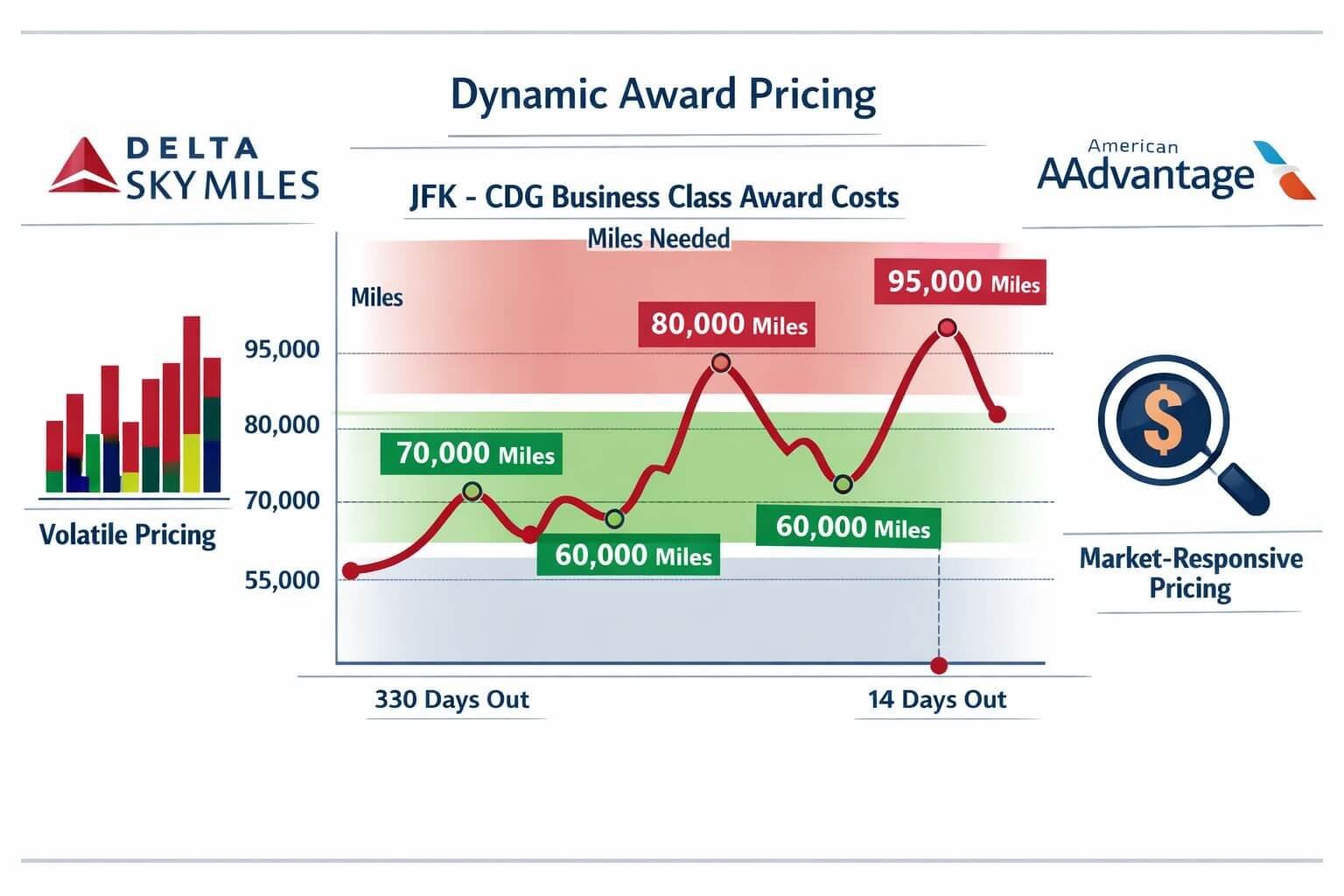
Dynamic award pricing sets the mileage cost of a flight or hotel night as a variable tied to underlying cash prices, demand signals, and inventory levels—not a published chart. This means the same Business Class seat from JFK to CDG can cost 55,000 miles on a Tuesday in March or 95,000 miles over a holiday weekend, with no advance notice.
Here’s the core mechanics:
- Cash fare correlation: Most dynamic programs price awards as a percentage of the cash fare. When cash fares spike (holidays, school breaks, major events), award prices follow.
- Inventory-based floors and ceilings: Airlines set minimum and maximum mileage prices per cabin. You’ll rarely see Delta price a transatlantic business class seat below 50,000 miles or above 200,000—but the range in between is wide.
- Demand signals: Algorithms factor in how quickly seats are selling, how many award seats remain, and historical booking patterns for that route and date.
- No advance notice of changes: Unlike a chart devaluation (which programs must announce), dynamic prices shift daily or even hourly without notification.
The 2026 landscape at a glance:
| Program | Pricing Model | Fixed Chart Remaining? |
|---|---|---|
| Delta SkyMiles | Fully dynamic | No |
| United MileagePlus | Fully dynamic | No (eliminated 2024) |
| American AAdvantage | Fully dynamic | No |
| Air France/KLM Flying Blue | Dynamic (Promo Awards monthly) | Partial |
| Aeroplan (Air Canada) | Semi-fixed partner charts | Yes, for most partners |
| Virgin Atlantic Flying Club | Fixed partner rates | Yes |
| World of Hyatt | Dynamic (effective May 2026) | No (was 8-category chart) |
| Marriott Bonvoy | Mostly dynamic | Partial peak/off-peak |
Common mistake: Assuming that because a program had a fixed chart last year, it still does. Hyatt’s shift in May 2026 caught many travelers off guard who had planned redemptions based on the old category system. Always verify current pricing before transferring points.
Real Examples of 2026 Award Price Swings on Popular Routes
Award prices vary dramatically by route, date, and program. The following examples illustrate realistic price patterns based on documented program behavior—not guaranteed prices, as dynamic pricing changes daily.
JFK–CDG (New York to Paris) Business Class
On a mid-week departure in April (shoulder season), Delta SkyMiles has priced this route in the 55,000–70,000 mile range for a one-way business class seat. The same seat over the July 4 holiday period has been observed at 90,000–120,000 miles—a swing of roughly 60–70%.
The partner alternative: Virgin Atlantic Flying Club prices Delta One business class on this route at a fixed 50,000 miles one-way. That’s a savings of 20,000–70,000 miles compared to booking directly with Delta, depending on the date. Virgin Atlantic points transfer from Amex, Chase, Capital One, and Bilt—making this one of the most accessible fixed sweet spots still available.
You may be interested



For more on booking this route efficiently, see the SkyTeam Award Booking Guide 2026.
LAX–HND (Los Angeles to Tokyo) Business Class
United MileagePlus has priced ANA business class on this route dynamically since eliminating its fixed chart. Observed prices in 2026 range from approximately 75,000 miles (off-peak, booked 8+ months out) to 130,000+ miles (peak summer, booked within 30 days).
The partner alternative: ANA Mileage Club still maintains a fixed award chart for its own metal, pricing LAX–HND business class at 75,000 miles one-way. However, ANA miles are harder to accumulate for U.S. cardholders (Virgin Atlantic and Amex transfer to ANA). Alternatively, Virgin Atlantic Flying Club prices ANA business class at 60,000 miles one-way—a significant discount.
For a complete walkthrough of booking this route, see the Star Alliance Business Class Awards Guide 2026.
Domestic U.S. (e.g., LAX–JFK) Economy Class
American AAdvantage’s “market-responsive” domestic pricing has produced some of the most frustrating variability for everyday travelers. A LAX–JFK economy seat that costs 7,500 miles in February can jump to 25,000+ miles during peak travel periods—a 233% increase for the same cabin and carrier.
The takeaway: For the domestic economy, dynamic pricing often produces poor cents-per-point (CPP) value. If your transferable points are worth 1.5–2.0 CPP toward premium international cabins, spending 25,000 miles on a $200 domestic flight (0.8 CPP) is rarely the right call. Our 2026 Guide to Cents-Per-Point walks through this math in detail.
Best and Worst Programs for Dynamic Award Pricing Right Now
Not all programs are equally unpredictable. Here’s a direct assessment of where dynamic pricing 2026 hurts most—and where fixed rates still protect you.
Programs to Approach with Caution
Delta SkyMiles is the most fully dynamic of the major U.S. programs. There is no partner chart, no fixed rate, and no published methodology. Award prices correlate closely with cash fares, which means peak-date redemptions frequently deliver under 1.0 CPP. For most international premium cabin goals, Delta miles are better used opportunistically (when prices dip) rather than as a primary currency. See the full Delta SkyMiles Transfer Partners Guide 2026 for program specifics.
United MileagePlus eliminated its last fixed award chart in 2024. While United does publish a general pricing guide by region, actual award prices deviate significantly. The program is more transparent than Delta, but still highly variable on popular routes.
American AAdvantage introduced “market-responsive” pricing that has produced some of the sharpest single-route increases. Business Class awards on certain transatlantic routes jumped substantially in 2025. AAdvantage miles transfer from Citi and Bilt, so they’re accessible, but treat them as opportunistic rather than foundational.
World of Hyatt (effective May 2026): The shift from an 8-category fixed chart to dynamic pricing is the most significant hotel program change of 2026. Properties that were reliably 15,000–25,000 points per night may now be priced based on occupancy and cash rates. For a detailed breakdown of what changed and which properties still offer value, see the World of Hyatt Award Chart 2026 guide.
Programs That Still Offer Predictability
Virgin Atlantic Flying Club maintains fixed partner award rates for Delta and ANA flights—two of the most dynamic programs when booked directly. This is one of the clearest examples of where a partner program creates genuine value that the operating carrier’s own program does not.
Aeroplan (Air Canada) still publishes fixed partner award charts for most Star Alliance carriers, including Lufthansa, Swiss, and Turkish Airlines. Aeroplan miles transfer from Amex, Chase, Capital One, and Bilt. For transatlantic business class, Aeroplan’s fixed rates frequently beat United’s dynamic pricing on the same flights. See the guide on Maximizing Aeroplan Awards for current sweet spots.
Flying Blue (Air France/KLM) uses dynamic pricing for standard awards but publishes monthly Promo Awards at fixed, discounted rates—often 25–50% below standard prices. These are worth monitoring if your travel dates are flexible. See the Flying Blue Transfer Partners Guide 2026 for how to track these.
Best for / Not for: Fixed-chart partner programs (Virgin Atlantic, Aeroplan) are best for travelers with specific routes and dates who need price certainty before transferring points. They’re not ideal for travelers who need maximum flexibility on routing, since partner award space can be limited.
Timing Strategies to Pay Fewer Miles for the Same Trip
Booking timing is the single most controllable variable in dynamic award pricing. The patterns below are based on documented program behavior, though exact prices vary.
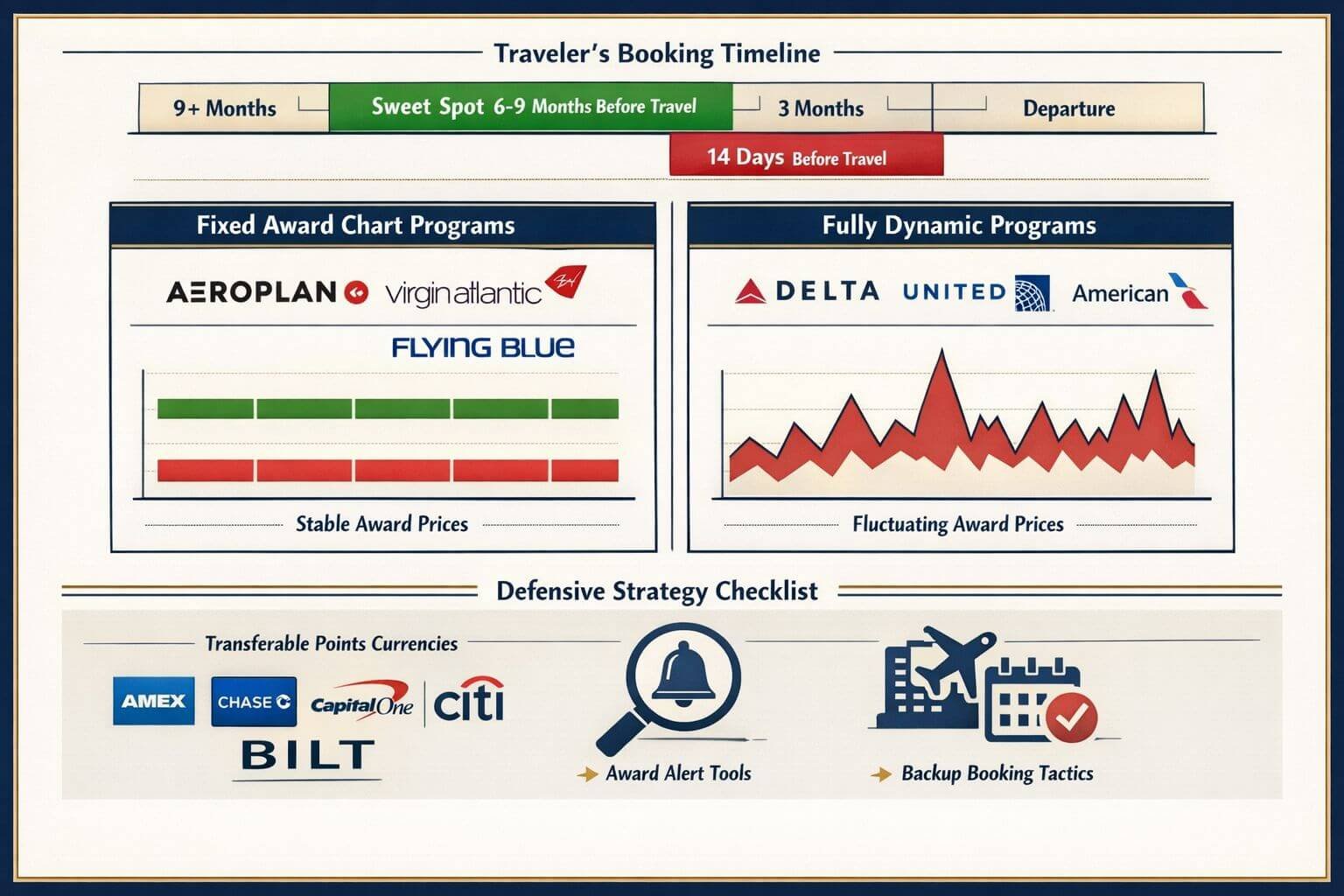
The 6–9 Month Window: Most Reliable for Premium Cabins
Airlines typically release international business and first class award space at the 330-day mark (roughly 11 months out). The 6–9 month window captures:
- Initial award release inventory before it sells down
- Pricing that hasn’t yet been influenced by high near-term demand
- Enough lead time to transfer points without rushing
On routes like JFK–CDG and LAX–HND, booking in this window has historically produced prices 20–35% lower than the same seat booked within 60 days of departure, based on observed pricing patterns across major programs.
Within 14 Days: Occasionally Useful, Usually Expensive
Last-minute award pricing is almost always higher under dynamic models—airlines know demand is inelastic close to departure. The exception: some programs release unsold premium inventory at discounted rates within 72 hours of departure. This is unpredictable and not a strategy to rely on for aspirational trips, but it can work for flexible travelers on domestic routes.
One-Way Bookings: An Underused Tool
Under dynamic pricing, booking two one-way tickets instead of a round-trip often produces lower total mileage costs—because you can optimize each direction independently for date and price. This is especially true when outbound and return travel dates fall in different demand periods. For a full breakdown of this tactic, see why one-way bookings can save you more miles under dynamic pricing.
Set Award Price Alerts
Several tools now track award pricing and notify you when prices drop on specific routes. This is particularly useful for Delta and United, where prices fluctuate frequently. The Best Award Travel Tools and Alerts for 2026 covers the current options worth using.
Booking window decision framework:
- 330 days out: Check availability; book immediately if space is open and price is acceptable for premium cabins
- 6–9 months out: Primary booking window for most international premium cabin awards
- 3–6 months out: Still viable; monitor for price drops if you haven’t booked
- 30–60 days out: Prices typically rising; consider partner program alternatives
- Within 14 days: Only book if the price is genuinely competitive; calculate CPP before transferring
How to Future-Proof Your Points Against More Devaluations
The most important defensive move in 2026 is to keep transferable points in bank currencies (Amex Membership Rewards, Chase Ultimate Rewards, Capital One miles, Citi ThankYou Points, Bilt Rewards) rather than transferring them prematurely to airline or hotel programs.
Here’s why this matters: once you transfer points to a loyalty program, they’re subject to that program’s pricing decisions. If Delta raises award prices tomorrow, your SkyMiles balance is worth less. If your points are still in your Amex account, you retain the flexibility to transfer to whichever partner offers the best rate at booking time.
Core defensive strategies:
- Hold transferable points until you have confirmed award space and an acceptable price. Transfer only when you’re ready to book—not speculatively.
- Diversify across at least two programs. If one program devalues, you have alternatives. A mix of Aeroplan (for Star Alliance) and Virgin Atlantic (for Delta/ANA) covers a wide range of premium cabin routes.
- Use free cancellation awards as strategic options. Some programs (notably United and Air Canada) allow free cancellation on award tickets. Book early to lock in pricing, then cancel if a better option emerges. See the guide on treating free-cancellation award bookings as strategic options.
- Monitor transfer bonuses. Periodic transfer bonuses (often 25–40%) from Amex, Chase, or Capital One can meaningfully increase the effective value of your points. See the Transfer Bonus Strategy guide for when to act on these.
- Recalculate CPP before every transfer. Dynamic pricing means the value of a redemption changes constantly. Before transferring, verify the current award price and calculate your CPP against the cash fare. If you’re getting under 1.2 CPP on a transferable currency worth 1.8 CPP elsewhere, the math doesn’t support the transfer.
Devaluation risk note: No loyalty currency is immune to devaluation. The programs with fixed charts today (Virgin Atlantic, Aeroplan for most partners) may shift to dynamic models in future years, as Hyatt’s May 2026 change illustrates. Earning and burning points at a reasonable pace—rather than hoarding large balances—reduces your exposure.
Conclusion: Your 2026 Dynamic Pricing Action Plan
Dynamic award pricing 2026 is not going away. The trend toward variable, demand-based mileage costs is accelerating across both airline and hotel programs, and travelers who rely on outdated assumptions about fixed rates will consistently overpay.
The practical response is straightforward:
- Book premium international awards 6–9 months out to capture the best combination of availability and pricing.
- Use partner programs with fixed rates (Virgin Atlantic, Aeroplan) to bypass dynamic pricing on Delta, United, and ANA flights.
- Keep transferable points unallocated until you’ve confirmed space and calculated CPP.
- Set award price alerts and monitor Flying Blue Promo Awards for opportunistic discounts.
- Avoid domestic economy awards on fully dynamic programs when CPP falls below 1.2.
For readers building or refining their broader strategy, the Award Travel Predictions for 2026 article covers the program-level shifts most likely to affect redemptions this year. And if you’re evaluating which transferable points currencies to prioritize earning, the Bank Transfer Partners Guide 2026 provides a current overview of which programs connect to which airlines and hotels.
Dynamic pricing rewards travelers who plan ahead, understand the math, and stay flexible. The tools and partner programs to beat it are still there—they just require more deliberate use than they did when fixed charts made everything predictable.
Frequently Asked Questions
Q: What is dynamic award pricing?
A: Dynamic award pricing sets the mileage cost of a flight or hotel night based on demand, cash fare levels, and availability—rather than a fixed published chart. Prices can change daily without notice.
Q: Which major airlines still use fixed award charts in 2026?
A: No major U.S. carrier (Delta, United, American) uses a fixed award chart for its own metal. Some partner programs—notably Virgin Atlantic Flying Club and Aeroplan—still publish fixed rates for flights on other airlines.
Q: Does dynamic pricing ever help travelers?
A: Yes. During off-peak periods or when airlines need to fill seats, dynamic pricing can produce award prices below what a fixed chart would have required. Flying Blue’s monthly Promo Awards are a structured example of this.
Q: Why should I keep points in a bank currency instead of transferring them?
A: Bank currencies (Amex, Chase, Capital One, Citi, Bilt) transfer to multiple programs. Keeping points there preserves flexibility—you can direct them to whichever partner offers the best rate at booking time, rather than being locked into one program’s pricing.
Q: Is the 6–9 month booking window always best?
A: It’s the most reliable window for international premium cabin awards, but not universal. Some routes release award space closer to departure, and last-minute inventory occasionally appears at lower prices. The 6–9 month window is a strong default, not an absolute rule.
Q: How do I calculate whether a dynamic award price is worth it?
A: Divide the ticket’s cash price by the number of miles required. The result is your cents-per-point (CPP). Compare that to the CPP you’d get from other redemptions. If the dynamic award delivers 1.8 CPP or more for a premium cabin, it’s generally a strong redemption.
Q: Did Hyatt really eliminate its fixed award chart?
A: Yes. World of Hyatt announced in February 2026 a shift to dynamic pricing for award nights, effective May 2026. The previous 8-category fixed chart no longer applies to most properties after that date.
Q: Can I use one-way bookings to reduce my mileage cost under dynamic pricing?
A: Often yes. Booking two one-way tickets lets you optimize each direction independently for date and price, which often yields a lower combined mileage cost than a round-trip award in the same program.
Q: What’s the biggest mistake travelers make with dynamic pricing?
A: Transferring points speculatively before confirming award space and price. Once points are in an airline or hotel program, they’re subject to that program’s pricing—and you lose the flexibility of the bank currency.
Q: Are hotel points worth less in 2026 because of dynamic pricing?
A: For Hyatt specifically, the May 2026 shift means peak-date redemptions at popular properties will cost more points than the old category chart required. Off-peak redemptions may remain competitive. Marriott Bonvoy has operated with dynamic elements for several years, so the impact there is less pronounced.


Content on Award Travel Hub is independently created by Award Travel Hub Editorial Desk and, where noted, reviewed by Award Travel Hub Review Desk. Some pages may contain affiliate links, but compensation does not determine our coverage, opinions, or methodology.