

Last updated: September 21, 2026
Quick Answer
Travel points are a currency, not a discount. In 2026, transferable bank points from issuers like Chase, Amex, Capital One, Citi, and Bilt are worth roughly 1.85 to 2.2 cents each when redeemed well, while airline miles and hotel points range from about 0.4 cents to over 3 cents depending on the program and the specific redemption. The fastest way to start is to pick one transferable points currency, earn it through a card you already qualify for, and learn one or two transfer partners before chasing multiple programs at once.
Key Takeaways
- Bank points (Amex, Chase, Capital One, Citi, Bilt) are generally worth more than airline miles or hotel points because they can move to multiple partners.
- Realistic 2026 values run from about 1.85 cents per point for Capital One to 2.2 cents for Bilt, based on August 2026 monthly valuations from major points sites.
- Airline miles vary widely: AAdvantage sits near 1.4 to 1.7 cents, while premium international partners like Virgin Atlantic or Lufthansa can exceed 3 cents on the right redemption.
- Hotel points are the weakest currency on average, with Hilton near 0.4 cents and Hyatt as the clear outlier at 1.6 to 1.8 cents.
- Most bank points do not expire as long as the account stays open, but many airline and hotel programs still expire miles after 12 to 24 months of inactivity.
- Transferring points to a partner almost always beats redeeming through an issuer’s fixed-value travel portal for anyone seeking premium cabin or hotel award value.
- The biggest beginner mistake is not a bad redemption. It is transferring points before confirming award availability on the partner site.
What Are Travel Points and How Do They Work
Travel points are a loyalty currency earned from credit card spending, airline flights, or hotel stays, and redeemed for flights, hotel nights, or occasionally cash-equivalent purchases. They function like a private currency with a floating exchange rate that program owners can change at any time.

There are three distinct categories, and confusing them is the single most common beginner error.
- Bank points (Amex Membership Rewards, Chase Ultimate Rewards, Capital One miles, Citi ThankYou, Bilt points) live inside a credit card ecosystem. They can often move to multiple airline and hotel partners, or redeem directly for travel.
- Airline miles (AAdvantage, SkyMiles, MileagePlus, Rapid Rewards, Atmos from Alaska) live inside a single airline’s loyalty program and are used mainly for flight awards on that airline or its partners.
- Hotel points (Marriott Bonvoy, Hilton Honors, World of Hyatt, IHG One Rewards, Wyndham Rewards) live inside a hotel loyalty program and redeem for free nights, though some can also convert to airline miles at poor ratios.
What’s the Difference Between Airline Miles and Hotel Points
Airline miles are priced against award charts or dynamic pricing tied to cash airfare, while hotel points are priced against a specific property’s award category, which can shift with demand. The practical difference for a beginner is redemption flexibility.
Airline miles typically work across an alliance or a defined partner list, so a single mileage currency can book flights on ten or more airlines. Hotel points are almost always redeemable only within their own brand family, so Hilton Honors points only book Hilton-branded properties, not Marriott or Hyatt hotels. That narrower use case is part of why hotel points, with the exception of Hyatt, tend to carry lower average value than airline miles or bank points.
Why Transferable Bank Points Are Worth More Than They Look
Bank points carry more value than a single-purpose airline or hotel currency because they hold optionality. A pool of 100,000 Chase Ultimate Rewards points can become a Hyatt hotel stay, a United Airlines flight through a partner transfer, or a cash-back statement credit, depending on which option delivers the best redemption value that month.
This flexibility matters because award availability and pricing move constantly. A fixed airline mile balance is only as useful as that one program’s partner network and saver-level seat release. A transferable points balance can pivot to whichever partner has award space when the reader is ready to book.
Can You Transfer Points Between Programs
Yes, but only between an issuer and its confirmed transfer partners, and only at the ratio the issuer sets, which is usually 1:1 but not always. Transfers are typically one-way and, once completed, cannot be reversed or moved back to the original bank account.
You may be interested



Here is a snapshot of major 2026 transfer relationships and typical ratios:
| Bank Program | Sample Airline Partners | Sample Hotel Partners | Typical Ratio |
|---|---|---|---|
| Chase Ultimate Rewards | United, Southwest, Air Canada Aeroplan, Air France-KLM | World of Hyatt | 1:1 |
| Amex Membership Rewards | Delta, ANA, British Airways, Air Canada Aeroplan | Hilton, Marriott | 1:1 (most), Marriott ratio varies |
| Capital One Miles | Air Canada Aeroplan, Avianca LifeMiles, TAP Air Portugal | Wyndham, Choice | 1:1 (most) |
| Citi ThankYou Points | American Airlines, Air France-KLM, Turkish Airlines | None major | 1:1 |
| Bilt Points | American Airlines, United, Air Canada Aeroplan, Alaska Atmos | World of Hyatt, IHG, Marriott | 1:1 |
Ratios and partner lists change without much notice, so it is worth confirming current partners directly before assuming a route still exists. For a fuller side-by-side breakdown of who transfers where, see this comparison of the best transferable points programs for 2026.
Travel Points vs Cash Back: Which Is Better
Cash back is simpler and predictable, but travel points usually deliver more value per dollar spent for anyone willing to research redemptions. A flat 2 percent cash-back card returns exactly 2 cents per dollar, no more, no less. A well-redeemed transferable points card can return 4 to 8 cents per dollar of spending when points go toward premium cabin awards with strong award availability.
Choose cash back if: the reader wants zero research time, has irregular travel patterns, or does not want to track expiration dates and transfer rules.
Choose travel points if: the reader flies or stays in hotels at least a few times a year, is comfortable searching partner award charts, and wants a shot at premium cabin travel that would otherwise cost thousands in cash. For a deeper side-by-side breakdown, see this comparison of credit card points versus cash back for 2026.
What Points Are Actually Worth: A Realistic 2026 Valuation Table
Points are worth what a reader can realistically extract from a specific redemption, not a marketing headline number. Independent valuation trackers publish monthly estimates based on award chart pricing and, increasingly, real booking data, and those estimates move as programs devalue or improve partner deals.

Based on August 2026 monthly valuations from major points trackers, here is a realistic range for the most common U.S. currencies:
| Currency Type | Program | Approximate Value per Point |
|---|---|---|
| Bank points | Bilt | 2.1 to 2.2 cents |
| Bank points | Chase Ultimate Rewards | 2.0 to 2.05 cents |
| Bank points | Amex Membership Rewards | 2.0 cents |
| Bank points | Citi ThankYou | 1.9 to 2.3 cents |
| Bank points | Capital One Miles | 1.85 to 2.1 cents |
| Airline miles | AAdvantage | 1.4 to 1.7 cents |
| Airline miles | Alaska Atmos | 1.55 to 2.3 cents |
| Airline miles | United MileagePlus | 1.2 to 2.0 cents |
| Airline miles | Delta SkyMiles | 1.2 to 1.35 cents |
| Airline miles | Southwest Rapid Rewards | 1.25 to 1.5 cents |
| Hotel points | World of Hyatt | 1.6 to 1.8 cents |
| Hotel points | Marriott Bonvoy | 0.7 to 0.75 cents |
| Hotel points | Wyndham Rewards | 0.7 cents |
| Hotel points | IHG One Rewards | 0.55 to 0.6 cents |
| Hotel points | Hilton Honors | 0.4 cents |
How much are travel points actually worth in dollars? A balance of 80,000 bank points valued at 2 cents each is roughly $1,600 in travel value, but only if redeemed through a partner transfer for a strong award rather than a portal purchase or a low-value gift card option. The gap between best-case and worst-case redemption on the same point balance can be a factor of three or more.
The ranges above reflect two different valuation methods: award-chart-based estimates from trackers like The Points Guy and NerdWallet, and actual-booking data from AwardWallet, which pulled figures from hundreds of thousands of real 2026 redemptions. The data-driven numbers tend to run higher for premium international partners such as Virgin Atlantic, Lufthansa, and Aer Lingus, sometimes averaging 3 cents or more per point, because travelers who transfer points to these programs are usually booking long-haul business or first class rather than economy. For a running update on these figures, see the latest points valuations for January 2026 and this points and miles calculator for running personal math on a specific balance.
Best Ways to Earn Travel Points Fast
The fastest legitimate way to build a points balance is combining one strong welcome bonus with everyday spending on a card that matches actual habits, rather than opening several cards at once. Chasing multiple bonuses simultaneously without a plan for meeting minimum spend often leads to unnecessary interest charges that erase any point value earned.
Practical, sustainable ways to earn points without changing overall spending:
- Route recurring bills through one rewards card. Utilities, streaming, insurance, and subscriptions add up to real points without new spending.
- Use shopping portals for planned purchases. Chase, Amex, and Capital One all run portals that add points on top of normal card earning for the same purchase.
- Match bonus categories to actual habits. A card with 3x on dining only helps if the household already eats out regularly.
- Meet one welcome bonus at a time. Most bonuses require $3,000 to $6,000 in spend within three months; stacking too many at once increases the risk of missing a deadline or overspending.
- Watch for periodic transfer bonuses. Banks occasionally offer 20 to 30 percent bonuses when transferring points to a specific airline partner, which can meaningfully boost redemption value for a limited window.
Are Sign-Up Bonuses Worth It
Yes, for most readers, because a single well-timed bonus often delivers more value than a full year of category spending. A 75,000-point bonus valued at 2 cents each is worth roughly $1,500 in travel value, more than most cards’ entire annual earnings from regular purchases.
The tradeoff is the minimum spend requirement and any annual fee. Worth it if: the spend requirement fits natural expenses over the next three months and the card’s ongoing benefits justify any fee. Not worth it if: meeting the minimum spend requires artificial purchases or carrying a balance, since interest charges erase the bonus value quickly.
Best Travel Points Credit Cards in 2026
The strongest cards for beginners in 2026 are the ones tied to Chase, Amex, or Capital One’s transferable ecosystems, since they offer the widest partner networks. Bilt remains notable for its no-annual-fee option that still earns transferable points on rent payments, a category most travel cards exclude entirely.
Card selection should follow spending patterns and travel goals rather than headline bonus size alone. A full breakdown of current offers is available in this guide to the best credit cards for points and miles in 2026 and this roundup of top travel rewards cards worth carrying this year.
Travel Points for People Who Don’t Fly Much
Infrequent flyers should favor bank points over airline miles or hotel points, since bank points can convert to whichever partner is useful when a trip does come up. Someone who travels once or twice a year has no reason to lock value into a single airline program that may not fly the needed route.
A better approach for occasional travelers is one no-annual-fee or low-fee transferable points card, paired with patience. Since bank points generally do not expire while the account stays open, there is no pressure to redeem before a trip is actually planned. The beginner’s blueprint for earning a first 100,000 points walks through a slower, lower-pressure path built for this exact situation.
How Points Turn Into Flights and Hotel Nights
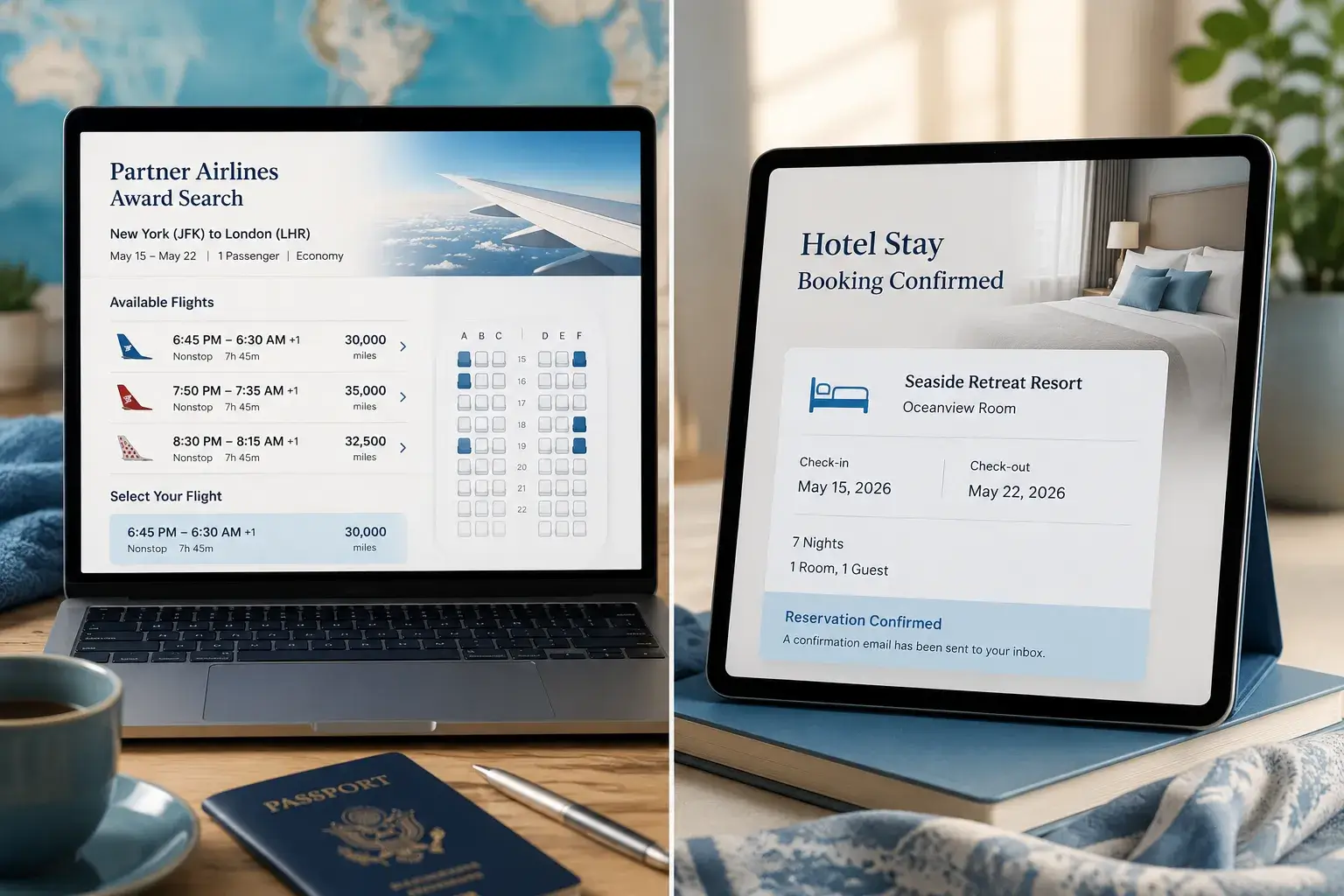
Points become usable travel by either transferring to a partner program and booking directly with that partner, or redeeming through the issuer’s own travel portal at a fixed value. The partner transfer route almost always produces a higher cents-per-point outcome for premium cabin flights and higher-end hotels.
How to Redeem Travel Points for Flights
The most reliable process is confirming award availability on the partner’s own site before transferring any points, since transfers are typically final. A basic booking walkthrough looks like this:
- Identify the route and cabin. Decide whether the trip needs economy, premium economy, business, or first class, and note flexible date ranges.
- Search award space on the partner airline’s site or an award search tool, not the transferring bank’s portal, since the bank’s own search often does not reflect true partner inventory.
- Confirm taxes and fees, especially for airlines and routes known for adding fuel surcharges, which can turn an otherwise good redemption into a weak one.
- Transfer only the exact points needed, plus a small buffer if the transfer speed is uncertain, since some transfers take minutes and others take days.
- Book immediately after the points land, because award space can disappear while a transfer is processing.
A tool like an award search engine, such as the one reviewed in this PointsYeah review for 2026, can speed up step two by scanning multiple partner programs for open award seats at once, saving significant manual search time.
How to Maximize Points Value
Maximizing points value means matching each redemption to the strategy that produces the highest realistic cents-per-point, not simply the easiest option. Portal bookings at a fixed 1 to 1.5 cents per point are convenient but rarely competitive against a well-executed partner transfer for business or first class.
Decision rule: use the issuer’s travel portal when award availability on partners is poor, the trip is short notice, or the redemption is for basic economy where partner transfers add little upside. Use a partner transfer when targeting premium cabins, when a strong sweet spot exists (such as Aeroplan’s stopover-friendly award chart or ANA’s fixed-region pricing on Amex-eligible transfers), or when a transfer bonus is active. For readers who want to combine balances from several cards to hit a bigger redemption, this guide on combining points from multiple cards for one award trip covers how to do that without losing value.
The Beginner Mistakes That Quietly Destroy Point Value
Most wasted points come from process errors, not bad luck. The most damaging mistakes happen before a single point is ever redeemed.
- Transferring before confirming availability. Points sitting in a partner account with no matching award space are effectively stuck until availability appears.
- Ignoring fuel surcharges and carrier fees. Some airline partners add surcharges of $200 to $600 or more per ticket on certain routes, even on an award booking.
- Letting points sit through a devaluation. Programs can and do lower award chart value or raise dynamic pricing with little warning; the 2026 points devaluation defense plan covers how to reduce this exposure.
- Redeeming through a portal for basic economy. This often produces the weakest possible cents-per-point outcome for the balance.
- Overlooking married segments and positioning flights. Some award tickets require booking two segments together as one itinerary to unlock better pricing or routing, and getting this wrong can mean rebooking from scratch.
Do Travel Points Expire
It depends entirely on the program type. Most major transferable bank points (Chase, Amex, Capital One, Citi, Bilt) do not expire as long as the account stays open and in good standing. Many airline and hotel programs still expire miles or points after 12 to 24 months of no earning or redemption activity, though some, like Delta SkyMiles and Southwest Rapid Rewards, no longer expire points at all.
Common mistake: assuming all points behave like bank points. A reader who parks miles in an airline account for three years without any account activity can return to find the balance wiped out. For hotel-specific rules, see this breakdown of whether hotel points expire in 2026.
Travel Points Scams to Watch Out For
The most common scams involve fake “point transfer” services, unauthorized account access, and phishing emails posing as a bank or airline asking to “verify” a points balance. Legitimate programs never ask for a password or full card number over email or text to protect a points balance.
Edge case to watch: third-party sites offering to sell miles or points below market rate almost always violate program terms and can result in the receiving account being frozen or the miles being clawed back. Points and miles should only move between an account holder’s own program accounts or through official transfer partnerships.
Your First 90 Days: A Simple Starting Plan
A beginner does not need five cards and three loyalty programs to start seeing real value. A focused 90-day plan produces a usable points balance and the foundational knowledge to redeem it well.
- Days 1 to 7: Pick one transferable bank points program (Chase, Amex, or Capital One are the most versatile starting points) based on current spending habits.
- Days 8 to 30: Apply for one card that fits, redirect recurring bills to it, and start tracking progress toward the minimum spend for any welcome bonus.
- Days 31 to 60: Research two or three transfer partners relevant to a realistic future trip, and note their award charts, sweet spots, and any known surcharge issues.
- Days 61 to 90: Run a practice award search on a partner site or search tool without transferring any points yet, to understand what real availability looks like for the target route.
- After day 90: Once the welcome bonus posts and a specific trip and dates are set, confirm award space first, then transfer only what is needed and book immediately.
This pace avoids the two most common beginner traps: opening too many cards before understanding any one program, and transferring points speculatively without a confirmed use.
Frequently Asked Questions
What are travel points worth on average in 2026? Bank points from Chase, Amex, Capital One, Citi, and Bilt generally range from 1.85 to 2.2 cents each, while airline miles and hotel points vary more widely, from roughly 0.4 cents for Hilton Honors up to 3 cents or more for premium international airline transfers.
Is it better to redeem points through a bank’s travel portal or transfer to a partner? Transferring to a partner airline or hotel program usually produces higher value, especially for business class, first class, or upscale hotel stays. The issuer’s portal is more convenient for last-minute economy travel or when no partner award space exists.
Do bank points expire if the account stays open? No, most transferable bank points from Chase, Amex, Capital One, Citi, and Bilt do not expire as long as the associated account remains open and active. Airline and hotel points have more varied rules and can still expire from inactivity in some programs.
How many points does a beginner need for a meaningful trip? A round-trip domestic economy flight often costs 15,000 to 25,000 points, while a one-way international Business Class seat can require 70,000 to 150,000 points depending on the airline and route. Hotel awards range from under 10,000 points per night for budget properties to over 60,000 for luxury Hyatt or Marriott-category resorts.
Should a beginner focus on one points program or spread earning across several? Focusing on one transferable bank points program builds a usable balance faster and reduces confusion around transfer partners and award charts. Spreading earning too thin across multiple programs early on often leaves every balance too small to book anything meaningful.
What is the biggest mistake beginners make with points? Transferring points to a partner program before confirming that award space actually exists for the desired flight or hotel. Since most transfers are final, this single step causes more wasted points than any other beginner error.
Conclusion
Travel points reward patience and process more than speed. The programs that consistently deliver the best value in 2026 are transferable bank points, because they adapt to whichever airline or hotel partner has real award availability when a trip comes together. Airline miles and hotel points can outperform bank points on specific sweet spots, but they carry more expiration risk and narrower use cases.
The practical next step is simple: choose one transferable points program that matches current spending, learn its two or three most useful transfer partners, and confirm award availability before ever moving a single point. From there, readers ready to go deeper should review the current transferable points program comparisons and the step-by-step guide to redeeming points for flights to turn a growing balance into an actual trip.


Content on Award Travel Hub is independently created by Award Travel Hub Editorial Desk and, where noted, reviewed by Award Travel Hub Review Desk. Some pages may contain affiliate links, but compensation does not determine our coverage, opinions, or methodology.