

Last updated: October 8, 2026
Quick Answer: Travel points come in three main types. Bank points (Chase, Amex, Capital One, Citi, Bilt) are flexible and can move to many partners. Airline miles buy flights in one program and its partners. Hotel points buy award nights at one chain. Bank points are usually the most valuable to hold because you can wait to choose the best transfer partner. Any of these points can lose value when you redeem them poorly, transfer them too early, or let them expire.
Key Takeaways
- Earn transferable points first. Their main advantage is optionality, because one balance can become miles or hotel points in many programs.
- Most bank-to-airline transfers are 1:1. Some hotel transfers use different ratios, such as Amex to Hilton at 1:2.
- Value is measured in cents per point (CPP): cash price minus award taxes, divided by points required.
- Points have no fixed dollar value. The same 60,000 miles can be a strong or weak redemption depending on route, date, and cabin.
- Transfers are final. Confirm award availability before moving any points.
- Hotel and airline points can expire after inactivity, while bank points generally last as long as the account stays open.
- Bonus points and transfer bonuses often come with conditions such as minimum spend, registration, or a specific booking rate.
- Never close a card before moving or redeeming its points.
What Points Are and Who Issues Them
Points are a loyalty currency issued by banks, airlines, or hotel chains in exchange for spending or travel. The issuer sets the earning rates, the redemption options, and the rules, and it can change any of them at any time. Points are not money in a legal sense. You hold them under the program’s terms.
How do credit card points actually work?
A credit card earns points on each purchase, usually 1 to 5 or more points per dollar depending on the category. The points land in a rewards account after each statement closes. From there, you can redeem them in a few ways:
- Cash back or statement credits: simple, but usually the lowest value, around 1 cent per point or less.
- Travel booked through the bank’s portal: a fixed rate per point, with no need for award availability.
- Transfers to airline and hotel partners: the most complex option, but where most outsized value comes from.
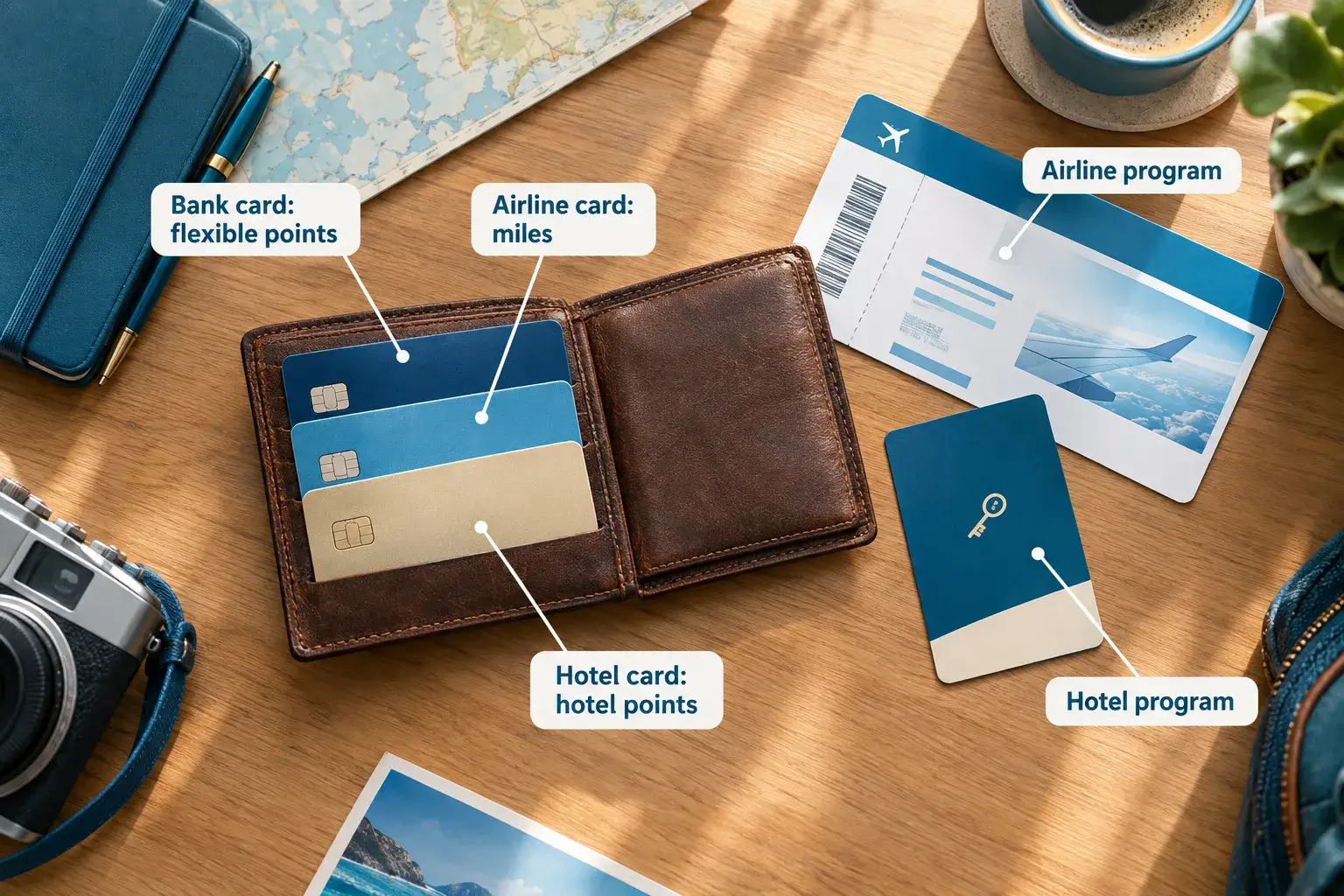
Who issues what: A Chase Sapphire card earns Chase Ultimate Rewards points. A Delta co-branded card earns Delta SkyMiles directly. A Marriott card earns Marriott Bonvoy points. That distinction drives everything that follows.
Bank Points vs Airline Miles vs Hotel Points
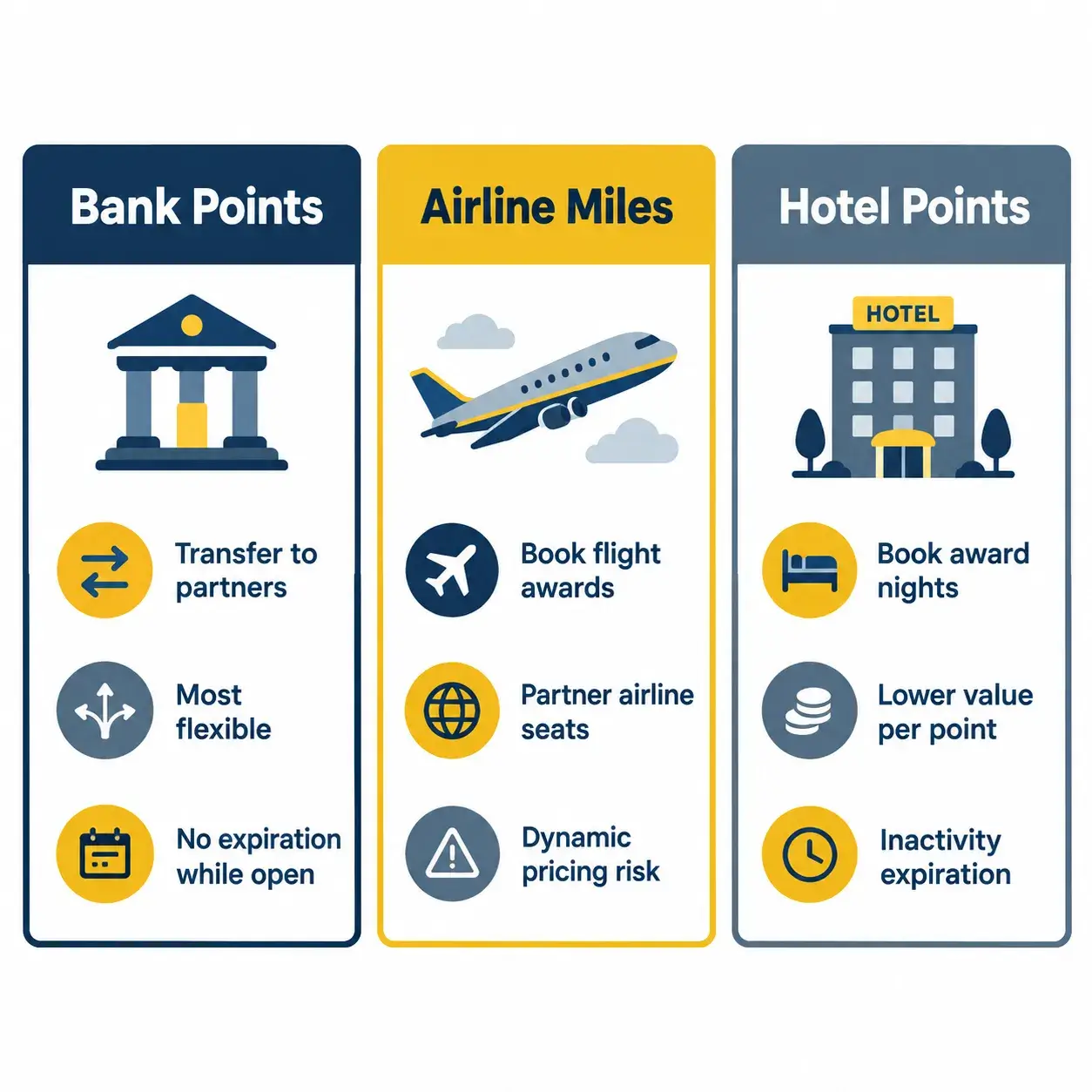
Bank points are flexible, airline miles are tied to one airline program, and hotel points are tied to one hotel chain. For most people, flexible bank points are the better currency to accumulate, because they can be converted later once you know exactly where you want to go.
| Feature | Bank points (Amex, Chase, Capital One, Citi, Bilt) | Airline miles | Hotel points |
|---|---|---|---|
| Main use | Transfer to partners or book via portal | Flight awards on airline and alliance partners | Award nights at one chain |
| Flexibility | High | Medium (alliance partners help) | Low |
| Typical value per point | Higher | Medium | Lower per point, but you earn more of them |
| Expiration | Generally none while account is open | Varies by airline | Often expire after inactivity |
| Main risk | Transfer ratio changes | Devaluations, dynamic pricing | Dynamic pricing, peak-night rates |
What’s the difference between points and miles?
The difference is mostly branding. “Miles” are rarely tied to distance flown anymore, and Capital One calls its bank currency “miles” even though it works like any other transferable point. What matters is the program behind the currency, its partners, and its rules.
You may be interested



Program rules also keep changing. Alaska’s Atmos Rewards, for example, began letting members choose in October 2026 whether flights earn based on distance, segments, or ticket price. New members joining from January 2027 will default to price-based earning.
Are airline miles or hotel points better?
Neither is better in general. Airline miles usually produce more value per point, especially for premium cabin awards on international routes. Hotel points can be excellent at high-cost properties or during peak dates when cash rates spike. Choose airline miles if long-haul flights are your biggest expense. Choose hotel points if you book many hotel nights in expensive cities. For a deeper breakdown, see the guide on hotel points vs airline miles transfer strategy.
Do hotel points expire?
Many hotel points do expire after a period of inactivity. Marriott Bonvoy, Hilton Honors, and World of Hyatt generally expire points after 24 months with no earning or redeeming activity, and IHG uses stricter rules for members without status. Any qualifying activity, such as a small purchase on a co-branded card, typically resets the clock. Check the details in Do Hotel Points Expire 2026.
How You Earn Points Beyond Credit Card Spending
Credit cards are the fastest way to earn points, but they are not the only way. Flying, staying at hotels, shopping portals, dining programs, and rent payments (through Bilt) can all add points without extra spending.
- Flights and hotel stays: Paid bookings earn miles or hotel points. Award bookings usually do not.
- Shopping portals: Clicking through an airline or bank portal before buying online earns bonus points.
- Dining programs: Linking a card to an airline dining program earns miles at participating restaurants.
- Promotions: Hotel and airline promos can add bonus points if you register.
How to maximize credit card points earnings
Match each card to the categories where it earns the most. A simple setup is one card for dining and groceries, one for travel, and one for everything else. Card choice matters more than any single trick. Start with the best credit cards for points and miles in 2026 if you are building a setup from scratch.
What’s the catch with earning bonus points?
Bonus points almost always come with conditions. Welcome bonuses require a minimum spend in a set time frame, often several thousand dollars in three months. Some issuers limit how often you can earn a bonus on the same card family.
Promotions can also be narrower than they appear. From October 1, 2026, World of Hyatt replaced its flat new-hotel bonus with a double-points offer that requires booking a specific “New Hotel Member Bonus Offer” rate, capped at 25,000 bonus points per stay. Booking the wrong rate means no bonus.
Rule of thumb: Never spend more than you otherwise would to earn a bonus. Interest charges wipe out the value of points almost immediately.
What Points Are Worth and Why Value Varies
Points are worth whatever you redeem them for, and the range is wide. One Chase or Amex point might be worth under 1 cent as a gift card and over 2 cents in a business class transfer. Published valuations are useful reference points, not guarantees.
How much are credit card points worth in dollars?
The table below shows approximate reference ranges based on how major valuation sites typically value these currencies. Treat them as estimates. The low end reflects easy portal or cash-style redemptions, and the high end reflects good transfer redemptions. For current figures, see Points Explained: What Travel Points Are Worth in 2026.
| Currency | Approximate value range (cents per point) |
|---|---|
| Chase Ultimate Rewards | 1.0 to 2.0 |
| Amex Membership Rewards | 0.6 to 2.0 |
| Capital One miles | 0.5 to 1.8 |
| Citi ThankYou points | 0.5 to 1.8 |
| Bilt points | 1.0 to 2.0 |
| United, American, Delta miles | 1.0 to 1.6 |
| World of Hyatt | 1.5 to 2.0 |
| Marriott Bonvoy | 0.6 to 0.9 |
| Hilton Honors | 0.4 to 0.6 |
The CPP formula: (Cash price − taxes and fees on the award) ÷ points required × 100.
Example: A one-way business class seat costs $1,200 in cash, or 60,000 miles plus $80 in taxes. The math is ($1,200 − $80) ÷ 60,000 × 100 = 1.87 cents per point. A $250 hotel night for 50,000 Hilton points works out to 0.5 cents per point, which is normal for Hilton.
Also count opportunity cost. A paid ticket earns miles, and an award ticket generally does not.
Best ways to redeem airline miles
The strongest redemptions are usually international premium cabin awards, short-haul partner flights that are expensive in cash, and routes where fixed award charts still exist. Current examples include Flying Blue’s October 2026 Promo Rewards, with Europe to North America business class from 45,000 miles one-way for travel through March 2027. Those prices may apply to restrictive fare types, so check baggage and change rules.
Airline programs are also adding cash-and-miles options. American Airlines announced in October 2026 that AAdvantage members can combine miles and cash on eligible domestic flights (excluding Alaska and Hawaii). American has not published a fixed value per mile, so run the CPP math on each booking.
How do blackout dates affect airline miles?
Most major U.S. airlines no longer publish formal blackout dates. In practice, limited saver award space and dynamic pricing work like blackouts: on holidays and peak summer dates, low-priced awards may disappear or cost two to three times more miles. Book early, stay flexible on dates, and search partner airlines as well.
How do I know if points are worth the annual fee?
A card is worth its fee if: (extra points earned × a conservative CPP) + credits you would genuinely use > annual fee. Use a conservative value, such as 1.2 to 1.5 cents for bank points, not the best-case figure. If you would only redeem for cash back, compare against a no-fee card using credit card points vs cash back.
Transferring Points to Airline and Hotel Partners
Yes, you can transfer credit card points to airlines, and this is where flexible points create the most value. Transfers are typically 1:1 to airlines, usually arrive within minutes to a few days, and cannot be reversed.
Can you transfer credit card points to airlines?
Each bank has its own partner list and transfer ratios. Standard ratios as of late 2026:
| Bank program | Typical airline ratio | Hotel examples |
|---|---|---|
| Chase Ultimate Rewards | 1:1 | Hyatt, Marriott, IHG at 1:1 |
| Amex Membership Rewards | 1:1 for most airlines | Hilton 1:2, Marriott 1:1 |
| Capital One miles | 1:1 for most; a few at lower ratios | Varies by partner |
| Citi ThankYou | 1:1 for most, including American | Choice 1:2 |
| Bilt Rewards | 1:1 | Hyatt 1:1 through Dec 31, 2026, then 4:3 |
Ratios change. The Bilt-to-Hyatt shift to 4:3 on January 1, 2027, reduces the value of Bilt points for Hyatt stays even though earning rates stay the same. For partner-by-partner detail, see this guide to Citi ThankYou transfer partners.
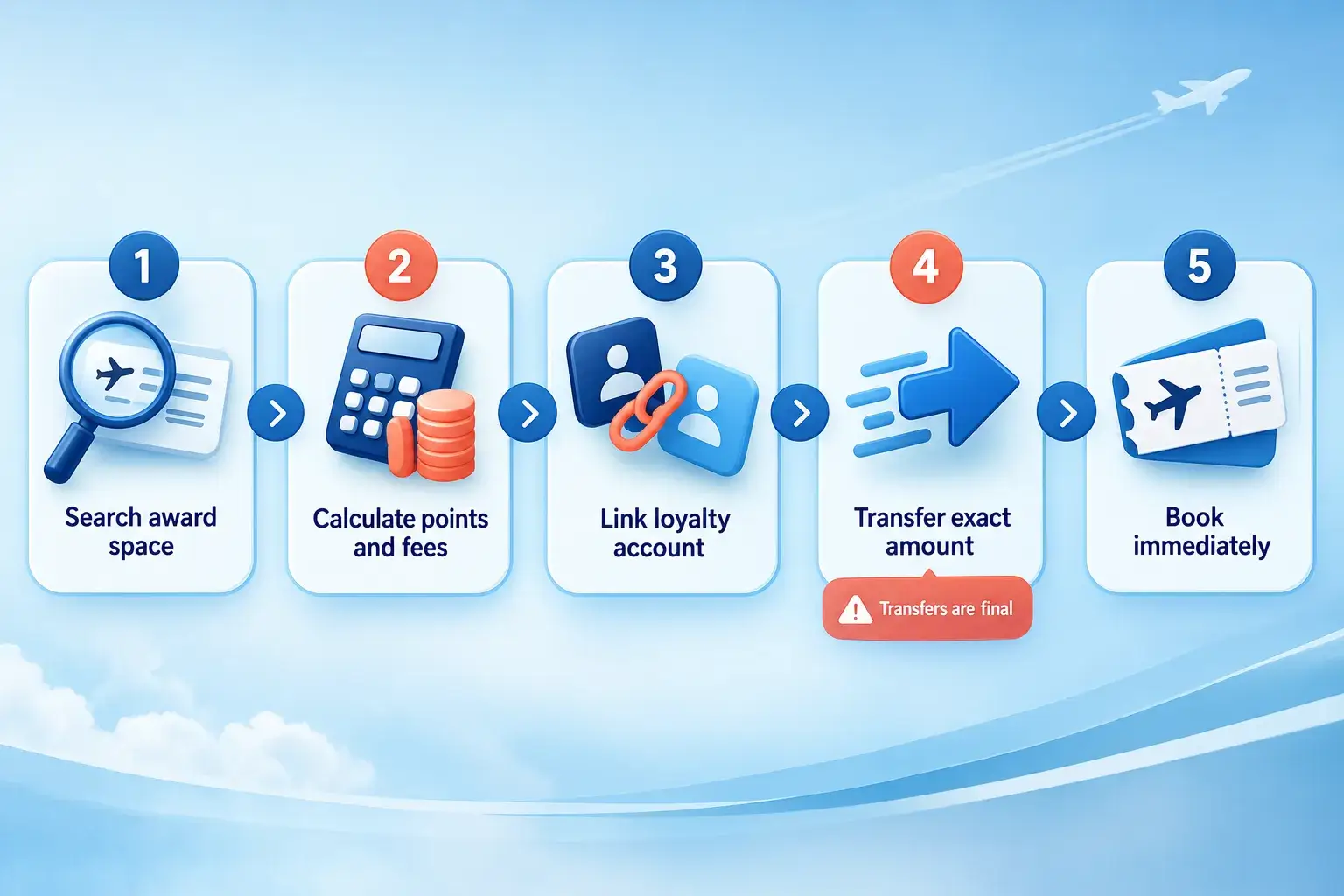
Safe transfer checklist:
- Search award availability in the partner program first.
- Calculate the exact points needed, plus taxes and fuel surcharges.
- Link your loyalty account to the bank account.
- Transfer only what you need (often in 1,000-point increments).
- Book immediately, because award space can disappear.
Transfer bonuses can lower the cost. In early October 2026, offers included 70% from Chase to Marriott (through October 15), 30% from Amex to Hilton (through October 14), 25% from Amex to Flying Blue, and 20% from Capital One to British Airways (both through October 31). A bonus only helps when you have a specific redemption ready.
Can you combine points from different cards?
You can combine points between cards in the same bank program, such as moving points from a Chase Freedom card to a Chase Sapphire account. You cannot combine Chase points directly with Amex points. You can, however, transfer from both banks into the same airline program, such as Flying Blue, and book one award. See how to combine points from multiple credit cards.
Common Beginner Mistakes to Avoid
Most lost value comes from a few avoidable errors: redeeming for low-value options, transferring before confirming space, and letting points expire or vanish with a closed card.
- Speculative transfers: Moving points “just in case” locks them into one program that may devalue.
- Low-value redemptions: Gift cards and merchandise often return well under 1 cent per point.
- Ignoring fees: Some partners add high fuel surcharges that erase the savings.
- Hoarding: Points lose value over time through devaluations. Earn and burn with a plan.
- Missing expiration dates: Track airline and hotel balances at least twice a year.
Best for / Not for: Transfer partners are best for travelers with flexible dates who will compare options. They are not for anyone who wants a guaranteed price with no searching. A portal booking or cash back may suit that traveler better.
What happens to points if I close my credit card?
Closing a card can forfeit its bank points if that was your only card in the program. Before closing, transfer points to another card in the same program, redeem them, or downgrade to a no-fee version. The guide to downgrading a travel credit card and keeping points covers the steps. Airline and hotel points earned through a co-branded card stay in your loyalty account.
Can you sell or gift your credit card points?
Selling points violates nearly every program’s terms and can lead to account closure and lost balances. Gifting is more limited but often allowed: many programs let you book awards for other people, Chase allows sharing with one household member, and Hilton allows free point pooling with up to 10 people.
FAQ
What are points in travel rewards? Points are a loyalty currency earned through card spending, flights, or hotel stays. They can be redeemed for travel, cash back, or transfers, depending on the program.
Are transferable points better than airline miles? For most travelers, yes. Transferable points can become miles in many programs, so you are not locked into one airline before you know your trip.
How long does a points transfer take? Most transfers to airlines and hotels arrive instantly or within a day, but some take several days. Check typical timing before you rely on a specific seat.
What is a good cents-per-point value? For bank points, many travelers target 1.5 cents or more. For hotel points like Hilton, around 0.5 cents is typical.
Do credit card points expire? Major bank points generally do not expire while the card account is open and in good standing. Airline and hotel points may expire after inactivity.
Should I use points for economy flights? Sometimes. Economy awards can make sense when cash fares are high, but premium cabins usually deliver more value per point.
Conclusion
Points work best when you treat them as a flexible currency with real risks, not as free money. Focus on earning transferable points, measure every redemption in cents per point, and transfer only after you confirm award space.
Next steps:
- Check which bank programs you already earn and list their transfer partners.
- Pick one goal trip and search award availability on two or three partner airlines.
- Run the CPP math against the cash price before transferring anything.
- Set reminders for airline and hotel point expiration dates.
- Review current valuations every few months, since ratios and award prices change.


Content on Award Travel Hub is independently created by Award Travel Hub Editorial Desk and, where noted, reviewed by Award Travel Hub Review Desk. Some pages may contain affiliate links, but compensation does not determine our coverage, opinions, or methodology.