

Last updated: July 5, 2026
Quick Answer: You can’t merge Chase, Amex, Citi, Capital One, and Bilt balances into one account — but you don’t need to. The practical workaround is to book separate one-way flights through different programs, fund hotels with a third currency, and use cash to cover fees. With 200,000–300,000 total points split across three or four programs, two people can realistically book business class to Europe or Asia in 2026 when you plan the routing before you transfer anything.
Key Takeaways
- Points can’t be merged across banks, but they can be strategically deployed on the same trip via separate bookings.
- Pool within each ecosystem first — consolidate all Chase cards into one Ultimate Rewards balance, all Amex cards into one Membership Rewards balance, etc.
- Book the outbound and return as separate one-way tickets through different programs to stretch two smaller balances into one round trip.
- Identify award availability before transferring — points moved to an airline are usually irreversible.
- Transfer bonuses (like Chase’s 20–30% Avios bonus through March 2026) can close a points gap without earning more.
- Burn high-devaluation-risk currencies first — programs with dynamic pricing or recent devaluation history should be spent before stable ones.
- Bilt Rent Day promotions offer periodic transfer bonuses that can accelerate a single program balance without extra spend.
- Hotels and positioning flights are natural places to deploy a third, smaller currency balance.
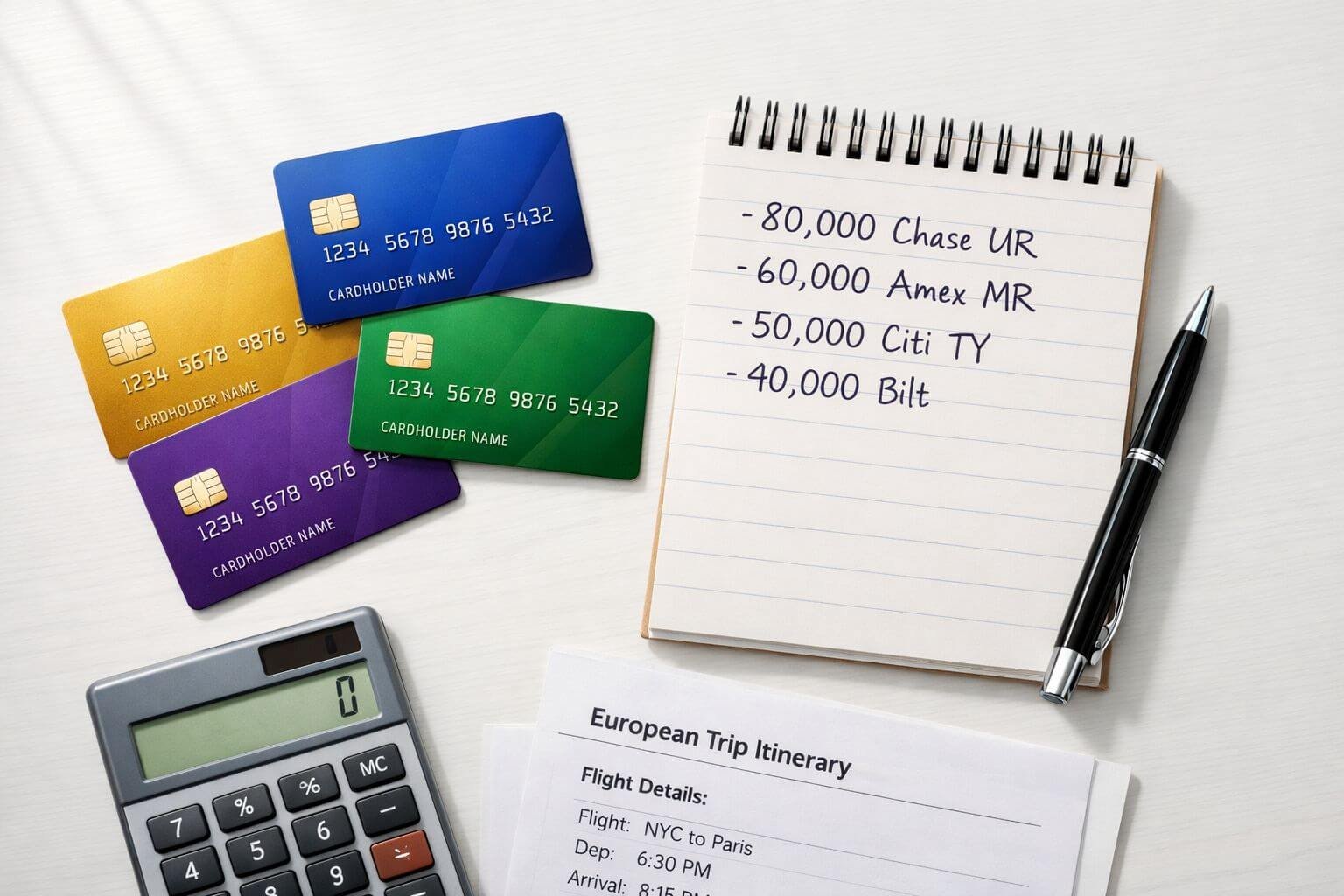
- A family of two with 80k Chase + 60k Amex + 50k Citi + 40k Bilt can book a viable Business Class trip to Europe or Japan with the right routing.
- Search award space first using tools like Seats.aero or Point.me — then decide which program to book through.
Why Scattered Points Don’t Have to Mean a Scattered Trip
The most common frustration in award travel goes something like this: “I have 80,000 Chase points, 60,000 Amex points, and 40,000 Bilt points — but none of them are enough for a business-class flight.” That’s a real constraint, but it’s not a dead end.
The key insight is that a trip is made up of multiple bookings — outbound flight, return flight, hotel nights, and sometimes a positioning flight. Each booking can come from a different currency. You’re not building one giant redemption; you’re assembling a set of smaller ones that together cover the whole trip.
This approach requires more planning upfront, but it’s exactly how experienced award travelers use what they have. See our guide to planning aspirational trips when award space is tighter than ever for the broader framework.
What You Can and Can’t Do When Combining Points Across Programs
Direct answer: You cannot transfer points between different bank ecosystems (e.g., Chase to Amex). But within each ecosystem, consolidation is straightforward — and across ecosystems, strategic deployment on separate bookings achieves the same goal.
What’s allowed
- Pool within one bank: Chase Ultimate Rewards can be combined across all your Chase cards (Freedom Flex, Freedom Unlimited, Sapphire Preferred, Sapphire Reserve, Ink cards) by moving points to one card. NerdWallet confirms Chase is a “point-combining powerhouse” for this reason.
- Book separately: Use Amex Membership Rewards to book the outbound on one airline, and Chase Ultimate Rewards for the return on a different carrier. Both tickets are on the same trip.
- Split flights and hotels: Use Citi ThankYou points or Capital One miles for flights; use Bilt or Hyatt points for hotels.
- Mix points and cash: Pay the outbound with points and the return in cash, or cover taxes and fees with a travel credit card.
What’s not allowed
- Transferring points from Chase to Amex (or any cross-bank transfer).
- Combining airline miles from two different programs on one ticket (with narrow exceptions like Star Alliance partner awards booked through a single carrier).
- Reverse-transferring points back from airline programs to bank currencies — once transferred, they’re gone.
Common mistake: Transferring points to an airline before confirming award availability. If the seat isn’t there, you’re stuck with miles in a program you may not need. Always search first, then transfer.
A Step-by-Step Framework: How to Combine Points From Multiple Cards for One Award Trip
This is the core workflow. Follow it in order — skipping steps is where most plans fall apart.
Step 1: Inventory your balances. List every transferable points balance: Chase UR, Amex MR, Citi ThankYou, Capital One miles, Bilt Rewards, plus any airline or hotel currencies. Note the approximate value using a consistent benchmark — our cents-per-point guide is a good starting point.
Step 2: Define the trip. Pick destination, travel window, and cabin (economy vs. business). Two people flying business class to Europe need roughly 100,000–130,000 points per person on most partner programs, or 200,000–260,000 total. To Japan, expect 90,000–130,000 per person, depending on the carrier and routing.
You may be interested



Step 3: Search award availability — before touching your points, use Seats.aero, Point.me, or AwardFares to find actual open seats. Check outbound and return separately. Note which programs have availability (e.g., ANA availability is bookable through Virgin Atlantic, or Lufthansa availability is bookable through United).
Step 4: Match availability to your currencies. Now connect the dots: which of your transferable points currencies can reach that award? Chase transfers to United, Air Canada Aeroplan, Singapore KrisFlyer, and others. Amex transfers to ANA, Air Canada, Delta, and more. See the full transfer partners guide for a complete breakdown.
Step 5: Check for active transfer bonuses. Before moving points, check whether any program has a live bonus. As of March 2026, Chase was offering 20–30% transfer bonuses to Avios programs (Aer Lingus, British Airways, and Iberia) and Wyndham through March 31. A 25% bonus means 80,000 Chase points become 100,000 Avios — which can close a gap without additional spending. For timing strategy, see our transfer bonus guide.
Step 6: Transfer and book in sequence. Transfer to the first program, book that ticket immediately, then transfer for the second booking. Don’t transfer everything at once.
Step 7: Cover hotels and fees with remaining balances. Use your smallest or lowest-value currency for hotel nights, positioning flights, or cash-equivalent redemptions.
Real Example: Europe Business Class for Two Using Three Currencies
Scenario assumptions: Two travelers, New York (JFK) to Paris (CDG) and back, business class, travel in October 2026. Starting balances: 90,000 Chase UR, 70,000 Amex MR, 45,000 Bilt points, 30,000 Citi ThankYou.
Outbound: JFK → CDG on Air France business class
- Program: Flying Blue (Air France/KLM’s loyalty program)
- Transfer source: Amex MR → Flying Blue at 1:1
- Cost: Approximately 55,000–65,000 Flying Blue miles per person in business class on a promo award (Flying Blue runs monthly promo awards). Two passengers: ~120,000 miles.
- Points used: 70,000 Amex MR transferred + 50,000 Amex MR from a second cardholder (partner or household member who also holds an Amex card). Or: use 70,000 Amex MR for one ticket and pay cash for the second if the cash fare is reasonable.
- Fees: Flying Blue charges modest carrier fees on transatlantic routes — typically $50–$150 per ticket. Pay with a travel credit card.
Return: CDG → JFK on United in Polaris business class
- Program: Chase Ultimate Rewards → United MileagePlus at 1:1
- Cost: 70,000 United miles per person in business class on a Saver award. Two passengers: 140,000 miles.
- Points used: 90,000 Chase UR (already pooled from multiple Chase cards). Gap of 50,000 miles covered by: (a) a Chase transfer bonus if active, (b) existing United miles, or (c) booking one ticket with miles and one with cash.
- Fees: United charges minimal carrier fees on transatlantic awards — often under $30 per ticket.
Hotels: 4 nights in Paris
- Program: Bilt Rewards → Hyatt at 1:1
- Cost: A Category 4 Hyatt in Paris runs 15,000–20,000 points per night. Four nights: 60,000–80,000 Hyatt points.
- Points used: 45,000 Bilt points transferred to Hyatt. Remaining nights paid with cash or Citi ThankYou points at 1 cent per point toward a hotel booking.
Total points deployed: ~120,000 Amex MR (outbound for two) + ~140,000 Chase UR (return for two) + 45,000 Bilt → Hyatt (hotels). The 30,000 Citi ThankYou points cover remaining hotel nights or incidentals at roughly $300 in value.
Cash outlay: Taxes and carrier fees, approximately $200–$400 total for two passengers.
Real Example: Japan Business Class for Two Using Chase, Amex, and Bilt
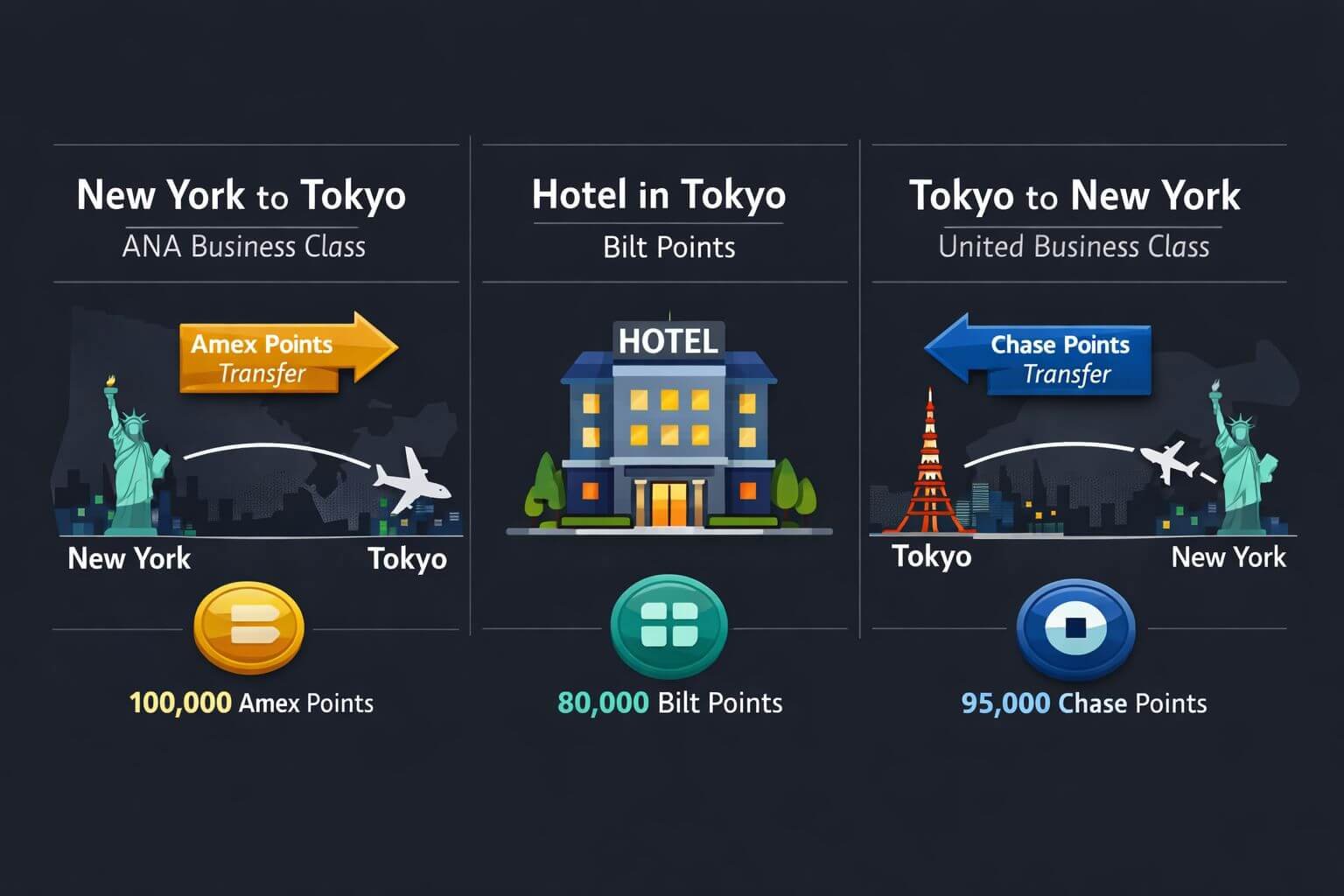
Scenario assumptions: Two travelers, JFK to Tokyo (NRT), business class, travel in March 2027 (booked in 2026). Starting balances: 100,000 Chase UR, 80,000 Amex MR, 50,000 Bilt points.
Outbound: JFK → NRT on ANA “The Room” business class
- Program: Amex MR → ANA Mileage Club at 1:1
- Cost: 88,000 ANA miles per person round-trip, or approximately 44,000 each way. Two passengers one-way: ~88,000 miles.
- Points used: 80,000 Amex MR + 8,000 ANA miles from existing balance (or earn the gap through ANA co-brand spend).
- Note: ANA’s award chart is distance-based and among the best-value options for transpacific business class. Fuel surcharges are low when booking directly through ANA.
Return: NRT → JFK on United Polaris
- Program: Chase UR → United MileagePlus at 1:1
- Cost: 70,000 United miles per person. Two passengers: 140,000 miles.
- Points used: 100,000 Chase UR covers one ticket fully (70,000 miles) with 30,000 remaining. The second ticket: book with remaining Chase UR after pooling all Chase cards, or supplement with a small cash co-pay if United’s pay-with-miles option is efficient.
Hotels: 5 nights in Tokyo
- Program: Bilt → Hyatt or World of Hyatt direct
- Cost: A Hyatt Regency Tokyo runs Category 4–5 (15,000–25,000 points/night). Five nights at Category 4: 75,000 points.
- Points used: 50,000 Bilt → Hyatt. Remaining two nights paid in cash (Tokyo hotels are expensive in cash; this is a reasonable split).
Travel rewards math check: Total business-class value for two round-trip transpacific tickets in cash would run $8,000–$14,000. Points deployed: roughly 268,000 across three programs. Effective CPP (cents per point): approximately 3–5 cents, well above the 1–2 cent baseline for most transferable points.
How to Prioritize Which Points to Burn First
Direct answer: Burn the points with the highest devaluation risk and lowest earning speed first. Preserve currencies that are stable, easy to earn, and have strong sweet spots you haven’t used yet.
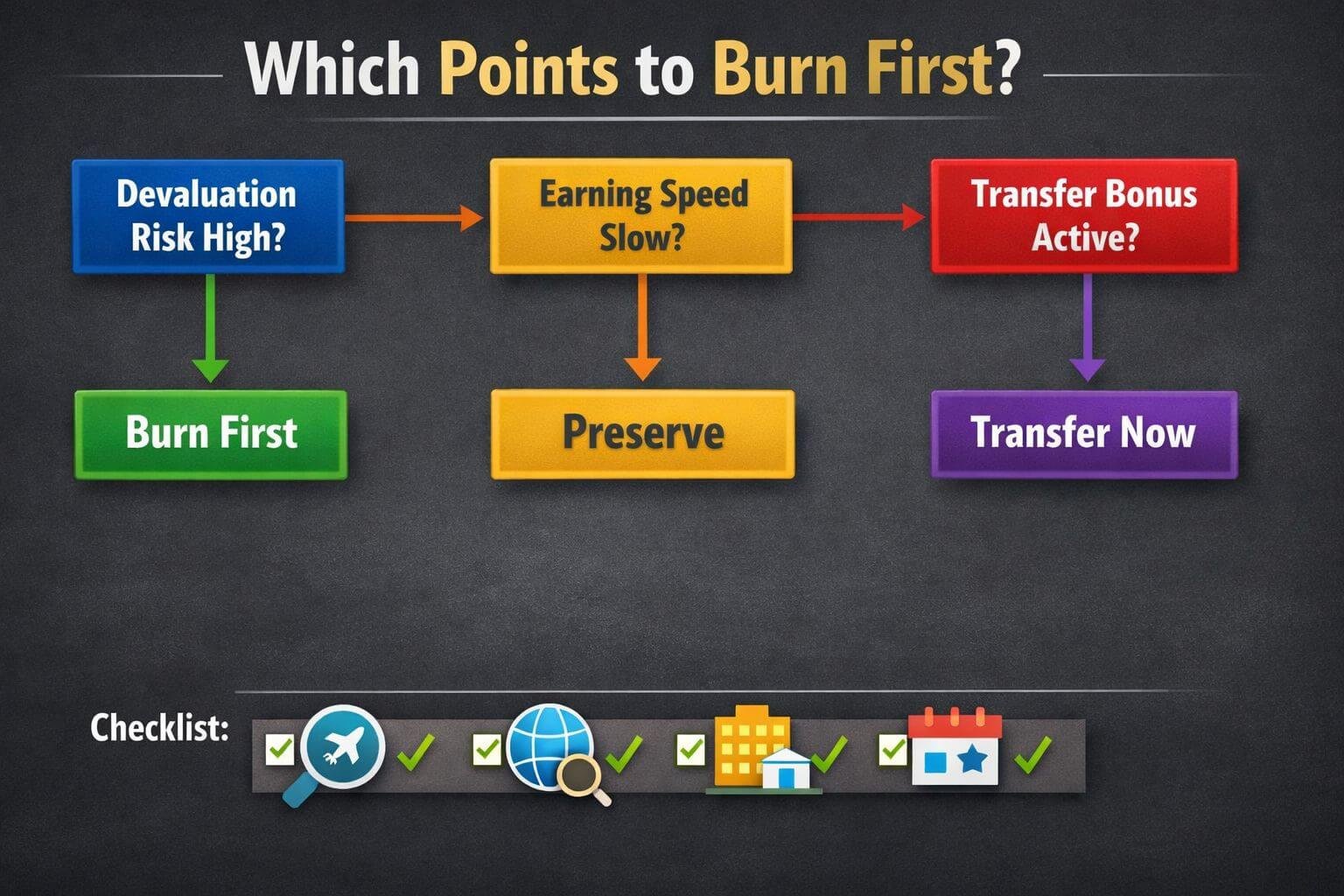
Use this decision framework:
| Priority | Burn First | Reason |
|---|---|---|
| 1 | Airline miles with dynamic pricing | No award chart protection; value erodes quickly |
| 2 | Hotel points with recent devaluations | Marriott Bonvoy is a current example — see our Marriott devaluation guide |
| 3 | Citi ThankYou (if transfer ratio cuts apply) | Citi reduced transfer ratios to Choice Privileges and Preferred Hotels in 2026 |
| 4 | Capital One miles | Flexible but fewer premium sweet spots than Chase or Amex |
| 5 | Chase Ultimate Rewards | Strong partner list, stable ratios, good sweet spots — preserve for high-value transfers |
| 6 | Amex Membership Rewards | Similar stability to Chase; ANA and Air Canada transfers remain strong |
| 7 | Bilt Rewards | Unique (only program that earns on rent); preserve for Hyatt transfers |
Devaluation risk note: TPG analysts have flagged continued devaluation pressure across transfer programs into 2026. Programs with dynamic pricing (Delta SkyMiles, most hotel programs) offer less predictable value than those with published award charts.
For a deeper valuation comparison, see our best use of 100,000 points guide and the January 2026 points valuations update.
Tools and Checklist for Planning a Multi-Program Award Trip
The right tools significantly cut planning time. For the search side, three tools cover most scenarios:
- Seats.aero — searches award availability across multiple programs simultaneously; best for finding open business-class seats across alliances.
- Point.me — shows which of your specific currencies can reach a given route; useful for matching your balances to available awards.
- AwardFares — strong for Star Alliance and SkyTeam searches; good alert functionality.
For a full comparison of these tools, see our award travel tools and alerts guide.
Pre-transfer checklist
- Inventory all transferable balances (bank currencies + airline/hotel miles)
- Define destination, dates, and cabin class
- Search award availability for outbound and return separately
- Confirm which programs can book the available seats
- Check for active transfer bonuses before moving points
- Verify transfer timelines (most are instant; some take 24–72 hours)
- Confirm award fees and surcharges before transferring
- Transfer to first program → book immediately → then transfer for second booking
- Use remaining balances for hotels, positioning flights, or incidentals
- Keep a small cash buffer for fees and taxes
On positioning flights: If your home airport doesn’t have nonstop award availability, a short domestic flight to a hub (say, flying from a regional airport to JFK before the transatlantic leg) can open up far better award options. See our positioning flight guide for the math on when this is worth it.
Frequently Asked Questions
Can I combine Chase and Amex points on one booking? No. Chase Ultimate Rewards and Amex Membership Rewards are separate currencies with no direct bridge. You can use each for separate bookings on the same trip — one for the outbound, one for the return, for example — but they can’t be merged into a single transaction.
Can I transfer points to a family member’s account? It depends on the program. Chase allows transfers to household members sharing an address. Amex allows transfers to other Amex cardholders but may charge a fee. Airline programs vary — some allow family pooling, others don’t. Check program rules before assuming.
What if I don’t have enough points in any one program for a full ticket? Three options: (1) book one ticket with points and one with cash, (2) use a transfer bonus to close the gap, or (3) use a program that allows partial points + cash payments (United’s “Pay with Miles” or similar). Booking one-ways also reduces the per-ticket cost compared to round-trip awards on some programs.
Is it better to book a round-trip or two one-ways when using multiple programs? Two one-way is usually more flexible and often more efficient when using two different currencies. Some programs charge the same for a one-way as a round trip (notably Aeroplan), which is worth checking. One-way also makes rebooking easier if one leg of the trip is rescheduled.
How long do transfers take? Most major bank-to-airline transfers (Chase, Amex, Citi, Capital One, Bilt) are instant or complete within a few minutes. Some programs take 24–72 hours. Never transfer the night before you need to book. Build in at least a 48-hour buffer .
What’s the best program for Europe business class in 2026? There’s no single answer, but strong options include: Aeroplan (Air Canada) for Star Alliance partners with low fees, Flying Blue for Air France/KLM (especially during promo award months), and Avios for British Airways short-haul or Iberia transatlantic. Each has tradeoffs on fees and availability. See our Europe award flights guide for a full breakdown.
Should I wait for a transfer bonus before moving points? If the award space is available and you’re confident in the booking, don’t wait indefinitely — award seats disappear. But if you’re within a few weeks of a known bonus period (like Bilt Rent Day or a Chase Avios promotion), it’s worth a short wait. See our transfer bonus timing guide for the decision framework.
Can I use points for taxes and fees on an award ticket? Generally, no — taxes and fees on award tickets must be paid in cash. Some programs allow using miles to offset fees, but this is usually a poor value. Pay fees with a travel card that earns points on all purchases, so you’re at least earning something back.
What happens if my award ticket gets canceled? Points are typically returned to your account if the airline cancels. If you cancel, rules vary by program — some charge a redeposit fee, others don’t. Review cancellation rules before booking, especially for multi-program trips, where a single cancellation could disrupt the entire itinerary. Our award cancellation fees guide covers the major programs.
Is Bilt worth building up for a big trip? Yes, particularly for Hyatt transfers. Bilt’s 1:1 transfer to Hyatt is one of the strongest hotel redemptions available, and Bilt is the only program that earns points on rent payments. The limitation is earning speed — unless you pay significant rent or use the Bilt card heavily for dining and travel, balances grow slowly. Bilt Rent Day promotions (monthly on the 1st) periodically offer transfer bonuses that accelerate value.
Conclusion
Scattered balances across Chase, Amex, Citi, Capital One, and Bilt aren’t a barrier to premium travel — they’re raw material for a multi-program booking strategy. The approach is straightforward: pool within each ecosystem, search for award availability before transferring anything, book outbound and return through separate programs, and use smaller balances for hotels or positioning flights.
The two examples above — Europe and Japan business class for two — show that 200,000–300,000 total points spread across three programs can realistically cover round-trip business-class flights and several hotel nights when the routing is planned carefully.
Your next steps:
- Run a full inventory of your transferable balances today.
- Use Seats.aero or Point.me to search availability for your target trip.
- Check for active transfer bonuses before moving any points.
- Review the best use of 100,000 points guide to benchmark your currencies.
- If you’re new to booking business class with points, the business class with points guide walks through the full process.
The points are already there. The plan is what’s missing — and now you have one.


Content on Award Travel Hub is independently created by Award Travel Hub Editorial Desk and, where noted, reviewed by Award Travel Hub Review Desk. Some pages may contain affiliate links, but compensation does not determine our coverage, opinions, or methodology.