Every year, millions of points expire unused. Travelers accumulate rewards through credit card spending, only to watch their balances sit idle because the redemption process feels overwhelming. In 2026, the landscape of points redemption has become more complex—but also more rewarding for those who understand the system.
Learning how to redeem points for flights in 2026 effectively can transform your travel budget. The difference between a mediocre redemption and an exceptional one can mean the gap between paying 150,000 points for economy or securing business class for the same cost. This guide walks through the complete process, from understanding your points currencies to clicking “confirm” on premium cabin awards that deliver outsized value.
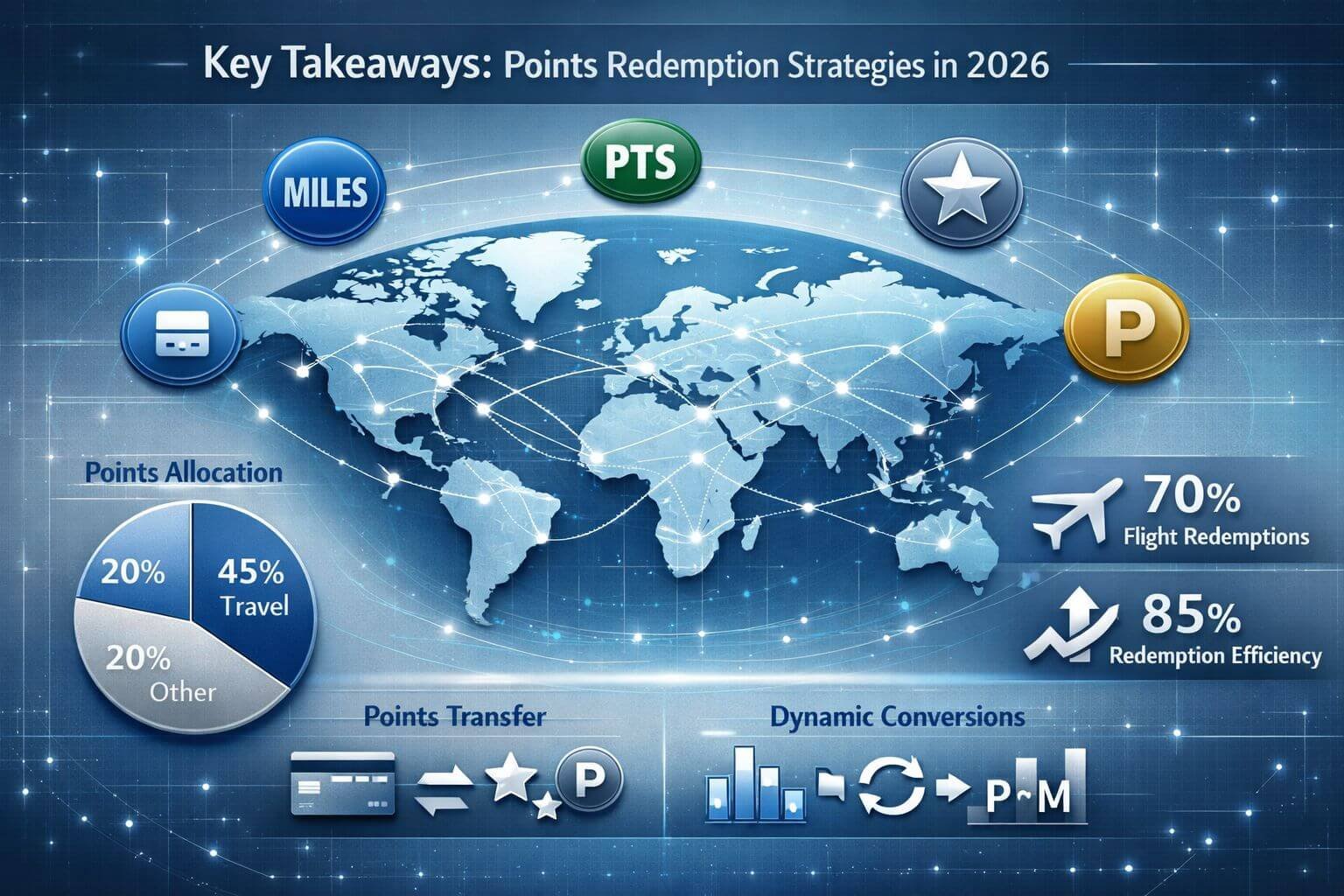
Key Takeaways
- Transfer partners unlock better value: Moving points from Amex, Chase, Capital One, Citi, or Bilt to airline programs typically delivers 30-50% more value than booking through credit card portals
- Award availability requires strategy: Premium cabin seats release according to predictable patterns; knowing when and where to search dramatically improves success rates
- Value calculation matters: Target 1.5+ cents per point for economy, 2+ for business class, and 3+ for first class to ensure redemptions beat cash fares
- Fees can destroy value: Fuel surcharges on some programs add $400-800 to “free” tickets; selecting low-fee partners protects your investment
- Timing drives results: Book 330-365 days out for long-haul premium cabins, watch for last-minute saver space, and leverage transfer bonuses to maximize points
Understanding Points Currencies in 2026
The foundation of smart redemptions starts with recognizing which points you hold and how they function.
Transferable Points vs. Airline Miles
Transferable points—earned through Amex Membership Rewards, Chase Ultimate Rewards, Capital One miles, Citi ThankYou Points, and Bilt Rewards—offer flexibility that airline-specific miles cannot match. These currencies transfer to multiple airline partners, allowing you to shop across programs for the best value.
The five major transferable currencies:
- Amex Membership Rewards: 21 airline partners including Delta, Air Canada, ANA, Virgin Atlantic
- Chase Ultimate Rewards: 11 airline partners including United, Southwest, Air France-KLM, Singapore Airlines
- Capital One Miles: 19 airline partners including Turkish Airlines, Air Canada, Avianca
- Citi ThankYou Points: 15 airline partners including Turkish Airlines, Avianca, Etihad
- Bilt Rewards: 13 airline partners including United, American, Alaska, Air Canada
Each currency maintains different transfer ratios and partner networks. Most transfers occur at 1:1 ratios, though some partners like Avianca LifeMiles receive transfers at different rates.
How Transfer Bonuses Work
Transfer bonuses periodically increase the value of moving points to specific partners. A 30% bonus means 100,000 points become 130,000 miles in the receiving program.
You may be interested



Common bonus patterns in 2026:
- Amex to Virgin Atlantic: Regular 30% bonuses (typically 3-4 times yearly)
- Chase to British Airways: Occasional 25-30% bonuses
- Capital One to Air Canada: Periodic 15-20% bonuses
- Citi to Turkish Airlines: Frequent 25% bonuses
Transfer bonuses amplify value but should not override fundamental redemption math. A 30% bonus to a mediocre program still delivers less value than standard transfers to an excellent program.
Decision Framework: Only chase transfer bonuses when the destination program offers competitive award pricing for your intended route. Calculate total points needed after bonus versus alternatives.
Understanding award travel trends shaping 2026 points strategy helps identify which programs will deliver the best long-term value.
Step-by-Step: How to Redeem Points for Flights 2026
The redemption process follows a consistent sequence regardless of which program you choose. Mastering these steps eliminates confusion and builds confidence.
Step 1: Determine Your Travel Goals
Start with destination, dates, and cabin preference. Flexibility in any of these variables dramatically improves award availability.
Key questions to answer:
- Where do you want to go? (specific city or region)
- When do you want to travel? (exact dates or date range)
- Which cabin class? (economy, premium economy, business, first)
- How many passengers?
- Are you willing to position to different airports?
A traveler searching for “Europe in summer” has more options than someone requiring “Paris on July 15-22.” The more flexible your parameters, the better your chances of finding available award space at reasonable rates.
Step 2: Research Award Availability
Award availability—the number of seats airlines release for points bookings—varies dramatically by route, season, and program. Searching availability before transferring points prevents the costly mistake of moving points to a program that cannot accommodate your trip.
Primary search tools:
- United.com: Shows United and Star Alliance partner space (free, no login required for basic searches)
- Air Canada Aeroplan: Displays Star Alliance availability with different filters
- British Airways: Excellent for searching oneworld partner space
- AwardFinder tools: PointsYeah, Seats.aero, Roame (subscription services with advanced filters)
Search multiple programs because each airline releases different inventory to different partners. A route showing no availability on United.com might have space when searched through Air Canada or ANA.
Common availability patterns:
| Route Type | Best Availability Window | Difficulty Level |
|---|---|---|
| Domestic US economy | 1-60 days out | Easy |
| Domestic US business | 90-330 days out | Moderate |
| Transatlantic economy | 90-330 days out | Easy |
| Transatlantic business | 330-365 days out | Moderate |
| Transpacific business | 330-365 days out | Difficult |
| Japan routes (any cabin) | 330-355 days out | Very Difficult |
Step 3: Calculate Points Value
Before committing points, calculate cents per point (CPP) to verify the redemption beats alternative uses.
CPP Formula:
CPP = (Cash ticket price - Award booking fees) ÷ Points required
Example calculation:
- Cash price for business class: $4,200
- Award price: 70,000 points + $150 in taxes
- CPP = ($4,200 – $150) ÷ 70,000 = 2.89 cents per point
Value thresholds:
- Poor value: Under 1.0 CPP (usually better to book cash or use a portal)
- Acceptable: 1.0-1.5 CPP (reasonable for economy)
- Good value: 1.5-2.5 CPP (solid for premium economy and business)
- Excellent value: 2.5-4.0 CPP (typical sweet spot redemptions)
- Outstanding: 4.0+ CPP (first class and exceptional business class deals)
These thresholds assume you value the cabin experience at cash prices. If you would never pay $4,200 for business class, the mathematical CPP becomes less relevant than your personal valuation.
Step 4: Select Your Transfer Partner
After confirming availability and value, choose which airline program to use for booking. This decision depends on:
Program-specific factors:
- Award pricing: Some partners charge fewer points for identical flights
- Fuel surcharges: Programs like British Airways add $400-800 in carrier-imposed fees on many routes
- Booking rules: Change fees, cancellation policies, and stopover allowances vary
- Transfer time: Most transfers complete within minutes to hours, but some take 1-3 days
Popular transfer partner sweet spots:
| Route | Best Program | Typical Cost | Why It Works |
|---|---|---|---|
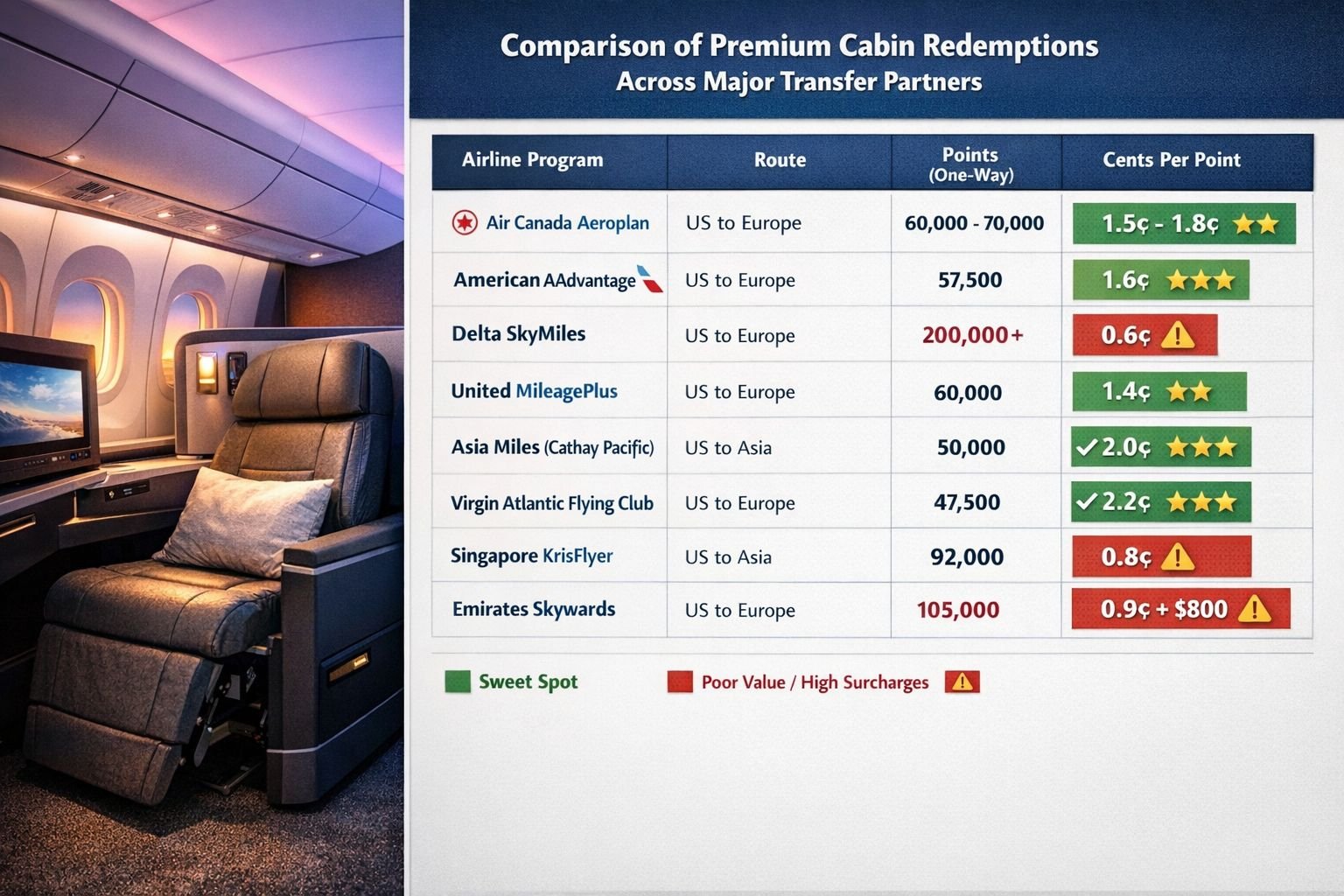
| US to Europe (business) | Air Canada Aeroplan | 60,000-70,000 | Low surcharges, good availability |
| US to Asia (business) | ANA Mileage Club | 75,000-90,000 | Reasonable pricing, minimal fees |
| US to Caribbean | Avianca LifeMiles | 35,000-40,000 | No fuel surcharges, good availability |
| Domestic US | United MileagePlus | 12,500-25,000 | Extensive network, no close-in fees |
| Australia/New Zealand | Virgin Atlantic | 50,000-60,000 | Exceptional value via ANA metal |
Selecting the optimal program requires comparing multiple options. A route might cost 70,000 points on one program with $150 in fees versus 80,000 points on another with $25 in fees—the second option delivers better total value.
Understanding airline fuel surcharges on award tickets helps avoid programs that destroy redemption value through excessive fees.
Step 5: Transfer Points and Book
Once you have verified availability and selected your program, execute the transfer and complete the booking.
Transfer process:
- Log into your credit card account (Amex, Chase, Capital One, Citi, or Bilt)
- Navigate to the transfer partners section
- Select the airline program and enter the transfer amount
- Confirm the transfer (most are instant, some take 1-3 business days)
- Wait for points to appear in the airline account
- Log into airline program and complete the booking
Critical timing note: Award space can disappear while points transfer. For competitive routes (Japan, Maldives, peak summer Europe), consider transferring speculatively if you have confirmed space and are ready to book immediately.
Booking walkthrough example:
Sarah wants to book Los Angeles to Paris in business class for September 2026. She searches United.com and finds availability on Air France for 70,000 United miles plus $150 in taxes. She has 75,000 Chase Ultimate Rewards points.
- Sarah confirms the dates work and the flight times are acceptable
- She calculates CPP: ($3,800 – $150) ÷ 70,000 = 5.2 CPP (excellent value)
- She compares alternatives: Air Canada wants 70,000 points, Virgin Atlantic wants 60,000 but adds $400 in surcharges
- She chooses United for the best total value (70,000 points + $150)
- She transfers 70,000 Chase points to United (arrives in 2 minutes)
- She books the award on United.com before space disappears
- She receives confirmation and adds the booking to her calendar
Premium Cabin Redemption Strategies
Premium cabin awards—business and first class—represent the highest-value use of transferable points for most travelers. The cash price gap between economy and premium cabins creates mathematical opportunities.
Business Class Sweet Spots
Business class redemptions consistently deliver 2-4 CPP when booked strategically. The key is identifying routes where award pricing remains reasonable while cash fares run high.
Top business class values in 2026:
Transatlantic routes:
- Air Canada Aeroplan: 60,000-70,000 points (off-peak)
- United MileagePlus: 70,000 points (saver awards)
- Virgin Atlantic: 50,000 points (on Delta metal, limited availability)
- Avianca LifeMiles: 63,000 points (no fuel surcharges)
Transpacific routes:
- ANA Mileage Club: 75,000-88,000 points (US to Japan)
- United MileagePlus: 80,000-90,000 points (saver space)
- Air Canada Aeroplan: 75,000-90,000 points (via Vancouver/Toronto)
Positioning strategy:
Flying from secondary cities often requires more points than departing from major hubs. Consider booking a separate positioning flight in economy to reach gateway cities like New York, Los Angeles, San Francisco, or Chicago, where premium cabin availability concentrates.
A traveler in Nashville might book a $150 cash ticket to New York, then use 70,000 points for New York to London in business class rather than spending 100,000+ points for a Nashville to London routing with connections.
First Class Opportunities
First Class awards deliver the highest CPP values but require more points and are subject to severe availability constraints. Most programs have eliminated true First Class, making remaining options highly competitive.
Viable First Class programs:
- ANA First Class: 110,000-120,000 points (US to Japan)
- Lufthansa First Class: 87,000-110,000 points (via Aeroplan or United, requires calling)
- Singapore Suites: 90,000-110,000 points (limited to specific routes)
- Emirates First Class: 85,000-100,000 points (via Alaska or Japan Airlines)
First Class availability requires booking at 330+ days out and significant flexibility. These awards disappear within hours of release for popular routes.
Reality check: First class redemptions make sense when you have surplus points and the experience matters to you. The incremental point cost over business class (often 30,000-50,000 additional points) may deliver better value when used for additional trips.
Avoiding Common Redemption Mistakes
Even experienced travelers make errors that waste points or create booking problems. These patterns appear consistently across redemption scenarios.
Mistake 1: Transferring Before Confirming Space
The error: Transferring points to an airline program before verifying award availability.
Why it happens: Excitement about a destination or misunderstanding the search process leads travelers to transfer speculatively.
The consequence: Points sit stranded in a program that cannot accommodate your dates, forcing you to either accept alternative dates or lose flexibility.
The solution: Always search award space thoroughly before transferring. Use multiple search tools to confirm availability across different programs. Only transfer when you have identified specific flights with confirmed space.
Mistake 2: Ignoring Fuel Surcharges
The error: Booking awards through programs that add $400-800 in carrier-imposed surcharges.
Why it happens: Focusing solely on point cost without calculating total out-of-pocket expense.
The consequence: A “free” ticket costs $600 in fees, destroying the value proposition.
The solution: Research surcharge policies before selecting a program. Programs like Avianca LifeMiles, United MileagePlus, and Air Canada Aeroplan charge minimal fees on most routes. British Airways, Air France-KLM, and Lufthansa often add substantial surcharges.
Surcharge comparison example:
| Program | Points | Surcharges | Total Value |
|---|---|---|---|
| British Airways | 50,000 | $650 | Poor (high fees destroy value) |
| Avianca LifeMiles | 63,000 | $75 | Excellent (minimal fees) |
| Air Canada Aeroplan | 60,000 | $150 | Good (reasonable total cost) |
Mistake 3: Booking Too Close to Departure
The error: Waiting until weeks before travel to search for award space.
Why it happens: Procrastination or hoping for better availability closer to departure.
The consequence: Premium cabin space has disappeared, leaving only expensive options or no availability.
The solution: Book long-haul premium cabins 330-365 days out when airlines release the most saver space. Set calendar reminders for booking windows. For domestic travel, 2-3 months provides adequate lead time.
Understanding award booking calendar strategy and when airlines release space prevents this common mistake.
Mistake 4: Overlooking Partner Airlines
The error: Only searching the program’s own flights instead of partner airline space.
Why it happens: Unfamiliarity with airline alliances and codeshare relationships.
The consequence: Missing better routing options, superior products, or more convenient schedules.
The solution: Learn which airlines partner with your chosen program. Star Alliance, oneworld, and SkyTeam members share award space. Additionally, bilateral partnerships exist outside alliances (like Alaska with Japan Airlines).
Major alliance partnerships:
- Star Alliance: United, Air Canada, ANA, Lufthansa, Swiss, Austrian, Singapore, Thai, Avianca, Copa, TAP
- oneworld: American, British Airways, Cathay Pacific, Qantas, Qatar, Iberia, Finnair, Japan Airlines
- SkyTeam: Delta, Air France, KLM, Virgin Atlantic (not a member but a partner), Korean Air, Aeromexico
Mistake 5: Not Comparing Multiple Programs
The error: Transferring to the first program that shows availability without comparing alternatives.
Why it happens: Relief at finding any availability leads to hasty decisions.
The consequence: Spending 20,000-40,000 more points than necessary or paying higher fees.
The solution: When you find availability, check if other programs can book the same flight for fewer points or lower fees. The same Air France flight might cost 70,000 United miles, 60,000 Virgin Atlantic miles (with high fees), or 63,000 Avianca miles (with low fees).
Advanced Booking Techniques
Once you master basic redemptions, advanced techniques unlock additional value and flexibility.
Stopover and Open-Jaw Routing
Some programs allow stopovers (staying in a connection city for days or weeks) or open-jaw routing (flying into one city, out of another) at no additional cost.
Programs with generous routing rules:
- Air Canada Aeroplan: One free stopover on international awards (additional stopovers for 5,000 points each)
- ANA Mileage Club: One stopover allowed on round-trip awards
- United MileagePlus: Allows open-jaw routing (no stopovers on partner awards)
- Alaska Mileage Plan: Generous stopover rules on partner awards
Example stopover strategy:
Book Los Angeles to Tokyo with a 3-day stopover in Seoul on the same award. Instead of two separate redemptions (LA to Seoul, Seoul to Tokyo), you book one award at the through rate, adding a mini-trip to South Korea.
Learning about Aeroplan stopovers to add a city for 5,000 points demonstrates how routing rules create value.
Positioning Flights
Positioning flights—separate tickets to reach a departure city with better award availability—often save points overall.
When positioning makes sense:
- Your home airport has limited international service
- Award space exists from major hubs, but not your city
- The positioning flight cost (cash or points) is less than the point premium for direct routing
Example:
- Direct award: Nashville to London = 100,000 points (limited availability)
- Positioned award: Nashville to New York ($180 cash) + New York to London (70,000 points)
- Total savings: 30,000 points minus $180 cash outlay
Book positioning flights on separate tickets with adequate connection time (4+ hours for domestic to international). Award tickets do not protect you if you miss the connection on a separate reservation.
Mixed-Cabin Awards
Some programs allow mixing cabin classes on a single award, charging based on the highest cabin flown or distance-based calculations.
Programs with mixed-cabin advantages:
- Air Canada Aeroplan: Prices each segment individually, allowing strategic cabin mixing
- United MileagePlus: Charges for the highest cabin on the entire itinerary
- ANA Mileage Club: Allows mixed cabins with complex pricing rules
Strategic use:
Book business class on the long-haul overnight segment where lie-flat seats matter, then economy on short daytime connections where comfort is less critical. This can save 20,000-40,000 points versus all-business routing.
Last-Minute Award Space
Airlines release unsold seats as awards close to departure, creating opportunities for flexible travelers.
Last-minute patterns:
- 2-14 days out: Airlines release unsold premium cabin inventory as awards
- 24-72 hours out: Additional space appears as airlines finalize loads
- Day of departure: Occasional releases, but unreliable for planning
Last-minute space requires flexibility and quick decision-making. Set award alerts through search tools to receive notifications when space opens.
Program-Specific Strategies for 2026
Each major transferable currency has unique strengths and optimal use cases.
Amex Membership Rewards
Best transfer partners:
- ANA Mileage Club: Excellent for Japan routes and round-the-world awards
- Virgin Atlantic: Strong value for Delta flights and ANA business class
- Air Canada Aeroplan: Versatile Star Alliance access with reasonable pricing
- Avianca LifeMiles: No fuel surcharges, good for Central/South America
Amex-specific advantages:
- Largest partner network (21 airlines)
- Frequent transfer bonuses to Virgin Atlantic
- Instant transfers to most partners
- Can pool points across personal and business cards
Watch out for:
- No Southwest or United as partners (major gap for domestic travel)
- Some partners have poor award availability (Delta SkyMiles)
Maximizing American Express Platinum Card value in 2026 helps earn more Membership Rewards for redemptions.
Chase Ultimate Rewards
Best transfer partners:
- United MileagePlus: Extensive domestic and Star Alliance network
- Southwest Rapid Rewards: Domestic travel with no blackout dates
- Air France-KLM Flying Blue: Monthly Promo Rewards with 25-50% discounts
- Singapore KrisFlyer: Premium cabin awards on Singapore and partners
Chase-specific advantages:
- United partnership covers domestic travel gaps
- Southwest transfers enable the companion pass strategy
- Strong portal value (1.5 cents per point with Reserve card) as a backup option
Watch out for:
- Limited oneworld access (only British Airways and Iberia)
- Fewer transfer partners than Amex (11 vs. 21)
Capital One Miles
Best transfer partners:
- Turkish Airlines Miles&Smiles: Excellent Star Alliance award pricing
- Air Canada Aeroplan: Strong all-around value
- Avianca LifeMiles: No surcharges, good availability
- Cathay Pacific Asia Miles: Good for Cathay and oneworld partners
Capital One-specific advantages:
- Transfer to multiple programs simultaneously
- Venture X card provides strong portal value (2 cents per point)
- Growing partner network
Watch out for:
- No United or Southwest partnerships
- Some partners require phone bookings (Turkish)
Citi ThankYou Points
Best transfer partners:
- Turkish Airlines Miles&Smiles: Best Star Alliance pricing
- Avianca LifeMiles: Consistent value with no surcharges
- Virgin Atlantic: Good for Delta and ANA bookings
- Etihad Guest: Unique access to Etihad and American Airlines space
Citi-specific advantages:
- Turkish partnership offers exceptional value
- Can transfer to multiple programs for comparison shopping
Watch out for:
- Smallest partner network among major currencies
- Limited domestic options
Bilt Rewards
Best transfer partners:
- United MileagePlus: Domestic and Star Alliance coverage
- American AAdvantage: oneworld access
- Alaska Mileage Plan: Strong partner access and generous routing rules
- Air Canada Aeroplan: Versatile international options
Bilt-specific advantages:
- Earn points on rent payments (unique value proposition)
- Monthly Rent Day bonuses increase the earning rate
- Growing partner network
Watch out for:
- Newer program with evolving partnerships
- No Southwest access
Tools and Resources for Award Searches
Efficient award searching requires the right tools. Free and paid options each serve specific purposes.
Free Search Tools
Airline websites:
- United.com: Best free tool for Star Alliance space
- British Airways: Excellent for oneworld partner searches
- Air Canada Aeroplan: Alternative Star Alliance view with different filters
- Qantas: Shows oneworld space (requires free membership)
Limitations of free tools:
- Must search each program separately
- No cross-alliance comparison
- Limited filtering options
- No automated alerts
Paid Search Tools
PointsYeah ($12-30/month):
- Searches multiple programs simultaneously
- Award alerts via email/text
- Calendar view shows availability across date ranges
- Covers Star Alliance and oneworld extensively
Seats.aero ($10-30/month):
- Real-time availability across programs
- Strong filtering by cabin, alliance, and aircraft type
- Telegram alerts for specific routes
- Excellent for competitive routes
Roame Travel ($20/month):
- AI-powered search across programs
- Suggests optimal redemption strategies
- Compares point costs across currencies
- Good for complex multi-city routing
Which tool to choose:
- Beginners: Start with free airline websites
- Intermediate: Add one paid tool (PointsYeah or Seats.aero)
- Advanced: Subscribe to multiple tools for comprehensive coverage
Comparing award search tools like PointsYeah vs. Seats.aero vs. Roame helps select the right option for your needs.
Maximizing Points Value: The Math That Matters
Understanding value calculations prevents poor redemptions and guides strategic decisions.
Cents Per Point Calculation
The CPP formula provides an objective comparison across redemption options:
Formula: CPP = (Cash price – Award fees) ÷ Points required
Example scenarios:
Scenario 1: Domestic economy
- Cash price: $350
- Award cost: 12,500 points + $11.20
- CPP = ($350 – $11.20) ÷ 12,500 = 2.71 CPP
- Verdict: Excellent value for domestic economy
Scenario 2: Transatlantic business
- Cash price: $4,200
- Award cost: 70,000 points + $150
- CPP = ($4,200 – $150) ÷ 70,000 = 5.79 CPP
- Verdict: Outstanding value
Scenario 3: Domestic economy (poor value)
- Cash price: $180
- Award cost: 25,000 points + $11.20
- CPP = ($180 – $11.20) ÷ 25,000 = 0.68 CPP
- Verdict: Poor value, book cash or use the portal
When Portal Bookings Make Sense
Credit card travel portals offer fixed-value redemptions (1.0-2.0 cents per point, depending on the card) with simpler booking processes.
Portal advantages:
- No need to understand airline programs
- Book any airline, any fare class
- Earn airline miles on paid tickets
- Simpler cancellation (follows airline policy)
Portal disadvantages:
- Lower maximum value (1.5-2.0 CPP vs. 3-6 CPP for transfers)
- No access to award-only space
- Prices follow cash rates (high during peak periods)
When to use portals:
- CPP calculation shows a transfer value under 2.0
- Need last-minute domestic economy
- Want to earn elite qualifying miles
- Prefer booking simplicity over maximum value
Opportunity Cost Considerations
Points have opportunity cost—using them for one trip means not using them for another.
Decision framework:
- High-value redemptions (3+ CPP): Usually worth booking
- Medium-value redemptions (1.5-2.5 CPP): Depends on personal valuation and future plans
- Low-value redemptions (under 1.5 CPP): Usually better to pay cash or use the portal
Example decision:
You have 100,000 Chase points and two trip options:
- Domestic US trip: 25,000 points for a $400 flight (1.6 CPP)
- Save points for future Europe business class: 70,000 points for a $4,000 flight (5.7 CPP)
The Europe redemption delivers 3.5x more value per point. If you can pay cash for the domestic trip, saving points for Europe makes mathematical sense.
Protecting Your Redemption Investment
After booking, several strategies protect your award and maximize flexibility.
Understanding Change and Cancellation Policies
Award ticket change and cancellation rules vary by program and fare type.
Generous programs:
- United MileagePlus: Free cancellation up to departure (points redeposit free)
- Air Canada Aeroplan: Free cancellation within 24 hours, then a $100-150 fee
- Southwest Rapid Rewards: Free cancellation anytime (points return immediately)
Restrictive programs:
- Avianca LifeMiles: $150-200 cancellation fee plus $25 redeposit fee
- ANA Mileage Club: Varies by fare rules, often non-refundable
- Singapore KrisFlyer: $75 cancellation fee for most awards
Strategy: Book refundable awards when uncertain about dates. The flexibility justifies slightly higher point costs on some programs.
Schedule Changes and Rebooking
Airlines frequently change schedules, creating opportunities for rebooking.
Your rights after schedule changes:
- Minor changes (under 60 minutes): Usually, no recourse
- Moderate changes (1-3 hours): May request alternative routing
- Major changes (3+ hours or different day): Entitled to full refund or rerouting
Proactive monitoring:
- Check bookings monthly for schedule changes
- Set alerts through airline apps
- Contact the airline immediately when changes occur
- Request better routing if available (longer connections, preferred aircraft, etc.)
A schedule change gives leverage to request improvements. If your 2-hour connection is reduced to 1 hour, request a longer connection. If availability exists in Business Class on a different flight, request the upgrade.
Travel Insurance Considerations
Award tickets qualify for travel insurance through credit card benefits and third-party policies.
Credit card coverage:
- Most premium travel cards provide trip cancellation/interruption insurance
- Coverage typically requires paying taxes/fees with the card
- Review terms carefully—coverage varies by issuer
Third-party insurance:
- Covers non-refundable taxes and fees
- Protects against missed connections and delays
- Useful for complex awards with positioning flights
Understanding best credit cards for travel insurance in 2026 ensures adequate protection.
Regional Redemption Strategies
Different regions require tailored approaches based on airline networks and pricing patterns.
North America
Domestic US:
- Best programs: United, Southwest, American, Alaska
- Typical costs: 12,500-25,000 points economy, 25,000-50,000 business
- Strategy: Book 2-3 months out, watch for saver space
US to Canada/Mexico/Caribbean:
- Best programs: United, Avianca LifeMiles, British Airways (short distances)
- Typical costs: 12,500-35,000 points economy, 30,000-50,000 business
- Strategy: Avoid British Airways for long distances (distance-based pricing)
Europe
Transatlantic:
- Best programs: Air Canada Aeroplan, United, Avianca LifeMiles
- Typical costs: 30,000-40,000 economy, 60,000-70,000 business
- Strategy: Book 330+ days out for business, avoid British Airways surcharges
Within Europe:
- Best programs: Air France-KLM Flying Blue (Promo Rewards), Avianca LifeMiles
- Typical costs: 10,000-20,000 points economy
- Strategy: Watch for Flying Blue monthly promos (25-50% off)
Asia
Transpacific:
- Best programs: ANA Mileage Club, United, Air Canada Aeroplan
- Typical costs: 35,000-45,000 economy, 75,000-90,000 business
- Strategy: Book 330-355 days out (Japan routes), consider positioning to the West Coast
Within Asia:
- Best programs: Singapore KrisFlyer, Avianca LifeMiles, Air Canada Aeroplan
- Typical costs: 15,000-30,000 economy, 30,000-50,000 business
- Strategy: Watch for Singapore KrisFlyer spontaneous escapes
South America
US to South America:
- Best programs: Avianca LifeMiles, United, Air Canada Aeroplan
- Typical costs: 25,000-35,000 economy, 50,000-63,000 business
- Strategy: Avianca offers the best value with no surcharges
Africa and the Middle East
US to Africa:
- Best programs: United, Turkish Airlines, Ethiopian via Avianca
- Typical costs: 40,000-50,000 economy, 75,000-100,000 business
- Strategy: Limited options, book early, consider positioning through Europe
US to Middle East:
- Best programs: Turkish Airlines, Etihad Guest, Air Canada Aeroplan
- Typical costs: 40,000-50,000 economy, 70,000-90,000 business
- Strategy: Turkish offers excellent value, watch for Etihad space to Abu Dhabi
Future-Proofing Your Points Strategy
The points landscape evolves constantly. Staying ahead requires understanding trends and adjusting strategy.
Devaluation Risk Management
Airlines regularly devalue programs by increasing award costs or reducing availability.
Recent devaluation patterns:
- Dynamic pricing replacing award charts (Delta, United increasingly)
- Partner award costs increasing (Air Canada 2024-2025 changes)
- Reduced saver availability on popular routes
Protection strategies:
- Book valuable awards when you find them (don’t hoard indefinitely)
- Diversify points across multiple currencies
- Transfer speculatively for high-value redemptions when space exists
- Monitor program changes through the award travel communities
Earning Strategy Alignment
The redemption strategy should align with the earnings strategy.
If you primarily earn Chase points:
- Focus on United and Southwest for domestic travel
- Transfer to Air France-KLM for Europe
- Use Singapore for premium Asia travel
If you primarily earn Amex points:
- Focus on ANA for Japan and Star Alliance
- Use Virgin Atlantic for Delta and ANA
- Transfer to Avianca for no-surcharge awards
If you earn multiple currencies:
- Maintain flexibility across programs
- Transfer based on specific redemption opportunities
- Watch for transfer bonuses to accelerate bookings
Understanding best business credit cards for award travel in 2026 helps optimize earning rates.
Staying Informed
Award travel requires ongoing education as programs change.
Key information sources:
- Award travel blogs (Award Travel Hub, Frequent Miler, One Mile at a Time)
- Reddit communities (r/awardtravel)
- FlyerTalk forums (program-specific threads)
- Award search tool newsletters
Monthly review process:
- Check for program devaluations or enhancements
- Review transfer bonus opportunities
- Monitor award space for planned trips
- Adjust strategy based on availability patterns
Conclusion
Learning how to redeem points for flights in 2026 effectively transforms travel possibilities. The process—from understanding transferable currencies through executing bookings—becomes straightforward with practice. Start with clear travel goals, thoroughly research award availability, calculate value objectively, and select optimal transfer partners.
The difference between mediocre and exceptional redemptions comes down to preparation and knowledge. A traveler who books the first available award might spend 100,000 points for economy to Europe. An informed traveler books business class for 70,000 points by selecting the right program, avoiding surcharges, and booking during optimal windows.
Your next steps:
- Inventory your points: Log into each credit card account and note current balances
- Define your goal trip: Choose destination, dates (with flexibility), and preferred cabin
- Search availability: Use free airline websites to confirm space exists
- Calculate value: Run CPP calculations on available options
- Select program: Choose the transfer partner offering the best total value
- Execute booking: Transfer points and complete the reservation
The award travel landscape in 2026 rewards strategic thinking and careful research. Programs continue evolving, but fundamental principles—finding availability, calculating value, avoiding fees, and booking strategically—remain constant.
For travelers ready to move beyond basic redemptions, exploring advanced award travel strategies and understanding program-specific sweet spots unlocks additional value.
Start with one successful redemption. The experience builds confidence for increasingly complex bookings. Whether redeeming 12,500 points for domestic economy or 90,000 points for business class to Asia, each booking reinforces the process and demonstrates the tangible value of transferable points.
The points you have earned represent real travel value. Understanding how to redeem points for flights in 2026 ensures you capture that value through bookings that deliver experiences worth far more than the points invested.





Content on Award Travel Hub is independently created by Award Travel Hub Editorial Desk and, where noted, reviewed by Award Travel Hub Review Desk. Some pages may contain affiliate links, but compensation does not determine our coverage, opinions, or methodology.