

July 28, 2026
Most points go to waste not because of bad redemptions, but because of bad earning. Cardholders put all their spending on one card, miss 3x and 4x bonus categories, and end up with a pile of points worth less than 1 cent each when redeemed through a travel portal. The gap between a mediocre points setup and a strong one often comes down to two decisions: which credit cards with points you hold, and how you pair them.
This guide covers the best points credit cards in 2026 across three earning strategies — flat-rate, bonus category, and transferable points — plus how to pair cards for maximum coverage and redeem points for real value.

Key Takeaways
- The best credit cards with points fall into three types: flat-rate earners, bonus category cards, and transferable points cards. Each serves a different role.
- Welcome bonuses remain the fastest way to accumulate a large points balance. Several cards currently offer bonuses worth over $1,500 in travel value.
- Transferable points — from Chase, Amex, Capital One, Citi, and Bilt — consistently deliver the highest redemption value when moved to airline and hotel partners.
- Pairing two cards (one flat-rate, one bonus category) often outperforms a single premium card for everyday spending.
- Redemption value depends on where you send your points. A point worth 1 cent in a portal can be worth 1.8–2.5 cents transferred to the right partner.
What Makes a Great Points Credit Card
Not all rewards cards are equal. A card that earns 2x on everything is not automatically better than one that earns 5x on dining if dining is your largest spending category. Evaluating credit cards with points requires looking at four factors together.
The four factors that matter:
- Earn rate by category — Does the card offer bonus multipliers on your actual spending? Dining, groceries, travel, and gas are the most common high-earn categories.
- Point currency quality — Are the points transferable to airline and hotel partners, or are they fixed-value? Transferable points have higher upside.
- Annual fee vs. net value — A $550 annual fee card can be worth holding if credits and earning offset the cost. A $95 card that earns mediocre points on your spending may not be.
- Transfer partners and redemption options — The more airline and hotel partners available, the more flexibility you have to find sweet spots and avoid dynamic pricing traps.
Quick framework: Is this card worth it for you?
| Question | If Yes | If No |
|---|---|---|
| Do you spend heavily in a bonus category? | Prioritize category cards | Consider flat-rate |
| Do you want premium cabin redemptions? | Prioritize transferable points | Fixed-value may work |
| Do you want simplicity? | One flat-rate card may be enough | Build a card stack |
| Are you comfortable with transfer rules? | Transferable points cards | Stick to portal redemptions |
Best Cards for Flat-Rate Points
Flat-rate cards earn the same number of points on every purchase, regardless of category. They are the best choice for spending that does not fall into a bonus category — utilities, insurance, rent (on some platforms), and miscellaneous purchases.

Top flat-rate picks in 2026
Capital One Venture X Rewards Credit Card
- Earn rate: 2x miles on all purchases, 5x on flights and 10x on hotels booked through Capital One Travel
- Annual fee: $395
- Key benefit: 10,000 anniversary miles, $300 travel credit through Capital One Travel, Priority Pass lounge access
- Points currency: Capital One miles — transferable to 15+ airline and hotel partners
You may be interested


Capital One Venture Rewards Credit Card
- Earn rate: 2x miles on all purchases, 5x on hotels and rental cars through Capital One Travel
- Annual fee: $95
- Best for: Travelers who want transferable miles without a high annual fee
Chase Freedom Unlimited
- Earn rate: 1.5x Ultimate Rewards points on all purchases, plus 3x on dining and drugstores, 5x on travel booked through Chase
- Annual fee: None
- Key benefit: When paired with a Sapphire card, points become transferable to Chase’s airline and hotel partners
Best for / Not for:
- Best for: Spending that earns no bonus on other cards; building a points base without tracking categories
- Not for: Maximizing dining or grocery spending, where category cards outperform by 2–3x
Best Cards for Bonus Category Points
Bonus category credit cards with points earn elevated rates on specific spending types. These cards are where most intermediate earners leave the most value on the table.

Top bonus category picks in 2026
American Express Gold Card
- Earn rate: 4x Membership Rewards points at U.S. restaurants and U.S. supermarkets (up to $25,000/year at supermarkets), 3x on flights booked directly with airlines
- Annual fee: $325
- Key benefit: Up to $120 dining credit, up to $120 Uber Cash annually
- Points currency: Amex Membership Rewards — transferable to 20+ airline and hotel partners
- Earn rate: 3x on dining, select streaming, and online groceries; 2x on all other travel; 5x on travel booked through Chase
- Annual fee: $95
- Key benefit: Strong transfer partner list including Hyatt, United, Air Canada Aeroplan, and Singapore Airlines; 25% bonus when redeeming through Chase Travel portal
- Points currency: Chase Ultimate Rewards — one of the most valuable transferable currencies
- Earn rate: 3x on travel and dining; 5x on flights and 10x on hotels through Chase Travel
- Annual fee: $550
- Key benefit: $300 annual travel credit (broad definition), Priority Pass, 50% bonus on portal redemptions
- Points currency: Chase Ultimate Rewards
Bilt Mastercard
- Earn rate: 3x on dining, 2x on travel, 1x on rent (up to 100,000 points/year with no transaction fee)
- Annual fee: None
- Key benefit: Rent payments earn points — a category no other major card covers without a fee
- Points currency: Bilt Rewards — transferable to American Airlines, United, Hyatt, Air Canada, and others
For a deeper look at how these cards stack up against each other, see the best travel credit cards for 2026 comparison.
Category coverage table:
| Spending Category | Best Card | Earn Rate |
|---|---|---|
| Dining (restaurants) | Amex Gold | 4x |
| U.S. supermarkets | Amex Gold | 4x |
| Rent | Bilt Mastercard | 1x (no fee) |
| Travel (general) | Sapphire Reserve | 3x |
| Online groceries | Sapphire Preferred | 3x |
| Flights (direct) | Amex Gold | 3x |
Best for / Not for:
- Best for: High dining and grocery spenders who can extract value from Amex or Chase transfer partners
- Not for: Cardholders who primarily spend in categories not covered by bonuses (use a flat-rate card for those)
Best Cards for Transferable Points
Transferable points are the foundation of high-value award travel. These currencies — Amex Membership Rewards, Chase Ultimate Rewards, Capital One miles, Citi ThankYou Points, and Bilt Rewards — can be moved to airline and hotel loyalty programs, often at a 1:1 ratio.
The value of transferable points depends entirely on where you send them. A Chase Ultimate Rewards point is worth 1 cent in the portal but can be worth 1.8–2.5 cents transferred to Hyatt or Air Canada Aeroplan for the right redemption.
Why transfer partners matter
Each transferable currency has a different set of partners. Before choosing a card, check whether its partners align with your travel goals.
| Currency | Key Airline Partners | Key Hotel Partners |
|---|---|---|
| Chase Ultimate Rewards | United, Southwest, Air Canada, Singapore, British Airways | Hyatt, IHG |
| Amex Membership Rewards | Delta, Air Canada, British Airways, ANA, Singapore, Air France | Marriott, Hilton |
| Capital One Miles | Air Canada, Turkish, Avianca, British Airways, Qantas | Wyndham, Choice |
| Citi ThankYou Points | Air France/KLM, Avianca, Turkish, Singapore, Cathay Pacific | Choice |
| Bilt Rewards | American, United, Air Canada, Alaska, Hyatt | Marriott |
For a full breakdown of how these currencies compare, see comparing transfer partners 2026: Chase vs Amex vs Citi vs Capital One.
Transfer ratio note: Most transfers happen at 1:1, but some partners (like Amex to Marriott) transfer at worse ratios such as 1:0.83. Always verify the transfer ratio before moving points — transfers are typically one-way and cannot be reversed.
Devaluation risk: Transferable points currencies are not immune to devaluation. The risk sits with the partner program, not the bank. If Hyatt changes its award chart or United shifts to fully dynamic pricing, the value of your Chase points for those partners changes too. Holding points in a bank currency rather than a loyalty program gives you flexibility to choose the best partner at booking time.
For guidance on how to calculate whether a specific redemption is worth it, see how to calculate cents per point.
Pairing Cards to Maximize Earning
No single card covers every spending category at a high rate. The most efficient setup pairs a bonus category card with a flat-rate card to minimize 1x earning.
The core two-card approach:
The most common and practical pairing for intermediate earners:
Amex Gold + Capital One Venture (or Venture X): Amex Gold handles dining and groceries at 4x. The Venture card covers everything else at 2x. The tradeoff is managing two different point currencies — Amex MR and Capital One miles — which require separate redemption strategies.
Chase Sapphire Preferred + Chase Freedom Unlimited: The Sapphire Preferred earns 3x on dining and travel. The Freedom Unlimited earns 1.5x on all other purchases. Because both earn Chase Ultimate Rewards, points pool together automatically. This is the simplest two-card stack for Chase loyalists.
Bilt Mastercard + Amex Gold: Bilt covers rent at 1x with no transaction fee, plus 3x dining and 2x travel. Amex Gold fills in with 4x at supermarkets. This pairing works well for renters who want to earn on their largest monthly expense.
Three-card stack (for higher spenders):
Adding a third card — typically a no-annual-fee flat-rate card like the Chase Freedom Unlimited — to a Sapphire + Amex Gold setup can capture residual spending at 1.5x instead of 1x. The incremental gain is modest but adds up over high monthly spend.
For a detailed look at one of the most popular pairings, see the best credit card combo for Hyatt and American Airlines.
Common pairing mistakes to avoid:
- Holding two cards that earn the same currency at similar rates — redundant coverage adds annual fees without adding earn rate
- Ignoring welcome bonuses — the fastest way to accumulate points is through sign-up bonuses, not everyday spending
- Transferring points before you have a confirmed redemption target — once transferred, points typically cannot be returned
See common mistakes when using travel credit cards for a fuller list of pitfalls.
Redeeming Your Points for Maximum Value
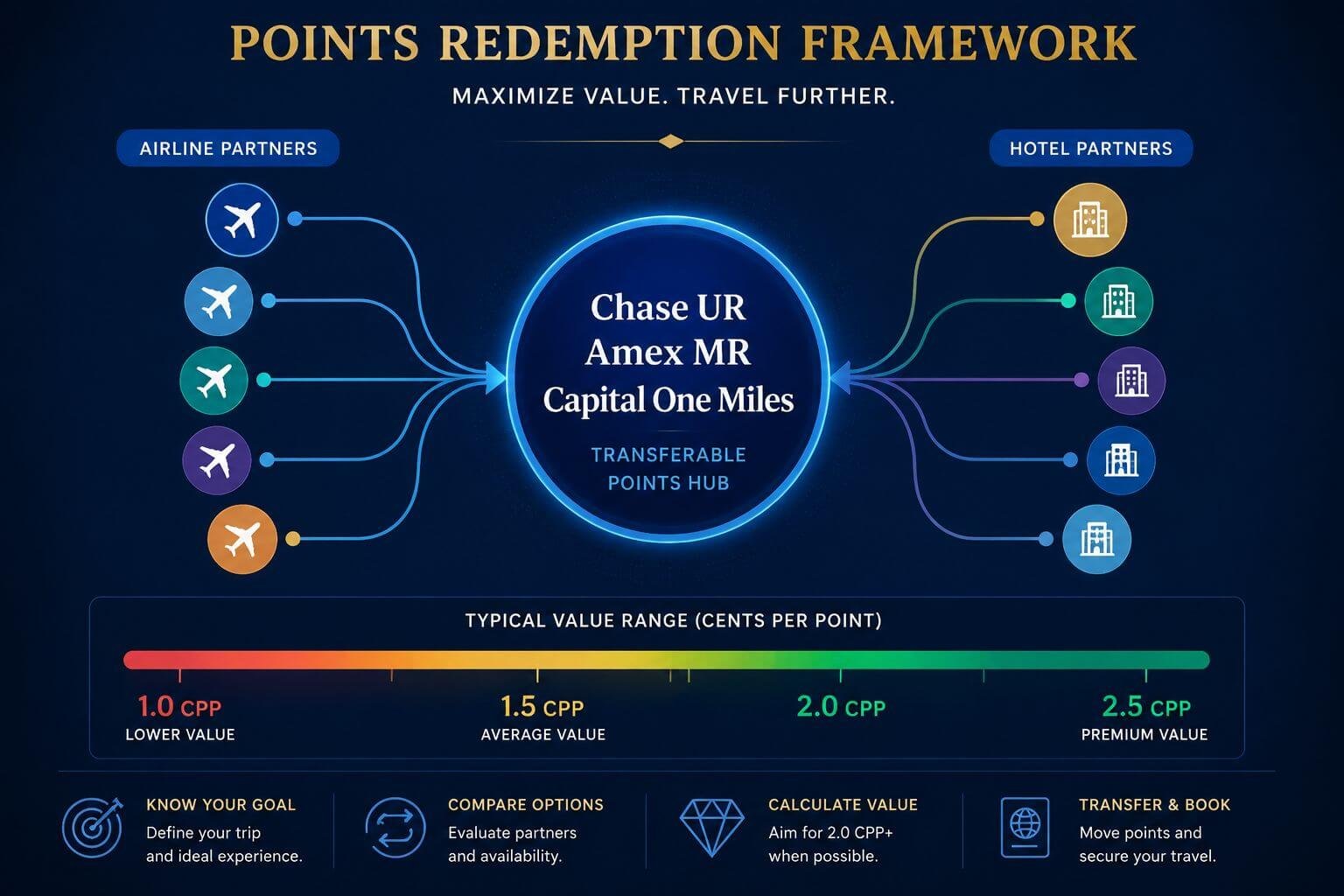
Earning points efficiently is only half the equation. Where and how you redeem determines whether those points deliver 1 cent each or 2+ cents each.
The redemption value hierarchy
From lowest to highest typical value:
- Statement credits or cash back — Usually 0.5–1 cent per point. Avoid unless you have no travel plans.
- Gift cards — Typically 1 cent per point. Acceptable but not optimal.
- Travel portal redemptions — 1–1.5 cents per point depending on the card. Chase Sapphire Reserve gets 1.5 cents; Sapphire Preferred gets 1.25 cents.
- Transfer to airline or hotel partner — 1.5–2.5+ cents per point for well-chosen redemptions. This is where transferable points earn their reputation.
Where transfers add the most value
Hyatt (via Chase): One of the last major hotel programs with a published award chart. Standard rooms at category 1–4 properties can deliver 1.8–2.5 cents per point. Hyatt is widely considered the best hotel transfer partner for Chase points.
Air Canada Aeroplan (via Chase, Amex, Capital One): Aeroplan prices awards based on distance, not carrier, and allows stopovers on one-way awards. Business class to Japan via Aeroplan can run 55,000–70,000 points depending on routing — often 30–40% fewer points than booking through the operating carrier’s own program. See best points for Japan business class for a full breakdown.
Singapore KrisFlyer (via Chase, Amex, Capital One): Business class sweet spots to Southeast Asia and Oceania. Note that Singapore charges fuel surcharges on some partner awards — factor these into your cents-per-point calculation.
Avianca LifeMiles (via Amex, Capital One, Citi): Useful for Star Alliance redemptions, especially United flights, without United’s own dynamic pricing. Check current availability carefully — partner award space on LifeMiles can be inconsistent.
When portal redemptions make sense
Not every redemption requires a transfer. If a flight or hotel costs 50,000 points in the portal at 1.5 cents each, that is $750 in value. If the cash price is $750 or less, the portal is a reasonable choice — especially when transfer partner award space is unavailable or the transfer would take 2–5 days to post.
For a step-by-step guide on booking award flights, see how to redeem points for flights in 2026.
Key redemption rules to follow
- Always calculate the cash price before redeeming points. If the cash price is low, save your points for a higher-value redemption.
- Check award availability before transferring. Transfers are usually instant but some (Amex to certain partners) take 24–72 hours. Do not transfer until you see the award space.
- Account for taxes and fees. Some partners, especially British Airways Avios on short-haul Iberia and Vueling, charge high carrier-imposed surcharges that can erode the value of a “cheap” award.
- Watch for transfer bonuses. Periodic 20–30% transfer bonuses from Amex, Chase, or Capital One to specific partners can meaningfully increase your effective earning rate. These bonuses are time-limited and worth acting on when the partner aligns with your travel plans.
Frequently Asked Questions
What is the difference between transferable points and fixed-value points? Transferable points — like Chase Ultimate Rewards, Amex Membership Rewards, and Capital One miles — can be moved to airline and hotel loyalty programs, where they often deliver 1.5–2.5 cents each on premium redemptions. Fixed-value points are worth a set amount (usually 1 cent) regardless of how you redeem them. Transferable points have higher upside but require more planning.
Which credit cards with points are best for beginners? The Chase Sapphire Preferred is the most commonly recommended starting point. It earns 3x on dining and travel, transfers to strong partners including Hyatt and Air Canada, and carries a manageable $95 annual fee. The Capital One Venture Rewards is a solid alternative for those who prefer a simpler 2x-on-everything structure with transferable miles.
Is it better to redeem points through a travel portal or transfer to a partner? It depends on the redemption. For domestic economy flights or budget hotels, portal redemptions at 1.25–1.5 cents per point are often competitive. For international business class or premium hotel stays, transferring to a partner almost always delivers more value — often 1.8–2.5 cents per point or more.
How do I avoid devaluation risk with my points? Keep points in a transferable bank currency (Chase, Amex, Capital One, Citi, Bilt) rather than moving them to a loyalty program until you have a specific redemption in mind. This preserves flexibility. Once transferred, points are locked into that program’s current and future award pricing.
What is the fastest way to earn a large points balance in 2026? Welcome bonuses. Several cards currently offer 60,000–100,000+ points after meeting a spending requirement, with some premium cards offering even larger bonuses. A single welcome bonus can be worth more than a full year of category spending. Read the terms carefully — some bonuses have clawback provisions if you cancel early. See credit card welcome bonus clawbacks you must avoid before applying.
Can I combine points from different cards into one balance? Within the same currency, yes. Chase Ultimate Rewards points from a Freedom Unlimited, Freedom Flex, and Sapphire Preferred all pool into one balance. Amex Membership Rewards work similarly across Amex cards. You cannot combine Chase points with Amex points — they are separate currencies requiring separate redemption strategies.
Conclusion
The best setup for most intermediate earners in 2026 is a two-card stack: one bonus category card for dining, groceries, or travel, and one flat-rate card for everything else. If both cards earn the same transferable currency, points pool automatically and redemption becomes simpler.
From there, the goal is to transfer points to the right partner at the right time — not to move them speculatively, not to cash them out at 1 cent each, and not to let them sit idle while devaluation risk compounds.
Practical next steps:
- Audit your current spending. Identify which categories earn the most and whether your current card covers them at a bonus rate.
- Choose a primary transferable currency based on your travel goals. If Hyatt is your target hotel brand, Chase is the cleaner path. If you want Amex airline partners like ANA or Air France, Amex MR may be the better anchor.
- Check current welcome bonuses before applying. Bonus offers change frequently, and timing an application to a higher offer can add 20,000–40,000 points to your opening balance.
- Before transferring any points, confirm award availability and calculate the cents-per-point value of the redemption.
For a broader comparison of how to evaluate the best transferable points programs in 2026, that guide covers each currency’s partner depth, transfer ratios, and redemption sweet spots in detail.


Content on Award Travel Hub is independently created by Award Travel Hub Editorial Desk and, where noted, reviewed by Award Travel Hub Review Desk. Some pages may contain affiliate links, but compensation does not determine our coverage, opinions, or methodology.