

Last updated: September 27, 2026
Quick Answer
A fully used hotel credit can offset the full $95 annual fee, but that doesn’t automatically make the Chase Sapphire Preferred Credit Card a good fit. The card is strongest for travelers who will use Chase’s points transfer partners, spend in its 3x categories, and value travel insurance; it is weaker for anyone seeking lounge access, simple 2% cash back, or unrestricted hotel credits.
Key Takeaways
- The annual fee is $95.
- The card earns 5x through Chase Travel, 3x on several everyday categories, 2x on other travel, and 1x elsewhere.
- New 2026 applicants should not assume every Chase Travel redemption is worth 1.25 cents per point. Standard portal value may be 1 CPP, while eligible Points Boost options can provide more.
- The hotel benefit provides up to $100 in statement credits per account anniversary year for qualifying hotel purchases through Chase Travel.
- The anniversary bonus equals 10% of the points implied by prior-year purchase dollars, not 10% of all points earned.
- There are no foreign transaction fees.
- Travel protections include trip cancellation and interruption insurance, trip delay reimbursement, baggage delay coverage, and primary rental car collision coverage.
- The card works best when you transfer Chase points only after you’ve found award space.
- Travelers who prefer cash back, lounge access, or direct hotel bookings may be better served by another card.
What the Chase Sapphire Preferred Actually Is in 2026
The Chase Sapphire Preferred is a $95 annual-fee travel card that earns transferable Ultimate Rewards points. Its core purpose is to combine everyday bonus categories, Chase Travel benefits, transfer partners, and meaningful travel protections without charging a premium-card fee.
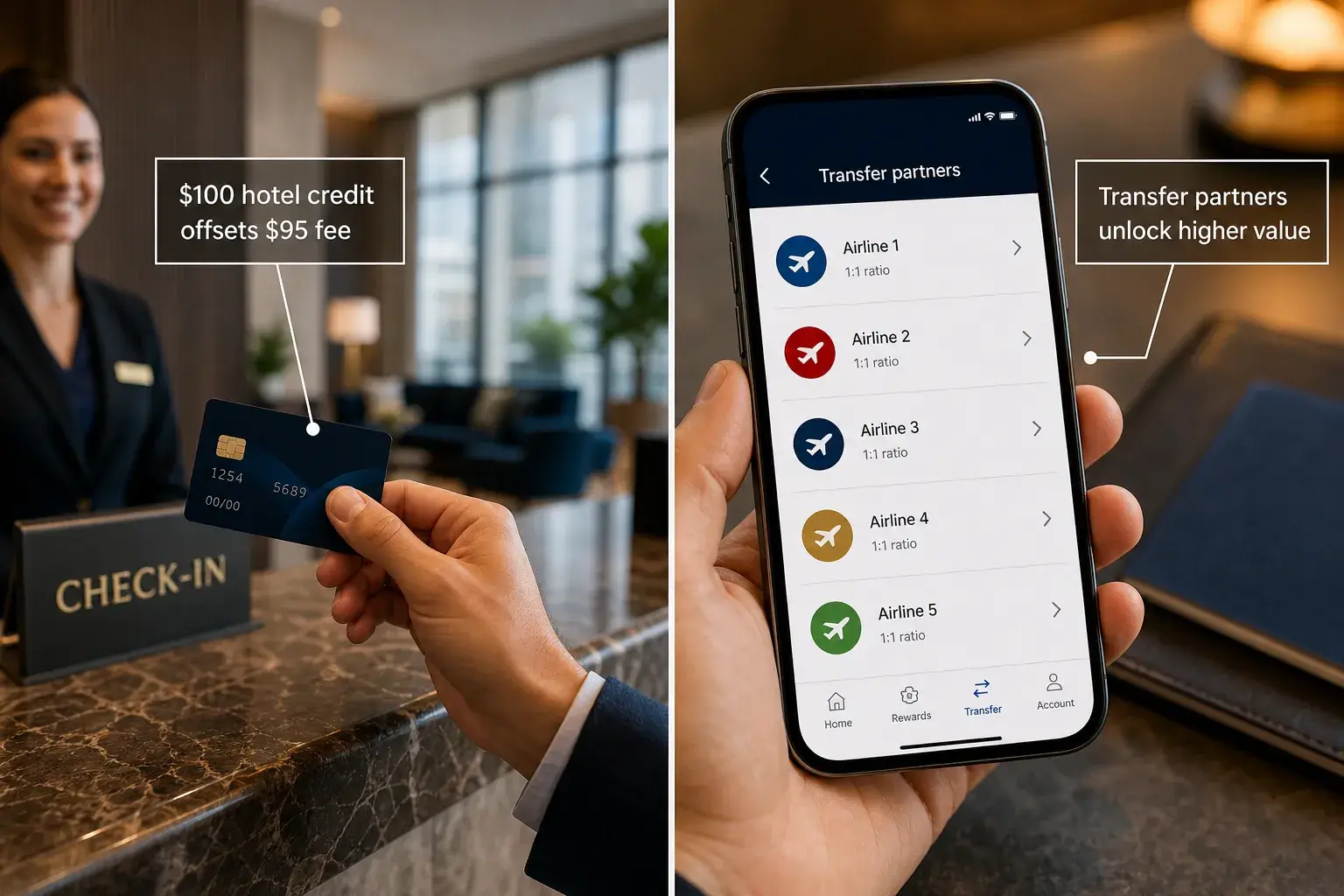
Cardholders can move Chase points to participating airline and hotel programs, generally at a 1:1 transfer ratio. That creates access to airline miles, hotel points, alliance partners, award charts, and program-specific sweet spots.
The card also acts as a transfer-enabling account. Points earned on eligible no-annual-fee Chase cards can usually be combined with the Sapphire Preferred account and then transferred to partners, subject to Chase’s household and account rules.
Chase Sapphire Preferred sign-up bonus in 2026
The welcome offer changes during the year, so applicants should use the number shown on the application page when they apply. Compare the public offer with targeted, branch, referral, and elevated limited-time offers before submitting an application.
Check four details:
- Required spending.
- Time allowed to complete that spending.
- Eligibility language for current and former Sapphire cardholders.
- Chase’s application and account-opening restrictions.
Do not manufacture spending, carry interest-bearing debt, or prepay expenses with poor cancellation terms to earn a bonus. Interest charges can erase the redemption value of even a strong offer.
You may be interested



For additional planning, see the guide to maximizing credit card sign-up bonuses.
Chase Sapphire Preferred foreign transaction fees
The Chase Sapphire Preferred has no foreign transaction fee. It is suitable for purchases outside the United States when Visa is accepted.
Always pay in local currency. Dynamic currency conversion at a foreign merchant or ATM often uses an unfavorable exchange rate, even when the credit card itself charges no foreign transaction fee.
Earning Rates by Category: Where the Card Beats a Flat 2% Cash Back
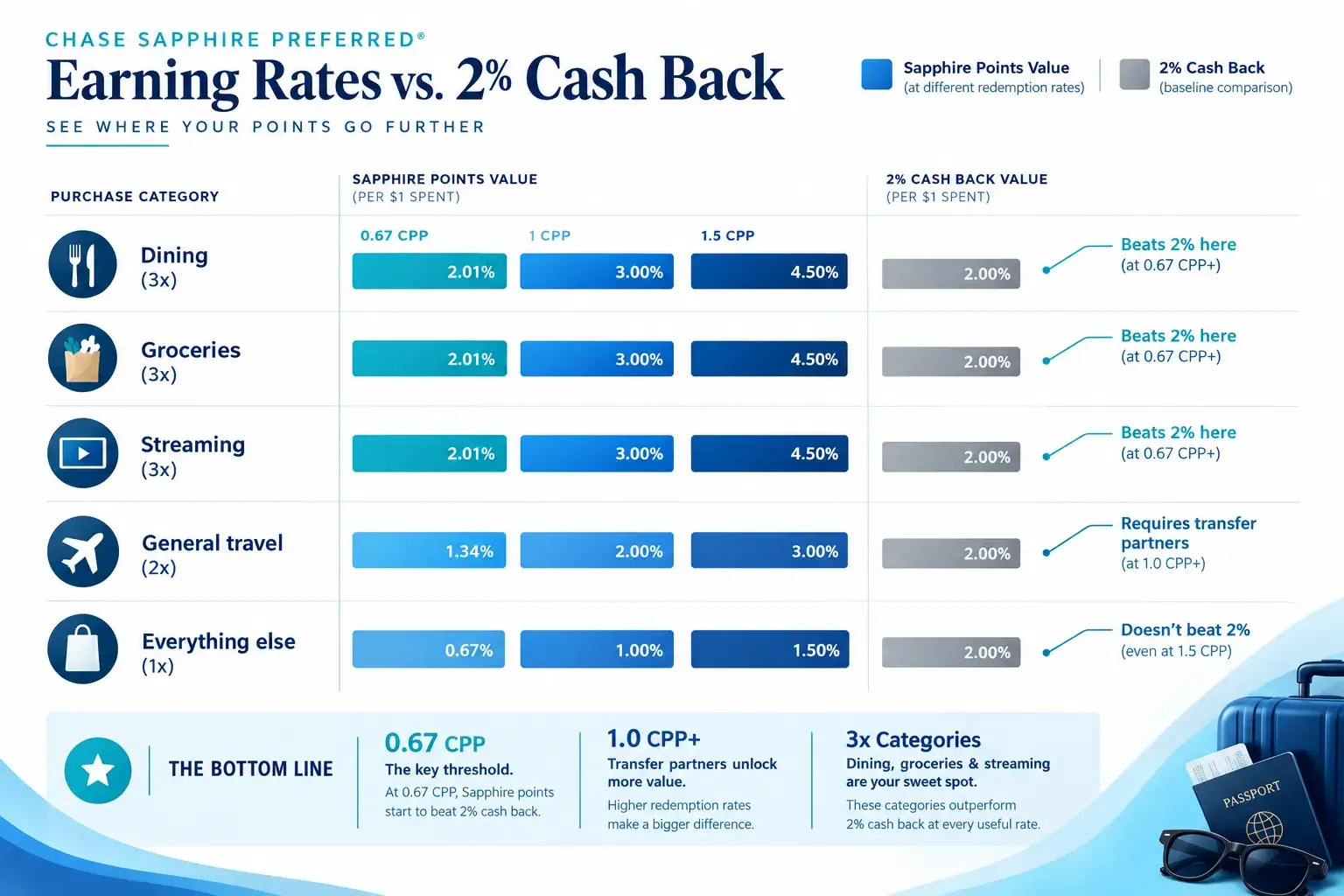
The card beats 2% cash back most clearly in 3x categories when you redeem Chase points for more than roughly 0.67 CPP. Its 2x general-travel category only pulls ahead when each point produces more than 1 cent of value.
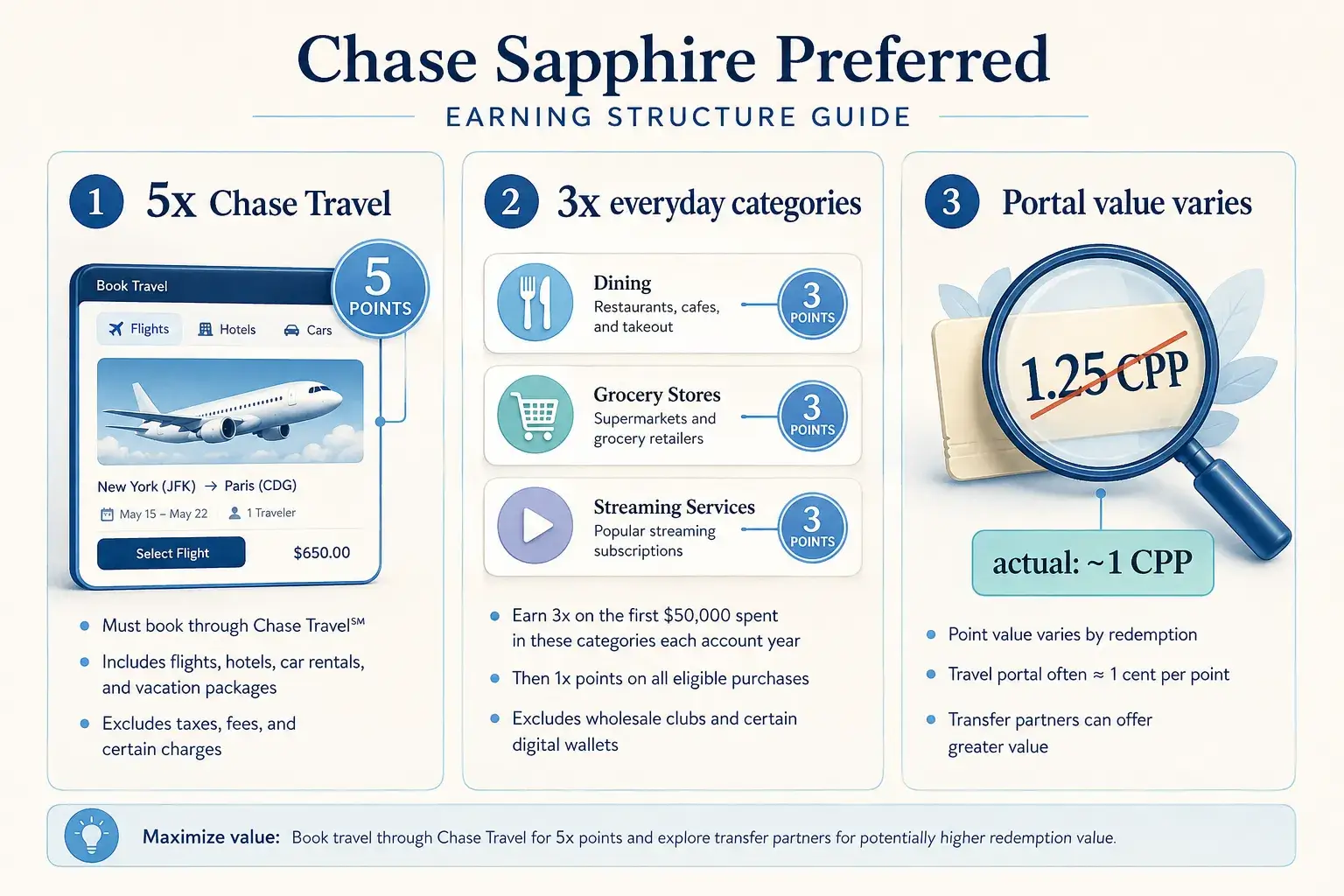
| Eligible purchase category | 2026 earning rate | Main restriction |
|---|---|---|
| Travel booked through Chase Travel | 5x | Portal booking required |
| Dining | 3x | Merchant coding controls eligibility |
| Vacation homes | 3x | Confirm eligible booking and coding terms |
| Gas stations and EV charging | 3x | Qualifying merchants only |
| Select streaming services | 3x | Chase’s eligible-service list applies |
| Online groceries | 3x | Excludes Walmart, Target, and wholesale clubs |
| Other travel | 2x | Must code as travel |
| All other eligible purchases | 1x | No category bonus |
The 5x rate applies to travel purchased through Chase Travel. A hotel booked directly with Hyatt, Marriott, or an independent property normally falls into the 2x travel category rather than 5x.
Portal bookings have trade-offs. Hotel reservations may not earn hotel points, elite-night credit, or status benefits. Prices and cancellation rules can also differ from direct bookings.
How many points do you earn with Chase Sapphire Preferred?
Consider a cardholder with the following annual spending:
- $6,000 on dining at 3x: 18,000 points
- $3,000 on gas and EV charging at 3x: 9,000 points
- $2,000 on online groceries at 3x: 6,000 points
- $4,000 on direct travel at 2x: 8,000 points
- $10,000 on other purchases at 1x: 10,000 points
That spending earns 51,000 base and bonus-category points, before the anniversary bonus.
At a conservative 1 CPP, those points represent $510. At 1.5 CPP, they represent $765. Neither value is guaranteed because transfer redemptions depend on award availability, program rules, surcharges and fees, and the cash price of the same trip.
Decision rule: Use the card for a 3x category when a purchase clearly qualifies and Chase points support the intended booking strategy. Use a flat 2% cash-back card for unbonused spending unless the anniversary bonus, purchase protection, or transferable-points option justifies the lower base rate.
The Annual Credits and Bonuses: Hotel Credit, Anniversary Points, and DoorDash
The most valuable recurring credit is up to $100 per account anniversary year for qualifying hotel stays purchased through Chase Travel. The anniversary bonus adds points based on spending, while DoorDash and Apple benefits should be treated as temporary extras rather than permanent reasons to keep the card.
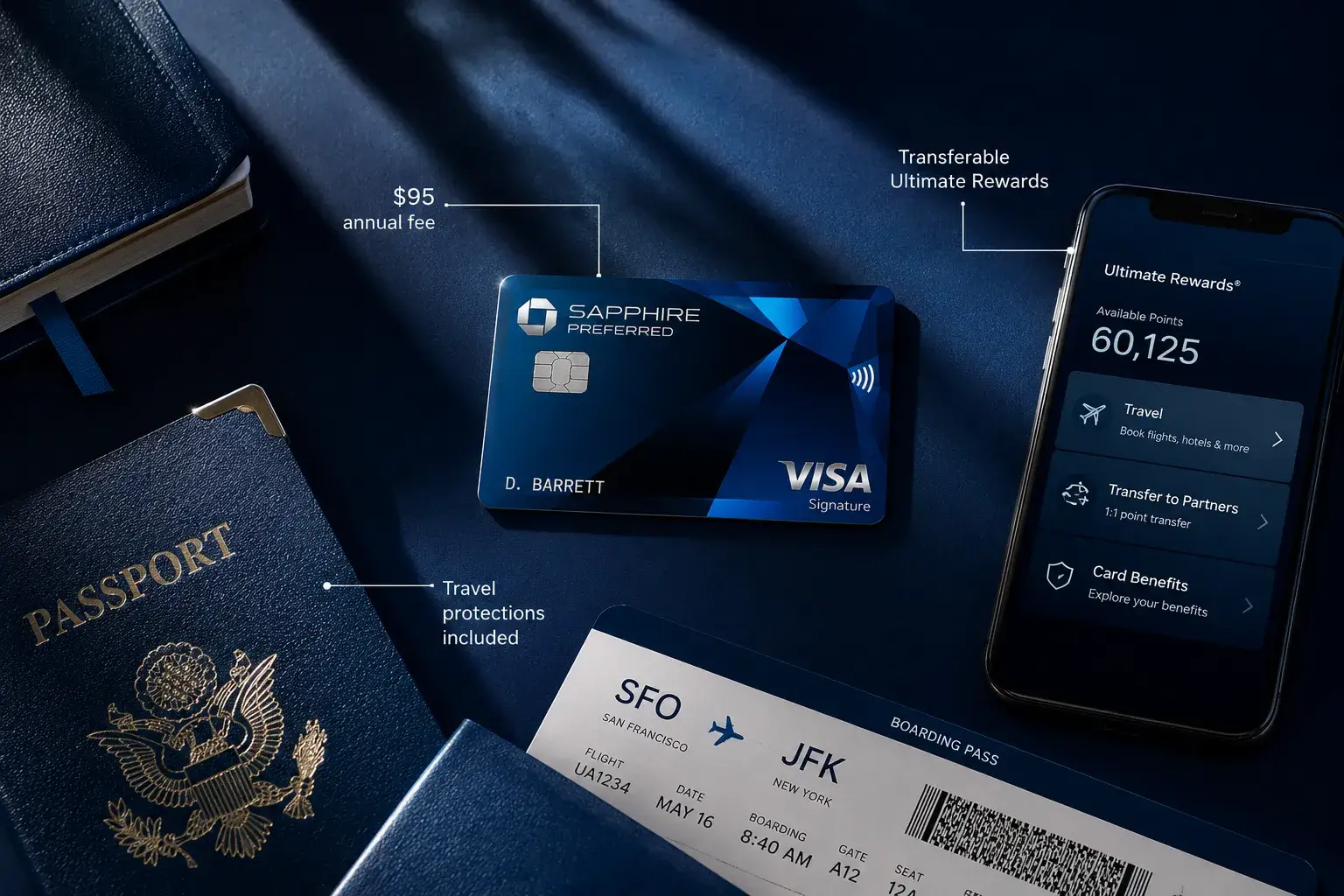
Chase Sapphire Preferred travel credits and benefits
The $100 hotel statement credit has three critical restrictions:
- The hotel must be purchased through Chase Travel.
- The benefit resets by account anniversary year, not calendar year.
- Credits are capped at $100 across qualifying purchases during that anniversary period.
A $120 eligible portal hotel purchase can trigger up to $100 in statement credits. A hotel booked directly with the property will not qualify, even if the direct rate is lower or offers better cancellation terms.
Compare the final portal price against the direct price before booking. A $100 credit is not worth $100 if the portal rate costs $40 more and causes the loss of hotel points or elite benefits.
How the anniversary points bonus works
The anniversary bonus equals 10% of the total purchase dollars from the prior account anniversary year, expressed as points. It does not add 10% to every point earned.
For example, $25,000 in eligible annual purchases generates a 2,500-point anniversary bonus. The calculation is based on spending, so it does not matter whether the original purchases earned 1x, 2x, 3x, or 5x.
Here is the spend required for the anniversary bonus alone to offset a $95 annual fee:
| Assumed redemption value | Required annual spending |
|---|---|
| 1 CPP | $95,000 |
| 1.25 CPP | $76,000 |
| 1.5 CPP | About $63,333 |
| 2 CPP | $47,500 |
The anniversary bonus should not be the sole reason to spend heavily on this card. At 1.5 CPP, it adds only about 0.15% in effective rewards.
The anniversary bonus is useful at the margin, but its opportunity cost can be high if unbonused spending could earn 2% cash back elsewhere.
DoorDash and Apple benefits
Eligible cardholders can receive complimentary DashPass and recurring DoorDash promotions under Chase’s current partnership terms. Activation requirements, eligible order types, minimum orders, and expiration dates apply.
A promotional year of Apple TV may also be available for activation through December 31, 2026. Because partner benefits can expire or change, value them only if they replace a service that would otherwise be purchased.
Travel Protections That Quietly Justify the Fee
The Chase Sapphire Preferred travel insurance package can justify the fee for travelers who pay for trips with the card and understand the exclusions. Coverage is not automatic for every disruption, and claims require documentation.
Chase Sapphire Preferred travel insurance coverage
| Protection | Core coverage |
|---|---|
| Trip cancellation or interruption | Up to $10,000 per covered traveler and $20,000 per trip for qualifying prepaid, nonrefundable expenses |
| Trip delay reimbursement | Up to $500 per covered traveler after a qualifying delay exceeding 12 hours or requiring an overnight stay |
| Baggage delay insurance | Up to $100 per day for five days after a qualifying delay of more than six hours |
| Auto rental collision damage waiver | Primary coverage for qualifying theft or collision damage, subject to vehicle, country, rental-length, and value restrictions |
| Lost luggage reimbursement | Up to $3,000 per covered traveler, subject to sublimits and exclusions |
Trip cancellation coverage does not provide broad “cancel for any reason” protection. Covered reasons, eligible family members, payment requirements, and claim deadlines are defined in the card’s benefits guide.
Primary rental coverage can be particularly useful because a qualifying claim may be handled before a personal auto collision policy. Cardholders generally must:
- Pay for the rental with the card or eligible Chase points.
- Decline the rental company’s collision damage waiver.
- Rent an eligible vehicle for an eligible period.
- Report damage promptly.
- Provide the rental agreement, repair estimate, police report when applicable, and payment records.
The benefit does not replace liability insurance. It may also exclude certain luxury vehicles, exotic cars, antique vehicles, trucks, motorcycles, and some countries.
See the 2026 credit card rental car coverage guide for a closer look at exclusions and claim steps.
Common mistake: Paying only the taxes on an award ticket with an unrelated card can affect which card’s travel protections apply. Review the benefits guide before departure rather than after a claim occurs.
Ultimate Rewards Redemption: Portal Value vs Transfer Partners
Chase points are generally best used by comparing a Chase Travel booking with at least two relevant transfer partners. Transfers can produce higher value, but they are irreversible and should not be made until bookable award space has been confirmed.
Chase Sapphire Preferred redemption rates
New applicants should not assume a blanket 1.25 CPP value for every Chase Travel booking. Standard portal redemptions may provide approximately 1 CPP, while selected Points Boost offers can deliver a higher rate.
Some legacy points may retain older redemption treatment for a limited transition period. The Chase Travel checkout page shows the actual points price, so cardholders should calculate the value rather than relying on an old review.
Use this formula:
CPP = (cash price minus award taxes and fees) ÷ points required × 100
A $600 flight requiring 60,000 points has a value of 1 CPP. If an eligible boosted option costs 40,000 points, the value is 1.5 CPP.
Portal or transfer partner: a practical comparison
| Booking method | Advantages | Main risks |
|---|---|---|
| Chase Travel | No transfer required; broad access to cash inventory; may earn airline miles | Variable redemption rate; portal service issues; hotel elite benefits may not apply |
| Airline transfer | Access to partner airlines, premium cabin awards, stopovers, and award-chart sweet spots | Limited award space, fuel surcharges, transfer delays, married segments, and devaluation risk |
| Hyatt transfer | Often strong value on expensive eligible hotels | Limited footprint, capacity controls, and dynamic peak pricing |
| Cash booking | Earns rewards and preserves points | Requires cash and may offer weak value during expensive travel dates |
Real-world redemption examples
Hotel example: A Hyatt property costs $350 after taxes or 20,000 transferred points with minimal taxes. The redemption produces about 1.75 CPP. That can be a reasonable use of points if you genuinely need the same hotel and room type.
Business-class example: A partner airline charges 70,000 miles plus $250 for a seat selling for $2,500. The calculated value is about 3.21 CPP:
($2,500 − $250) ÷ 70,000 × 100 = 3.21 CPP
That figure can overstate practical redemption value if the traveler would never pay $2,500. Premium cabin awards may also require flexible dates, positioning flights, alliance-partner searches, and acceptance of high fuel surcharges.
Booking strategy:
- Search the operating airline and relevant alliance partners.
- Confirm award space for the exact date and cabin.
- Price taxes, carrier surcharges, positioning flights, and change rules.
- Compare with Chase Travel and a cash fare.
- Transfer only the points needed.
- Book immediately and save confirmation records.
Transfers cannot normally be reversed. Speculative transfers expose points to devaluation risk and leave the traveler dependent on one loyalty program.
For partner selection and transfer ratios, read the best credit card transfer partners for 2026 value.
Is $95 Worth It? Break-Even by Spending Profile
The $95 fee is usually worth paying when the hotel credit is used without overpaying, or when transfer partners and travel protections produce at least $95 of real annual value. Spending alone requires much more volume than many applicants expect.
Chase Sapphire Preferred annual fee: Is it worth it?
Use this decision framework:
Profile 1: Full hotel-credit user
- Annual fee: $95
- Usable hotel credit: up to $100
- Net before other benefits: up to $5 ahead
This profile breaks even quickly, but only if the Chase Travel rate is competitive and the hotel stay would have happened anyway.
Profile 2: Transfer-partner user
A cardholder transfers 40,000 Chase points for a hotel redemption worth 1.7 CPP instead of using the portal at 1 CPP. The incremental value is about $280. That can cover the annual fee, but only if the award replaces a real cash expense.
Profile 3: Dining-focused spender
At 1 CPP, 3x dining earns 3% in value. Compared with 2% cash back, the incremental return is 1%. It would take $9,500 of dining purchases to create $95 of incremental value.
At 1.5 CPP, 3x produces 4.5% of assumed value. The advantage over 2% cash back becomes 2.5%, lowering the break-even dining spend to $3,800.
This math excludes the hotel credit, anniversary bonus, welcome offer, and insurance.
Chase Sapphire Preferred vs. Sapphire Reserve: Which is better?
The Preferred is generally better for cost-conscious travelers who need transfer partners but don’t value airport lounges or premium travel credits. The Reserve can be better for frequent travelers who will use its broader benefits enough to offset its much higher fee.
Compare:
- Effective annual cost after credits
- Lounge visits per year
- Chase Travel redemption treatment
- Travel and dining earning
- Insurance limits
- Authorized-user costs
- Existing lounge access from other cards
A detailed benefit-by-benefit analysis is available in Chase Sapphire Preferred vs. Reserve for 2026.
Who Should Skip This Card and What to Get Instead
Skip the Chase Sapphire Preferred if transferable points add little value, portal hotel bookings conflict with hotel-status goals, or most spending earns only 1x. A cheaper card can be more useful than an underused travel card.
Who should get the Chase Sapphire Preferred card?
The card is best for someone who:
- Wants access to Chase airline and hotel transfer partners.
- Can use the $100 Chase Travel hotel credit without overpaying.
- Spends meaningfully on dining, gas, EV charging, streaming, online groceries, or travel.
- Travels enough to value primary rental coverage and trip protection.
- Will search for award availability before transferring points.
- Wants a lower-fee alternative to a premium travel card.
The card is also useful in a Chase points setup. A no-annual-fee Freedom card can cover other spending categories, while the Sapphire Preferred enables eligible point transfers. Review the Chase Freedom Unlimited card for 2026 before building that combination.
Reasons the Chase Sapphire Preferred may not be worth it
The card may not be worth keeping when:
- The hotel credit goes unused.
- Direct hotel bookings are consistently cheaper or more valuable.
- Most purchases earn 1x.
- Cash back is preferred over award searches.
- The traveler already has equivalent insurance and transfer access.
- Award availability is too limited for the traveler’s dates.
- Premium cabin awards require unacceptable surcharges or positioning flights.
- Airport lounge access is a priority.
- Interest or late fees are likely.
Common mistakes with Chase Sapphire Preferred
Avoid these common pitfalls:
- Assuming every portal redemption is worth 1.25 CPP.
- Booking a more expensive portal hotel solely to trigger the credit.
- Transferring points before confirming award space.
- Ignoring carrier-imposed fuel surcharges.
- Expecting hotel elite credit from a portal booking.
- Using the card for large unbonused purchases without comparing a 2% card.
- Counting DoorDash or streaming benefits at face value when they do not replace existing spending.
- Failing to save receipts and carrier notices for insurance claims.
Cheaper alternatives to Chase Sapphire Preferred
A no-annual-fee cash-back card is better for simple rewards and unbonused spending. A no-fee transferable-points card may be better when its partners match the traveler’s booking needs.
Options to compare include:
- Chase Freedom Unlimited: Useful for Chase-category combinations, but it does not independently provide the same transfer capability.
- Wells Fargo Autograph: No annual fee and several travel-related bonus categories, with a smaller transfer-partner network.
- Bilt Mastercard: No annual fee and transferable Bilt points, especially relevant for eligible rent payments.
- A flat 2% cash-back card: Better for straightforward value and broad non-category spending.
- Premium travel cards: Better when lounge access and larger recurring credits are used consistently.
Review the best no-annual-fee travel credit cards for 2026 before paying for benefits that may go unused.
Frequently Asked Questions
Is the Chase Sapphire Preferred a good first travel card?
Yes, for applicants who can pay in full, use the hotel credit, and learn a few transfer partners. A cash-back card is simpler for travelers who do not want to search for awards.
Does the Chase Sapphire Preferred have lounge access?
The card does not provide broad complimentary airport lounge membership. Travelers seeking lounge access should compare premium cards based on annual cost and realistic visits.
Does the $100 hotel credit reset every calendar year?
No. The Chase Sapphire Preferred hotel credit resets each account anniversary year and applies only to qualifying hotel purchases through Chase Travel.
Can Chase points be transferred to another person?
Chase permits certain point combinations and transfers involving eligible household members or authorized users, subject to current program rules. Confirm eligibility before moving points.
Are Chase transfers instant?
Many transfers process quickly, but instant delivery is not guaranteed. Transfer delays can cause award space to disappear, so avoid transferring speculatively.
Is Chase Travel always more expensive than booking directly?
No, but portal and direct prices can differ. Compare the room type, taxes, cancellation terms, hotel points, elite benefits, and final cost before booking.
Conclusion
The Chase Sapphire Preferred Credit Card can justify its $95 fee in 2026, but the strongest case does not come from the anniversary bonus or marketing value assigned to temporary perks. The practical value comes from using the $100 hotel credit carefully, earning 3x in relevant categories, transferring Chase points for well-priced awards, and paying for trips with a card that provides meaningful insurance.
Before applying, take three steps:
- Confirm the current welcome offer and eligibility terms.
- Price one realistic hotel or flight redemption through both Chase Travel and a transfer partner.
- Compare the card’s expected annual value with a 2% cash-back card and a no-fee travel alternative.
Transfer points only after award space is confirmed. For a broader selection process, use the guide to comparing travel credit cards in 2026.


Content on Award Travel Hub is independently created by Award Travel Hub Editorial Desk and, where noted, reviewed by Award Travel Hub Review Desk. Some pages may contain affiliate links, but compensation does not determine our coverage, opinions, or methodology.