

Last updated: August 10, 2026
Quick Answer: The luxury hotel brands most worth your points in 2026 are Park Hyatt, Alila, St. Regis, Waldorf Astoria, and the Small Luxury Hotels of the World (SLH) properties now bookable through Hilton Honors. Hyatt delivers the strongest cents-per-point value at luxury properties, Marriott’s Luxury Group offers the widest global footprint, and Hilton’s SLH integration has meaningfully expanded boutique options. The right choice depends on which transferable points currency you hold and whether you prioritize redemption value, elite perks, or property variety.
Key Takeaways
- World of Hyatt consistently delivers the best CPP at luxury properties: Park Hyatt averages around 2.60 cents per point, Alila around 3.31 cents per point, based on tracked booking data.
- Marriott Bonvoy’s Luxury Group (Ritz-Carlton, St. Regis, EDITION) clusters top brands under a semi-independent tier with dedicated concierges, but St. Regis averages only about 1.31 cents per Bonvoy point — above the program average, but far below Hyatt’s best.
- Hilton’s full integration of 500-plus SLH properties in 2025 is the most significant luxury upgrade in hotel points in recent years. Waldorf Astoria delivers roughly 0.84 cents per Hilton point.
- Amex Fine Hotels + Resorts (FHR) and the Luxury Hotel Collection (LHC) are portal programs, not loyalty programs. They use Amex points as a payment method and add guaranteed perks like room upgrades, daily breakfast, and late checkout — often making them better than award bookings at the same property.
- Bilt Rewards added Wyndham as a 1:1 transfer partner in March 2026, opening Registry Collection and Wyndham Grand to renters accumulating Bilt points.
- Wyndham is raising its top award category to 45,000 points starting September 15, 2026. Book high-end Wyndham Grand or Registry Collection stays before that date if you’re holding Wyndham points.
- Dynamic pricing has made luxury award availability unpredictable. Use tools like Rooms.aero and MaxMyPoint to track award space before transferring points.
- Not every luxury label delivers luxury value on points. JW Marriott, for example, averages below the Bonvoy program average at around 0.88 cents per point — a poor use of transferable currency.
What Counts as a Luxury Hotel Brand
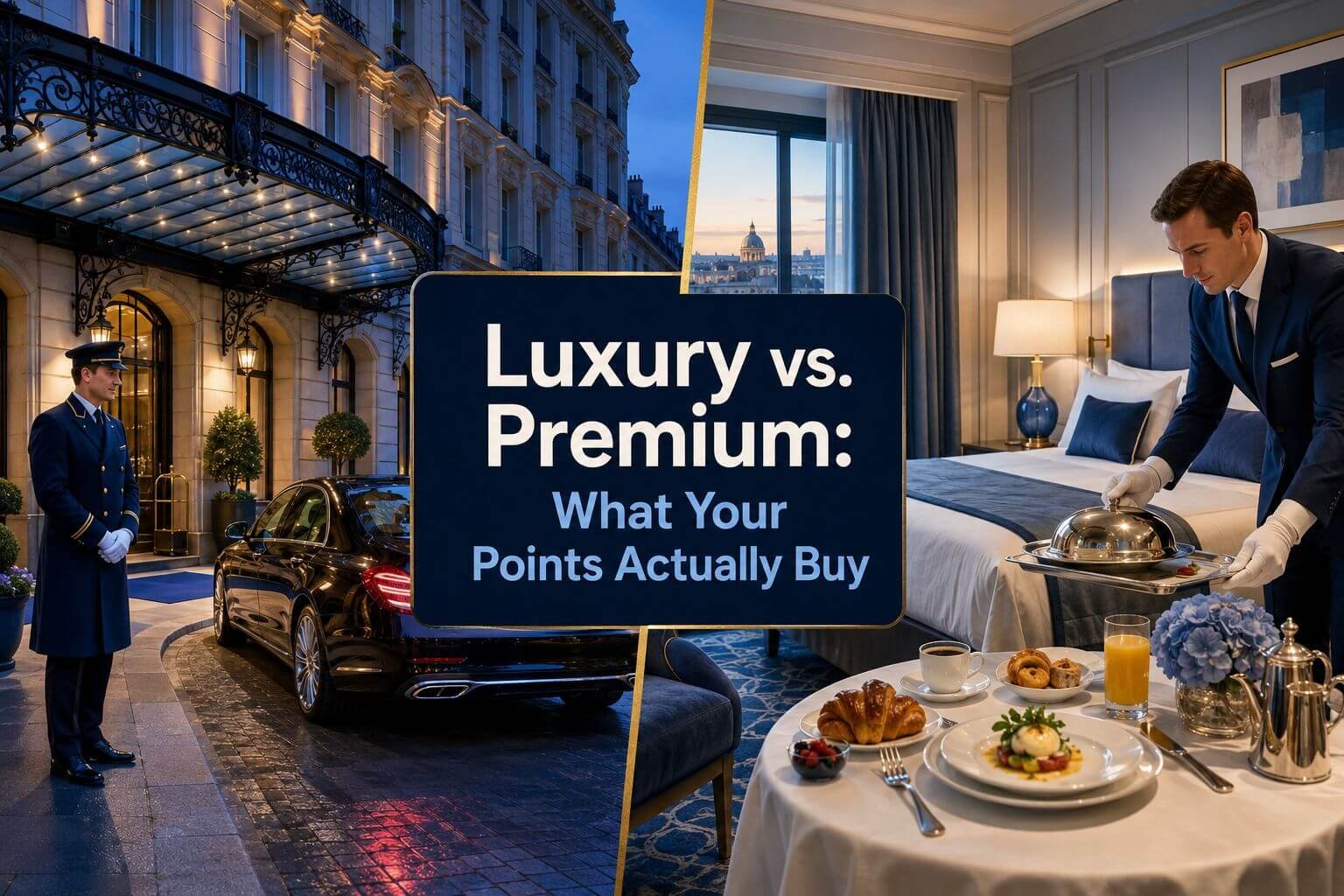
A luxury hotel brand is not simply an expensive property. In the context of points redemptions, the distinction matters because it affects both the points cost and the experience you’re paying for.
True luxury hotel brands share several defining characteristics: dedicated butler or concierge service, consistently high physical standards across the portfolio, controlled brand size (fewer properties, tighter quality oversight), and meaningful on-property amenities that justify a premium over standard upscale hotels.
Luxury vs. Premium: The practical distinction
- Luxury brands (Park Hyatt, St. Regis, Ritz-Carlton, Waldorf Astoria, Four Seasons, Mandarin Oriental, Aman): Typically fewer than 150 properties globally, with individual property investment in service training, design, and food and beverage.
- Upper-upscale brands (JW Marriott, Hilton, Westin, Hyatt Regency): Larger portfolios, more consistent but less differentiated experiences. Often miscategorized as luxury.
- Soft-brand collections (Autograph Collection, Curio Collection, Tapestry Collection): Independent hotels affiliated with a loyalty program. Quality varies widely — some are genuinely luxurious, others are simply boutique.
For points purposes, the key question is whether the brand commands a cash rate that justifies the award cost. A Park Hyatt Tokyo at $900 per night redeemed for 35,000 Hyatt points is a different calculation than a JW Marriott at $350 redeemed for 50,000 Bonvoy points.
Marriott Luxury Brands: Ritz-Carlton, St. Regis, and EDITION
Marriott Bonvoy’s Luxury Group — anchored by Ritz-Carlton, St. Regis, and EDITION — represents the program’s clearest play for high-end travelers. In 2025, Marriott reorganized these brands into a semi-independent ecosystem with dedicated concierges and member-only benefits, a deliberate effort to separate the luxury experience from the broader Bonvoy mass market.
You may be interested



Points cost and value
Marriott Bonvoy uses dynamic pricing, so award rates vary by property and date. Rough benchmarks for 2026:
| Brand | Typical Award Range | Avg. CPP |
|---|---|---|
| St. Regis | 60,000–100,000+ pts/night | ~1.31¢ |
| Ritz-Carlton | 60,000–95,000+ pts/night | ~1.20¢ (est.) |
| EDITION | 50,000–85,000 pts/night | ~1.10¢ (est.) |
| JW Marriott | 40,000–70,000 pts/night | ~0.88¢ |
St. Regis is the strongest value within Bonvoy’s luxury tier, but it still trails Hyatt’s top brands significantly. JW Marriott, despite its upscale reputation, falls below the Bonvoy program average — not a strong use of transferable points.
Transferable currencies that feed Bonvoy: Amex Membership Rewards, Chase Ultimate Rewards, Citi ThankYou Points, Capital One miles, and Bilt Rewards all transfer to Marriott Bonvoy, generally at a 1:1 ratio (Amex transfers at 1:1 as well). Given the relatively modest CPP at most Bonvoy luxury properties, consider whether cash or Amex FHR delivers better value before transferring points.
For a full breakdown of Bonvoy’s transfer partners and current award structure, see the Marriott Bonvoy Transfer Partners Guide and the Marriott Bonvoy Points Devaluation 2026 update.
Best for: Travelers with large Bonvoy balances, Marriott Titanium or Ambassador elites who receive confirmed suite upgrades, and those targeting St. Regis properties in markets where cash rates are highest (New York, Maldives, Bora Bora).
Not for: Travelers optimizing CPP from transferable currencies. The math rarely beats Hyatt or Amex FHR at comparable properties.
Hilton and Hyatt Top Tiers: Where Luxury Hotel Brands Deliver Real Value
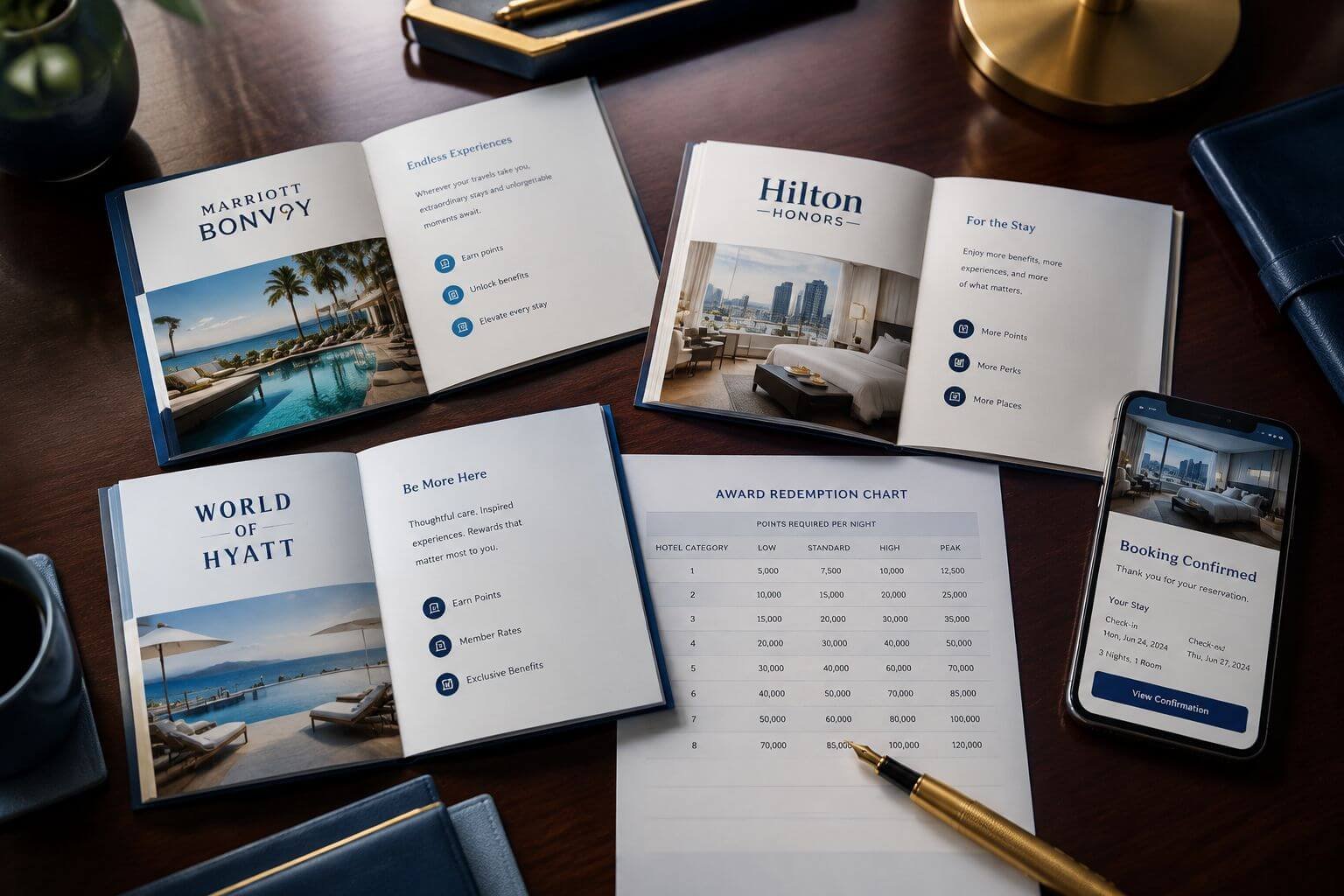
These two programs represent opposite ends of the luxury points spectrum in 2026 — and both have legitimate cases depending on what you’re trying to accomplish.
World of Hyatt: The strongest CPP at luxury properties
Hyatt’s luxury portfolio — Park Hyatt, Alila, Andaz, and Thompson Hotels — consistently delivers the best redemption value among major hotel loyalty programs. Alila averages around 3.31 cents per point and Park Hyatt around 2.60 cents per point, based on tracked booking data. Those figures are well above what Marriott or Hilton deliver at comparable properties.
Hyatt moved to a 5-tier dynamic pricing model in 2026, which adds variability but hasn’t eliminated the strong value at aspirational properties. The Hyatt Award Chart Changes 2026 guide covers what shifted and which properties moved tiers.
Transferable currencies that feed Hyatt: Chase Ultimate Rewards transfers to World of Hyatt at 1:1, making it the primary on-ramp. Bilt Rewards also transfers to Hyatt at 1:1. Neither Amex nor Capital One transfers to Hyatt directly — a meaningful limitation if Chase points aren’t your primary currency.
Hyatt Privé: This invitation-only program allows travel advisors to confirm room upgrades at booking rather than waiting for check-in availability. For luxury travelers, confirmed upgrades are more valuable than the theoretical upgrades that most elite programs offer. Booking through a Hyatt Privé advisor stacks with Globalist status benefits.
Best for: Chase or Bilt points holders targeting Park Hyatt or Alila properties, Hyatt Globalist members who want the best elite treatment in the program, and travelers booking aspirational properties where cash rates exceed $500 per night.
Hilton Honors: Upgraded by SLH integration
Hilton completed its full integration of more than 500 Small Luxury Hotels of the World (SLH) properties in 2025. This is a material upgrade. SLH properties include boutique villas, historic estates, and secluded resorts that were previously inaccessible through any major loyalty program. Hilton Honors members can now redeem points at these properties directly.
Waldorf Astoria delivers roughly 0.84 cents per Hilton point — above the program’s portfolio-wide average of 0.62 cents, but below Hyatt’s luxury tier. Conrad and LXR hover around 0.67 cents per point.
The SLH opportunity: Many SLH properties have lower award prices than flagship Waldorf Astoria hotels, and the cash rates can be substantial. A boutique SLH villa in Tuscany or a heritage estate in Scotland may offer better CPP than a Waldorf in a major city.
Best for: Travelers holding Amex, Capital One, Citi, or Bilt points (all transfer to Hilton at various ratios), those targeting SLH boutique properties, and Hilton Diamond members who want free breakfast as a baseline benefit.
Not for: Travelers chasing maximum CPP from Chase points (Chase does not transfer to Hilton).
Independent and Small Luxury Collections
Not every top-tier property belongs to Marriott, Hilton, or Hyatt. Four Seasons, Mandarin Oriental, Aman, and Rosewood operate independently and do not participate in major transferable points programs. This is a critical limitation for points-focused travelers.
What you can do with independent luxury hotels:
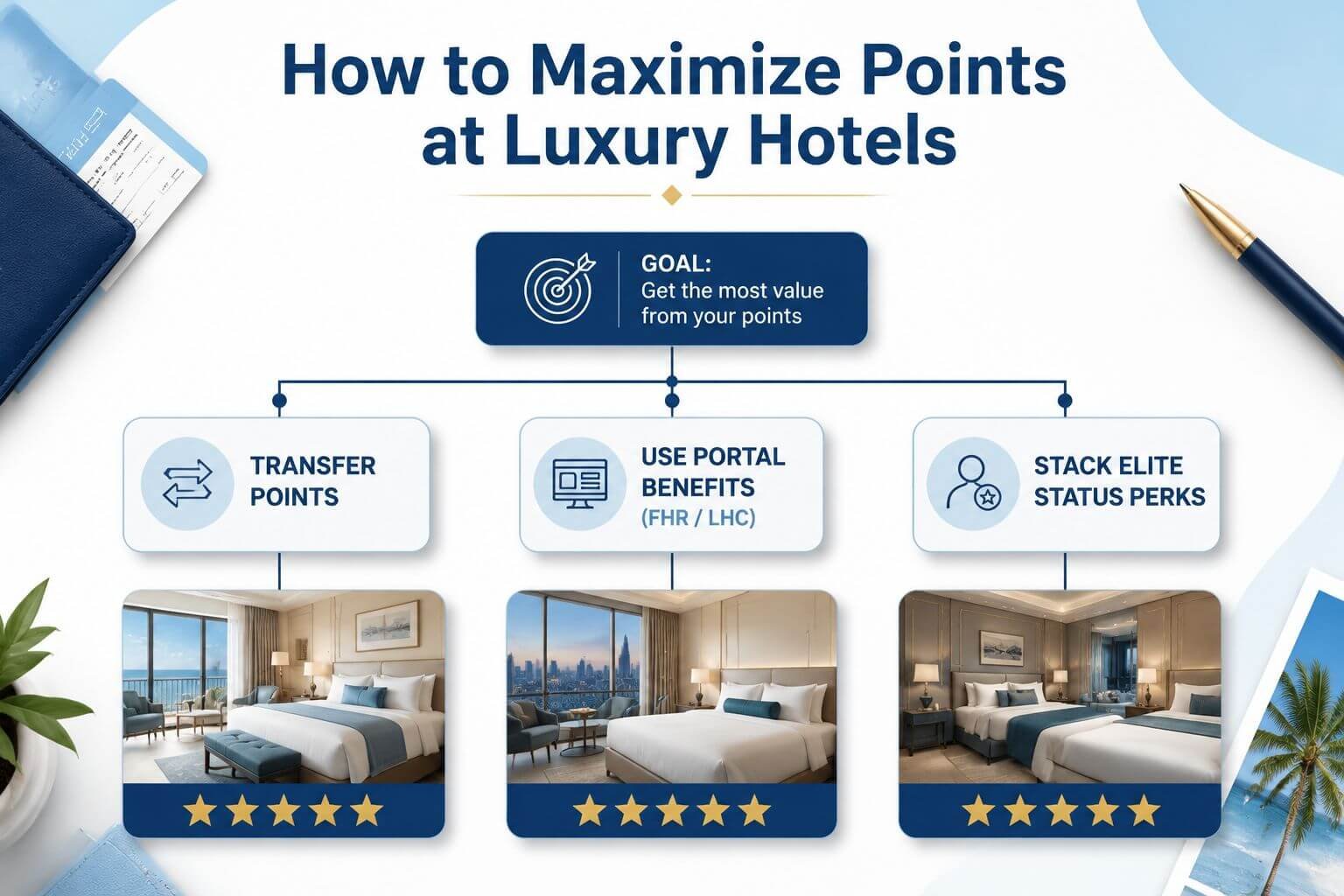
- Amex Fine Hotels + Resorts (FHR): Book Four Seasons, Mandarin Oriental, Rosewood, and hundreds of other independents using Amex Membership Rewards points as a payment method (at roughly 1 cent per point toward the room rate), while receiving guaranteed perks: daily breakfast for two, room upgrade on arrival when available, early check-in, late checkout, and a property credit typically worth $100. The perks often add $200–$400 in value per stay.
- Amex Luxury Hotel Collection (LHC): A smaller portal with similar perks at a slightly different property set. Available to Amex Platinum and Centurion cardholders.
- I Prefer Hotel Rewards: Preferred Hotels & Resorts runs its own loyalty program, and several transferable currencies connect to it. See the I Prefer Hotel Rewards Transfer Partners guide for current options.
FHR vs. award booking: When FHR wins
FHR is often the better choice at Four Seasons and Rosewood properties because:
- No direct award booking option exists (these brands don’t participate in Bonvoy, Honors, or Hyatt).
- The guaranteed perks (breakfast, upgrade, credit) add tangible value that a cash booking doesn’t include.
- FHR rates are typically the same as the hotel’s best available rate — you’re not paying a premium for the perks.
The tradeoff: Amex points used via FHR typically redeem at 1 cent per point toward the room rate, below the 1.5–2 cents per point you might achieve via airline transfers. Run the math before committing.

Best Ways to Book Luxury Hotel Brands on Points
The booking method matters as much as the program. Here are the primary strategies, with honest tradeoffs for each.
1. Direct award booking through the loyalty program
Best for Hyatt, Hilton (including SLH), and Marriott’s Luxury Group. Transfer points only after confirming award availability — never transfer speculatively at luxury properties where availability is limited.
Use Rooms.aero and MaxMyPoint to search award space before initiating any transfer. Both tools surface real-time availability across programs without requiring you to log into each program separately.
Step-by-step for a Park Hyatt booking:
- Search availability on Rooms.aero or the Hyatt app for your dates.
- Confirm the award rate (dynamic pricing means rates vary by date — weekends and peak seasons cost more).
- Verify your Chase or Bilt points balance covers the stay plus a buffer.
- Transfer points to Hyatt (transfers are typically instant from Chase, 1–2 days from Bilt).
- Book immediately after transfer — award space at Park Hyatt properties can disappear within hours.
2. Amex FHR or Luxury Hotel Collection
Best for Four Seasons, Mandarin Oriental, Rosewood, and other independents. Also worth considering at Ritz-Carlton and St. Regis when the guaranteed perks outweigh the CPP difference versus a Bonvoy award.
3. Points + Cash awards
Several programs offer hybrid redemptions where you pay a reduced points rate plus a cash co-pay. Hyatt’s Points + Cash option can work well at mid-tier luxury properties. Marriott’s equivalent is less consistent in value.
4. Fifth Night Free (Hyatt and others)
Hyatt Globalist members receive the fifth night free on award stays. On a five-night Park Hyatt stay at 35,000 points per night, that’s 35,000 points saved — effectively reducing the per-night cost to 28,000 points. This is one of the most concrete elite benefits in hotel loyalty.
Common mistake: Transferring points to Marriott Bonvoy for a JW Marriott stay. JW Marriott’s average CPP (around 0.88 cents) is below the Bonvoy program average and well below what Chase points can achieve via Hyatt. Treat JW Marriott as an upper-upscale brand, not a luxury one, for points purposes.
Maximizing Elite Perks at Luxury Hotel Brands
Elite status at luxury properties isn’t just about room upgrades — it’s about confirmed benefits, service priority, and the ability to stack perks across programs.
Which elite tiers actually deliver at luxury properties
| Program | Top Elite Tier | Key Luxury Benefit |
|---|---|---|
| World of Hyatt | Globalist | Fifth night free on awards, confirmed suite upgrades (Privé), club lounge access |
| Marriott Bonvoy | Ambassador Elite | Your24 (flexible check-in/out), dedicated ambassador, suite upgrades |
| Hilton Honors | Diamond | Free breakfast (most properties), space-available upgrades, executive lounge |
| Accor Live Limitless | Platinum | Strong value in Asia-Pacific, Le Club benefits at luxury Accor brands |
Hyatt Globalist remains the strongest elite tier for luxury-focused travelers in 2026. The combination of confirmed benefits (not just “space available” upgrades), fifth-night-free on awards, and the Privé program for confirmed upgrades at booking is difficult to match.
For travelers who can’t reach Globalist organically, a status match or challenge may be worth exploring. The Airline Hotel Status Match Challenge guide covers current options across programs.
Stacking elite status with portal perks
One underused strategy: book through Amex FHR while holding elite status at the same property’s parent program. For example, a Marriott Titanium member booking a Ritz-Carlton through FHR can receive both the FHR guaranteed perks (breakfast, upgrade, property credit) and Bonvoy elite recognition (points earning, potential suite upgrade). The programs don’t always stack perfectly, but it’s worth calling the property directly to confirm what will be honored.
For a broader look at underused card benefits that apply at luxury hotels, see Credit Card Travel Perks: 12 Underused Benefits in 2026.
Are luxury hotel points worth more than airline miles?
For most U.S.-based points holders, airline miles used for international premium cabin redemptions still deliver higher CPP than hotel points. A business class seat to Tokyo on ANA using Virgin Atlantic miles might cost 47,500 miles for a seat with a $4,000+ cash value — over 8 cents per point. Hotel points rarely approach that ceiling.
That said, hotel points have a practical advantage: you need them for multi-night stays where airline miles don’t apply. A five-night Park Hyatt stay using Hyatt points at 2.60 cents per point is a strong redemption by hotel standards, even if it doesn’t match the best airline mile sweet spots.
The decision framework: use airline miles for flights first (especially premium cabins), then deploy hotel points for aspirational properties where cash rates are highest. Don’t transfer hotel points to airlines — the conversion ratios are almost always unfavorable.
For more on calculating whether a specific redemption is worth it, see the how to calculate cents per point guide.
FAQ: Luxury Hotel Brands and Points Redemptions
Which luxury hotel brand gives the best value on points in 2026? Alila and Park Hyatt, both in the World of Hyatt program, deliver the strongest cents-per-point value among major luxury hotel brands — roughly 3.31 and 2.60 cents per point, respectively. These figures are based on tracked booking data and reflect properties where cash rates are high relative to award costs.
How many points does a luxury hotel night typically cost? It depends heavily on the program and property. Park Hyatt properties typically run 35,000–50,000 Hyatt points per night under dynamic pricing. St. Regis and Ritz-Carlton properties on Bonvoy range from 60,000 to 100,000-plus points per night. Waldorf Astoria on Hilton Honors varies widely, from 60,000 to 150,000-plus points at peak properties. Always check current award pricing before transferring.
Can you book Four Seasons or Mandarin Oriental with points? Not through a traditional loyalty program. Four Seasons and Mandarin Oriental are independent brands. The best option is Amex Fine Hotels + Resorts (FHR), which allows Amex Membership Rewards points to offset the room rate at roughly 1 cent per point, while adding guaranteed perks worth $200–$400 per stay.
Is Hyatt Globalist worth pursuing just for luxury hotel access? For travelers who stay 60 or more nights per year at Hyatt properties, yes. Globalist’s fifth-night-free benefit on award stays, combined with confirmed suite upgrades via Hyatt Privé and club lounge access, makes it the most tangible elite program for luxury redemptions. For occasional luxury travelers, reaching Globalist through a status match or challenge may be a faster path.
Should I transfer Amex or Chase points to Marriott Bonvoy for a Ritz-Carlton stay? Only if the math works. St. Regis averages about 1.31 cents per Bonvoy point — above the program average, but well below what Chase points can achieve via Hyatt. If you hold Chase points, transferring to Hyatt for a Park Hyatt stay is almost always a better use than transferring to Bonvoy for a Ritz-Carlton. If you hold Amex points and the property is available through FHR, run the FHR comparison first.
What is the Wyndham points change happening in fall 2026? Wyndham is adding a new 45,000-point top award category on September 15, 2026, along with a category reshuffle that will push some Wyndham Grand and Registry Collection properties into higher tiers. If you’re holding Wyndham points and targeting a high-end property, book before that date. Bilt Rewards added Wyndham as a 1:1 transfer partner in March 2026, so Bilt points holders now have direct access to Wyndham award bookings.
Conclusion: Where to Focus Your Luxury Hotel Points Strategy in 2026
The clearest takeaway from 2026’s luxury hotel points landscape: Hyatt delivers the best redemption value, Marriott offers the widest luxury footprint, and Hilton’s SLH integration has created genuine new options for boutique-minded travelers.
Practical next steps:
If you hold Chase or Bilt points: Prioritize World of Hyatt transfers for Park Hyatt and Alila properties. Check award availability on Rooms.aero before transferring. Review the Hyatt Award Chart Changes 2026 guide to understand current pricing tiers.
If you hold Amex points: Compare FHR bookings against direct Bonvoy awards at Ritz-Carlton and St. Regis. FHR often wins when the guaranteed perks are factored in. For independent brands (Four Seasons, Rosewood), FHR is the primary option.
If you hold Wyndham points: Book Registry Collection or Wyndham Grand stays before September 15, 2026, to avoid the new 45,000-point top category.
For elite status: Hyatt Globalist is the strongest tier for luxury hotel access. If you’re close to qualification, the fifth-night-free benefit alone can justify the push. Check whether a status match or challenge can accelerate your path.
Before any transfer: Confirm award availability, calculate CPP against the cash rate, and consider whether Amex FHR or another portal delivers better guaranteed value. Transferring points to a hotel program is irreversible — never transfer speculatively.
The best luxury hotel brands for your points depend on which currency you hold and which properties matter to you. The programs above give you a clear starting framework for making that decision without wasting points.
Related Reading:
- World of Hyatt Transfer Partners Guide
- Marriott Bonvoy Points Devaluation 2026: What Changed
- Best Hotel Credit Cards 2026 After Devaluations
- Dynamic Hotel Award Pricing Playbook 2026
- Hotel Transfer Partners Directory 2026


Content on Award Travel Hub is independently created by Award Travel Hub Editorial Desk and, where noted, reviewed by Award Travel Hub Review Desk. Some pages may contain affiliate links, but compensation does not determine our coverage, opinions, or methodology.