

Last updated: April 18, 2026
Key Takeaways
- Dynamic hotel award pricing means award rates often move with cash rates, so the same room can swing sharply in points from one date to the next.
- Hyatt still publishes an award chart, but its new 5-tier system makes pricing act more like dynamic pricing in many cases.
- Marriott, Hilton, and IHG usually behave like variable-value currencies, so a fast cents per point (CPP) check is the simplest decision tool.
- A practical rule of thumb for 2026: start considering points when value is about 1.5+ CPP for Hyatt, 0.8+ CPP for Marriott, 0.6+ CPP for Hilton, and 0.6+ CPP for IHG.
- Dynamic pricing hurts most on high-demand dates, at luxury resorts, and during convention weeks, when point costs rise almost as fast as cash rates.
- Dynamic pricing can still help with midweek dips, shoulder season stays, and occasional low-demand dates when point prices lag behind falling cash prices.
- Marriott’s 5th Night Free, Hyatt free night certificates, and waived taxes on some award stays can turn a borderline redemption into a strong one.
- Flexible dates matter more than ever. Shifting a stay by one or two nights can materially improve value under dynamic hotel award pricing.
- Transferable points should usually be used only for near term hotel bookings with confirmed availability, because hotel points carry devaluation risk.
- If the value is mediocre, paying in cash and saving bank points for flights is often the better booking strategy.
Quick Answer
Dynamic hotel award pricing is still worth using in 2026, but only when the math is clearly in your favor. For most intermediate travelers, the winning strategy is simple: calculate cents per point, compare it to a chain-specific threshold, then check for hidden value, such as 5th Night Free, taxes saved, or a midweek dip, before transferring any points.
A good default is to use hotel points when the redemption beats your fallback cash value, and when you are booking a stay you would actually pay for. If the redemption is weak, save transferable points for higher-value airline partners or better hotel dates.
How does dynamic hotel award pricing work in 2026?
Dynamic hotel award pricing means hotel programs price award nights, partly or mostly, based on demand, cash rates, and internal revenue management rather than a fixed award chart. In practice, travelers see more price swings, fewer obvious sweet spots, and a greater need to compare points against cash every time.
Marriott, Hilton, and IHG already price awards in a mostly dynamic way. Hyatt remains the outlier because it still publishes ranges, but Hyatt’s 2026 five-tier update widened those ranges enough that many travelers will experience it as dynamic-like behavior.
A useful way to think about it:
- Fixed chart: one hotel category, one stable award price or a narrow band
- Dynamic pricing: points often rise and fall with the paid rate
- Dynamic-like chart: published ranges remain, but the spread becomes wide enough to mimic demand-based pricing
Hyatt’s update is the biggest 2026 story here. Hyatt announced a move from three pricing levels to five levels, with significantly wider intra-category pricing bands. Some top-end redemptions will jump sharply, and Hyatt has said broader use of higher tiers will expand through 2026.
The practical change for travelers is not just “higher prices.” It is that hotel points now require a repeatable decision framework, not intuition.
For broader context on hotel and airline pricing changes, see ATH’s award travel predictions for 2026 and our guide to award travel trends shaping 2026.
What are the best cents-per-point rules for dynamic hotel award pricing?
The easiest answer is to use a threshold by chain. If your redemption clears that number after taxes and fees, points are usually reasonable. If not, cash is often better.
2026 rule-of-thumb CPP matrix
| Hotel program | Good starting threshold | Strong redemption | Usually pay cash if below |
|---|---|---|---|
| Hyatt | 1.5 CPP | 2.0+ CPP | Under 1.3 CPP |
| Marriott Bonvoy | 0.8 CPP | 1.0+ CPP | Under 0.7 CPP |
| Hilton Honors | 0.6 CPP | 0.75+ CPP | Under 0.5 CPP |
| IHG One Rewards | 0.6 CPP | 0.75+ CPP | Under 0.5 CPP |
You may be interested



These are working thresholds, not guarantees. They reflect how these programs commonly behave in 2026 and give readers a fast “go or no-go” test.
Quick CPP formula
CPP = (cash price minus taxes you avoid on awards) ÷ points required
Example:
- Cash rate: $320
- Taxes on paid stay: $45
- Award price: 29,000 points
CPP = ($320 + $45 if award avoids those charges, depending on program/property) ÷ 29,000 = about 1.26 CPP
That would be:
- Great for Hilton or IHG
- Good for Marriott
- Probably not exciting for Hyatt unless there are other reasons to use points
For readers who want the full math, ATH’s 2026 guide to cents-per-point and points valuations update is the best companion read.
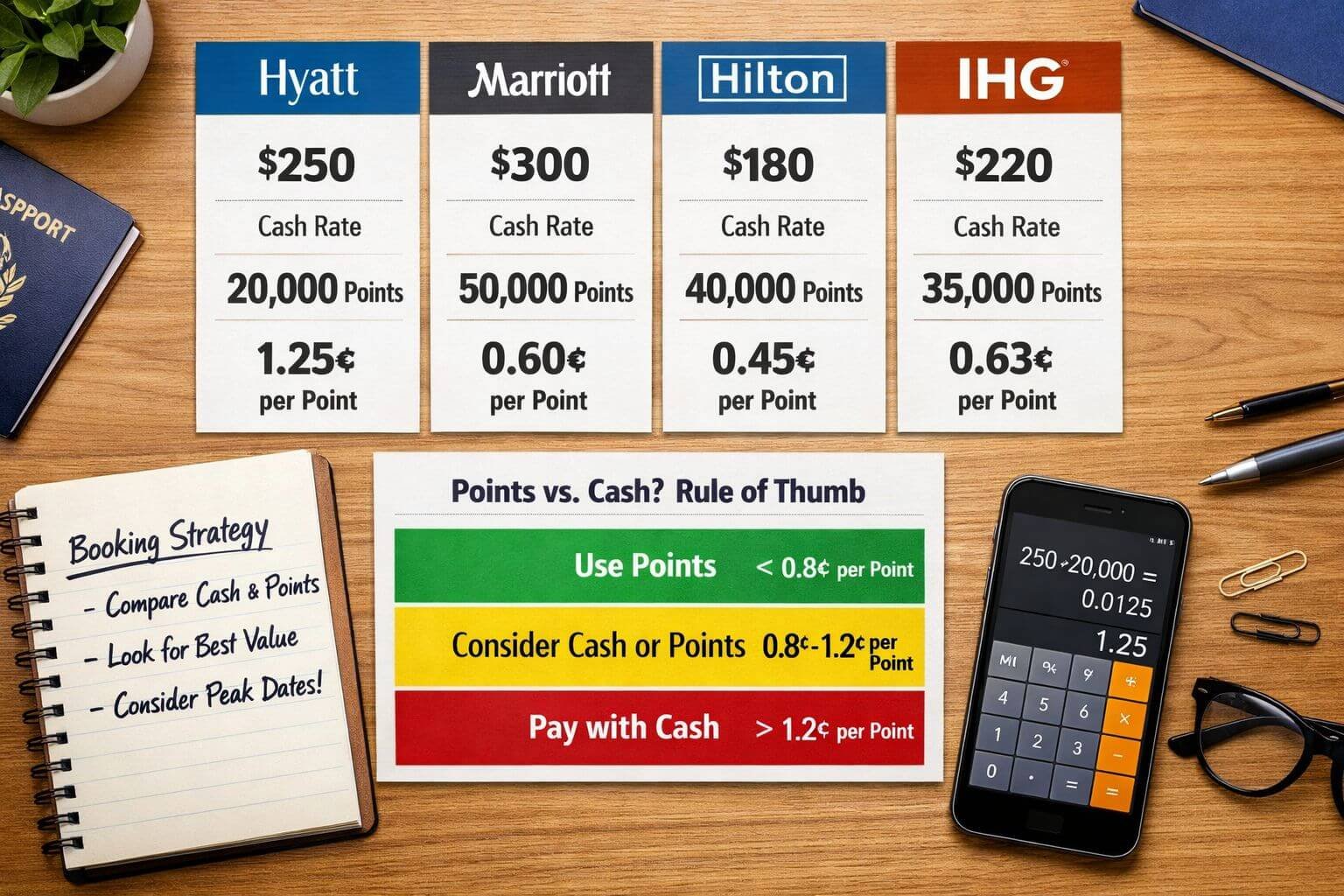
Common mistake
A common mistake is comparing points to the pre-tax cash rate. Many hotel awards reduce or eliminate some taxes and resort charges, so the correct comparison is often the all-in cost you would otherwise pay.
Which hotel chains still offer good value under dynamic hotel award pricing?
The short answer: Hyatt still offers the best upside, Hilton has selective wins, Marriott can work with 5th Night Free, and IHG is more date-sensitive than ever.
Hyatt: best upside, but less predictable than before
Hyatt still has more transparency than fully dynamic programs because it publishes pricing bands. That matters. Even after the 2026 changes, Hyatt can still produce standout value at lower categories, shoulder-season city hotels, and some all-inclusives booked before the highest tiers spread widely.
When Hyatt points still win
- Off-peak or “Lowest/Low” nights at Category 1-4 hotels
- Standard rooms when cash rates spike for local events
- Free night certificate stays, because certificates remain unchanged by the 2026 chart update
When Hyatt points disappoint
- Category 8 luxury resorts under new higher tiers
- Peak holiday dates
- Premium-demand weekends where yield management pushes pricing upward
For Hyatt-specific changes, see ATH’s Hyatt award chart changes 2026 guide and World of Hyatt award chart 2026 analysis.
Marriott: often average, sometimes very good
Marriott’s value is usually middling on one-night stays, but longer stays can improve fast because of 5th Night Free. That benefit is often the main reason a Bonvoy redemption beats cash.
Choose Marriott points if:
- You are booking five nights
- A resort or city hotel has inflated paid rates
- You can top off with existing Bonvoy points rather than transfer flexible points speculatively
Avoid Marriott points if:
- The CPP is under 0.7
- You are looking at luxury peak dates where Bonvoy pricing climbs aggressively
- A paid rate includes perks through another booking channel you would lose on an award
ATH readers should also review Marriott Bonvoy points devaluation 2026 and the broader Marriott Bonvoy guide 2026.
Hilton: more useful than many travelers assume
Hilton points often look weak at first glance because prices are high in absolute terms. But Hilton can still work well on lower-cost dates, at some international properties, and on five-night award stays for elites because Hilton offers every 5th night free on standard room reward stays for elite members.
Best Hilton use cases
- Five-night stays with elite benefits
- International hotels where paid rates include heavy taxes
- Midweek business-market hotels that soften outside peak days
IHG: value exists, but timing matters
IHG’s algorithmic pricing means values can shift quickly. That makes IHG less of a “store points for later” program and more of a “book when the rate is right” program.
Best IHG use cases
- Off-season nights where cash rates are low but points drop even faster
- Short-notice redemptions when paid rates surge
- Stays where the fourth-night reward from certain credit card benefits applies
When does dynamic hotel award pricing destroy value?
Dynamic hotel award pricing destroys value when points rise almost in lockstep with cash rates, leaving you with low CPP and fewer future options. The biggest warning signs are peak dates, luxury resorts, and event-driven demand.
Fast ways to spot a bad redemption
- The award rate rose sharply, but the room is still a standard room
- CPP is below your program threshold
- The chain is charging far more points than your usual baseline for the property
- A transferable-points transfer would be one-way and irreversible for a mediocre booking
Real-world “hurts” patterns by chain
These are realistic scenarios that show where dynamic pricing tends to fail, not fixed live quotes:
Hyatt hurts
- Luxury all-inclusive on a holiday week after the 2026 changes push top pricing much higher
- Category 8 resort that moved from prior peak pricing to a new top tier
- Friday-Saturday city stay during a major convention
Marriott hurts
- Aspirational resorts on winter holiday dates
- One-night luxury stays where 5th Night Free does not apply
- High-end brands on weekends with weddings or local events
Hilton hurts
- Big-city conference hotels when standard room awards remain available but expensive
- Luxury resorts on school breaks
- U.S. leisure weekends where paid rates and point prices both surge
IHG hurts
- Airport hotels during weather disruptions
- Boutique city hotels during festivals
- Last-minute stays where dynamic pricing overreacts to occupancy
Common pitfalls
- Transferring Amex points, Chase points, Capital One miles, Citi points, or Bilt points before checking cash rates
- Ignoring cancellation terms
- Forgetting to compare a prepaid member rate or AAA rate against the points option
- Treating all hotel points as equal to airline transfer partners
For a broader transferable-points strategy, use ATH’s bank transfer partners guide and transfer bonus strategy guide.
When does dynamic hotel award pricing create hidden sweet spots?
Dynamic hotel award pricing helps when point prices lag behind changing cash rates or when low-demand dates drop sharply. Midweek dips, shoulder season, and odd calendar gaps are where points can still win.
A good example is a resort that drops from 48,000 points to 29,000 points midweek while the cash rate falls from $570 to $320. The traveler who shifts dates improves value materially and preserves points for a better redemption later.
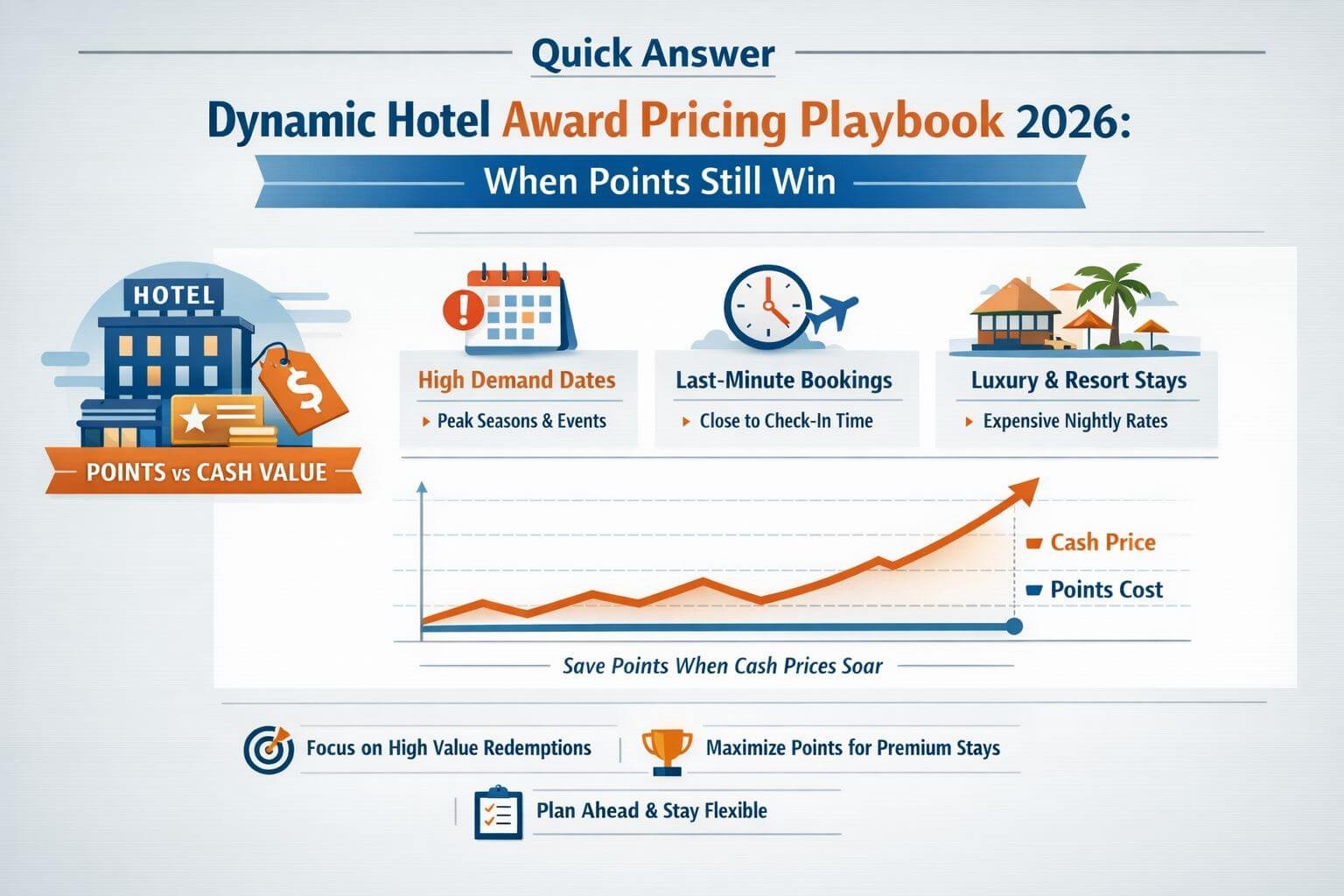
Where to look first
- Sunday to Thursday nights at resorts
- Shoulder seasons just before or after peak periods
- Business hotels on weekends, or leisure hotels midweek
- Category 1-2 Hyatt properties where lower bands can still undercut expected cash value
- Five-night bookings in Marriott or Hilton
“Helps” patterns by chain
Hyatt helps
- Category 1-2 hotels during soft demand periods
- Select city hotels before major demand periods start
- Free night certificate redemptions at properties that would otherwise be expensive in cash
Marriott helps
- Five-night beach stays with 5th Night Free
- Midweek urban properties with softened paid demand
- Secondary-city resorts in shoulder season
Hilton helps
- International midscale and upscale properties with high tax loads
- Five-night standard-room stays for elites
- Off-peak dates where point prices dip faster than expected
IHG helps
- One-night stays during temporary soft demand
- Off-season resort stays
- Hotels where a fourth-night-free benefit lowers effective average cost
For seasonal examples, ATH’s best hotel points redemptions for Christmas week and winter travel deals with points after holiday crowds show the same logic in action.
What is the 60-second checklist for points vs cash?
Use points when the redemption clears your chain threshold, preserves cash on a genuinely expensive stay, and does not require a speculative transfer. Use cash when the value is average and your transferable points can do more elsewhere.
The 60-second decision framework
Check the all-in cash rate
Include taxes, fees, and resort charges you would actually pay.Check the award rate
Look at the exact room type and cancellation policy.Calculate CPP
Compare against the chain threshold.Add hidden value
Consider 5th Night Free, certificates, taxes avoided, elite perks, and promotions.Check alternatives
Compare one day earlier, one day later, and a nearby property.Decide how you would fund it
Existing hotel points are easier to justify than a fresh transfer from transferable points.
Choose X if…
- Choose points if: CPP is strong, dates are firm, and the award saves real cash.
- Choose cash if: CPP is weak, there is a paid promo, or the transfer would lock flexible points into a low-value hotel currency.
- Choose “wait and monitor” if: pricing is moving, your dates are flexible, and you can rebook without penalty.
Are transferable points still worth using for hotels?
Yes, but only selectively. Transferable points remain most valuable because they keep options open across flights and hotels, so hotel transfers should usually be reserved for strong redemptions with confirmed award availability.
That matters even more in 2026, as hotel programs can reprice with little notice. Hyatt still offers some transparency through published ranges, but the direction across the industry is clear: more revenue-based pricing, fewer obvious fixed-value bargains.
Best for
- Travelers with flexible dates
- Readers willing to run quick CPP math
- Travelers booking expensive cash stays where points avoid real out-of-pocket cost
Not for
- Travelers who transfer speculatively
- Anyone chasing a redemption only because the hotel looks aspirational
- Readers who consistently get higher value from partner airlines and premium cabin awards
If flights are usually your better use of bank points, keep hotel transfers as a backup and review ATH’s hotel transfer partners directory and best use of 100,000 points guide.
Related reading
- 2026 Guide to Cents-Per-Point
- Do Hotel Points Expire? Rules by Program + Easy Extensions
- Hyatt Award Chart Changes 2026
- Marriott Bonvoy Points Devaluation 2026
FAQ
Is dynamic hotel award pricing always bad?
No. Dynamic hotel award pricing is bad when point prices rise as fast as cash rates, but it can be useful on off-peak or midweek dates where points drop enough to create good value.
What is a good Hyatt redemption in 2026?
A good Hyatt redemption usually starts around 1.5 cents per point, with stronger value above 2.0 cents per point, especially after the wider 2026 pricing ranges.
Is Marriott dynamic pricing worth it?
Marriott dynamic pricing is often worth it on five-night stays because 5th Night Free can materially improve value, but many one-night stays are only average.
Should transferable points be used for Hilton or IHG?
Transferable points should be used for Hilton or IHG only for near-term bookings with solid math. In many cases, those hotel currencies are not the best use of flexible bank points.
Why do hotel point prices change so much?
Hotel point prices change because many programs now tie award costs to demand, occupancy, seasonality, and paid rates through revenue management systems.
Are Hyatt award charts gone?
No. Hyatt still publishes an award chart, but the 2026 five-tier structure widened pricing enough that it behaves more like dynamic pricing in many situations.
Do free night certificates become more valuable under dynamic pricing?
Often, yes. A certificate can protect value when cash rates spike or point prices inflate, as long as the property still meets the certificate’s rules.
What is the biggest mistake travelers make with dynamic hotel award pricing?
The biggest mistake is transferring flexible points before comparing all-in cash rates and calculating cents per point.
Conclusion
Dynamic hotel award pricing is no longer a niche issue. It is the default reality across major chains, and it changes how smart travelers should value hotel points in 2026.
The good news is that the solution is simple. Do the math, use chain-specific thresholds, and look for hidden value from flexible dates, 5th Night Free, taxes avoided, and certificates. Hyatt still offers the best upside, Marriott can work well on longer stays, Hilton has selective wins, and IHG rewards careful timing more than loyalty.
The best next step is practical: bookmark this playbook, then pair it with ATH’s CPP guide before the next hotel booking. If a transfer is required, only move points once the room is available and the value is clearly there.


Content on Award Travel Hub is independently created by Award Travel Hub Editorial Desk and, where noted, reviewed by Award Travel Hub Review Desk. Some pages may contain affiliate links, but compensation does not determine our coverage, opinions, or methodology.