
Last updated: April 19, 2026
Key Takeaways
- The cents-per-point (CPP) formula is simple: (Cash price – fees you still pay) ÷ points used = your CPP value.
- Most programs have a “baseline” value. Getting above it means a good redemption; falling below it means you may be leaving value on the table.
- Premium cabin flights and high-demand hotel nights yield the best CPP; portal and gift card redemptions typically yield the worst.
- A “low” CPP redemption can still be the right call — expiring points, tight cash flow, and orphan balances are all valid reasons.
- 2026 transfer bonuses and dynamic pricing have changed the math for several programs; always run the numbers before you book.
Quick Answer
To know whether a redemption is worth it, divide the cash price of what you’re booking (minus any taxes or fees you still pay in cash) by the number of points required. If that number is at or above the program’s baseline value, it’s a good deal. If it’s well below, consider paying cash or finding a better use for those points.
What Is Cents Per Point, and Why Does It Matter?
Cents per point (CPP) is the single most useful number for any beginner in points. It tells you, in plain dollars-and-cents terms, how much value you’re squeezing out of each point you spend.
Without knowing how to calculate cents per point, it’s nearly impossible to answer the most common beginner question: “Is this redemption good?” A flight for 30,000 points sounds exciting, but it might be a terrible value if the same seat costs $180 in cash. Or it might be a steal if that seat costs $900.
CPP gives you a consistent measuring stick so you can compare any redemption — flights, hotels, portal bookings — against a known baseline.
The Simple Cents-Per-Point Formula (And How to Use It)
The formula has two steps, and it takes about 60 seconds to run.
You may be interested



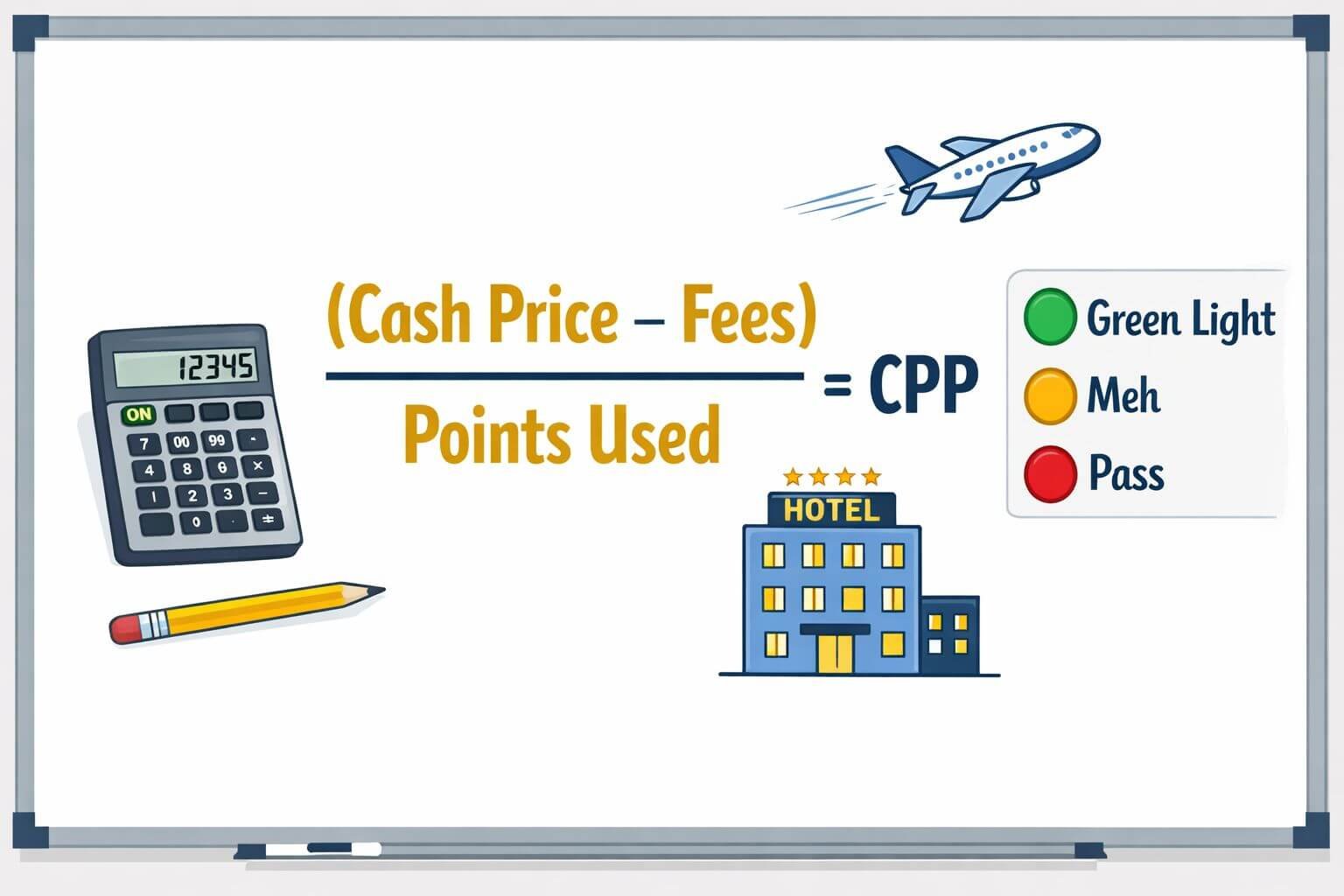
Step 1: Find the cash price of what you want to book, then subtract any taxes or fees you still have to pay in cash (since those come out of pocket).
Step 2: Divide that net cash value by the number of points required.
CPP = (Cash Price – Out-of-Pocket Fees) ÷ Points Used
Then multiply by 100 to express it as cents.
A Quick Example
Say a round-trip economy flight costs $250 in cash, or 10,000 points plus $50 in taxes.
- Net cash value: $250 – $50 = $200
- Points used: 10,000
- CPP: $200 ÷ 10,000 = $0.02, or 2 cents per point
That’s a solid result for most programs. Compare it to the baseline for your program (more on that below), and you’ll know instantly whether to book.
Quick tip: Cash back redemptions almost always return exactly 1 cent per point — straightforward, but with no upside. Points shine when you can beat that baseline significantly.
2026 Baseline Values: What CPP Is “Good” for Each Program?
Every points currency has a rough baseline value — a floor below which most experts consider a redemption a bad deal.
These baselines come from aggregated data across thousands of redemptions and are updated regularly by travel research sites. Use them as a guide, not gospel, because dynamic pricing means individual results vary.
2026 Reference Valuations (Approximate)
| Program | Estimated Baseline CPP | Notes |
|---|---|---|
| Chase Ultimate Rewards | ~1.8–2.0¢ | Transfer to partners for best value |
| Amex Membership Rewards | ~1.8–2.0¢ | Strong airline transfer options |
| Bilt Rewards | ~2.2¢ | Rent earning + strong transfer partners |
| World of Hyatt | ~1.8–2.5¢ | Among the best hotel programs |
| Marriott Bonvoy | ~0.7–0.9¢ | Dynamic pricing has compressed value |
| Hilton Honors | ~0.5–0.6¢ | Low per-point value; volume matters |
| United MileagePlus | ~1.2–1.5¢ | Better on partner awards |
| American AAdvantage | ~1.2–1.5¢ | Watch for partner sweet spots |
| Delta SkyMiles | ~1.1–1.3¢ | Fully dynamic; harder to find deals |
Sources: TPG Monthly Valuations, NerdWallet Airline Miles and Hotel Points Valuations. These are estimates based on average redemption data and will vary by route and availability.
For a deeper look at how these numbers shift month to month, the Points Valuations 2026: January Updates & Redemption Guide is a useful companion to this article.
The Traffic-Light System
Rather than obsessing over exact numbers, use this simple framework:
- Green Light — CPP is at or above the program baseline. Book it.
- Yellow Light — CPP is within 20–30% below baseline. Acceptable if no better option exists.
- Red Light — CPP is well below baseline (e.g., 0.5¢ for a program worth 1.8¢). Pay cash or find a better redemption.
How to Calculate Cents Per Point: 5 Real Examples With Step-by-Step Math
These worked examples cover the most common redemption types beginners encounter. Each one shows the full calculation and a traffic-light verdict.
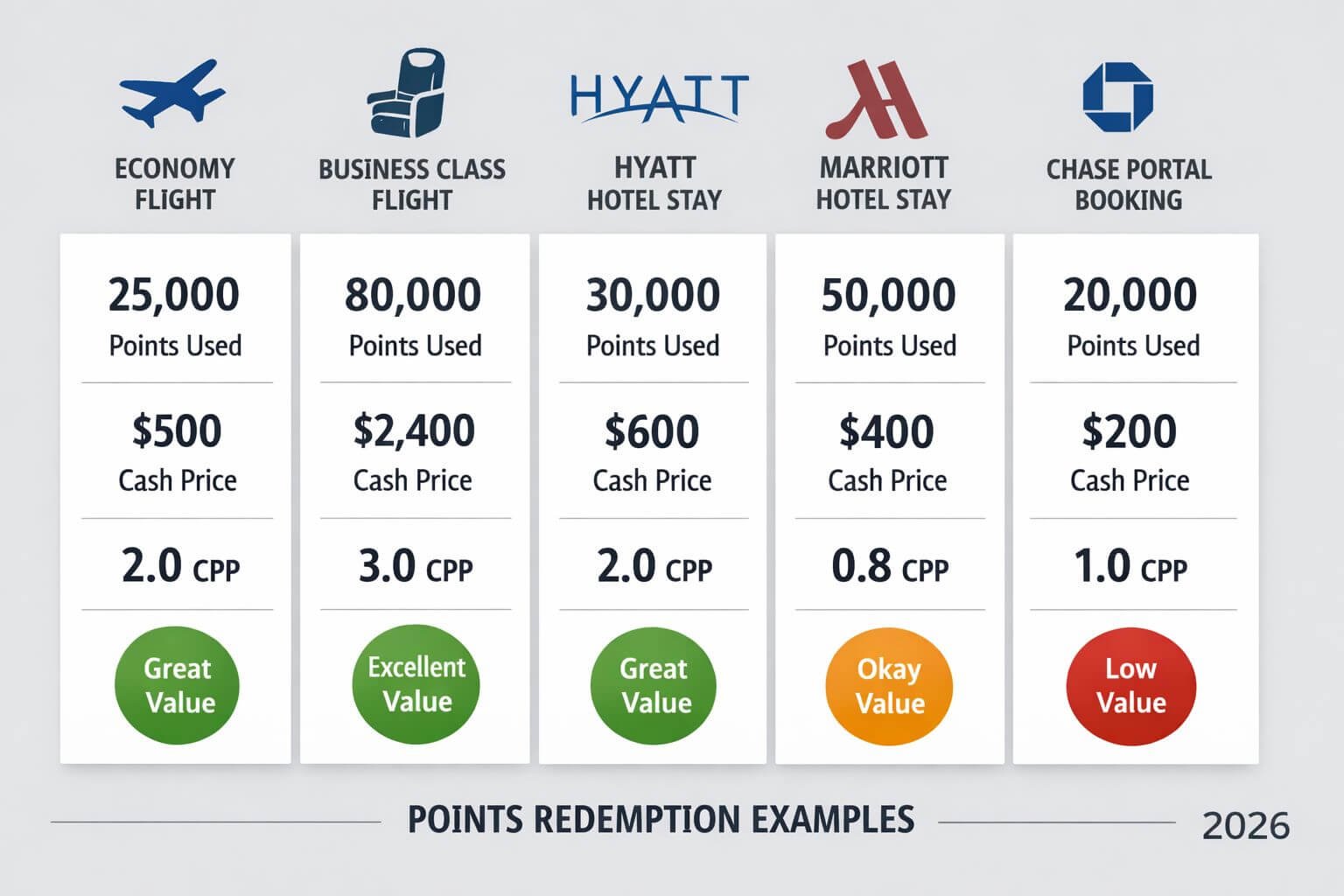
Example 1: Economy Flight (Chase → United)
Scenario: New York to London, round-trip economy. Cash price: $680. Award cost: 30,000 United MileagePlus miles + $112 in taxes.
- Net cash value: $680 – $112 = $568
- CPP: $568 ÷ 30,000 = 1.89¢
- United baseline: ~1.2–1.5¢
- Verdict: Green Light
This beats the United baseline comfortably. If you transferred Chase Ultimate Rewards to United to book this, you’re getting strong value from a flexible currency.
Example 2: Business Class Flight (United → Lufthansa Partner Award)
Scenario: Montreal to Munich, one-way business class. Cash price: $6,428. Award cost: 88,000 United MileagePlus miles + $59 in fees.
- Net cash value: $6,428 – $59 = $6,369
- CPP: $6,369 ÷ 88,000 = 7.2¢
- United baseline: ~1.2–1.5¢
- Verdict: Green Light (exceptional)
This is the kind of redemption that makes points enthusiasts excited. A business class seat worth over $6,000 for under 90,000 miles is a genuine sweet spot. For more on booking this type of award, see the Star Alliance Award Booking Guide 2026.
Example 3: Weekend Hotel Stay (World of Hyatt)
Scenario: Two nights at a Hyatt Category 4 property. Cash price: $340/night ($680 total). Award cost: 15,000 points per night (30,000 total).
- Net cash value: $680 (no extra fees for most Hyatt awards)
- CPP: $680 ÷ 30,000 = 2.27¢
- Hyatt baseline: ~1.8–2.5¢
- Verdict: Green Light
Hyatt remains one of the best hotel programs for CPP, especially at mid-tier properties where cash rates are high relative to the points cost. The World of Hyatt Transfer Partners Guide covers how to efficiently transfer points into this program.
Example 4: Marriott Bonvoy Hotel Stay
Scenario: One night at a Marriott property. Cash price: $220. Award cost: 35,000 Bonvoy points.
- Net cash value: $220
- CPP: $220 ÷ 35,000 = 0.63¢
- Marriott baseline: ~0.7–0.9¢
- Verdict: Pass
This falls below even Marriott’s already-modest baseline. Dynamic pricing at Marriott has made it harder to find strong CPP, particularly at mid-range properties. Marriott Bonvoy Points Devaluation 2026 explains what changed and where the remaining sweet spots are.
Example 5: Chase Travel Portal Booking
Scenario: Domestic round-trip flight. Cash price: $320. Portal cost: 25,600 points (at 1.25¢ per point via Sapphire Preferred’s old rate).
- Net cash value: $320
- CPP: $320 ÷ 25,600 = 1.25¢
- Chase UR baseline: ~1.8–2.0¢
- Verdict: Meh
Portal redemptions are convenient but rarely the best use of flexible currencies. You’re essentially cashing out at a fixed rate rather than unlocking premium value through transfers. That said, Chase’s new Points Boost feature (rolling out in 2026) can push portal CPP up to 1.75¢ (Sapphire Preferred) or 2.0¢ (Reserve) on select bookings, which changes the math significantly.
Example 6: Bilt → Accor Transfer (2026 Promotion)
Scenario: One night at an Accor property in Paris. Cash price: €280 (~$305 USD). Bilt is running a 2026 transfer bonus to Accor, giving 25% extra points on transfers. You transfer 8,000 Bilt points and receive 10,000 Accor points, enough for the night.
- Net cash value: $305
- Points effectively used: 8,000 Bilt points
- CPP based on Bilt points spent: $305 ÷ 8,000 = 3.81¢
- Bilt baseline: ~2.2¢
- Verdict: Green Light (transfer bonus amplified value)
This is a live example of how 2026 transfer bonuses change the CPP math. The bonus effectively gave you 25% more purchasing power. For a full breakdown of how to time these moves, see the Transfer Bonus Strategy: When to Transfer Points in 2026 guide.
Example 7: Gift Card / Merchandise Redemption
Scenario: Redeeming 10,000 Chase Ultimate Rewards points for a $100 Amazon gift card.
- Net cash value: $100
- CPP: $100 ÷ 10,000 = 1.0¢
- Chase UR baseline: ~1.8–2.0¢
- Verdict: Pass
This is the classic “bad redemption” example. You’re getting the same value as a cashback card while giving up the potential for 1.8–7¢+ per point through travel transfers. Avoid non-travel redemptions with flexible currencies whenever possible.
When a “Bad” CPP Redemption Still Makes Sense
Low CPP doesn’t always mean wrong choice. There are real situations where taking a below-baseline redemption is the smart move.
1. Expiring Points
If points are about to expire and you can’t extend them through activity, a 0.8¢ redemption beats a 0¢ redemption every time. Check program rules first — many programs reset expiration clocks with any account activity.
2. Cash-Flow Constraints
Sometimes cash is tight, and points are plentiful. Redeeming at 1.0¢ to cover a necessary expense is perfectly rational if paying cash would cause financial stress. Points are a tool, not a trophy.
3. Orphan Balances
An “orphan balance” is a small stash of points in a program you no longer actively use — say, 4,000 Delta SkyMiles from a flight years ago. Transferring those out is often impossible, and they’ll never reach a useful award threshold. Redeeming them for a magazine subscription or a small statement credit at 0.5¢ is better than watching them expire.
4. Simplicity Has Real Value
Not everyone wants to spend hours researching partner awards and transfer windows. If a portal redemption at 1.25¢ gets the trip booked with zero hassle, that convenience has genuine value that CPP math doesn’t capture.
The key insight: CPP is a decision-making tool, not a moral code. Use it to avoid obviously bad redemptions, but don’t let perfect be the enemy of good.
How Dynamic Pricing Affects Your CPP Calculations in 2026
Dynamic pricing means award costs fluctuate with demand, just like cash prices. This is now the norm at Delta, United (for most routes), Marriott, Hilton, and increasingly at other programs.
For beginners, this creates two practical problems:
The CPP on the same route can vary wildly by date. A domestic flight might cost 7,500 miles in January and 25,000 miles over spring break — even if the cash price difference is much smaller. This is why checking CPP for your specific dates matters more than relying on general benchmarks.
“Good” redemptions disappear fast. When a dynamic program prices a premium cabin at a low points cost, award space often fills quickly. Knowing your CPP target in advance means you can book confidently when you see it.
For a broader look at how this affects strategy, Award Travel Trends 2026: 8 Strategies for Your Points Plan covers dynamic pricing, along with other shifts happening this year.
Points vs. Cash: How to Decide in Under Two Minutes
Use this decision checklist before every redemption:
- Find the cash price of what you want to book.
- Subtract any fees you’ll pay in cash, regardless.
- Divide by the number of points required, then multiply by 100 to get CPP.
- Compare to the program baseline (see the table above).
- Ask: Do you have a better use for these points? (e.g., a future premium cabin trip)
- Ask: Are there constraints? (expiring points, tight cash, orphan balance)
- Decide: Green light, meh, or pass.
If you want to skip the manual math, the 2026 Guide to Cents-Per-Point includes a calculator tool that runs these numbers for you automatically.
When Cash Usually Wins
- The redemption CPP is below 1.0¢ for any program
- You have a strong cash back card earning 2%+ on the purchase
- The points have a clear, higher-value future use (e.g., business class trip planned)
- The booking has flexible cancellation, and you want to keep options open
When Points Usually Win
- CPP is at or above the program baseline
- The cash price is high (premium cabin, holiday travel, peak hotel nights)
- You have a large balance and no near-term cash redemption planned
- A transfer bonus is active that boosts the effective CPP
For a side-by-side comparison of the two strategies, Points vs Cash Back: Which Credit Card Strategy Wins 2026? walks through the full tradeoff in detail.
Common Mistakes Beginners Make With CPP
Knowing how to calculate cents per point is only half the battle. These are the errors that trip up most newcomers:
- Forgetting to subtract fees. Taxes and carrier surcharges come out of your pocket either way. If you don’t subtract them, you’ll overestimate your CPP.
- Using the cash price from a sale fare. If the flight is $199 because of a sale, that’s the correct comparison price — not the regular $450 fare. Don’t inflate your CPP by using an unrealistic cash benchmark.
- Comparing against the wrong baseline. A 1.3¢ CPP is great for Marriott Bonvoy but poor for Chase Ultimate Rewards. Always match the CPP to the specific program’s baseline.
- Hoarding points indefinitely. Points sitting unused are points at risk of devaluation. Programs can and do cut values with little notice. A 2.0¢ redemption today is often better than waiting for a 2.5¢ redemption that may never come — especially as inflation continues to affect points purchasing power.
- Ignoring transfer bonuses. A 30% transfer bonus to an airline partner can turn a mediocre CPP into an excellent one. Always check for active bonuses before transferring.
FAQ: Cents Per Point for Beginners
Q: What is a good CPP for airline miles? A: For most major U.S. airlines, a CPP of 1.2–1.5¢ or above is considered solid for economy. Business class awards routinely reach 3–7¢+ per point, which is where the real value lies.
Q: What is a good CPP for hotel points? A: It depends on the program. Hyatt is strong at 1.8–2.5¢+. Marriott is lower, with 0.7–0.9¢ being typical. Hilton is lower still at 0.5–0.6¢, but Hilton often prices awards at high point volumes, so absolute value can still be reasonable.
Q: Is a 1.0¢ CPP ever worth it? A: Yes — if points are expiring, you have an orphan balance, or cash is tight. But for flexible currencies like Chase UR or Amex MR, 1.0¢ is generally a poor result since those points can easily reach 1.8–2.0¢+ through travel transfers.
Q: Do portal redemptions count as “good” CPP? A: Usually not for flexible currencies. Chase’s old portal rate was 1.25¢ (Preferred) or 1.5¢ (Reserve), which is below the transfer partner potential. The new Points Boost feature can push this to 1.75–2.0¢ on select bookings, which is more competitive.
Q: How does a transfer bonus change my CPP? A: A transfer bonus gives you more points in the destination program per point transferred. For example, a 25% bonus means 10,000 points transferred become 12,500. Your effective CPP is calculated on the original points spent, so the bonus directly raises your CPP by the same percentage.
Q: Should I always maximize CPP? A: No. CPP is a guide, not a rule. Practical constraints — expiring points, travel timing, simplicity — all matter. A slightly lower CPP that gets you on a trip you actually want is better than a perfect CPP on a trip you never book.
Q: What’s the easiest way to find the cash price for comparison? A: Search the same dates on the airline or hotel’s website without logging into your points account. Use an incognito browser window to avoid personalized pricing. That’s your comparison baseline.
Q: Are first-class redemptions really worth 24¢+ per point? A: In theory, yes — some first-class cash fares exceed $20,000, and if you can book them for 100,000–150,000 points, the math produces extraordinary CPP. In practice, finding that award space is the hard part.
Q: How often do program valuations change? A: Frequently. Dynamic pricing programs change award costs in real time. Fixed-chart programs (like Hyatt) change when they announce category adjustments, which have happened annually in recent years. Check current valuations before any major redemption.
Q: Is it better to earn points or cash back? A: Points cards typically offer larger welcome bonuses and higher upside on premium travel. Cash back is simpler and more predictable. The right answer depends on whether you’ll actually use points for travel — if not, cash back is often the better choice.
Key Takeaways
- The CPP formula is: (Cash Price – Out-of-Pocket Fees) ÷ Points Used × 100 = cents per point.
- Baseline values in 2026: Chase UR and Amex MR are worth ~1.8–2.0¢ through transfers; Hyatt is 1.8–2.5¢+; Marriott is 0.7–0.9¢; airline programs vary by route.
- Business class and luxury hotel stays consistently deliver the best CPP because the cash price is high relative to the points cost.
- Portal and merchandise redemptions almost always underperform — avoid them with flexible currencies.
- Transfer bonuses can significantly boost CPP — always check for active promotions before moving points.
- Low CPP isn’t always wrong: expiring points, cash-flow needs, and orphan balances are all valid reasons to take a below-baseline redemption.
- Dynamic pricing in 2026 means CPP varies by date and demand — run the numbers for your specific booking, not just a general estimate.
- Hoarding points carries real risk — devaluations happen, and a good redemption today often beats a perfect redemption that never comes.
Conclusion: Start Simple, Then Build
Learning how to calculate cents per point doesn’t require a spreadsheet or a finance degree. The formula is short, the math is basic arithmetic, and the traffic-light system (green/meh/pass) makes decisions fast.
Start with one upcoming trip. Pull up the cash price, find the points cost, run the formula, and compare it to the program’s baseline. Do that a few times, and the process becomes automatic.
Once CPP feels comfortable, the next step is understanding where to find the best redemptions — premium cabin partner awards, peak hotel nights, and transfer bonus windows. The Transfer Bonus Strategy: When to Transfer Points in 2026 guide is a natural next read, and Plan 2026 Aspirational Trips with Points shows how to put CPP knowledge to work on real bucket-list travel.
The goal isn’t to squeeze every last fraction of a cent out of every redemption. It’s to stop leaving obvious value on the table — and to feel confident every time you choose between points and cash.


Content on Award Travel Hub is independently created by Award Travel Hub Editorial Desk and, where noted, reviewed by Award Travel Hub Review Desk. Some pages may contain affiliate links, but compensation does not determine our coverage, opinions, or methodology.