

Last updated: October 6, 2026
A standard room at a Hilton property can cost anywhere from roughly 5,000 points to the program’s reaffirmed 250,000-point cap for a single night, depending on the date, the market, and how aggressively demand pricing is running that week. That spread is the entire problem with a Hilton award booking: the same room type at the same hotel can swing in value by 40x or more depending on when you search, which makes “how many points is this worth” a moving target instead of a fixed answer.
This guide gives Hilton Honors members with large point balances a repeatable method for separating the redemptions that genuinely beat cash from the ones that just look attractive because the point number is smaller than usual.
Quick Answer
Set a personal cents-per-point floor (roughly 0.5 cents per point for Hilton) and refuse to book any Hilton award night that prices below it relative to the cash rate. Fifth-night-free, points-and-money hybrid rates, and off-peak resort dates are the three levers that most reliably push a redemption above that floor. Reserve free night certificates for properties where the cash rate clears roughly $250-$350 a night; anything cheaper wastes the certificate’s ceiling.
Key Takeaways
Hilton’s dynamic award pricing has an observed floor near 5,000 points and a program-confirmed ceiling of 250,000 points per standard room, per night.
Taxes and resort fees are waived on standard Hilton award bookings paid fully in points, which is a real advantage over Marriott and some cash-rate comparisons.
Fifth night free applies automatically to reward stays of five or more consecutive nights booked with points, including many points-and-money bookings, and requires no elite status.
A realistic baseline value for Hilton points is about 0.5 cents per point; treat anything paying out meaningfully less as a mistake, not a bargain.
You may be interested
Points-and-money bookings often produce a better effective rate than an all-points redemption, especially at mid-tier properties during shoulder season.
Sub-rate nights cluster at beach and resort properties in off-peak weeks, in high-tax U.S. and European markets, and during rate dips 30-60 days out.
Free Night Certificates from Hilton co-brand cards cap at 95,000 points of value; using one at a property below that cash-rate threshold leaves value on the table.
Elite status (Gold and Diamond) doesn’t change the points price of a room, but it adds space-available upgrades and waived resort fees on cash stays, which changes the comparison math.



How Hilton Honors Dynamic Award Pricing Actually Behaves
Hilton Honors prices standard rooms dynamically, meaning the points cost moves with the cash rate rather than sitting on a fixed chart. The program has reaffirmed a ceiling of 250,000 points per standard room, per night, with an observed floor around 5,000 points at low-demand properties, and most bookings land somewhere in a much narrower band shaped by local demand.
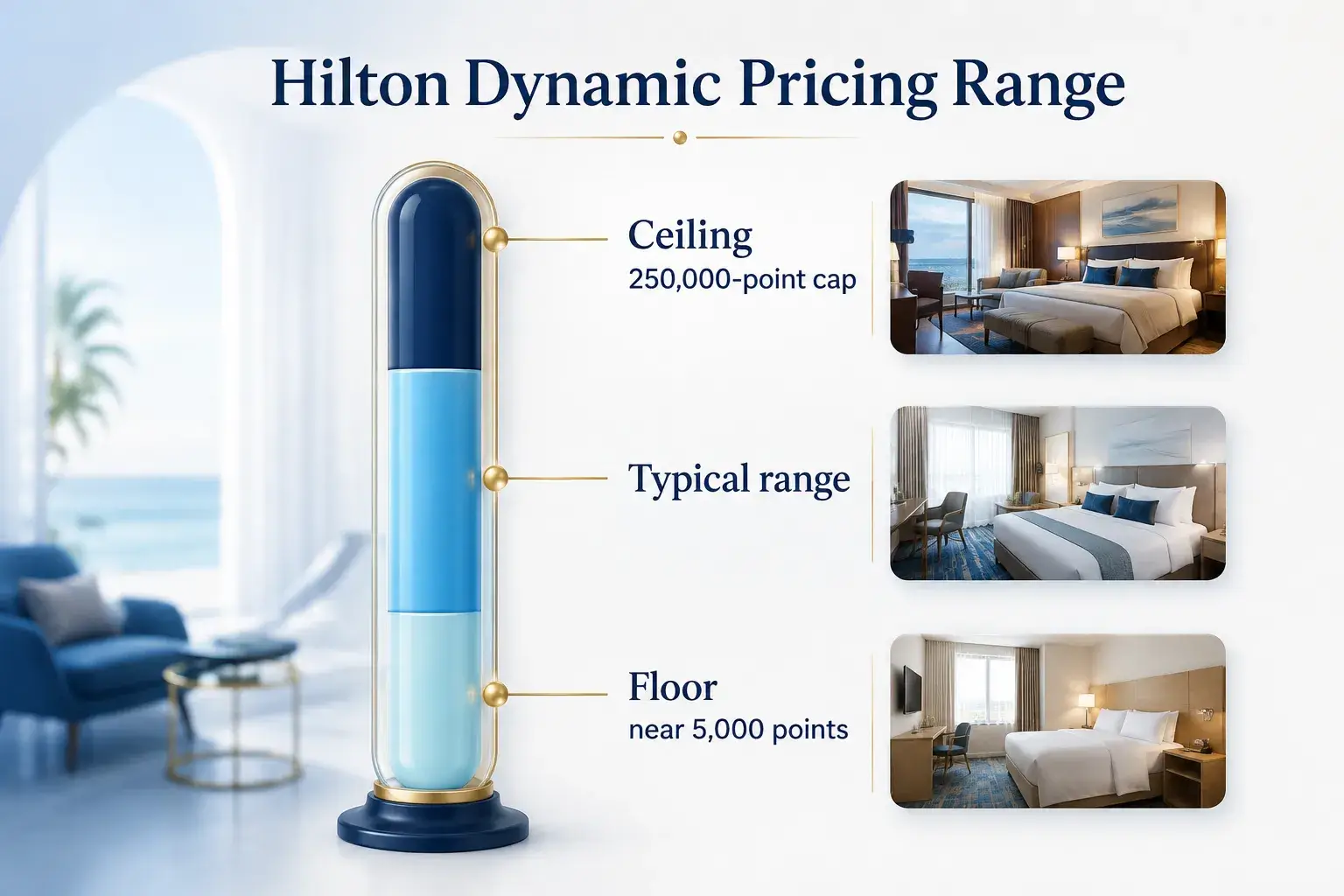
That ceiling matters because it used to sit far lower. Hilton’s standard-room cap moved from roughly 95,000 points, to 120,000, to 200,000, and now sits at 250,000 points at the top end of the market. Each increase pushed the most expensive redemptions further out of reach for members trying to book luxury and resort properties on points alone, even though the vast majority of hotels in the portfolio never approach that number.
What Is a Hilton Award Night and How Does It Work
A Hilton Award Night is a standard room reservation paid fully or partly with Hilton Honors points instead of cash, priced in real time against that day’s cash rate rather than a static chart. The points price adjusts nightly based on demand, so the same room can cost different point totals on a Tuesday versus a Saturday, or in July versus November.
Unlike airline award charts with fixed regional pricing, Hilton does not publish a rate table members can check in advance. The only way to know the points price is to search live on Hilton.com or the app for specific dates.
Hilton Points vs Hilton Awards: What’s the Difference
Hilton points are the loyalty currency earned from stays, co-brand card spend, and transfers from programs like Amex Membership Rewards; a Hilton award is the specific redemption transaction that converts those points into a room, upgrade, or other benefit. Points sit in a member’s account as a balance; an award is what happens when that balance is spent on a live rate.
This distinction matters for planning: a large points balance says nothing about redemption value until it’s matched against a specific night’s dynamic price.
Why Your Hilton Award Night Costs More Than Last Year
A Hilton award night usually costs more than it did a year ago because dynamic pricing tracks rising cash rates and because Hilton has raised the standard-room ceiling multiple times since introducing dynamic pricing. Both forces move in the same direction: up.
Members who booked a resort property for 80,000 points in 2023 may now find the same dates priced at 140,000-180,000 points, even with no change in the hotel’s star rating or amenities. This is the core devaluation risk of any dynamically priced hotel program, and it’s covered in more detail in Hidden Hilton Award Value After 2025 Devaluations.
Setting Your Own Redemption Floor in Cents Per Point
The most reliable way to avoid wasting points on a Hilton award is to set a personal minimum value, typically around 0.5 cents per point, and decline any booking that prices below it. This single rule does more to protect redemption value than any search trick, because it forces a direct comparison to the cash price every time.
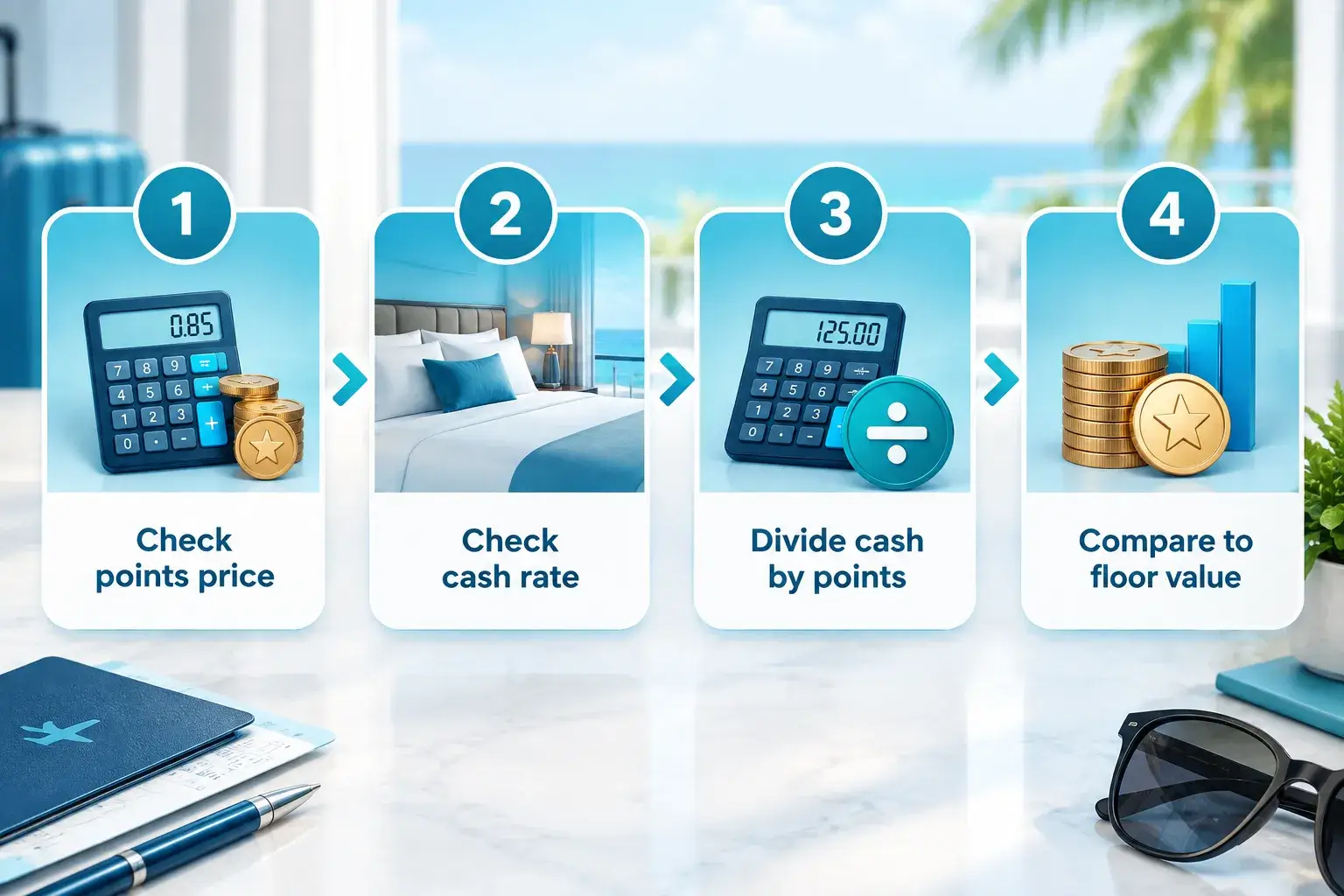
Calculate the rate with three numbers: the cash price for the night (including taxes and resort fees, since those are usually waived on the award), the points price, and simple division.
Formula: (Cash price in cents) ÷ (Points required) = cents per point (CPP)
Example: A resort room costs $340 cash including a resort fee, or 68,000 points on the same date with no fees added.
340,000 cents ÷ 68,000 points = 5.0 cents per point… that’s a typo-prone way to say it, so run it the standard way: $340 = 34,000 cents. 34,000 ÷ 68,000 = 0.50 cents per point.
That example lands exactly on the floor, which makes it a marginal redemption, not a clear win. A stronger example: the same room dips to 55,000 points during a rate promotion while cash stays at $340. That’s 34,000 ÷ 55,000 = 0.62 cents per point, comfortably above the baseline.
How Many Points Do You Need for a Hilton Award Night
Standard rooms typically run somewhere between 20,000 and 100,000 points a night at mainstream Hilton, DoubleTree, and Embassy Suites properties, with luxury and resort brands like Waldorf Astoria and Conrad often landing in the 80,000-200,000 range and occasionally approaching the 250,000-point cap on peak dates. The exact number depends entirely on that night’s cash rate, so members should treat any remembered number as a rough guide, not a guarantee.
Decision rule: Choose to book with points when the calculated CPP clears 0.5 cents. Choose to pay cash, or look at a points-and-money hybrid, when it falls below that line.
Hilton Award Night vs Paying Cash: Which Wins
Paying cash wins whenever the calculated redemption value falls below roughly 0.5 cents per point, since that’s close to what Hilton points are worth through other redemption paths, including some retail transfer promotions. Booking with points wins when the award clears that floor, particularly at properties where cash rates run high due to resort fees, city taxes, or peak-season pricing.
Common mistake: Comparing the points price only against the base room rate and ignoring resort fees and taxes. Because those charges are usually waived on award stays, leaving them out of the cash-side calculation understates the redemption’s true value and can cause a member to skip a good deal.
The Fifth Night Free Benefit and How It Moves the Math
Fifth night free means any Hilton Honors reward stay of five consecutive nights or longer, booked with points through Hilton’s own channels, gets the fifth night at no points cost, cutting the average per-night rate by roughly 20 percent. It’s the single most effective counterweight to rising dynamic prices, because it doesn’t require elite status or a specific card.
Multiple industry sources have reconfirmed this mechanic through late summer 2026, and it applies broadly:
Available to all Hilton Honors members, not just elites.
Applies to standard points redemptions and to many points-and-money bookings, provided the stay is booked through Hilton’s site or app.
Requires five or more consecutive nights at the same property; split stays across different hotels don’t qualify.
The discount is baked into the total points shown at checkout; there’s no separate code or request needed.
Example: A property prices at 60,000 points a night. A five-night stay booked separately at that rate would cost 300,000 points. Booked as one five-night reservation, Hilton charges for four nights and waives the fifth: 240,000 points total, or 48,000 points a night effective rate, a meaningful drop in cost for the same stay.
This is why any redemption-value comparison should default to five-night math whenever the itinerary allows it. For a deeper walkthrough of how this interacts with dynamic pricing more broadly, see the Dynamic Hotel Award Pricing Playbook 2026.
Using Elite Status to Get Cheaper Hilton Award Nights
Hilton Gold and Diamond elite status does not lower the points price of a standard room award; dynamic pricing applies the same number to elites and base members alike. Status instead improves the value of a stay indirectly, through space-available suite upgrades, waived resort fees on cash and points-and-money bookings, and complimentary breakfast that would otherwise cost extra on a cash rate.
For members deciding whether chasing status is worth it purely for award-booking purposes, the honest answer is no, status affects the cash side of the comparison, not the points price itself. It’s still valuable, just not as an award-pricing lever. Full tradeoffs are covered in the Hilton 2026 Loyalty Strategy guide.
Points and Money Bookings: When the Hybrid Rate Wins
A points-and-money booking splits the cost between a reduced points amount and a cash co-payment, and it frequently produces a better effective cents-per-point rate than an all-points redemption, especially at mid-tier properties during shoulder-season dates. This option shows up on the booking page as an alternative rate alongside the standard points price.
Can you combine Hilton points and cash for award nights? Yes. Hilton offers a points-and-money option on most standard room award nights, letting a member choose a lower points amount in exchange for paying part of the rate in cash, and fifth-night-free typically still applies to qualifying five-night hybrid stays.
Best for:
Members with a large points balance who want to stretch it across more nights rather than draining it on one stay.
Properties where the all-points price sits close to the personal CPP floor, since even a modest cash co-payment can push the effective rate meaningfully higher.
Not for:
Members trying to conserve cash rather than points, since the co-payment can still run $50 – $150 a night depending on the split offered.
Nights where the all-points rate already clears a strong CPP; adding cash to an already-efficient redemption doesn’t improve it.
Example: A room prices at 70,000 points all-in, or 40,000 points plus $120 cash. If cash-only would run $310, the all-points version returns roughly 0.44 CPP (below floor), while the hybrid version returns ($310−$120)=$190 saved for 40,000 points, or 0.475 CPP, still marginal, illustrating why the math has to be checked on a case-by-case basis rather than assumed.
Where Sub-Rate Nights Cluster: Resorts, Peak Dates, and High-Tax Markets
Sub-rate Hilton award nights, meaning redemptions that clear a strong cents-per-point value, cluster most reliably at resort and beach properties during shoulder-season weeks, and in cities with high lodging taxes or mandatory resort fees that get waived on award stays. These are the conditions where the cash side of the comparison is inflated by fees the points booking simply skips.

Yes, it’s possible to get Hilton award nights cheaper than the standard rate implies, not in points terms, but in effective value terms, because the award booking avoids charges the cash guest has to pay.
Patterns worth tracking:
Market typeWhy it worksWhat to watchCaribbean and Mexico resortsHigh resort fees (often $40,$75/night) waived on pointsPeak winter weeks push points prices up too; shoulder months work bestU.S. convention cities (Orlando, Las Vegas, New Orleans)High local occupancy taxes folded into cash rate but waived on awardConvention calendars spike cash and points together; check off-peak weeksEuropean city hotels (Paris, Rome, Amsterdam)VAT and city tourist taxes add up on cash bookingsCurrency swings can shift the calculation month to monthSuburban and airport propertiesLower baseline demand keeps dynamic pricing near the floorLower cash rates too, so absolute savings are smaller even if CPP is fine
Common mistake: Assuming a resort is automatically a good redemption because resort fees get waived. If the underlying cash rate is already low, the fee waiver alone often isn’t enough to clear the 0.5 CPP floor.
Using Free Night Certificates on the Right Properties
Hilton co-brand Free Night Certificates (issued by the Aspire, Surpass, and Honors American Express cards) currently cap at 95,000 points of value per certificate and should be reserved for properties where the cash rate runs at least $250 – $350 a night; using one below that threshold leaves value on the table. The certificate has no blackout dates and can be applied to any standard room at eligible properties, subject to availability.
Key terms to confirm before booking:
Certificates are valid for standard rooms only; they can’t be combined with cash to book a higher-priced room outright, though members can sometimes upgrade with points on top.
No blackout dates apply, but the reservation is still subject to standard room award availability, so highly booked dates may show no eligible rooms at all.
Certificates typically expire on a set date tied to the card’s cardmember year; unused certificates don’t roll points back to the account.
Decision rule: Redeem a certificate at a property pricing near or above the 95,000-point cap in cash-equivalent terms. Redeeming it at a budget property that would only cost 30,000-40,000 points anyway wastes the certificate’s built-in value ceiling.
For a broader comparison of certificate strategy against straight points redemptions, see Free Night Certificates Vs Points Nights: Which Gets You More Luxury Stay, and for card-specific bonus timing, Amex Hilton Transfer Bonus 2026.
Search Tactics: Flexible Dates, Split Stays, and Rate Comparison
The most effective way to book a Hilton award night at a lower rate is to search a flexible date range on the Hilton app’s calendar view, compare the points price against the cash price for the same dates, and shift the stay by a few days when the gap narrows. Dynamic pricing can swing meaningfully within the same week, so a Tuesday-to-Thursday search often beats a Friday-to-Sunday search at the same property.
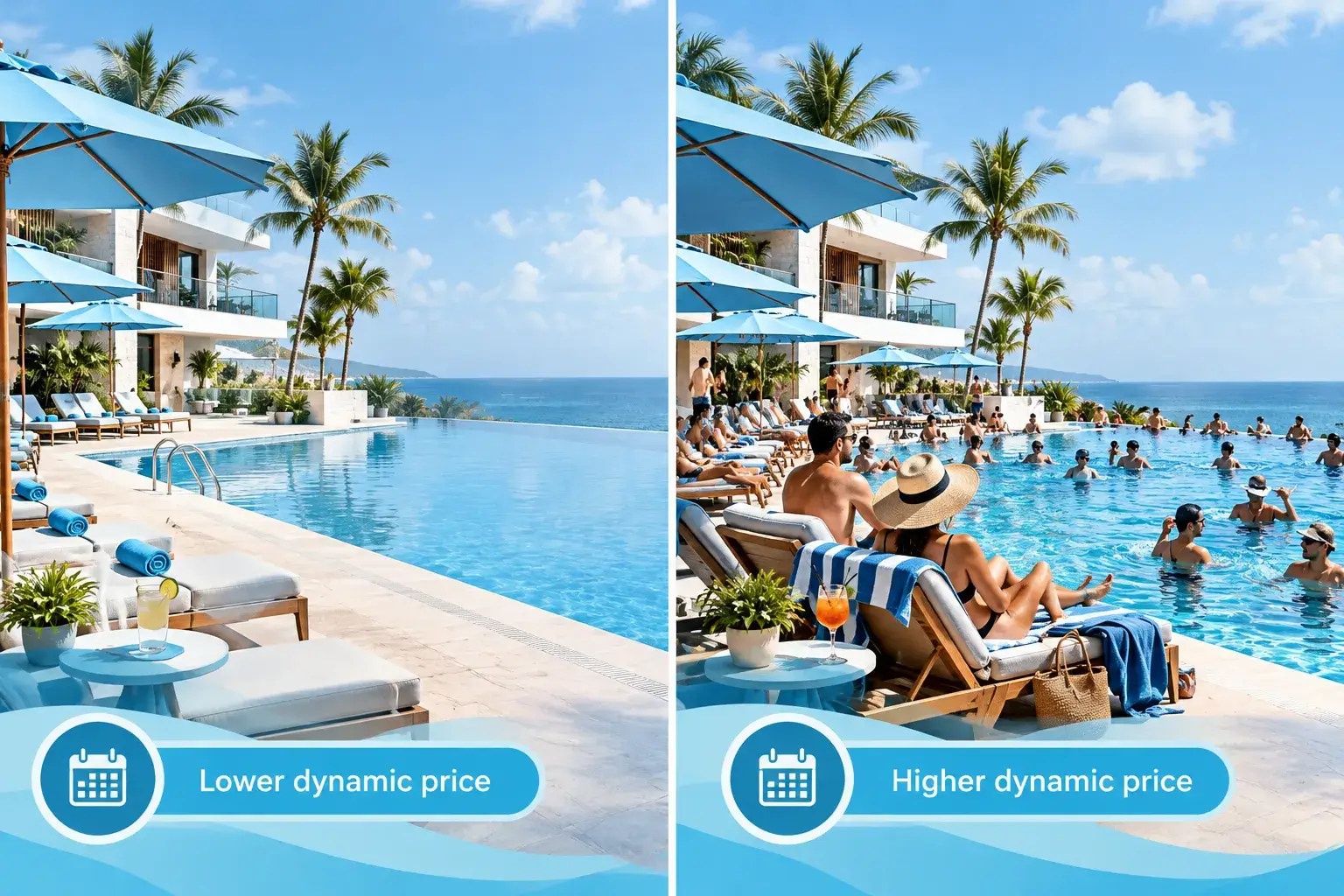
Best time to book Hilton award nights for the lowest rates: Shoulder-season weeks (just before or after a destination’s peak), midweek stays over weekend stays, and rate checks done 30-60 days out, when some properties adjust dynamic pricing downward if cash demand is soft. There’s no universal “book exactly 45 days ahead” rule; the calendar view is the actual tool, not a fixed number.
If a Hilton award night shows no availability, try these steps in order:
Check the calendar view for nearby dates instead of a single fixed night.
Search a different room type; suites sometimes show availability when standard rooms don’t, though at a higher points cost.
Consider a split stay across two nearby properties in the same city if the original hotel is sold out on points.
Call Hilton Honors reservations; phone agents occasionally see inventory not yet reflected online.
Revisit closer to the stay date, since some award space opens up in the final 1-2 weeks as cash bookings shift.
Split stays deserve a specific caution: because fifth-night-free requires five consecutive nights at one property, breaking a week-long trip across two hotels forfeits that discount at both. Run the math both ways before splitting a stay purely for variety.
Rate-comparison tools built into the Hilton app and third-party trackers have been updated through August and September 2026 to reflect fifth-night logic automatically, which makes manual five-night math less necessary than it used to be, though it’s still worth a spot check before booking a large redemption. For a wider look at tools worth setting up, see Best Award Travel Tools and Alerts to Set Up for 2026 Bookings.
Redemptions to Refuse No Matter How Many Points You Hold
Some Hilton award nights should be declined regardless of point balance, because the effective rate falls so far below reasonable value that paying cash or holding the points for a better use is the stronger move. A large balance doesn’t change the math; it just makes it easier to justify a bad redemption without noticing.
Refuse a redemption when:
The calculated CPP falls meaningfully under 0.4 cents per point, even after accounting for waived taxes and fees.
A single-night stay prices near or at the 250,000-point ceiling at a property with a comparable non-Hilton alternative for a fraction of the cash cost.
Award pricing for a five-night stay doesn’t reflect the fifth-night-free discount, which can happen with third-party booking channels or when nights aren’t fully consecutive at the same property; verify the discount is applied before confirming.
A Free Night Certificate would be used at a property pricing well under its 95,000-point value ceiling.
Hilton award nights and blackout dates: Hilton does not use traditional blackout dates the way some legacy airline programs do. Instead, dynamic pricing itself acts as a soft blackout, a property can technically show award availability on a peak date while pricing at or near the 250,000-point cap, which functions the same as a blackout in practical terms even though no calendar restriction exists.
Compare that structure against competitors: Marriott Bonvoy runs a similar fifth-night-free benefit but applies different dynamic mechanics and caps, discussed in Marriott Bonvoy’s Dynamic Award Pricing: Is It Worth It in 2025. Hyatt, by contrast, doesn’t offer a broad fifth-night-free benefit but keeps more transparent, capped pricing tiers, covered in Hyatt vs Marriott vs Hilton 2026 Europe. Members weighing which hotel currency to build should read that comparison before committing a large points balance to one program.
Frequently Asked Questions
Are Hilton award nights worth it, based on member experience?
Community discussion on forums like Reddit’s r/hilton generally agrees that award nights are worth it at resort and high-tax properties where fees get waived, and less worth it at budget properties where the points price barely undercuts a low cash rate. The consensus lines up with the 0.5 cents-per-point floor described in this guide.
What is a realistic cents-per-point value for Hilton Honors points?
A baseline of around 0.5 cents per point is a reasonable planning number for Hilton Honors, which runs lower than transferable currencies like Amex points or Chase points used toward premium cabin flights, but is competitive with other hotel-specific currencies once fifth-night-free and fee waivers are factored in.
Do resort fees and taxes apply to Hilton award bookings?
No. Standard Hilton award bookings paid fully in points waive resort fees and occupancy taxes, which matters when comparing the points price with an all-in cash rate that includes those charges.
Does fifth-night-free apply to points-and-money bookings?
Yes, in most cases. Fifth-night-free typically applies to qualifying five-consecutive-night stays booked through Hilton’s own channels, including many points-and-money hybrid rates, though it does not apply to Free Night Certificate reservations combined into a longer stay.
Why does the points price for the same hotel change from one search to the next?
Dynamic pricing adjusts with demand in near real time, so cash rate changes, occupancy shifts, and even the specific dates searched can move the points price up or down between visits to the site.
Should a Free Night Certificate be used at a budget property to save points?
Generally no. Certificates cap at 95,000 points of value, so using one at a property that would only cost 30,000-40,000 points anyway wastes the certificate’s built-in ceiling; save it for a property pricing near or above that cap.
Conclusion
Dynamic pricing turned Hilton award bookings into a math problem rather than a lookup exercise, and treating it that way is the only way to protect redemption value. Set a personal floor near 0.5 cents per point, run every prospective booking through that calculation including waived taxes and fees, and default to five-night stays whenever an itinerary allows it so fifth-night-free can do its work.
Next steps: check the Hilton app’s calendar view for flexible dates before locking in a stay, reserve Free Night Certificates for properties clearing the $250 – $350 cash-rate range, and compare points-and-money rates against all-points pricing before committing a large balance to a single redemption. For members still deciding how much of their transferable points strategy should run through Hilton versus other hotel programs, the Hilton Honors Transfer Partners Guide is the logical next read.


Content on Award Travel Hub is independently created by Award Travel Hub Editorial Desk and, where noted, reviewed by Award Travel Hub Review Desk. Some pages may contain affiliate links, but compensation does not determine our coverage, opinions, or methodology.