
Last updated: July 7, 2026
Quick Answer: The value of airline miles in 2026 ranges from roughly 1.0 to 1.6 cents per point (CPP) for most major U.S. programs on average, but the number that actually matters is the CPP on your specific redemption. A single program can deliver anywhere from 0.5 CPP on a bad economy booking to 5.0+ CPP on a well-timed premium cabin award. Published averages are a starting point, not a decision tool. This guide gives you cross-program benchmarks, the formula, and route-level math to decide whether to redeem or pay cash each time.
Key Takeaways
- No single CPP number is authoritative. TPG, OMAAT, and NerdWallet disagree on the same program by 0.2–0.5 CPP. Use a range, not a point estimate.
- The CPP formula is simple: (Cash fare minus award taxes and fees) ÷ miles required × 100. Memorize it and run it before every redemption.
- Cabin class is the biggest CPP lever. Economy redemptions typically land at 1.0–1.3 CPP; business class partner awards can clear 3.0–6.0+ CPP on the same program.
- Dynamic pricing has widened CPP ranges dramatically since 2023. Programs like Delta SkyMiles and United MileagePlus can price the same route at 0.7 CPP one day and 2.5 CPP the next.
- Transferable points (Amex, Chase, Capital One, Citi, Bilt) are worth more than airline-specific miles because they let you pick the best program per trip. Chase Ultimate Rewards are valued at around 2.0 CPP; Amex Membership Rewards are similarly valued.
- Set a personal “redeem floor” per program. If the CPP on a specific booking falls below your threshold, pay cash and save miles for a better use.
- Always check partner award pricing, not just the airline’s own site. Booking through partner airlines often unlocks fixed award charts and lower surcharges.
The CPP Formula: How to Calculate the Value of Airline Miles Yourself
The cents-per-point calculation is the single most useful tool in travel rewards math. Here’s the formula:
CPP = (Cash Price of Ticket − Award Taxes & Fees) ÷ Miles Required × 100
Step-by-step example:
- Find the cash fare for the same flight, cabin, and date: $2,400 round-trip business class, JFK to London.
- Note the award price: 70,000 miles + $86 in taxes.
- Subtract taxes from the cash fare: $2,400 − $86 = $2,314 in value the miles are replacing.
- Divide by miles: $2,314 ÷ 70,000 = 0.033.
- Multiply by 100: 3.3 CPP.
That’s a strong redemption. If the same flight is priced at 120,000 miles with $450 in fuel surcharges, the math changes: ($2,400 − $450) ÷ 120,000 × 100 = 1.6 CPP, which is decent but not exceptional.
For a full breakdown of this formula with more worked examples, see our guide to cents per point and award travel math.
Common mistake: Forgetting to subtract taxes and fees from the cash fare. If an award booking carries $500 in fuel surcharges, those reduce the value your miles provide. Always use the net value.
What Major Airline Miles Are Worth in April 2026 (Multi-Source Comparison Table)
Published valuations differ because each outlet uses different methodology, sample sizes, and assumptions. The table below reconciles April 2026 estimates from four major sources into a usable range.
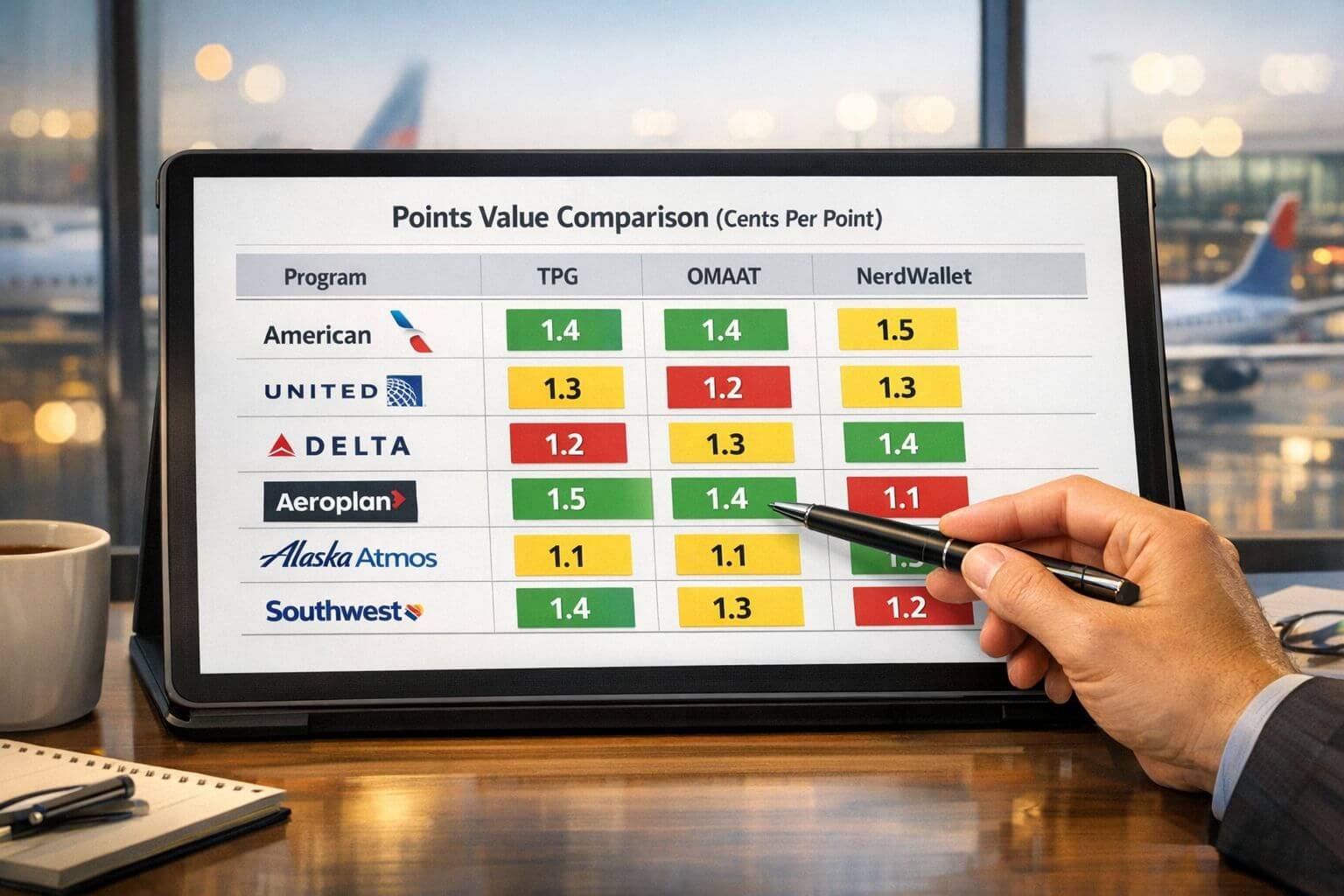
| Program | TPG (Apr 2026) | OMAAT (Apr 2026) | NerdWallet (2026) | ATH Working Range |
|---|---|---|---|---|
| American AAdvantage | 1.6¢ | 1.5¢ | 1.5¢ | 1.4–1.7¢ |
| Air Canada Aeroplan | 1.4¢ | 1.5¢ | 1.5¢ | 1.4–1.6¢ |
| Alaska Atmos Rewards | 1.4¢ | 1.5¢ | 1.4¢ | 1.3–1.5¢ |
| United MileagePlus | 1.35¢ | 1.1¢ | 1.2¢ | 1.1–1.4¢ |
| Delta SkyMiles | 1.2¢ | 1.1¢ | 1.1¢ | 1.0–1.3¢ |
| Southwest Rapid Rewards | 1.25¢ | 1.3¢ | 1.3¢ | 1.2–1.4¢ |
You may be interested



Why the ranges matter more than a single number: TPG valued AAdvantage at 1.6¢ while OMAAT pegged it at 1.5¢. That 0.1¢ gap means a 60,000-mile redemption is “worth” either $960 or $900, depending on which source you trust. Neither is wrong; they’re measuring different redemption mixes. The ATH working range captures the credible floor-to-ceiling so you can benchmark your own bookings.
All six programs above showed downward revisions from prior months, driven by continued expansion of dynamic award pricing. For a deeper look at individual programs, see our guides to American Airlines AAdvantage, United MileagePlus, Delta SkyMiles, and Alaska Atmos Rewards.
Key context: Transferable points programs like Chase Ultimate Rewards (valued around 2.0¢ by TPG) and Amex Membership Rewards (2.0¢ per Upgraded Points) consistently outperform airline-specific miles because they offer transfer flexibility across multiple partner airlines. That optionality is worth real cents. See our best transferable points programs guide for a full comparison.
CPP by Cabin: Economy vs. Business vs. First Class Across Programs
The cabin you book is the single biggest factor in the value of airline miles on any given redemption. Economy awards on your own airline’s flights tend to deliver mediocre CPP. Premium cabin partner awards are where outsized value lives.
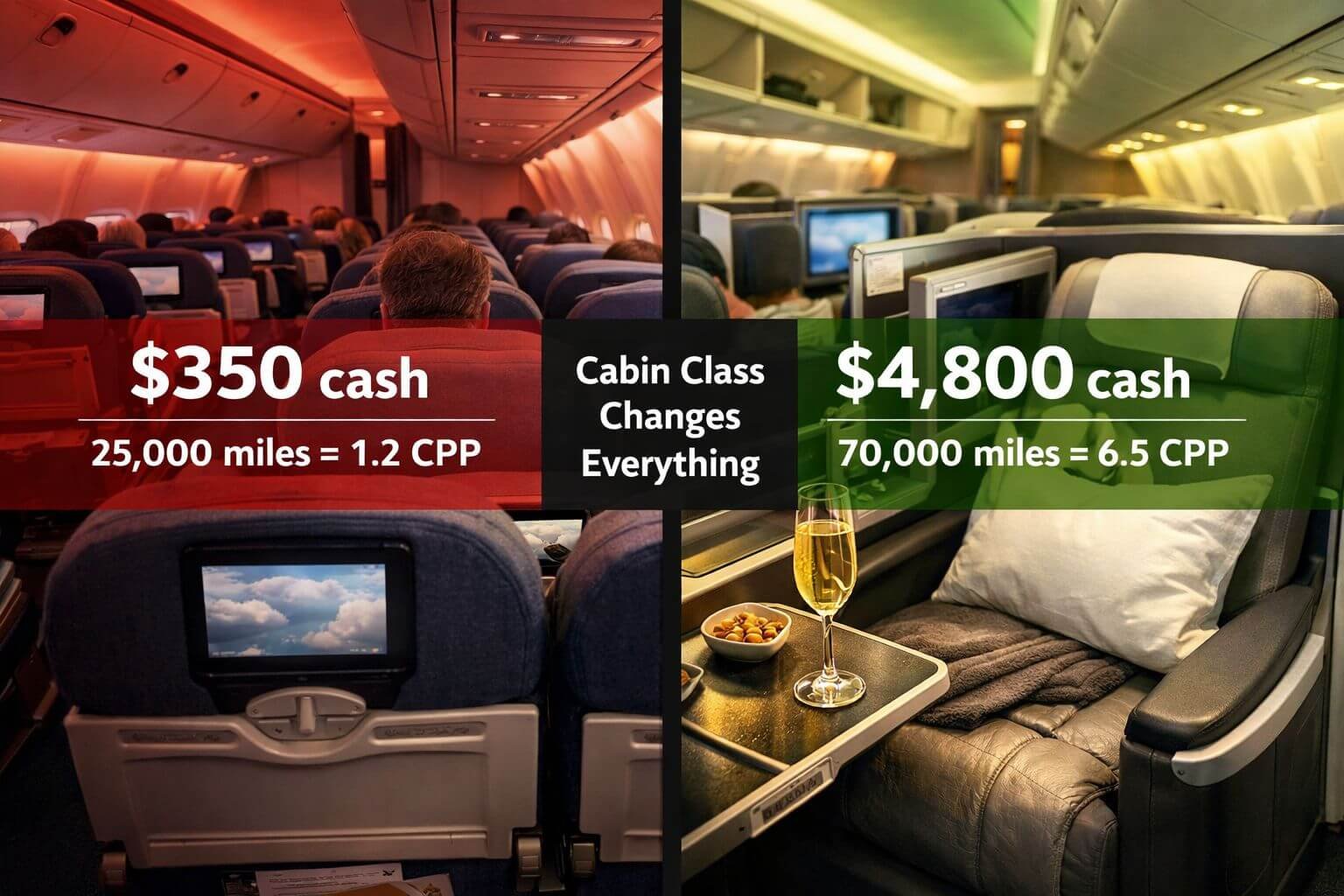
| Program | Economy (Typical CPP) | Business Class (Typical CPP) | First Class (Best Case CPP) |
|---|---|---|---|
| AAdvantage | 1.0–1.4¢ | 2.0–4.0¢ | 4.0–7.0¢ |
| Aeroplan | 1.0–1.5¢ | 2.5–5.0¢ | 4.0–8.0¢ |
| Atmos Rewards | 1.0–1.3¢ | 2.0–3.5¢ | 3.0–5.0¢ |
| MileagePlus | 0.8–1.3¢ | 1.5–3.5¢ | 3.0–6.0¢ |
| SkyMiles | 0.8–1.2¢ | 1.2–3.0¢ | 2.0–4.0¢ |
| Southwest RR | 1.2–1.5¢ | N/A | N/A |
What this means practically:
- Economy domestic flights rarely justify using miles from programs like AAdvantage or MileagePlus. Cash fares of $150–$300 round-trip often price at 15,000–25,000 miles, yielding 0.8–1.2 CPP. That’s below the average for most programs.
- International business class is the sweet spot for maximizing points. A $4,000–$8,000 cash fare booked for 60,000–90,000 miles through a partner program can deliver 4.0–6.0+ CPP.
- First Class redemptions on carriers like ANA, JAL, or Cathay Pacific through partner programs can exceed 7.0 CPP, but award availability is extremely limited.
For step-by-step instructions on finding and booking premium cabin awards, see our guide to booking Business Class with points.
Southwest is the exception. Because Rapid Rewards uses a revenue-based model (miles offset the cash fare directly), CPP remains roughly 1.3–1.4¢ regardless of cabin. There’s no way to extract outsized value, but there’s also less downside risk.
Real-World Examples: 10 Redemptions Priced in April 2026
These sample itineraries illustrate how CPP varies wildly by route, cabin, program, and timing. All cash fares and award prices were checked in April 2026 for travel in Q3 2026. Assumptions: one adult, round-trip, midweek dates with reasonable flexibility.
| # | Route | Cabin | Program | Miles Required | Taxes/Fees | Cash Fare | CPP |
|---|---|---|---|---|---|---|---|
| 1 | LAX–NYC | Economy | Delta SkyMiles | 22,000 | $11 | $240 | 1.0¢ |
| 2 | ORD–CUN | Economy | AAdvantage | 15,000 | $78 | $310 | 1.5¢ |
| 3 | SFO–HNL | Economy | Southwest RR | 18,500 | $11 | $260 | 1.3¢ |
| 4 | JFK–LHR | Business | AAdvantage (via BA) | 57,500 | $450 | $3,200 | 4.8¢ |
| 5 | JFK–LHR | Business | AAdvantage (via AA) | 57,500 | $86 | $3,200 | 5.4¢ |
| 6 | IAD–NRT | Business | Aeroplan (via ANA) | 75,000 | $92 | $5,100 | 6.7¢ |
| 7 | LAX–SYD | Business | MileagePlus (via UA) | 140,000 | $55 | $4,800 | 3.4¢ |
| 8 | DFW–CDG | Economy | Delta SkyMiles | 52,000 | $45 | $620 | 1.1¢ |
| 9 | SFO–NRT | First | AAdvantage (via JAL) | 80,000 | $95 | $12,000 | 14.9¢ |
| 10 | EWR–DOH | Business | Aeroplan (via QR) | 70,000 | $68 | $4,400 | 6.2¢ |
Key observations:
- Examples 4 vs. 5 show the same route and miles cost, but different surcharges. Booking through British Airways adds ~$450 in fuel surcharges; booking on American’s own metal drops fees to $86, improving CPP from 4.8¢ to 5.4¢. Surcharges and fees matter enormously.
- Example 9 is an aspirational outlier. JAL first class from SFO to NRT at 80,000 AAdvantage miles is a legendary sweet spot, but award availability is extremely scarce. Don’t plan around it unless you can be flexible by months.
- Examples 1 and 8 show that the domestic and transatlantic economy on Delta SkyMiles hovers around 1.0–1.1 CPP, below the program’s average valuation. These are cases where paying cash and saving miles for a future Premium Cabin booking makes more sense.
Program-by-Program “Redeem vs. Cash” Threshold Rules
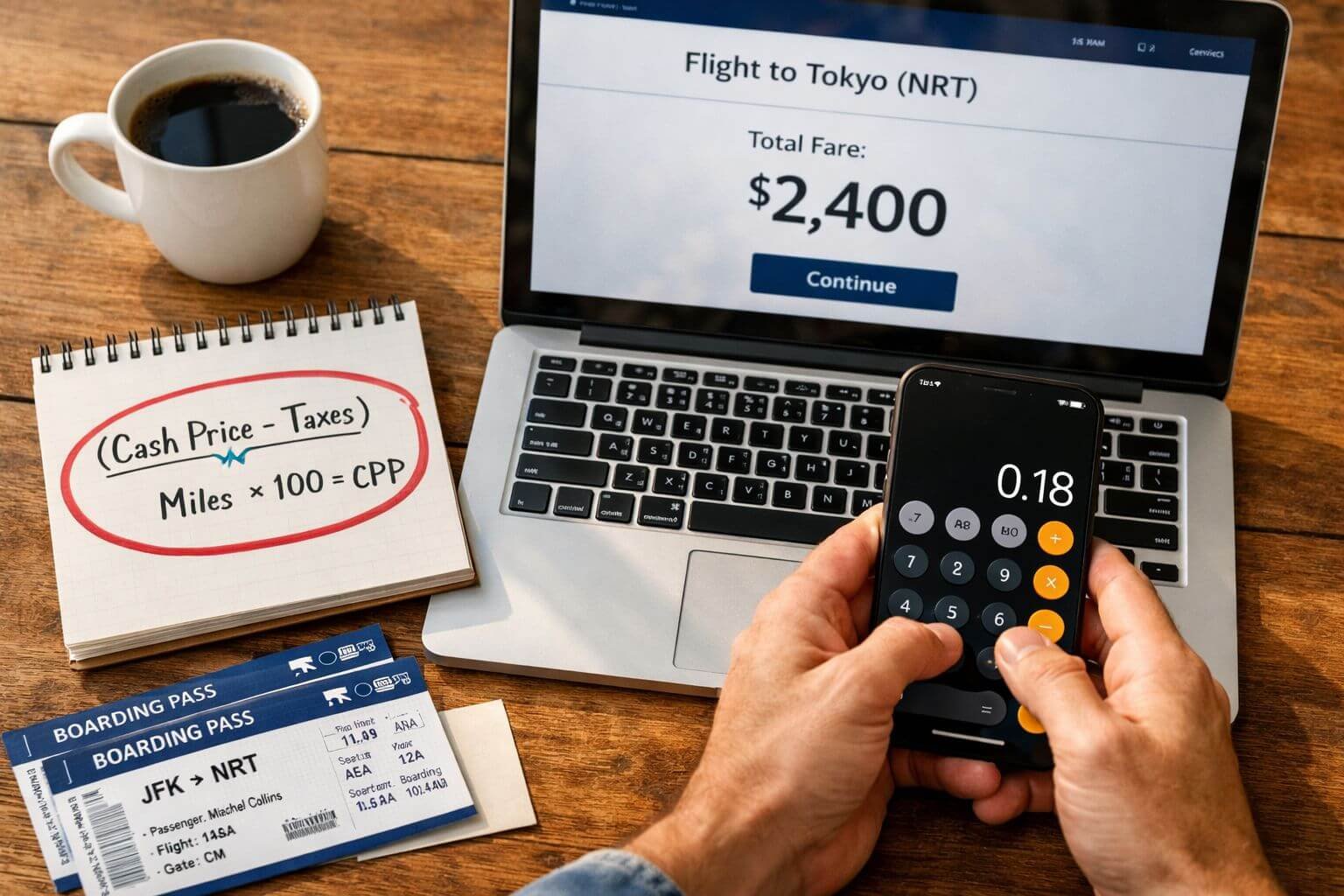
Based on the working ranges and real-world examples above, here are recommended minimum CPP thresholds per program. If your specific redemption falls below the threshold, pay cash and save your miles.
| Program | Minimum CPP to Redeem | Reasoning |
|---|---|---|
| AAdvantage | ≥ 1.5¢ | Strong partner award chart; save for business/first on oneworld carriers |
| Aeroplan | ≥ 1.4¢ | Excellent Star Alliance sweet spots justify holding for premium cabins |
| Atmos Rewards | ≥ 1.3¢ | Program still stabilizing post-merger; be selective |
| MileagePlus | ≥ 1.2¢ | Dynamic pricing makes economy awards unpredictable; hold for Polaris |
| SkyMiles | ≥ 1.3¢ | Low floor on dynamic pricing; only redeem when CPP clearly beats average |
| Southwest RR | ≥ 1.2¢ | Revenue-based, so CPP is consistent; redeem freely above 1.2¢ |
Decision framework in practice:
- Search the award price (miles + taxes).
- Search the identical cash fare.
- Run the CPP formula.
- Compare to the threshold above.
- If CPP is below threshold: pay cash, earn miles on the paid fare, and save your bank for a higher-value redemption.
- If CPP is above threshold: redeem.
When to break the rule: If you have a large balance with devaluation risk (program has announced or hinted at changes), redeeming at slightly below threshold can be smart. Miles sitting in an account aren’t gaining value. Recent examples include United’s April 2026 MileagePlus earning rate changes and Capital One’s January 2026 Emirates transfer ratio cut from 1:1 to 1,000:750.
How Dynamic Pricing Has Changed CPP Floors and Ceilings Since 2023
Dynamic pricing means the airline sets award prices based on demand, fare class, and revenue management algorithms rather than a fixed award chart. This is the single biggest trend affecting the value of airline miles in 2026.
Where we are now:
- Fully dynamic: Delta SkyMiles (since 2015), United MileagePlus (accelerating since 2023).
- Hybrid: American AAdvantage uses web-based dynamic pricing for its own flights but still offers fixed partner award charts through programs like Aeroplan and Alaska.
- Mostly chart-based: Air Canada Aeroplan, Alaska Atmos Rewards (though both have introduced variable pricing on select routes).
What dynamic pricing means for your strategy:
- The CPP floor has dropped. Delta and United economy awards can price at 0.5–0.7 CPP during peak demand, making them worse than paying cash.
- The CPP ceiling has also risen in some cases. Off-peak dynamic pricing occasionally surfaces business class awards at 40,000–50,000 miles that would cost 80,000+ on a fixed chart.
- Predictability is lower. You can’t rely on “it always costs X miles to fly Y route.” Check pricing on your specific dates.
Practical response: Lean toward programs with fixed partner award charts for long-haul premium cabins (Aeroplan, AAdvantage partner awards). Use dynamic programs like SkyMiles and MileagePlus for opportunistic bookings when the price is right, but don’t transfer points speculatively. For a broader look at how these trends affect your 2026 strategy, see our award travel trends and strategy guide.
Common pitfall: Transferring Chase points or Amex points to a dynamic program before confirming the award price. Always search first, confirm the price holds, then transfer. Points transfers are one-way and irreversible.
The Fastest Way to Check If a Specific Award Is Worth It Before Booking
Before every redemption, run this 5-minute check:
Step 1: Search the award. Use the airline’s own site or a search tool like Seats.aero, Point.me, or AwardFares to find the miles price and taxes for your route and dates.
Step 2: Search the cash fare. Open Google Flights or the airline’s site and price the identical itinerary (same cabin, same dates, same routing).
Step 3: Run the CPP formula. (Cash fare − award taxes) ÷ miles × 100.
Step 4: Compare to your threshold. Use the table above or your own personal floor.
Step 5: Check for transfer bonuses. Before transferring from Amex, Chase, Capital One, Citi, or Bilt, check whether any active transfer bonuses improve the effective CPP. A 20–30% bonus can push a borderline redemption into strong territory. We track current bonuses in our bank transfer partner guides.
Step 6: Factor in opportunity cost. Could those miles get you a premium cabin award on a different trip? If you’re spending 50,000 miles for a $500 economy flight (1.0 CPP), but those same miles could book a $3,000 business class seat next quarter, the real cost of redeeming now is the lost future value.
Best for: Readers who earn transferable points and have flexibility on when and where to travel. The more flexible you are, the more often you’ll find redemptions above your CPP threshold.
Not for: Last-minute domestic economy bookings where cash fares are low and award prices are inflated. In those cases, pay cash almost every time.
Conclusion: Stop Chasing a Magic Number
The value of airline miles in 2026 isn’t a single number you can look up and trust. It’s a range that depends on the program, the cabin, the route, the date, and whether you’re booking through the airline or a partner. Published valuations from TPG, OMAAT, and others are useful as rough benchmarks, but they can’t tell you whether your specific booking is a good deal.
Your next steps:
- Bookmark the CPP formula and commit to running it before every redemption. It takes 2 minutes and prevents wasting thousands of miles.
- Set your personal threshold per program using the table above as a starting point. Adjust based on your earning rate and how quickly you accumulate miles.
- Prioritize premium cabin partner awards for the highest CPP. Economy domestic flights are almost never the best use of points.
- Hold transferable points until you have a specific booking in mind. Don’t transfer speculatively to dynamic programs.
- Watch for transfer bonuses from Amex, Chase, Capital One, Citi, and Bilt, which can boost effective CPP by 15–40%.
For deeper dives into individual programs, start with our Aeroplan sweet spots guide, best ways to find partner award space, and when to book award flights in 2026.
FAQ
Q: What is a “good” CPP for airline miles in 2026? A: For most U.S. airline programs, anything above 1.5 CPP is solid for economy, and above 3.0 CPP for business class is strong. First class redemptions on partner airlines can exceed 5.0 CPP. Below 1.0 CPP, you’re almost always better off paying cash.
Q: Why do different websites give different valuations for the same program? A: Each outlet uses different sample itineraries, weighting methods, and assumptions about cabin mix. TPG tends to weight premium cabins more heavily, which inflates averages. OMAAT skews toward realistic redemptions most readers would actually book. Neither is wrong; they’re measuring different things.
Q: Are airline miles worth less in 2026 than in previous years? A: On average, yes. Dynamic pricing expansion and periodic devaluations have pushed most program averages down 0.1–0.3 CPP over the past two years. But individual sweet spots still exist, especially on partner award charts.
Q: Should I hoard miles or redeem them now? A: Miles generally lose value over time due to devaluation risk. If you have a redemption above your CPP threshold, book it. Don’t hoard indefinitely, waiting for a “perfect” use. Also, check whether your miles have expiration policies that could put your balance at risk.
Q: Are transferable points always better than airline-specific miles? A: In most cases, yes, because of flexibility. Amex points, Chase points, Capital One miles, Citi points, and Bilt points can transfer to multiple airline and hotel partners, letting you pick the best value per trip. Airline-specific miles lock you into one program’s pricing.
Q: How do fuel surcharges affect CPP? A: Significantly. A $500 fuel surcharge on an award ticket reduces the net value of your miles. When comparing programs for the same route, always factor in surcharges. For example, booking AAdvantage awards on American Airlines metal avoids the high surcharges that British Airways imposes on the same oneworld route.
Q: Does buying airline miles ever make sense? A: Only when a specific redemption is already identified, and the purchase price (after any bonus) results in a CPP well above your threshold. Buying miles speculatively is risky. See our guide to buying airline miles for the math on current sales.
Q: What’s the best airline miles program to collect in 2026? A: It depends on your home airport and travel patterns. AAdvantage and Aeroplan offer the strongest partner award charts for premium cabins. Delta SkyMiles is convenient if you’re hub-captive, but it offers a lower CPP on average. For a head-to-head comparison, see our best airline loyalty program analysis.


Content on Award Travel Hub is independently created by Award Travel Hub Editorial Desk and, where noted, reviewed by Award Travel Hub Review Desk. Some pages may contain affiliate links, but compensation does not determine our coverage, opinions, or methodology.