

Last updated: June 16, 2026
Quick Answer: The single most reliable way to choose an airline loyalty program in 2026 is to start with your home airport, not a sign-up bonus. Identify which carrier operates the most nonstop flights from your city, then check whether that airline’s alliance and transfer partner ecosystem aligns with where you actually want to fly. If no single airline dominates your airport, anchoring around a bank program like Chase Ultimate Rewards or Amex Membership Rewards gives you more flexibility than committing to one airline’s miles.
Key Takeaways
- Home airport dominance is the first filter. The airline with the most nonstop routes from your city is almost always your best primary program — elite status, upgrades, and award availability all compound at hub airports.
- Alliance membership matters as much as the airline itself. A United MileagePlus membership gives you Star Alliance access; AAdvantage gives you oneworld. Those networks unlock partner awards on dozens of carriers.
- 2026 program changes shift the value equation. United’s April 2026 MileagePlus overhaul rewards co-branded cardholders more than casual flyers. Alaska’s Atmos Rewards now offers flexible elite earning. American added meaningful mid-tier perks. These changes affect who benefits most.
- Bank programs beat airline programs for non-hub travelers. If your airport has split airline service or no clear dominant carrier, transferable points from Chase, Amex, Capital One, or Citi give you more options than locking into one airline’s miles.
- Devaluation risk is real and uneven. Dynamic pricing has spread to most major programs. Earning miles you can’t use quickly is a liability, not an asset.
- One primary program is usually enough. Spreading activity across four programs means you reach status in none of them and accumulate balances too small to redeem meaningfully.
- Co-branded card choice should follow your program decision — not the other way around.
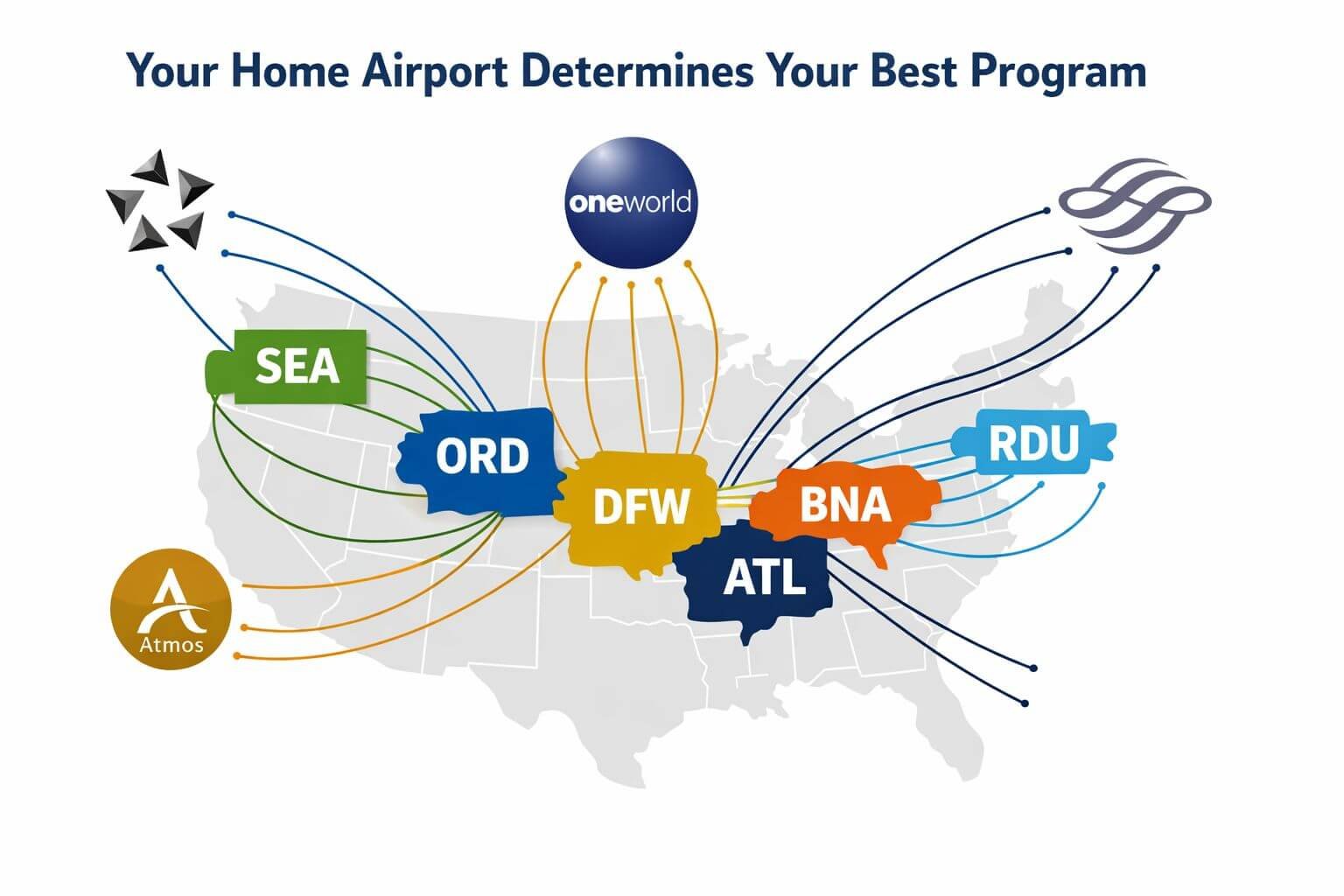
Why Your Home Airport Is the Right Starting Point for Choosing an Airline Loyalty Program
The most common mistake travelers make when choosing an airline loyalty program is picking based on a card welcome bonus or a single aspirational trip. The result: miles accumulate in three or four programs, none large enough for a meaningful redemption, and status in zero programs.
Your home airport solves this problem immediately. The airline that flies most of your routes is the one where your miles will compound fastest, where upgrades are actually available, and where elite status delivers real day-to-day value.
How to assess your home airport in 60 seconds:
- Go to Google Flights or a similar tool and search your home airport to your top three destinations.
- Note which airline operates the most nonstop options.
- Check whether that airline has a hub or focus city designation at your airport (hub = dominant; focus city = meaningful but not dominant).
- If two airlines split the nonstops roughly evenly, that’s a signal to consider a bank program instead.
What “hub dominant” actually means for your miles:
At a true hub like Atlanta (Delta), Dallas/Fort Worth (American), or Houston Bush (United), one airline controls 60–80% or more of departures. At those airports, the math is simple: fly that airline, earn that airline’s miles, and pursue that airline’s status. Award availability, upgrade priority, and partner redemption options all work better when you’re flying the dominant carrier on its own metal.
At split airports like Chicago O’Hare (United and American share significant presence) or Los Angeles (Delta, United, American, Alaska all compete), the calculus is less obvious, and flexibility becomes more valuable than loyalty.
Step 1: Map Your Nonstop Routes and Alliance Coverage
Once you know which airline dominates your airport, the next step is checking whether that airline’s alliance unlocks the international routes you actually want to fly.
You may be interested



The three major alliances in 2026:
| Alliance | U.S. Anchor Programs | Best For |
|---|---|---|
| Star Alliance | United MileagePlus | Europe, Asia, South America via Lufthansa, ANA, Singapore, ITA Airways |
| oneworld | American AAdvantage, Alaska Atmos | Europe, Asia, Middle East via British Airways, Cathay Pacific, Qatar, Japan Airlines |
| SkyTeam | Delta SkyMiles | Europe via Air France-KLM, Korean Air, Virgin Atlantic (affiliate) |
| Atmos | Alaska Airlines | oneworld partners + Alaska’s own Pacific and Latin routes |
Key 2026 update: ITA Airways joined Star Alliance on April 1, 2026, integrating fully into Lufthansa’s Miles & More program. This makes United MileagePlus miles more useful for Italy-focused travel, with JFK-Rome business class awards running roughly 21–22% cheaper than they did under the old Volare structure.
Decision rule: If you want to fly to Japan, Singapore, or Germany in business class, a Star Alliance program (United MileagePlus) is your most direct path. If Cathay Pacific First Class or Qatar Qsuites is the goal, oneworld (AAdvantage or Atmos) is the better anchor. For Air France business class to Paris, Delta SkyMiles or Flying Blue both apply — though Flying Blue transfer partners include Amex, Chase, Capital One, and Citi, so you don’t need Delta status to access it.
For a full breakdown of how each alliance works and which partner awards offer the best value, the Airline Alliances 2026 guide covers oneworld, SkyTeam, Star Alliance, and Atmos in detail.
Step 2: Match Your Airline Program to Your Card Ecosystem
Choosing an airline loyalty program doesn’t happen in isolation — it interacts directly with which credit cards you carry and which bank’s transferable points you’re earning.
Why this matters: Most airline miles today come from credit card spending, not flights. If your primary card earns Chase Ultimate Rewards but your target airline doesn’t accept Chase transfers, you’re leaving significant value on the table.
Transfer partner alignment by bank (2026):
| Bank Program | Key Airline Transfer Partners | Notable Gaps |
|---|---|---|
| Chase Ultimate Rewards | United, Southwest, British Airways, Air France-KLM, Singapore, Aeroplan | No Delta, no American |
| Amex Membership Rewards | Delta, British Airways, Air France-KLM, ANA, Singapore, Virgin Atlantic | No United, no Southwest |
| Capital One Miles | Turkish Miles&Smiles, Avianca LifeMiles, Air France-KLM, Singapore, TAP | No Delta, no United, no American direct |
| Citi ThankYou | American AAdvantage, Turkish Miles&Smiles, Air France-KLM, Singapore | No United, no Delta |
| Bilt Rewards | United, American, Air France-KLM, British Airways, Singapore, Turkish | Broadest airline coverage of any bank program |
Practical example: A traveler based in Charlotte (CLT) where American dominates, should consider pairing AAdvantage with a Citi card (direct 1:1 transfer to AAdvantage) or a Bilt card (also transfers to American). Chasing Chase points at CLT makes less sense unless the goal is partner awards on British Airways or Singapore through the oneworld connection.
For a side-by-side comparison of all four major bank programs and their transfer ratios, see Comparing Transfer Partners 2026: Chase vs Amex vs Citi vs Capital One.
Common mistake: Picking a co-branded airline card first, only to realize the bank ecosystem doesn’t support your actual travel goals. The card should follow the program decision, not lead it.
Step 3: Factor in 2026 Program Changes and Devaluation Risk
Several significant program changes took effect in early 2026. These shifts affect which programs offer the best long-term value — and which carry the most devaluation risk.
What changed in 2026 and what it means for you:
United MileagePlus (effective April 2, 2026) United overhauled its earning structure, giving co-branded cardholders up to 2x miles per dollar on flights while offering 3x base for non-cardholders. Award ticket discounts of 10–15% now apply for card users. The net effect: MileagePlus rewards cardholders more than casual flyers. If you’re not carrying a United card, the program’s value proposition weakened. See the full United MileagePlus 2026 changes breakdown for a winner/loser analysis.
American AAdvantage (effective March 1, 2026) American added meaningful mid-tier perks: food and beverage credits at 15,000 Loyalty Points, a 25% partner spending bonus at 60,000 LPs (up from 20%), and vacation package credits at higher tiers. These are incremental improvements, not a structural overhaul. AAdvantage remains strong for oneworld partner awards and benefits from Citi ThankYou’s direct transfer partnership.
Alaska Atmos Rewards (2026) Alaska’s renamed program now lets elites choose how they earn status: by distance flown, dollars spent (5x points per dollar), or segments (500 points each). Titanium elites receive unlimited lie-flat upgrade eligibility on global routes. This flexibility makes Atmos particularly attractive for West Coast travelers who fly Alaska frequently but don’t have a single dominant earning pattern.
Devaluation risk to watch: Dynamic award pricing has expanded across most major programs. United, Delta, and American all use some form of revenue-based or demand-based award pricing on at least a portion of their inventory. This means the miles you earn today may buy less than you expect in two or three years. The practical response: don’t hoard miles. Earn toward a specific redemption goal, then transfer and book. For a deeper look at how dynamic pricing affects redemption math, the Dynamic Award Pricing 2026 survival guide is worth reading before you commit to any program.
Example Playbooks: Hub, Focus City, and Non-Hub Airports
These four scenarios cover the most common situations travelers face when deciding how to choose an airline loyalty program based on where they live.

Scenario A: Major Hub (ORD, DFW, ATL, IAH, SFO)
At a single-airline hub: Align with the dominant carrier and pursue status aggressively.
- DFW (American hub): Focus on AAdvantage. Pair with a Citi or Bilt card for transfer flexibility. Use Citi ThankYou points to top off AAdvantage balances for oneworld partner awards.
- ATL (Delta hub): Focus on SkyMiles. Amex Membership Rewards is your primary bank program since Delta only accepts Amex transfers. Note that Delta SkyMiles transfer partners are limited to Amex — no Chase, no Citi.
- IAH (United hub): Focus on MileagePlus. Chase Ultimate Rewards is your natural card ecosystem. ITA Airways joining Star Alliance in April 2026 adds a useful Italy redemption path.
- ORD (split United/American): This is the exception. With two major carriers competing, a bank-first strategy — Chase or Amex — with selective transfers based on award availability often beats committing to one airline’s status track.
Scenario B: Focus City (BNA, RDU, MCI, PIT)
Focus cities have meaningful service from one or two airlines but lack the hub dominance that makes status pursuit straightforward.
Nashville (BNA): American and Southwest both have significant presence. If you fly domestically most of the time and value simplicity, Southwest Rapid Rewards is worth considering — no blackout dates, easy redemption, and a Companion Pass that’s genuinely valuable for families. If international travel is the goal, AAdvantage with oneworld access is the stronger long-term play. Check the Southwest Rapid Rewards transfer partners guide to understand the program’s limitations before committing.
Raleigh-Durham (RDU): Delta and American both serve RDU. Neither dominates enough to make status pursuit obvious. This is a strong candidate for a bank-first approach: earn Amex or Chase points, then transfer based on the specific award you’re booking rather than building toward one airline’s status.
Scenario C: Non-Hub with Heavy Southwest Presence (MDW, HOU, BWI, DAL)
Southwest’s point-to-point model means no alliance, no partner awards on international carriers, and no traditional upgrade path. But for travelers who fly primarily domestic routes, the Companion Pass is one of the highest-value perks in U.S. travel loyalty.
Choose Southwest if: You fly 20+ domestic segments per year, travel with a consistent companion, and rarely need international premium cabin redemptions.
Don’t choose Southwest if: International Business Class or First Class redemptions are a priority. Southwest miles have no path to Lufthansa, Cathay, or Qatar award space.
Scenario D: West Coast with Strong Alaska/Atmos Options (SEA, PDX, SAN, ANC)
Seattle (SEA) is Alaska’s primary hub. Portland (PDX) and San Diego (SAN) have strong Alaska presence. For travelers at these airports, Atmos Rewards deserves serious consideration in 2026.
Why Atmos works here: Flexible elite earning (distance, spend, or segments), oneworld partner access for international redemptions, and Titanium upgrade benefits on long-haul routes. Alaska also partners with American, which means AAdvantage miles can sometimes substitute for Atmos on overlapping routes.
The tradeoff: Atmos has a smaller partner network than United or American for pure international Premium Cabin redemptions. If Tokyo in business class is the goal, Singapore Airlines KrisFlyer (accessible via Chase, Amex, Citi, and Capital One transfers) may offer better award availability than routing through Atmos. See the KrisFlyer transfer partners 2026 guide for specifics.
When a Bank-First Strategy Beats Picking Any Single Airline
For travelers at non-hub airports, split-service cities, or anyone who flies multiple carriers throughout the year, anchoring around transferable points is often the better strategy than committing to one airline’s ecosystem.
Choose a bank-first approach if:
- No single airline operates more than 40% of your nonstop routes
- You travel internationally on different carriers depending on the destination
- You want to book partner awards (ANA, Singapore, Cathay, Turkish) without needing status on a U.S. carrier
- You want optionality when one program devalues — you can redirect transfers to a different partner
The best transferable points programs for 2026 are covered in detail in the Best Transferable Points Programs 2026 guide, but the short version: Chase Ultimate Rewards and Amex Membership Rewards have the deepest partner networks. Capital One and Citi fill specific gaps (Turkish Miles&Smiles for Star Alliance redemptions; Citi for direct AAdvantage transfers). Bilt is the most flexible single program if you pay rent.
The tradeoff: Bank programs don’t offer airline status, upgrades, or lounge access on their own. If those perks matter to you, a hybrid approach — one co-branded airline card for status, one bank card for flexible earning — is usually the right answer.
Quick Checklist: How to Choose an Airline Loyalty Program and Commit to It
Use this checklist to move from “overwhelmed” to “decided” in one sitting.
Step 1 — Identify your home airport type
- Is one airline clearly dominant (60%+ of nonstops)? → That’s your primary program.
- Is service split between two airlines? → Consider bank-first with selective transfers.
- Is Southwest the primary carrier? → Evaluate Companion Pass value vs. your travel patterns.
- Are you at a West Coast Alaska hub? → Atmos Rewards deserves serious consideration.
Step 2 — Check alliance alignment
- Do you want to fly Japan, Singapore, Germany in business class? → Star Alliance (United MileagePlus).
- Do you want Cathay, Qatar, British Airways, Japan Airlines? → oneworld (AAdvantage or Atmos).
- Do you want Air France, Korean Air, Virgin Atlantic? → SkyTeam (Delta SkyMiles or Flying Blue directly).
Step 3 — Match your card ecosystem
- Already earning Chase points? → United, Southwest, British Airways, Singapore are natural partners.
- Already earning Amex points? → Delta, British Airways, Air France-KLM, ANA, Virgin Atlantic.
- Already earning Citi points? → American AAdvantage is a direct 1:1 transfer.
- Paying rent? → Bilt transfers to United, American, Air France-KLM, British Airways, and more.
Step 4 — Assess devaluation risk
- Does the program use dynamic pricing? (United, Delta, American all do to varying degrees.)
- Do you have a specific redemption target within 12–18 months? → Transfer and book; don’t hoard.
- Are you earning miles you can’t use for 3+ years? → Reconsider the program or the earning strategy.
Step 5 — Commit
- Pick one primary airline program.
- Pick one bank program that transfers to it.
- Set a redemption goal (specific route, cabin, date range).
- Stop earning in programs you won’t use within 18 months. Check when airline miles expire to avoid losing existing balances.
Frequently Asked Questions
Q: Should I pick a program based on a sign-up bonus? A: No. A sign-up bonus is a one-time event. Your home airport and travel patterns determine whether you’ll earn and redeem miles efficiently for years. Pick the program first, then find the best card that supports it.
Q: What if I live near two airports (e.g., NYC with JFK, LGA, and EWR)? A: Multi-airport markets give you more flexibility, not less clarity. Map which airport you actually use most often, then apply the same home airport framework. If you genuinely split evenly across airports and airlines, a bank-first strategy is almost always the right answer.
Q: Is Delta SkyMiles worth it in 2026? A: For travelers at Delta hub airports (ATL, MSP, DTW, SLC), yes — the network depth and upgrade availability at those hubs justify the program’s dynamic pricing drawbacks. For non-hub travelers, SkyMiles is harder to justify because award availability and redemption value are inconsistent without status.
Q: Can I earn American AAdvantage miles without flying? A: Yes. AAdvantage has an extensive network of shopping, dining, and partner earning options. The AAdvantage Loyalty Points earning guide covers the non-flying paths in detail, including credit card spend, partner purchases, and the 2026 LP reward thresholds.
Q: Does Alaska Atmos work for international premium cabin redemptions? A: It can, through oneworld partners. Cathay Pacific, Japan Airlines, and British Airways awards are bookable with Atmos miles. The program is strongest for West Coast travelers who also want domestic flexibility. For purely international premium cabin goals, AAdvantage or a bank program with Singapore KrisFlyer access often offers better award availability.
Q: What’s the biggest mistake beginners make when choosing a loyalty program? A: Splitting activity across too many programs. Earning 8,000 miles in four different programs means you have nothing redeemable in any of them. Pick one primary program, direct all earning there, and reach a meaningful balance before diversifying.
Q: How do I know if a program is about to devalue? A: There’s no reliable advance warning — programs rarely announce devaluations ahead of time. The practical defense is to earn toward a specific redemption goal and book when you have enough miles rather than accumulating indefinitely. Monitoring industry sources and setting a 12–18 month earning horizon reduces your exposure.
Q: Is it worth getting a co-branded airline card if I already have a Chase Sapphire or Amex Gold? A: Sometimes. A co-branded card makes sense if you fly that airline frequently enough to benefit from the card-specific perks (free checked bags, priority boarding, companion certificates, lounge access). If you’re only using it for the sign-up bonus and the airline isn’t your primary carrier, the annual fee is hard to justify. See the United credit cards 2026 comparison for a structured look at when co-branded cards add value versus when they don’t.
Q: What’s the best program for families? A: Southwest Rapid Rewards is often the most family-friendly domestic program because of the Companion Pass and no seat fees. For international family travel, a bank program (Chase or Amex) that allows transfers to multiple partners gives you the most flexibility in finding award availability for a travel party.
Q: Should I worry about miles expiring while I’m building a balance? A: Yes, especially in programs with activity-based expiration policies. Most programs reset the expiration clock with any account activity — a small purchase, a partner transaction, or a credit card swipe. The airline miles expiration 2026 guide covers each program’s rules and the easiest ways to keep balances active.
Conclusion
Knowing how to choose an airline loyalty program comes down to one foundational question: where do you actually fly from, and which airline makes that easiest?
Start with your home airport. Identify the dominant carrier. Check whether that airline’s alliance covers your international destinations. Then align your credit card ecosystem so that every dollar you spend moves you toward a redemption you’ll actually use.
If no single airline dominates your airport, don’t force a loyalty decision. A bank program like Chase Ultimate Rewards or Amex Membership Rewards gives you the flexibility to transfer to whichever partner has the best award availability when you’re ready to book.
The 2026 program changes — United’s cardholder-focused earning overhaul, Alaska’s flexible Atmos status structure, American’s expanded mid-tier perks — don’t change the underlying framework. They just mean you should verify that the program you choose still rewards your specific travel pattern, not just the average cardholder.
Pick one primary program. Set a redemption goal. Earn toward it deliberately. That’s the entire strategy.
Next steps:
- Compare the top programs head-to-head: Best Airline Loyalty Program 2026: Atmos vs United
- Understand how bank programs fit into your overall strategy: Best Transferable Points Programs 2026
- Learn when to transfer points and when to wait: When to Book Award Flights in 2026


Content on Award Travel Hub is independently created by Award Travel Hub Editorial Desk and, where noted, reviewed by Award Travel Hub Review Desk. Some pages may contain affiliate links, but compensation does not determine our coverage, opinions, or methodology.