
Last updated: November 23, 2026
Five new partners and at least four ratio changes hit the major bank programs in 2026, and two of those changes quietly cut the value of points that many travelers were already holding. This guide to credit card transfer partners 2026 covers the current ratios for Chase, Amex, Citi, Capital One, and Bilt, what was added this year, what got worse, and how to avoid the transfer mistakes that cost the most points.
How to Read This Transfer Partner Chart
Read every row as “1,000 bank points become X partner points,” then check two things before transferring: whether the ratio is below 1:1 and whether your specific card earns the full ratio. Most bank-to-airline transfers still move at 1:1, but the exceptions have grown in 2026, and several now depend on which card you hold.
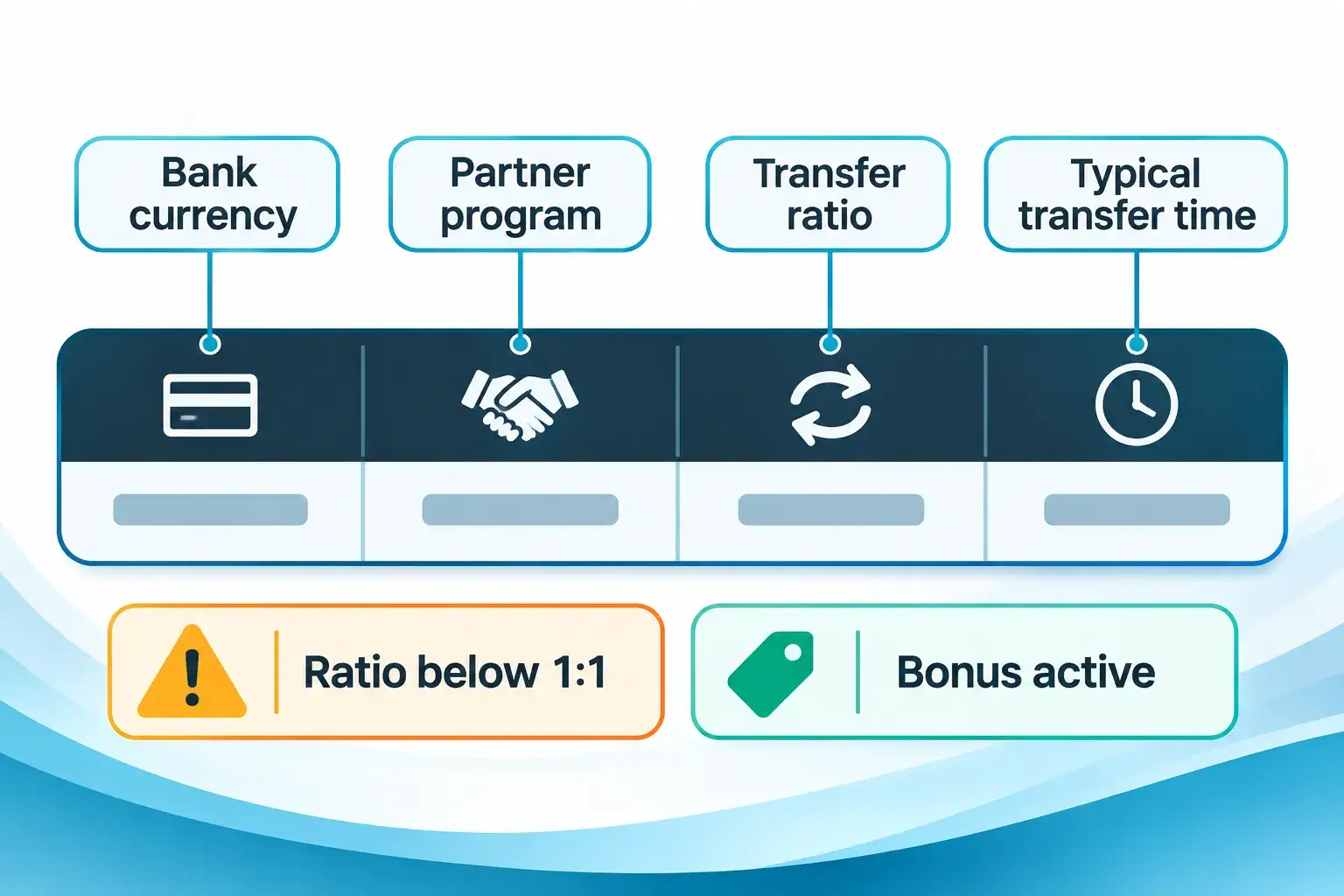
Each partner listing below includes four pieces of information:
- Transfer ratio: bank points to partner points. A 2:1.5 ratio means 1,000 bank points become 750 partner miles.
- Card eligibility: Chase, Citi, and Bilt now tier some ratios by card. Your Sapphire Preferred does not get what a Sapphire Reserve gets for Hyatt.
- Typical transfer time: most partners are instant, but a handful take one to several days.
- Minimum increments: most programs transfer in blocks of 1,000. Capital One allows 100-mile increments after a 1,000-mile minimum.
Apply the ratio to the redemption, not the chart
A worse ratio is not automatically a bad deal. What matters is the cents per point (CPP) you get on the final booking. For example, a 2:1.5 transfer to Emirates costs 33% more bank points per mile, so a redemption that looks like 2.0 CPP in Skywards miles is really about 1.5 CPP in Capital One miles.
Rule of thumb: If a sub-1:1 partner is your only option for a route, compare it against booking the same flight through a 1:1 alliance partner first. Award charts across alliance partners often price the same seat very differently.
For a single-page version of every row, see the credit card transfer partners full ratio chart.
Chase Ultimate Rewards Partners and Ratios
Chase points transfer 1:1 to every partner except World of Hyatt, which is now 4:3 from Sapphire Preferred and Ink Business Preferred. Chase has a smaller partner list than its competitors, but it still holds two of the most useful U.S. options: United and Hyatt.
The Hyatt change matters most
On October 1, 2026, Chase cut Hyatt transfers from Sapphire Preferred and Ink Business Preferred to 4:3. A Category 4 night at 15,000 Hyatt points now costs 20,000 Chase points from those cards. For Preferred-only households, Hyatt may no longer be the automatic best use of points.
You may be interested



Best for: Reserve cardholders who book Hyatt and United. Not for: travelers who need access to Oneworld programs beyond British Airways and Iberia, or who want the widest choice of Asian carriers.
Wyndham and the current bonus
Wyndham Rewards joined Chase earlier in 2026 at 1:1. A 30% bonus runs through December 3, 2026, making 1,000 Chase points worth 1,300 Wyndham points. That can be useful for Vacasa rentals or cheap Wyndham nights, but most redemptions will not beat Hyatt or United value. Compare against the Chase travel portal vs transfer partners before moving points.
Amex Membership Rewards Partners and Ratios
Amex has roughly 16 airline partners, most at 1:1, plus hotel transfers that are generally weak outside of promotions. Amex is the only major bank that transfers to Delta, and it holds strong options like ANA and Aeroplan.
What Amex lost in 2026
Amex ended Etihad Guest transfers on June 30, 2026. Anyone who had planned Etihad partner awards through Amex lost that route overnight. The lesson applies across every program: do not stockpile points in one bank for one airline. Diversifying across two currencies reduces devaluation risk.
Fanatics is not a travel sweet spot
Fanatics FanCash broadens Amex’s ecosystem, but it is a retail redemption. For most readers, it is a fallback for leftover balances, not a reason to earn Amex points. Ranked value by partner is covered in Amex transfer partners ranked for 2026.
Common mistake: Transferring Amex points to Hilton at 1:2 because the number looks larger. A 1:2 ratio at roughly 0.5 cents per Hilton point is about 1 CPP, which many Amex airline redemptions easily beat.
Citi ThankYou and Capital One Partners and Ratios
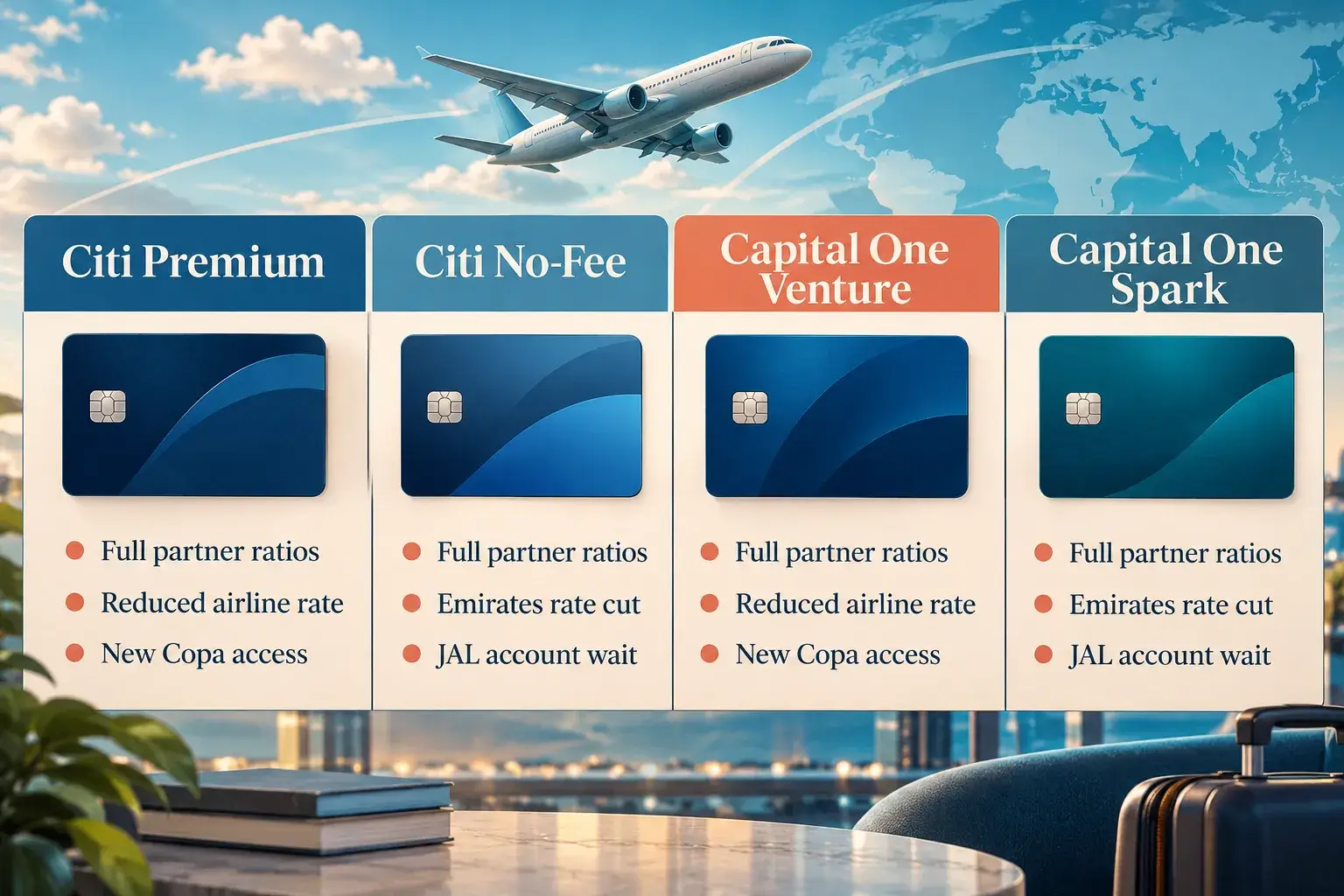
Citi and Capital One both added partners in 2026 and both run tiered or sub-1:1 ratios on some programs. Citi’s premium cards (Strata Premier, Strata Elite, Prestige) get full ratios, while no-fee Citi cards get reduced airline rates. Capital One’s partner list is the widest of the banks, at roughly 19 airlines, but several transfer below 1:1.
Citi ThankYou highlights
- 1:1 from premium cards: American AAdvantage, Avianca, Cathay Pacific, Etihad, EVA, Flying Blue, JetBlue, Qantas, Qatar, Singapore, Thai, Turkish, Virgin Atlantic, and the new Japan Airlines and Copa partners.
- Emirates: 5:4, below 1:1.
- No-fee cards: Copa transfers at 1,000 to 700, and other airline transfers are similarly reduced.
- Hotels: six partners, including Choice and Accor, with mixed value.
Citi’s AAdvantage access remains the biggest differentiator. Few flexible currencies transfer to American, which makes Citi the default for Oneworld bookings priced through AAdvantage. Additional ideas are in maximizing Citi ThankYou points top transfer partners.
Capital One highlights
- 1:1: Aeroplan, Avianca, British Airways, Cathay Pacific, Finnair, Flying Blue, Qantas, Singapore, TAP, Turkish, Virgin Red, and others.
- 2:1.5: Emirates (cut from 1:1 in January 2026), EVA, and Copa (new).
- 5:3: JetBlue, one of the weakest airline ratios in any program.
- Hotels: Wyndham and Choice at 1:1; Accor at 2:1.
The Emirates cut reduced Capital One miles by 25% for Skywards redemptions. Before transferring, compare against using the travel portal or Purchase Eraser, explained in Capital One Travel vs transfer partners, and the broader Capital One transfer partners best uses.
Decision rule: If the same award is bookable through a 1:1 partner (for example, Turkish or Aeroplan for Star Alliance space), skip the sub-1:1 transfer.
New Partners Added in 2026
Five notable partners were added across the major programs in 2026, along with several ratio changes that matter just as much. Most additions are niche, but Citi’s Japan Airlines and Bilt’s JetBlue fill real gaps.
Ratio changes and removals this year
- Capital One to Emirates: 1:1 to 2:1.5 (January 2026).
- Amex to Etihad: transfers ended June 30, 2026.
- Chase to Hyatt: 4:3 from Sapphire Preferred and Ink Business Preferred (October 1, 2026).
- Bilt to Hyatt: scheduled to drop from 1:1 to 4:3 on January 1, 2027.
How to treat the new partners
Citi to JAL is the most useful addition for premium cabin awards. JAL’s own awards and Oneworld partner awards can price well. The catch: newly created JAL accounts reportedly cannot book awards for their first 60 days. Open the account now, even if no trip is planned.
Capital One to Copa with the launch bonus works out to roughly 2:1.95, close to 1:1. Without the bonus, the 2:1.5 rate is hard to justify when Aeroplan, Avianca, and Turkish all book Star Alliance space at 1:1.
Bilt to Hyatt before January 1, 2027 is worth considering only if you have a confirmed stay to book. Do not move points speculatively to beat the deadline, because Hyatt points cannot move back.
Bilt now pairs JetBlue with American, United, Alaska, and Southwest-adjacent options depending on current listings, giving it one of the broadest U.S. airline mixes. Promotions like these change monthly, so check current credit card transfer bonuses before acting.
Transfer Times and Common Mistakes
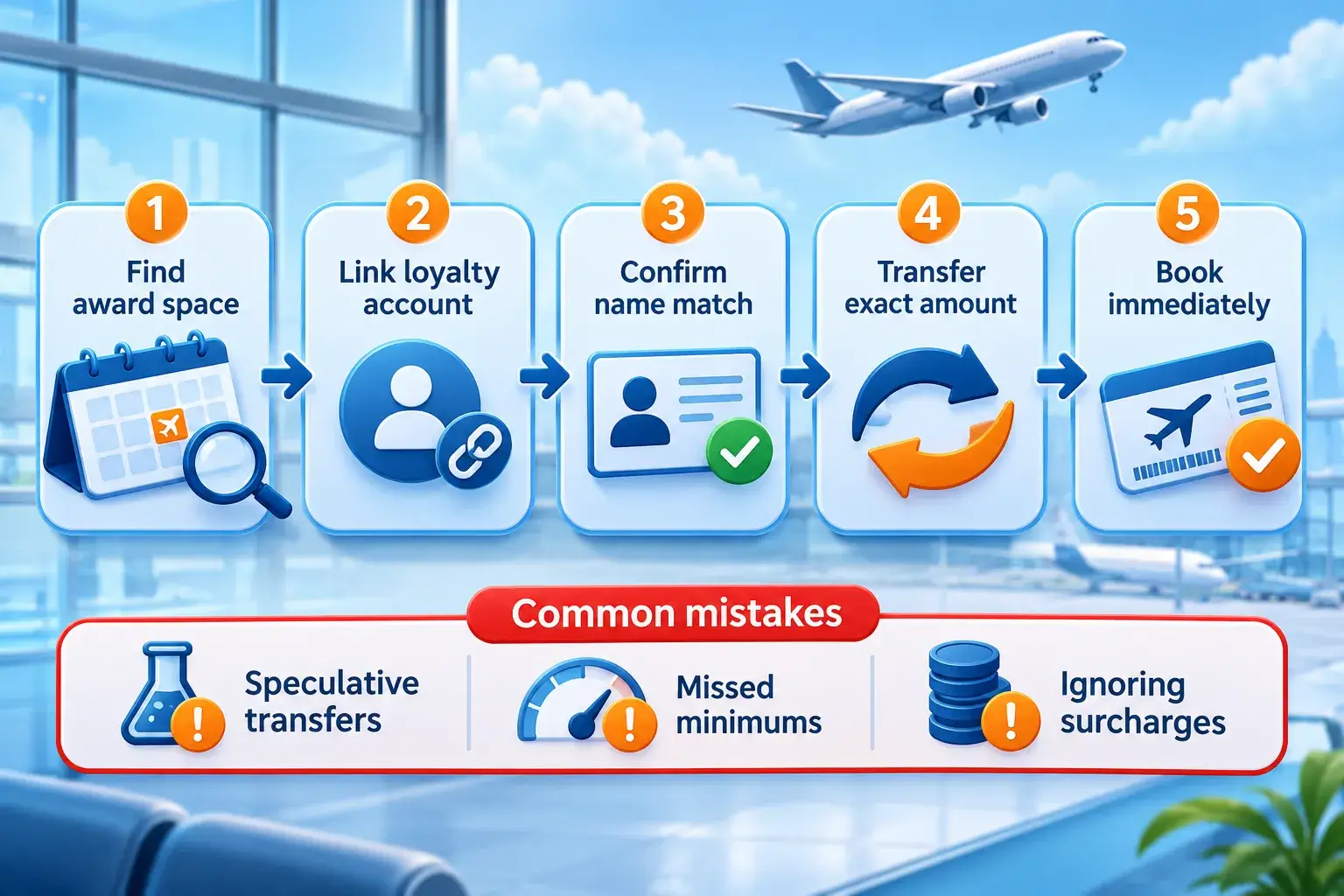
Most transfers from Chase, Amex, Citi, Capital One, and Bilt post instantly or within minutes, but a few partners take one to several days, and every transfer is final. Find and confirm award space before moving any points.
Typical transfer times
- Usually instant: United, Hyatt, Flying Blue, British Airways, Aeroplan, Virgin Atlantic, Avianca, Turkish (from most banks).
- Often delayed: ANA from Amex (one to two days), some Singapore and Cathay transfers (hours to a day), and first-time transfers to a newly linked account.
- Minimums: Chase, Amex, and Citi generally require 1,000-point increments. Capital One requires 1,000 miles minimum, then 100-mile increments.
Award space can disappear during a delayed transfer. On partners known to be slow, consider holding the award first if the airline allows it.
Common mistakes to avoid
- Transferring before finding award space. Points cannot move back to the bank, and airline programs can devalue without notice.
- Name mismatches. Bank and loyalty account names must match, or transfers can fail or be reversed.
- Ignoring fuel surcharges. British Airways, Virgin Atlantic, and Flying Blue can add significant carrier-imposed fees on some routes.
- Assuming your card earns the headline ratio. Check card-tier rules for Chase Hyatt, Citi no-fee cards, and Bilt.
- Paying a poor ratio when a 1:1 partner books the same seat. Search alliance partners before settling.
- Combining points incorrectly. Points usually move only within the same bank’s ecosystem, such as between your own Chase cards or to a household member under program rules. You cannot move Amex points to Chase.
Frequently asked questions
Which bank has the most airline transfer partners in 2026? Capital One leads with roughly 19 airline partners, followed by Bilt (about 18), Citi (17), Amex (16), and Chase (10).
Are transfer partners worth it versus booking through the card portal? Transfers usually win for international premium cabin awards, often at 1.5 CPP or more. Portals can win for cheap economy flights and when award space is scarce.
Which ratios should I avoid? Capital One to JetBlue at 5:3, Amex to Hilton at 1:2, and most sub-1:1 transfers, unless no 1:1 alternative exists.
Are hotel transfers or airline transfers better? Airline transfers generally offer higher value. Hyatt is the main hotel exception, and its value dropped for Chase Preferred and soon Bilt.
Should I transfer during a bonus? Only if you have a specific redemption in mind. A 30% bonus on a weak partner can still be worse than a 1:1 transfer to a strong one.
Bottom line and next steps
The 2026 changes reward diversification and punish speculative transfers. Check your card tier against the ratio table, search award space on two or three alliance partners, and transfer only the exact amount needed. Next, review the best credit card transfer partners 2026 to see which programs deliver the strongest redemption value.




Content on Award Travel Hub is independently created by Award Travel Hub Editorial Desk and, where noted, reviewed by Award Travel Hub Review Desk. Some pages may contain affiliate links, but compensation does not determine our coverage, opinions, or methodology.