

Last Updated: November 10, 2026
The United card with the biggest bonus is usually the wrong card for most people. A 100,000-mile offer means little if you pay a $695 annual fee every year and only visit a United Club twice. This guide to the best United credit cards 2026 starts with the current welcome offers. It then matches each card to a real flying pattern, with break-even math you can check against your own trips.
The short answer:
- Flying United one to four round trips a year: the Explorer is the default choice.
- Flying United several times a year and redeeming miles regularly: the Quest usually comes out ahead of the Explorer.
- Using United Clubs at least monthly: the Club Card can cost less than buying a membership outright.
- Rarely flying United: a transferable points card is probably the better choice.
1. Current United Credit Card Welcome Offers
As of early November 2026, all three Chase-issued personal United cards have elevated public offers. Each offer splits the bonus between a spend requirement and an authorized-user add-on.
| Card | Public welcome offer | Spend requirement | Annual fee |
|---|---|---|---|
| United Explorer | Up to 80,000 miles (70,000 + 10,000 for an authorized user) | $3,000 in 3 months | $0 first year, then $150 |
| United Quest | Up to 90,000 miles (80,000 + 10,000 for an authorized user) plus 500 PQP after first purchase | $4,000 in 3 months | $350 |
| United Club Card | Up to 100,000 miles | See current terms | $695 |
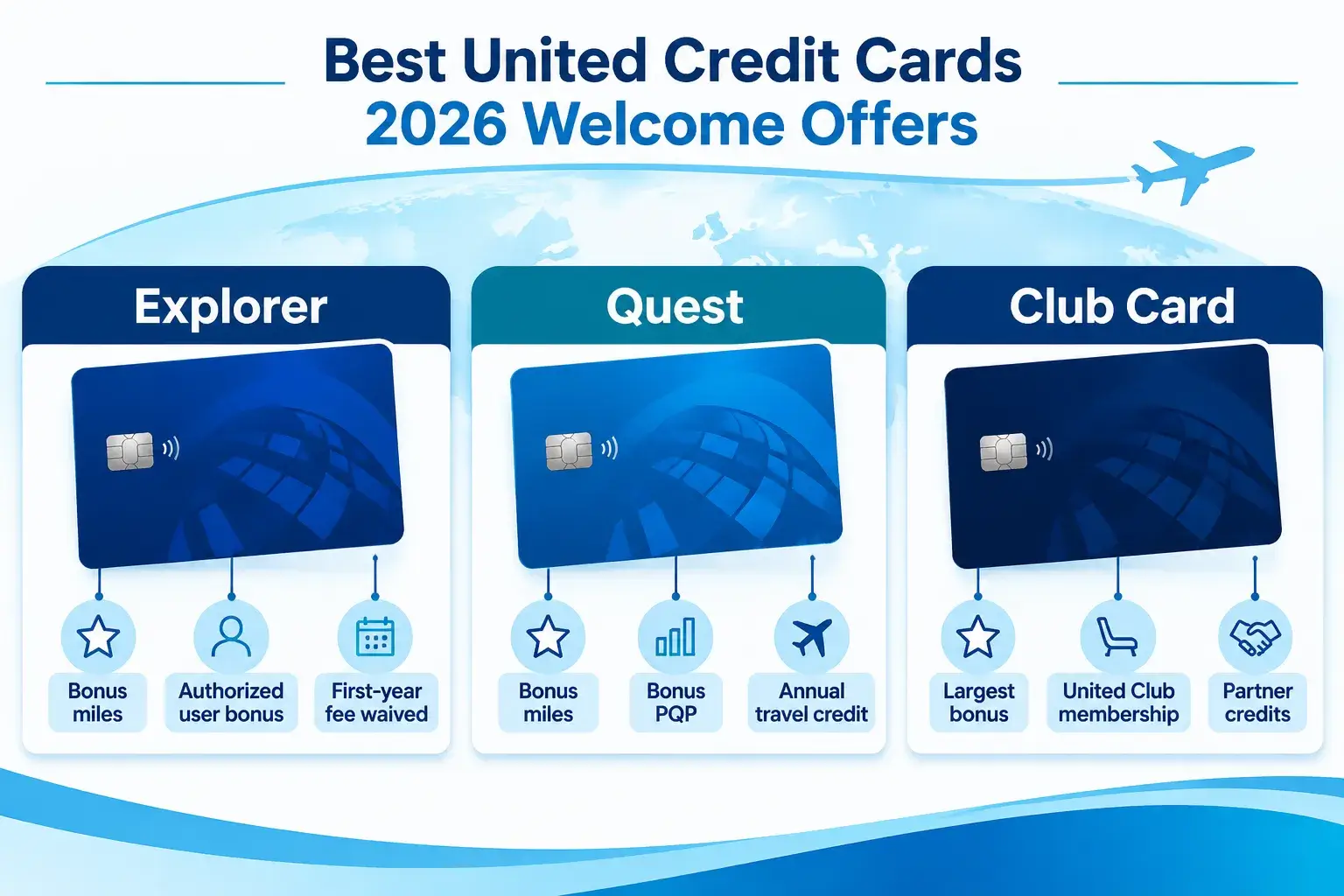
Offer timing matters more than usual right now. Some alternative Explorer application paths have recently shown bonuses up to 90,000 miles, which is higher than the standard 80,000-mile public offer. Targeted offers, offers inside the United app or MileagePlus account, and offers on the Chase site can all differ. Before you apply, screenshot the exact offer on the page you are using. Once a bonus posts, it is very hard to get it raised to a better offer.
What the bonuses are worth. Valuations from major outlets put the Explorer offer at up to about $960, the Quest at up to about $1,080 (not counting the PQP), and the Club Card at up to about $1,200. Those figures assume roughly 1.2 cents per point. United uses dynamic pricing, so your real redemption value depends on when and where you book. Saver space on partner airlines can beat 1.2 CPP. Peak-date United domestic awards often fall short of it.
Approval rules to know first:
- Chase’s 5/24 rule applies. If you have opened five or more personal cards from any bank in the past 24 months, you will likely be denied.
- You are generally not eligible for a United card bonus if you currently hold that card, or if you earned its bonus in the last 24 months. Read the offer terms before applying.
- These cards generally require good to excellent credit. Applicants with poor credit are unlikely to be approved, and each application adds a hard inquiry.
- Many applicants get an instant decision. Others go to pending review, which can take from a few days to about two weeks. Calling Chase reconsideration can sometimes speed this up.
For a deeper look at the entry card, see our analysis of the United Explorer Card 80,000 bonus miles offer.
2. United Explorer: Best for Occasional United Flyers
The Explorer is the easiest United card to justify. The $150 annual fee is waived in year one, so the welcome bonus plus a year of benefits costs you nothing beyond the required spend. After the first year, the card has to earn its keep through bag fees and the award discount.
You may be interested



Core benefits:
- Free first checked bag for you and one companion on the same reservation
- Group 2 priority boarding
- Two one-time United Club passes per year
- At least 10% off United award flights as a primary cardholder, rising to at least 15% if you also hold Premier status
- Strong earning on United purchases. After United’s 2026 earning changes, a general MileagePlus member using the Explorer can earn 9 total miles per dollar on eligible United flights.
How it differs from the old “Premier” card. Some readers ask about the “United Premier” card. That name is outdated. The Explorer is the current mid-tier card, and it sits above the no-fee Gateway card. “Premier” now refers to United’s elite status levels, not a credit card.
The math that matters. The companion bag benefit is where most of the value comes from. Here is one example:
- Assumption: a standard first checked bag costs $35 each way (verify current pricing for your route).
- One round trip with two travelers, each checking a bag, saves $140.
- That single trip covers almost the entire $150 annual fee.
For solo travelers who fly carry-on only, the case is much weaker. In that situation, the 10% award discount and the two club passes do most of the work. Those two passes are worth something only if you would actually pay to use a lounge.
Redeeming the miles. Miles post to your MileagePlus account. You can book United flights or Star Alliance partner awards at united.com. United generally does not add fuel surcharges on partner awards, which is a real advantage over programs that do. The cardholder discount applies to United-operated awards, not partner bookings.
Best for: Couples or families who fly United one to four times a year and check bags. Not for: Solo carry-on travelers who fly United once a year or less.
3. United Quest: Best for Frequent Flyers Without Club Access Needs
The Quest has a $350 sticker price, but much of the fee comes back through fixed credits. One Mile at a Time calls it United’s best-value card for travelers who fly United several times a year and redeem miles from time to time. That assessment holds up when you run the numbers.
What offsets the fee:
- $200 United travel credit each year. This is easy to use if you book any United airfare.
- 10,000-mile award discount on each account anniversary.
- Another 10,000-mile award discount after you spend $20,000 on the card in a cardmember year.
- 500 PQP after your first purchase in the welcome offer. This is a real head start toward Premier Silver.
- Free first and second checked bags for you and a companion, plus priority boarding.
Effective annual fee. Start with $350. Subtract the $200 credit you would use anyway, leaving $150. Then value the anniversary 10,000-mile discount at about 1.2 CPP, which is roughly $120. That brings the effective cost to about $30 a year before you count any bag savings. A couple who checks bags on one round trip has already come out ahead.
PQP from spending. Both the Quest and Explorer earn Premier qualifying points from card spend, with annual caps. The Quest has the higher earning rate and the higher cap. Check the current card terms for exact rates and caps, since United has adjusted them more than once. Spend-based PQP helps most travelers who already fly enough to come close to Silver or Gold. It rarely gets a low-volume flyer to status on its own.

Common pitfalls:
- Treating the award discounts like miles. They are discounts on award bookings. If you do not redeem, they expire unused.
- Assuming the $200 credit covers everything. It applies to United purchases under the card terms. Confirm which bookings qualify before you count on it.
- Paying for lounge access you do not need. The Quest does not include a United Club membership. If you use clubs every month, compare it with the Club Card in the next section.
Best for: Flyers taking four to ten United trips a year who redeem miles at least once a year. Not for: Anyone who will not use the $200 credit, or who wants lounge access as a primary benefit.
For a head-to-head breakdown, see Best United Credit Cards 2026: Explorer vs Quest vs Club.
4. United Club Infinite: Best for Lounge-Heavy Travelers
The card is now marketed as the United Club Card, though many people still search for it as the United Club Infinite. Its value rests on one comparison:
- An individual United Club membership costs $750 cash, or 94,000 miles for a general member.
- The card’s annual fee is $695.
If you would buy a club membership anyway, the card costs less than the membership and adds other benefits.
Benefits:
- Full United Club membership
- Two free checked bags
- Premier Access, which covers priority check-in, security lanes where available, and boarding
- More than $875 in annual partner credits
- The strongest card earning on United. A cardholder can earn 11 total miles per dollar on eligible United flights under the 2026 structure.
- The 10% or 15% cardholder award discount
The tradeoff. The partner credits look large on paper, but credits only count if they replace spending you would have done anyway. Count only the credits you know you will use. If you would use none of them, you are paying $695 mainly for lounge access and bags.

Rule of thumb:
- At roughly 12 or more lounge visits a year, each visit costs about $58 or less against the full fee, before counting bags or credits. Most frequent United flyers would call that reasonable.
- At four visits a year, the Explorer’s two free passes plus paid day passes usually cost less.
Remember that lounge access depends on where you fly. A traveler based at a United hub such as Newark, Chicago, Houston, Denver, or San Francisco will get far more use from a club membership than someone who connects through a hub once a year. To compare lounge access across card issuers, see airport lounge access credit cards and cost-per-visit math.
Best for: Hub-based travelers who fly United monthly or more. Not for: Anyone who would pay the full fee mainly to collect the bonus.
5. Break-Even Math by Number of United Trips per Year
The table below estimates net annual value after the first year. It uses conservative assumptions:
- A $35 first bag and a $45 second bag each way (check current fees for your route)
- Two travelers on each round trip
- Credits counted only if you would use them anyway
- Club value counted only for frequent lounge users
| United round trips per year (2 travelers) | Explorer ($150) | Quest ($350, ~$30 effective after credit and discount) | Club Card ($695) |
|---|---|---|---|
| 1 | About -$10 (two first bags each way) | About +$110 | Negative unless you value lounge access |
| 2 | About +$130 | About +$290 with first bags only; more with second bags | Usually negative |
| 4 | About +$410 | About +$530 or more | Break-even if you use the lounge on most trips |
| 8+ | Strong | Strong | Often the best choice for hub-based flyers |
Here is how to read the table:
- The Quest’s advantage depends on two things: using the $200 credit and redeeming the anniversary discount. Remove either one and the Explorer wins at low trip counts.
- Solo travelers should cut the bag savings roughly in half. That can push the Explorer to a loss at one or two trips a year.
- Opportunity cost is real. The spend you put on a United card earns United miles. The same spend on a Chase, Amex, Capital One, Citi, or Bilt card could earn transferable points that move to multiple partner airlines. Outside of United purchases, a flexible card usually earns more.
Is a United card worth it if you rarely fly United? Usually not, beyond the first-year Explorer bonus. If you fly United less than once a year, consider a cash back card or a transferable points card. Chase Ultimate Rewards transfers to United at 1:1, and Bilt also transfers to United. Both let you top up a MileagePlus account when you need to. See credit card transfer partners for 2026.
United vs Amex vs Chase. A United card wins on airline-specific perks: free bags, the award discount, and lounge access. Amex and Chase transferable points cards win on flexibility and earning outside the airline. Many United flyers do best holding both types: one United card for perks, and a transferable points card for everyday spending.
6. United Business Cards and the No-Fee Option
Chase also issues United cards for business owners and a no-annual-fee personal card. Offers on these change often, so confirm current bonuses and spend requirements on Chase’s site before applying.
United Gateway (no annual fee). The Gateway earns bonus miles on United purchases and has no annual fee. It does not include free checked bags, which is the main reason most travelers choose an airline card in the first place. It works for keeping a MileagePlus account active, or as a downgrade path. Compare options in best airline credit cards with no annual fee.
United Business Card. This is the business version of the Explorer tier. It includes a free first checked bag, priority boarding, and lounge passes, with an annual fee similar to the Explorer’s. Business cards generally do not add to your Chase 5/24 count, though Chase still checks 5/24 when you apply. That makes this card attractive if you are close to the limit. A sole proprietorship, including freelance or resale income, may qualify.
United Club Business Card. This card offers club membership and Club-tier benefits for business owners. Apply the same lounge-frequency test from section 4.
What happens if you cancel. Your miles stay in your MileagePlus account; they do not disappear when you close the card. You do lose bag, boarding, and discount benefits right away. Canceling within about a year of opening can risk a bonus clawback. A downgrade to the Gateway avoids the fee and keeps your credit line open. See the annual fee review: keep, downgrade, or cancel.
FAQ
Do United credit cards waive baggage fees? Yes, on most paid cards. The Explorer and Business card cover the first checked bag for you and one companion. The Quest covers the first and second bags. The Club Card covers two bags. The Gateway card does not include a bag benefit. To be eligible, you generally need to pay for the ticket with the card. For other airlines, see airline credit cards for free checked bags.
What are the annual fees on United cards? The Gateway is $0. The Explorer is $0 the first year, then $150. The Quest is $350, and the Club Card is $695.
How do you maximize a United card? Use the card for United purchases, where it earns the highest rate. Put other spending on a transferable points card. Redeem your award discounts before they expire. Search saver partner awards before booking United-operated flights at dynamic prices.
Should you get a United card or a cash back card? If you check bags on at least two United round trips a year, a United card usually comes out ahead. Below that level, a cash back card or flexible points card typically delivers more value.
Can you hold more than one United card? Yes. However, the benefits overlap, and you will be paying more than one annual fee. Most travelers need only one United personal card.
Conclusion
Choose based on how often you fly United, not the size of the bonus. The Explorer works best for occasional flyers who check bags. The Quest is the better value for regular flyers who redeem miles. The Club Card makes sense only if you use United lounges often. As a next step, count your United round trips over the last 12 months, run them through the break-even table above, and check for a higher targeted offer before you apply.





Content on Award Travel Hub is independently created by Award Travel Hub Editorial Desk and, where noted, reviewed by Award Travel Hub Review Desk. Some pages may contain affiliate links, but compensation does not determine our coverage, opinions, or methodology.