

Last updated: October 1, 2026
Quick Answer
Delta miles are worth roughly 1.1 to 1.2 cents each in 2026, based on independent valuations from NerdWallet, The Points Guy, and Frequent Miler’s observed-booking data. That makes SkyMiles one of the weaker major airline currencies for outsized redemptions, but a reliable one for cheap, no-fee domestic tickets. The best use of Delta miles is a Delta One transatlantic seat found on a low-pricing date, or a partner award on Virgin Atlantic, Air France, or KLM. The worst use is a mileage upgrade or a Delta Vacations package, both of which typically return about 1.0 to 1.1 cents per mile.
Key Takeaways
SkyMiles uses fully dynamic award pricing with no published award chart. Mileage prices track cash fares and demand, with no fixed floors or caps you can rely on.
A realistic baseline is 1.1 to 1.2 cents per mile (CPP). Frequent Miler’s March 2026 analysis of more than 6.4 million itineraries found a median observed value of 1.11 cents.
Delta miles do not expire. There is no activity requirement to keep a SkyMiles balance alive, which is one of the program’s genuine advantages.
American Express is the only transferable-points partner that feeds SkyMiles at a 1:1 ratio. Chase points, Capital One miles, Citi points, and Bilt points cannot be converted to Delta miles.
TakeOff 15 cuts the mileage cost of Delta-operated awards by 15% for eligible Delta SkyMiles Amex cardholders, which effectively lifts your CPP by about 18%.
The cheapest awards typically appear 30+ days out for domestic and 60+ days out for international travel, per Delta’s own guidance.
You may be interested
Delta’s award search window shows only about five weeks at a time, which makes broad date flexibility hard to exploit without a third-party award search tool.
Skip miles and pay cash when the redemption value falls below roughly 1.0 cent per mile, especially on cheap domestic fares where the cash price is already low.



How Does SkyMiles Pricing Work Without an Award Chart?
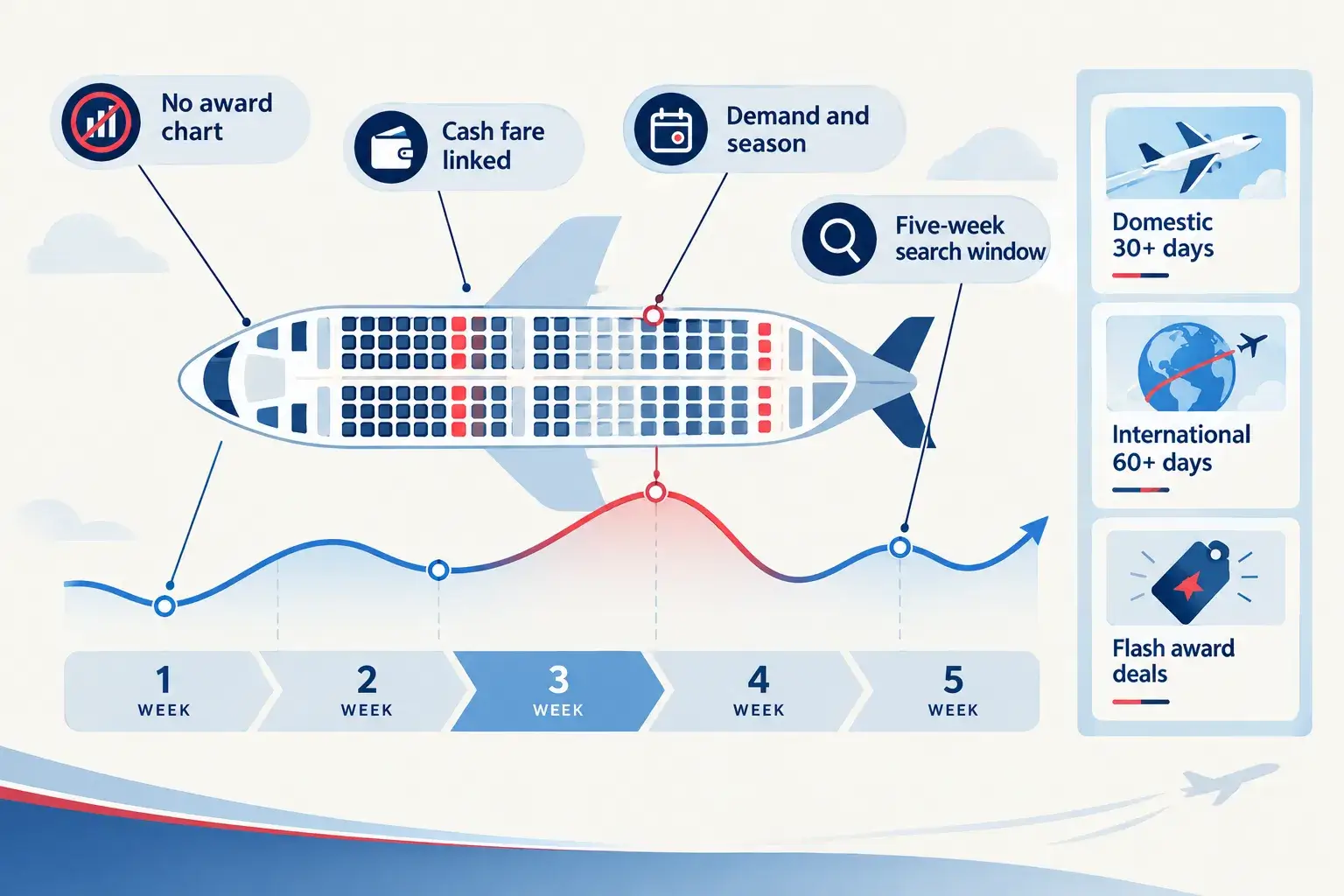
Delta has no published award chart. Every SkyMiles price is generated dynamically, which means the mileage cost of a seat is loosely tied to the cash fare for that same seat on that same date. There are no reliable floors or caps, no fixed regional bands, and no saver-level pricing tier you can plan around.
What that means in practice:
Mileage prices move with cash fares. When a fare spikes for a holiday weekend, the award price spikes too, often disproportionately.
There is no “sweet spot” award chart to memorize. Value comes from finding low-priced dates, not from exploiting a published distance band.
Promotional inventory replaces the chart. Delta runs limited-time SkyMiles Award Deals rather than publishing fixed pricing, and that promotional page was still live in September 2026.
The search window is narrow. Delta’s calendar view shows roughly five weeks at a time, so scanning a full season requires repeated searches or an outside tool.
Delta does publish timing guidance: the lowest award prices are usually found 30 or more days ahead for domestic trips and 60 or more days ahead internationally. That is not a guarantee, but it matches what most award searchers observe.
Decision rule: if you are checking a date inside 21 days of departure and the mileage price looks high, it almost certainly is. Dynamic pricing punishes last-minute award bookings harder than it punishes last-minute cash bookings, because the cash fare gets multiplied into the mileage price.
Common mistake: assuming a high price on one date reflects the route. Run the same route across three or four separate five-week windows before concluding the award is expensive. Swings of 40,000 to 100,000 miles on the same transatlantic route are normal.
What Are Delta Miles Worth in 2026?
Independent valuations converge on 1.1 to 1.2 cents per Delta mile in 2026. NerdWallet’s August 2026 analysis values SkyMiles at 1.2 cents, describing that as the median value of a random Main Cabin economy redemption. The Points Guy also lists 1.2 cents, drawn from a sample of more than 1.8 million Delta itineraries, and notes it sits below several competing airline currencies.
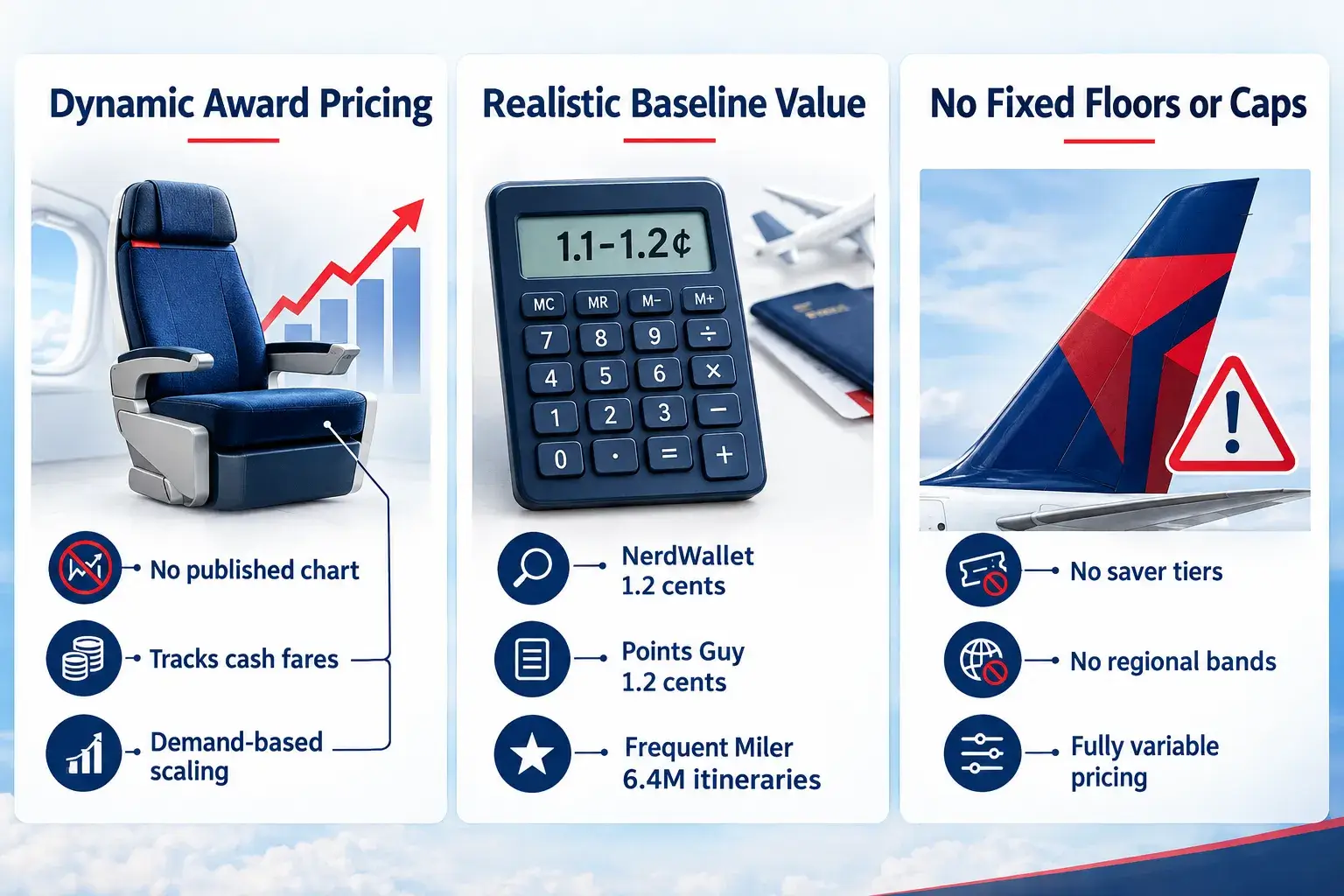
Frequent Miler set Delta’s Reasonable Redemption Value at 1.1 cents in March 2026, using observed booking data across 6,455,387 itineraries. Its median observed value came to 1.11 cents, with business class median value slightly lower at 1.09 cents. That last number is the one worth pausing on: in a dynamically priced program, premium cabins do not automatically deliver better value than economy.
One mid-2026 industry analysis estimates SkyMiles’ effective redemption value at 1.18 cents, down from 1.22 cents at the end of 2024 and 1.31 cents in 2022 before the 2023 program reset. The headline valuations look stable; the underlying baseline has softened.
Use 1.2 cents as your benchmark. If a redemption clears 1.5 cents, it is a good use of Delta miles. Below 1.0 cent, pay cash. For a broader cross-program view, our comparison of airline mile values and CPP methodology shows where SkyMiles sits against Aeroplan, Flying Blue, and AAdvantage.
How Do I Redeem Delta Miles for Flights, and How Many Do I Need?
Redeem Delta miles on delta.com or the Fly Delta app, where every award-eligible Delta and partner seat is priced in miles alongside the cash fare. There is no minimum redemption for flights, and there are no close-in booking fees or award change fees on most tickets.
Typical 2026 mileage prices, based on the 1.1 to 1.2 cent baseline and common cash fares:
Route typeCabinTypical miles (one way)Short-haul domestic (under 700 mi)Main Cabin8,000-15,000Transcontinental domesticMain Cabin12,000-30,000Transcontinental domesticFirst35,000-75,000US to EuropeMain Cabin25,000-60,000US to EuropeDelta One85,000-250,000+US to Latin America / CaribbeanMain Cabin15,000-40,000
Treat these as ranges, not prices. A US-Europe Delta One seat can genuinely cost 85,000 miles on a low-demand Tuesday in February and 280,000 miles for the same route in late June.
Step-by-step booking walkthrough:
Price the cash fare first, including taxes. This is your comparison number.
Search the award on delta.com with the “Shop with Miles” toggle enabled and the flexible-date calendar on.
Advance through at least three consecutive five-week windows to see how the mileage price moves.
Calculate CPP: (cash price minus award taxes and fees) divided by miles required, times 100.
Check the same route on Virgin Atlantic, Flying Blue, and other SkyTeam programs before transferring anything.
Only then transfer Amex Membership Rewards points, if needed. Transfers to SkyMiles are typically near-instant, but they are irreversible.
Book. Apply TakeOff 15 automatically if you hold an eligible Delta co-brand card.
Edge case: if you need more miles than your balance, Delta lets you pay a cash-plus-miles combination on many itineraries. The cash portion usually values your miles near 1.0 cent, so it is a convenience tool rather than a value play. Our broader guide to redeeming points for flights covers the same math across other programs.
Domestic Delta Miles Redemptions: Where Value Holds and Where It Collapses
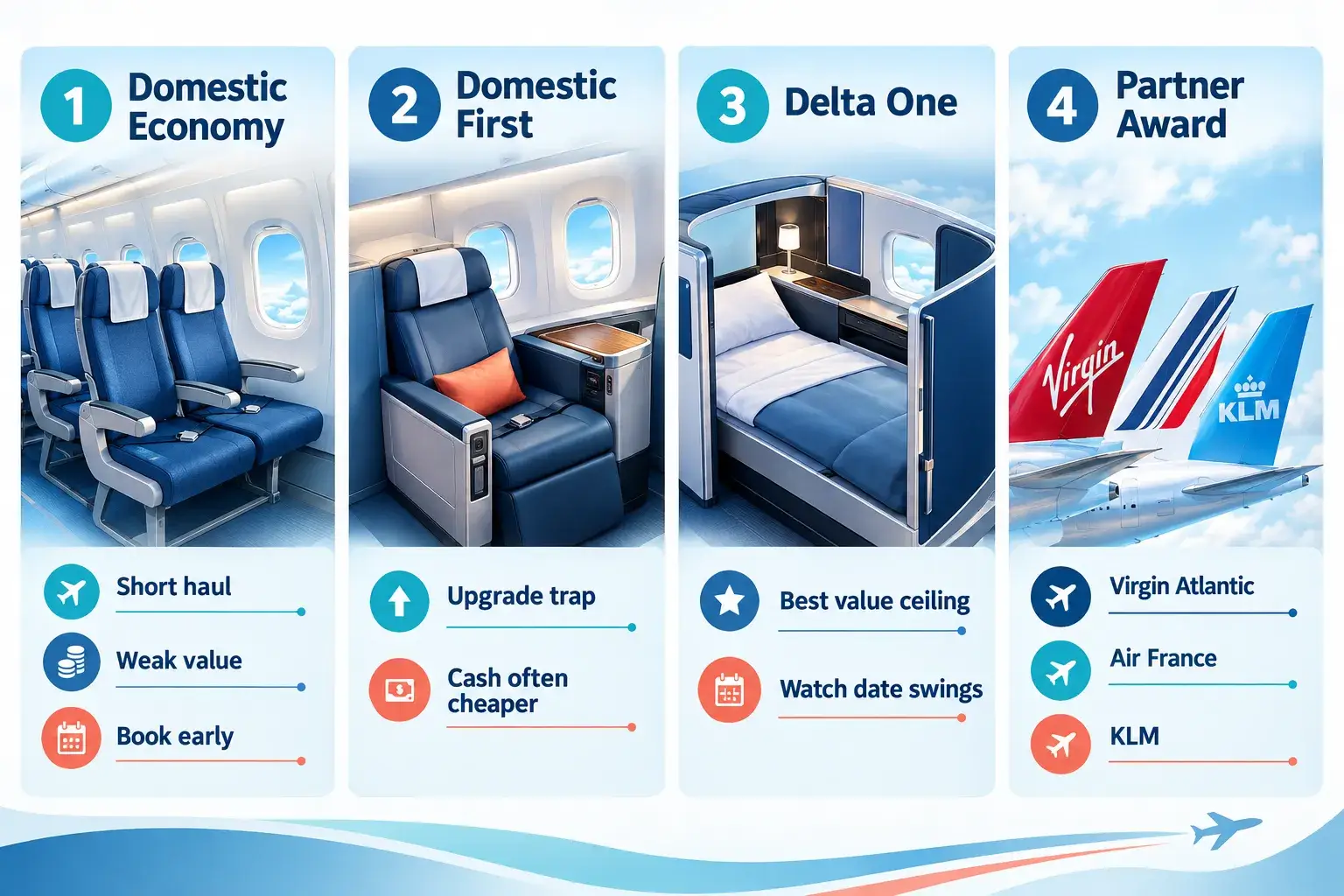
Domestic economy is where Delta miles are most consistently useful, and domestic first class is where they most consistently disappoint. The difference comes down to how dynamic pricing scales: award prices rise faster than cash prices as the cabin gets nicer.
Where domestic value holds:
Short-haul routes booked 30 to 90 days out, where Main Cabin awards often land at 8,000 to 15,000 miles for a fare that would cost $130 to $200.
Routes out of Delta hubs (Atlanta, Detroit, Minneapolis, Salt Lake City) where Delta has capacity and award inventory is deep.
Expensive one-way business-travel fares. If a last-minute Main Cabin seat costs $540 cash and 32,000 miles, that is 1.7 cents per mile, well above baseline.
SkyMiles Award Deals, which periodically discount specific domestic markets below normal dynamic pricing.
Where it collapses:
Domestic first class. Delta prices first-class awards off the cash first-class fare, which is often 3 to 5 times the Main Cabin fare. The mileage cost scales the same way, so CPP rarely improves.
Cheap fares. A $98 round trip that costs 16,000 miles is roughly 0.6 cents per mile. Pay cash.
Peak holidays. Thanksgiving, the December window, and spring break see award pricing inflate alongside fares.
Mileage upgrades. Upgrading with Delta miles typically returns about 1.0 cent per mile, which is below the program baseline.
Rule of thumb for domestic Delta miles: redeem when the cash fare is high relative to the route, pay cash when the fare is already cheap. Miles are best used as insurance against expensive dates, not as a default payment method.
International and Delta One: The Redemptions Worth Saving For
Delta One transatlantic awards are the highest-ceiling use of Delta miles, and also the most volatile. Reporting in August and September 2026 highlighted continued dynamic pricing pressure on Delta One awards, with mileage prices swinging dramatically by date and route on the same transatlantic markets.
That volatility is the strategy. The goal is not to find a good average price; it is to find the outlier date.
What a strong Delta One redemption looks like (illustrative example, with stated assumptions):
Route: New York (JFK) to Amsterdam, one way, Delta One
Award price on a low-demand February weekday: 95,000 miles plus about $6 in taxes
Comparable cash fare on that date: about $2,100
CPP: roughly 2.2 cents per mile
Now the same route in late June:
Award price: 265,000 miles plus about $6
Comparable cash fare: about $3,400
CPP: roughly 1.3 cents per mile
Same seat, same route, same cabin. The February booking delivers nearly twice the value per mile. This is why Frequent Miler’s business-class median value came in at only about 1.09 cents: most people book the expensive dates.
How to find the low-priced dates:
Search shoulder seasons: late January through early March, and late October through early December.
Prefer Tuesday, Wednesday, and Saturday departures.
Check secondary European gateways (Amsterdam, Paris, Dublin, Rome) rather than only London, which carries higher surcharges on some partner programs.
Use an award search tool that scans wider date ranges than Delta’s five-week window. Tools like PointsYeah surface Delta One availability across months at once.
Not for: travelers locked into fixed school-holiday dates. If your dates cannot move, Delta One awards will almost always price above the point where miles beat cash.
Also worth noting: Delta One award taxes and fees are low on US-originating itineraries, usually under $50. That is a real advantage over programs that pass through heavy carrier-imposed surcharges.
Partner Awards: Booking Virgin Atlantic, Air France, and KLM With Delta Miles
Partner awards are frequently the best value available to Delta miles, because partner inventory is sometimes priced closer to a fixed structure than Delta’s own metal. SkyMiles can book SkyTeam carriers plus several non-alliance partners, though availability and pricing vary widely by partner.
Partners most useful to SkyMiles holders:
PartnerAlliance statusWhy it mattersVirgin AtlanticNon-alliance joint ventureTransatlantic Upper Class; often competitive mileage pricing from Delta hubsAir France / KLMSkyTeamDeep European network, low US-origin surcharges, good connectivity beyond Paris and AmsterdamKorean AirSkyTeamStrong Asia access, quality business cabinAeromexicoSkyTeamUseful for Mexico and Latin America beyond Delta’s own routesLATAMNon-alliance joint ventureSouth America coverage Delta does not fly itselfVirgin AustraliaNon-allianceDomestic Australia connectionsAir Europa, ITA Airways, China Eastern, Kenya Airways, Saudia, Vietnam AirlinesSkyTeamSituational regional value
Practical partner rules:
Not all partners are bookable online. Virgin Atlantic, Air France, KLM, and Korean Air generally appear on delta.com. Several smaller SkyTeam carriers require calling the SkyMiles service line.
TakeOff 15 does not apply to partner awards. The 15% discount covers Delta-operated flights only.
Partner award space is thinner than Delta’s own. Expect one or two premium seats per flight, not five.
Reverse the comparison. Before spending Delta miles on an Air France or KLM flight, price the same flight through Flying Blue directly. Flying Blue accepts transfers from Amex, Chase, Capital One, Citi, and Bilt, and often prices its own metal lower than SkyMiles does. Flying Blue also runs frequent transfer bonuses, including Citi to Flying Blue promotions.
Decision framework: if the flight is Delta-operated, SkyMiles plus TakeOff 15 is usually your cheapest path. If the flight is partner-operated, check the partner’s own program first. SkyMiles is rarely the cheapest currency for another airline’s seats.
Flash Sales, Award Deals, and Timing Your Delta Miles Redemption
Delta’s SkyMiles Award Deals page is the closest thing the program has to a sweet spot, and it was still active in September 2026. These are limited-time promotional award prices on specific routes and dates, usually well below what dynamic pricing would otherwise produce.
How to work the timing:
Check the award deals page before searching a specific route. If your destination appears, book it. Deal pricing disappears without notice.
Respect the 30/60-day guidance. Delta states lowest award prices are typically found 30+ days out domestically and 60+ days out internationally.
Book on the award side of the calendar, not the cash side. Low cash fares and low award prices do not always align, especially during fare sales where Delta discounts cash but not miles.
Free changes work in your favor. Most Delta award tickets carry no change fee, so you can book a decent price and rebook if it drops. Verify the fare rules on your specific ticket before assuming this.
Common pitfall: waiting for a flash sale on a route you must fly. Award deals target markets Delta wants to fill, not markets you want to visit. If your trip is fixed, book when the price clears your CPP threshold and stop watching.
How to Earn Delta Miles Fast, and Which Transfer Partners Feed SkyMiles
The fastest way to earn Delta miles is a Delta SkyMiles American Express card welcome offer, followed by Amex Membership Rewards transfers. American Express is the only major transferable-points program that transfers to SkyMiles, at a 1:1 ratio. Chase Ultimate Rewards, Capital One miles, Citi ThankYou points, and Bilt points cannot be converted to Delta miles at all.
That single-partner restriction is the most important structural fact about earning SkyMiles. If you are building toward a Delta redemption, your earning strategy runs through Amex.
Earning channels ranked by speed:
Delta SkyMiles Amex welcome offers. Typically the largest single injection of miles, and eligible cards also unlock TakeOff 15. Compare the lineup in our guide to Delta SkyMiles credit cards.
Amex Membership Rewards transfers. 1:1, usually near-instant. Amex runs occasional transfer bonuses to SkyMiles, though they are less frequent and generally smaller than bonuses to partners like Flying Blue or Virgin Atlantic.
Flying Delta. Base earning is revenue-based, scaled by Medallion status.
SkyMiles Dining and the SkyMiles Shopping portal. Slow but steady, and useful for topping off a balance.
Partner spend. Delta’s Uber partnership and rideshare-linked earning add incremental miles on spending you already do. See how to maximize SkyMiles with Delta’s Uber partnership.
Starbucks. Note the change: as of August 5, 2026, Delta reduced Starbucks-linked earning to 1 SkyMile per $1 spent at participating stores, and members must be flight-active to keep earning beyond the transition period.
Transfer-bonus reality check: because Amex is the only feeder, there is no arbitrage across programs. You cannot wait for a better ratio from a different issuer. The practical rule is to transfer only when you have confirmed award space, since SkyMiles transfers are one-way and cannot be reversed.
Can You Buy, Gift, or Lose Delta Miles?
Do Delta miles expire? No. SkyMiles do not expire, and there is no activity requirement to keep a balance alive. That policy has not changed as of September 2026, and it remains one of the program’s clearest advantages over carriers that enforce 12, 18, or 24-month expiration windows. For context on how other programs handle this, see our overview of which airline miles expire in 2026.
Can you buy Delta miles, and is it worth it? Delta sells miles through its official channel, typically at around 3 cents per mile before promotional discounts. At a 1.1 to 1.2 cent redemption baseline, buying miles at retail is a clear loss. Purchased miles only make sense in one narrow case: you have already found a specific high-value award (a Delta One seat pricing above 2 cents per mile) and you are short by a modest number of miles. Even then, run the math against the cash fare first. Our guide to buying airline miles covers when the math works and when it does not.
Can you gift Delta miles to someone else? Delta allows members to transfer or gift miles, but the fees are steep enough that it is rarely worth it. A better approach: book the award ticket in the other person’s name directly from your own account. Delta does not require the traveler to be the account holder, so there is almost never a reason to move miles between accounts.
What else can you use Delta miles for besides flights?
Delta Sky Club access, seat upgrades, and preferred seats. Upgrades return about 1.0 cent per mile.
Delta Vacations packages. Around 1.1 cents per mile.
SkyMiles Marketplace merchandise, gift cards, and experiences. Generally 0.5 to 0.9 cents per mile.
Wine and charitable donations. Low value, but a legitimate use for an orphaned balance.
Every non-flight option prices below the 1.2 cent flight baseline. Use them only to clean up a balance too small to fly with.
Are Delta Miles Devaluing, and How Do They Compare to Other Airline Miles?
Delta miles are slowly devaluing rather than collapsing. Headline valuations have held around 1.2 cents, but effective redemption value has drifted down from about 1.31 cents in 2022 to roughly 1.18 cents by mid-2026 according to one industry analysis. Dynamic pricing means Delta does not need to announce a devaluation; it can simply let award prices track rising fares.
The takeaway is not that SkyMiles are bad. It is that SkyMiles are not a currency to hoard. Programs with published charts reward stockpiling because you can plan against known prices. Dynamic programs punish it, because your balance quietly loses purchasing power as fares climb. This is the core argument in our piece on why sitting on a large mileage balance costs you money.
Devaluation-risk rule for Delta miles: hold no more than roughly one premium-cabin redemption’s worth of SkyMiles at a time. Keep everything else in Amex Membership Rewards, where you retain the option to move points to Flying Blue, Virgin Atlantic, Aeroplan, or ANA instead.
When Should You Pay Cash and Keep the Delta Miles?
Pay cash whenever the redemption returns less than about 1.0 cent per mile, and strongly consider cash below 1.2 cents. Because SkyMiles carry no expiration, there is no pressure to burn them on a mediocre redemption.
Pay cash when:
The fare is already cheap. A $120 round trip is not worth 20,000 miles.
You need the Medallion Qualification Dollars. Award tickets earn no MQDs, so status-chasers lose progress by redeeming.
The trip is within two weeks. Dynamic pricing is at its worst close-in.
It is a domestic first-class seat and the cash upgrade is priced reasonably.
The itinerary would earn meaningful redeemable miles and elite credit on a paid fare.
Use Delta miles when:
The cash fare is unusually expensive for the route.
You found a Delta One award pricing at 1.5 cents per mile or better.
Plans may change. Free award changes and no close-in fees make miles the more flexible option.
The alternative is watching your balance lose value to dynamic pricing.
Quick calculation: (cash fare minus award taxes) divided by miles required, times 100 equals your CPP. Compare it to 1.2 cents. If you want to run this across multiple programs, our travel points calculator guide walks through the methodology.
Frequently Asked Questions
How much are Delta miles worth in 2026?
About 1.1 to 1.2 cents each. NerdWallet and The Points Guy both value SkyMiles at 1.2 cents in their 2026 analyses, while Frequent Miler’s observed-booking data puts the median at 1.11 cents. Use 1.2 cents as your benchmark when deciding between miles and cash.
Do Delta miles expire?
No. SkyMiles have no expiration date and no activity requirement. A balance will remain in your account indefinitely as long as the account stays open, and that policy is unchanged as of September 2026.
How many Delta miles do I need for a free flight?
There is no fixed number, because pricing is dynamic. Realistically, expect 8,000 to 15,000 miles for a short domestic one-way, 12,000 to 30,000 for a transcontinental Main Cabin seat, and 85,000 to 250,000-plus for a one-way Delta One seat to Europe. Taxes on US-originating awards are usually under $50.
Which credit card points transfer to Delta SkyMiles?
Only American Express Membership Rewards, at a 1:1 ratio. Chase Ultimate Rewards, Capital One miles, Citi ThankYou points, and Bilt points have no SkyMiles transfer option.
What is the best use of Delta miles?
A Delta One transatlantic award booked on a low-demand date, which can exceed 2 cents per mile, or a partner award on Virgin Atlantic, Air France, or KLM. High-priced last-minute domestic Main Cabin fares also redeem well.
What are the worst ways to redeem Delta miles?
Mileage upgrades (about 1.0 cent per mile), Delta Vacations packages (about 1.1 cents), and SkyMiles Marketplace merchandise or gift cards (often under 1 cent). Buying miles at retail prices near 3 cents each is also a loss against a 1.2 cent baseline.
Can you gift Delta miles to someone else?
Yes, but transfer fees make it inefficient. Book the award ticket directly in the other traveler’s name from your own account instead. Delta does not require the passenger to be the account holder.
Does TakeOff 15 apply to partner awards?
No. The 15% mileage discount for eligible Delta SkyMiles Amex cardholders applies only to Delta-operated award tickets booked on delta.com or the Fly Delta app.
Conclusion: A Practical Plan for Your SkyMiles Balance
Delta miles in 2026 are a functional currency with a modest ceiling. At 1.1 to 1.2 cents each, they will not deliver the outsized value that a chart-based program like Aeroplan can. What they will deliver is reliability: no expiration, no close-in booking fees, no change penalties, and a strong domestic network. The mistake is treating SkyMiles as a store of value. The right approach is to earn them with purpose and spend them on specific, verified redemptions.
Next steps, in order:
Check your SkyMiles balance and calculate what it buys at 1.2 cents per mile. That is the honest value of what you hold.
If you hold a large balance, identify one target redemption now. Delta One transatlantic in shoulder season is the best candidate.
Before transferring any Amex points, price the same flight through Flying Blue and Virgin Atlantic. Those programs often cost fewer points for the same seat.
If you hold an eligible Delta SkyMiles Amex, confirm TakeOff 15 is applying at checkout. It is a 15% discount you should never leave on the table.
Keep future earnings in Amex Membership Rewards rather than pre-transferring to SkyMiles, so you retain the option to route to a better program.
For a broader view of where the market is heading, read our 2026 award travel predictions.
Use the miles you have on a redemption that clears 1.5 cents. Pay cash for everything cheaper. That single rule will do more for your SkyMiles value than any amount of searching.


Content on Award Travel Hub is independently created by Award Travel Hub Editorial Desk and, where noted, reviewed by Award Travel Hub Review Desk. Some pages may contain affiliate links, but compensation does not determine our coverage, opinions, or methodology.