

Last updated: September 5, 2026
Quick Answer
The best credit cards with travel benefits are not necessarily the cards with the longest benefit lists. Based on realistic use, the Chase Sapphire Reserve and Capital One Venture X offer the strongest net benefit value for frequent travelers, while the Chase Sapphire Preferred provides a better risk-adjusted choice for occasional travelers.
This ranking discounts restricted credits, values lounges per likely visit, and treats insurance as protection against expected losses rather than its maximum advertised payout.
Key Takeaways
- Capital One Venture X offers the simplest premium-card value proposition if its annual travel credit and anniversary miles are easy for the cardholder to use.
- Chase Sapphire Reserve can produce more net value, but only for travelers who use its lounge access and several restricted credits.
- Chase Sapphire Preferred is the strongest mid-tier option in this model because of primary rental coverage, travel protections, points transfer partners, and a manageable annual fee.
- American Express Platinum works best for frequent lounge users who already spend with participating credit and hotel partners. Its $895 annual fee is difficult to offset otherwise.
- No-annual-fee cards provide useful rewards and no-foreign-transaction-fee options, but most lack strong travel insurance and airport benefits.
- Value lounge access by expected visits, not the price of a separate membership.
- Portal credits deserve a discount because portal rates, program rules, and booking flexibility may differ from direct reservations.
- Sign-up bonuses can be valuable, but they should not determine whether a card is worth keeping after the first year.
- Transferable points have no guaranteed value. Award availability, transfer ratios, surcharges and fees, and devaluation risk affect every redemption.
How We Priced Each Travel Benefit
A travel benefit is worth only what it replaces in the cardholder’s normal budget. The valuation method below excludes welcome bonuses and ordinary spending rewards so a large first-year offer does not hide a weak long-term value proposition.
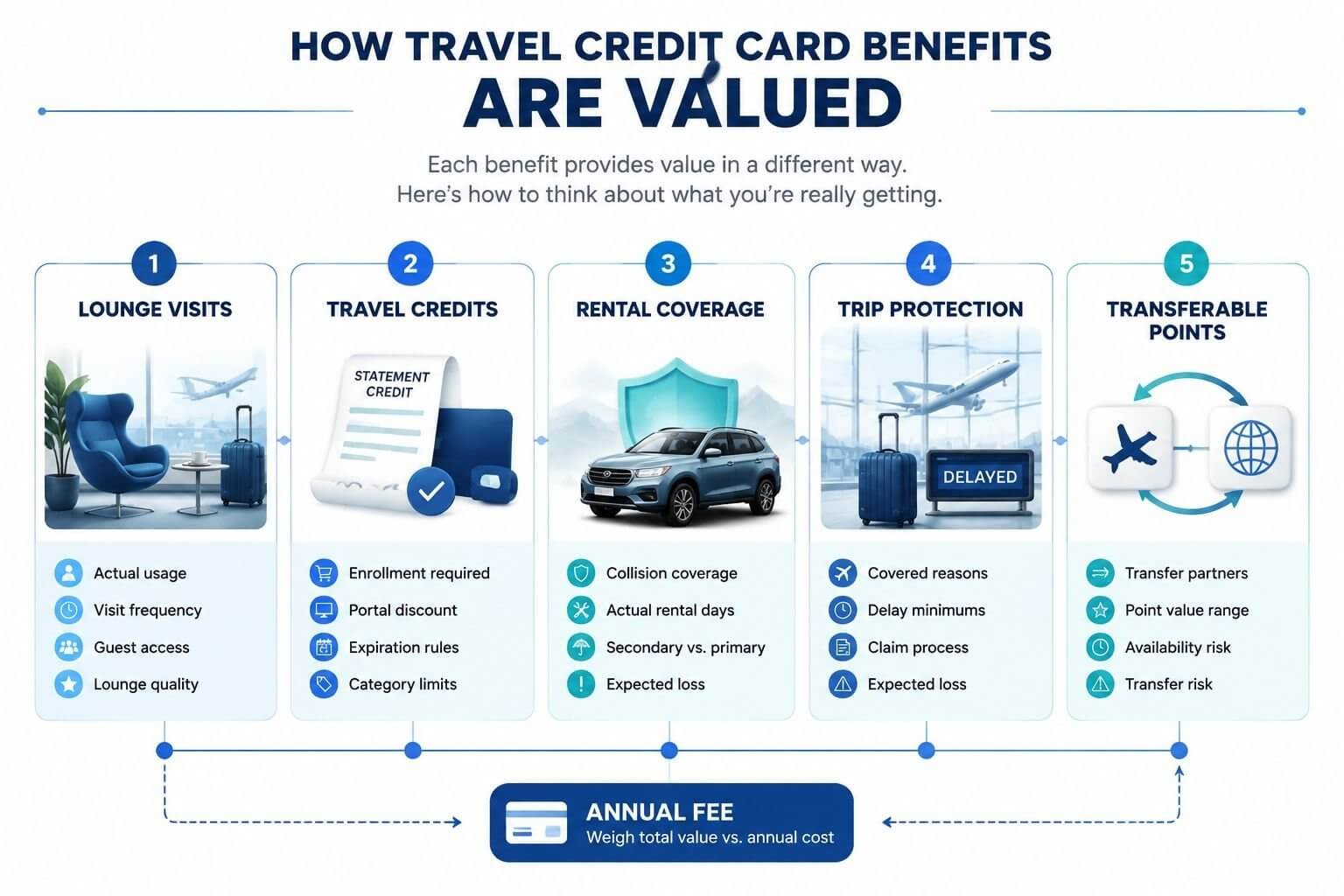
The estimates use the following decision framework:
| Benefit | Valuation method | Main discount |
|---|---|---|
| Airport lounge access | Expected visits multiplied by $35 | Crowding, guest limits, alternative food cost |
| Broad travel credit | 90% to 100% of face value | Little if normal travel triggers it |
| Portal-restricted credit | 45% to 85% of face value | Price differences and lost hotel benefits |
| Trusted traveler credit | Annualized over benefit interval | Available on many competing cards |
| Primary rental coverage | $25 to $50 per year | Depends on rental frequency and personal insurance |
| Trip delay or cancellation coverage | $15 to $40 per year | Claims are infrequent and exclusions apply |
| Anniversary points | Conservative cash-equivalent floor | Transfer value is uncertain |
| Hotel status | $0 unless regular stays create measurable savings | Benefits and upgrades are not guaranteed |
How much can you save with travel rewards credit cards?
A frequent traveler can reasonably save several hundred dollars per year, but savings depend on actual use. A card with a $300 broad travel credit, six lounge visits valued at $35 each, and $40 of expected insurance value produces $550 in gross benefits before its annual fee.
Points require separate travel rewards math. For example:
- Cash fare: $2,400
- Partner-airline award: 70,000 points
- Taxes and fuel surcharges: $250
- Net cash avoided: $2,150
- Redemption value: 3.07 cents per point
That is a strong redemption, but only if award space exists and the traveler would otherwise pay close to the cash price. A $2,400 business-class ticket does not create $2,150 of personal value for someone who would have purchased a $700 economy fare.
You may be interested



Use the Travel Points Calculator for 2026 to compare cash and award options with taxes included.
Do travel credit card benefits offset the annual fee?
Travel benefits offset an annual fee when their conservative usable value, excluding the sign-up bonus, exceeds the fee. Credits that change spending behavior should receive a substantial discount or a value of zero.
A $300 credit is not worth $300 when it requires an unwanted purchase, a higher portal rate, or a booking that gives up hotel points and elite benefits.
Decision rule: Keep a card when recurring benefits exceed the annual fee by at least 20%. The margin helps absorb benefit changes, missed credits, reduced travel, and devaluation risk.
Benefits Worth Real Money: Lounge Access, Travel Credits, and Primary Rental Coverage
The most valuable card benefits replace expenses a traveler was likely to incur anyway. Broad travel credits, repeated lounge access, free checked bags, and primary rental coverage generally deserve more weight than coupons for unfamiliar merchants.

Lounge access
Credit card lounge access value depends on visit frequency and the available alternative. A traveler who would otherwise spend $20 on food should not assign a $79 value to each visit merely because that is the posted single-entry price.
This ranking uses $35 per visit, subject to these limits:
- Count only likely visits at airports with eligible lounges.
- Include guests only when the card’s rules permit free entry.
- Do not count visits during known peak periods if access is routinely restricted.
- Cap the annual value near what the traveler would pay for a suitable membership.
Frequent travelers should compare networks, guest rules, and authorized-user costs in the 2026 airport lounge access cost-per-visit analysis.
Travel credits
A broad credit that automatically covers airlines, hotels, transit, or rental cars can be valued close to face value. A portal-restricted hotel credit should be discounted because the traveler may face higher rates, limited inventory, stricter cancellation rules, or lost hotel points.
Typical valuation ranges are:
- Broad automatic travel credit: 90% to 100%
- Airline incidental credit: 50% to 70%
- General portal credit: 75% to 85%
- Luxury hotel portal credit: 40% to 60%
- Merchant-specific lifestyle credit: 0% to 75%, depending on existing spending
Primary rental car coverage
Primary coverage lets an eligible cardholder file a covered collision or theft claim with the card benefit administrator before involving personal auto insurance. Secondary coverage generally pays only after other applicable insurance.
Among major cards in this comparison:
- Chase Sapphire Reserve: Primary coverage, generally up to $75,000 for eligible rentals.
- Capital One Venture X: Primary coverage through its Visa Infinite benefits, generally up to $75,000.
- Chase Sapphire Preferred: Primary coverage, with the current guide generally limiting reimbursement to $60,000 for eligible vehicles.
- Amex Platinum: Standard coverage is generally secondary. Optional Premium Car Rental Protection can provide primary coverage for an added flat fee per rental.
- Citi Strata Premier: Coverage is generally secondary in the cardholder’s country of residence and primary outside it, subject to the benefit guide.
Coverage limits, excluded countries, vehicle types, rental periods, and payment requirements matter. Review the current guide before declining a rental company’s collision damage waiver. The 2026 credit card rental insurance guide provides a deeper comparison.
Travel credit cards with travel insurance and protections
Chase Sapphire Reserve and Preferred offer two of the more balanced protection packages. Both generally include trip cancellation and interruption coverage up to $10,000 per person and $20,000 per trip, while Reserve trip-delay coverage can begin after a six-hour delay and Preferred coverage generally requires 12 hours or an overnight stay.
Amex Platinum generally provides trip-delay coverage after a delay of more than six hours, up to $500 per covered trip, with claim-frequency limits. Its trip cancellation and interruption insurance generally covers up to $10,000 per covered trip and $20,000 per eligible card in a consecutive 12-month period.
Capital One Venture X includes useful Visa Infinite protections, including trip delay and primary rental coverage, but exact eligibility and exclusions must be checked in the current benefits guide.
Insurance has no value if the trip is not paid for in the required way. For policy details and common exclusions, see the guide to credit card travel insurance benefits.
Benefits That Sound Better Than They Are
The weakest benefits have high advertised values but narrow use cases. Hotel status, coupon-style statement credits, luxury hotel booking programs, and transfer bonuses can be worthwhile, but none should receive full value automatically.

Common examples include:
- Hotel elite status: Late checkout and upgrades depend on the program, property, and availability.
- Luxury hotel credits: Eligible rates may cost more than public or member rates.
- Transfer bonuses: A 20% transfer bonus is useful only when the destination program has bookable award space.
- Premium concierge service: The service may save time, but it rarely replaces a fixed expense.
- Large insurance maximums: The maximum payout is not an annual cash benefit.
- Loyalty Point bonuses: Valuable to travelers pursuing status, but worth little without a realistic qualification plan.
Can you use travel benefits on any airline or hotel?
No. Broad travel credits may work with many travel providers, but airline incidental credits, free checked bags, elite benefits, and companion certificates usually apply to one airline or hotel group. Portal credits require booking through the issuer’s platform.
Transferable points provide wider access through partner airlines and hotels, but transfers are normally irreversible. Amex points, Chase points, Capital One miles, Citi points, and Bilt points each have different transfer ratios and points transfer partners.
A practical booking strategy is:
- Search for award availability with the airline program.
- Confirm the operating flight, cabin, taxes, and fuel surcharges.
- Check whether married segments or positioning flights improve access.
- Compare cash, portal, and partner award prices.
- Transfer only after confirming award space.
- Book immediately and retain screenshots.
Transfers can be delayed, and premium cabin awards may disappear before the points arrive. Transfer bonuses also do not fix poor award charts or dynamic pricing.
Is a travel credit card sign-up bonus worth it?
A sign-up bonus is worth pursuing when the normal spending requirement can be met without carrying a balance, paying fees, or advancing purchases. The bonus should also support a realistic redemption plan.
For example, 75,000 transferable points can be valuable for business class deals or hotel stays, but redemption value may fall below one cent per point if the points are used for cash back or poor-value portal bookings.
Common mistake: Applying for a card because a bonus looks large without checking transfer partners, award availability, application restrictions, or the opportunity cost of using that spending on another card.
Travel credit cards that don’t require minimum spending
Credit card travel benefits usually do not require ongoing minimum spending once the account is open, although welcome bonuses do. Some airline certificates, status boosts, and annual credits may require spending or a qualifying transaction.
Travelers who do not want a spending target should focus on automatic benefits such as:
- No foreign transaction fees
- Transfer-partner access
- Primary rental coverage
- Anniversary points
- Lounge membership
- Automatic annual travel credits
Always distinguish an application bonus requirement from a recurring card benefit.
No-Annual-Fee Cards: What You Actually Get
No-annual-fee travel cards provide basic rewards, transfer access in a few programs, and sometimes no foreign transaction fees. Most do not include comprehensive lounge access, strong trip-delay insurance, or primary rental coverage.

Useful options include:
| Card | Annual fee | Practical strengths | Main limitation |
|---|---|---|---|
| Wells Fargo Autograph | $0 | Broad bonus categories, transfer partners, no foreign transaction fee | Limited premium protections |
| Capital One VentureOne | $0 | Capital One miles, transfer partners, no foreign transaction fee | Low earning rate and few travel perks |
| Bank of America Travel Rewards | $0 | Simple rewards, no foreign transaction fee | No airline transfer partners |
| Bilt Mastercard | $0 | Bilt points, transfer partners, primary rental coverage subject to terms | Requires careful management of program rules |
Transfer access matters more than the word “travel” in the product name. A no-fee card connected to useful alliance partners may deliver better redemptions than a basic card that restricts points to statement credits.
See the best no-annual-fee travel credit cards for 2026 for current earning structures and eligibility details.
Travel credit cards for bad credit
Most travel rewards cards require good to excellent credit. Applicants rebuilding credit should prioritize approval odds, no foreign transaction fees, and low account costs rather than premium benefits.
The U.S. Bank Altitude Go Visa Secured can be a practical option for some applicants because it has no annual fee and no foreign transaction fee, but it requires a security deposit and does not offer a premium travel package. General secured cards may be easier to obtain, although foreign transaction fees vary.
Best for: Building positive payment history while retaining basic international usability.
Not for: Lounge access, transferable airline miles, premium cabin awards, or extensive travel insurance.
Paying interest erases travel rewards quickly. A low-cost card with automatic full-balance payments is preferable to a rewards card carrying revolving debt.
Mid-Tier Cards Under $150: The Value Sweet Spot
Mid-tier cards often provide the best balance for occasional travelers because they offer transfer partners and meaningful protections without a premium annual fee. The Chase Sapphire Preferred leads this category in the 2026 benefit-only model.
The mid-2026 Sapphire Preferred update kept the $95 annual fee while adding 3 points per dollar on gas, EV charging, and eligible vacation-home rentals. Its annual Chase Travel hotel credit increased to $100, and the card added an application-fee credit of up to $120 for Global Entry, TSA PreCheck, or NEXUS every four years.
The card also retains primary rental coverage and adds emergency evacuation coverage. The portal hotel credit receives a 70% valuation in this analysis because direct hotel bookings can offer better rates, hotel points, and elite benefits.
Citi Strata Premier remains useful for earning Citi points and accessing partner airlines. Its annual hotel benefit is less flexible because it requires a qualifying hotel booking through Citi Travel, so the credit receives a steep discount.
Which travel credit card is best for flights vs. hotels?
For flights, choose a card with strong airline transfer partners, useful delay protection, and no foreign transaction fees. Chase Sapphire Preferred is the balanced mid-tier choice, while Amex Platinum is stronger for lounge-heavy premium travel.
For hotels, the correct card depends on booking behavior:
- Direct hotel bookings: A co-branded hotel card can provide elite-night credits, status, and an annual free-night certificate.
- Independent hotels: Capital One Venture X or a flexible travel card may offer better earning and redemption options.
- Hyatt redemptions: Chase points and Bilt points are often useful because World of Hyatt retains valuable award-chart sweet spots, though availability can be limited.
- Luxury prepaid stays: Amex Platinum can work when Fine Hotels + Resorts pricing is competitive and its benefits are usable.
Readers focused on hotel benefits should compare the best hotel credit cards for 2026.
How to maximize credit card travel points
The best use of points starts with award availability, not a speculative transfer. Keep transferable points with the bank until you’re ready to book.
Use this step-by-step guide:
- Set a realistic route, date range, and cabin.
- Search the operating airline and relevant alliance partners.
- Check nearby airports and positioning flights.
- Test one-way searches and longer connecting itineraries.
- Compare award charts, dynamic pricing, and surcharges and fees.
- Confirm transfer ratios and expected processing time.
- Look for transfer bonuses without letting one dictate the trip.
- Transfer only enough points for the confirmed booking.
Award search tools can reduce search time, but their results may be delayed or incomplete. Confirm every premium cabin award on the loyalty program’s own website before transferring points.
Premium Cards Over $395: When the Math Works
A premium card works when its core travel benefits cover the annual fee without forcing extra spending. Capital One Venture X is the easiest premium card to justify, while Chase Sapphire Reserve can deliver higher net value for travelers who use its expanded credits.
Amex Platinum is more conditional. Its $895 annual fee requires consistent lounge use and natural use of several credits. The card is a poor fit when a cardholder must create new spending habits to recover the fee.
The Citi/AAdvantage Executive World Elite Mastercard is best treated as an Admirals Club and American Airlines status card rather than a general travel card. Its refreshed benefits include up to $500 in annual American Airlines Vacations credits split across two windows, up to $100 in annual inflight and Admirals Club purchase credits, up to $180 in annual Lyft credits, and larger Loyalty Point bonuses. Restrictions make the credits worth much less than face value for many travelers.
For a deeper benefits comparison, see premium travel cards worth paying for in 2026.
Best credit cards for international travel in 2026
The best international travel card depends on airport access, booking preferences, and insurance needs.
- Capital One Venture X: Best for travelers wanting straightforward premium value, transfer partners, lounge access, and no foreign transaction fees.
- Chase Sapphire Reserve: Best for frequent travelers who can use the broad travel credit, lounges, protections, and issuer-specific credits.
- Amex Platinum: Best for lounge-heavy travelers who value Centurion Lounge access and can use its restricted credits.
- Chase Sapphire Preferred: Best for occasional international travelers who want primary rental coverage and transfer partners at a lower fee.
- Wells Fargo Autograph: Best no-fee option for international spending and basic transferable rewards.
Amex acceptance can be weaker than Visa or Mastercard in some destinations. Carrying a backup card is prudent even when the Amex Platinum offers the best airport experience.
The Ranked Table: Net Benefit Value After Annual Fee
Chase Sapphire Reserve ranks first under the stated assumptions, but Capital One Venture X is the safer recommendation for most premium-card shoppers. Reserve’s advantage depends on several credits that may not fit every traveler.
The following estimates exclude welcome bonuses, category rewards, and speculative First Class redemptions.
| Rank | Card | Annual fee | Estimated recurring benefit value | Estimated net value | Best for |
|---|---|---|---|---|---|
| 1 | Chase Sapphire Reserve | $795 | $1,060 | $265 | Frequent travelers using lounges and multiple credits |
| 2 | Capital One Venture X | $395 | $635 | $240 | Simple premium value and regular portal users |
| 3 | Amex Platinum | $895 | $1,085 | $190 | Heavy lounge users with natural credit usage |
| 4 | Chase Sapphire Preferred | $95 | $170 | $75 | Occasional travelers wanting protections and transfers |
| 5 | Bilt Mastercard | $0 | $45 | $45 | Renters and transfer-partner users |
| 6 | Wells Fargo Autograph | $0 | $20 | $20 | No-fee international spending |
| 7 | Citi Strata Premier | $95 | $70 | -$25 | Citi transfer users who value earning categories |
| 8 | Capital One VentureOne | $0 | $0 | $0 | Keeping transfer access without an annual fee |
These are modeled values, not guaranteed savings. The premium-card calculations assume multiple lounge visits and eligible use of core travel credits. An unused credit has zero value.
The rankings can change quickly:
- Venture X falls behind if the cardholder avoids Capital One Travel.
- Sapphire Reserve becomes unattractive if its restricted credits go unused.
- Amex Platinum can rank first for a traveler making frequent Centurion Lounge visits and using hotel and airline credits naturally.
- Citi Strata Premier may still be worth keeping because of points earned on spending, even though its stand-alone benefit value does not offset the fee in this model.
- Bilt’s value depends heavily on current program rules and points transfer partners.
Matching a Card to Your Travel Frequency
Occasional travelers should favor low annual fees, while frequent flyers can justify premium cards through repeated lounge visits and stronger protections. The correct card is determined by expected behavior over the next 12 months, not last year’s travel pattern.
Travel cards for occasional travelers vs. frequent flyers
Occasional traveler, one or two trips per year
Choose Chase Sapphire Preferred if primary rental coverage and transfer partners matter. Choose Wells Fargo Autograph if avoiding an annual fee is the priority.
Regular traveler, three to six trips per year
Capital One Venture X often provides the cleanest value if the annual portal credit is easy to use. Its lounge access and anniversary miles can offset the remaining fee.
Frequent flyer, seven or more trips per year
Compare Chase Sapphire Reserve and Amex Platinum based on home-airport lounge access, guest rules, travel credits, delay coverage, and authorized-user costs.
Airline loyalist
A co-branded card may be better than a general premium card when free checked bags, priority boarding, companion benefits, or status qualification create measurable savings.
Hotel loyalist
Choose a hotel card when the annual certificate and status benefits exceed the fee. Account for dynamic pricing, certificate caps, resort fees, and limited award availability.
What happens to travel points if you cancel the card?
Bank points may be lost when the last eligible rewards card in that program closes. Airline miles and hotel points already transferred to a loyalty program generally remain there, subject to that program’s expiration and account rules.
Before canceling:
- Confirm the points balance and card anniversary date.
- Ask whether a no-fee product change is available.
- Move or combine points with another eligible household or business account where permitted.
- Use remaining annual credits.
- Download statements and benefit records.
- Transfer points only if there is a strong booking plan.
A speculative transfer can create devaluation risk and strand points in a program with poor award space. The 2026 guide to downgrading a travel card while keeping points explains program-specific options.
A practical annual-fee review checklist
Use this checklist 30 to 45 days before the annual fee posts:
- Total each credit actually used during the previous year.
- Count real lounge visits, including denied or inconvenient visits.
- Record insurance claims or rental coverage used.
- Exclude the original sign-up bonus.
- Compare the card with a no-fee downgrade.
- Review new annual fees and benefit restrictions.
- Check whether another card duplicates the same lounges or insurance.
- Keep the card only when the next year’s expected value exceeds its cost.
Frequently Asked Questions
Which travel credit card has the most valuable benefits?
Chase Sapphire Reserve has the highest modeled net value for frequent travelers who use its lounges and credits. Capital One Venture X offers a simpler value proposition with fewer credits to manage.
Are premium travel cards worth the annual fee?
Premium travel cards are worth the fee when broad credits, realistic lounge use, insurance, and anniversary benefits exceed the fee without changing normal spending habits.
What is the best no-annual-fee travel card?
Wells Fargo Autograph is a strong general option because it combines broad earning categories, transfer partners, and no foreign transaction fee. The best choice still depends on transfer needs and approval eligibility.
How much is airport lounge access worth?
A reasonable estimate is about $35 per visit, based on the food, drinks, workspace, and comfort a traveler would otherwise purchase. Posted walk-in prices often overstate personal value.
Should points be transferred during a transfer bonus?
Transfer points during a bonus only after confirming suitable award space. Transfers are usually irreversible, and a bonus does not protect against award-price changes or disappearing seats.
Is primary rental car coverage enough by itself?
No. Credit card rental coverage usually covers collision damage and theft, not liability, personal injury, personal property, or every vehicle type. The card’s benefits guide controls eligibility.
Can a travel card help if a flight is delayed?
A covered card may reimburse eligible meals, lodging, and local transportation after the required delay threshold. The fare must usually be charged to the card or paid with eligible rewards, and documentation is required.
Is CPP the best way to compare redemptions?
Cents per point is useful, but it can overstate value when the cash price is higher than the traveler would have paid. Compare the award with the realistic cash alternative, including taxes, surcharges, flexibility, and positioning costs.
Conclusion
The strongest credit cards with travel benefits in 2026 are those with benefits that fit existing travel habits. Capital One Venture X offers the clearest premium value for many travelers, Chase Sapphire Reserve can produce more value with heavier use, and Chase Sapphire Preferred remains the practical mid-tier choice.
Start with the next 12 months of expected trips. Price broad credits near face value, discount portal credits, count only realistic lounge visits, and assign modest expected-loss value to insurance. Then subtract the annual fee.
Before applying, compare options using the current benefit guides and search the relevant partner airlines for the trips the points are meant to book. Do not transfer points until award space is confirmed, and do not keep a premium card merely because its advertised benefits exceed its fee.


Content on Award Travel Hub is independently created by Award Travel Hub Editorial Desk and, where noted, reviewed by Award Travel Hub Review Desk. Some pages may contain affiliate links, but compensation does not determine our coverage, opinions, or methodology.