

Last updated: September 2, 2026
Quick answer
A card earning 5 points per dollar can deliver less value than one earning 2 points per dollar. Travel credit card rewards depend on the earning rate multiplied by the redemption value, so a high multiplier matters only when the points have a useful cash-out option, portal rate, or set of transfer partners.
The practical approach is to use one card for strong category multipliers and another for flexible redemptions or everyday spending. Transfer points only after finding bookable award space and comparing the award against the best realistic cash fare.

Key takeaways
Calculate return on spending as points earned per dollar multiplied by cents per point.
A 3x category at 2 CPP produces a 6% effective return; 5x at 0.8 CPP produces 4%.
Fixed-value rewards are easier to use, while transferable points have a higher ceiling and more risk.
Most cash-back rewards are worth 1 cent per point. General travel redemptions often land near 1 to 1.5 cents, depending on the card and booking method.
Premium cabin awards can exceed 2 CPP, but limited award availability and high surcharges can erase the apparent value.
You may be interested
Never transfer Amex points, Chase points, Capital One miles, Citi points, or Bilt points speculatively.
Annual fees are worth paying only when measurable rewards and used benefits exceed the fee.
A two-card setup can cover bonus categories and uncategorized spending without creating unnecessary complexity.



Earning Rate Is Only Half the Equation
Earning rate tells you how many points a purchase generates, while redemption value tells you what those points buy. Both numbers are required to compare travel credit cards rewards accurately.

The basic travel rewards math is:
Effective return = earning rate × redemption value
A card earning 3 points per dollar with points redeemed at 1.5 CPP provides 4.5 cents of value per dollar spent, or a 4.5% effective return. A card earning 5 points per dollar but offering only 0.8 CPP provides a 4% return.
Earning rateRedemption valueEffective return2x1.0 CPP2%3×1.5 CPP4.5%4×1.25 CPP5%5×0.8 CPP4%
How do travel credit card rewards points work?
Travel credit card points are earned from eligible spending and redeemed through statement credits, issuer portals, airline or hotel programs, or cash-back options. The card’s program rules determine earning categories, transfer ratios, redemption floors, and expiration policy.
Transferable currencies such as Amex Membership Rewards, Chase Ultimate Rewards, Capital One miles, Citi ThankYou Points, and Bilt Points offer several redemption paths. That flexibility can protect value when one airline raises award prices or removes a sweet spot.
Readers who need a refresher on reward structures can start with Credit Card Rewards 101.
What is the difference between earning rate and redemption value?
The earning rate applies when making a purchase; redemption value applies when using the resulting points. Neither figure should be evaluated alone.
For example, $1,000 of dining spend could produce:
3,000 points at 3x, worth $45 when redeemed at 1.5 CPP
4,000 points at 4x, worth $40 when redeemed at 1 CPP
2,000 points at 2x, worth $60 when redeemed at 3 CPP
The third outcome has the lowest earning rate but the highest final value. However, 3 CPP may require scarce premium cabin award space, flexible dates, positioning flights, or high surcharges and fees.
Travel rewards cards vs cash-back cards
Cash back is usually better for travelers who want a guaranteed return and do not want to search partner airlines. Transferable points are better for flexible travelers willing to learn alliance partners, award charts, stopovers, and booking restrictions.
Best for transferable points:
International premium cabin awards
Travelers with flexible dates and airports
Users willing to compare several points transfer partners
People who can keep points at the bank until award space appears
Best for cash back:
Fixed schedules or school-holiday travel
Travelers who usually buy low-cost economy fares
Users who want simple, predictable value
Purchases that would earn only 1x in a points program
A 3% cash-back card beats a 2x points card when those points are consistently redeemed below 1.5 CPP.
How to Calculate Cents Per Point on Any Redemption
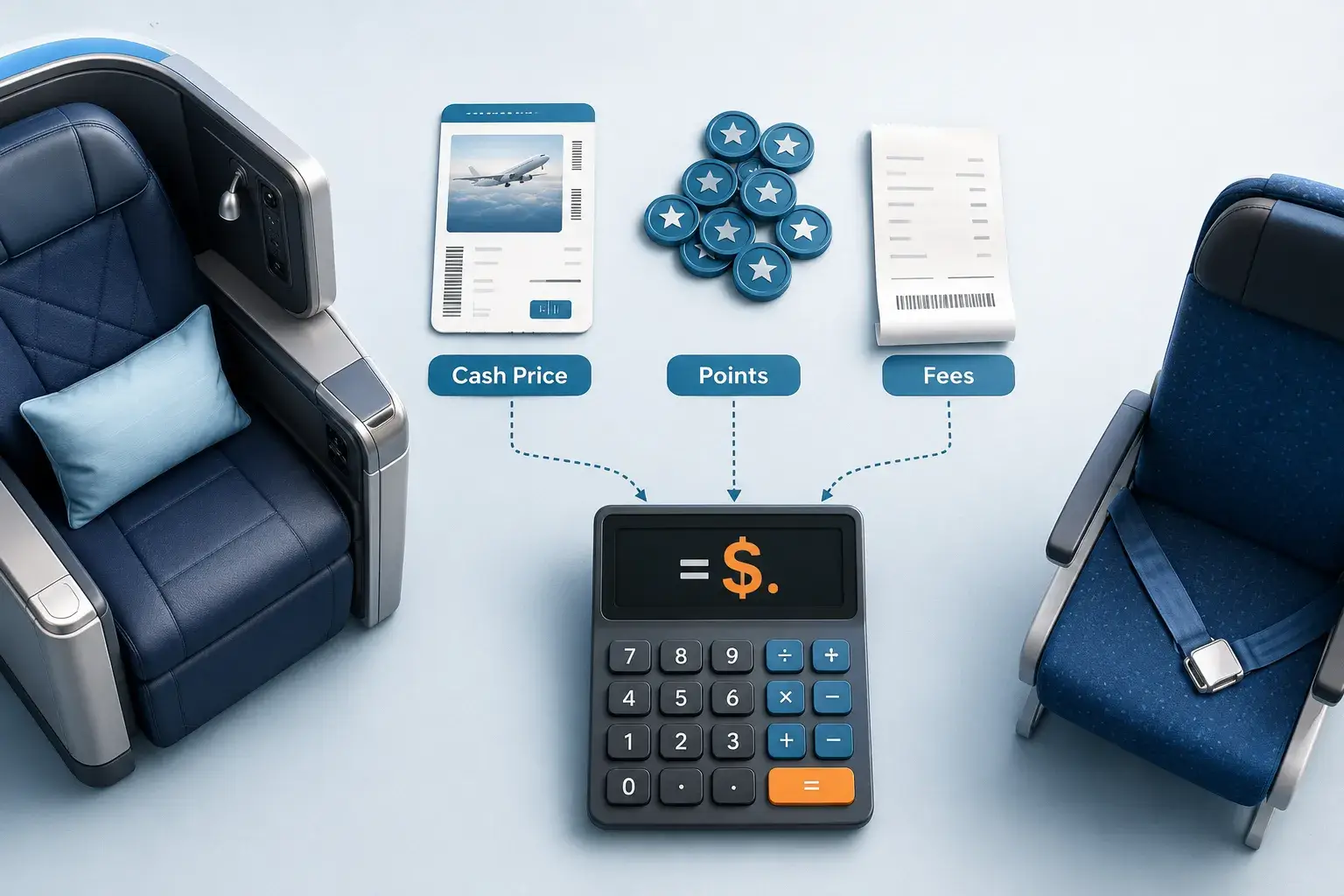
Calculate cents per point by subtracting award taxes and fees from the comparable cash price, dividing by the points required, and multiplying by 100. Use the fare or room rate that would actually have been purchased, not an inflated price that makes the redemption look better.
The formula is:
CPP = (comparable cash price − award taxes and fees) ÷ points required × 100
Real-world travel credit cards rewards examples
These examples are illustrative booking scenarios, not promises of current award availability.
Economy flight through Flying Blue
Comparable cash fare: $450
Award price: 20,000 miles
Taxes and fees: $90
Calculation: ($450 − $90) ÷ 20,000 × 100
Redemption value: 1.8 CPP
Business class through Air Canada Aeroplan
Comparable fare that the traveler would buy: $2,800
Award price: 70,000 points
Taxes and fees: $80
Calculation: ($2,800 − $80) ÷ 70,000 × 100
Redemption value: 3.89 CPP
Hotel booked with transferred Chase points
Refundable cash rate: $500
Award price: 25,000 hotel points
Resort or destination fee on award: $0
Calculation: $500 ÷ 25,000 × 100
Redemption value: 2 CPP
The business-class example produces the highest CPP, but only if the traveler values that seat near $2,800. Comparing a $7,000 flexible fare that would never have been purchased can create a misleading 9.89 CPP valuation.
Use the Award Travel Hub calculators to compare points, cash prices, taxes, transfer bonuses, and opportunity cost.
How many points do you need for a free flight?
A domestic economy flight may require roughly 5,000 to 30,000 airline miles each way, while international business class commonly requires far more. Dynamic pricing, route distance, partner award charts, demand, and award availability determine the actual amount.
A “free flight” also may include:
Government taxes
Carrier-imposed fuel surcharges
Partner booking fees
Telephone ticketing fees
Positioning flights to reach the departure gateway
Always price the complete trip. A 60,000-point business class deal can become unattractive if it requires $900 in fuel surcharges and a separate domestic ticket.
How to redeem travel points for the best value
The best use of points is the redemption that beats the available cash alternative without creating unreasonable fees or travel complications.
Use this step-by-step guide:
Find the best realistic cash fare or refundable hotel rate.
Search the operating airline and relevant alliance partners.
Confirm award space for every segment.
Check married segments, which can make a connecting itinerary available when individual legs are not.
Add taxes, fuel surcharges, positioning costs, and change fees.
Calculate CPP.
Compare the result with cash back or portal value.
Transfer only after confirming the award is bookable.
Award search tools can shorten the search, but verify space directly with the loyalty program before moving points.
Fixed-Value vs Transferable Currencies: The Ceiling Difference
Fixed-value currencies provide predictable redemptions, often around 1 to 1.5 cents per point, while transferable points can deliver more through partner airlines and hotels. The higher ceiling comes with award-search work, transfer risk, dynamic pricing, and possible devaluations.

These are planning ranges, not official values. A point has no universal valuation because travel dates, available fares, transfer partners, and personal alternatives differ.
Can you transfer credit card points to airlines?
Yes. Major transferable programs let eligible cardholders move points to airline and hotel partners, but transfer ratios and access depend on the specific card.
Issuer rules can change, and some partners use transfer ratios other than 1:1. Review the transfer screen before confirming.
Transfers are generally one-way. A delayed transfer can leave points stranded if award space disappears. For current options, compare the best credit card transfer partners.
Travel credit cards for international flights
Transferable cards are generally the strongest choice for international flights because several bank programs can access the same alliance through different partner airlines. That creates more booking options for business class deals and first class redemptions.
A practical booking strategy is to:
Search the airline operating the flight.
Check alliance partners with better award charts.
Compare fuel surcharges.
Look for transfer bonuses only after finding award space.
Consider nearby gateways and positioning flights.
Verify stopover and cancellation rules.
A 25% transfer bonus reduces a 60,000-mile award to 48,000 bank points, assuming the bonus applies and the program accepts the required transfer increment. The bonus does not make an unavailable award bookable.
What happens to unused travel rewards points, and do they expire?
Bank points usually remain active while the qualifying account stays open and in good standing. Airline miles and hotel points follow the loyalty program’s own expiration rules after transfer.
Closing the only card connected to a bank rewards account can cause unused points to be forfeited. Before closing or downgrading:
Confirm whether another card can keep the rewards account open.
Combine points with an eligible household or business account when permitted.
Review the cash-out option.
Avoid speculative airline transfers solely to prevent expiration.
Transferred points also take on the airline or hotel program’s devaluation risk. Bank points are usually more flexible until a specific booking is ready.
Category Multipliers That Actually Move the Needle
The best multipliers apply to large, recurring expenses and produce points that can be redeemed well. A narrow 5x category may matter less than reliable 3x dining, grocery, gas, or travel earnings.

Representative 2026 earning structures among major transferable-currency cards include:
American Express Gold Card: 4x at restaurants worldwide and U.S. supermarkets, subject to annual caps and issuer terms; 3x on eligible flights.
Chase Sapphire Preferred: 3x dining, eligible streaming, and online grocery; 2x on broad travel; higher rates may apply through Chase Travel.
Capital One Venture X: 2x on general purchases, with higher portal rates for eligible hotels, rental cars, and flights.
Citi Strata Premier: 3x across several common categories, including air travel, hotels, dining, supermarkets, and eligible gas or EV charging.
Bilt: Category earnings and transfer access depend on the current Bilt card and membership terms.
Issuer terms, caps, exclusions, and portal multipliers change. Confirm the current application page before choosing a card.
Best travel credit cards for 2026
There is no single best card. The right choice depends on spending categories, preferred points transfer partners, annual-fee tolerance, and whether the traveler books economy or premium cabins.
Use this decision framework:
Choose Amex for strong dining and U.S. supermarket spending when its airline partners and credits fit.
Choose Chase for simpler redemptions, useful partner airlines, and hotel-transfer opportunities.
Choose Capital One for a strong base earning rate and a mix of portal and transfer options.
Choose Citi for broad everyday bonus categories and access to its distinct partner list.
Choose Bilt when rent-related earning and its partner mix justify the program rules.
For card-level comparisons, see the best travel credit cards for 2026.
Travel credit cards with no annual fee
No-annual-fee cards can out-earn premium cards in selected categories, especially when paired with another card that enables transfers. They also preserve account age and reduce the pressure to use coupons or credits.
Examples include cards offering rotating 5% categories, 3% dining, or elevated grocery earnings. A no-fee category card can beat a premium card earning 1x on the same purchase.
The limitation is redemption access. Some no-fee cards earn cash back or require pairing with an eligible premium card before rewards can transfer to airlines or hotels. Compare the best no-annual-fee travel cards before assuming an annual fee is required.
Where High Earn Rates Get Erased by Poor Redemptions
High earning rates lose their advantage when points are redeemed below their reasonable cash or travel value. Weak portal rates, merchandise, statement credits, excessive surcharges, and speculative transfers are common causes.
A 5x purchase redeemed at 0.6 CPP yields only a 3% return. A 2x purchase redeemed at 2 CPP yields 4%.
Are travel credit card annual fees worth it?
An annual fee is worth paying when the value of rewards and benefits actually used exceeds the fee and the return available from a no-fee alternative. Face-value credits should not be counted at 100% unless they replace spending that would happen anyway.
Use this annual review:
Calculate incremental rewards over a no-fee card.
Add the realistic value of lounge access, travel insurance, free-night certificates, and other used benefits.
Discount restrictive monthly or merchant-specific credits.
Subtract the annual fee and extra spending caused by credit usage.
Keep, downgrade, or cancel based on the net figure.
A $300 credit is not worth $300 if it requires changing merchants, booking through a less competitive portal, or making purchases that were not planned.
Worst mistakes people make with travel rewards
The costliest mistakes usually involve moving points too early or valuing an award against the wrong cash price.
Common pitfalls include:
Transferring before confirming award space
Ignoring fuel surcharges and positioning flights
Using an inflated premium fare for CPP calculations
Paying annual fees for unused benefits
Carrying interest-bearing debt to earn points
Letting a transfer bonus create an unnecessary booking
Assuming every partner displays the same award space
Ignoring schedule changes and transfer delays
Hoarding points despite ongoing devaluation risk
No redemption can offset credit card interest. Rewards cards are poor tools for anyone who does not pay the statement balance in full.
Building a Two-Card Setup That Maximizes Both Sides
A practical two-card setup pairs a strong category card with a card that earns well on uncategorized spending or improves redemption access. The goal is broad coverage, useful transfer partners, and manageable annual fees.
How to maximize travel rewards points
Maximize points by directing each purchase to the card with the highest effective return, not merely the highest multiplier. Then preserve flexibility until a specific redemption is available.
A simple setup may look like this:
Card 1: Category specialist
3x or 4x on dining, groceries, gas, or travel
Transferable currency with useful partner airlines
Benefits that offset the annual fee
Card 2: Everyday-spend card
At least 1.5x to 2x on purchases outside bonus categories
No foreign transaction fee if used abroad
Same rewards ecosystem or complementary transfer partners
Two-card booking walkthrough
Assume a household spends $12,000 annually on dining and groceries, plus $18,000 on uncategorized purchases.
Category card at 4x: 48,000 points
Everyday card at 2x: 36,000 points
Total: 84,000 transferable points
At a fixed 1 CPP, the points are worth $840. At 1.5 CPP through a carefully selected transfer, the same balance produces $1,260 in travel value. A premium cabin award at a higher CPP may be possible, but only when partner award space fits the trip.
Before applying, compare travel credit card setups based on annual spending rather than welcome bonuses alone.
When a two-card setup is not for you
Use cash back or one simple travel card when:
Award searches feel too time-consuming
Travel dates and airports are fixed
Most trips involve inexpensive economy tickets
Annual fees outweigh realistic benefits
Managing category rules risks missed payments
Transfer partners do not serve planned destinations
Complexity has an opportunity cost. A smaller, reliable return is better than theoretical value that never gets redeemed.
Frequently asked questions
What is a good cents-per-point value?
At least 1 CPP is a reasonable floor for most general travel points. Transferable points can justify a higher target, but the right threshold depends on available cash fares and personal travel plans.
Is 2 CPP a realistic redemption value?
Yes, 2 CPP can be realistic for selected airline and hotel transfers. It should not be assumed for every point because award availability, dynamic pricing, and surcharges vary.
Should points be transferred during a transfer bonus?
Transfer during a bonus only when suitable award space is available and the booking is ready. Speculative transfers create devaluation and expiration risk.
Are portal bookings better than airline transfers?
Portal bookings are better for simple economy fares, broad availability, and earning airline credit. Transfers can be better for premium cabin awards or specific sweet spots.
Can credit card points be combined?
Points can often be combined between eligible cards in the same issuer ecosystem, subject to household and business-account rules. Different bank currencies generally cannot be combined directly.
Do points disappear after closing a credit card?
They can. Confirm whether another eligible card keeps the rewards account active, then combine, redeem, or transfer points before closing.
Conclusion
Travel credit cards rewards should be evaluated as a complete equation: earning rate multiplied by realistic redemption value, minus annual fees, taxes, surcharges, and booking friction. A large multiplier cannot rescue a weak redemption, and a valuable transfer partner is not useful without award space.
Start with three practical steps:
Calculate annual spending by category.
Choose one category card and one everyday-spend card with useful redemption options.
Search cash fares and partner awards before transferring any points.
The best setup is the one that earns rewards for trips you can actually book, without forcing extra spending or unnecessary complexity.


Content on Award Travel Hub is independently created by Award Travel Hub Editorial Desk and, where noted, reviewed by Award Travel Hub Review Desk. Some pages may contain affiliate links, but compensation does not determine our coverage, opinions, or methodology.