
Last Updated: July 3, 2026
Most people leave hundreds of dollars in credit card rewards on the table every year — not because they aren’t earning points, but because they don’t know how to use them. A $500 flight can cost 25,000 points one way or 60,000 points the other. That gap is the difference between a 2 cents-per-point (CPP) redemption and a 0.8 CPP one.
Credit card rewards are genuinely useful — but only when you understand the system well enough to make intentional decisions. This guide covers how rewards work, how to earn them efficiently, how to redeem them without wasting value, and how to avoid the mistakes that cost beginners the most.
Key Takeaways
Three reward types exist: cash back, fixed-value travel points, and transferable points — each with different earning potential and redemption flexibility.
Welcome offers are the fastest way to build a large points balance quickly, often worth $500–$1,000+ in travel value.
Transferable points (Amex, Chase, Capital One, Citi, Bilt) typically offer the highest ceiling — 1.5 to 2+ CPP — when transferred to airline or hotel partners.
The biggest beginner mistake is carrying a balance. Interest charges eliminate any reward value instantly.
A two-card setup — one no-annual-fee card plus one mid-tier travel card — covers most earning categories without overcomplicating your wallet.
You may be interested



What Credit Card Rewards Are and How They Work
Every time you use a rewards credit card, the card issuer pays you back a percentage of your spending in the form of points, miles, or cash back. That percentage varies by card and by spending category — typically between 1% and 5% of the purchase amount.
The mechanics are simple: spend money, earn rewards, and redeem rewards for something of value. The complexity comes from understanding what those rewards are actually worth and how to get the most out of them.
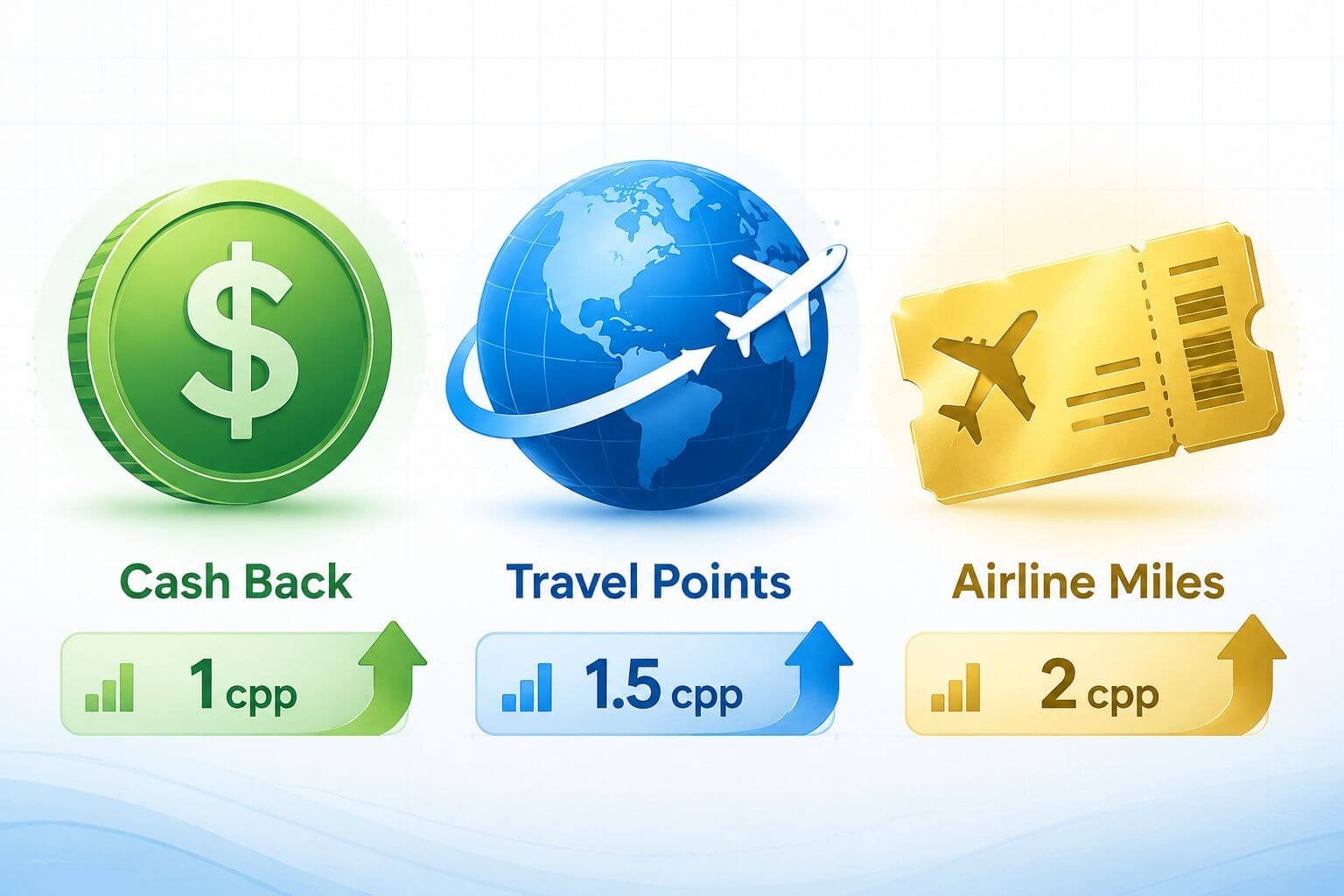
The Three Main Types: Cash Back, Travel Points, and Airline/Hotel Miles
Not all credit card rewards work the same way. Before picking a card, you need to know which type fits your goals.
1. Cash Back
Cash back cards pay a flat percentage of your spending as a cash credit to your statement or bank account. One dollar spent at 2% back returns $0.02. Simple, predictable, no expiration games.
Best for: People who want simplicity and don’t want to manage a points program.
Limitation: The ceiling is fixed. You’ll never get more than face value — typically 1 CPP.
2. Fixed-Value Travel Points
Some cards issue points redeemable at a fixed rate — usually 1 to 1.5 CPP — through the issuer’s own travel portal. Capital One miles redeemed through the Capital One travel portal, for example, are worth 1 CPP. Chase points redeemed through the Chase travel portal are worth 1.25 CPP on the Sapphire Preferred.
Best for: Beginners who want to redeem travel without managing transfer partners.
Limitation: You’re capped at the portal rate. You can’t unlock higher value through partner transfers.
3. Transferable Points (The Highest Ceiling)
Transferable points — Amex Membership Rewards, Chase Ultimate Rewards, Capital One miles, Citi ThankYou Points, and Bilt Rewards — can be moved to airline and hotel loyalty programs at set transfer ratios, usually 1:1.
Once transferred, those points can book award flights or hotel stays at rates that often exceed 1.5–2+ CPP, especially for international premium cabins.
Best for: Readers willing to learn partner programs and search for award space.
Limitation: Requires more effort. Transfer times vary (instant to 3+ days). Transfers are usually one-way and irreversible.
For a deeper look at how transferable points programs compare, see our complete guide to the best transferable points programs in 2026.
How Earning Categories and Welcome Offers Build Your First Stash
Bonus Categories
Most rewards cards pay elevated rates on specific spending categories. Common structures in 2026:
| Category | Typical Earn Rate |
| Dining | 3x–5x points |
| Groceries | 3x–4x points |
| Travel (booked through portal) | 3x–5x points |
| Gas / EV charging | 2x–3x points |
| Streaming | 2x–3x points |
| Everything else | 1x–2x points |
Matching your highest-spend categories to the right card is one of the most straightforward ways to earn more without spending more.
Welcome Offers: The Fastest Points Accelerator
Welcome offers — also called sign-up bonuses — are the single fastest way to accumulate a large points balance. A typical mid-tier card in 2026 offers 60,000–100,000 points after spending $3,000–$5,000 in the first 3 months.
At 1.5 CPP, 75,000 Chase Ultimate Rewards points are worth $1,125 in travel. That’s a significant return on a card with a $95 annual fee.
Important rules around welcome offers:
Most issuers restrict bonuses if you’ve held the same card before (Chase’s 48-month rule, Amex’s once-per-lifetime rule on some cards)
The spending requirement must be met within the stated window — usually 90 days
Manufactured spending to hit the minimum is against most card agreements and can result in reward clawbacks
For more on what can go wrong, read our guide on credit card welcome bonus clawbacks to avoid.
Redemption Options: Statement Credit, Travel, Transfer Partners
Once you have points, you have several ways to use them. The option you choose determines your actual return.
Statement Credit
Redeeming for cash back or statement credits is the simplest option, but usually the lowest value — often 0.6–1 CPP depending on the program. Avoid this unless you’re in a pinch or the card specifically values points at 1 CPP for cash redemptions.
Issuer Travel Portal
Booking through Chase Travel, Capital One Travel, or Amex Travel gives you a predictable redemption rate — typically 1–1.5 CPP. You can book any flight or hotel available on the portal, which is convenient. The trade-off: you’re capped at portal rates and, in most cases, don’t earn airline miles on the booked ticket.
Transfer Partners: Where the Value Is
Transferring points to airline or hotel programs unlocks the highest redemption potential. A 1:1 transfer of 60,000 Chase points to United MileagePlus, for example, could book a round-trip economy flight to Europe that would otherwise cost $900–$1,200 cash.
The math on a strong redemption:
Cash price of flight: $1,200
Points used: 60,000 (transferred at 1:1)
Taxes and fees paid: $56
CPP: ($1,200 − $56) ÷ 60,000 = ~1.9 CPP
That’s nearly double the portal rate. But it requires knowing which partner to use, finding award space, and understanding the program’s rules.
For a step-by-step walkthrough of using points for flights, see our complete guide to redeeming points for flights in 2026.
To understand how to calculate your own redemption value, our cents per point calculator guide walks through the math with real examples.
How to Pick Your First Rewards Credit Card
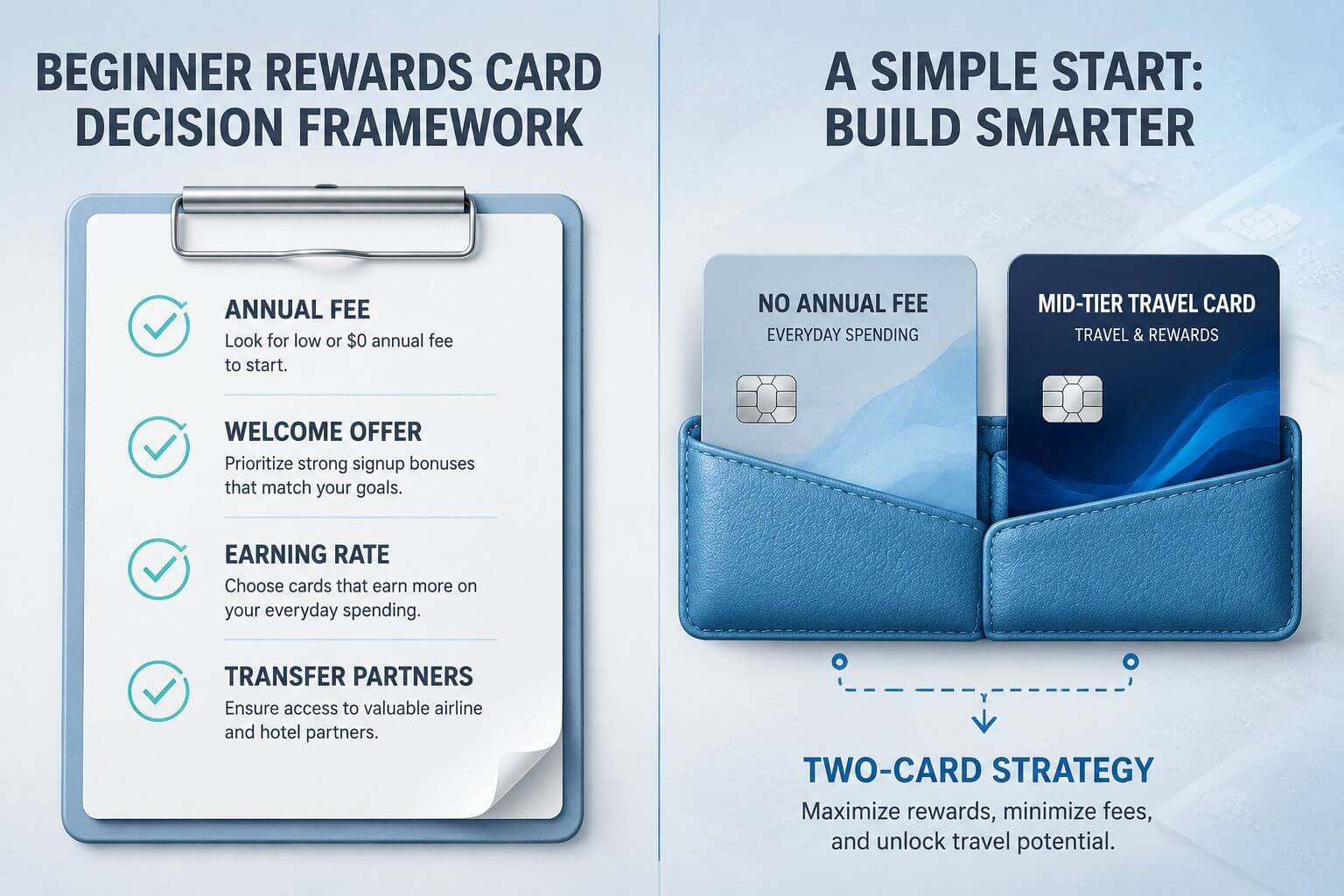
Use this decision framework before applying:
Step 1: Decide between cash back and travel rewards.
If you travel at least 1–2 times per year and are willing to learn the basics of award booking, travel rewards cards offer more upside. If you want simplicity, start with a flat-rate cash back card.
Step 2: Check your credit score.
Most mid-tier travel cards require a good to excellent credit score (700+). If you’re building credit, start with a secured card or a no-annual-fee starter card.
Step 3: Evaluate the welcome offer.
A strong welcome offer can justify a card’s annual fee for the first year. Calculate: if the bonus is worth $600 in travel and the fee is $95, you’re ahead by $505 in year one — assuming you would have spent that money anyway.
Step 4: Match categories to your spending.
Look at your last 3 months of spending. Where does most of your money go? Dining? Groceries? Gas? Pick the card that earns the most on your actual habits.
Step 5: Consider the annual fee math beyond year one.
In year two and beyond, the card needs to earn its keep through ongoing benefits — lounge access, travel credits, elevated earn rates — not just the welcome offer. Our guide on whether premium travel cards are worth it in 2026 covers this in detail.
Beginner-friendly starting points in 2026:
No annual fee + cash back: Good for building habits and credit
$95 annual fee travel card: Chase Sapphire Preferred-tier cards offer strong welcome bonuses and transferable points
No annual fee + transferable points: Bilt Rewards (earns points on rent at no fee) is a unique option for renters
See our full breakdown of best no-annual-fee travel cards for beginners and the best travel credit cards in 2026 for side-by-side comparisons.
Common Mistakes Beginners Make and How to Avoid Them
Carrying a Balance
This is the most costly mistake. A 20%+ APR on a carried balance eliminates any rewards value immediately. Rewards cards are only worth it if you pay the full statement balance every month.
Redeeming for Low-Value Options
Gift cards, merchandise, and Amazon checkout redemptions typically return 0.6–0.8 CPP. That’s a significant discount on your points’ potential value. Always compare the portal or transfer rate before redeeming.
Transferring Points Without Confirming Award Space First
Points transfers are usually irreversible. Transferring 60,000 points to an airline program and then discovering no award space exists on your route is a real risk. Always search and confirm award availability before initiating a transfer.
Ignoring Devaluation Risk
Loyalty programs can and do devalue their currencies — sometimes with little notice. Hoarding large balances in a single program for years exposes you to devaluation risk. Earn and burn at a reasonable pace rather than stockpiling indefinitely. Our guide on dynamic award pricing and devaluation explains how to protect your balances.
Applying for Too Many Cards Too Quickly
Multiple hard inquiries in a short window can temporarily lower your credit score and trigger issuer restrictions (Chase’s 5/24 rule, for example). Space out applications and prioritize cards that fit your current strategy.
For a full list of common errors, see mistakes to avoid when using travel credit cards.
Building a Two-Card Strategy for Maximum Value
One card rarely covers all categories efficiently. A simple two-card setup solves most of the gap
This structure ensures you’re never earning just 1x on any significant purchase. The primary card handles your bonus categories; the catch-all handles everything else.
As your strategy matures, you can add a third card for a specific category — a grocery card, a hotel co-brand, or an airline card — but two cards is the right starting point for most beginners.
One important note: Each card you hold should have a clear, justifiable role. If you can’t explain why a card is in your wallet, it probably shouldn’t be. If a card stops earning its keep, consider a product change rather than cancellation to preserve your credit history.
FAQ: Credit Score, Annual Fees, and When Rewards Aren’t Worth It
Will applying for a rewards card hurt my credit score?
A hard inquiry typically drops your score by 5–10 points temporarily. The impact fades within 6–12 months. Opening a new account also increases your total available credit, which can improve your credit utilization ratio over time. See our credit utilization guide for more detail.
Are annual fees worth it?
In year one, almost always — if the welcome offer exceeds the fee. In subsequent years, it depends on whether you use the card’s ongoing benefits. A $95 fee card that earns you $200 in annual travel credits and 3x on dining is worth it. A $550 premium card where you only use one benefit is probably not.
What if I don’t travel much?
Cash back is the right choice. Transferable points require some travel engagement to unlock their full value. If you fly once a year domestically, the complexity of managing transfer partners isn’t worth the marginal upside.
Can I earn rewards on rent?
Yes — Bilt Rewards allows points earning on rent payments with no transaction fee, which is unusual. For renters, this is one of the most efficient ways to earn transferable points on a large monthly expense that most cards don’t cover.
When should I transfer points to an airline or hotel?
Only when you have a specific redemption in mind and have confirmed award availability. Speculative transfers — moving points “just in case” — lock your currency in a less flexible program and expose you to devaluation risk.
Conclusion: Start Simple, Then Build
Credit card rewards work best when the strategy matches your actual spending and travel habits. Start with one card that earns well on your biggest categories and has a strong welcome offer. Pay the balance in full every month. Then learn the redemption options — portal first, transfer partners second — before adding complexity.
The gap between a beginner who earns 1 CPP on everything and an informed user who earns 2+ CPP on strategic redemptions is real, but it’s not complicated to close. It just requires making intentional decisions at each step.
Practical next steps:
Identify your top two spending categories from the last 90 days
Compare cards that earn 3x or more on those categories — see our best travel credit cards comparison
Calculate whether the welcome offer justifies the annual fee using the CPP framework
Before your first redemption, read our guide to redeeming points for flights
If you’re ready to explore transfer partners, start with our best use of 100,000 points guide
The system rewards people who understand it. This guide is your starting point.


Content on Award Travel Hub is independently created by Award Travel Hub Editorial Desk and, where noted, reviewed by Award Travel Hub Review Desk. Some pages may contain affiliate links, but compensation does not determine our coverage, opinions, or methodology.