

Last updated: August 15, 2026
Quick Answer: Delta Air Lines credit cards are co-branded American Express cards that earn SkyMiles, provide a free first checked bag, and — on the mid-tier and premium cards — contribute Medallion Qualifying Dollars (MQDs) toward elite status. The right card depends on how often you fly Delta, how much you spend annually, and whether the annual fee is offset by perks you’ll actually use.
Key Takeaways
- There are four Delta SkyMiles Amex cards: Blue Delta SkyMiles (no annual fee), Gold ($150/year), Platinum ($350/year), and Reserve ($650/year).
- Free first checked bag is available on all paid cards (Gold, Platinum, Reserve) and saves $35 per bag per direction on most domestic routes.
- The Platinum and Reserve cards earn MQDs from card spend, which count toward Silver, Gold, Platinum, or Diamond Medallion status.
- The Reserve card includes Delta Sky Club lounge access and a companion certificate valid in First Class.
- Welcome offers vary by card and timing — always compare current public offers against targeted or referral offers before applying.
- Delta SkyMiles are not transferable to other airline programs, which limits their flexibility compared to transferable points currencies like Amex Membership Rewards.
- Frequent Delta flyers who check bags and travel at least four to six times per year will likely offset the Gold card’s annual fee easily. The Platinum and Reserve require more spend and travel to break even.
- None of the Delta cards charge foreign transaction fees.
Why Get a Delta Airline Credit Card?
The primary case for a Delta airline credit card is straightforward: if Delta is your main carrier, the card’s perks align directly with costs you’re already paying. A free first checked bag alone is worth $70 round-trip per person. For a traveler checking bags on four round trips per year, that’s $280 in savings — enough to cover the Gold card’s $150 annual fee with room to spare.
Beyond bag savings, the cards offer priority boarding, in-flight discounts, and a path toward Medallion status that doesn’t require additional flying. The Platinum and Reserve cards earn MQDs from everyday card spend, which is the most significant structural change Delta made to its loyalty program in recent years.
That said, Delta SkyMiles have real limitations. They don’t transfer to partner programs, Delta uses dynamic award pricing (no fixed award chart), and upgrade availability for Medallion members has become more competitive as more travelers earn status through card spend. These tradeoffs matter and should factor into any decision.
For a broader view of how Delta SkyMiles fits into a transferable points strategy, see the Delta SkyMiles Transfer Partners Guide.
The Delta SkyMiles Amex Lineup at a Glance
Four cards make up the Delta SkyMiles American Express family in 2026. Here’s how they compare at a high level:
| Card | Annual Fee | Free Checked Bag | MQDs from Spend | Lounge Access |
|---|---|---|---|---|
| Blue Delta SkyMiles | $0 | No | No | No |
| Delta SkyMiles Gold | $150 | Yes (primary + 8 companions) | No | No |
| Delta SkyMiles Platinum | $350 | Yes (primary + 8 companions) | Yes ($1 MQD per $20 spent) | No |
| Delta SkyMiles Reserve | $650 | Yes (primary + 8 companions) | Yes ($1 MQD per $10 spent) | Yes (Sky Club) |
Note on MQD earn rates: The Platinum earns MQDs at $1 per $20 in card spend; the Reserve earns at the faster rate of $1 per $10 spent. Delta’s program rules confirm that MQDs from card spend are an accelerator toward Medallion status, not a standalone qualification path — you still need to meet the annual MQD threshold through a combination of flying and card spend.
You may be interested



American Express confirmed in its June 2026 card comparison that the Reserve is positioned for travelers who want to advance toward Medallion status faster, while the Platinum targets frequent Delta flyers who want a lower fee with status-building capability.
Key Perks: Free Checked Bags and Priority Boarding
The free first checked bag benefit is the most universally valuable perk across the paid Delta cards. It applies to the primary cardholder and up to eight companions on the same reservation — a meaningful benefit for families or groups traveling together.
How the bag benefit works in practice:
- The benefit applies on Delta-marketed and Delta-operated flights.
- You must pay for your ticket with the Delta card or have your SkyMiles number on the reservation.
- It covers the first checked bag only. Additional bags are still charged at standard rates.
- At $35 per bag each way on most domestic routes, a family of four checking bags saves $280 on a single round trip.
Priority boarding (Zone 5 on most Delta flights) is included on the Gold, Platinum, and Reserve cards. It’s a modest perk — you board before general boarding but after First Class, Comfort+, and Medallion members — but it helps with overhead bin space on full flights.
The Reserve card adds Sky Club lounge access, which is the most significant premium perk. Access is limited to the cardholder (guests cost extra or require a higher-tier membership). If you regularly use Sky Club lounges, this benefit alone can justify a significant portion of the $650 annual fee, given that standalone Sky Club memberships cost considerably more.
Earning SkyMiles and MQDs Toward Status
Delta airline credit cards earn SkyMiles on all purchases, with bonus multipliers on Delta purchases and select categories. The earning structure across cards in 2026:
- Blue: 2x on Delta purchases, 2x on dining and U.S. supermarkets, 1x on everything else
- Gold: 2x on Delta purchases, 2x on dining and U.S. supermarkets, 1x on everything else
- Platinum: 3x on Delta purchases, 3x on hotels booked directly, 2x on dining and U.S. supermarkets, 1x on everything else
- Reserve: 3x on Delta purchases, 1x on everything else
The MQD path to Medallion status is where the Platinum and Reserve cards differentiate themselves. Delta’s 2026 Medallion thresholds remain unchanged from prior years: Silver requires 5,000 MQDs, Gold requires 10,000, Platinum requires 15,000, and Diamond requires 25,000 — all earned within the calendar year.
Card spend contributes:
- Platinum card: $100,000 in annual spend = 5,000 MQDs (Silver threshold)
- Reserve card: $50,000 in annual spend = 5,000 MQDs (Silver threshold)
For most cardholders, card-spend MQDs supplement flying rather than replace it. Delta also awards $1 MQD per $1 spent on eligible ticket price for qualifying Delta-marketed flights, and Delta Vacations packages earn $1 MQD per $1 of total package price — sometimes making a vacation booking a faster path to status than everyday card spend.
For a deeper look at building status without relying solely on flights, see the guide on earning airline elite status without flying.
Annual Fees vs. Benefits by Card

The core question for any co-branded card is whether the annual fee is worth it given your actual travel habits. Here’s a practical breakdown:
Delta SkyMiles Gold ($150/year)
Worth it if: You check bags on at least two or three round trips per year and fly Delta regularly.
- Two round trips with one checked bag each = $140 in bag savings, nearly covering the fee.
- The $200 Delta flight credit (available after spending $10,000 in a calendar year) can tip the math further in your favor.
- No MQD earn from card spend, so this card doesn’t help with status.
Not worth it if: You fly Delta fewer than twice a year, always travel carry-on only, or already have Medallion status (which includes free bags).
Delta SkyMiles Platinum ($350/year)
Worth it if: You fly Delta four or more times per year, check bags, and want to build toward Silver or Gold Medallion status through card spend.
- Includes a domestic companion certificate each year (valid in Main Cabin), which can offset a significant portion of the fee if used.
- The faster MQD earn rate makes this the better status-building card for travelers who don’t want to pay the Reserve’s $650 fee.
Not worth it if: You can’t use the companion certificate, don’t value status, or spend less than $15,000–$20,000 per year on the card.
Delta SkyMiles Reserve ($650/year)
Worth it if: You use Sky Club lounges regularly, want the fastest MQD earn rate from card spend, and can use the companion certificate (valid in First Class).
- Sky Club access alone is worth $50–$75 per visit for frequent travelers.
- The Reserve earns MQDs at twice the rate of the Platinum, so high spenders ($50,000+/year) reach Silver status faster.
Not worth it if: You don’t use Sky Club lounges, rarely fly First Class, or can’t justify $650 in annual fees based on actual usage.
For a broader framework on evaluating whether any airline card’s annual fee makes sense, the annual fee review guide for 2026 is a useful reference.
Who Each Delta Card Is Best For
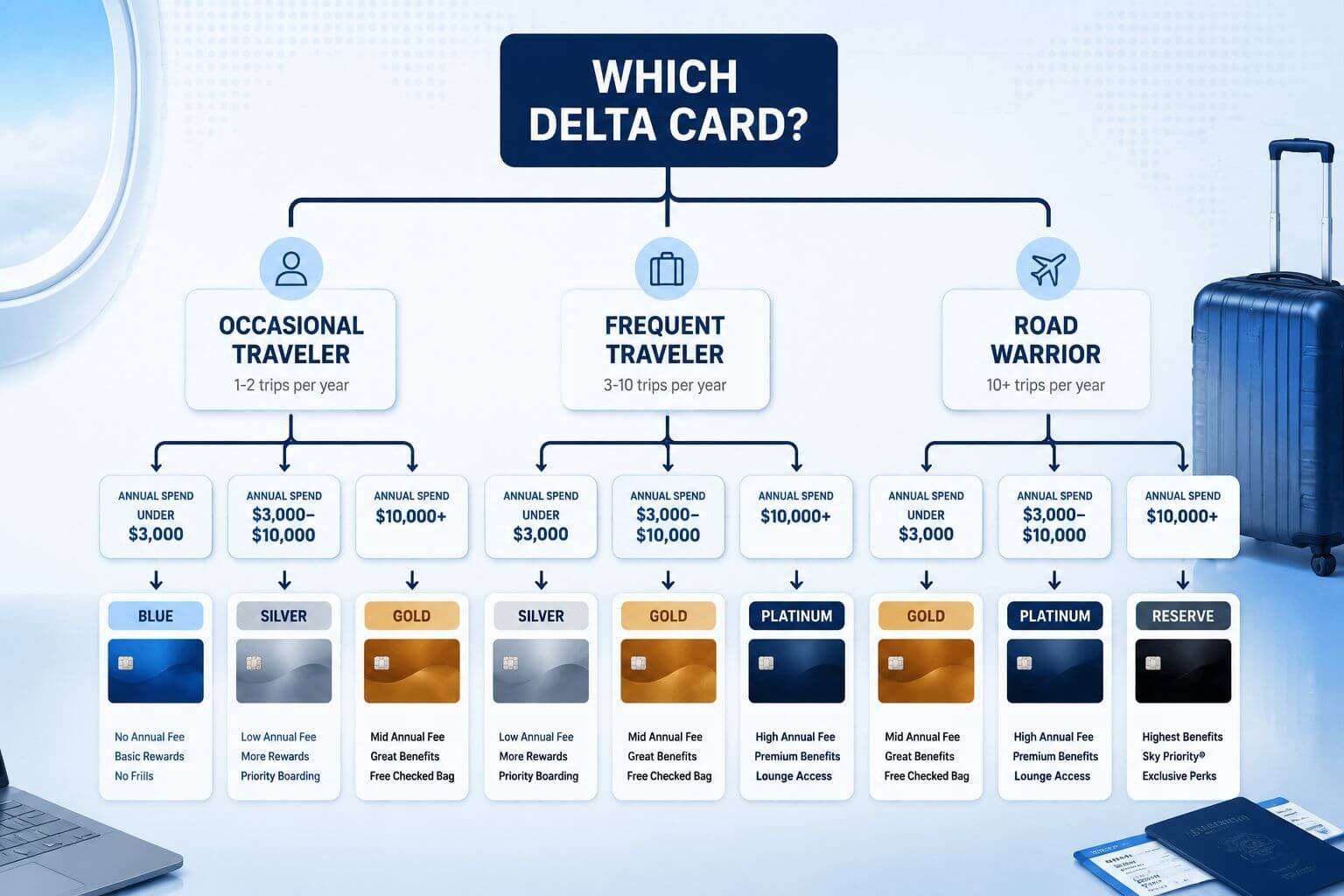
Best for occasional Delta flyers: Delta SkyMiles Gold. The free bag benefit and priority boarding cover the fee for most travelers who check luggage. It’s a straightforward value proposition without requiring high spend or frequent flying.
Best for frequent Delta flyers building status: Delta SkyMiles Platinum. The combination of MQD earn from spend, a companion certificate, and a lower fee than the Reserve makes it the practical middle ground for travelers flying Delta six or more times per year.
Best for road warriors and lounge users: Delta SkyMiles Reserve. The Sky Club access, First Class companion certificate, and fastest MQD earn rate make this the right card for travelers who are already spending heavily on Delta and want to accelerate toward Gold or Platinum Medallion.
Best for infrequent travelers or those testing Delta loyalty: Delta SkyMiles Blue (no annual fee). Earns SkyMiles with no cost, but provides no bag benefit or status path. Better than nothing for casual Delta flyers, but a general travel card with transferable points will almost always outperform it for non-Delta spend.
Who should not get a Delta credit card:
- Travelers who fly multiple airlines and don’t have a strong Delta preference. A card earning transferable Amex Membership Rewards points — which can transfer to Delta and 20+ other partners — offers more flexibility. See the best travel credit cards for 2026 for alternatives.
- Travelers who already have Medallion status, which includes free bags, making the Gold card’s primary value proposition redundant.
- Anyone who primarily flies internationally on partner airlines. Delta SkyMiles can’t be transferred to SkyTeam partners for bookings, limiting redemption options compared to programs like Amex Membership Rewards.
- Travelers focused on maximizing cents per point on premium cabin redemptions. Delta’s dynamic pricing means award costs fluctuate, and the program lacks the fixed sweet spots found in programs like Air France/KLM Flying Blue or Virgin Atlantic Flying Club, both of which are Amex transfer partners.
For travelers considering a no-annual-fee alternative, the best airline credit cards with no annual fee covers options worth comparing.
How to Apply and Maximize the Welcome Offer
Application requirements: Delta SkyMiles Amex cards are issued by American Express and generally require good to excellent credit — typically a FICO score of 670 or higher, with better approval odds above 700. American Express also has its own application rules, including limits on how many cards you can hold and eligibility restrictions on welcome bonuses (if you’ve held the same card before, you may not qualify for the welcome offer again).
Before applying, check your credit profile. If you’re concerned about how a new application affects your score, the guide on credit inquiries and your score explains what to expect.
Welcome offer strategy:
Welcome offers on Delta cards typically range from 40,000 to 90,000 SkyMiles depending on the card tier and current promotions, often with a minimum spend requirement of $2,000–$5,000 in the first three to six months.
A few practical rules:
- Always check for targeted offers (via email or the Amex pre-qualification tool) before applying through a public link. Targeted offers are sometimes higher.
- Compare the welcome offer value against the first-year annual fee. A 60,000-mile offer on the Platinum card at a conservative valuation of 1.1 to 1.2 cents per mile is worth approximately $660–$720 in flights, which more than covers the $350 fee in year one.
- Don’t apply for multiple Amex cards within a short window. Amex limits approvals and welcome bonus eligibility based on card history.
- Meet the minimum spend requirement naturally. Avoid manufactured spend or paying bills that add fees — the math rarely works out. For more on this, see the guide on avoiding welcome bonus clawbacks.
Maximizing ongoing card value:
- Use the card for all Delta purchases to capture the 2x or 3x bonus multiplier.
- Register for and use the companion certificate before it expires (typically issued on your card anniversary).
- Track your MQD progress in your SkyMiles account if you’re targeting Medallion status.
- Reassess the card’s value each year before the annual fee posts. If your travel patterns have changed, a downgrade to a lower-tier card may be the right move. The credit card downgrade guide explains how to do this without losing your SkyMiles balance.
Frequently Asked Questions
What credit score do you need for a Delta airline credit card? American Express generally approves Delta SkyMiles cards for applicants with good to excellent credit, typically a FICO score of 670 or above. Higher scores (700+) improve approval odds and may result in a higher credit limit. There’s no published minimum, and Amex considers income and existing card relationships as well.
Does the Delta credit card charge foreign transaction fees? No. All four Delta SkyMiles Amex cards — Blue, Gold, Platinum, and Reserve — have no foreign transaction fees, making them reasonable options for international travel.
Can you use Delta SkyMiles earned from the credit card for non-Delta flights? Delta SkyMiles can be used on Delta-operated and Delta-marketed flights, as well as on some SkyTeam partner airlines booked through delta.com. However, SkyMiles cannot be transferred to other airline programs. This is a meaningful limitation compared to transferable points currencies like Amex Membership Rewards, which can be sent to Delta and 20+ other partners. If flexibility matters, a card earning transferable points is worth considering alongside or instead of a Delta co-branded card.
Is the Delta credit card annual fee waived in the first year? American Express does not currently waive the annual fee for the first year on Delta SkyMiles cards. The fee is charged when the account opens. However, the welcome offer is typically large enough to offset the first-year cost when redeemed at reasonable value.
How much do you need to spend to make the Delta Gold card worth it? The Gold card’s $150 annual fee is offset primarily by the free checked bag benefit. If you check one bag on two round trips per year ($35 x 4 = $140), you’re nearly at breakeven before earning any SkyMiles. Travelers who check bags on three or more round trips annually will come out ahead. The $200 Delta flight credit (triggered by $10,000 in annual spend) adds further value for moderate spenders.
What happens if your Delta credit card is lost or stolen? Call the number on the back of your card or American Express’s 24-hour customer service line immediately to report the card lost or stolen. Amex will cancel the compromised card and issue a replacement, typically within a few business days. Your SkyMiles balance is tied to your Delta SkyMiles account, not the physical card, so miles are not at risk. Review recent transactions for unauthorized charges and dispute any fraudulent activity through Amex’s online portal or by phone.
Is the Delta Reserve card worth $650 per year? The Reserve justifies its fee for travelers who use Sky Club lounges at least eight to ten times per year, can use the First Class companion certificate, and spend enough on the card to meaningfully build MQDs. For travelers who don’t use lounges or fly First Class, the Platinum card at $350 offers a better fee-to-benefit ratio. American Express’s own June 2026 comparison frames the Reserve as the card for travelers who want faster status progress and premium lounge access — not a general-purpose upgrade.
Conclusion
The Delta SkyMiles Amex lineup covers a wide range of traveler profiles, from the occasional flyer who just wants a free bag to the road warrior building toward Diamond Medallion. The key is matching the card to actual travel habits rather than aspirational ones.
Practical next steps:
- Estimate how many times per year you fly Delta and whether you check bags. If the bag savings cover the fee, the Gold card is a low-risk starting point.
- If you’re targeting Medallion status, calculate how much card spend you’d realistically generate and whether the Platinum or Reserve’s MQD earn rate moves the needle for you.
- Compare the current welcome offer against the first-year annual fee before applying. If the offer doesn’t clear that bar, wait for a better promotion.
- If you’re not a committed Delta flyer, consider whether a card earning transferable Amex Membership Rewards points — which can transfer to Delta and many other programs — gives you more flexibility for the same or lower annual fee.
For a side-by-side look at how Delta cards compare to other airline co-branded options, see the best airline credit cards comparison for 2026.
References
- Delta Air Lines. “Medallion Status Overview 2026.” delta.com. Accessed June 2026.
- Delta Air Lines. “Status Match Challenge 2026.” delta.com. Accessed June 2026.
- American Express. “Delta Reserve vs. Delta Platinum Card Comparison.” americanexpress.com. Updated June 4, 2026.
- American Express. “Delta SkyMiles Card Annual Fee and Benefits Disclosure.” americanexpress.com. Accessed June 2026.


Content on Award Travel Hub is independently created by Award Travel Hub Editorial Desk and, where noted, reviewed by Award Travel Hub Review Desk. Some pages may contain affiliate links, but compensation does not determine our coverage, opinions, or methodology.