
Last updated: June 11, 2026
Quick Answer: American Airlines is the most accessible U.S. airline for earning elite status without flying in 2026, because its Loyalty Points (LP) system counts all co-branded card spend, hotel portal bookings, dining, and shopping toward status thresholds—with no flight requirement. Delta and United offer partial credit-card paths but still require some flying or spending minimums that are harder to clear without butt-in-seat activity. For most intermediate travelers, a combination of AA co-branded cards plus strategic hotel portal bookings is the most realistic no-fly route to Gold or even Platinum Pro status.
Key Takeaways
- AA Gold (40,000 LP) is reachable with ~$40,000 in co-branded card spend alone, no flights needed.
- Hotel portals like AAdvantage Hotels can generate 5,000–25,000+ bonus LP per stay when stacked with promotions and card multipliers.
- Delta requires holding up to four premium Amex cards (total annual fees ~$1,500+) to earn 10,000 MQDs toward Gold without flying.
- United’s path is the most flight-dependent; credit cards contribute PQP but can’t fully replace flight activity for most tiers.
- Alaska’s Atmos Rewards program now awards status points for partner spending (Lyft, shopping portals), but caps non-flight earnings at modest levels.
- The honest math often favors buying premium economy or business class tickets over spending $40K+ on cards and portals purely for status—unless that spend is organic.
- Upgrade queue dilution is a real concern: forum communities report growing skepticism about non-flying elites competing for the same complimentary upgrades.
- Status matches and challenges (United’s 120-day match, Alaska’s 90-day challenge) can supplement a spend-based strategy if you fly even a handful of segments.
Which Airline Programs Actually Let You Earn Elite Status Without Flying?
American Airlines is the only major U.S. carrier in 2026 where you can reach meaningful elite status entirely through non-flight spending. Delta and United offer partial credit-card shortcuts, and Alaska’s newer Atmos Rewards program has limited non-flight earning. Here’s how they compare:
| Program | Can You Hit Status With Zero Flights? | Primary Non-Flight Mechanism | Lowest Tier Threshold | Annual Card Fees Required |
|---|---|---|---|---|
| AA AAdvantage | Yes, fully | Loyalty Points from cards, portals, dining, shopping | Gold: 40,000 LP | ~$99–$450 (1–2 cards) |
| Delta SkyMiles | Technically yes (Gold) | MQD waiver via 4 premium Amex cards | Gold: 10,000 MQDs | ~$1,500+ (4 cards) |
| United MileagePlus | Very difficult | PQP from card spend (up to 1,000/yr per card) | Silver: 4,000 PQP + 12 PQF | ~$99–$525 |
| Alaska Atmos | No (caps too low) | Status points from partners (Lyft, shopping) | Silver: 20,000 status points | Varies |
AA’s Loyalty Points framework is the clear winner because every dollar spent on co-branded cards earns 1 LP, sign-up bonuses count, and portal/dining activity stacks on top—all without setting foot on a plane.
Delta’s path works mathematically but requires holding the Amex Platinum, Delta Reserve, Delta Platinum, and Delta Gold cards simultaneously, generating a combined 10,000 MQD head start that clears Gold. The ~$1,500 in annual fees make this expensive for status alone.
United is the toughest. Credit cards contribute modest PQP (typically capped at 1,000 per card per year), and most tiers require PQFs (qualifying flights) that can’t be earned through spend. United’s January 2026 status match relaunch is more practical for non-flyers who hold status elsewhere.
For a deeper look at Alaska’s non-flight earning paths, see ATH’s Alaska Atmos Rewards guide.
How to Stack Portals, Hotels, and Credit Cards for Elite Status
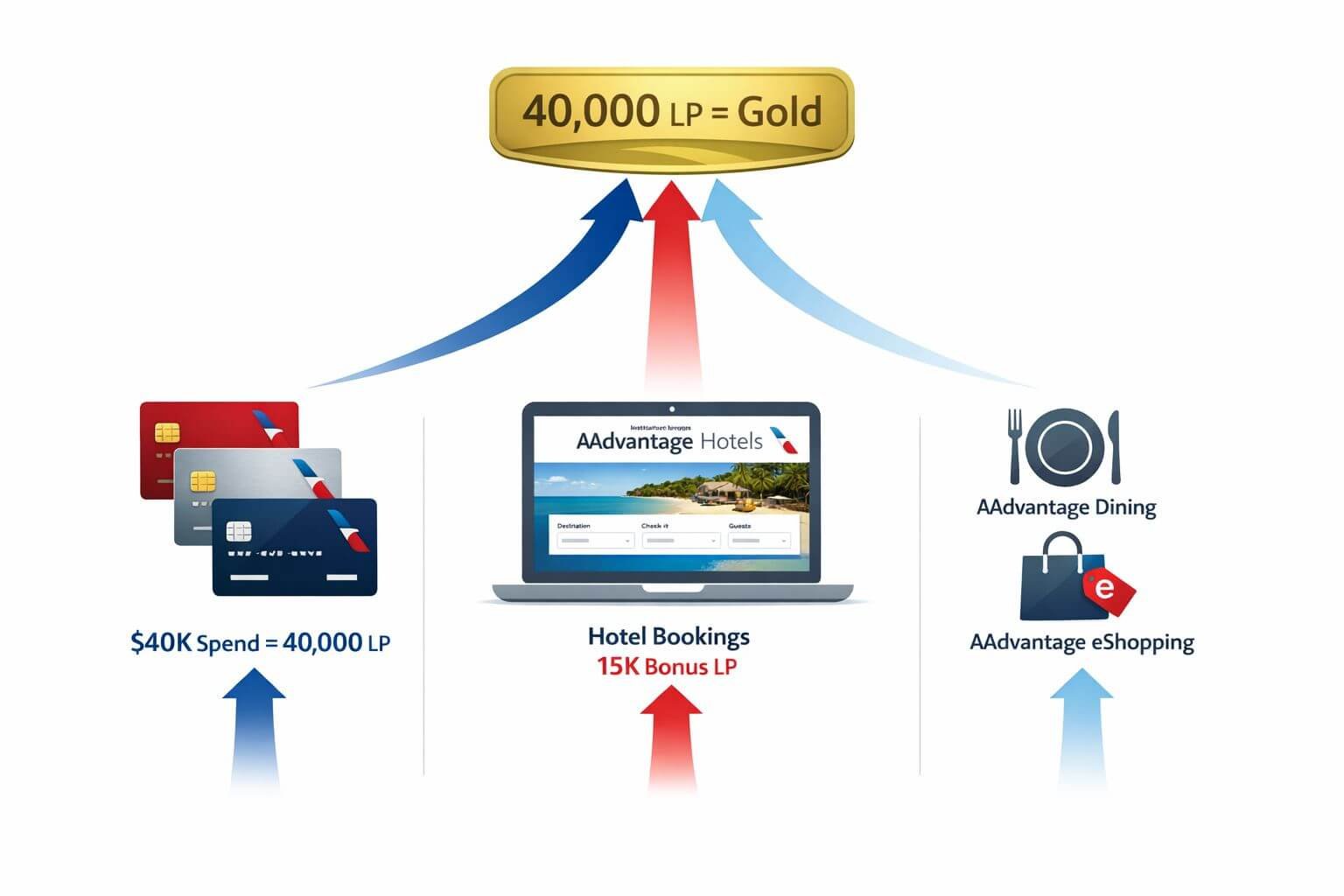
The core strategy is layering multiple LP-earning channels so that each dollar of spending counts two or three times toward status. Here’s the stacking framework, focused on AA:
Step 1: Choose the Right Co-Branded Card(s)
The Citi / AAdvantage Executive World Elite Mastercard is the anchor. It earns 1 LP per dollar on all purchases, plus bonus LP at spending milestones:
- 10,000 bonus LP at $50,000 annual spend
- 20,000 bonus LP at $90,000 annual spend
You may be interested



The Citi / AAdvantage Platinum Select is a lower-fee alternative (1 LP per dollar, with smaller milestone bonuses). Holding both cards accelerates earning.
Decision rule: If your organic annual spend exceeds $50,000 across all categories, the Executive card alone can carry you to Gold. Below $40,000 in spend, you’ll need portal and dining activity to close the gap.
Step 2: Route Hotel Bookings Through AAdvantage Hotels
AAdvantage Hotels (powered by Rocket Travel) awards bonus AAdvantage miles and Loyalty Points for bookings made through the portal. Rates vary by property, but typical earnings range from 3 to 15 miles per dollar, with periodic promotions offering 5,000–25,000 bonus miles per stay.
Key detail: Miles earned through AAdvantage Hotels count as Loyalty Points. A $300/night hotel booked for four nights at 10x through the portal generates 12,000 LP from a single trip—equivalent to 30% of Gold status.
Common mistake: Booking through the hotel’s direct site or a general OTA instead of the airline portal. Those bookings earn hotel loyalty points but zero airline LP.
For strategies on earning hotel status alongside airline status, check ATH’s guide to hotel status shortcuts.
Step 3: Add Dining and Shopping Portals
- AAdvantage Dining: Earn 3–5 miles (and LP) per dollar at enrolled restaurants.
- AAdvantage eShopping: Earn 1–15 miles per dollar at hundreds of online retailers.
These won’t single-handedly earn status, but $5,000–$10,000 in annual dining and shopping through these portals adds 5,000–15,000 LP to the total.
Step 4: Capture Sign-Up Bonuses
New co-branded card sign-up bonuses count as Loyalty Points. A 60,000-mile welcome bonus on a Citi/AAdvantage card contributes 60,000 LP—enough for Gold plus a head start on Platinum.
Edge case: Sign-up bonuses are one-time events. This strategy works best in year one; subsequent years require sustained spend or portal activity.
Two Realistic “No-Fly” Status Blueprints for American Airlines
Blueprint A: Gold Status (40,000 LP) — The Moderate Spender
| Channel | Annual Spend/Activity | LP Earned |
|---|---|---|
| Citi/AAdvantage Executive card (all spend) | $35,000 | 35,000 |
| AAdvantage Hotels (2 trips, ~$2,500 total at 8x avg) | $2,500 | ~5,000 |
| AAdvantage Dining ($200/month) | $2,400 | ~3,600 |
| Total | ~$40,000 | ~43,600 LP |
Effective cost: The Executive card annual fee is $450. Assuming the spend is organic (money you’d spend anyway), the incremental cost of Gold status is roughly $450 in card fees plus any rate premium on portal hotel bookings vs. direct rates (typically 0–10%).
What Gold gets you: Priority check-in, complimentary Main Cabin Extra on domestic flights, oneworld Ruby status (priority boarding on partner airlines), and—critically—a position in the complimentary upgrade queue on AA domestic flights.
Blueprint B: Platinum Pro (125,000 LP) — The Heavy Spender
| Channel | Annual Spend/Activity | LP Earned |
|---|---|---|
| Citi/AAdvantage Executive card | $90,000 | 90,000 + 20,000 milestone bonus |
| AAdvantage Hotels (4 trips, ~$5,000 total at 10x avg) | $5,000 | ~10,000 |
| AAdvantage eShopping + Dining | $6,000 | ~8,000 |
| Total | ~$101,000 | ~128,000 LP |
Effective cost: $450 card fee. But this requires $90,000+ in organic card spend, which limits the audience to business owners or those who can route significant expenses through a personal card.
What Platinum Pro adds over Gold: Complimentary upgrades to first class (domestic), oneworld Sapphire (lounge access on international itineraries), 4 Admirals Club one-day passes, and higher upgrade priority.
Honest assessment: Platinum Pro via spend alone demands roughly $100,000 in annual card charges. For most individuals, this only makes sense if the spending is genuinely organic. Manufacturing $100K in spend purely for status is not a sound financial decision.
For context on how transferable points from these cards can be used to fund Business Class bookings, see ATH’s dedicated guide.
Hybrid Strategies With Other Major U.S. Carriers
Delta SkyMiles Gold via Amex Cards
Delta Gold requires 10,000 MQDs (or 12 MQSs + 6,000 MQDs). Holding four Delta/Amex cards provides a combined 10,000 MQD head start, technically clearing Gold with zero flights.
The math:
| Card | Annual Fee | MQD Boost |
|---|---|---|
| Amex Platinum (Delta benefit) | $695 | 4,000 |
| Delta Reserve | $650 | 4,000 |
| Delta Platinum | $350 | 1,000 |
| Delta Gold | $150 | 1,000 |
| Total | $1,845 | 10,000 MQDs |
Is it worth it? At $1,845 in annual fees for Gold status (no Medallion upgrades to first class until Platinum or higher, limited lounge access), this is a poor ROI for status alone. It only makes sense if you’d hold these cards anyway for their other benefits (companion certificates, Sky Club access via Reserve, Amex Platinum perks).
For a broader comparison of whether premium card fees justify themselves, see ATH’s points vs. cash back analysis.
United MileagePlus: Status Match as the Best Non-Flight Path
United relaunched status matching in January 2026, offering elite members of competitors a 120-day trial at an equivalent United tier. The match can be extended by completing a modest flying challenge (e.g., 5 PQFs + 1,700 PQP for Silver).
Best for: Travelers who earn AA Gold via spend (Blueprint A above) and then status-match to United Silver for a 120-day trial, covering a specific travel period without committing to United long-term.
Not for: Anyone expecting permanent United status without flights. The challenge requirements, while modest, still demand butt-in-seat activity.
When Elite Status via Spend Beats Just Buying Better Seats

This is the question most status chasers avoid asking: Would you be better off skipping the status game entirely and simply purchasing premium economy or business class tickets when comfort matters?
The ROI Comparison
Consider a traveler who flies 8 domestic round trips per year on AA:
Option A: Chase Gold status via $40K spend (Blueprint A)
- Cost: $450 annual fee + time managing portals
- Benefit: Complimentary Main Cabin Extra seats, upgrade queue position (upgrades clear ~30–50% of the time on competitive routes, less on hubs)
- Estimated value: ~$1,200–$2,000/year in upgrades and seat improvements (highly variable)
Option B: Buy premium economy/Main Cabin Extra outright
- Cost: ~$50–$80 per segment upgrade = $800–$1,280/year for 8 round trips
- Benefit: Guaranteed better seat on every flight, no status dependency
Verdict: If your card spend is organic and you’d pay the annual fee regardless, Gold status is essentially free and the upgrade queue access is pure upside. But if you’re manufacturing spend or routing purchases through inconvenient portals solely for status, buying better seats directly is often cheaper and more reliable.
When Status Is Clearly Worth It
- International travel on oneworld partners: Gold gives Ruby status; Platinum Pro gives Sapphire with lounge access. If you fly internationally 2+ times per year on BA, Qantas, or Cathay, the lounge access alone can be worth $200+ per trip. See ATH’s airline alliances guide for partner benefits by tier.
- Business owners with $50K+ in organic spend: Card fees are negligible relative to spend, and status is a byproduct.
- Travelers combining status with aspirational award bookings: Elite status improves the experience on positioning flights and domestic connections.
When Status Is Not Worth Chasing
- Fewer than 4 round trips per year: The upgrade opportunities are too infrequent to justify the effort.
- Flying primarily on routes with low upgrade clearance rates (e.g., JFK–LAX, DFW–MIA): Status won’t help much when every seat is contested.
- Non-organic spend required: If you need to shift spending patterns significantly, the opportunity cost (lost Amex, Chase, or Bilt points from preferred cards) often outweighs the status benefit.
The Upgrade Queue Dilution Problem
A growing concern in FlyerTalk and Reddit communities: as more travelers earn status through spending rather than flying, upgrade queues are lengthening and clearance rates are dropping. AA’s system prioritizes by tier and then by AAdvantage account tenure, but within the same tier, a non-flying Gold competes equally with a 50-segment Gold. This dilution is real and likely to worsen as AA promotes its LP-based system.
Practical implication: Don’t count on complimentary upgrades as the primary value of status. Treat them as a bonus, and evaluate status based on guaranteed benefits (seat selection, priority boarding, checked bags, lounge access at higher tiers).
For travelers weighing whether to use transferable points for premium cabin awards instead of chasing status, ATH’s valuation guide provides current CPP benchmarks.
Conclusion: Build Your Status Strategy Around Organic Spend
Earning airline elite status without flying is genuinely possible in 2026—but only on American Airlines without significant compromises. AA’s Loyalty Points system rewards card spend, hotel portal bookings, dining, and shopping equally alongside flight activity, making Gold status achievable at ~$40,000 in annual co-branded card spend and Platinum Pro reachable (though demanding) near $100,000.
Delta’s multi-card path works on paper but costs $1,800+ in fees for modest Gold benefits. United remains flight-dependent. Alaska’s Atmos Rewards is promising, but capped too low for status without flying.
Next steps:
- Audit your annual spend. If it’s already $35,000+ on a single card, AA Gold via the Citi/AAdvantage Executive is the lowest-friction path.
- Set up AAdvantage Hotels, Dining, and eShopping accounts before your next hotel booking or restaurant visit.
- Run the ROI math for your specific travel pattern. If you fly fewer than 4 domestic round trips per year, buying better seats likely beats chasing status.
- Consider a status match to extend your AA status to United or Alaska for specific travel windows.
- Watch for devaluation risk. AA hasn’t raised LP thresholds for 2026, but increased non-flying participation makes future threshold increases likely.
The best status strategy is one built on spending you’d do anyway. Anything beyond that deserves the same scrutiny you’d give any other travel investment.
FAQ
Can you earn American Airlines Gold status with zero flights in 2026?
Yes. AA Gold requires 40,000 Loyalty Points, and every dollar spent on co-branded Citi/AAdvantage cards earns 1 LP. Combined with portal and dining activity, Gold is achievable with approximately $35,000–$40,000 in annual card spend and no flights.
Do AAdvantage Hotels bookings count toward elite status?
Yes. Miles earned through the AAdvantage Hotels portal count as Loyalty Points, which directly contribute to elite status thresholds.
Is Delta Gold status possible without flying?
Technically, yes, by holding four Delta-affiliated Amex cards that provide a combined 10,000 MQD head start, clearing the Gold threshold. However, annual fees total approximately $1,845.
Does United let you earn status without flights?
Not practically. United credit cards contribute limited PQP (capped per card), and most tiers require PQFs (qualifying flights). A status match from another airline is the most viable non-flight path.
Will non-flying elites hurt upgrade clearance rates?
This is a legitimate concern. As more travelers earn status through spending, upgrade queues grow longer. AA prioritizes by tier and tenure, but within the same tier, non-flying and flying elites compete equally.
Do credit card sign-up bonuses count as Loyalty Points for AA?
Yes. Welcome bonuses on co-branded Citi/AAdvantage cards count as Loyalty Points toward status thresholds.
How much does it cost to earn AA Platinum Pro without flying?
Approximately $100,000 in annual co-branded card spend plus portal/dining activity, with an annual card fee of ~$450. This is only practical for high-organic spenders or business owners.
Can I use Chase points or Amex points to earn AA status?
No. Transferable points from Chase, Amex, Capital One, or Bilt do not earn AA Loyalty Points. Only co-branded AA cards and AA partner portals/dining programs contribute to status.
Is chasing airline status worth it if I only fly a few times per year?
For most travelers flying fewer than 4 domestic round trips annually, purchasing premium economy or Main Cabin Extra seats outright is more cost-effective than the effort and fees required to earn and maintain status.
What’s the difference between AAdvantage miles and Loyalty Points?
AAdvantage miles are the redeemable currency for award flights. Loyalty Points are a parallel counter that tracks progress toward elite status. Most earning activities credit both simultaneously, but they serve different purposes.
Can I status match AA Gold to another airline?
Yes. United’s January 2026 status match program accepts AA Gold for a 120-day United Silver trial. Alaska also periodically offers status match opportunities.
What happens if AA raises Loyalty Point thresholds in 2027?
This is a real devaluation risk. As non-flight earnings grow, AA has an economic incentive to raise thresholds. There’s no guarantee current levels will hold beyond 2026.


Content on Award Travel Hub is independently created by Award Travel Hub Editorial Desk and, where noted, reviewed by Award Travel Hub Review Desk. Some pages may contain affiliate links, but compensation does not determine our coverage, opinions, or methodology.