Last updated: August 14, 2026
Quick Answer
The biggest award travel trends 2026 are clear: dynamic pricing is spreading, two major programs (Air Canada Aeroplan and World of Hyatt) raised award costs, and the best premium-cabin seats are increasingly gated behind co-branded cards and elite status. The practical response is to earn and burn rather than hoard, lock in high-value redemptions before deadlines, and keep your points in flexible bank currencies so you can pivot when a program devalues.
Key Takeaways
- Aeroplan raised partner award prices for travel on or after June 1, 2026, with long-haul premium bands up 15–20% (U.S.–Asia business class moved from 87,500 to 102,500 points one-way).
- World of Hyatt expanded from 3 to 5 award tiers on May 20, 2026, widening price bands and pushing top-category nights as high as 75,000 points.
- United MileagePlus (effective April 2, 2026) now gives cardholders better award discounts and reserves more Polaris saver space for elites and cardholders.
- Dynamic and hybrid pricing is eroding predictable award charts, making traditional sweet spots harder to find and value harder to estimate.
- Fixed-ish charts still exist, but fewer of them; Hyatt’s new model is semi-fixed (pre-assigned tiers), not fully demand-driven like Marriott.
- Flexible transferable points from Amex, Chase, Capital One, Citi, and Bilt are now more valuable as insurance against single-program devaluation.
- Book aspirational trips earlier, treat refundable awards as options, and avoid sitting on large balances in one airline or hotel program.
What Are the Big Shifts Reshaping Award Travel in 2026?
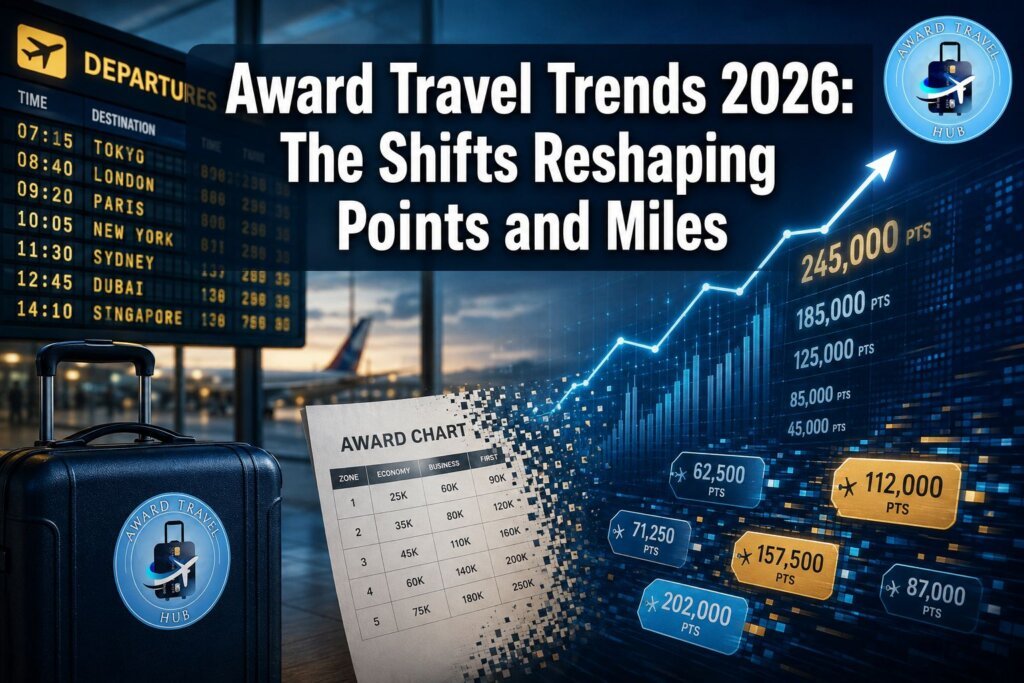
The defining shift is the steady erosion of predictable award charts in favor of dynamic or hybrid pricing, paired with a wave of devaluations and tighter gating of premium seats. In plain terms: points still work, but they buy less, less predictably, and the best redemptions increasingly require the right co-branded card or status.
Three structural changes stand out this year:
- Award costs are tracking cash fares and demand more closely, which undercuts the old “sweet spot” playbook.
- Major programs raised prices, headlined by Aeroplan and World of Hyatt, with ripple effects across partner programs like Cathay Asia Miles and Singapore KrisFlyer.
- Premium awards are being protected for top customers, cardholders, and “native program” bookings rather than partner transfers.
The U.S. Department of Transportation has even opened a probe into American, Delta, Southwest, and United over devaluation and opaque dynamic pricing, a sign that regulators are watching. None of this means points are worthless. It means the margin for sloppy strategy is gone.
The clear takeaway for 2026: flexibility beats loyalty. Keep points liquid, redeem with intent, and stop assuming next year’s chart looks like this year’s.
How Far Is Dynamic Pricing Spreading in 2026?
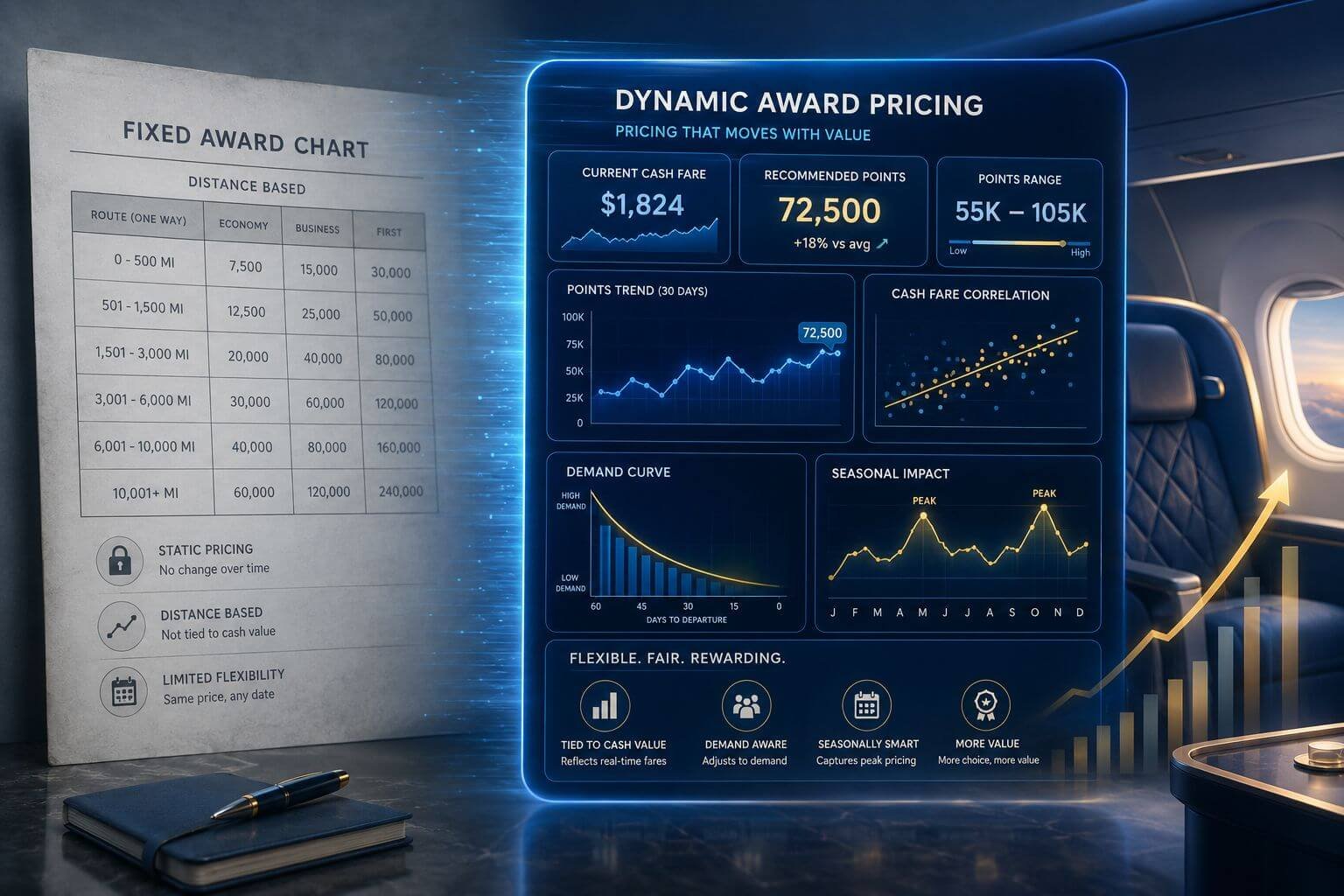
Dynamic award pricing is now the default direction of travel, not an experiment. More airlines and hotels are letting award costs float with cash prices, demand, and route popularity, which makes it harder to know what your points are worth on any given date.
Here’s what dynamic pricing changes in practice:
- Wide seasonal swings. The same route can cost dramatically more during peak weeks, even in economy.
- Disappearing fixed sweet spots. Redemptions that were reliable bargains now fluctuate or vanish.
- Harder valuations. Cents-per-point math has to be run per booking, not assumed from a chart.
Decision rule: When pricing is dynamic, always compare the points price against the cash price at booking time. If you’re getting under roughly 1.2–1.5 cents per point on economy or under ~2 cents on premium cabins, paying cash (and earning points) is often the better call.
You may be interested



A useful nuance: not every program is fully dynamic. Hyatt’s 2026 change widened bands but kept pricing semi-fixed, since each date is assigned a tier that doesn’t shift until Hyatt remaps it. For the full mechanics of how this works and when points still win, see the dynamic hotel award pricing playbook.
Common mistake: Assuming a transfer is “worth it” because the program used to have a good chart. Confirm live award pricing before you move points, because transfers are usually irreversible.
What Major Devaluations Hit in 2026, and How Do You Adapt?
Two devaluations dominate the 2026 landscape: Air Canada Aeroplan’s partner award increases (June 1, 2026) and World of Hyatt’s expanded 5-tier chart (May 20, 2026). Both reduce the value of points you may already be holding, so timing your redemptions matters more than ever.
Aeroplan’s 2026 award chart changes
Air Canada frames it as “the number of points you may need is changing,” but analysts widely call it a devaluation. Key increases on partner premium awards:
| Route band | Cabin | Old (one-way) | New (one-way) | Increase |
|---|---|---|---|---|
| N. America–Asia (7,501–11,000 mi) | Business | 87,500 | 102,500 | ~17% |
| N. America–Atlantic (4,001–6,000 mi) | First | 100,000 | 120,000 | ~20% |
| Various long-haul | Business/First | — | — | ~15–18% |
Aeroplan remains a strong program because it has no fuel surcharges on many partners and allows stopovers, but the high-value bands for ANA, EVA, Singapore, and Asiana business class to Asia are exactly the ones that got more expensive. If your Aeroplan miles are already earned, prioritize booking premium partner space before increases fully bite. For program survival tactics, review whether Aeroplan points expire and how to keep miles alive.
Hyatt’s 5-tier expansion
World of Hyatt moved from 3 redemption levels (off-peak/standard/peak) to 5 (lowest/low/moderate/upper/top). That widens the bands and lifts top-end pricing significantly:
- Category 1: 3,500–6,500 became 3,000–9,000 points (up to ~38% higher at the top).
- Category 8: 35,000–45,000 became as high as 75,000 points (up to ~67% higher at the top).
The silver lining: Hyatt’s pricing is semi-fixed, so 2026–early 2027 pricing is largely “pre-baked.” That gives planners a window before the bigger move expected in 2027. Walk through the details in the Hyatt award chart 2026 survival guide and the new 5-tier pricing breakdown.
Marriott Bonvoy also continued its dynamic-pricing creep; see what changed in the 2026 Bonvoy devaluation.
How to adapt to devaluations:
- Book confirmed premium-cabin and high-category hotel awards sooner, not later.
- Don’t transfer speculative balances into a program just before a known increase.
- Shift everyday earning toward programs with more stable value or better near-term sweet spots.
How Are Flexible Points and New Programs Changing the Game?
Transferable points are now your best defense against devaluation, because they let you move value to whichever program offers the best redemption at booking time. When any single airline or hotel raises prices, flexible currencies let you pivot instead of eating the loss.
The major transferable currencies remain Amex points, Chase points, Capital One miles, Citi points, and Bilt points. Their value comes from the breadth of points transfer partners and frequent transfer bonuses. For a current comparison of which currencies cover the most useful partners, see the best transferable points programs.
A few 2026 dynamics worth tracking:
- Newer programs are competing on transfer bonuses and no-fee access. Rove Miles, for example, has run bonuses to Aeroplan, Virgin Atlantic, Turkish, and SAS EuroBonus. Compare it head-to-head in Rove Miles vs Bilt Rewards 2026.
- Portal-versus-transfer decisions matter more under dynamic pricing. When partner awards are expensive, a fixed-value portal can occasionally win. The Capital One Travel portal vs transfer partners comparison shows when each makes sense.
- Diversification is now a strategy, not a hedge. Holding two or three flexible currencies covers more partners and protects you when one bank loses a partner.
Best for: Travelers who book a mix of airlines and hotels and want optionality. Not for: Someone loyal to a single airline who consistently earns and redeems in that ecosystem and can stomach its devaluation risk.
Common pitfall: Transferring points to “lock them in” before you have confirmed award space. Once transferred, points usually can’t come back, and surcharges and fees on some partners can erase the savings.
What’s Happening to Award Availability and Booking Windows?
Award availability is tightening, especially for premium cabins, and the best saver space is increasingly reserved for elites and co-branded cardholders. United, for instance, is steering more Polaris business saver seats toward its own loyalists, and cardholders can see at least 10–15% off award prices.
This reshapes when and how you should search:
- Book aspirational premium trips as early as schedules open. Saver space for two or more passengers in business or first is the first to go. The guidance in how to plan 2026 aspirational trips when award space is tight is more relevant than ever.
- Use multiple award search tools and check the native program. Premium awards are shifting toward “native program” bookings over partner transfers, so the seat you can’t find via a partner may appear when you search the operating airline’s own program.
- Treat refundable awards as options. Holding a free-cancellation award reserves space while you finalize plans; see treating free-cancellation awards as strategic options.
For peak-season planning, the when to book summer 2026 Europe award flights guide covers realistic booking windows, and Japan business class after devaluations shows which programs still surface space.
Edge case: Flying from a small U.S. airport often has fewer saver seats, so building in a positioning flight or a married-segment search can open availability. See booking award flights to Europe from small airports.
How Do You Future-Proof Your Points Strategy for 2026?
Future-proofing comes down to one principle: keep value liquid and redeem with intent. Earn into flexible currencies, transfer only when you have confirmed space, and prioritize redemptions before announced increases take effect.
Use this checklist:
- Hold flexible points first. Favor Amex, Chase, Capital One, Citi, or Bilt over committing everything to one airline or hotel program.
- Earn and burn. Don’t sit on six-figure balances. Programs can change charts unilaterally, as 2026 proved.
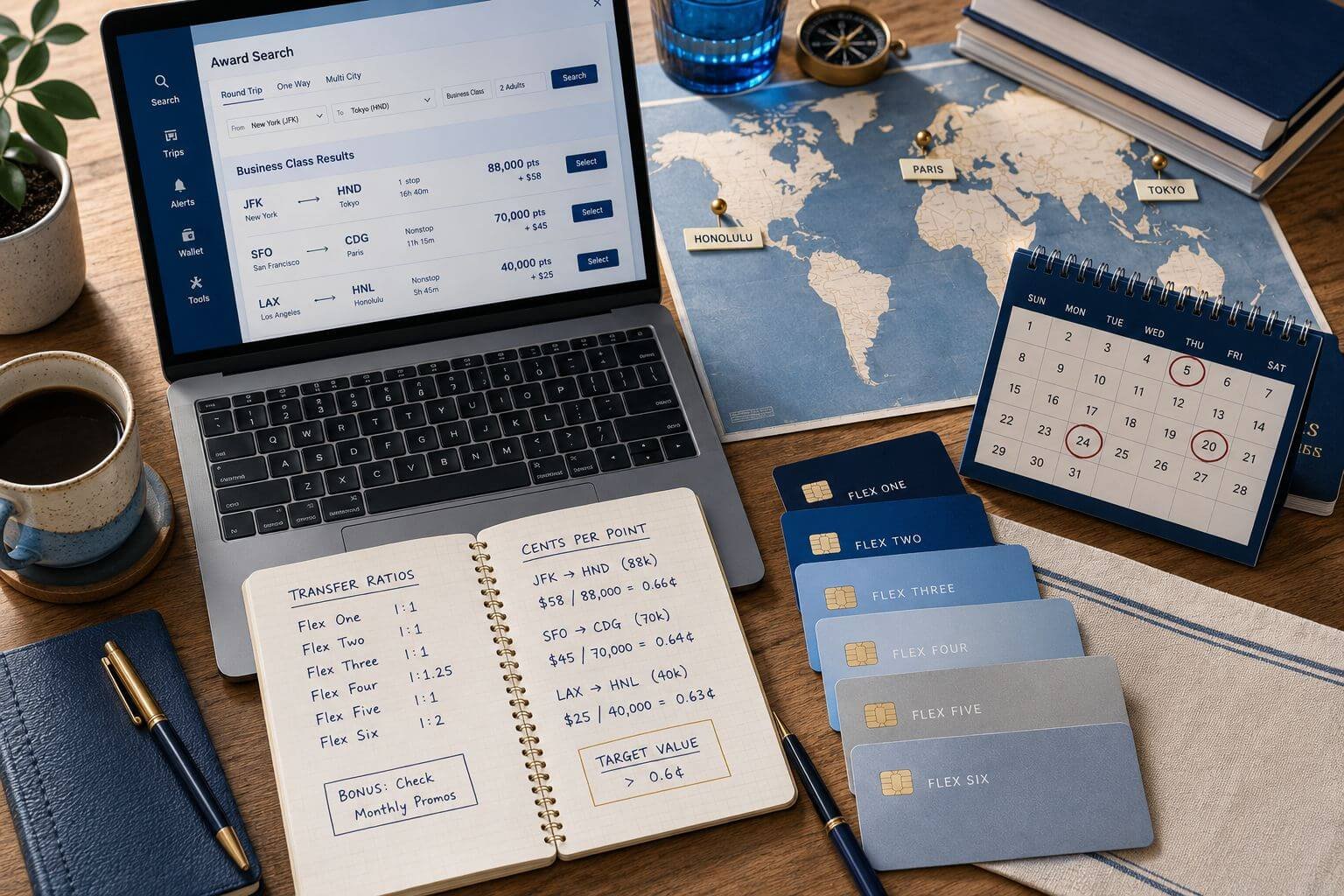
- Calculate cents per point every time. Compare the points price to the cash price before transferring or booking. Aim for solid CPP, not just “free” travel.
- Watch transfer bonuses. A 25–50% bonus can offset a recent devaluation, but only if there’s real award availability at the destination.
- Map deadlines. Note program-specific cutoffs (Aeroplan’s June 1, Hyatt’s May 20 remap) and book ahead of them.
- Diversify partners across alliances. Coverage across Star Alliance, oneworld, and SkyTeam partners gives you backup routes when saver space is gated.
- Protect elite-gated value when it fits. If you concentrate flying with one airline, a co-branded card may now be the price of admission for the best awards.
For broader context on these trends, the deeper dive in 8 award travel trends shaping 2026 strategy and the 2026 award travel predictions round out the picture.
Quick example: You hold 110,000 flexible points and want U.S.–Tokyo business class. Pre-June 1, Aeroplan priced ANA business at 87,500 miles one-way; post-increase it’s 102,500. If saver space exists now, transferring and booking before the change saves 15,000 points per passenger and locks the lower rate. If space isn’t available, transferring early just strands points in a devalued program. Confirm the seat first, then move the points.
Frequently Asked Questions
Which programs devalued in 2026?
Air Canada Aeroplan raised partner award prices for travel on or after June 1, 2026 (long-haul premium bands up 15–20%), and World of Hyatt expanded from 3 to 5 award tiers on May 20, 2026. Cathay Asia Miles and Singapore KrisFlyer also saw increases, and Marriott Bonvoy continued its dynamic-pricing drift.
Are there any fixed award charts left in 2026?
Fewer than before, but they exist. Aeroplan still publishes a region-based partner chart (now more expensive), and Hyatt’s new model is semi-fixed rather than fully dynamic, since each date is pre-assigned a tier. Fully fixed, no-surprises charts are becoming the exception.
Is dynamic pricing always bad for award travelers?
No. Dynamic pricing can occasionally produce cheap off-peak awards, and it sometimes makes more seats bookable. The downside is unpredictability and the loss of reliable sweet spots, so you have to check live cents-per-point value on every booking instead of trusting a chart.
Should I hoard points or use them in 2026?
Lean toward earn and burn. Programs can change award charts, add dynamic tiers, or gate premium seats with little notice, as Aeroplan and Hyatt demonstrated. Keep balances in flexible currencies and redeem when you have a clear, high-value use.
Are transferable points safer than airline miles in 2026?
Generally yes, because flexible points from Amex, Chase, Capital One, Citi, and Bilt let you pivot to whichever partner offers the best value. The risk is that banks can drop or change partners, so diversifying across two or three currencies provides the best protection.
Why are premium award seats harder to find?
Airlines are reserving more saver business and first class space for elites and co-branded cardholders, and steering premium redemptions toward native-program bookings over partner transfers. United’s 2026 changes are a clear example, with better award access for its own loyalists.
Conclusion and Next Steps
The award travel trends 2026 story is consistent: less predictability, higher prices on key premium awards, and more value reserved for loyalists and cardholders. The programs that raised prices, especially Aeroplan and Hyatt, rewarded members who booked ahead of the deadlines and punished those sitting on idle balances.
Three next steps to act on now:
- Audit your balances. Identify any large airline or hotel stashes exposed to devaluation, and plan redemptions or transfers around confirmed availability.
- Consolidate toward flexible points and review the best transferable points programs to make sure your earning covers the partners you actually use.
- Run the math before every booking using a cents-per-point check, and lean on the dynamic award pricing playbook when a program prices awards dynamically.
The points game still works in 2026. It just rewards intention, timing, and flexibility far more than loyalty.


Content on Award Travel Hub is independently created by Award Travel Hub Editorial Desk and, where noted, reviewed by Award Travel Hub Review Desk. Some pages may contain affiliate links, but compensation does not determine our coverage, opinions, or methodology.