

Last updated: April 24, 2026
Quick Answer
Yes, families can book award flights to Europe from small US airports for summer 2026, but the simplest path is usually not a single all-in-one award. The practical strategy is to find transatlantic award space from a larger gateway first, then add a separate positioning flight or use a portal booking for the short domestic leg. For most beginners, programs like Flying Blue, Aeroplan, Avios, and American Airlines miles are the best places to start.
Key Takeaways
- Summer 2026 Europe awards are possible from regional airports, but gateway-first planning usually works better than searching from the home airport.
- The best family strategy is often: small airport → U.S. hub → Europe gateway.
- Families needing 3 to 4 seats should search economy and premium economy first, then compare portal bookings and alliance awards.
- Google Flights helps with route discovery, FlightConnections helps identify hub options, and award tools help confirm saver space.
- Good beginner-friendly programs to compare are Flying Blue, Aeroplan, Avios, and AAdvantage.
- Separate positioning flights can save many points, but they increase the risk of misconnects. Build in a buffer.
- Transferable points matter because they let families move Amex points, Chase points, Capital One miles, Citi points, or Bilt points to the best partner airline.
- Dynamic pricing, fuel surcharges, and devaluation risk can change the math quickly, so compare total out-of-pocket cost, not just points.
- If summer nonstop options are weak, consider flying into one European city and returning from another.
- Do not transfer points until award seats are available and the booking path is confirmed.
Why is Europe harder to book on points from small U.S. airports?
Booking Europe from a small airport is harder because regional airports have fewer daily flights, fewer alliance partners, and less saver award availability. For families, the biggest problem is finding 3 or 4 seats on the same long-haul flight.
A traveler in Chicago or Newark can search dozens of Europe departures. A traveler in Des Moines or Spokane usually sees only a handful of domestic feeder flights, and those domestic segments may not line up with the best transatlantic award.
Common friction points:
- Limited domestic feed to major hubs
- Married segments, where airlines release award space only on certain combined routes
- Dynamic pricing, where mileage cost changes based on demand
- Fewer seats for a family of 4 than for a solo traveler
- Higher taxes or fuel surcharges on some partner airlines
Decision rule: If the search from the home airport looks bad, stop searching for city-to-city routes. Search the long-haul segment from a major hub first.
For most families in non-hub cities, the best use of points is often the transatlantic flight, not the domestic connector.
How do you book award flights to Europe from small US airports step by step?
The fastest way to book award flights to Europe from small US airports is to work backward from the Europe flight, then add the domestic piece. This avoids wasting time on weak all-in-one searches.
Step-by-step guide
You may be interested
List 2 to 4 acceptable European entry cities
- Good examples: Dublin, London, Paris, Amsterdam, Madrid.
- Families with flexible arrival cities usually do better than those locked into one airport.
Map your realistic U.S. gateways
- For Midwest and East: ORD, EWR, IAD, JFK, BOS, PHL
- For West: DEN, SEA, SFO, LAX
- FlightConnections is useful for seeing which hubs your home airport serves.
Check the cheapest or best-value transatlantic awards first
- Flying Blue for Air France/KLM
- Aeroplan for Star Alliance
- Avios programs for British Airways, Iberia, Aer Lingus
- AAdvantage for Oneworld partners and AA-operated flights
Search for 3 or 4 seats
- Do not search one seat and assume more exist.
- Family trips fail most often at this step.
Compare three booking paths
- Alliance award from home airport if pricing is reasonable
- Hybrid: separate paid positioning flight plus award to Europe
- Portal booking if cash fares are low and transferable points can cover them
Only then transfer points
- Check transfer ratios and any current bonuses first
- For example, Chase offered a 20% transfer bonus to Avios programs in March 2026, which can improve economy redemptions to Europe from East Coast gateways



For more on booking timing, see ATH’s when to book award flights in 2026 and transfer bonus strategy guide.
What tools help families book award flights to Europe from small US airports?
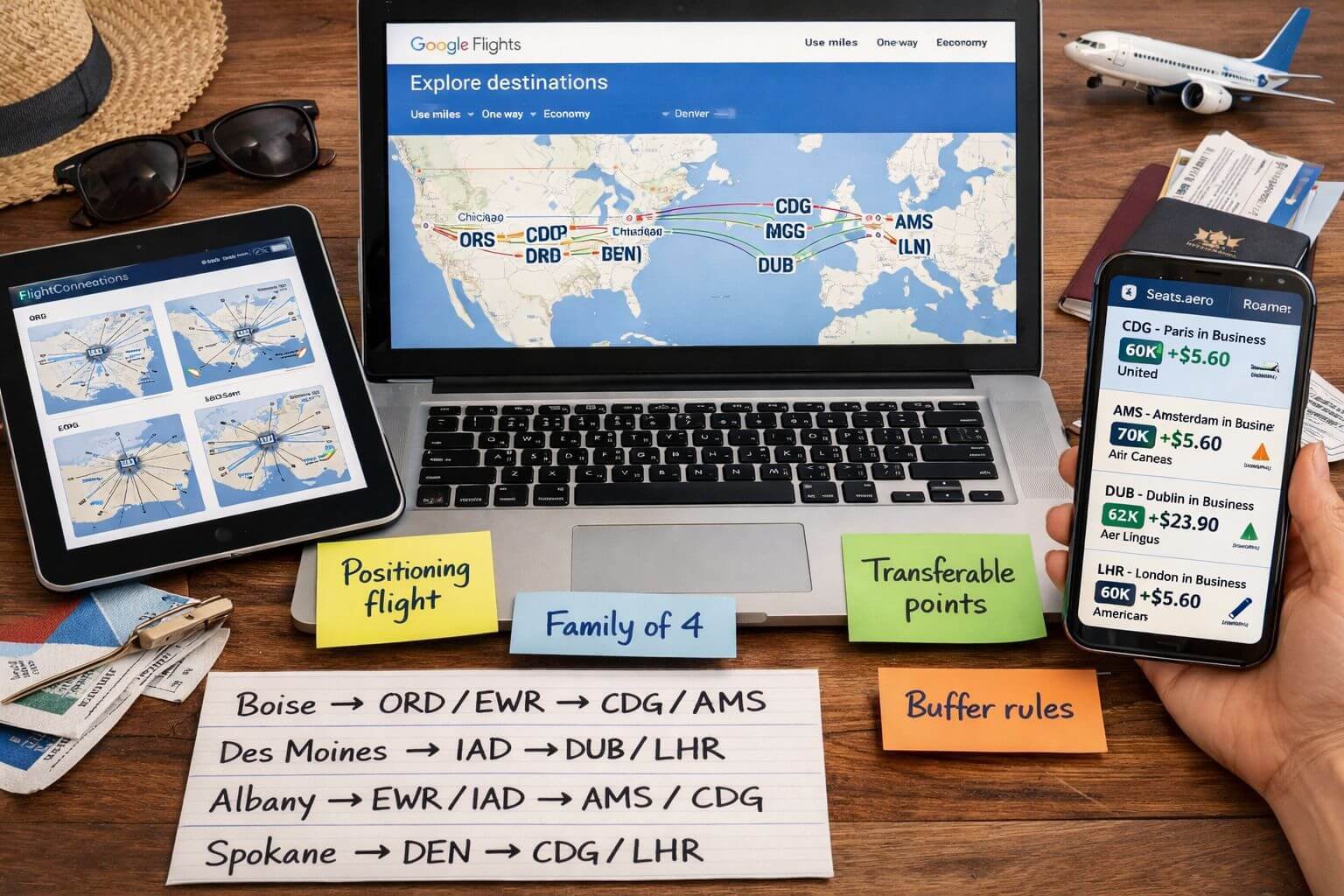
Families should use three tool types: route discovery, award search, and price comparison. Each solves a different problem.
Best tool stack for beginners
Google Flights
- Best for checking cash fares and route patterns
- Use it to find which U.S. hubs have the cheapest Europe fares from your region
FlightConnections
- Best for seeing where your small airport flies nonstop
- Useful for identifying easy positioning flights to ORD, EWR, IAD, DEN, or JFK
Seats.aero, point.me, or Roame
- Best for locating award availability across partner airlines
- Helpful when searching for 4 seats, though results should always be verified on the airline site
Airline sites
- Always verify final pricing on the actual program website before transferring
A practical workflow:
- Use FlightConnections to find your hub options
- Use Google Flights to spot cheap domestic hops and Europe gateways
- Use an award search engine to find a saver space
- Confirm on Air France, Air Canada, British Airways, Iberia, or American Airlines
For a deeper search workflow, see ATH’s best ways to find partner award space fast and bank transfer partners guide.
Common mistake: Searching for only one program. The same seat may be priced very differently with different partner airlines.
Which points programs are best for summer 2026 Europe family trips?
For most beginners, the best programs are the ones with flexible routing and broad transfer access. Flying Blue and Aeroplan are usually the most useful starting points, while Avios and AAdvantage can be strong on specific routes.
Best for / Not for
Flying Blue
- Best for: Families wanting Paris or Amsterdam, broad U.S. coverage, and occasional saver-style pricing
- Air France/KLM saver examples around 45,000 points one-way to Europe were widely seen for travel through September 2026
- Promo Rewards can bring some routes lower
- Not for: Travelers who need perfect consistency in pricing because Flying Blue uses dynamic pricing
Aeroplan
- Best for: Flexible Star Alliance routing and low-to-moderate fees
- Strong from hubs like ORD, EWR, IAD, and DEN
- Not for: Travelers who only want one specific nonstop route
Avios
- Best for: East Coast to UK, Ireland, Spain, and for taking advantage of transfer bonuses
- Virgin Atlantic and Avios programs can offer low economy prices, but fees vary and summer dates can spike
- Not for: Families that ignore surcharges and only look at the mileage number
AAdvantage
- Best for: Oneworld flights and occasional solid summer economy or business pricing
- Summer 2026 availability has been reported at around 30,000 miles economy and 57,500 miles business on some Europe options
- Not for: Travelers without any flexibility on date or gateway
If choosing between transferable currencies, ATH’s comparison of transfer partners in 2026 is a useful next step.
What do real family itineraries look like from non-hub cities?
Realistic itineraries usually mix one of three methods: all-award, hybrid, or portal. For families, hybrid often wins because it opens more long-haul seats.
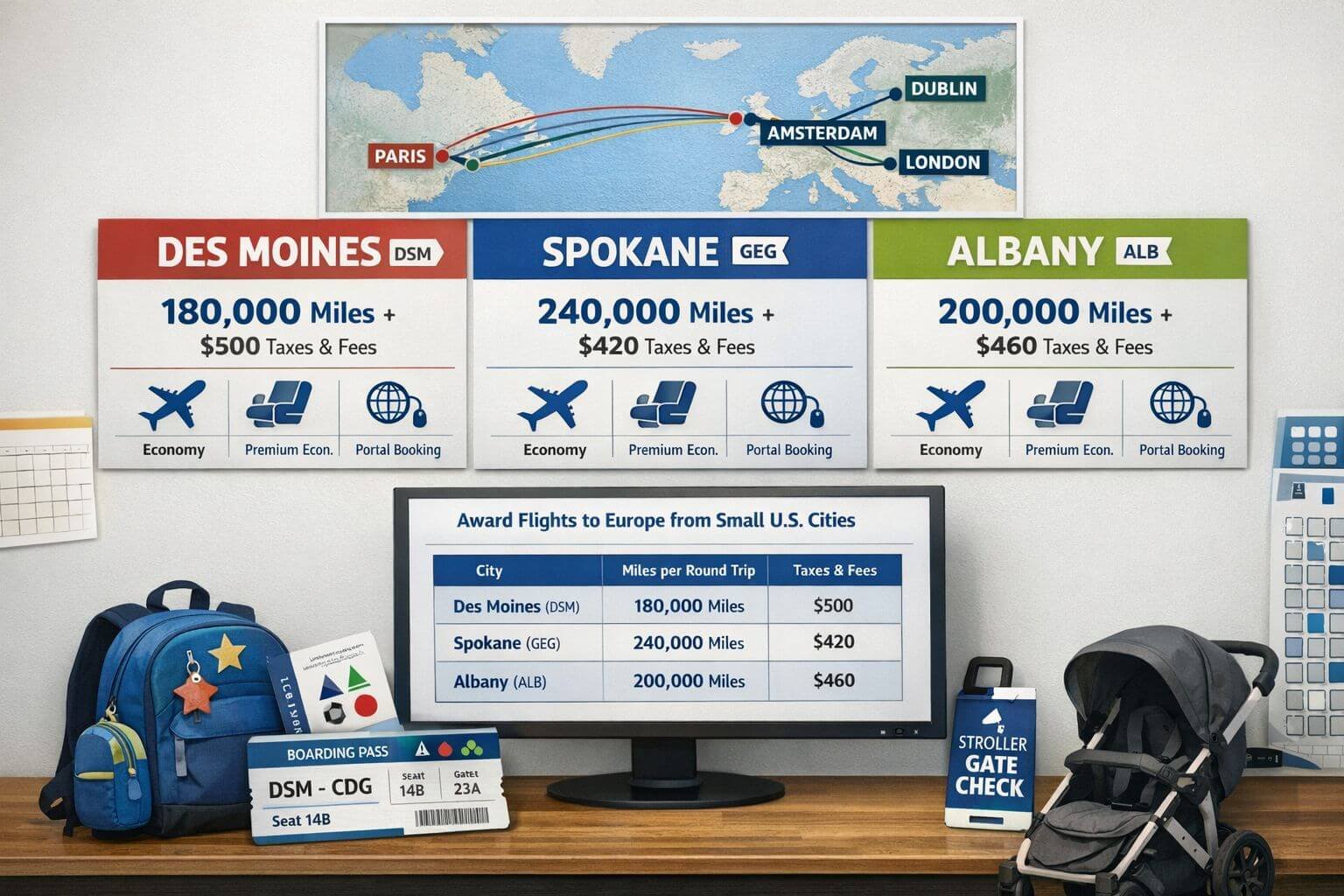
Sample city 1: Des Moines (DSM)
Typical routing pattern: DSM → ORD / DFW / CLT / EWR → Europe
| Option | Example routing | Family of 4 estimate | Best for |
|---|---|---|---|
| Alliance award | DSM-ORD-CDG on Flying Blue or Aeroplan partner search | Often hard to find all 4 seats on one ticket | Simplicity if available |
| Hybrid | Cash DSM-ORD, then ORD-CDG on Flying Blue | Lower points cost, more transatlantic options | Best overall |
| Portal | Book full itinerary through Chase portal | Good when cash fares dip | Families with fixed dates |
Example:
- Separate DSM → ORD paid ticket
- ORD → CDG on Air France/KLM award
- Why it works: the transatlantic segment has more award availability than the full DSM-origin itinerary
Sample city 2: Spokane (GEG)
Typical routing pattern: GEG → SEA / DEN / SFO / ORD → Europe
This is where a positioning flight matters most. West Coast regional airports usually need one extra step before Europe value appears.
Option ideas:
- GEG → DEN paid flight, then DEN → Europe with Aeroplan
- GEG → SEA paid flight, then SEA → LHR or AMS using a partner program
- Full cash fare in a portal if the fare sale is strong
AwardWallet-style examples have highlighted low-fee LifeMiles routings to Europe on Star Alliance carriers, which are useful for West-origin families trying to avoid high surcharges. NerdWallet and TPG also note that the cheapest mileage options often start from larger gateways rather than smaller origins.
Sample city 3: Albany (ALB)
Typical routing pattern: ALB → JFK / EWR / PHL / IAD / BOS → Europe
Albany families often have a strong East Coast advantage because short hops can unlock cheaper Europe awards.
Good choices:
- ALB → EWR, then United or Star Alliance to Europe
- ALB → JFK, then Virgin Atlantic, British Airways, or Air France/KLM
- ALB → BOS, then Aer Lingus or other transatlantic option
Because East Coast pricing can be very strong, even a separate cash connector may still be the best use of points. Virgin Atlantic and some Avios routes can be very cheap in points on the right dates, but summer peak pricing and fees can rise sharply.
Sample city 4: Boise (BOI)
Typical routing pattern: BOI → DEN / SLC / SEA / SFO → Europe
A family from Boise should usually compare:
- Aeroplan via DEN
- Flying Blue via SEA or SFO
- A cash positioning flight plus a Europe award from a better gateway
- A full portal booking if fares are moderate and points balances are strong
Quick example block
A family of 4 from Boise might see:
- Full one-ticket award pricing: too high or unavailable
- BOI → DEN paid separately, DEN → AMS on Aeroplan: better points value
- Full portal fare: simpler, but may use more Chase points overall
Use ATH’s cents per point guide if comparing portal value versus transfer partner value.
Should you use a positioning flight or book one ticket?
A positioning flight is often the right answer for non-hub travelers, but only if the savings are large enough and the schedule is safe. Families should be more conservative than solo travelers.
Use a positioning flight if:
- The long-haul award from a hub is much cheaper
- The home-airport award adds too many points
- You need 4 seats and the hub has better award availability
- The positioning flight is cheap and frequent
Book one ticket if:
- The price difference is small
- Travel involves young children, car seats, or tight connections
- Weather or summer IRROPS risk is high
- Bags and overnight airport transfers would be a hassle
Buffer rule: For a separate-ticket positioning flight before Europe, many families should arrive the night before or build a very long same-day cushion. This is especially true when checking bags or traveling during peak summer storms.
Related reading:
- ATH’s “Positioning Flight: How to Book It Safely (Math + Buffer Rules)”
- ATH’s “Beginner’s Guide to Booking ‘Anywhere in Europe’ Award Trips”
- ATH’s award ticket cancellation fees guide
Common pitfall: Treating separate tickets like protected connections. If the first flight is delayed, the second airline usually does not owe a free rebooking.
When should families book summer 2026 Europe awards?
For summer 2026, families should search early, then keep checking. The best pattern is usually to book acceptable seats first, then improve later if the change rules are reasonable.
Practical timeline
- 8 to 11 months out: Best for saver-level family space
- 4 to 7 months out: Still useful, especially if airlines add inventory
- Last-minute: Possible for 1 or 2 seats, much harder for 4
Useful context:
- United added new summer 2026 Europe routes from Newark, including Split, Glasgow, Santiago de Compostela, and Bari
- More transatlantic flying can create new award opportunities from major gateways
- Summer demand is still high, so extra flights do not guarantee cheap award space
Choose this approach if…
- Fixed school schedule: Book early and protect the trip
- Flexible destination: Watch several gateways and pounce when 4 seats appear
- Strong Chase points balance: Keep an eye on Avios transfer bonuses and portal deals
What mistakes should beginners avoid?
Most mistakes happen before the transfer, not after. A clear booking strategy saves points and stress.
Common mistakes
- Transferring points before confirming seat availability
- Searching for one seat instead of the full family
- Ignoring taxes, surcharges, and fees
- Forcing one Europe airport when “anywhere in Europe” would work
- Booking a separate positioning flight with too little buffer
- Comparing points but not travel rewards math
- Overvaluing premium cabins when the economy gets the family there for far fewer points
There can also be ripple effects on the hotel side. If a Europe trip depends on Hyatt points, remember that Hyatt announced 2026 award chart changes with a new five-level system, which may affect family hotel planning.
FAQ
Can families really book Europe awards from regional airports?
Yes. Most successful bookings start by finding long-haul award space from a larger U.S. gateway and then adding the regional connection separately or through a portal.
What is the best program for 4 economy seats to Europe?
Flying Blue and Aeroplan are often the best places to start because they cover many U.S.-Europe routes and accept multiple transferable point currencies.
Is premium economy worth it for families?
Premium economy can be worth it on overnight flights if the points jump is modest. If the premium economy price is close to business class or far above economy, skip it.
Are positioning flights safe?
Positioning flights are safe only when you build a large buffer. Separate tickets are not protected like one itinerary.
Should points be transferred before searching?
No. Search first, verify on the airline website, then transfer only when the booking path is ready.
Is London a bad award option because of fees?
Not always. London can still work well, but some programs add higher fees. Compare total cash co-pay against Paris, Amsterdam, Dublin, or Madrid before booking.
What if there is no award space from the home airport?
Search from hubs your airport serves, then add a separate short flight. That is often the normal solution for non-hub travelers.
Is a portal booking ever better than transferring points?
Yes. If cash fares are low and saver awards are poor, a portal booking can be the simpler and better-value option.
Conclusion
Families do not need to live near New York, Chicago, or Los Angeles to reach Europe on points in summer 2026. The practical way to book award flights to Europe from small US airports is to break the problem into parts: first, find the best transatlantic award; then compare it with portal pricing; and only then decide whether a positioning flight makes sense.
For most readers, the next steps are simple:
- Pick 2 to 4 acceptable Europe arrival cities.
- List the hubs your airport serves nonstop.
- Search Flying Blue, Aeroplan, Avios, and AAdvantage for 4 seats, not 1.
- Compare one-ticket, hybrid, and portal options.
- Transfer points only after verifying availability.
If the goal is a smoother planning process, start with ATH’s when to book award flights in 2026, best partner award search tools, and comparison of transfer partners. Those three guides pair well with this seasonal playbook and make the next search much faster.


Content on Award Travel Hub is independently created by Award Travel Hub Editorial Desk and, where noted, reviewed by Award Travel Hub Review Desk. Some pages may contain affiliate links, but compensation does not determine our coverage, opinions, or methodology.