

Last updated: June 12, 2026
Quick Answer
For most Capital One cardholders, the right answer in the Capital One Travel portal vs transfer partners debate is simple: use the portal for cheap cash flights, independent hotels, and trips where you value ease or need to use portal credits; transfer miles for premium cabin awards and true sweet spots that clearly exceed 1 cent per mile after taxes and fees. In 2026, that line matters more because some transfer options are weaker, including the less attractive Emirates Skywards ratio from Capital One, while the portal still offers fixed-value simplicity, broad hotel coverage, and useful booking features.
Key Takeaways
- Use Capital One Travel for low-cost economy tickets when award pricing is high or availability is poor.
- Use transfer partners for Business Class and First Class redemptions when partner awards produce well above 1 cent per point in value.
- Portal bookings often favor boutique hotels because independent properties may not be part of major hotel loyalty programs.
- Capital One miles transfer ratios are not all equal. A weaker ratio can erase what looks like a good award on paper.
- Emirates is less compelling from Capital One in 2026 for many travelers, so it should no longer be a default transfer option.
- The Venture X $300 annual Capital One Travel credit can tilt the math toward the portal for travelers who would have paid cash anyway.
- Price prediction, price match, and broad inventory are real portal advantages when you need a normal ticket, not a complex award hunt.
- Never transfer speculatively. Transfers are generally one-way and can leave miles stranded if award space disappears.
- CPP is useful, but not enough by itself. Consider surcharges and fees, cancellation rules, elite benefits, and time spent searching.
- If a partner redemption is only barely above 1 cpp, the portal often wins in practice.
How do Capital One Travel and transfer partners work in 2026?
The short answer: Capital One Travel lets you redeem at a fixed value against cash travel pricing, while transfer partners let you move Capital One miles into airline or hotel programs for potentially higher value. The portal is easier and more predictable; transfers have more upside and more risk.
Capital One miles can generally be used in two main ways:
Book through Capital One Travel
- Flights, hotels, and rental cars use cash-style pricing.
- Redemptions are usually around 1 cent per mile in the portal.
- Venture X still earns 5x on flights and vacation rentals, 10x on hotels and rental cars booked through the portal in 2026.
Transfer to points transfer partners
- Capital One has a large partner list, with no major new additions in early 2026 after the most recent additions in late 2025.
- Many airline partners transfer at 1:1, but not all do.
- Transfers are typically irreversible, and availability can vanish while you wait.
A practical way to frame the Capital One Travel portal vs transfer partners question is this:
Portal = cash-like simplicity. Partners = award upside, but only if the award is actually available and the math is clearly better.
You may be interested



Best for
- Portal: economy flyers, family trips, independent hotels, fixed-date travel
- Partners: flexible travelers, premium cabin awards, alliance searches, sweet spot hunters
Not ideal for
- Portal: travelers trying to maximize points on international business class
- Partners: travelers who need certainty, easy cancellations, or last-minute basic economy alternatives
For a broader bank comparison, see ATH’s guide to Comparing Transfer Partners 2026: Chase vs Amex vs Citi vs Capital One and our Capital One miles transfer partners guide.
When does the Capital One Travel portal beat transfer partners on flights?
The direct answer: the Capital One Travel portal beats transfer partners on flights when cash fares are cheap, partner award prices are inflated, or you need a straightforward ticket with no award search friction.
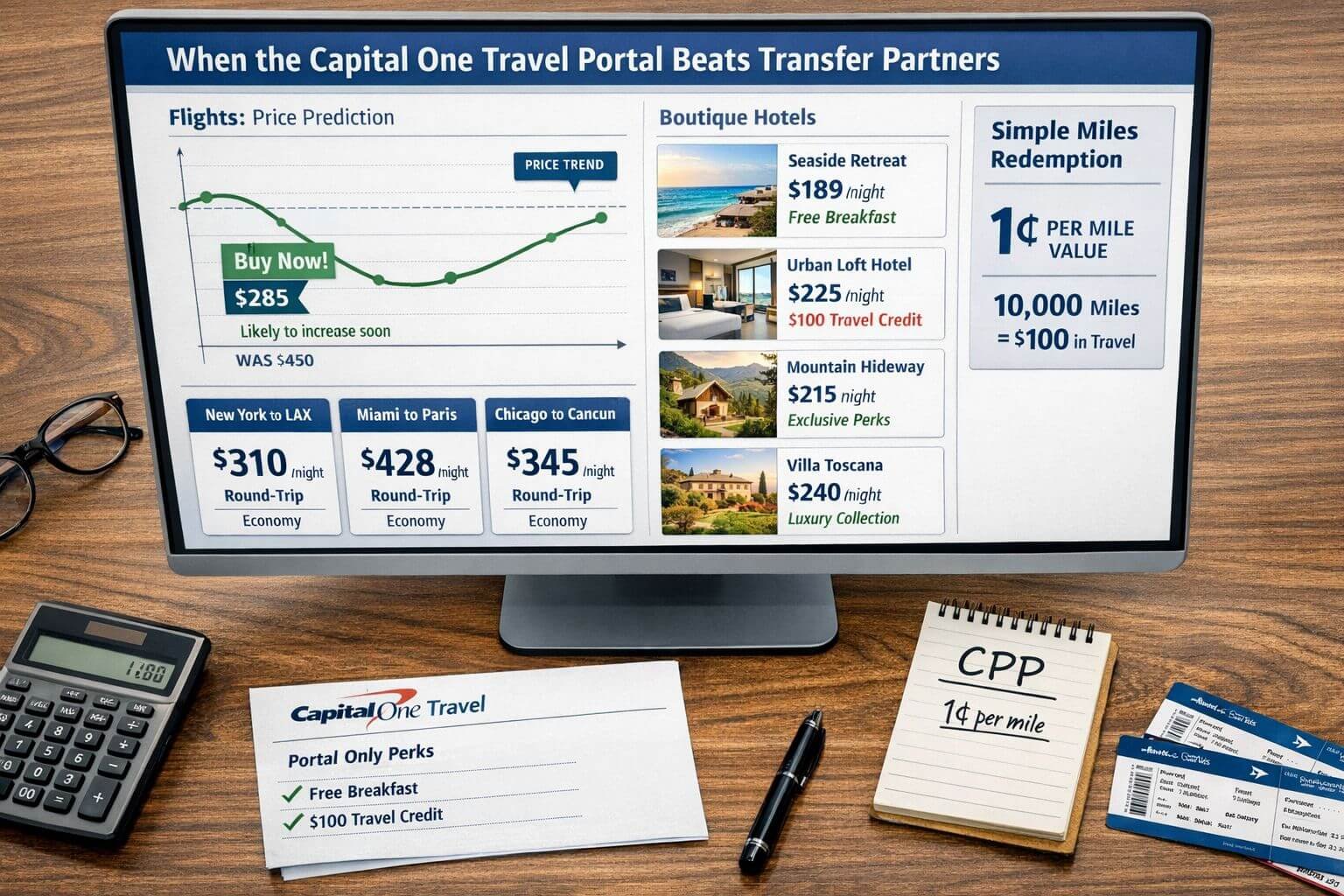
This happens more often than many points users expect, especially on domestic and short-haul international economy itineraries where dynamic cash prices drop faster than award rates.
Four real-world style examples where the portal wins
Below, CPP means cents per point, a simple travel rewards math formula:
CPP = cash price saved ÷ points used
| Scenario | Portal redemption | Transfer option | Winner |
|---|---|---|---|
| Dallas to Chicago roundtrip economy sale | $178 cash = 17,800 miles = 1.0 cpp | 15,000 partner miles + $11.20 taxes for same route, effective value about 1.11 cpp before transfer friction | Portal, because the gain is tiny |
| New York to Miami last-minute economy | $221 cash = 22,100 miles = 1.0 cpp | 24,000 partner miles + $11.20 taxes, effective value about 0.87 cpp | Portal |
| Los Angeles to Vancouver roundtrip | $246 cash = 24,600 miles = 1.0 cpp | 27,500 partner miles + $58 taxes, effective value about 0.68 cpp | Portal |
| Boutique hotel in Lisbon, 3 nights | $612 total = 61,200 miles = 1.0 cpp | No useful chain partner option; nearby chain hotel costs 72,000 hotel points and is less desirable | Portal |
A strict CPP reader may notice the first example still gives a bit more than 1 cpp through a partner. That is exactly the point. If the transfer gain is tiny, the portal often wins in practice because:
- the ticket earns airline miles if booked as a paid fare
- you skip award availability headaches
- there is no transfer delay risk
- you can use card credits and portal protections more easily
Portal-friendly flight situations
Choose the portal if most of these are true:
- Cash fare is under $250 to $300 domestic or under $400 to $500 international economy
- Partner awards require close to the same number of miles as the cash fare
- Taxes and surcharges narrow the gap
- You need specific dates, not flexible dates
- You want a paid fare for easier changes, seat selection, or elite credit
Common mistake
A common mistake is transferring 15,000 to 25,000 miles for a cheap economy ticket just because “transfers are supposed to be better.” That is often not the best use of points.
Capital One Travel also includes booking features like price prediction, price match, and in some cases price drop protection, which can make portal bookings more attractive for travelers who care more about total trip cost than squeezing every last fraction of a cent from a redemption.
When does the Capital One Travel portal beat transfer partners on hotels?
The short answer: the portal wins on hotels when the property is independent, boutique, or poorly covered by transfer partners, and when portal-only perks or credits improve the all-in value.
Capital One’s hotel transfer options are generally weaker than its airline options for many U.S.-based travelers. That means the portal often becomes the better booking strategy for:
- boutique hotels
- small luxury properties
- non-chain resorts
- places where chain award rates are inflated
- short stays where elite perks would not matter much
Four examples where the portal wins clearly
| Scenario | Portal redemption | Transfer option | Winner |
|---|---|---|---|
| Boutique hotel in Kyoto, 2 nights | $480 total = 48,000 miles = 1.0 cpp | No transfer partner option for the property | Portal |
| Independent beach hotel in Crete, 4 nights | $744 total = 74,400 miles = 1.0 cpp | Nearest chain option: 96,000 hotel points at similar quality | Portal |
| Premier Collection-style stay, 1 night in NYC | $390 room rate, plus breakfast and property credit improve effective value beyond face price | No direct award option at same hotel | Portal |
| I Prefer property during 30% transfer bonus | Portal at $650 = 65,000 miles = 1.0 cpp | If the award costs 130,000 I Prefer points, a 30% transfer bonus may narrow or beat portal math, but only if award pricing cooperates | Usually portal, unless the award chart lines up unusually well |
The important detail is not just CPP. It is what hotel you actually want. If the portal lets you book the right property with breakfast, a credit, or a better location, that can be the best use of points even if a chain transfer looks decent on paper.
Capital One Travel can also matter more for Venture X cardholders because the $300 annual travel credit is tied to portal bookings, which changes the real cost equation for many cardholders.
For hotel alternatives, see ATH’s Hotel Transfer Partners Directory 2026 and World of Hyatt transfer partner guide.
When do transfer partners still crush the Capital One Travel portal?
The direct answer: transfer partners still dominate when you are booking premium cabin awards, niche airline sweet spots, or high-cash-price flights where award pricing stays relatively stable.

This is where transferable points still shine. A flat 1 cpp portal redemption cannot compete with a good business class or first class award.
Four examples where partners trounce the portal
| Scenario | Portal cost | Partner cost | Approx value | Winner |
|---|---|---|---|---|
| East Coast to Europe business class | $2,450 = 245,000 miles | 70,000 partner miles + $220 taxes | about 3.19 cpp | Partner |
| U.S. to Tokyo business class | $4,200 = 420,000 miles | 75,000 partner miles + $180 taxes | about 5.36 cpp | Partner |
| U.S. to North Asia one-way premium cabin via alliance partner | $3,100 = 310,000 miles | 85,000 miles + $120 taxes | about 3.51 cpp | Partner |
| U.S. to Europe lie-flat business during summer | $3,600 = 360,000 miles | 60,000 miles + $350 taxes | about 5.42 cpp | Partner |
These examples assume saver-level or close-to-saver award availability. That caveat matters. If you cannot find bookable award space, the value is theoretical.
Why partners win here
- Premium cabin cash prices are often very high
- Award charts or semi-fixed partner pricing can hold below cash rates
- Transfer bonuses can lower the effective mileage cost further
- Some partner airlines avoid fuel surcharges better than others
Avianca LifeMiles, Flying Blue, Virgin Atlantic, and select alliance partners remain worth checking depending on route and date. ATH readers can dig deeper with our guides to Flying Blue transfer partners and strategy, Best ways to find partner award space fast, and current transfer bonus strategy for 2026.
Common pitfall
A common pitfall is comparing a premium cabin award to economy cash prices. That is not a real comparison. Compare business class award cost to the actual cash fare you would otherwise pay for business class.
How should you decide in the Capital One Travel portal vs transfer partners debate?
The answer-first version: start with the trip type, then compare the real mileage cost, then factor in taxes, perks, and transfer risk. A simple decision tree beats a vague “always transfer” rule.
A practical decision framework
Choose the portal if…
- The trip is economy
- Cash fare is low
- Award availability is poor or requires awkward connections
- You want an independent hotel
- You need to use the Venture X portal credit
- The partner redemption is only around 1.0 to 1.2 cpp
- Transfer ratios are weak or the partner adds high surcharges and fees
Choose transfer partners if…
- The trip is business class or first class
- You found bookable saver or near-saver award space
- Net value is clearly above 1.5 cpp, ideally 2 cpp+
- Taxes and fuel surcharges are reasonable
- You know the partner program rules
- A transfer bonus improves the deal materially
Step-by-step checklist
- Price the trip in cash through Capital One Travel.
- Check partner award space before moving any miles.
- Calculate net CPP, subtracting taxes and fees from the cash fare.
- Factor in portal credits and perks like the Venture X $300 annual credit.
- Consider earning and protections on paid tickets.
- Transfer only when the award is available and clearly better.
If you want a wider framework across issuers, start with ATH’s Best Transferable Points Programs 2026 comparison and our Best use of 100,000 points guide.
What changed after the Emirates devaluation, and why does it matter?
The short answer: Emirates is no longer the default “premium cabin transfer” option for Capital One cardholders because a weaker transfer ratio reduces value and raises the bar for a transfer to be worthwhile.
In earlier years, Emirates could look attractive for First Class redemptions or aspirational bookings. In 2026, many intermediate cardholders are reassessing that strategy because a weaker transfer ratio makes the travel rewards math less forgiving. That means more people should compare against the portal instead of assuming a transfer is automatically better.
What to do now
- Treat Emirates as a route-specific play, not a blanket recommendation
- Compare net value after:
- transfer ratio
- surcharges and fees
- actual seat availability
- If the adjusted value is only a little above portal value, keep the miles flexible
Capital One’s transfer page remains the best place to verify current ratios before any transfer. ATH also tracks program-specific changes in our Emirates Skywards transfer partners guide and broader Award Travel Trends 2026.
Edge case
If a transfer bonus appears, the economics can change quickly. But that does not make every transfer good. Bonus-driven bookings still need strong award availability and low extra fees.
What portal-only perks make Capital One Travel more attractive in 2026?
The direct answer: Capital One Travel is more attractive when you can stack portal credits, elevated earning, price tools, and hotel perks, especially if you were going to pay cash anyway.
For Venture X cardholders, the practical portal value still comes from:
- $300 annual Capital One Travel credit
- 10,000 anniversary miles that help offset the annual fee
- 5x or 10x earning rates on portal travel purchases
- price match and some price drop protection features highlighted in current Venture X discussions
There is also a behavioral point here. Lounge access changes in 2026 made some cardholders reevaluate the Venture X value proposition, but the portal remains central to how many still come out ahead on the card’s annual fee.
When stacking makes sense
Use the portal when you can combine:
- annual travel credit
- good cash pricing
- broad inventory
- no meaningful award sweet spot
- paid-fare flexibility or easier booking management
A simple example
A traveler books a $320 domestic ticket through Capital One Travel using the Venture X annual travel credit. If that traveler had paid cash anyway, the out-of-pocket cost can be effectively zero, and there is no need to chase a 14,000-mile partner redemption with less flexibility.
What mistakes should Capital One cardholders avoid?
The direct answer: most lost value comes from transferring too early, overvaluing weak partner awards, and ignoring all-in costs.
Common mistakes
- Transferring before confirming award availability
- Ignoring taxes and surcharges, especially on premium cabin awards
- Using poor-ratio partners and assuming all partners are equal
- Forgetting portal credits that materially change the math
- Comparing fantasy CPP to trips you would never pay cash for
- Booking chain hotels with transferred miles when the portal has a better independent option
- Ignoring cancellation rules for both awards and portal bookings
For a stronger award search process, use ATH’s award travel tools and alerts guide.
FAQ
Should I use Capital One Travel or transfer miles for economy flights?
Use Capital One Travel for most cheap economy flights. Transfer only if the award is clearly cheaper after taxes and fees.
What is a good CPP for Capital One miles in 2026?
A good transfer redemption is usually well above 1 cpp, and many experienced users aim for 1.5 cpp or more on partner awards. The portal is generally around 1 cpp.
Is the Capital One Travel portal good for hotels?
Yes. The Capital One Travel portal is often strong for boutique, independent, and non-chain hotels where transfer partners offer few or no useful options.
Are Capital One transfers reversible?
No. In most cases, Capital One transfers are one-way, so miles should not be transferred until the award is available.
Did the Emirates change affect Capital One strategy?
Yes. A weaker Emirates transfer ratio means many cardholders should recheck the math rather than assume Emirates is still a top-value option.
Does Venture X make portal bookings more valuable?
Yes. The $300 annual Capital One Travel credit and high portal earning rates can make portal bookings the best practical choice for many travelers.
Are transfer partners always better for business class?
Usually, but not always. Transfer partners are best for business class only when saver-level or reasonably priced award space is actually available.
Should I book through the portal if partner award space is gone?
Yes. If there is no useful award availability, the portal often becomes the best option because it uses normal cash inventory.
Conclusion
The cleanest answer in the Capital One Travel portal vs transfer partners debate is this: book through the portal for cheap economy flights, many boutique hotels, and any trip where simplicity, credits, or fixed pricing matter more than theoretical upside. Transfer miles for premium cabin awards and true sweet spots, but only after confirming award space and doing the math.
In 2026, that balanced approach matters more than ever. Transfer partners still offer the best use of points for premium cabin awards, but weaker transfer ratios in spots like Emirates, plus high surcharges and devaluation risk, mean the portal now wins more often than many traditionalists admit.
Next steps
- Check the cash price in Capital One Travel first
- Search partner award space second
- Transfer only when value is clearly higher
- Use ATH’s guides to compare programs, track transfer bonuses, and find award space faster
Related reading
- Comparing Transfer Partners 2026: Chase vs Amex vs Citi vs Capital One
- Capital One Miles Transfer Partners Guide
- Transfer Bonus Strategy: When to Transfer Points in 2026
- Best Ways to Find Partner Award Space Fast
- Venture X Benefits 2026: $300 Credit, Lounges & True Value
- Best Award Travel Tools and Alerts to Set Up for 2026 Bookings


Content on Award Travel Hub is independently created by Award Travel Hub Editorial Desk and, where noted, reviewed by Award Travel Hub Review Desk. Some pages may contain affiliate links, but compensation does not determine our coverage, opinions, or methodology.