

Last updated: June 27, 2026
Quick Answer: The Chase Freedom Q3 2026 categories are gas stations and EV charging, public transit, select live entertainment, and United Way donations. All earn 5% cash back on up to $1,500 in combined purchases from July 1 through September 30, 2026. Activation is required and must be completed by September 14, 2026. If you pair your Freedom card with a Chase Sapphire Preferred or Reserve, those cash-back points become transferable Ultimate Rewards points worth significantly more than face value.
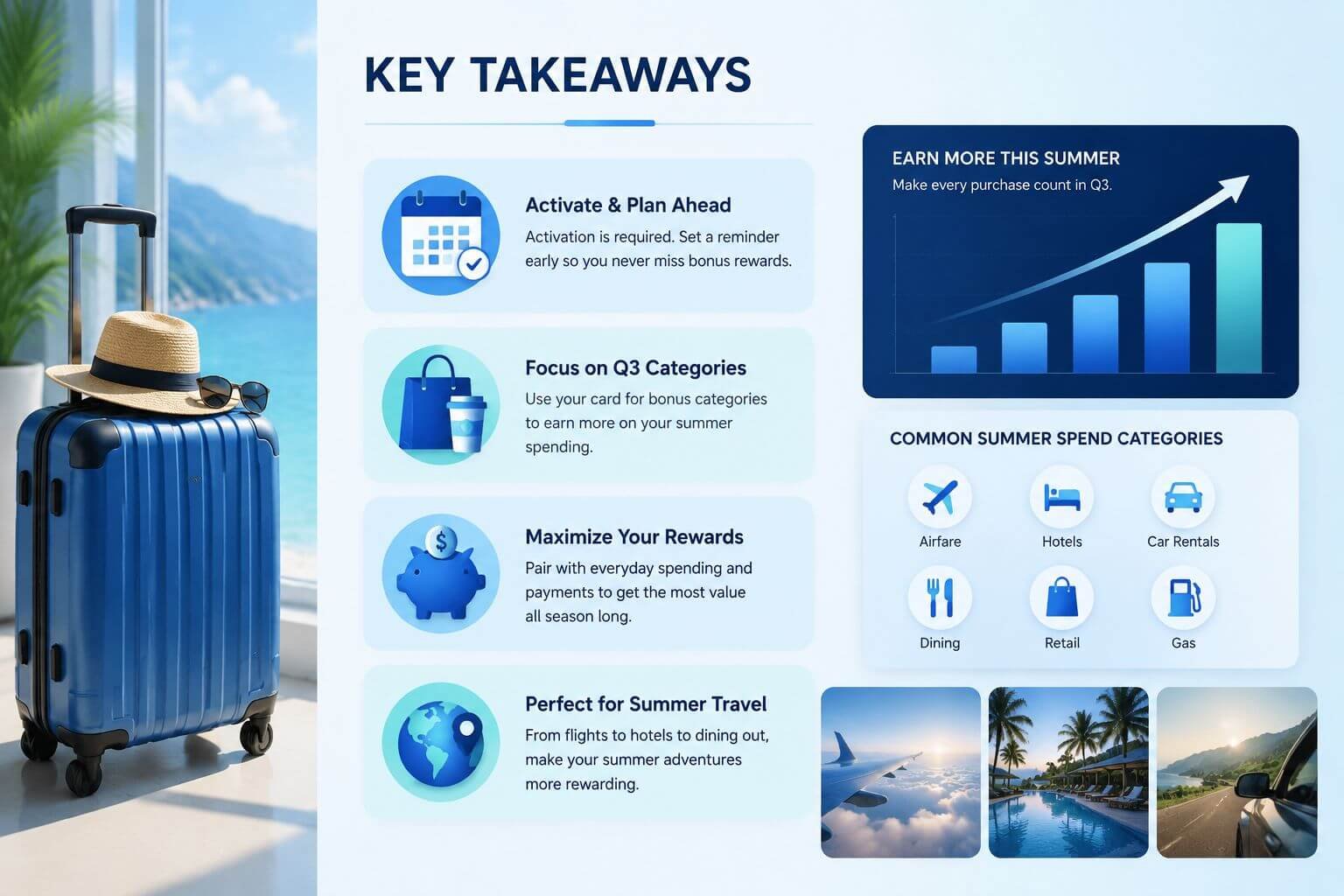
Key Takeaways
- The four Chase Freedom Q3 2026 categories are gas stations and EV charging, public transit, select live entertainment, and United Way.
- The 5% earn rate applies to up to $1,500 in combined spending across all four categories, yielding a maximum of $75 (or 7,500 points) per quarter.
- Activation opens June 15 and closes September 14, 2026. Purchases made after July 1 are retroactively credited at 5% even if you activate late.
- Spending beyond $1,500 drops to 1% — there is no partial cap per category.
- Freedom points are not directly transferable to airline or hotel partners. Pairing with a Chase Sapphire Preferred or Reserve unlocks full Ultimate Rewards transfer capability.
- At a conservative valuation of 1.8 to 2.0 cents per point, 7,500 points from a maxed Q3 cap can be worth $135–$150 in travel versus $75 in cash back.
- Public transit and live entertainment are newer additions to the rotating calendar, making Q3 2026 one of the stronger quarters for urban travelers and summer event-goers.
- Road-trip travelers can stack gas station spend with rental car fuel costs to hit the cap faster.
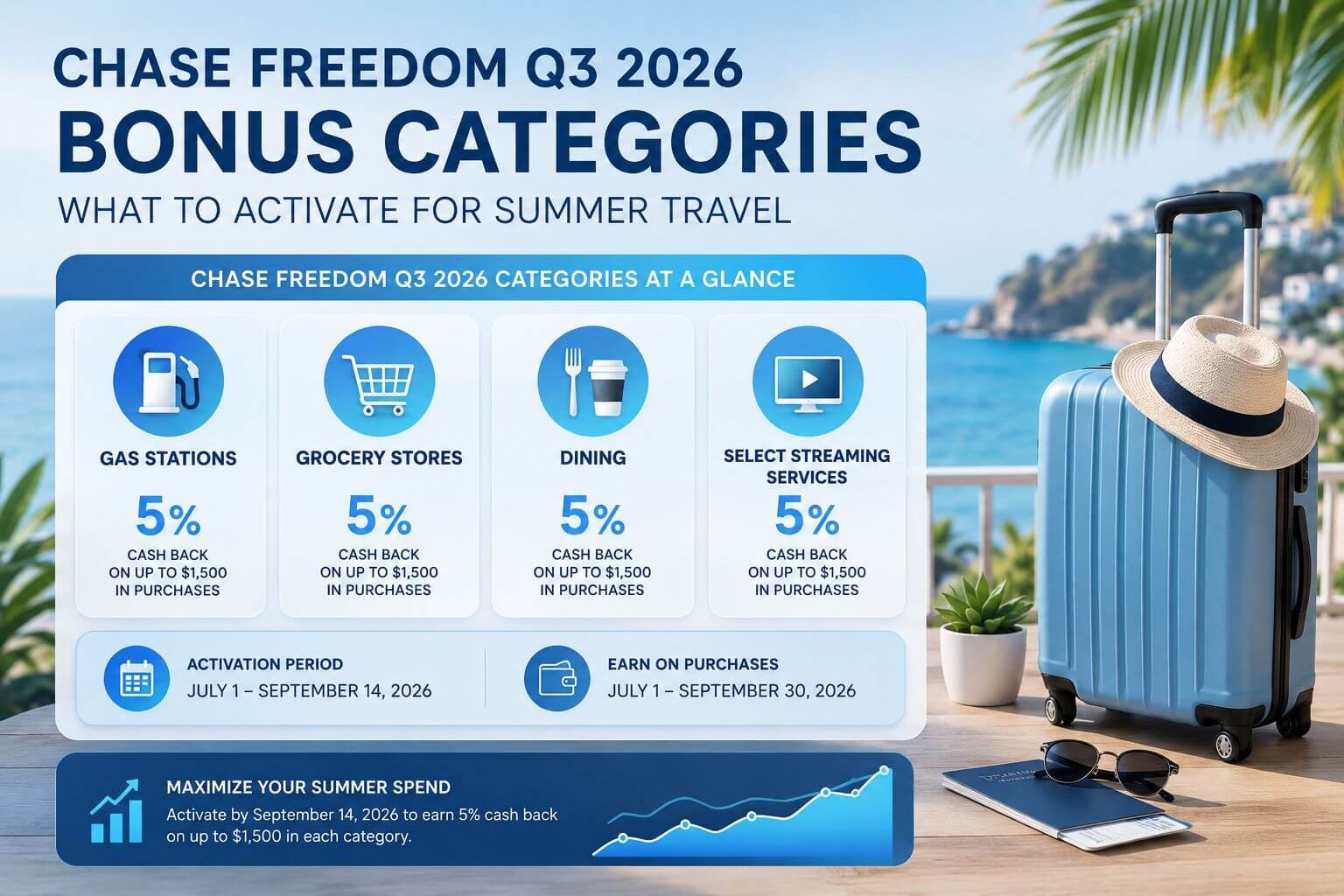
Chase Freedom Q3 2026 Categories at a Glance
The official Chase Freedom Q3 2026 categories cover four spending areas that align well with summer behavior: gas stations and EV charging, public transit, select live entertainment, and United Way donations. The earning window runs July 1 through September 30, 2026, with a $1,500 combined spending cap at 5%.
This is the same structure that applies to both the Chase Freedom (the original card, now closed to new applicants) and the Chase Freedom Flex. Both cards participate in the same rotating category calendar.
| Category | Typical Summer Use Case |
|---|---|
| Gas stations and EV charging | Road trips, commuting, rental car fill-ups |
| Public transit | Subway, bus, train, rideshare coded as transit |
| Select live entertainment | Concerts, festivals, sporting events, theater |
| United Way | Charitable donations timed to Q3 |
A few practical notes on category definitions:
- Gas stations and EV charging includes most stand-alone gas stations and EV charging networks. Gas purchased at warehouse clubs (Costco, Sam’s Club) or superstores (Walmart, Target) typically does not qualify because the merchant category code (MCC) is retail rather than fuel.
- Public transit covers subway, bus, and commuter rail purchases, but rideshare apps like Uber and Lyft may or may not code as transit depending on the transaction. Test a small charge before relying on it.
- Select live entertainment has appeared in Q3 for several consecutive years. Tickets purchased directly from venues or primary ticketing platforms generally qualify. Resale platforms may not.
- United Way is a charitable category that Chase has included in at least one quarter each year as a way to stack giving with rewards. Donations made directly through United Way’s platform should qualify.
For context on how this quarter compares to earlier in the year, the Q2 2026 bonus categories guide covered Amazon, Chase Travel, and Feeding America — a different mix that favored online shoppers and direct travel bookings.
How and When to Activate Your 5% Categories
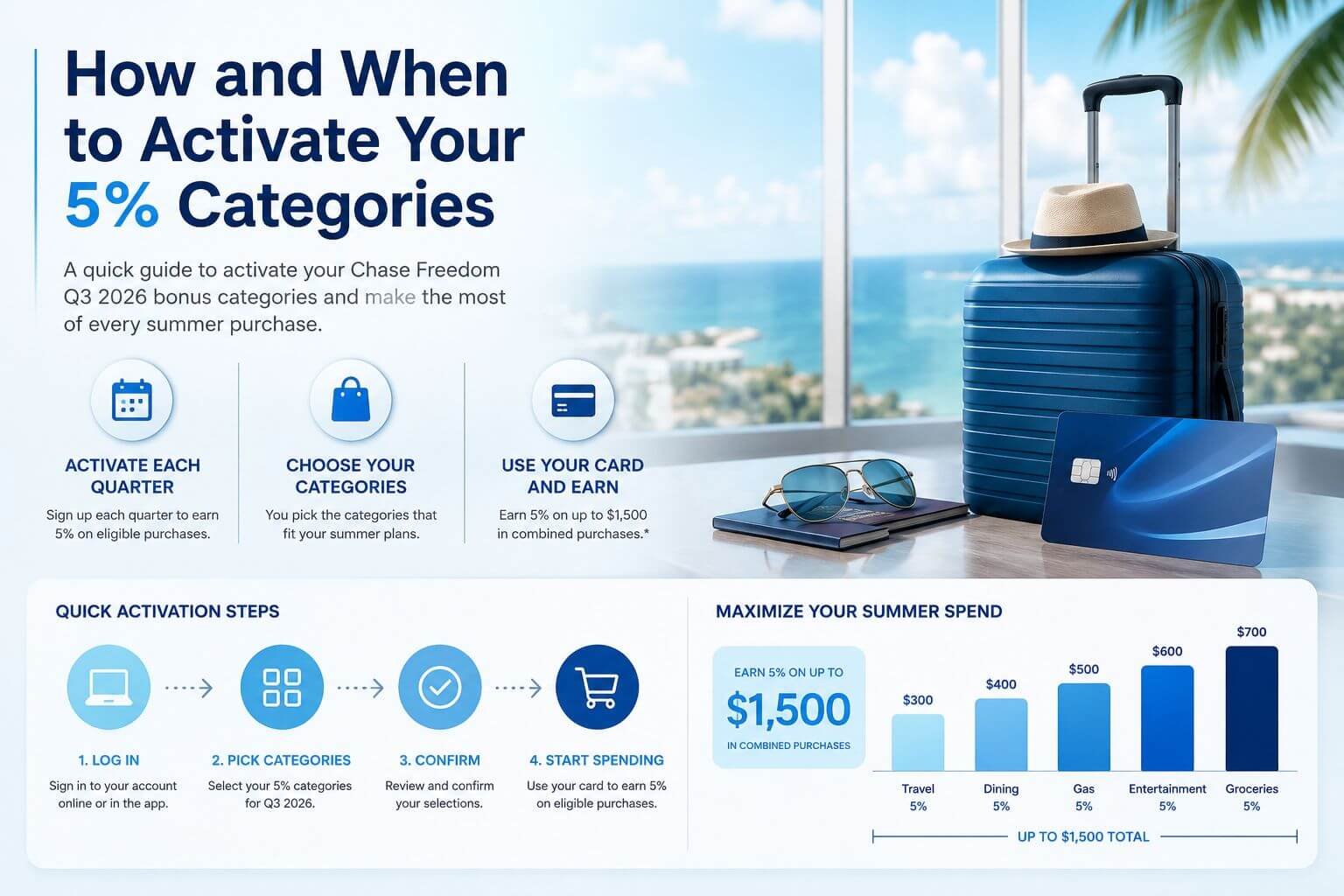
Activation is required. Purchases made before activation do not earn 5%, with one important exception: if you activate after July 1 but before September 14, Chase will retroactively apply the 5% rate to eligible purchases made on or after July 1.
That retroactive window is genuinely useful if you forget to activate at the start of the quarter. However, waiting too long still creates risk — if you miss the September 14 deadline entirely, the entire quarter earns at the base 1% rate.
You may be interested



How to activate:
- Log in to your Chase account at chase.com or open the Chase mobile app.
- Navigate to your Freedom or Freedom Flex card.
- Find the “Activate 5% Cash Back” or “Activate Bonus Categories” prompt.
- Confirm activation. No additional steps are required.
Alternatively, activation is available by calling the number on the back of your card or by responding to a Chase email or push notification if you have those enabled.
The activation window opened June 15, 2026. Setting a calendar reminder now to activate before July 1 is the simplest way to avoid any gap in earnings.
Maximizing the $1,500 Quarterly Cap
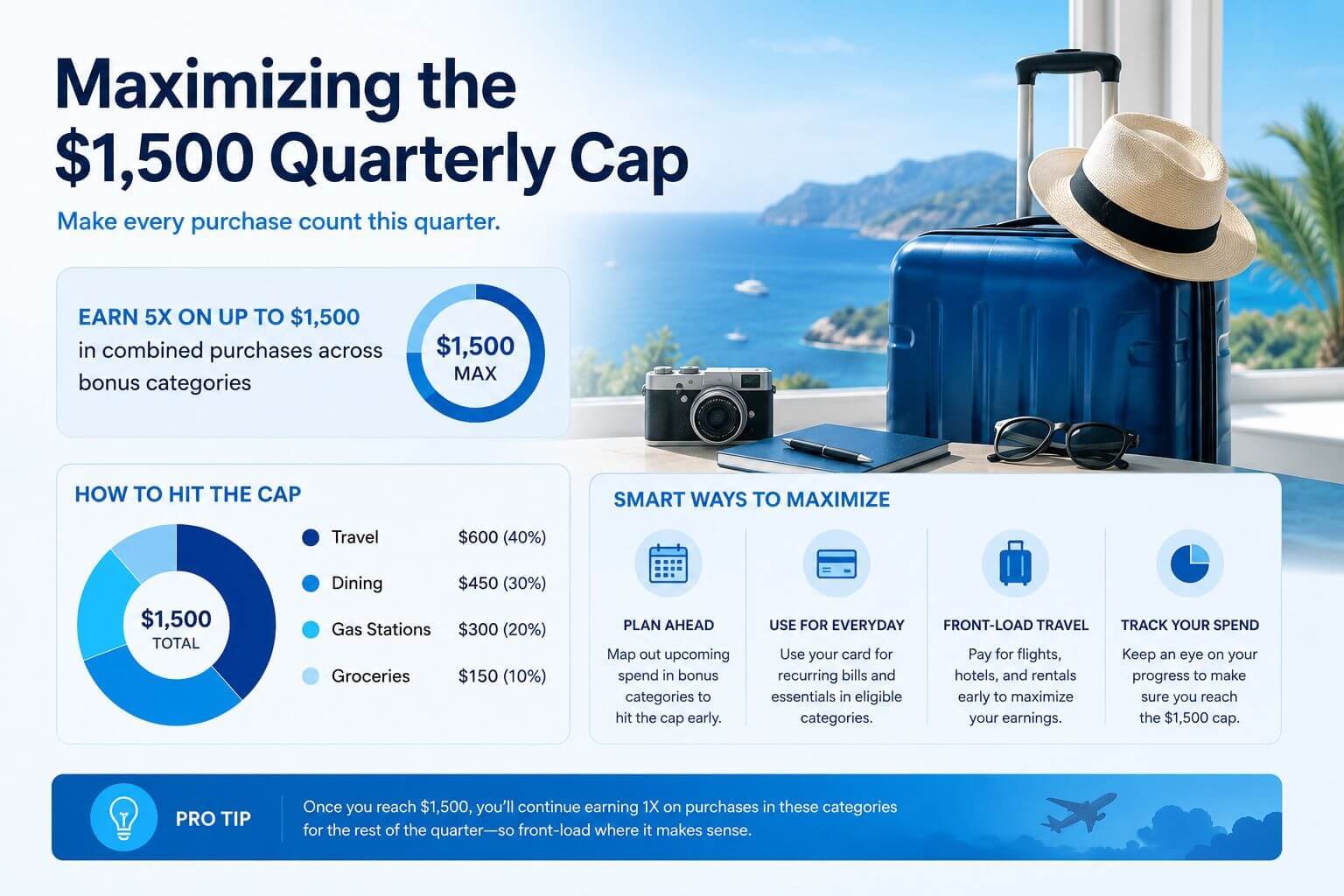
The $1,500 cap applies to all four categories combined, not per category. That means spending $800 on gas and $700 on concert tickets in Q3 uses the full cap, while spending $1,000 on gas and $600 on transit would also exhaust it — there is no separate $1,500 bucket for each category.
At 5%, the maximum quarterly reward is $75 in cash back, or 7,500 Ultimate Rewards points if paired with a premium Chase card.
Spending $1,500 across Q3 categories is realistic for most summer travelers:
- A two-week road trip with a family vehicle can easily generate $150–$300 in gas alone.
- Monthly transit passes in major cities (New York, Chicago, San Francisco) cost $100–$130, totaling $300–$390 over three months.
- Two concert or festival tickets at $75–$150 each contribute $150–$300.
- Stacking all three gets most active travelers to the cap without any artificial spending.
What happens after $1,500: All four categories drop to 1% for the remainder of the quarter. There is no benefit to continuing to route spending through these categories once the cap is hit. Shift gas and transit purchases to a card with a permanent bonus in those categories, such as a card that earns 3–4% on gas year-round.
Tracking the cap: Chase does not send an automatic alert when you approach $1,500. Check your Chase account or use a tool like CardPointers to monitor category spending and avoid leaving 5% earnings on the table by overspending past the cap on lower-priority purchases.
Turning Cash Back Into Transferable Points
This is the most important strategic layer for points-focused cardholders. Chase Freedom and Freedom Flex earn cash back by default, but those earnings are actually stored as Ultimate Rewards points at a 1:1 ratio ($0.01 per point). On their own, Freedom points can only be redeemed for cash, statement credits, or gift cards at 1 cent per point.
To access Chase’s transfer partners — including United MileagePlus, Air Canada Aeroplan, Singapore Airlines KrisFlyer, Hyatt, and others — you need to hold a Chase card that carries full Ultimate Rewards transfer capability. That means the Chase Sapphire Preferred, Chase Sapphire Reserve, or Chase Ink Business Preferred.
The pairing strategy works like this:
- Earn points on Chase Freedom or Freedom Flex (including Q3 5% categories).
- Transfer those points to your Sapphire Preferred, Sapphire Reserve, or Ink Business Preferred account within Chase’s portal.
- From the premium card, transfer to any Chase airline or hotel partner at a 1:1 ratio.
The math on why this matters: 7,500 Freedom points redeemed as cash back equals $75. The same 7,500 points transferred to Aeroplan and applied toward a business class redemption could be worth $135–$150 or more depending on the route, based on a conservative 1.8–2.0 cents per point valuation. That’s roughly double the cash-back value.
For a deeper look at which Chase transfer partners offer the best redemption value right now, the Chase Transfer Partners Guide 2026 covers current options and sweet spots in detail.
If you’re weighing which premium card to pair with your Freedom, the Chase Sapphire Preferred vs Reserve comparison breaks down the annual fee math for 2026.
Stacking Categories With Travel Spending
The Q3 2026 categories are well-suited for stacking with summer travel plans, but the stacking logic requires some attention to which card earns what.
Road trips: Use Freedom or Freedom Flex for gas station fill-ups (5% through Q3). For the hotel stays along the route, use a card that earns bonus points on hotels — Freedom earns only 1% on hotels unless booked through Chase Travel. If you’re booking directly with a hotel chain, a Sapphire Reserve (3x on travel) or a co-branded hotel card may be more valuable.
Urban travel: If the trip involves significant subway or bus use, Freedom’s 5% on public transit is hard to beat. Most permanent travel cards earn 2–3x on transit, so the 5% Q3 rate is a genuine advantage for the quarter.
Concerts and festivals: Few cards permanently bonus live entertainment at a meaningful rate. Using Freedom for ticket purchases through primary platforms during Q3 is a straightforward win, provided the merchant codes correctly.
What Freedom does not cover well in Q3:
- Airfare (earns 1% unless booked through Chase Travel portal)
- Hotel stays booked directly (earns 1%)
- Rental cars (earns 1%; the gas fill-up on return does qualify)
- Restaurants (earns 1% in Q3; this was a Q2 category)
For current transfer bonuses that could amplify the value of points you’re accumulating this summer, check the Best Transfer Bonuses June 2026 roundup for active promotions across Chase and other programs.
Common Activation Mistakes to Avoid
Not activating at all. The most common and costly mistake. Without activation, every purchase in the four categories earns 1%, not 5%. There is no workaround.
Assuming activation carries over from Q2. Each quarter requires a separate activation. Q2 activation does not roll into Q3.
Spending past the $1,500 cap on bonus categories. Once the cap is hit, continuing to use Freedom for gas or transit earns 1%. Shift to a card with a permanent bonus in those categories.
Relying on rideshare apps as transit. Uber and Lyft transactions sometimes code as transportation and sometimes as rideshare, which may not qualify as public transit. Confirm the MCC before assuming 5% applies.
Forgetting the September 14 activation deadline. The retroactive credit for purchases made after July 1 is useful, but only if you activate it before September 14. After that date, the quarter is closed.
Not pairing with a premium Chase card. Earning 5% as cash back is fine, but leaving those points locked at 1 cent each when they could be transferred to Aeroplan or Hyatt at 1.8–2.0+ cents per point is a significant opportunity cost. If you don’t currently hold a Sapphire Preferred or Reserve, this is worth evaluating.
For a full breakdown of how the Chase 5/24 rule affects your ability to add a Sapphire card to your wallet, the Chase 5/24 rule guide explains eligibility in plain terms.
What to Watch for in Q4 2026
Chase has not officially announced Q4 2026 categories as of this writing. Based on recent years’ patterns, Q4 typically includes department stores, PayPal, and sometimes Amazon or wholesale clubs — categories that align with holiday shopping rather than travel.
For travel-focused cardholders, Q4 is generally a lower-value quarter on the Freedom calendar unless you have significant retail spend. The more important Q4 move is usually ensuring that any Freedom points accumulated through Q3 are transferred to a premium Chase card and positioned for a transfer to an airline or hotel partner before any potential devaluations.
The Q4 2025 Freedom categories guide from last year provides a useful reference for what to expect, though official Q4 2026 announcements typically come in September.
Also worth monitoring: Chase has run targeted transfer bonuses to partners like Marriott, Southwest, and British Airways Avios in recent quarters. If a transfer bonus aligns with your redemption goals, stacking Q3 Freedom earnings with a bonus transfer window can meaningfully improve your cents-per-point outcome. The Chase to Marriott 55% Transfer Bonus guide and the Chase to Avios 20% Transfer Bonus guide show how those stacks have worked in 2026.
FAQ
Do both Chase Freedom and Chase Freedom Flex have the same Q3 2026 categories? Yes. Both cards share the same rotating 5% category calendar. The Q3 2026 categories — gas stations and EV charging, public transit, select live entertainment, and United Way — apply to both cards with the same $1,500 combined cap.
What happens if I forget to activate before July 1? You can still activate anytime through September 14, 2026. Chase applies the 5% rate retroactively to eligible purchases made on or after July 1, so late activation does not forfeit early-quarter earnings. Missing the September 14 deadline entirely means the quarter earns at 1%.
Is the $1,500 cap per category or across all four categories combined? It is a combined cap across all four categories. Total spending on gas, transit, entertainment, and United Way is pooled together. Once the combined total hits $1,500, all four categories revert to 1% for the rest of Q3.
Can I transfer Chase Freedom points directly to airline partners? No. Freedom and Freedom Flex points cannot be transferred to airline or hotel partners on their own. You must first move those points to a Chase account that holds a Sapphire Preferred, Sapphire Reserve, or Ink Business Preferred, and then initiate the transfer from that premium card.
Does gas purchased at Costco or Walmart qualify for the 5% gas category? Generally no. Gas purchased at warehouse clubs or superstores typically codes under a retail or grocery merchant category code rather than a fuel station code. Stand-alone gas stations and dedicated EV charging networks are more reliable for the 5% rate.
How much are 7,500 Freedom points worth if transferred for travel? At a conservative 1.8 cents per point, 7,500 points are worth approximately $135 in travel redemptions through a Chase transfer partner. At 2.0 cents per point, that rises to $150 — roughly double the $75 cash-back value of the same points.
Does activating Q3 categories affect my Q2 activation? No. Each quarter’s activation is independent. Activating Q3 categories does not change or cancel Q2 status.
Conclusion
The Chase Freedom Q3 2026 categories are a practical fit for summer spending. Gas and EV charging cover road trips. Public transit covers urban travel. Live entertainment covers concerts and festivals. The $1,500 cap is reachable without manufactured spending for most active summer travelers.
The activation step is non-negotiable — set a reminder now if you haven’t already. The September 14 deadline gives you a wide window, but there is no reason to leave retroactive credit to chance.
The bigger strategic decision is whether you’re holding a premium Chase card to unlock the transfer value of those points. Earning 5% as cash back is straightforward. Converting those same points to transferable Ultimate Rewards and routing them toward a Business Class or hotel redemption through a partner program is where the real value sits.
Practical next steps:
- Activate Q3 2026 categories at chase.com or in the Chase app before July 1.
- Review your summer spending plan and identify which of the four categories you’ll hit naturally.
- If you’re not yet paired with a Sapphire Preferred or Reserve, evaluate whether the annual fee math works for your situation using the Sapphire Preferred vs Reserve 2026 guide.
- Monitor Chase transfer partner bonuses through Q3 to time any point transfers strategically.


Content on Award Travel Hub is independently created by Award Travel Hub Editorial Desk and, where noted, reviewed by Award Travel Hub Review Desk. Some pages may contain affiliate links, but compensation does not determine our coverage, opinions, or methodology.